





Jennifer Lopez | Sun Nov 08 2026
Best Wholesale Websites for Boutiques: How to Choose Wisely
The most popular advice about the best wholesale websites for boutiques is also the least useful: choose the biggest catalog with the lowest prices. That approach ignores what you'll receive, what it costs to get stock onto your shelf, and whether you can reorder a winning style before customers lose interest. Rank suppliers by landed cost, verified materials, and replenishment performance, not the discount displayed beside a product photo.
Best Wholesale Websites at a Glance
No single site wins every category, so choose a supplier type that fits your buying model before comparing individual websites.
Wholesale website types compared
| Supplier type | Best for | Order minimum | Main strength | Check before ordering |
|---|---|---|---|---|
| Dedicated jewelry platform (JewelryBuyDirect) | Trend-led jewelry and fashion accessories | No minimum order quantity | 120,000+ SKUs and 100+ new arrivals daily | Destination transit times |
| Factory-direct storefront | Core lines at lower unit cost | Confirm per-style minimum and production minimum | Low unit prices on repeat styles | Material disclosure and documentation |
| Multi-category wholesale marketplace | Broad discovery and small test buys | Check each vendor's opening-order and pack requirements | Many vendors in one place | Vendor vetting and return terms |
| Sourcing agent or wholesale directory | Custom or niche items | Confirm supplier minimum plus agent engagement terms | Access to suppliers not listed publicly | Fees and quality control |
Treat this table as a shortlist, not a verdict. A dedicated jewelry platform makes sense when you need coordinated necklaces, bracelets, earrings, and fashion accessories without searching unrelated categories. At our platform, we offer curated, trend-driven inventory and support small businesses without requiring large opening commitments.
Factory-direct storefronts deserve consideration when you already know which core styles sell. However, a low production quote isn't enough if the seller can't document the material or repeat the approved finish. Don't assume every factory has the same minimums or inspection standards.
Match the website to your buying job
Multi-category marketplaces work well for discovery, especially when you're exploring accessories beyond jewelry. Their weakness is vendor inconsistency: a positive experience with one seller doesn't qualify another.
Agents and directories are better suited to sourcing problems that a searchable catalog can't solve, such as unusual components or custom development. Establish who contracts with the factory, who approves samples, and who pays when goods fail inspection.
Before shortlisting, obtain these terms in writing:
- Order requirements: Opening minimum, per-style minimum, pack size, and reorder minimum.
- Payment terms: Deposit, balance timing, accepted methods, and refund route.
- Lead time: Whether the quote covers stocked goods, production, dispatch, or delivery.
Copy those answers into your comparison sheet. An attractive assortment with missing commercial terms isn't ready for approval. Hold every shortlisted supplier against the cost, material, ordering, and shipping checks that follow.
Sample Wholesale Prices Across Accessory Lines
Sample wholesale entry prices from JewelryBuyDirect
| Product or line | Price shown | Stated material | Check before buying |
|---|---|---|---|
| Kawaii Style Heart-Shaped Adjustable Ring with Crown Detail | $2.16 | Gold-plated brass | Plating type and thickness |
| Minimalist Irregular Bean Shape Necklace | $1.07 | 18K gold plated titanium steel | Plating durability and skin-contact claims |
| Sparkle Accents jewelry | From $0.41 | Not stated in the line-level price | Material and finish for each style |
| Letter Jewelry | From $0.59 | Not stated in the line-level price | Material and finish for each letter set |
These are sample entry prices drawn from a much larger catalog, and prices can change. Treat every “from” figure as the floor of a line. The design, size, or finish you order may sit well above it.
Start with the adjustable ring if your customers already buy fashion rings. Its named brass base and gold-plated finish give you concrete specifications to investigate, whereas a broad collection label leaves more unanswered. The necklace also identifies a base material and finish, but you still need the detailed alloy and coating information before writing customer-facing claims.
Choose a product before you trust a price bracket
Sparkle Accents and Letter Jewelry deserve more than a budget built on their starting prices. Select the actual style or letter set, obtain its material specification, and record the current price for the quantity you intend to buy. A starting price of $0.41 or $0.59 tells you only where the line opens; the piece you reorder at volume needs its own confirmed figure.
For curated discovery, Jeweler's Picks contains handpicked, retailer-ready styles selected by our Trend Desk. Our Zoe collection is waterproof and anti-tarnish; obtain written product-specific confirmation of those performance claims and any care conditions before repeating them in your own listings.
The Bohemian Style Heart-Shaped Copper Pendant Necklace with Gold Plating and Enamel Finish for Women offers another concrete catalog example. Its page files the piece under pendants for women, which helps with assortment planning. The listing alone won't confirm current price or availability, so verify both before you commit shelf space.
Buying rule: Compare the specification attached to the exact item you'll order, rather than the collection name above it.
Choose one line, enter its current item price into your landed-cost sheet, and use a small test order to evaluate the finished product. Cheap adjacent styles are a temptation. Assortment expansion should wait until the first piece sells through.
Calculate Landed Cost Before You Compare Prices
The cheapest-looking supplier can become the most expensive when you divide the invoice by sellable units, rather than units ordered. Say one supplier quotes a lower item price but charges more for freight, delivers more defective pieces, and requires costly international returns. Its apparent saving may disappear before you make a sale.
The price on a product page is not the cost of the stock on your shelf. Our wholesale prices are visible before ordering, but your buying decision still needs a destination-specific cost calculation.
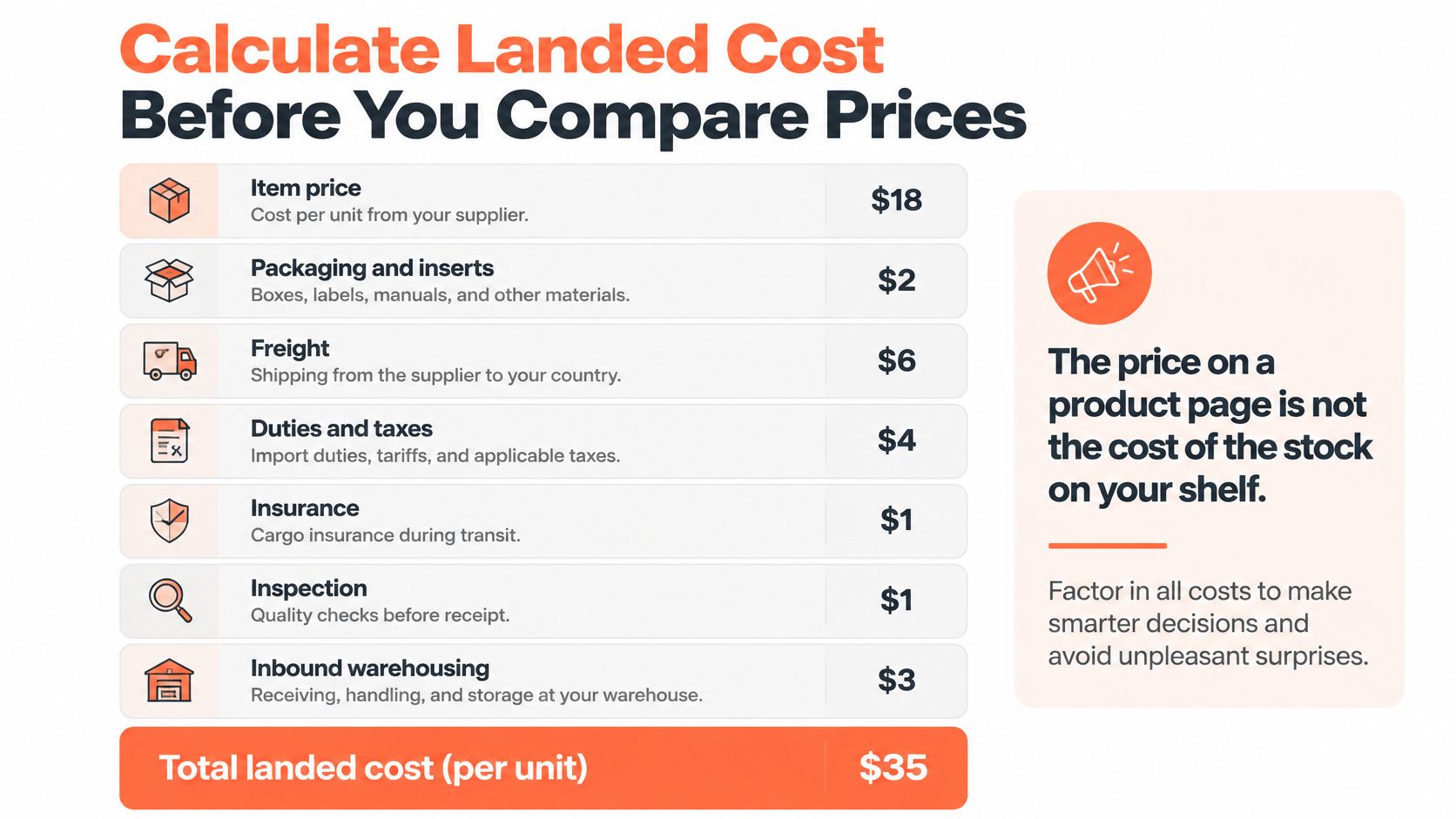
Landed cost lines to add to every supplier sheet
| Cost line | Why it counts | What to request |
|---|---|---|
| Item price | Base cost at your order quantity | Price tiers in writing |
| Packaging and inserts | Gift boxes and tags add cost per unit | Packaging specification |
| Freight and shipping | Destination rates change the landed cost | Quote for your country and postcode |
| Duties and taxes | Import charges can erase the item margin | Tariff classification and confirmation of who pays import charges |
| Payment fees | Card and transfer fees reduce margin | Accepted payment methods and applicable charges |
| Inspection and defects | Plating wear and alloy variance add loss | Written defect policy |
| Returns and replacements | Damaged or unsold stock cost money | Return window and process |
Compare equivalent orders
Build a separate sheet for each supplier using the same quantity, destination, packaging requirement, and delivery service. Separate confirmed costs from estimates, and don't enter zero where a charge remains unknown.
Shopify's wholesale-pricing guidance describes adding a desired profit margin to production costs and cites commonly used wholesale margins ranging from 15% to 50%. Those are wholesale-pricing margins, not a guarantee that your boutique will achieve the same result.
Our pricing is 15–30% below market average, secured through bulk procurement and efficient logistics. Test that claim against equivalent specifications on your own sheet rather than assuming every listing provides the same saving.
Calculate your required retail price using:
Required retail price = landed cost per sellable unit ÷ (1 − target gross margin)
Enter the target margin as a decimal. Keep marketplace commissions, outbound fulfillment, promotions, and overhead visible elsewhere in your profitability model so you don't mistake merchandise margin for net profit.
Use our guide to reducing total cost of ownership when evaluating expenses beyond the purchase invoice. Reject a supplier whose economics only work when nothing goes wrong.
Verify Metal and Material Claims Before You Buy
A listing that casually says “silver” leaves you guessing whether the seller means composition or color. 925 sterling silver gives you a specification to verify, not merely an appearance to judge from a photograph.
The FTC Jewelry Guides document sets the benchmark for descriptions including silver and sterling silver at at least 925 parts per 1,000 pure silver, and prohibits misrepresentations involving metallic content, plating, coating, grade, quality, durability, origin, or value. Don't treat ambiguous wording as permission to make a stronger claim in your boutique.
Material terms and what to request
| Term on listing | What it means | What to request |
|---|---|---|
| Sterling silver or 925 | At least 925 parts per 1,000 pure silver | Invoice stating metal content |
| Silver plated | Base metal with a silver surface layer | Base metal and plating type |
| 18K gold plated | Base metal with a gold layer | Base metal and gold layer thickness |
| Stainless or titanium steel | Steel alloy base | Alloy composition |
| Silver-look or gold-tone | Styling term, not a material claim | Written material specification before use |
The sterling threshold in the table is the FTC benchmark cited above. For plated jewelry, remember that the description of the surface does not establish the composition of the underlying item.
Turn descriptions into purchase specifications
For sterling pieces, require the metal content on the invoice and connect any supporting documentation to the product you're ordering. A generic certificate without an identifiable product or batch connection isn't a substitute for an accurate purchase record.
For plated items, document the base metal, plating process, layer thickness, and care instructions. If a supplier describes a finish as PVD, our explanation of PVD coating on jewelry can help you frame questions, but a process name alone doesn't prove durability.
The FTC's jewelry marketing guidance also calls for clear, prominent disclosures and truthful product attributes. Keep solid metal, plated, alloy, imitation, treated, and gemstone descriptions distinct in your product records.
Apply the same discipline beyond jewelry. If you're adding headwear, Dirt Cheap Headwear's baseball dad hat buying guide provides category-specific context for preparing a separate buying checklist rather than reusing jewelry criteria.
A product photograph can establish visual fit. It cannot establish metal content.
Pull three listings from your shortlist and rewrite each vague material phrase as a specification the supplier must confirm. If the seller won't commit to that wording, don't use it in your customer listing.
Shipping, Returns and Traceability Checks
A damaged parcel, a replacement shipment, or two weeks of empty display space can erase the margin that made a cheap listing attractive. A ships worldwide label tells you nothing about whether an order will reach your address when you need it. Treat delivery promises as questions to answer before you pay.
Radial's retail and consumer trends report found that 29% of shoppers expect two- to three-day shipping and 45% expect three- to five-day shipping, while 43% of retailers reported difficulty with their returns policy. Those figures describe retail shoppers rather than wholesale transit terms. They still explain why you need stock in hand before taking customer orders.
We offer fast global shipping. Confirm the delivery window for your destination anyway, and separate warehouse handling, carrier transit, and customs clearance before planning a launch. A quoted transit time that excludes customs can add days you never budgeted for.
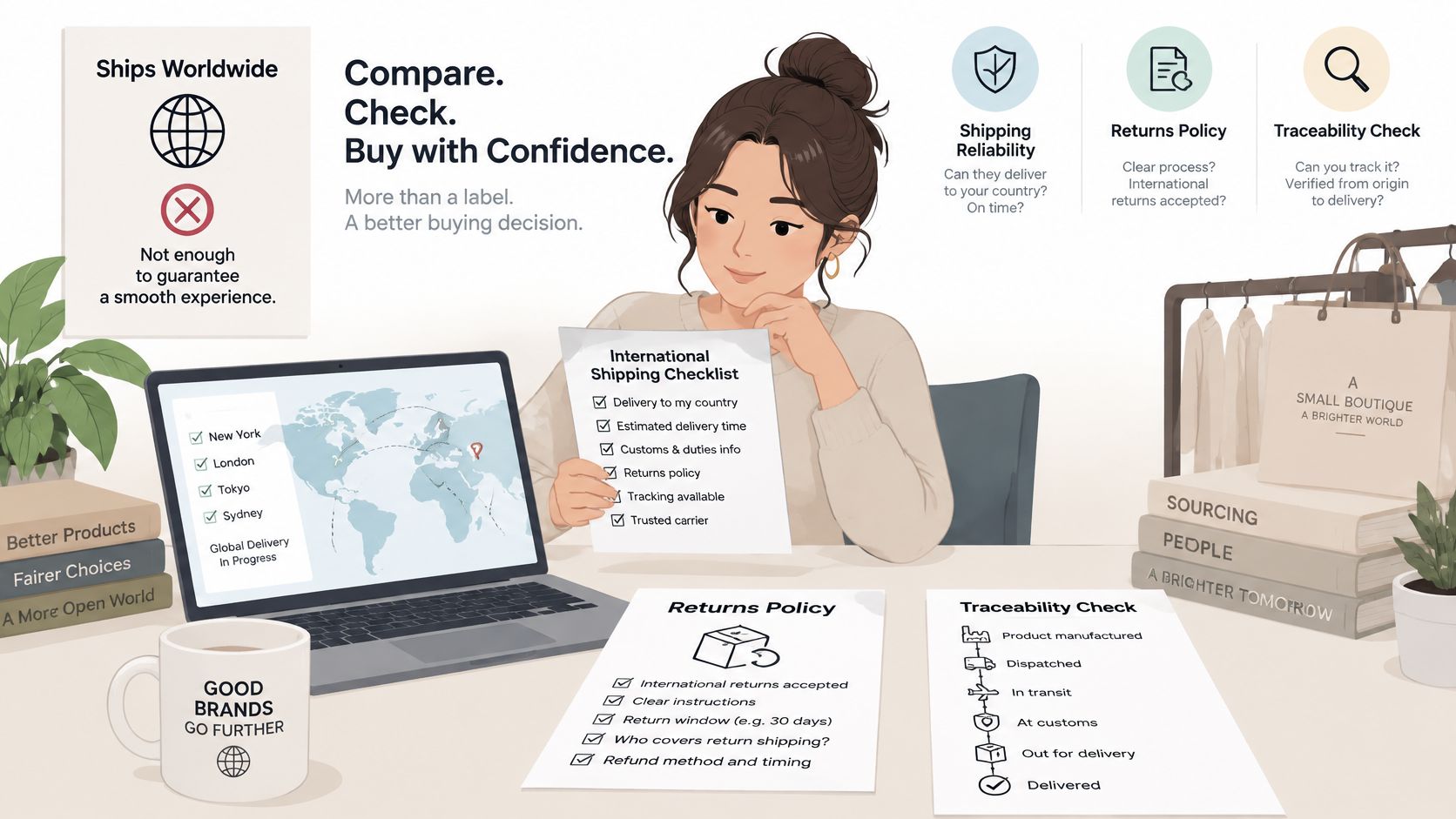
Send this checklist before payment
- Tracking: Identify the carrier, tracking method, and the point at which shipment status becomes available.
- Delivery window: Obtain a written estimate for your country and postcode, including dispatch timing.
- Damage protection: Confirm covered events, evidence requirements, claim deadlines, and responsibility for replacement freight.
- Return eligibility: Establish which products qualify, the return window, required condition, and who pays shipping.
- Defect resolution: Get a named contact and clarify whether the remedy is a refund, credit, replacement, or repair.
- Traceability: Request material disclosures and supporting documents tied to each product line or batch.
- Repeat specifications: Require written approval before substitutions to base metals, finishes, clasps, or other agreed components.
Return eligibility deserves a direct question: does it cover only defective goods, or also unwanted inventory? Those are different commercial risks, and a generous-sounding policy may cover only one.
Variant-level records matter for the same reason. The Bohemian Vintage Stainless Steel Resin Black Bead Necklace and Bracelet Set for Women is categorized as a women's jewelry set with Bohemian and Vintage styling, and its catalog snapshot lists three variants. Your purchase record should identify the selected variant rather than referring only to the product title, since a return or reorder dispute hinges on which version shipped.
Photograph the received goods, packaging, labels, and any damage before distributing stock. Request every checklist answer in writing, then compare suppliers on the remedies they commit to providing. A supplier that hesitates to put remedies in writing is telling you what the first dispute will look like.
How to Run a Test-and-Reorder Order
Retailers are moving from large seasonal commitments toward smaller, more frequent in-season orders, according to NuORDER's wholesale-buying analysis. That approach requires more than permission to buy small quantities. You need a supplier that can repeat the approved product while demand is still active.
A test order should answer a narrow business question: Can this product sell profitably, and can this supplier replenish it reliably? Don't turn the trial into an unfocused tour of the catalog.
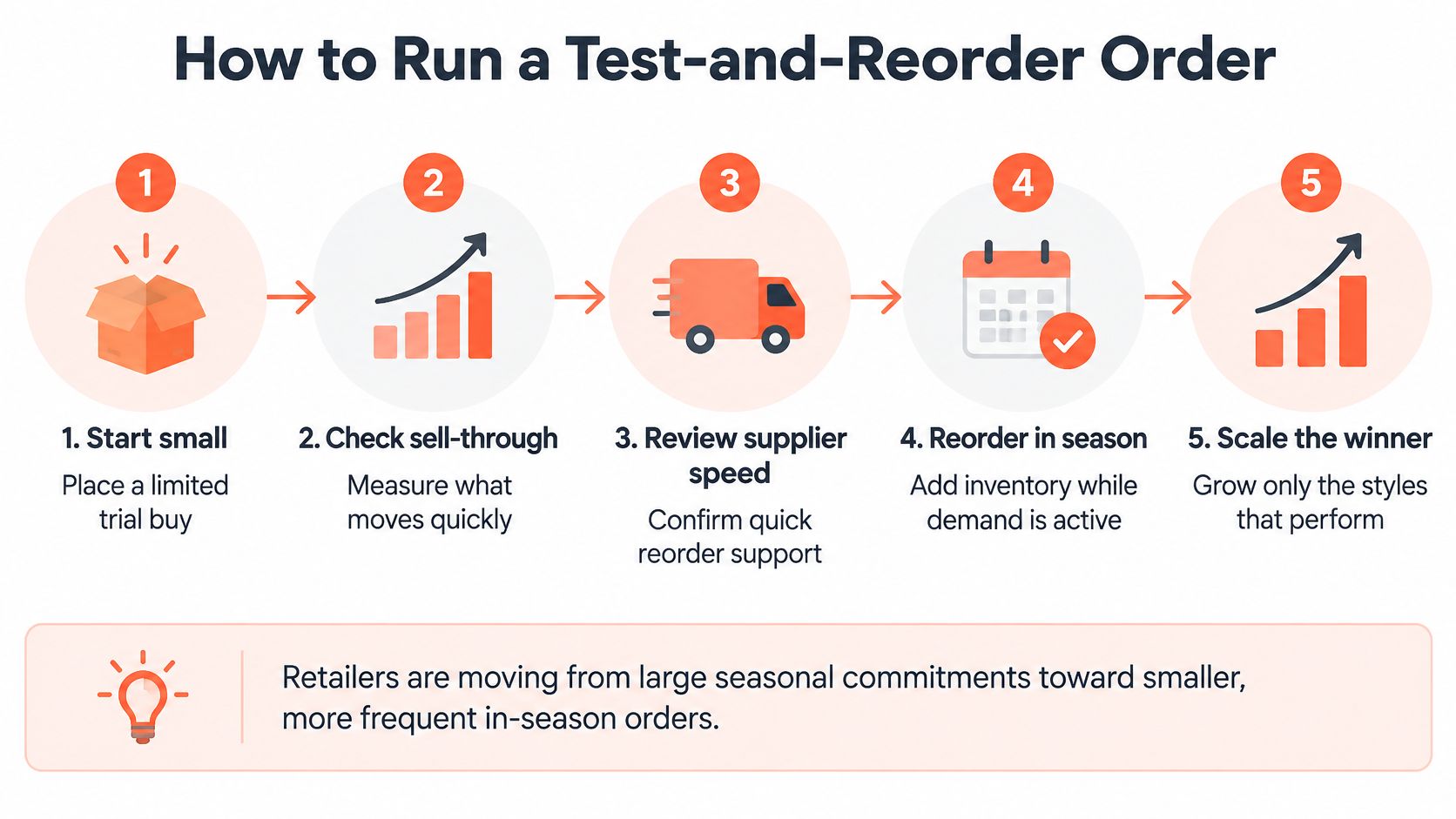
Run the trial with a simple spreadsheet
- Choose a narrow assortment. Combine established core styles with a limited selection of trend items. Keep distinct finishes and sizes identifiable so you can tell which variant customers choose.
- Confirm wholesale access and first-order terms. On our website, buyers can request wholesale access, and our team helps identify suitable online categories and place the first wholesale order. Our factory-direct wholesale deals include bulk discounts and require no minimum order.
- Place a small first order. Retailers can order directly online. Compare the delivered goods with your approved specifications, checking closures, finish consistency, sharp edges, packaging, and correspondence between labels and contents.
- Record product-level sell-through each week. Use a spreadsheet with product identifier, variant, receipt date, opening stock, receipts, units sold, returns, and closing stock. Calculate sell-through as units sold divided by units available for sale during the same tracking period, and use that definition consistently.
- Reorder proven sellers after stock confirmation. Ask for available quantity, reservation terms, and dispatch timing before committing. Mark slow sellers for a deliberate markdown or merchandising decision rather than automatically replenishing them.
- Audit every replenishment. Compare ordered and received quantities, promised and actual delivery, and approved and delivered specifications. Record shortages, substitutions, and finish differences against the relevant purchase order.
Don't judge demand without recording how you presented the product. A necklace featured in a live-selling session and a ring left off your website haven't received comparable exposure.
Decide what earns a larger order
A healthy test produces identifiable fast sellers, replenishments that arrive as quoted, and continuity on proven styles. Track both the product result and the supplier result: a popular item isn't a scalable winner if you can't obtain it again.
Our guide to wholesale buying with no minimum order offers additional context for structuring a limited commitment. If you also sell beauty accessories, Conde Professional's guidance on how to vet wholesale extension suppliers is a category-specific companion to your supplier approval process.
Scale the evidence: Increase purchasing only when customer demand and supplier performance both justify it.
Rank suppliers by replenishment speed, stock accuracy, reorder consistency, and small-quantity flexibility. A headline discount can't compensate for a reorder that arrives after your selling opportunity has passed.
Choose Your Supplier and Place a Test Order
Match the supplier to the job before you compare prices. A storefront, an online seller, and a maker each need a wholesale website to perform different work.
- Independent jewelry boutique: Pair a dedicated jewelry platform for trend restocks with a factory-direct source for established core lines. Keep each supplier accountable for a clearly defined part of your assortment.
- Shopify, Etsy, or Amazon seller: Put shipping reliability, workable returns, and usable reorder information ahead of unit price. Base customer delivery promises on tracked performance from your test order, because a supplier estimate gives you no protection once orders go live.
- Social-commerce or pop-up seller: Prioritize small trial purchases and rapid restocking. Hold most of your buying budget back until you know which styles attract actual purchases.
- Maker or small brand: Favor factory-direct sources that can document components and discuss private-label requirements explicitly. Confirm development charges, sample approval, and ownership of custom work before production.
Separate credentials from purchasing evidence
We've served jewelry retailers for over 16 years and hold an 85% repeat purchase rate. Treat credentials like these as a reason to investigate further, then confirm them with references, written specifications, and your own order history. Apply the same standard to performance claims such as waterproof and anti-tarnish finishes: verify them inside your test order before you repeat them in your own product copy.
If you're expanding into home fragrance, Aroma Warehouse's guide to find suppliers for incense and fragrance oils provides a category-specific starting point. Qualify that category separately rather than assuming a jewelry supplier checklist covers it.
Now commit to a shortlist. This week, choose the supplier type that matches your business, identify three candidates, and build your first landed-cost sheet around the sample line you intend to test. Order a small quantity, compare delivered cost and specifications against the listing, and let the result decide which candidate earns a reorder.
JewelryBuyDirect offers wholesale jewelry and trend-driven fashion accessories, with online ordering and support for small test purchases. Visit JewelryBuyDirect, choose a focused assortment, and compare its specifications and delivered costs before placing your first test order.