






Jennifer Lopez | Mon Oct 26 2026
Wholesale with No Minimum Order: Find and Vet Suppliers
You have shelf space for a new bracelet line, a list of six designs you like, and no way to know which two your customers will buy. Ordering a case of each would tie up cash you need for rent, packaging, and ads. Ordering nothing leaves the shelf empty. That's the gap wholesale with no minimum order is meant to fill, but only if you treat it as a sourcing decision, not a cheap shortcut. The right first order checks metal specs, nickel test reports, and landed cost before you pay. Skip those checks and even a tiny order can still create a listing takedown, a return pile, or a margin you can't repeat.
Where No-MOQ Suppliers Really Operate
Say a boutique owner wants to test six bracelet designs without paying for a case of each. She doesn't need the lowest unit price on day one. She needs two to five units per design, clear material claims, and a restock path if one style moves.
That test-and-grow habit is now normal. In 2024, JOOR's retailer survey reported nearly 90% of retailers used a test-and-grow approach, placing small initial orders before expanding to evaluate consumer response. A MOQ 1 label on one SKU doesn't mean the whole catalog works that way, so read listings by channel first.
No-MOQ Supplier Channels Compared
| Supplier channel | Typical MOQ | Best for | Main risk |
|---|---|---|---|
| B2B platforms with listed no-MOQ SKUs | None listed, confirm per SKU | Boutiques and online sellers testing designs | Stock and MOQ can change by SKU |
| Factory-direct trading sites | Often 1+ units on stock lines, higher for custom work | Makers and small brands seeking private label | Sample quality may differ from bulk output |
| Dropship suppliers | None, ships per order | Dropshippers and e-commerce resellers | Thin margins and limited control over packaging |
| Marketplace wholesale resellers | Usually 1 unit | Pop-up vendors and social sellers | Often resellers, not makers, so specs are secondhand |
| Trade-show agents | Often high, sample rate may be negotiable | Growing brands with cash to commit | Minimums are rarely stated upfront |
| Local jobbers and showrooms | Frequently case-pack or dozen-based | Brick-and-mortar shops | Visiting costs time and fuel |
JewelryBuyDirect fits the first row as a B2B platform that lists no minimum order quantity across a catalog of more than 120,000 SKUs, with 100+ new arrivals daily. That breadth suits boutiques and online sellers testing high quality and affordable jewelry and fashion accessories across styles. If you're comparing platform sourcing with going straight to a maker, the guide to factory-direct jewelry sourcing helps you weigh control against convenience.
Routing rule: Brick-and-mortar shops should start with platforms and showroom jobbers, dropshippers with dropship suppliers, and makers needing private label with factory-direct sites.
How to Vet a No-MOQ Supplier Step by Step
A no-MOQ listing removes the quantity barrier. It doesn't remove the need to verify the operator behind it. I would run these seven checks in order and stop early if a supplier fails the written ones.
The first two checks are summed up in this quick visual.
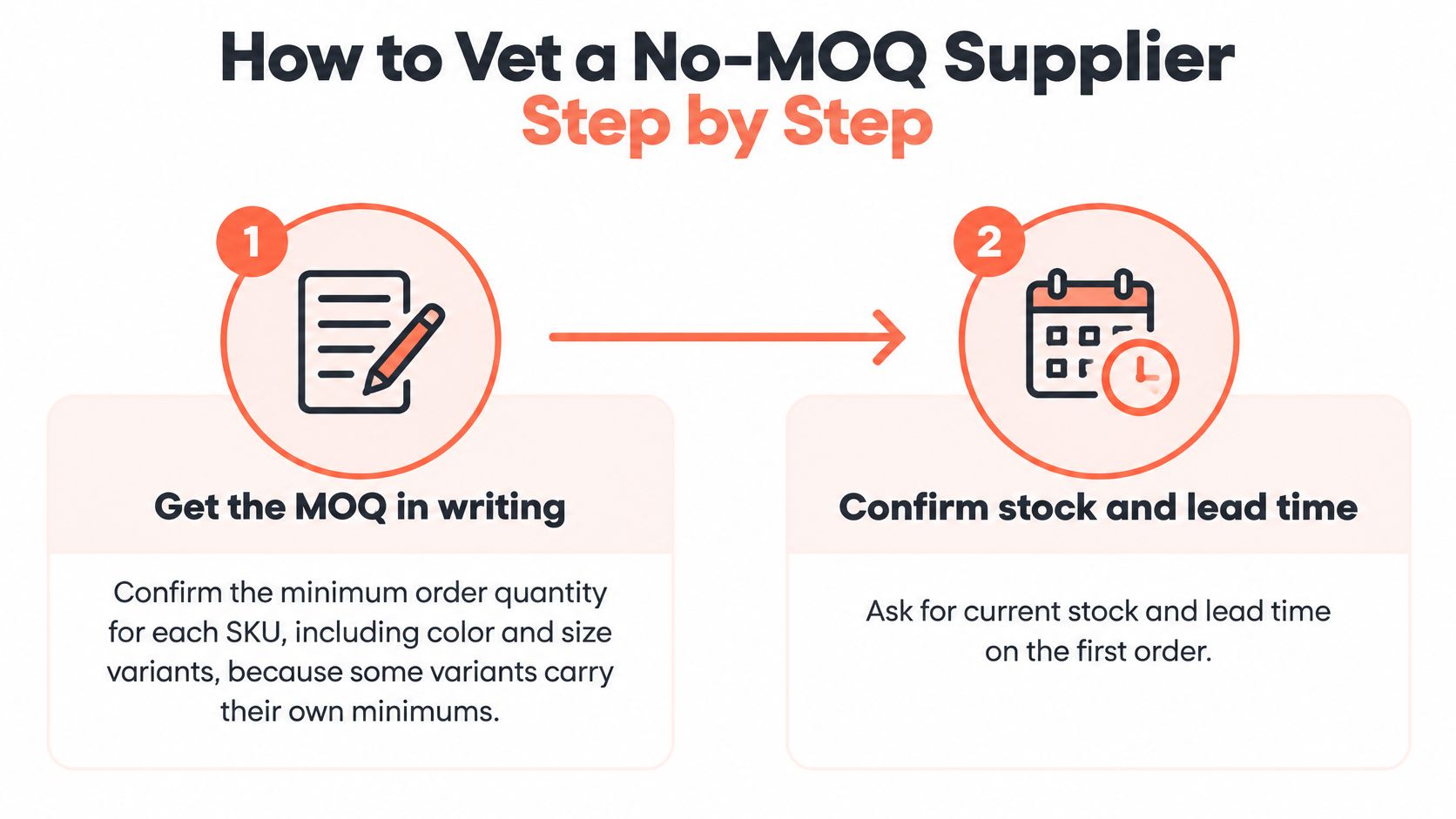
- Get the MOQ in writing per SKU. Confirm color and size variants too, because some variants carry their own minimums. This prevents a cart that works for gold-tone but blocks silver-tone at checkout.
- Confirm current stock and lead time. Ask for the first order and whether restocks follow the same terms. A fast sample followed by a slow restock strands a proven seller.
- Request a spec sheet for every metal claim. Ask for base metal, plating type, and thickness where durability matters. A vague sheet usually hides a plated product described like solid metal.
- Check the business itself. Look for registration, a physical address, years trading, and whether it manufactures or resells. Resellers can be fine, but you need to know who's accountable for specs.
- Test response quality with an operator question. Ask for plating thickness or the base alloy grade and note speed and precision. A supplier who's slow before payment rarely speeds up after it.
- Place a small paid test order. Inspect packaging, labels, finish, clasps, and damage on arrival, then photograph everything. The same discipline helps in adjacent categories, and this resource on how to avoid costly candle decor inventory mistakes shows why counting and inspecting small decor lots matters before you scale them.
- Score and decide. Repeat only when the supplier clears at least five of the six earlier checks. Don't let a pretty sample override missing paperwork.
This short video walkthrough reinforces what to inspect when that first parcel lands.
Keep the score in a simple sheet. You'll need it when you compare a second supplier for the same design.
Jewelry Terms That Need a Spec Check
Start with 925 sterling silver, because it's the claim buyers get wrong most often. The FTC guidance on buying platinum, gold, and silver jewelry defines "silver," "sterling," and "sterling silver" as products containing 92.5% pure silver, and the 925 mark means 925 parts per thousand are pure silver. Silver items must also identify the company or person responsible for the mark through a name or U.S.-registered trademark.
Vermeil is stricter than ordinary gold plating. The FTC Jewelry Guides in the Federal Register require a sterling-silver base and gold or gold-alloy plating of at least 22-karat fineness, with a minimum thickness of 100 millionths of an inch, approximately 2.54 microns, throughout, covering all significant surfaces. If a supplier can't state base, karat, and thickness, don't list the piece as vermeil.
Listing Terms and the Spec to Request
| Listing term | What it must mean | What to request |
|---|---|---|
| 925 sterling silver | 92.5% pure silver, marked 925 | Assay or mill report and maker mark with company name or U.S.-registered trademark |
| Vermeil | Sterling base, 22K+ gold plating, about 2.54 microns minimum on all significant surfaces | Plating thickness report for the tested batch |
| Gold-plated | Base metal or other base with gold layer, must be identified as plated | Plating type and thickness if durability is claimed |
| Silver-plated | Silver layer over a non-sterling base, not sterling | Plating type and base metal identification |
| Stainless steel | Base metal, not precious, no purity claim | Steel grade for the product type |
| Titanium steel | Base metal alloy, not titanium unless stated | Alloy composition sheet |
| Zinc or copper alloy | Base alloy, often plated | Base alloy composition and plating spec, including nickel content |
Gold-plated, gold-tone, silver-plated, and alloy listings must be identified as plated or treated rather than presented as solid metal. If you're unsure how plated construction differs from a thicker bonded layer, Carat 24 explains gold filled jewelry in plain terms you can use when questioning a catalog description.
Apply the same test to a concrete listing such as the Bohemian Irregular Textured 925 Sterling Silver Ring with Raised and Recessed Surface Design for Women, described as a women's ring with Polka Dot, Circular pattern, Bohemian, Retro, Artistic style, and 7g weight across 1 variant. Check the stamp, maker mark, and report before you repeat the 925 claim in your own store.
Compliance Documents Small Orders Still Need
Small order, small risk is a myth. Buy five units and you can still sell them through Amazon, Etsy, Shopify, social commerce, and a physical shop. One SKU can face several jurisdictions before you've sold the second piece.
The NAJ Code of Practice on Product Safety states that for jewelry sold in the EU and Northern Ireland, skin-contact items must meet nickel-release limits of 0.5 micrograms per square centimeter per week, while piercing products face a stricter 0.2-microgram limit, and jewelry is also subject to lead restrictions and traceability requirements such as batch or serial identification. No minimum order lowers inventory exposure. It doesn't lower regulatory exposure.
Compliance Requirements and the Document to Request
| Requirement | Rule or limit | Document to request |
|---|---|---|
| Nickel release, skin-contact jewelry (EU and Northern Ireland) | 0.5 micrograms per square centimeter per week | Nickel release test report for the batch |
| Nickel release, piercing jewelry | 0.2 micrograms per square centimeter per week | Piercing-specific nickel test report |
| Lead restrictions | Jewelry subject to lead restrictions in the EU and Northern Ireland | Lead test report |
| Traceability | Batch or serial identification | Batch code on packaging and invoice |
| Labeling | Rules differ by market, confirm per destination | Labeling sheet with material and care information |
| Responsible person | Named seller or importer for each market | Written confirmation of the responsible party |
Ask three questions before you pay. Which test reports cover this exact product? Does a certificate cover a whole material category or only the tested batch? Who is responsible when goods are imported under your name, and how long will you keep the documents?
Treat the sample order as a compliance-validation stage, not just a trend test.
One noncompliant product can cost more through delisting, recalls, customs delays, or reputation damage than the entire first order earned.
Landed Cost, Payment and Break-Even Math
Calculate landed cost per unit by adding the item price, shipping per order, payment fees, duties and taxes, packaging, and a returns allowance, then dividing by the number of units. For marketplace resale, include commission before judging whether a SKU is profitable. A low item price can still produce a high per-unit cost when shipping is spread across just a few pieces.
Jungle Scout's Amazon Seller Report 2025 found that 38% of Amazon sellers identify higher shipping costs as a top challenge. A separate seller analysis in the same report attributes shipping costs to 29% of sellers and marketplace fees to 35%. Small orders make fixed delivery charges particularly visible in the unit economics.
Landed Cost per Unit at Different Order Sizes
The example below uses an illustrative $8.00 item and $12.00 shipping per order, with free shipping at $150. It excludes payment fees, duties, packaging, and returns.
| Order size | Merchandise value | Shipping charged | Landed cost per unit |
|---|---|---|---|
| 1 unit | $8.00 | $12.00 | $20.00 |
| 2 units | $16.00 | $12.00 | $14.00 |
| 5 units | $40.00 | $12.00 | $10.40 |
| 19 units | $152.00 | $0.00 | $8.00 |
At one unit, the $20.00 landed cost is a paid sample cost, not a retail-ready target. Five units bring the cost to $10.40 per unit, which may suit a test if the retail price still covers fees. At 19 units, the order passes the free-shipping threshold and the landed cost falls to $8.00 per unit. Once a SKU sells repeatedly, compare consolidated orders with separate shipments. Before reordering, use a wholesale profit margin calculator to include selling fees and other costs.
Payment terms affect how much cash stays tied up before the goods arrive, as well as the final cost.
- Card payment: Settles at order and keeps the process simple, but add the card fee to the order cost and spread it across the units.
- Deposit: Reduces the initial outlay on larger lots, but leaves funds with the supplier until delivery. Confirm refund terms in writing.
- Buy-now-pay-later: Splits payment into installments, but any associated fees still belong in the landed-cost calculation.
Negotiating Samples, Returns and Shipping Terms
No-MOQ suppliers often accept small orders on standard terms. Standard terms rarely favor the buyer. You don't need hardball tactics, but you do need five specific asks in writing before the first order becomes a pattern.

Ask for a sample fee credited against the first order, so testing doesn't become a sunk cost when the product passes. Next, get a written returns window and clarify who pays return shipping for defects. JewelryBuyDirect backs purchases with 7-day returns and full damage protection, which gives you a useful benchmark when another supplier offers no window at all.
Then pin down the damage-claim process. Expect to send photos within a short reporting deadline, keep outer packaging until the claim closes, and confirm whether the remedy is refund, credit, or replacement. Ask for consolidated shipping so several SKUs arrive in one parcel, and request a price hold on the same SKU for a set period so a restock doesn't end up costing more without notice. For phrasing you can adapt, this guide to negotiating with suppliers covers how to ask without damaging the relationship.
Check logistics with the same care. Confirm where the item ships from, whether tracking starts at dispatch, and how customs duties are handled for cross-border orders. Clear delivery pages in other retail sectors, such as these Highlandwear shipping details, show the level of specificity to look for on dispatch times and delivery options before you commit.
Get every agreed term into the order confirmation, because a verbal promise on a small order is the first thing lost when a dispute starts.
Turn Your First Test Order Into a Reorder Plan
A test batch only helps if it changes what you buy next. Netstock's 2024 Inventory Management Benchmark Report found nearly 80% of SMBs simultaneously struggle with inadequate forward planning and overstocking, and average excess stock rose from 37% to 38% of inventory. Track the test from the start so weak sellers do not slip unnoticed into excess stock.
Use this checklist image as the structure for your sheet, and set it up before the parcel arrives.
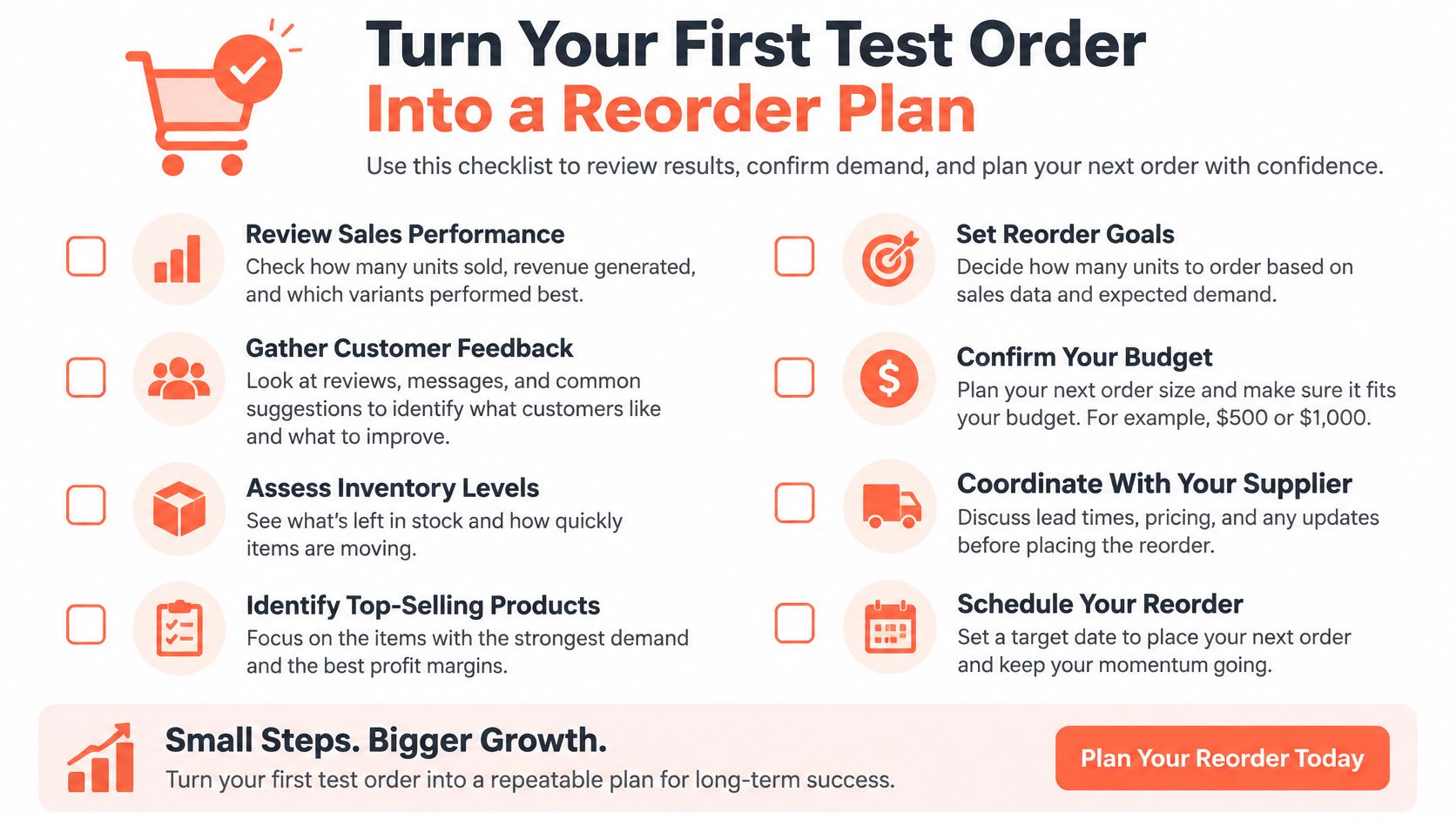
Build One Row per SKU
Create one inventory row per SKU with supplier, verified MOQ, landed cost, lead time, sales per week, and reorder point. Add compliance and spec status as separate fields. That way, a fast seller does not get reordered while its nickel report or material details are still unconfirmed. Base weekly sales on paid orders, not likes, saves, or comments.
Set the reorder point against lead time and the stock you still have. If a ring sells steadily but the supplier's restock time is longer than your remaining cover, you can run out even when the supplier has no MOQ. Record changes in lead time between the test and reorder, too. A delay affects both availability and the cost of keeping stock on hand.
Use a Clear Switch Rule
Keep buying two to five units at a time while demand and compliance are still being tested. Move to a consolidated order when the SKU sells through its test batch within two reorder cycles and the supplier's lead time remains steady. Size that order to the reorder point, then check whether consolidating reduces shipping cost or qualifies for a free-shipping threshold. No-MOQ has served its purpose for that SKU once demand is established and a larger order improves the numbers.
Keep testing new colors, materials, and plating finishes in small quantities, even when the shape is a proven seller. Each finish brings its own questions about returns, tarnish, and skin contact. A bestseller is not evidence that every variation will sell or meet your requirements.
For each reorder, check the sales record, stock remaining, lead time, landed cost, and document status before approving the quantity. Keep the test-small rule for any variation whose specs or compliance information are incomplete.
Place a test order from a supplier that passed your vetting checks, then update the sheet after the first sales cycle. Drop slow SKUs before they tie up more cash, and consolidate only the products that meet your reorder rule.
Start your next test with JewelryBuyDirect and apply its 15% first-three-orders offer if it fits the styles you are testing. Choose a small range, check the specs and documents when it arrives, and let recorded sales guide the reorder.