






Jennifer Lopez | Fri Oct 09 2026
Wholesale Jewelry Ring Settings: A B2B Buyer's Guide
USD 242.79 billion in 2025, rising to USD 387.36 billion by 2034, with rings expected to represent 32.68% of jewelry-market revenue in 2026. The profitable question isn't which ring setting looks attractive in a catalog, but whether its metal, geometry, finish, and documentation can protect the stone and your margin after the sale.
Why do conventional wholesale buying guides treat a ring setting as decoration when a short prong, weak alloy, or inaccurate plating claim can create returns, repairs, and lost trust? Wholesale jewelry ring settings are engineered frameworks, not interchangeable shells. They determine how securely a stone sits, how long a finish lasts, what you can legally say about the product, and whether a low unit cost remains low after inspection and customer service.
Why Ring Settings Are Your Biggest Margin Lever
A retailer orders an inexpensive batch of solitaire settings after approving a polished digital image. The shipment arrives with uneven shoulders, prongs that don't reach the stone seat, and plating that looks warmer than the approved sample. The catalog price was attractive, but the retailer now has to sort defective units, photograph products again, answer customer complaints, and decide whether resizing or repair is worth the labor.
That scenario is common because buyers often compare settings by unit price while ignoring the costs surrounding that price. The setting controls the product's reliability, and reliability affects sell-through, returns, repair work, reviews, and the time required to prepare every listing. A setting that costs slightly more can be commercially cheaper if it arrives consistent and needs less intervention.
The market gives this category unusual importance. One industry estimate places the global jewelry market at USD 242.79 billion in 2025, projecting USD 387.36 billion by 2034, with a 5.41% compound annual growth rate. That forecast expects rings to represent 32.68% of jewelry-market revenue in 2026. A separate estimate places rings at 35.45% of global jewelry revenue in 2025, with sales of approximately USD 135.25 billion. Because these estimates differ in scope and methodology, they shouldn't be combined into one exact total. Together, they show that rings account for roughly one-third or more of worldwide jewelry revenue, as reported in this jewelry market forecast.
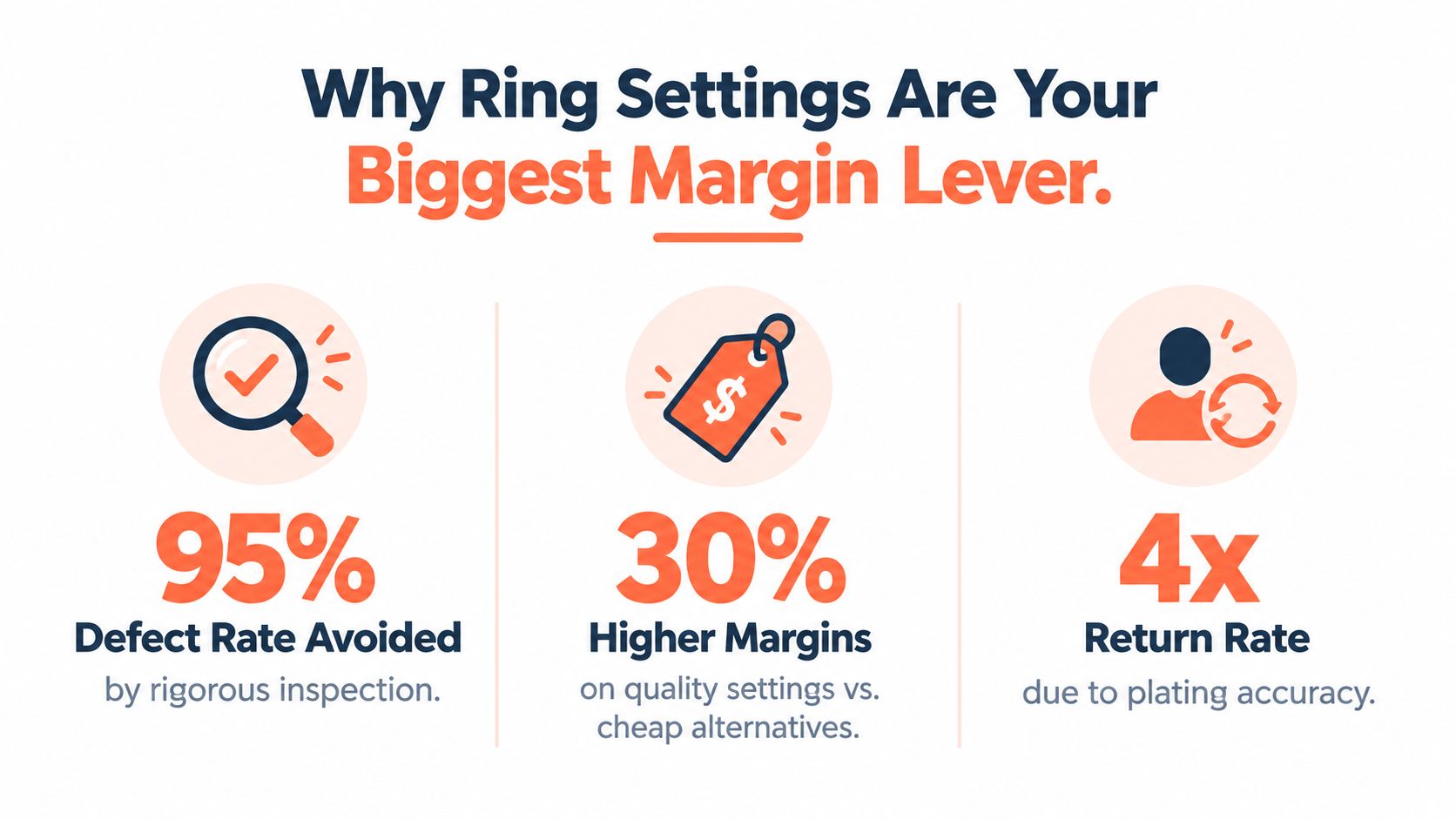
The infographic's performance figures aren't part of the verified market evidence, so don't use them as purchasing assumptions. Instead, build your own margin model around measurable factors:
- Incoming quality: Count defective settings, uneven finishes, missing sizes, and stone-seat problems before stock reaches the sales floor.
- Conversion readiness: Check whether the sample photographs accurately, wears comfortably, and can be described without vague material claims.
- After-sale exposure: Estimate the labor involved in customer support, resizing, replacement, and returns.
- Reorder confidence: Confirm whether the supplier can reproduce the same dimensions, finish, and compatible stone seat.
A useful cost framework should include more than factory price. The fabrication estimating cost structure is a helpful reference for separating direct production costs from labor, overhead, and other factors that can distort a supposedly cheap quote.
Practical rule: Compare suppliers on landed, sellable cost, not the invoice price alone.
The strongest assortment usually combines standardized core settings with controlled variation. A single mounting architecture can support different gemstones, metal colors, plating finishes, and sizes, but only when the supplier documents compatibility accurately. That modularity gives independent retailers room to test demand without treating every variation as a completely new product.
Understanding the Engineering Behind Ring Settings
A ring setting is the structural skeleton beneath the visible design. Its prongs, bezel wall, basket, gallery, shoulders, shank, and stone seat must work together, because changing one dimension can alter both appearance and retention.
The modern solitaire provides a useful historical example. Tiffany & Co. introduced the Tiffany setting in 1886, elevating the diamond above the band with six slender prongs. The design made the center stone visually dominant and helped popularize a scalable architecture in which the mounting could be produced separately from the interchangeable gemstone, as documented in this history of important jewelry dates.
Prongs, seats, and visual exposure
Four-prong settings expose more of the stone and allow strong light entry, which makes them appealing for fashion and bridal presentation. Their weakness is consequence. If one prong bends or breaks, the remaining structure carries more responsibility for retaining the stone.
Six-prong settings add redundancy and are generally better suited to daily-wear solitaire rings. That doesn't make every six-prong setting secure. Prong symmetry, tip geometry, metal thickness, and the fit of the seat still matter, and a poorly cast six-prong design can fail just as surely as a poor four-prong design.
A full bezel takes a different approach. It surrounds the gemstone's girdle continuously, reducing exposed edges and eliminating protruding tips that can catch clothing. The bezel wall must follow the stone circumference closely, so manufacturing tolerances become more demanding. For wholesale orders, ask for stone-specific drawings rather than accepting a generic claim that a setting is “universal.”
The same principle applies to digital fabrication and prototypes. A strength calculator for prints can help teams think through wall thickness and structural behavior during design development, although a printed prototype isn't a substitute for testing the final jewelry alloy and casting.
Hardness is only one part of security
Metal hardness affects whether small prongs deform, bezel edges dent, and contact surfaces wear down. Jewelry-alloy specialists identify approximately 100 HV as a desirable minimum for reasonable service durability, while practical wear-resistant hardness often falls between 110 and 135 HV, based on this palladium casting reference.
Hardness doesn't tell the whole story. Ductility, casting porosity, wall thickness, heat treatment, and finishing quality can determine whether a setting bends gradually or cracks under stress. Before ordering, specify the intended stone shape, stone dimensions, prong count, seat depth, gallery support, and metal alloy. For broader component terminology, retailers and makers can also review this guide to jewelry findings and components.
Comparing Materials, Plating, and Durability
Material selection should follow the customer's use case, not the supplier's cheapest available option. A ring for occasional fashion wear has different requirements from a daily-wear solitaire, and a plated setting has a different service expectation from a solid precious-metal mounting.
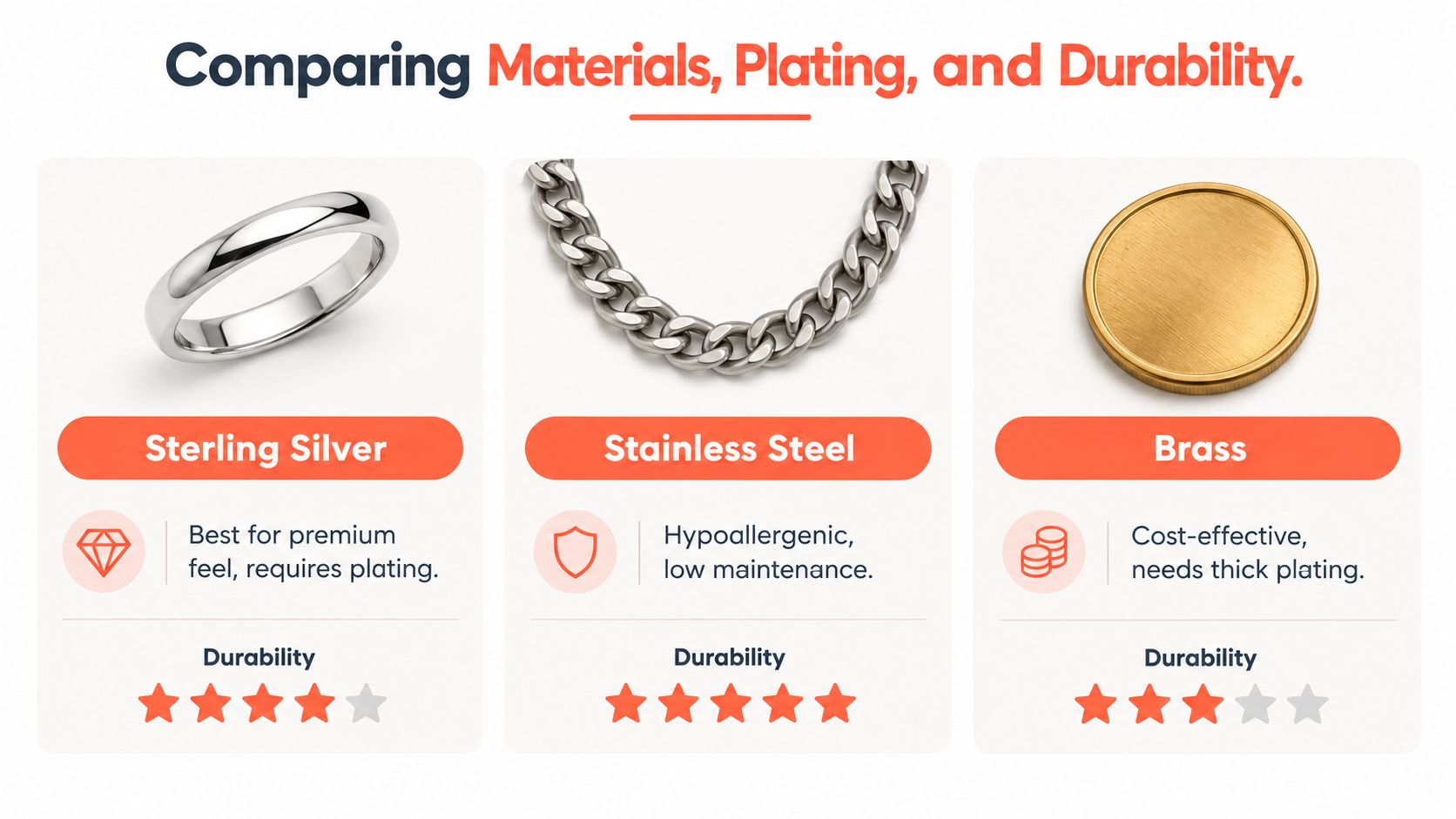
Sterling silver offers a recognizable material story and works well for premium-feel fashion, stackable designs, and affordable bridal-inspired products. Its surface can tarnish and may require plating or refinishing, so product care information matters. Stainless steel generally supports low-maintenance assortments and can suit customers who want a durable, contemporary look, but repairs, resizing, and color matching may be less straightforward than with precious-metal alloys. Brass helps reduce initial cost and can support trend-led designs, yet it needs carefully specified plating and clear customer disclosure.
How the material choice changes the economics
A supplier may quote the same silhouette in several metals, but the finished product won't carry the same risk profile. Thin prongs and narrow bezel edges lose material faster than broad, protected surfaces. Repeated contact with counters, clothing, skin, and other jewelry makes a weak edge a recurring service issue rather than a one-time cosmetic flaw.
Ask for the alloy designation and available quality-control data. If the supplier can't identify the material beyond “silver color,” “gold color,” or “premium metal,” you don't have enough information to set customer expectations or compare quotes.
| Material or finish | What it can do well | What the buyer must verify |
|---|---|---|
| Sterling silver | Supports a familiar quality story and broad fashion assortments | Purity, polishing, tarnish-care guidance, and plating details |
| Stainless steel | Suits low-maintenance and contemporary collections | Grade, finish consistency, stone-seat accuracy, and repair limitations |
| Brass or other base metal | Keeps trend-led styles accessible | Base metal disclosure, plating method, coating specification, and wear expectations |
| Gold-plated material | Creates a precious-metal appearance at a lower entry price | Karat, plating terminology, coating thickness, and application method |
The FTC guidance on buying platinum, gold, and silver jewelry states that “silver,” “sterling,” and “sterling silver” mean 92.5% pure silver, while “925” represents 925 parts pure silver per 1,000. The same guidance says gold electroplate must use at least 10-karat gold and a coating at least 0.175 microns thick.
For surface treatments, don't treat vermeil, gold-filled, gold-overlay, and electroplate as interchangeable language. Ask the factory what base metal sits beneath the surface, how the coating is applied, what karat rating applies, and what thickness or weight specification supports the description. A technical explanation of PVD coating on jewelry can help buyers distinguish a process from a generic color claim.
The commercial lesson is straightforward. A cheaper setting isn't affordable if the finish fails the intended use or the material description creates compliance risk. Match the metal and coating to the customer's wear pattern, then price the product with its real service life in mind.
Quality Control and Legal Verification for Settings
Quality control should begin before the carton leaves the factory. A supplier's product page can show a beautiful silhouette, but only a sample inspection reveals whether the prongs are even, the stone seat is centered, and the finish survives close examination.
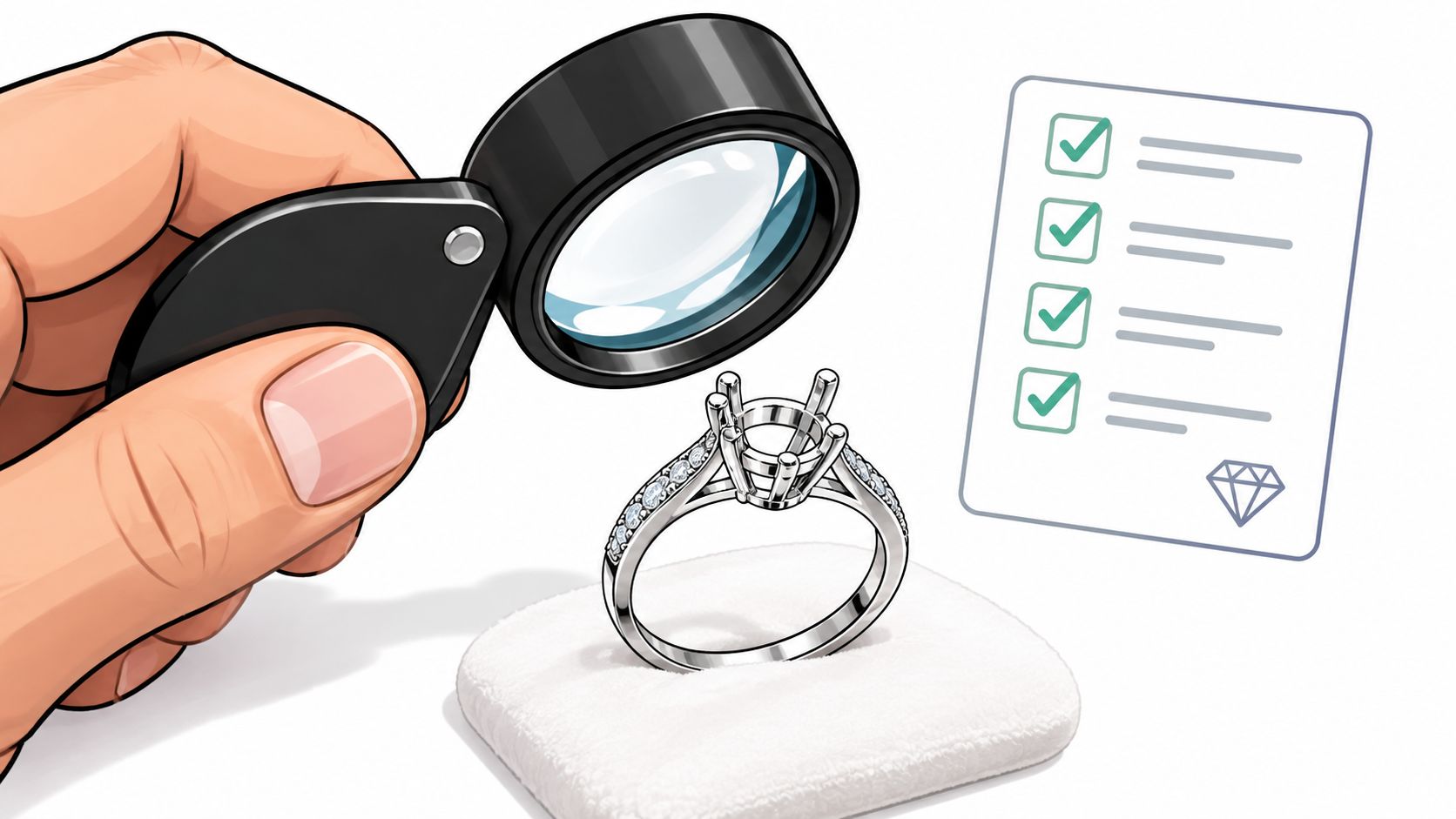
A practical receiving checklist
Use the same inspection sequence for approved samples and production shipments. Consistency makes supplier conversations objective and gives you evidence when a batch falls outside specification.
- Confirm the SKU and variant. Match the delivered ring to the approved drawing, size, finish, metal, and intended stone shape.
- Inspect the silhouette under magnification. Look for uneven prong height, asymmetrical shoulders, sharp inner edges, casting pits, porosity, and incomplete polishing.
- Check the stone seat. Place the specified test stone or gauge into the setting. It should sit evenly without rocking, excessive force, or visible gaps.
- Examine the retention points. Prong tips should contact the stone consistently, while bezel walls should follow the girdle without thin spots or open corners.
- Review the finish. Compare color, reflectivity, plating coverage, and edge wear with the approved sample under the lighting used for product photography.
- Record defects by type. Separate cosmetic issues from structural or safety issues. A rough inner edge may require rework, while a weak prong should trigger rejection.
- Retain evidence. Photograph nonconforming units, keep inspection notes, and tie findings to the purchase order and supplier batch.
Inspection standard: Don't approve a setting because it looks attractive from arm's length. A retailer needs symmetry, secure seating, clean finishing, and a defensible material description.
Hardness data can support a procurement decision, but it doesn't replace microscopic inspection. Casting pits, thin edges, and poor finishing can undermine an otherwise suitable alloy. Ask the supplier to identify hardness or quality-control information where available, then test the features most likely to fail in actual wear.
Verify every material claim
The FTC also says marketers must not misrepresent gold content, karat fineness, plating thickness, weight ratio, or application method. For plated wholesale settings, request the base metal, karat rating, plating process, thickness where relevant, and legally accurate wording before the product enters your catalog.
Use “sterling silver” only when the product meets the 92.5% purity threshold. Describe a gold surface as plated when it is plated, and don't let a gold-colored finish become an implied solid-gold claim. A supplier's stamp isn't enough by itself. Keep supporting documents, sample records, and product-page language aligned.
Retailers who need an additional verification workflow can consult this guide on testing gold purity. The practical objective isn't to make every product sound more luxurious. It's to make the description accurate enough that the customer receives what the listing promises.
Adapting Settings for Modern Stone Trends
A setting designed for a small round stone shouldn't automatically be used for a larger oval or elongated center. Stone weight, shape, depth, girdle profile, and points of contact change the forces placed on prongs, galleries, shoulders, and the shank.
BriteCo reports that the average lab-grown engagement-ring center grew from 1.31 carats in 2019 to 2.45 carats in 2025, while oval became the leading lab-grown shape, according to its lab-grown versus natural diamond report. The commercial implication is more important than the trend label. Larger centers demand better support, more deliberate prong geometry, and a closer match between the setting and the stone's actual dimensions.
Match architecture to the stone
| Center profile | Setting priorities | Common mistake |
|---|---|---|
| Round | Four or six evenly spaced prongs, accurate seat, stable gallery | Treating every round seat as interchangeable |
| Oval | Prongs positioned to control the ends, reinforced gallery, adequate shoulder support | Using a round layout that leaves the tips exposed |
| Pear or marquise | Protection at vulnerable points, precise tip coverage, balanced orientation | Leaving points exposed to impact or snagging |
| Soft or cleavage-prone stone | Bezel, channel, or recessed construction | Choosing an exposed prong design for visual openness alone |
A larger oval may look impressive in a catalog, but a high setting can snag clothing and place more stress on the prongs. Reinforced galleries and appropriately placed supports can improve stability without making the ring visually heavy. For an active customer, a protective bezel or recessed architecture may be a better commercial choice than maximum exposure.
Four prongs can work for fashion presentation when the stone and use case support them. Six prongs are generally more forgiving for daily-wear solitaires, while a full bezel reduces exposed girdle risk but demands close dimensional accuracy. The right answer depends on the stone, not on a generic style name.
Plan inventory around compatibility
Don't build an assortment around attractive photographs alone. Define the stone shapes and dimensions each setting family supports, then separate ready-to-ship pieces from semi-mounts and made-to-order options. This prevents a customer from ordering a visually similar stone that doesn't fit the seat.
A practical system keeps a few proven setting architectures in compatible sizes, while custom requests require stone measurements and written approval. Record the stone length, width, depth, shape, metal, finish, ring size, and expected lead time before production. If a customer supplies a stone, state clearly who carries responsibility for fit, damage, and return eligibility.
Negotiating Pricing, MOQs, and Fulfillment
The lowest MOQ isn't automatically the best deal, and a high MOQ isn't automatically a sign of factory efficiency. The relevant question is whether the order structure lets you test fit, finish, size demand, and customer response without creating unsellable inventory.
Ask suppliers to quote the same setting under several fulfillment models: finished ring, loose semi-mount, and made-to-order component. Finished rings simplify merchandising but tie inventory to specific sizes and stones. Loose settings offer more flexibility, although they require labor, stone sourcing, fitting, and clearer customer approvals. Made-to-order production can reduce finished inventory, but lead time and communication become part of the product.
Calculate the cost that reaches the shelf
Include sample charges, labor, shipping, packaging, inspection time, resizing, defective units, payment costs, and returns in your landed-cost worksheet. A setting can have an attractive factory quote and still produce poor cash flow if every sale requires manual correction.
Before negotiating, prepare a specification sheet that names:
- Core dimensions: Stone shape, length, width, depth, prong count, seat, gallery, and ring size.
- Material details: Alloy, plating method, karat rating, finish, and available quality documentation.
- Commercial terms: MOQ by SKU, sample policy, lead time, reorder terms, and treatment of defective units.
- Customer workflow: Approval requirements, deposit rules, incompatibility policy, resizing responsibility, and return conditions.
No-MOQ sourcing can be useful for testing sizes, metals, and finishes before committing to depth. JewelryBuyDirect offers wholesale ring blanks and jewelry-making components through its B2B catalog, alongside a broader catalog for retailers and makers, so it can serve as one option when a buyer wants to validate a small assortment before scaling. Compare its terms with other suppliers on actual landed cost, quality documentation, fulfillment speed, and return handling rather than relying on the absence of an MOQ alone.
Negotiation point: Ask what happens when the setting meets the drawing but doesn't meet the approved sample. The answer reveals more about supplier accountability than a small unit-price concession.
A sound first order buys information as well as stock. Test a controlled range of setting families, inspect every variant, and measure which combinations create customer questions or service work. Then negotiate deeper pricing on the designs that prove compatible with your buyers, your production workflow, and your return policy.
Finalizing Your Wholesale Sourcing Strategy
A profitable wholesale ring-setting order balances appearance, engineering, material accuracy, and fulfillment discipline. Before approving a supplier, confirm the alloy and plating specification, hardness data where available, stone-shape compatibility, prong and bezel dimensions, inspection process, MOQ, lead time, defective-unit policy, and returns terms.
Start with samples, document acceptance criteria, and calculate landed cost before comparing quotes. The setting that protects the stone, photographs accurately, and arrives consistently will usually outperform the cheapest option on the invoice.
If you need to test wholesale jewelry ring settings, ring blanks, metals, finishes, and compatible components without committing to deep inventory, visit JewelryBuyDirect. Use the platform to compare specifications, validate a focused assortment, and build your next order around inspection results rather than catalog price alone.