






Arthur Lynch | Mon Aug 18 2025
How to Test Gold Purity A Practical Guide
So, you need to figure out how pure your gold really is. There are a handful of ways to do this, and the right one for you depends on what you have and why you're testing it. This guide provides actionable insights for each method.
For a quick, easy check you can do at home without damaging anything, you'll want to start with a visual inspection and a simple magnet test. If you need a more definitive answer, a classic acid test kit will give you a pretty accurate karat value. For the pros who need absolute certainty, high-tech tools like X-Ray Fluorescence (XRF) analyzers are the go-to for precise, non-destructive results.
Your Quick Guide to Verifying Gold Purity
Before we get into the nitty-gritty of each test, let's talk about why this is so important. Knowing the real gold content is everything when it comes to value, whether you're sizing up a family heirloom, a cool flea market find, or a serious investment piece.
Gold preferences also change dramatically around the world, reflecting distinct regional jewelry trends. Being able to test and identify these differences is a huge advantage. In North America and across Europe, the trend leans toward subtle luxury and durability, making 14K (58.3% gold) and 18K (75% gold) the most popular choices. These alloys offer a great mix of rich color and everyday resilience.
But in South Asia and the Middle East, jewelry is often a primary form of investment and a display of wealth. Here, the fashion is for the deep, buttery yellow of high-purity gold, with 22K (91.7% gold) being the preferred standard for its vibrant color and intrinsic value.
Understanding the Core Testing Principles
Every test works a little differently, relying on a unique scientific principle to get the job done. Once you get the hang of how they work, you can pick the best method for your situation and feel confident in what the results are telling you.
Here's a quick look at the main testing methods we'll walk through in this guide:
-
At-Home Visual and Physical Tests: Think of these as your first line of defense. They take advantage of gold’s most basic physical traits—it's heavy for its size (dense) and not magnetic at all. We'll also cover how to spot hallmarks, which are the official stamps that indicate the karat. A stamp like "750" means 18K gold, which is very different from markings on other metals. For instance, you can learn more about what "316 L" means on jewelry to see how different materials are identified.
-
Chemical Reaction Tests (The Acid Test): This is the old-school, reliable method. It involves scratching a tiny, unnoticeable bit of metal onto a stone and applying specific acids to see how it reacts. Gold alloys of different purities will react in predictable ways, letting you nail down the karat. It’s cheap and effective, but you have to be careful.
-
Advanced Electronic and Lab Methods: When there's no room for error, professionals bring out the big guns. An XRF analyzer gives an instant, non-destructive chemical breakdown of the metal. For the most accurate result possible—the industry's gold standard—a fire assay is performed. This involves melting a small sample, but it’s destructive and reserved for high-stakes situations.
Before you choose a method, it helps to see how they stack up against each other.
Gold Purity Testing Methods At a Glance
This table gives you a quick comparison of the most common gold testing methods, covering their accuracy, cost, and what they're best suited for. It's a handy cheat sheet to help you decide which test is the right fit for your needs.
| Method | Accuracy Level | Cost | Best For |
|---|---|---|---|
| Visual/Magnet Test | Low | Free | Quick screening for obvious fakes at home. |
| Acid Test | Medium-High | $15 - $50 | Reliable home or shop testing for karat value. |
| Electronic Tester | High | $150 - $600 | Fast, non-destructive checks for frequent buyers/sellers. |
| XRF Analyzer | Very High | $15,000+ | Professional-grade, instant, and non-destructive analysis. |
| Fire Assay | Highest Possible | Varies | The definitive standard for bullion and refineries; destructive. |
Knowing the pros and cons of each method puts you in a much better position to test your gold with confidence.
Learning these methods isn’t just about spotting fakes. It's about understanding the science behind one of the world's most treasured metals. This knowledge gives you the power to make smarter choices, whether you're buying, selling, or just collecting.
With this overview in mind, you're ready to move on to the practical, step-by-step instructions for each test. By the end of this guide, you'll have everything you need to confidently evaluate any piece of gold you encounter.
Simple At-Home Tests for Initial Verification
Before you jump into more complex testing methods, some of the most reliable first checks for gold purity can be done right in your own home. These tests are completely non-destructive and perfect for quickly weeding out obvious fakes. Think of them as a first-pass screening—they won't give you an exact karat value, but they’ll tell you if it's even worth bothering with further tests.
This initial check is especially helpful because global jewelry trends create such variety. An 18K (75% gold) European ring has a different weight and feel than a 22K (91.7% gold) Indian bangle. These simple tests help you get a basic feel for the metal you're holding.
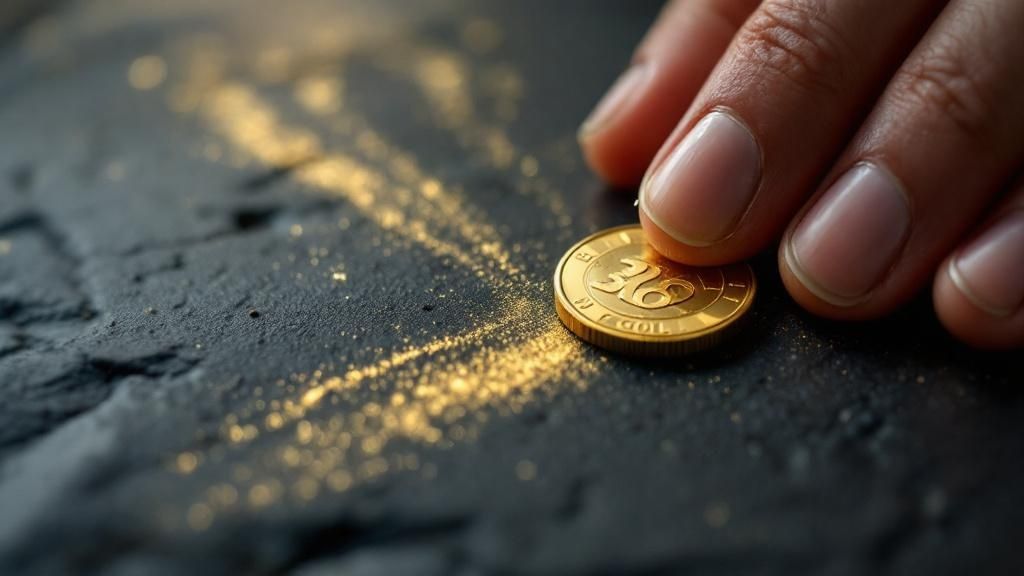
Here you see the magnet test in action. It's a foundational step for anyone learning how to test gold at home. If the piece shows any magnetic attraction, it’s a red flag that non-precious metals are present, meaning the item likely isn't solid gold.
The Magnet Test: A Quick First Pass
Here's a basic scientific fact that works in our favor: gold is not magnetic. This simple property makes the magnet test one of the easiest and fastest checks you can do. If your jewelry sticks to a magnet, it’s a dead giveaway that it isn’t solid gold.
Actionable Insight: Use a strong neodymium magnet (found at hardware stores) for the best results, as a weak refrigerator magnet may not detect a small amount of ferrous metal in an alloy.
- No Reaction? Great. If the jewelry shows no attraction whatsoever, it passes this first test. It could be gold or another non-magnetic metal.
- Strong Pull? If the magnet snatches the item, you can stop right there. It’s definitely not real gold and is probably just gold-plated steel or iron.
- Just a Slight Tug? Sometimes you might feel a very weak pull. This often happens with clasps on chains or bracelets, which can contain a tiny steel spring. Test the main body of the piece—the chain links or a pendant—to get an accurate reading.
Be aware that this test isn't a silver bullet. A clever fake could be made from a non-magnetic base metal. That's why the magnet test is a great starting point, but it should never be your only test.
The Float and Density Test
Another simple at-home method leverages one of gold’s most distinctive properties: its incredible density. Real gold is heavy for its size—much heavier than the common metals used to make fakes.
The float test is a very basic way to check this. Just drop your piece into a glass of water. Real, solid gold will sink like a stone, straight to the bottom. Anything that floats, hovers in the middle, or sinks very slowly is an imposter.
Actionable Insight: For a more advanced density check, use a kitchen scale and a cup of water. Weigh the item dry, then weigh it while submerged in water (without touching the bottom). Divide the dry weight by the difference between the dry and submerged weights. Pure gold's density is 19.3 g/cm³, so your result should be close to that range, depending on the karat.
This test is particularly handy if you’re thinking about selling jewelry online, as it helps you quickly filter out junk before investing more time.
The Ceramic Scratch Test
This test gives you a much more telling result, but you have to be careful. If you're not gentle, you could scratch your item. All you need is an unglazed ceramic plate or tile.
Actionable Insight: The rough, unglazed ring on the bottom of a coffee mug or ceramic bowl is perfect for this. It's accessible and has the right texture. Gently rub a small, out-of-the-way spot on your jewelry across the ceramic. You don't need to apply a lot of pressure.
- A gold-colored streak is a very good sign that your item is real gold.
- A black or gray streak means it's not. The item is likely made of a base metal like brass or is thinly plated.
This method works surprisingly well. I once found a piece stamped "14K" at a flea market that looked promising. I discreetly ran it across the bottom of my coffee cup, and it left a dark gray line. An instant fake. That simple check saved me from a bad buy.
Using an Acid Scratch Test for Karat Value
So, you’ve done the visual checks and the magnet test, but you're still not 100% sure what you have. It's time to bring out the classic method jewelers have relied on for generations: the acid scratch test. This is a fantastic, low-cost way to get a much more definitive answer on your gold’s purity right at home.
This chemical test is especially handy for telling apart the different gold alloys that reflect global jewelry trends. Whether it's distinguishing a North American 14K (58.3% gold) piece from a European 18K (75% gold) one, or confirming the high purity of a 22K (91.7% gold) piece from South Asia, the acid test provides clear answers.
The image below shows the basic setup: the testing stone, the acid vials, and the gold you're testing. It’s a straightforward process, but every piece of the kit plays a crucial part.
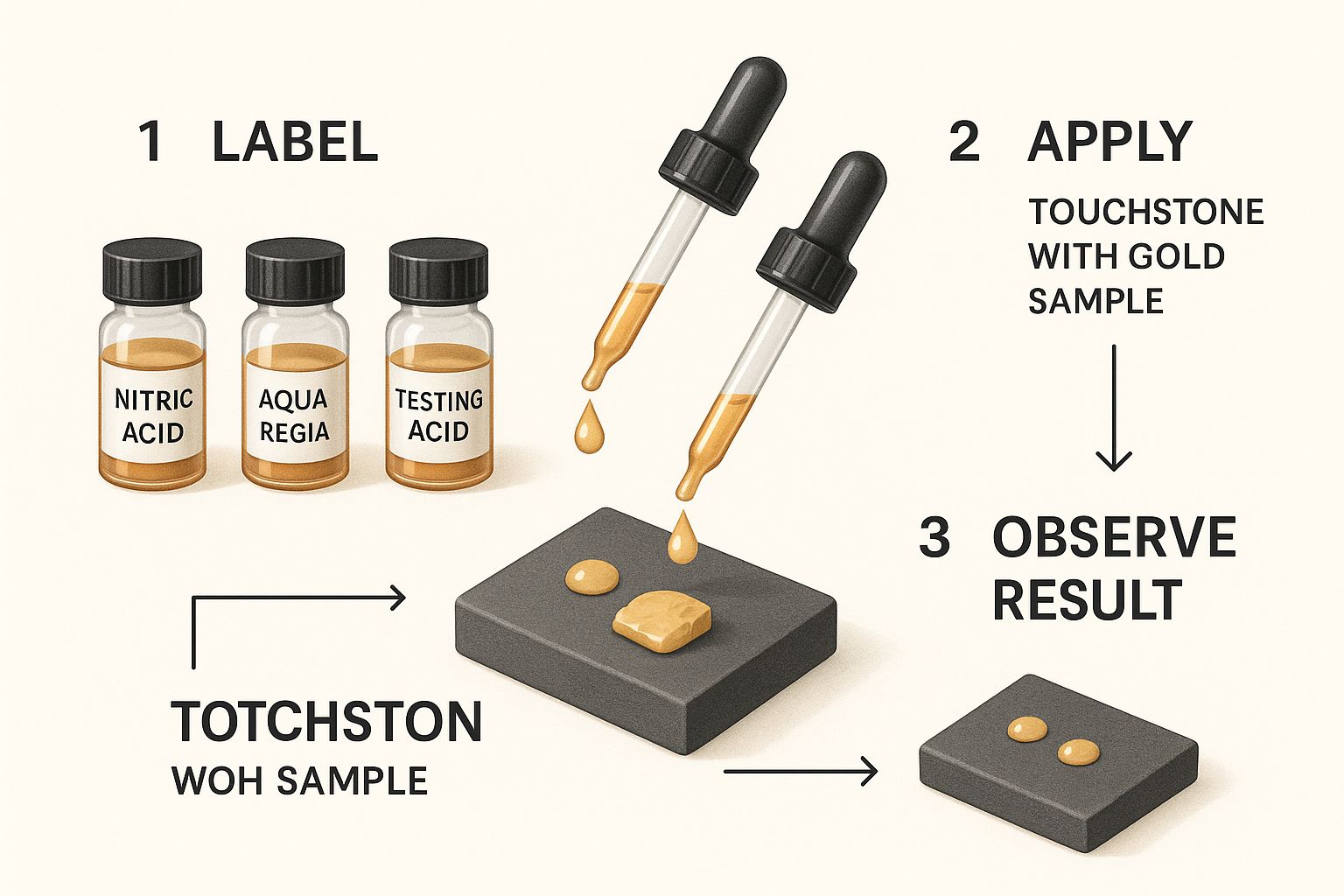
Gathering Your Gold Testing Kit
First thing's first, you'll need a proper gold testing kit, which you can easily find online. A good kit is your starting point for getting accurate results.
Here’s what should be inside:
- A Black Testing Stone (Touchstone): This is a small slab of slate with a slightly abrasive surface. You'll use it to rub off a tiny, non-damaging streak of metal from your item.
- Karat-Specific Needles: These are small tools tipped with verified gold alloys (10K, 14K, 18K, etc.). They let you create "control" streaks on the stone for a direct comparison.
- Acid Solutions: Your kit will have several small bottles of nitric acid, each one precisely formulated to react with a specific karat. This is where the magic happens.
Actionable Safety Tip: You're working with acid. Always wear the gloves and safety goggles included in your kit, and work on a protected surface like a ceramic plate in a well-ventilated area to avoid skin irritation or damage to furniture.
Performing the Scratch Test
Alright, once you're set up and have your safety gear on, it’s time to test. The key is to be gentle enough not to damage your piece but firm enough to get a good sample for the acid to work on.
Start by finding a discreet spot on your jewelry—the inside of a ring or near the clasp works perfectly. Press it firmly against the black testing stone and rub to create a clear, solid line about an inch long.
Next, grab one of your control needles. The 14K needle is usually a good place to start for most jewelry. Make a parallel streak right next to your sample streak. Now you have a known benchmark.
Finally, carefully uncap the 14K acid solution and apply a single drop so that it covers a bit of both streaks. Now, just watch closely.
Interpreting the Acid Reaction
How your gold streak reacts (or doesn't react) to the acid tells you everything. This is where you get your answer.
Here’s a breakdown of what you might see:
- The streak vanishes immediately: If the acid makes your sample streak disappear in a flash, your item is a lower karat than the acid you used. In this case, it’s less than 14K.
- The streak fizzes, turns brown, or slowly dissolves: This almost always means you're looking at gold-plated jewelry. The acid has burned through the thin gold layer and is reacting with the base metal underneath.
- The streak stays strong: If your sample streak looks exactly like the 14K control streak—no change, no dissolving—you've got a match. Congratulations, your item is 14K gold.
- Your streak outlasts the control: What if the 14K acid slightly dulls the control streak, but your sample streak remains bright and untouched? This is great news! It means your gold is a higher karat than 14K.
If you suspect your gold is higher than 14K, just clean the stone and repeat the whole process. This time, make a new sample streak next to a streak from the 18K needle and test it with the 18K acid. You just keep moving up the karat scale until you find the acid that finally affects your sample. That's how you pinpoint its purity.
Understanding Professional XRF Analysis
When you need a precise, definitive answer about gold purity without leaving so much as a scratch, X-Ray Fluorescence (XRF) is the gold standard. This is the exact technology used by professional jewelers, reputable pawnshops, and bullion dealers who can't afford to be wrong. It's fast, incredibly accurate, and completely non-destructive.
Think of an XRF analyzer as a high-tech scanner for metal. The device, which usually looks like a handheld "gun," fires a safe, concentrated beam of X-rays at the gold. This energy gets the atoms inside the metal excited, causing them to emit their own unique X-ray signatures in response. The analyzer reads these signatures in real-time, identifying every single element present and calculating its exact percentage.
Why Professionals Trust XRF Technology
The biggest draw for professionals is getting a detailed elemental breakdown in seconds. That speed and precision are absolutely critical in a commercial environment. An acid test might tell you a piece is "at least 18K," but an XRF readout gives you the complete story: 75.2% gold, 15.5% copper, 5.3% silver, and 4.0% zinc. This level of detail is non-negotiable when you're assessing the true melt value of an item.
This technology is perfectly adapted to the diverse global jewelry market:
- Western Trends: It can instantly confirm the specific alloy mix in 14K (58.3% gold) or 18K (75% gold) pieces common in Europe and North America.
- Eastern & Middle Eastern Trends: It's equally adept at verifying the high-purity 22K (91.7% gold) or even 24K (99.9% gold) items fashionable in Asian and Middle Eastern cultures, where gold is often held as a primary investment.
This image from Thermo Fisher Scientific shows a typical handheld XRF analyzer in action, testing gold jewelry on the spot.
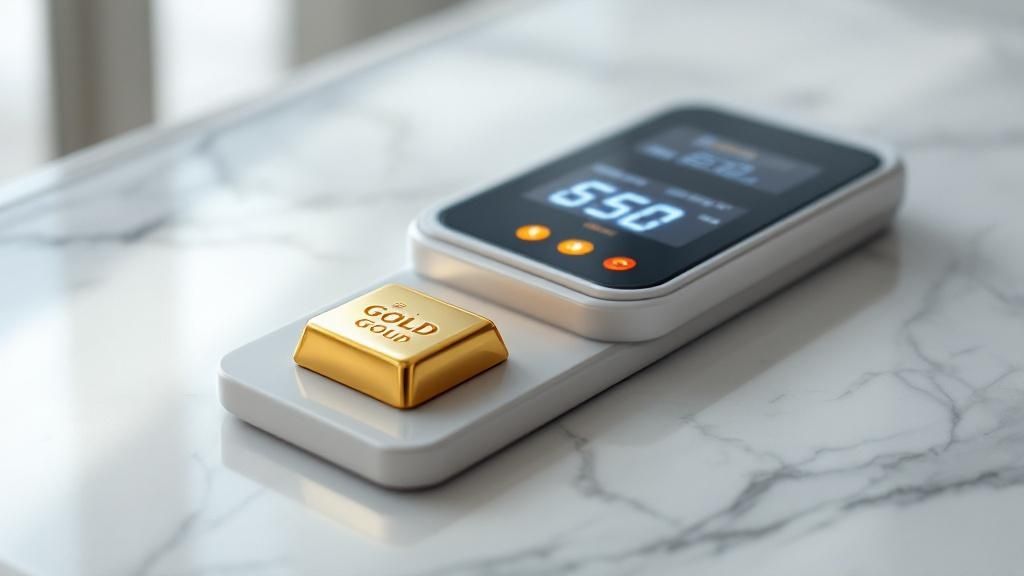
The device delivers a complete, non-destructive analysis, giving the user immediate confidence in the item's composition. This kind of instant verification is essential for both buying and selling precious metals.
Understanding The Accuracy And Limitations
For most gold alloys you'll encounter, from 8 karat (around 33% gold) up to pure 24 karat, an XRF machine is exceptionally accurate. Depending on the quality of the machine and the skill of the person using it, you can expect an accuracy within 0.1 to 0.5 karat. It's an incredibly reliable tool. For a deeper dive, the GIA published some fantastic research on gold testing methods that covers this in detail.
However, it's not foolproof. The biggest limitation of XRF is that it's fundamentally a surface-level analysis. Actionable Insight: To counter this, a skilled operator will test multiple spots, especially worn areas like the edges of a coin or the inside of a ring band. Discrepancies in readings across the piece can be a tell-tale sign of thick plating over a base metal core.
Key Takeaway: XRF analysis is incredibly powerful for confirming the purity of solid gold items, but it can be tricked by sophisticated fakes with thick plating. It gives you a perfect snapshot of the surface, not necessarily the core.
When To Pay For A Professional Scan
Let's be realistic—a professional XRF analyzer can set you back $15,000 or more, so it's not exactly a household tool. So, when does it make sense to find a jeweler or precious metals dealer who offers this as a service?
Paying for an XRF scan is a smart investment in a few key situations:
- High-Value Items: If you're buying or selling something with significant value—a heavy gold chain, a bullion coin, or a luxury watch—the small fee for a scan provides invaluable peace of mind.
- Unmarked Pieces: Have an inherited piece of jewelry or a flea market find with no hallmarks? An XRF test is the only way to know its exact purity without damaging it.
- Verifying Online Purchases: Bought a pricey gold item online? Getting an XRF test the moment it arrives is the best way to confirm you got what you paid for before it's too late.
Ultimately, while at-home tests are great for a first pass, an XRF scan provides a level of scientific certainty that no other non-destructive method can match. It closes the gap between a good guess and a verified fact.
The Fire Assay: The Definitive, Unquestionable Purity Test
When there’s absolutely no room for error and you need an irrefutable answer, you turn to the fire assay. This isn't just another test; it's the gold standard, the final word on purity that has been trusted by mints, refineries, and metallurgical labs for centuries. All other methods are, in one way or another, measured against it.
Forget the non-invasive elegance of an XRF scanner. The fire assay is a hands-on, completely destructive process that gets right to the heart of the metal. It begins by taking a small, precisely weighed sample from the item. This sample is then mixed with lead oxide (litharge) and other fluxing agents and packed into a special porous crucible called a cupel.
From there, it goes into a furnace heated to blistering temperatures, often pushing past 1,100°C (2,000°F).
Melting Away the Impurities
At this intense heat, a process called cupellation begins. The lead oxidizes and melts, acting like a solvent that scoops up all the base metals—copper, zinc, nickel, you name it. This molten cocktail of impurities is then absorbed directly into the porous walls of the cupel, leaving behind only the precious metals that resist oxidation: gold and silver.
But the job isn't done. The tiny bead that remains, called a dore, is a simple alloy of gold and silver. This bead is flattened out and bathed in nitric acid in a step known as parting. The acid makes short work of the silver, dissolving it completely and leaving behind nothing but pure, elemental gold.
The Final Calculation
This final speck of pure gold is then meticulously weighed. By comparing its final weight to the original sample's weight, a technician can calculate the gold's purity—or fineness—with incredible precision, often down to one part in ten thousand.
This is the level of accuracy required to certify investment-grade bullion or verify the massive gold shipments that underpin international trade, where a tiny fraction of a percent can be worth a fortune. For more on how this ancient technique has been refined for modern use, check out this look into its impact on modern gold analysis.
Unmatched Accuracy vs. A Major Drawback
So, what's the trade-off?
-
Pro: Its accuracy is simply unparalleled. The fire assay doesn't just analyze the surface; it physically rips the gold apart from everything else. This eliminates any ambiguity you might get from surface tests, especially when dealing with cleverly plated fakes.
-
Con: The process is, by its very nature, destructive. A piece of the item must be cut off and melted down. This makes it completely impractical for finished jewelry, family heirlooms, or rare coins. You’d never, ever run a fire assay on a finished engagement ring or a valuable gold sovereign.
When is a Fire Assay Actually Used?
This method is strictly for situations where the raw material's value is the only thing that matters. Refiners use it to figure out the exact payout for a large batch of scrap gold, and mining operations rely on it to confirm the quality of their ore before committing to a full-scale extraction.
Why It Matters to You
Even though you’ll probably never order a fire assay yourself, understanding it gives you critical context for the entire gold market. This is the test that provides the foundation of trust for the whole industry.
When a refinery stamps a gold bar as "999.9 Fine," a fire assay was used to certify that purity. This is why investors in high-purity 24K (99.9% pure) gold, a major fashion and investment trend in Chinese and Vietnamese markets, can trust what they're buying.
The fire assay is the silent authority working in the background, ensuring the integrity of the gold you buy, sell, and invest in. It’s the ultimate guarantee that a kilogram of gold from a Swiss refinery has the exact same purity as one from Dubai, making the global gold trade possible.
Common Questions About Gold Purity Testing
When you're dealing with gold, questions are bound to come up. Whether you're sorting through an old jewelry box or thinking about buying a new piece, getting straight answers is crucial. Here are some of the most common questions I hear, answered with practical, real-world advice.
Can I Test Gold Purity Without Damaging My Jewelry?
Yes, absolutely. The best place to start is with non-destructive methods you can do at home. A simple visual check for hallmarks and a quick test with a good magnet can often weed out obvious fakes without leaving a single mark.
If you need a definitive answer without any risk, X-Ray Fluorescence (XRF) analysis is the gold standard (pun intended). This is what professionals use. An XRF gun shoots X-rays at the piece and reads the energy that bounces back, giving a precise breakdown of every metal inside—all without altering the item in any way.
Other common methods do carry a small risk. The acid scratch test, for instance, requires you to rub the item on a testing stone, leaving a tiny streak of metal behind. While you can usually do this on an inconspicuous spot, like the inside of a ring band or a clasp, it's still a physical alteration. The only truly destructive method is the fire assay, which involves melting a sample and is strictly for raw gold, not finished jewelry.
What Do Numbers Like 750 or 585 Mean on Gold?
Those three-digit numbers are part of the millesimal fineness system, which is just a fancy way of saying the gold's purity is measured in parts per thousand. It's the international standard for hallmarking because it's more precise than just using karats.
Here’s how it corresponds to global jewelry trends:
- 750: This means the metal is 750 parts pure gold out of 1000. That's 75% gold, which we call 18K. It's a favorite for high-quality jewelry in Europe and the Americas, where luxury and craftsmanship are paramount.
- 585: This stamp tells you the piece is 585 parts pure gold out of 1000, or 58.3% gold. This is the hallmark for 14K gold, a workhorse in the U.S. jewelry market because it hits the sweet spot between rich color and durability.
- 916: You’ll see this a lot on pieces from South Asia and the Middle East. It stands for 91.7% pure gold, or 22K, prized for its deep yellow color, which is a major fashion statement in these regions.
This system isn't exclusive to gold, either. For example, if you're curious about silver, you can learn more about what makes for valuable 925 silver by looking into its own hallmarking standards.
How Reliable Are At-Home Gold Testing Kits?
For what they cost, those DIY acid test kits are surprisingly reliable. They do a great job of telling the difference between major karat values—like 10K, 14K, and 18K—and are fantastic at catching fakes that contain no gold at all. If you're a hobbyist or just trying to sort through some family heirlooms, they're a great tool to have.
The catch? Their accuracy depends entirely on how you use them. Actionable Insight: Their biggest blind spot is heavy gold plating. To avoid a false positive, make a deeper scratch on the testing stone, or even use a small file on a hidden part of the jewelry before scratching, to ensure you are testing the metal beneath the plating.
An at-home kit is a great first step, but it shouldn't be the final word for anything high-value. Use it as a screening tool, but always get professional verification with something like an XRF analyzer before making a big decision.
Why Does Some Gold Look More Yellow Than Others?
The final color of a gold piece all comes down to the other metals—the alloys—mixed in with it. Pure, 24K gold has a rich, almost orange-yellow hue. It's beautiful, but it's also very soft and not practical for most jewelry. To make it stronger and create different looks, jewelers mix it with other metals.
The specific alloy "recipe" reflects global fashion trends:
- Yellow Gold: To keep that classic golden glow in 14K or 18K pieces, pure gold is usually mixed with silver and copper. Jewelers can tweak the ratio to create subtle variations in the yellow shade.
- Rose Gold: This warm, pinkish color, which has seen a massive trend in Western fashion, comes from adding a higher percentage of copper to the mix. More copper means a deeper, redder tone.
- White Gold: To get that sleek, silvery look popular for engagement rings, pure gold is alloyed with white metals like palladium, nickel, or zinc. Most white gold jewelry is also plated with rhodium to give it a brilliant, mirror-like finish and extra durability.
This is exactly why an 18K ring from Italy can look slightly different from an 18K ring made in India. The gold content is identical, but the artists used different alloy recipes to achieve their unique vision.