






Arthur Lynch | Wed Jan 07 2026
Wholesale Freshwater Pearl: Sourcing Guide for High-Quality, Affordable Jewelry
Sourcing wholesale freshwater pearl supplies is the lifeblood of any profitable jewelry and fashion accessories business. It’s where you find the beautiful, high-quality materials that will become your signature pieces, all at a price that keeps your margins healthy. This guide is your roadmap to navigating the world of sourcing, from understanding what makes a great pearl to finding the right partners and boosting your profits.
Your Blueprint for Sourcing High-Quality Pearls
Building a jewelry business that stands out doesn’t start with a flashy marketing campaign. It starts with your materials. The real challenge for any designer, retailer, or fashion brand is locking in a reliable source for wholesale freshwater pearls that are stunning, consistently high-quality, and priced for profitability. Nail this, and you’re well on your way. Get it wrong, and it will impact everything from your product quality to customer trust and, of course, your bank account.
Success comes down to three things. First, you have to know your product. That means getting comfortable with pearl grading—luster, shape, surface quality, and other key factors. Second, you need a solid grasp of fair market pricing so you can source affordable accessories without sacrificing quality. And finally, the most critical piece of the puzzle: finding a supplier you can build a real partnership with.
Why Freshwater Pearls Offer the Best Value for Your Business
For any business creating modern, accessible jewelry and fashion accessories, freshwater pearls are a game-changer. They deliver classic, organic beauty at a fraction of the cost of saltwater alternatives like Akoya or Tahitian pearls. This affordability is your secret weapon, letting you design diverse, exciting collections without needing a massive upfront investment.
Here's a simple way to think about it: if saltwater pearls are high-fashion couture, freshwater pearls are impeccably made ready-to-wear. They provide a luxurious look and feel at a price point that opens the door to a much wider audience. That accessibility is how you build a fashion business that can truly grow.
Smart sourcing isn't just a race to the bottom on price. It's about finding the sweet spot—that perfect blend of quality, cost, and a supplier you can count on—to build a brand that people come back to again and again.
The Foundation of a Profitable Partnership
Think of your wholesale supplier as more than just a vendor; they're a partner in your business's success. A great one becomes an extension of your team, offering not just high-quality pearls but also insights into what's selling and what’s next in fashion. They’re your eyes and ears on the ground, helping you stay ahead of trends and keep your inventory exciting.
To get started on the right foot, here's what your business needs to do first:
- Do Your Homework: Before contacting suppliers, learn the lingo. Understanding terms like "nacre" and "luster" gives you the confidence to ask smart questions and shows you're a serious buyer.
- Know What You Want: Get specific about the types, shapes, and sizes of pearls that fit your brand's style. Are you making classic strands, edgy baroque earrings, or other fashion accessories?
- Set Your Budget: Figure out what you can realistically spend. Having a clear number in mind will help you filter suppliers and negotiate from a position of strength.
With this plan in hand, you're ready to build a sourcing process that’s not just efficient but truly profitable, laying the foundation for a business built on high-quality, affordable materials from day one.
Wholesale Freshwater Pearl Sourcing Checklist
This table maps out the critical actions for your business at each stage of the sourcing process. Think of it as your project plan, ensuring you don’t miss a step as you move from research to placing your first order.
| Sourcing Phase | Key Action | Impact on Your Business |
|---|---|---|
| 1. Education & Planning | Learn pearl grading (luster, shape, surface). Define your product needs and budget. | Empowers you to make informed buying decisions and negotiate effectively. |
| 2. Supplier Discovery | Research and identify potential suppliers through trade shows, online directories, and referrals. | Builds a list of viable partners, reducing risk and increasing options. |
| 3. Vetting & Verification | Request samples, check certifications, and verify business credentials and reviews. | Ensures you partner with a reliable supplier, protecting your investment and brand quality. |
| 4. Negotiation & Ordering | Discuss pricing, Minimum Order Quantities (MOQs), and lead times. Place a small test order. | Secures the best possible terms and validates the supplier's quality and logistics. |
| 5. Relationship Building | Establish clear communication channels and provide feedback to build a long-term partnership. | Fosters trust and can lead to better pricing, priority access to new stock, and valuable insights. |
Following these steps methodically will help your business forge strong supplier relationships and secure the high-quality, affordable materials essential for your brand's success.
Decoding Freshwater Pearl Quality and Grades
Diving into the world of wholesale freshwater pearls can feel like learning a new language. You'll hear terms like luster, nacre, and baroque, but what do they really mean for your designs and your bottom line? Getting a firm grip on these core quality factors is the single most important skill for sourcing high-quality yet affordable jewelry components. It’s the difference between buying high-value pearls and simply low-cost ones.
Think of it like buying fabric for a clothing line without checking the material. It might look good on the bolt, but it could fall apart after one wash. When you master these fundamentals, you can confidently assess value, ask suppliers the right questions, and pick the perfect pearls for your collection.
The flowchart below breaks down the three pillars of any smart sourcing strategy. Quality is front and center, but it works hand-in-hand with price and supplier reliability.
This just goes to show that a balanced approach is everything. If you focus too much on just one of these areas, your business will feel the pinch down the road.
The Four Pillars of Pearl Value
When an expert or supplier talks about a pearl's quality, they're really talking about a blend of four key characteristics. Each one plays a huge part in the pearl's final look, its durability, and, of course, its wholesale price.
- Luster: This is the magic. Luster is that deep, inner glow that seems to shine from within the pearl itself. A pearl with great luster will have sharp, crisp reflections. Low-luster pearls can look chalky or dull, cheapening the final fashion accessory.
- Surface Quality: Think of this as the pearl’s complexion. A perfectly clean surface is rare and commands a premium. Most pearls have minor blemishes. The trick for sourcing affordable jewelry is finding pearls where these spots are minimal and won't stand out in the final piece.
- Shape: While the perfectly round pearl is a classic, the real fun with freshwater pearls is their variety of shapes. You have everything from symmetrical ovals and drops to unique, free-form baroques, each bringing a different feel to a design.
- Nacre Thickness: Nacre is the substance that makes a pearl a pearl. A thick coating of nacre gives a pearl its luster and makes it durable. Thin nacre not only looks dull but also makes the pearl more likely to chip or peel, affecting your product's longevity.
Understanding the A-AAA Grading System
To simplify things, the industry uses a grading system—most often the A to AAA scale—to give buyers a quick snapshot of a pearl's overall quality. While not perfectly standardized globally, it provides a solid baseline for your business.
A common mistake is thinking a lower-grade pearl is a "bad" pearl. An A-grade baroque pearl might be the perfect, character-rich choice for an organic-style earring, while a AAA-grade round is what you want for a classic, elegant strand. It's all about matching the pearl to the design and price point of your fashion accessory.
Here’s a general guide to what you can expect from each grade:
| Grade | Luster & Nacre | Surface Quality | Shape | Best For |
|---|---|---|---|---|
| A | Good luster, sufficient nacre | Up to 25% of the surface may have blemishes | Off-round or baroque | Affordable, on-trend fashion jewelry and pieces where unique shapes are celebrated. |
| AA | Very good luster, thicker nacre | Up to 10% of the surface may have blemishes | Near-round or symmetrical | High-quality everyday jewelry. This is often the sweet spot for a great balance of beauty and price. |
| AAA | Excellent, mirror-like luster | At least 95% of the surface is blemish-free | Perfectly round or symmetrical | Fine jewelry, bridal collections, and high-end pieces where perfection is the goal. |
A Quick Word on Enhancements and Treatments
Finally, your business needs to be aware of common treatments. Many freshwater pearls are enhanced, such as being bleached for a uniform white color or dyed to create vibrant, fashionable hues. This is standard practice and isn't a red flag for low quality.
The key here is transparency. A good supplier will always be upfront about any treatments. Always ask. Knowing exactly what your business is buying lets you represent the product accurately to your customers, which is crucial for building brand trust. It also helps explain price differences for different fashion accessories.
Where in the World Do Wholesale Pearls Come From?
To get the best deals on wholesale freshwater pearls, your business needs to know where they come from. This isn't just a geography lesson; it's a strategic move that directly impacts your costs, product variety, and supply chain reliability. Going straight to the source always pays off when sourcing affordable jewelry components.
The vast majority of the world's freshwater pearls are farmed in a few key regions, which have become global hubs for pearl cultivation. For any business buying in bulk, this concentration makes sourcing simpler but also means the market can be easily affected by local events.
The Epicenter of Pearl Production
When we talk about freshwater pearls, Asia—and specifically China—is the market. This dominance is the bedrock of the entire wholesale landscape, with the region producing an estimated 95% of the world's total supply.
For businesses like JewelryBuyDirect, sourcing directly from these Chinese hubs means we can offer unbeatable factory-direct pricing, often 15-30% below what you’d typically find elsewhere. You can learn more by reading the full research about freshwater pearl production.
This massive scale is precisely why freshwater pearls are so accessible and affordable. The efficiency and expertise in these regions create a steady stream of beautiful pearls across all quality grades and price points, fueling the affordable fashion jewelry world.
Why Sourcing Location Matters for Your Business
Knowing the supply is so concentrated highlights why having the right partner is critical. When you source through a B2B platform with deep, direct relationships in these production hubs, your business gains a massive competitive advantage. You cut out several layers of middlemen, each adding their own markup.
Working directly with a sourcing partner plugged into the production epicenter is like buying produce from the farmer instead of the grocery store. You get trend-forward styles, better prices, and a more direct, transparent relationship—all key for sourcing high-quality, affordable fashion accessories.
This direct line also helps protect your business from price swings, which can be affected by:
- Weather Patterns: A rough monsoon season can impact an entire year's harvest.
- Economic Shifts: Changes in local labor costs or regulations can affect global prices.
- Fashion Trends: A sudden surge in popularity for a specific shape, like baroque pearls, can temporarily make those styles more expensive.
The Advantage of a Consolidated Supply Chain
Trying to manage international sourcing, language barriers, and vetting dozens of suppliers can exhaust your business's time and money. This is where a consolidated platform becomes your secret weapon. Instead of juggling risky relationships, you have one trusted partner who handles that complexity.
This approach gives your business stability. You get consistent, factory-direct pricing without the hassle of negotiating with every farm. Plus, a good platform provides a curated selection of high-quality, pre-vetted pearls. Our guide on selecting wholesalers in China for jewelry offers a deeper dive into building these crucial partnerships.
Ultimately, it frees up your business to focus on what you do best: designing incredible jewelry and growing your brand.
How to Vet and Select Your Ideal Pearl Supplier
Finding the right partner for your wholesale freshwater pearl supply is the single most important decision for your jewelry business. A great supplier is the bedrock of your brand, delivering consistent quality and reliable service. A bad one introduces chaos—inconsistent products, missed deadlines, and communication issues that can tank your reputation and profits.
Your supplier is a critical part of your production line. Taking the time to properly evaluate potential suppliers is an investment that pays your business back over and over again in high-quality, affordable products.
Differentiating Supplier Types
Not all suppliers operate the same way. In the wholesale world, you'll mainly encounter open marketplaces and dedicated B2B platforms.
Open marketplaces like Alibaba or Etsy Wholesale host thousands of individual sellers. This offers variety, but quality and reliability are inconsistent. It's like a gigantic flea market—you might find a hidden gem, but you'll have to sift through a lot of low-quality options.
Dedicated B2B platforms are different. They partner directly with a network of pre-vetted, often certified factories. This provides a much more consistent and dependable sourcing experience because the platform has already done the quality control. For a business without the budget to inspect factories in person, this is a game-changer.
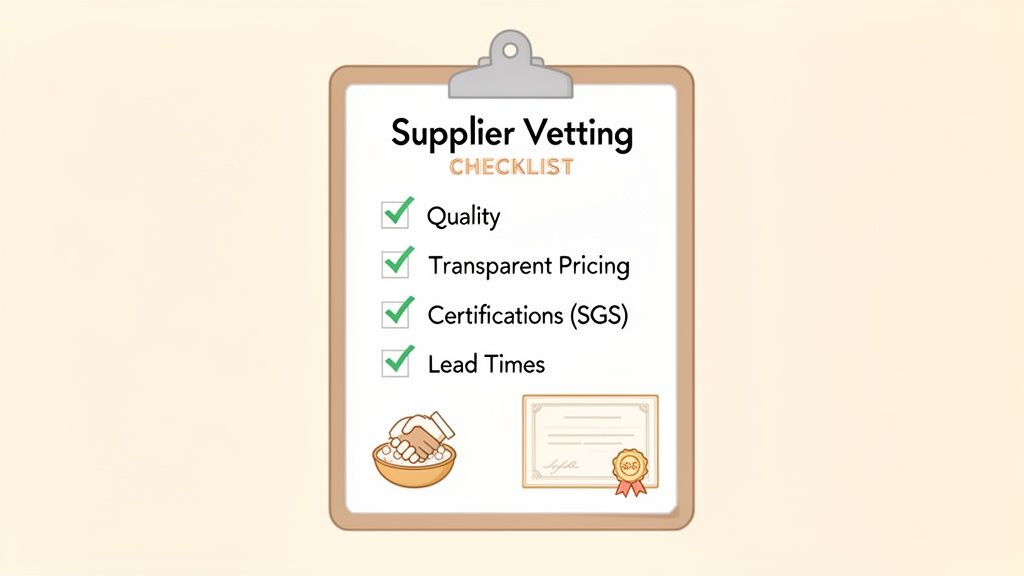
Your Essential Supplier Vetting Checklist
When evaluating potential partners, a structured checklist helps you cover all the bases that impact your business's profitability.
- Consistent Product Quality: This is non-negotiable. Always request samples to see if the quality lives up to their advertised grades. Place a small test order to ensure quality holds up across a larger batch.
- Transparent Pricing: Look for clear, upfront pricing with no hidden fees. A great supplier will offer factory-direct pricing that cuts out middlemen, making your accessories more affordable to produce.
- Certifications and Compliance: Ask for quality certifications. Credentials from a company like SGS—a globally recognized inspection body—provide third-party proof of their manufacturing standards and product safety.
- Logistics and Reliability: Inquire about lead times, shipping options, and tracking. Predictable delivery is essential for managing your inventory and keeping your customers happy.
A supplier’s policies on Minimum Order Quantities (MOQ) and returns tell you a lot. A partner with no MOQ shows confidence in their product and a willingness to work with businesses of all sizes. A clear return policy shows they stand behind their quality.
Must-Ask Questions for Any Potential Supplier
Once you have a shortlist, it's time to dig deeper. The answers to these questions will reveal their operational standards and how they treat clients.
- Can you provide details on your quality control process? This signals that you care about more than just price and helps you understand how they prevent defects.
- What are your standard lead times from order placement to shipping? You need this for your own production planning and inventory management.
- What are your policies for damaged or incorrect orders? You must know you’ll be taken care of if something goes wrong. A vague answer is a major red flag.
- Do you offer dedicated customer support for business accounts? Having a specific point of contact can save you countless headaches.
Building a strong relationship with your supplier is foundational. A trustworthy partner provides the high-quality materials and reliable service your business needs to create beautiful, profitable products. Our guide on finding suppliers for jewelry for pearls wholesale offers more insight on forging these connections.
Getting Your Pearls from Supplier to Studio: A Guide to Logistics
You’ve found your supplier—congratulations! Now comes the part that can make or break your business: getting those pearls into your hands smoothly and predictably. Honing your logistics for wholesale freshwater pearl orders is what separates a thriving jewelry business from one constantly putting out inventory fires.
Your logistics are the backbone of your supply chain. When strong, products flow where they need to go, on time and in perfect condition. When weak, everything grinds to a halt, costs rise, and your business suffers. Getting this right means building a low-stress system you can count on.
The Fine Print That Actually Matters: Key Supplier Policies
Supplier policies aren't just legal jargon; they directly affect your cash flow, risk, and creative freedom. For a growing fashion accessories business, paying attention to these details is critical.
You want a partner who offers terms that feel like a safety net, not a trap.
- No Minimum Order Quantity (No MOQ): For a small business, this is pure gold. It gives you the freedom to order exactly what you need, when you need it, without tying up cash in excess inventory. This allows you to experiment with new styles or trendy fashion accessories without a massive financial gamble.
- Free Shipping Thresholds: International shipping can silently kill your margins. When a supplier offers free shipping over a certain amount (say, $150), it dramatically lowers your cost-per-pearl and simplifies budgeting.
- Trackable Shipping: This should be non-negotiable. Knowing precisely where your order is gives your business—and your customers—peace of mind. It’s a basic sign of a professional operation.
Modern Payments and Making Sure You're Covered
How your business pays for inventory, and what happens if something goes wrong, are two more pieces of the puzzle. The best B2B platforms understand that flexible payments and solid guarantees are how you build trust and help clients grow.
When a supplier offers modern payment options like "buy now, pay later," it's a clear sign they understand the cash flow realities of a retail business. This flexibility lets you stock up for a big holiday season without draining your bank account, allowing you to pay for the pearls as you sell your finished fashion accessories.
On top of that, a rock-solid damage protection policy is a must. Your pearls travel a long way, and things can happen. A supplier who stands behind their product with a clear process for reporting issues is one you can trust. To handle the final leg of the journey, consult a good wholesale shipping supplies buying guide to ensure you're equipped for any repacking or local shipping.
Nailing Your Timing: Lead Times and a Smooth Supply Chain
Finally, your business needs to get a firm handle on its lead times. This is the total time from the moment you click "buy" to when the package lands at your door. Knowing this number is the key to managing your inventory like a pro and reordering popular styles before you run out.
The goal is a supply chain so smooth you barely have to think about it. By choosing a supplier with fair policies, modern payment options, and reliable shipping, you build a system that works for your business. This frees you up to do what you do best: designing incredible jewelry and making customers happy.
Turning Wholesale Pearls into Retail Profits
So you've found a great source for wholesale freshwater pearls. That’s a huge step, but it's only half the journey. The real magic happens when you connect those high-quality pearls with customers in a way that makes your business money. This is where smart merchandising and pricing strategy turn your affordable inventory into a profitable enterprise.
The best thing about freshwater pearls is their accessibility. You can offer stunning fashion accessories at retail prices that feel like a fantastic deal to your customers, all while keeping your own profit margins healthy. It’s a win-win that builds a loyal following for your brand.
Crafting a Story That Sells
Your product descriptions need to do more than just state facts. Don't just say "8mm white freshwater pearl." You have to make the customer feel something.
Talk about the "creamy, iridescent luster that glows against the skin" or the "wonderfully unique, organic shape of a baroque pearl." Using descriptive, evocative language transforms a simple accessory into a piece of wearable art. It elevates the perceived value, justifies your price point, and forges an emotional connection that leads to a sale.
Remember, your business isn't just selling an item; it's selling an experience. Someone buying a pearl necklace is looking for elegance, confidence, or the perfect gift. Your words should sell that feeling.
It also helps to find a supplier who keeps things fresh. A constant flow of new arrivals and on-trend designs means your collection never gets stale and gives regular customers a reason to keep checking back.
Pricing and Bundling for Bigger Sales
Pricing is part science, part art. The affordable cost of wholesale freshwater pearls gives your business a lot of room to work. A standard keystone markup (doubling your wholesale cost) is a solid starting point. But don't be afraid to aim higher for your truly special or higher-grade pearls—a markup of 2.5x to 3x the cost is definitely not out of the question for high-quality fashion accessories.
To really move the needle on your average order value, think beyond selling one piece at a time. Bundling is your best friend here.
- Create Ready-Made Gift Sets: Pair a classic pearl necklace with matching earrings. Box them up beautifully. You've just created the perfect, no-fuss gift for holidays, anniversaries, or Mother's Day.
- Target Life's Big Events: Curate a collection specifically for bridal parties. Offer a small discount for buying multiple sets for bridesmaids, making their decision easy.
- Suggest a "Complete Look": When a customer is looking at a pearl bracelet, show them a complementary ring or necklace on the same page. It’s a simple nudge that often leads to a bigger cart.
These tactics don't just increase revenue; they make shopping easier for your customers. To ensure your numbers are working for you, it’s crucial to understand the math. You can get a solid grasp on this by learning how to calculate profit margins for every item you sell.
In the end, it’s this combination of a compelling story and smart pricing that will turn your high-quality pearls into a thriving business.
Your Top Pearl Sourcing Questions, Answered
Diving into the world of wholesale freshwater pearl sourcing can feel a little overwhelming for a business at first. To help you get your bearings, here are straightforward answers to the questions we hear most often from retailers and designers.
What’s The Best "Bang For Your Buck" Grade?
For most jewelry lines, AA-grade pearls hit the sweet spot. They have that beautiful, rich luster and a clean enough surface for high-quality pieces that customers will want to wear every day.
You could spring for AAA-grade, but the jump in price is significant. Those near-flawless pearls are typically reserved for true fine jewelry. With AA-grade, you get a gorgeous pearl that offers incredible value, letting your business create a profitable collection of affordable fashion accessories for a much wider audience.
Remember, the goal isn't always to buy the highest grade. It's about buying the right grade for your brand. A funky A-grade baroque pearl might be the perfect star for a trendy design, making it more valuable to your business than a pricey, "perfect" AAA-round.
How Can I Be Sure a Supplier is Legit?
This is a big one for any business. Protecting your investment starts with proper vetting. Check online reviews and ask for references, but don't stop there.
Always ask to see their business credentials and any third-party certifications. A certificate from a globally respected auditor like SGS is a fantastic sign. It shows they've been independently verified for their manufacturing processes and product safety. Good B2B platforms often do this legwork for you, partnering only with pre-vetted, certified suppliers to take the guesswork out of sourcing.
Is It Okay to Ask for a Discount on Bulk Orders?
Absolutely. In fact, it's expected. Most wholesale suppliers have a tiered pricing structure that rewards larger orders for your business.
But here’s a pro tip: the best long-term pricing comes from building a solid relationship. Suppliers value loyalty. Consistent, reliable orders—even if they aren’t gigantic—prove you’re a serious partner. Don't be shy about starting a conversation about better pricing as your business and order volume grow.
Ready to find high-quality, on-trend freshwater pearls and components you can trust? Explore the factory-direct catalog at JewelryBuyDirect. You'll get no minimum orders, free worldwide shipping on orders over $150, and real support to help you build your business.