






Arthur Lynch | Wed Dec 10 2025
How to Calculate Profit Margins for Your Jewelry & Accessories Business
At its core, calculating a profit margin is pretty simple: you divide your profit (what's left after costs) by your revenue and multiply by 100. The result is a percentage, and that single number tells you a powerful story about your business's financial health. It shows you exactly how much of every dollar you earn is pure profit, which is vital for making smart decisions on everything from pricing your pieces to sourcing your wholesale jewelry and accessories.
Why Profit Margins Are Your Business's North Star
Building a successful jewelry and fashion accessories brand is one thing, but knowing if you’re actually making money on each sale is what keeps the lights on. For any business owner, understanding profit margins isn't just a "nice-to-have" skill—it's absolutely essential. Think of it as your financial GPS, helping you navigate the tricky terrain of inventory costs, marketing spend, and pricing strategies.
It’s not just one single calculation, though. To get the full picture, you need to track three different types of margins.
- Gross Profit Margin: This looks purely at the profitability of your products. It’s what’s left after you subtract the direct cost of acquiring each piece of jewelry or accessory.
- Operating Profit Margin: This gives you a sense of how efficiently your core business is running. It shows you the profit you’ve made before factoring in things like interest and taxes.
- Net Profit Margin: This is the big one—the true bottom line. It’s the percentage of revenue that remains after every single expense, including taxes, has been paid.
Each of these margins reveals a different layer of your business's performance. The diagram below does a great job of showing how you move from the initial gross profit down to the final net profit.
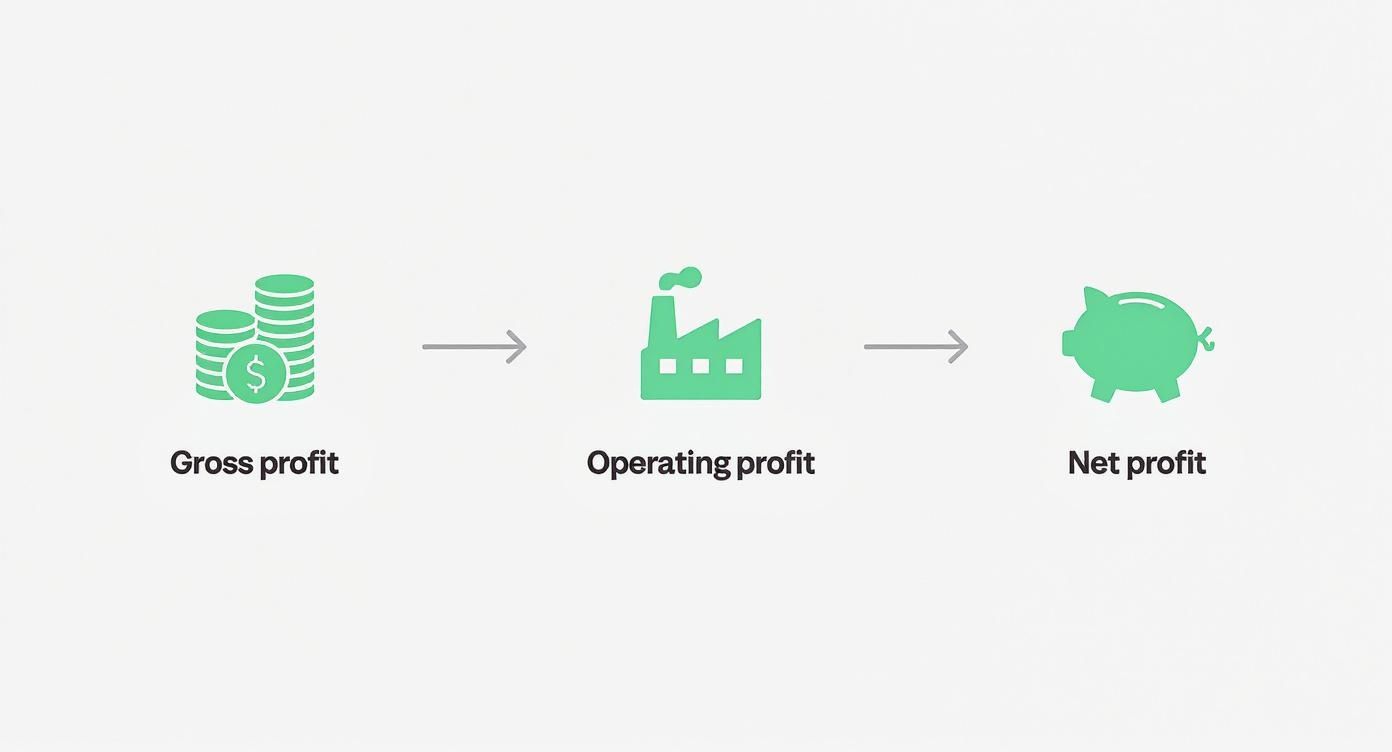
As you can see, the profit naturally gets smaller as you account for more of your operational costs. This is exactly why it's so important to keep a close eye on your expenses at every step, starting with sourcing affordable, high-quality products.
To make it even clearer, here's a quick reference table.
Your Quick Guide to Jewelry & Accessories Profit Margins
This table breaks down the three key profit margins, showing you the formula for each and what it tells you about the health of your jewelry and accessories business.
| Margin Type | Formula | What It Reveals |
|---|---|---|
| Gross Profit Margin | (Revenue - COGS) / Revenue * 100 |
The profitability of your products alone, without overhead. |
| Operating Profit Margin | (Operating Income / Revenue) * 100 |
The efficiency of your core business operations. |
| Net Profit Margin | (Net Income / Revenue) * 100 |
Your overall profitability after all expenses are paid. |
Having a handle on these three figures gives you a comprehensive view of where your money is going and how much you're truly earning.
More Than Just a Number
Keeping track of your margins isn't just an internal exercise; it also helps you understand how your business fits into the bigger economic picture. For example, the average net profit margin for S&P 500 companies recently climbed to 9.75%, a major increase from the 5.85% historical average between 1989 and 2015. This kind of shift shows how global factors can influence profitability across the board.
At the end of the day, your profit margins directly dictate what you can reinvest into your business. Healthy margins are what allow you to source a wider range of high-quality accessories, launch that new marketing campaign you've been dreaming of, or finally build up a proper inventory. They are the fuel for growth.
A solid grasp of these numbers is also the bedrock of good financial planning. It’s nearly impossible to manage your money well without knowing how profitable your business actually is. For a deeper dive into this, our guide on small business cash flow management is a great next step.
Calculating Your Gross Profit Margin
Let's start with the most essential metric for your business's health: the gross profit margin. Think of it as the purest measure of your product's profitability. It tells you exactly how much money you make from selling a piece before accounting for other business expenses like marketing, website fees, or rent.
To figure this out, you just need two numbers: your total revenue (what you sold the item for) and your Cost of Goods Sold (COGS).
The formula is pretty simple:
(Revenue - COGS) / Revenue * 100 = Gross Profit Margin
This calculation gives you a percentage, showing how much of each sale is left to cover your operating costs and, hopefully, become pure profit.
Nailing Down Your COGS for Sourced Goods
Getting your Cost of Goods Sold right is everything for a jewelry and accessories reseller. It’s every single direct cost that goes into acquiring a finished product and getting it ready to ship to your customer.
Your COGS should always include things like:
- Product Cost: The wholesale price you paid for each piece of jewelry or fashion accessory.
- Inbound Shipping: The cost to get the inventory from your supplier to your place of business.
- Packaging: This includes your branded jewelry boxes, pouches, and even shipping mailers or tissue paper.
If you want to dig deeper into this crucial expense, this Cost of Goods Sold (COGS) profitability guide is a great resource.

Let's See It in Action: Imagine you source a high-quality gold-plated necklace for your boutique. You sell it for $75. You add up the wholesale cost of the necklace ($20), inbound shipping per piece ($1), and your beautiful branded gift box ($4). Your total COGS for that one necklace is $25.
Now, we just pop those numbers into the formula:
( $75 - $25 ) / $75 = 0.667
Multiply that by 100, and you get a gross profit margin of 66.7%.
What this really means is that for every $75 necklace you sell, you have $50 left over to pay for everything else—your website hosting, marketing ads, pop-up shop fees, and your own salary. Getting a handle on this number is the first step to pricing your products intelligently and sourcing affordable accessories wisely.
Finding Your True Profitability with Net Margin
While gross margin tells you what you could be making on your products, the net profit margin reveals what’s actually left in the bank. This is your true bottom line—the percentage of revenue remaining after every single business expense has been paid.
Think of it as the money that really belongs to you and your business. It's what you can use to reinvest, save for a rainy day, or finally pay yourself a decent salary.
To figure out your net profit margin, you'll subtract all those day-to-day operating expenses from your gross profit.
Here’s the simple formula we use:
Net Income / Revenue * 100 = Net Profit Margin
First, you need to find your Net Income by adding up every business expense that isn't directly tied to acquiring the product itself (your COGS).

Accounting for Every Business Cost
For a jewelry and accessories business, operating costs can be surprisingly sneaky and add up fast. You have to track everything to get an honest look at your profitability.
Common expenses often include:
- Platform Fees: Your monthly bill for Shopify, listing fees on Etsy, or fulfillment costs on Amazon.
- Marketing & Advertising: All the money you put into Instagram ads, collaborations with influencers, or your email marketing tools.
- Software & Tools: Subscriptions for things like accounting software, photo editing apps, or inventory management systems.
- Shipping & Logistics: This goes beyond just the pretty packaging; it includes carrier fees to ship to customers and any insurance costs.
- Salaries & Labor: Any wages paid to yourself or staff for tasks like marketing, order fulfillment, or customer service.
Back to Our Necklace Example: Remember that gold-plated necklace? It sold for $75 and gave you a gross profit of $50. Now, let's say after you add up all your monthly operating expenses (ads, software, platform fees), you figure out that about $30 of those costs can be attributed to that single sale.
Suddenly, your net profit shrinks to just $20.
Here’s how that impacts your net profit margin:
($20 / $75) * 100 = 26.7%
That 26.7% gives you a much clearer, more realistic picture of how your business is actually performing. It’s a perfect illustration of why it’s so critical to find high-quality yet affordable jewelry and accessories. Every dollar you save on both your inventory sourcing and overhead directly fattens up this final number.
It’s a tough reality check for many. Industry data from VenaSolutions.com shows that while the average gross profit margin hovers around 36.56%, the average net profit margin plummets to a slim 8.54% once all the other business costs are factored in.
Using Operating Margin to Sharpen Your Efficiency
While your gross margin tells you how profitable your products are, the operating profit margin tells you how profitable your business is. Think of it as a stress test for your entire operation. It cuts through the noise of taxes and financing to show you how much money you’re actually making from your core business activities.
Getting this number is straightforward. First, find your operating income by subtracting all your operating expenses from your gross profit.
Then, use this simple formula: (Operating Income / Revenue) * 100 = Operating Margin
Keeping a close eye on this metric is one of the best ways to spot wasteful spending. It forces you to look past the wholesale cost of your necklaces and earrings and really scrutinize every dollar you spend just to keep the lights on.
Distinguishing Costs
So, what’s the difference between the costs you use for gross margin (COGS) and the ones you need for operating margin (OpEx)? It’s a common point of confusion, but the distinction is clear.
-
COGS (Cost of Goods Sold): These are the direct costs of acquiring your products. We're talking about the wholesale price for the accessories, the shipping from the supplier, and the branded gift boxes you ship them in.
-
Operating Expenses (OpEx): These are the costs of running the business. This category includes everything from your office rent and marketing software to website hosting fees and salaries for non-production staff.
Getting this right is crucial. A fantastic gross margin can be completely wiped out by bloated operating costs. This is why having streamlined systems is so important. In fact, efficient operations often come down to smart inventory management; our guide on the inventory turnover ratio is a great place to start optimizing.
When operations are truly dialed in, the results can be staggering. Back in 2018, the world's largest financial exchanges posted an average operating margin over 60%, a testament to how lean operations can supercharge profitability. You can dig into more industry benchmarks over at BusinessInsider.com.
A Tale of Two Brands: Let's imagine two online boutiques, "Adorn & Co." and "Chic Finds." Both have an identical 65% gross margin on their fashion accessories. But Adorn & Co. runs a lean operation and boasts a healthy 20% operating margin. Meanwhile, Chic Finds is saddled with high marketing costs and inefficient systems, leaving them with just a 5% operating margin. This shows that sourcing great, affordable products doesn't mean much if your day-to-day operations are a cash drain.
Actionable Ways to Boost Your Jewelry & Accessory Profit Margins
Knowing your numbers is one thing, but actually improving them is where the magic happens. For jewelry and accessory business owners, boosting profitability isn't about some massive, overnight change. It’s really about making a series of smart, targeted adjustments everywhere from how you source your products to the final price tag.
A great place to start is your supply chain. You absolutely have to find high-quality yet affordable jewelry and accessories to protect your margins from the get-go. Don't be shy about negotiating with your suppliers, especially when you're placing a larger order. Building a real, long-term relationship with a good supplier often leads to better pricing and even first dibs on new inventory.
The goal isn't just to find cheaper products but to find smarter products. Sourcing high-quality, gold-filled jewelry or well-made stainless steel pieces, for example, can offer a premium feel that customers love, while providing an excellent wholesale cost that directly boosts your gross profit on each sale.
Fine-Tune Your Sourcing and Pricing
Once you've got your sourcing dialed in, your pricing strategy is the next big lever you can pull. If you're still just adding a standard markup to your wholesale cost, you're likely leaving money on the table.
- Audit Your Suppliers: Get in the habit of comparing prices from different wholesalers every few months. Loyalty is great, but you need to make sure you’re still getting a competitive deal on trending fashion accessories or classic jewelry staples.
- Implement Tiered Pricing: Think about offering small discounts for customers who buy multiple items at once (e.g., "3 for $50" on earrings). This simple tactic can bump up your average order value (AOV), improving your overall revenue without having to raise individual prices.
- Value-Based Pricing: This is crucial for a curated collection. Price your items based on their perceived value, the style they represent, and your brand's story—not just the wholesale cost. Our guide on how to price handmade jewelry has principles that apply to pricing any unique collection.
Trim Operational Fat
Finally, take a hard look at where you might be wasting time or money in your day-to-day operations. Every inefficiency eats into your net profit.
Can you streamline your order fulfillment process to save time? Maybe it's time to adopt a just-in-time inventory system to avoid tying up cash in unsold stock or over-ordering styles that end up sitting on a shelf.
The same logic applies to your marketing budget. Check in on your ad performance. Are those Instagram ads actually bringing in sales? If not, it might be time to move that money into a channel that's working better for you. If you're ready for a deeper dive, there are some fantastic resources out there on how to improve gross profit margin with more advanced cost management strategies. By making these kinds of focused adjustments, you'll start to see more of your hard-earned revenue drop straight to your bottom line.
Answering Your Top Questions About Jewelry Profit Margins
When you're running a jewelry business, a few key financial questions always seem to pop up. Getting straight answers is the first step to feeling confident in your numbers and making smarter decisions, especially when you're just learning how to calculate profit margins. Let’s dive into some of the most common hurdles I see business owners face.

What Is a Good Profit Margin for a Jewelry Business?
Everyone wants to know the "magic number," but the truth is, it depends entirely on your niche. Fine jewelry plays by different rules than fashion accessories.
That said, a good benchmark for gross profit margin in retail is often between 50% and 70%. But the real measure of your business's health is the net profit margin. For a business to be truly sustainable, you should aim for a net margin somewhere in the 10% to 20% range after all costs are covered.
How Do I Handle Fluctuating Sourcing Costs?
This is a big one for resellers. The cost of goods, especially with international shipping and material price changes, can feel like a constant battle. The best practice is to update your Cost of Goods Sold (COGS) right before you place a new inventory order.
It’s crucial to use the actual price you just paid for your latest batch of inventory, not an old price from months ago. From there, I recommend reviewing your retail prices at least quarterly. This simple habit protects you from accidentally selling at a loss when your supplier's prices go up, safeguarding those margins you worked so hard to build.
One non-negotiable rule: pay yourself a fair market salary and record it as an operating expense. If you don't, you're getting a dangerously inflated and inaccurate view of your profitability. Think of it this way—if you had to hire someone else to do your job, you'd have to pay them. Your financials need to reflect that reality.
How Can I Source Affordable Jewelry & Accessories Without Sacrificing Quality?
Smart sourcing is an art form, especially when you're trying to find that sweet spot between affordable inventory and pieces that feel high-end and on-trend.
A great place to start is by attending trade shows or using reputable online wholesale marketplaces. You can meet suppliers and often negotiate better rates. Keep an eye out for wholesalers who offer tiered pricing on bulk orders—building a relationship with a reliable supplier can lead to much better deals down the road.
Don't shy away from testing smaller batches from new suppliers, but always do your due diligence on their quality and ethical sourcing claims. You might also want to explore materials like gold vermeil, sterling silver, or high-quality stainless steel. They are fantastic options that let you offer accessible price points without compromising on style or durability, which is key to a profitable business.
Sourcing high-quality, affordable jewelry and fashion accessories is the bedrock of a profitable business. At JewelryBuyDirect, we provide factory-direct pricing on over 120,000 on-trend styles, helping you boost your margins with confidence. Explore our catalog and get 15% off your first three orders at https://www.jewelrybuydirect.com.