






Arthur Lynch | Tue Jan 20 2026
How to Find a Jewelry Manufacturer for Your Business
Finding the right jewelry manufacturer is a strategic business decision, not a creative whim. For business owners looking to source high-quality yet affordable jewelry and fashion accessories, success hinges on a methodical process. This process breaks down into three core phases: defining your product needs and budget, identifying qualified partners, and rigorously vetting your shortlist.
This guide will provide a clear roadmap to help you find a factory that can deliver quality products on time and within budget, forming the foundation of a profitable jewelry business.
Laying the Groundwork for Your Search
Before contacting any factory, you need a solid sourcing plan. Simply browsing Alibaba and messaging suppliers without preparation is a recipe for wasted time and money. This initial groundwork translates your business goals into a concrete, actionable brief that a professional manufacturer can work with to deliver high-quality, affordable products.
It starts with getting crystal clear on your product specifications. What materials align with your brand's quality and price point? You might target the timeless appeal of 925 sterling silver for a premium feel, or perhaps your customers prefer the affordability of durable, gold-plated brass. Ambiguity here costs money later.
Defining Your Product and Budget
Once you've settled on materials, define the design complexity. Are you sourcing simple, minimalist pendants that are easy to produce at a low cost, or intricate designs with detailed engravings and multiple gemstone settings? The more complex the piece, the more specialized—and potentially expensive—your manufacturing partner will need to be. This decision is directly tied to your target cost per unit, which is the foundation of your profitability.
At the same time, you must establish a realistic budget. This isn't just the price per piece. You need to calculate the total landed cost, which includes manufacturing, shipping, import duties, and taxes. Many new business owners get blindsided by these additional costs, which can completely erode their margins. A clear budget also helps you determine a Minimum Order Quantity (MOQ) you can afford, ensuring your initial investment is manageable.
This preparation provides an actionable roadmap for your sourcing efforts. The process is a simple three-step flow: finalize your product specs, set a firm budget, and build a professional tech pack.
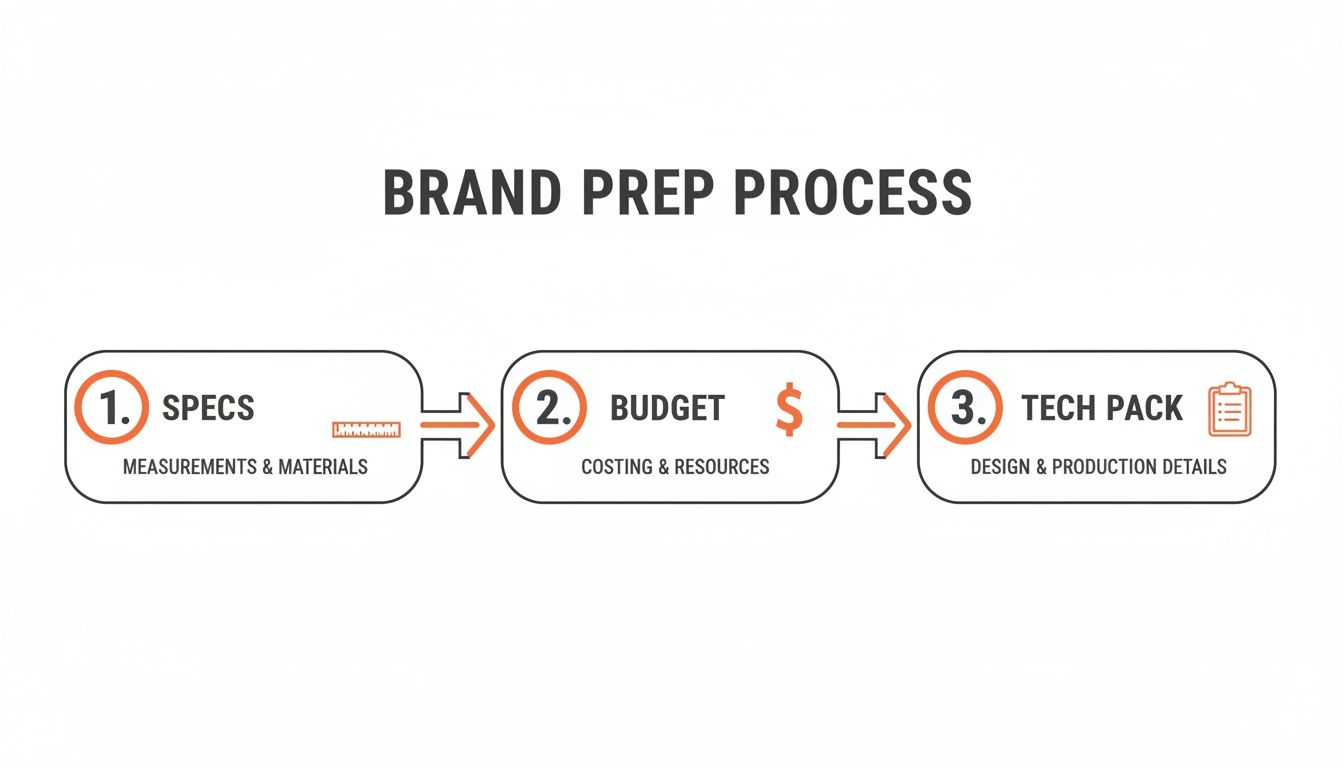
Each step builds logically on the last, ensuring you have all the necessary details before beginning your outreach to potential manufacturing partners.
Creating a Professional Tech Pack
All of this critical information is organized into one indispensable document: the tech pack. For any business serious about sourcing, a detailed tech pack is your most important tool. It’s a comprehensive blueprint that eliminates guesswork and ensures potential suppliers can provide accurate quotes for high-quality production.
To make sure nothing gets lost in translation, your tech pack must be incredibly detailed.
Table: Essential Elements of a Manufacturer Tech Pack
| Component | Description | Example |
|---|---|---|
| Product Renderings/Sketches | Clear, multi-angle visuals of the design. | Front, side, and top-down CAD renderings or detailed hand sketches. |
| Dimensions & Weight | Precise measurements in millimeters (mm) and target weight in grams (g). | Height: 25mm, Width: 15mm, Thickness: 2mm, Target Weight: 4.5g. |
| Material & Plating Specs | Base metal, plating material, and plating thickness in microns. | Base: 925 Sterling Silver, Plating: 18k Gold at 1.5 microns. |
| Gemstones/Components | Type, size, cut, and quality of any stones or other components. | 1x 5mm round-cut, Grade AAA Cubic Zirconia, bezel setting. |
| Finishing & Details | The desired surface texture and any special features. | High-polish finish, spring ring clasp, laser-engraved logo on back. |
| Packaging Requirements | How each individual piece should be packaged for shipping. | Individually bagged in a 2x3 inch clear poly bag with SKU sticker. |
A professional tech pack signals to potential partners that you are a serious business. It leads to more accurate quotes, better service, and a smoother production process. For more guidance on these early stages, refer to our comprehensive guide on https://www.jewelrybuydirect.com/blog/starting-a-jewelry-business?articleId=610800959574.
The US jewelry manufacturing industry is projected to hit $16.4 billion in 2025, but it's a fragmented market. While this can be good for small brands, jewelry is a discretionary purchase, and economic shifts can really impact sales. This uncertainty leads many businesses to seek the cost-effectiveness and stability of established supply chains in Asia. While this guide focuses on manufacturing, understanding alternatives like how to find winning products for a dropshipping store using AI can provide a broader perspective on sourcing strategies.
Where to Find High-Quality Manufacturing Partners
With your strategy mapped out and a solid tech pack ready, it's time to find the perfect manufacturer. The goal for your business is to secure a partner who is reliable, affordable, and consistently delivers high-quality jewelry and accessories. Your search will span online platforms, trade shows, and professional networks—each offering unique advantages for sourcing effectively.
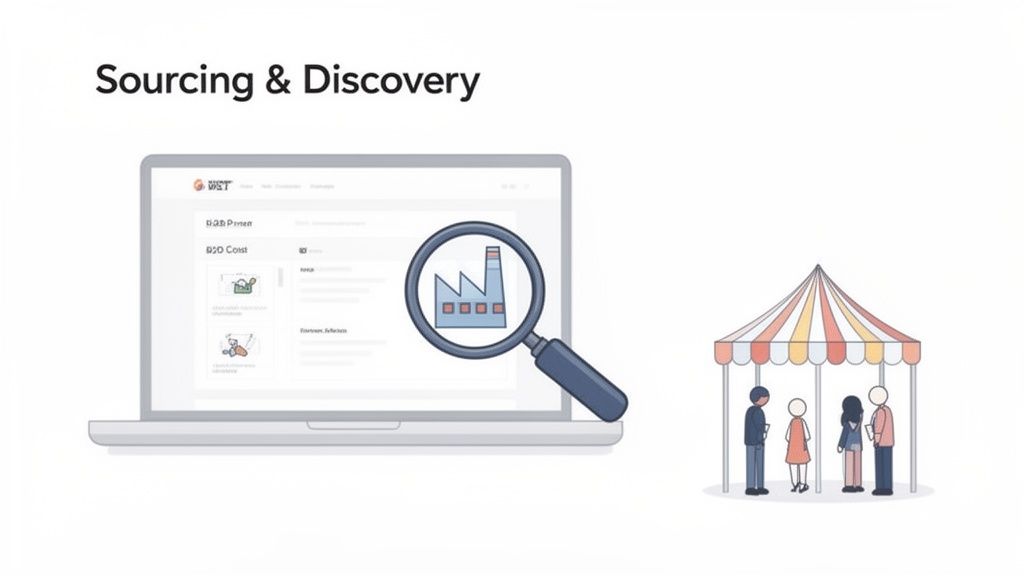
Online sourcing is typically the fastest way to build a list of potential suppliers. However, knowing where to look and how to filter the options is key to finding a partner that balances quality with affordability.
Navigating Online B2B Marketplaces
Digital platforms have revolutionized how businesses connect with factories. Large sourcing sites like Alibaba are a common starting point, offering access to thousands of suppliers, primarily in Asia. While the volume of options is beneficial, it requires careful vetting. You must filter for experienced factories with strong ratings, a history of positive reviews, and relevant quality certifications.
To streamline this process, consider specialized B2B wholesale marketplaces. Platforms like JewelryBuyDirect focus specifically on the jewelry and fashion accessories industry, providing access to pre-vetted, SGS-certified suppliers and factory-direct pricing. This approach saves significant time by connecting you with partners who already meet high standards for quality, ethics, and affordability. For a deeper look, check out our guide on finding the best private label jewelry manufacturers.
The global jewelry market is projected to hit $374.08 billion by 2025, with online channels driving much of this growth. The Asia-Pacific region, holding 37.83% of the market share, is a manufacturing powerhouse. This concentration allows specialized platforms to offer pricing that is often 15-30% below typical market rates, giving your business a competitive edge.
The Power of In-Person Connections
While online sourcing is efficient, meeting potential partners face-to-face is invaluable for building trust and assessing quality firsthand.
Attending a major trade show allows you to accomplish in a few days what might take months of online research. The ability to compare dozens of suppliers side-by-side is a game-changer for sourcing high-quality, affordable products.
Events like JCK Las Vegas or the Hong Kong Jewellery & Gem Fair gather the world’s best suppliers in one location. Key benefits for your business include:
- Build Personal Relationships: It’s easier to build rapport and negotiate terms in person.
- Inspect Quality Firsthand: You can touch and examine sample pieces, giving you a true sense of craftsmanship.
- Discover New Trends: These shows reveal emerging trends, offering inspiration for profitable new collections.
- Verify Legitimacy: Meeting the team in person provides a level of confidence you can’t get from an email.
Here’s a comparison to help you decide on the best sourcing strategy for your business.
Online Sourcing Platforms vs Offline Trade Shows
| Sourcing Method | Pros | Cons | Best For |
|---|---|---|---|
| Online Sourcing Platforms | Vast selection of suppliers, easy to compare, lower initial cost, accessible from anywhere. | Hard to verify quality without samples, potential for communication barriers, risk of scams. | Businesses starting out, those with clear specs, and anyone seeking a wide range of price points. |
| Offline Trade Shows | Face-to-face interaction builds trust, can inspect quality in person, discover trends. | High cost (travel, tickets), time-consuming, limited to scheduled event dates. | Businesses seeking long-term partnerships, focusing on high-end quality, and buyers wanting to see products firsthand. |
A hybrid approach often yields the best results. Use online platforms to create a shortlist, then aim to meet your top candidates at a trade show to finalize your decision.
Tapping into Your Professional Network
Finally, never underestimate the power of a referral. The jewelry industry is a well-connected community. A strong recommendation from another business owner can be the most valuable lead you'll find.
Engage in industry groups on LinkedIn, Facebook, and specialized forums. When asking for recommendations, be specific about your needs—mention materials, target price points, and desired order volumes. Hearing about another business's direct experience provides insights you won't find on a company website, often leading you directly to reliable and affordable partners.
A Practical Checklist for Vetting Manufacturers
Finding a promising manufacturer is just the beginning. Proper, diligent vetting is what separates a successful business from one plagued by quality issues, missed deadlines, and financial losses. This process is your insurance policy, ensuring the partner you choose can consistently deliver high-quality products that meet your business's standards.
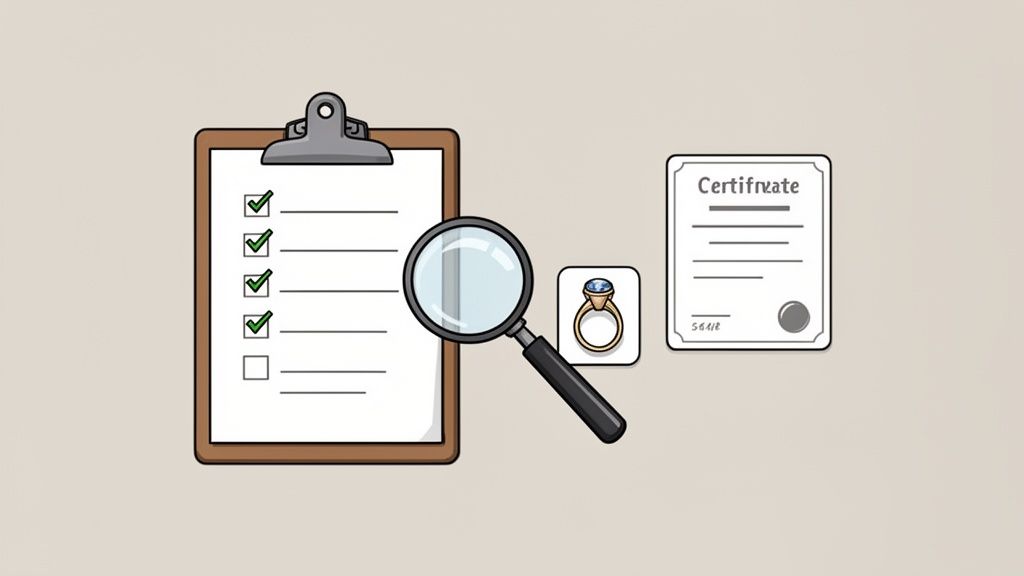
Before placing a bulk order, you must systematically qualify each potential partner. You are verifying their legitimacy, assessing their skills, and confirming their quality firsthand. Skipping these steps is a risk your business cannot afford to take.
Verifying Legitimacy and Certifications
First, confirm you are dealing with a legitimate, established business. This initial check weeds out unreliable operators and provides a baseline of confidence. It is a simple but non-negotiable step.
Request their essential business documents. Any professional factory will have these readily available.
- Business License: Basic proof that they are a legally registered company.
- Export Permits: Crucial for international sourcing. They must have the proper licenses to ship to your country.
- Quality Certifications: Look for recognized standards like ISO 9001 (quality management) or audit reports from third-party firms like SGS or Bureau Veritas.
A manufacturer’s willingness—or unwillingness—to share these documents is telling. Any hesitation is a major red flag. Do not proceed, no matter how attractive their prices are.
This is especially critical when sourcing from overseas, as it adds a vital layer of security. For more on this, see our deep dive on working with top-tier manufacturers in China for jewelry.
Assessing Production Capabilities and Communication
Once you've confirmed their legitimacy, determine if they can actually produce your product to the required quality standards. It's time to investigate their production capabilities, skills, machinery, and experience.
This conversation also serves as a test of their communication. Are they responsive, clear, and professional? A partner who is difficult to communicate with now will only become more challenging once production begins.
Come prepared with targeted questions.
- Experience with Your Materials: "Can you provide examples of past work using 18k gold plating on 925 sterling silver?"
- Production Machinery: "What specific equipment do you use for pavé stone setting and achieving a high-polish finish?"
- Team and Capacity: "How many skilled jewelers are on your team? What is your monthly output capacity?"
- Subcontracting Policy: "Is all work, including plating and casting, handled in-house?"
Their answers will quickly reveal if they are a good technical fit. A factory specializing in simple alloy charms is likely not the right partner for intricate, hand-set gemstone rings.
The Final Test: Ordering and Evaluating Samples
No amount of documentation or conversation can replace a physical product evaluation. Ordering samples is the single most important step in the vetting process. It’s your chance to judge their craftsmanship, material accuracy, and attention to detail before committing to a full production run.
Order a few different pieces from your collection to test a range of skills—one with fine engraving, another with a complex stone setting, and one with a unique finish.
When the samples arrive, use your tech pack and calipers for a detailed inspection.
- Check Dimensions: Are the measurements exact? A few millimeters of variance can ruin a design.
- Verify Materials: Does the metal have the correct weight? Is the plating color accurate and evenly applied?
- Examine Craftsmanship: Look for clean solder joints, secure stone settings, and a flawless finish.
- Test Durability: Wear the jewelry. Do clasps function securely? Does the plating hold up to normal wear?
This hands-on evaluation is the ultimate deciding factor. If the samples do not meet your quality standards, the bulk order will not either. While you can provide feedback for a second sample, if the quality is fundamentally poor, it's best to move on to the next manufacturer on your list.
Hammering Out the Deal: Negotiation and Agreements
You've vetted your candidates and approved a high-quality sample. Now, it's time to formalize the partnership. This stage is where you negotiate the details that will determine your profitability and production efficiency. A successful negotiation sets the foundation for a healthy, long-term business relationship.
The first point of discussion is usually the Minimum Order Quantity (MOQ). For a new business, a high MOQ can be a significant barrier, tying up cash in inventory. However, this number is often negotiable.
Getting Creative with the MOQ
A factory sets an MOQ to ensure a production run is profitable for them. Your goal is to find a solution that works for their business model while protecting your own.
Approach it as a collaborative discussion.
- Pitch a smaller trial order. Propose an initial order of 50-100 units as a paid test run. This allows you to gauge market response and their production quality before committing to a larger volume.
- Show them the long game. Share your growth plan. Explaining your intent to place a much larger order of 500+ units in the next quarter demonstrates that you are a serious long-term partner, making them more likely to be flexible upfront.
- Offer to pay a bit more per piece. Sometimes, accepting a slightly higher unit cost is the easiest way to secure a lower MOQ. This can be a smart trade-off to minimize your initial investment and maintain healthy cash flow.
The objective is to find a win-win solution that allows your business to get started affordably.
Making Sense of Quotes and Payment Terms
Once you agree on a quantity, you will receive a formal quote or proforma invoice. Review it line by line. A proper quote will clearly itemize costs for units, custom molds, sampling, and packaging. If anything is unclear, request clarification.
Payment terms are equally important. The industry standard is often a 30% deposit to begin production (covering raw material costs) and the remaining 70% upon completion and successful inspection, just before shipping. This is a fair arrangement that protects both parties.
A manufacturer demanding 100% upfront is a major red flag, as it leaves you with no leverage if issues arise. A 30/70 split is a solid standard. For larger orders, you might negotiate a 30/40/30 split, with the second payment released after a mid-production quality check.
Locking in Timelines and Protecting Your Designs
With financial terms settled, focus on timelines. Get firm dates. Ask for their official production lead time, measured from the day they receive your deposit. Also, clarify the shipping schedule. A clear calendar is essential for planning your product launch, marketing campaigns, and inventory management.
Finally, protect your intellectual property. Before sending any money or final tech packs, get a signed Non-Disclosure Agreement (NDA). This contract legally prevents the manufacturer from sharing or stealing your designs. It is non-negotiable.
For custom designs, your agreement must also clarify ownership of molds and tooling. It should state that you own these assets, ensuring you can move them to another factory if needed. This prevents supplier lock-in and protects your business's future.
Managing Quality Control for Your First Production Run
Once the deposit is paid and production is underway, your focus must shift to quality control (QC). Effective QC is not a final step; it is a continuous process that ensures the final product run matches the quality of the approved sample.
Your QC plan is an insurance policy for your investment and your brand's reputation. Without it, you are gambling that a factory thousands of miles away will perfectly execute every detail of your design.
The Key Stages of Production Inspection
To maintain quality, build checkpoints into the manufacturing timeline. A final inspection alone is insufficient; by then, fixing a major issue can lead to significant costs and delays. A multi-stage approach catches problems early.
Break the inspection process down into three critical phases:
-
Pre-Production Check (PPC): This occurs before production begins. It verifies that the raw materials—metals, gemstones, findings—match your tech pack specifications. It is far easier to reject a substandard batch of silver before it becomes thousands of finished pieces.
-
During Production Check (DUPRO): This in-line inspection happens when 20-30% of your order is complete. It provides a first look at manufacturing consistency. Are solder joints clean? Are stone settings uniform? A DUPRO check helps identify systemic issues and allows the factory to correct its process before the entire run is compromised.
-
Final Pre-Shipment Inspection (PSI): This is the most comprehensive check, performed when 100% of the order is finished and at least 80% is packaged. During the PSI, an inspector pulls a random sample and rigorously checks it against your detailed inspection checklist.
This staged approach provides oversight from start to finish, removing the uncertainty from receiving a large shipment.
Creating Your Inspection Checklist
Your quality control is only as good as its checklist. This document must be meticulously detailed, leaving no room for ambiguity. It is the official standard that defines "acceptable quality" for your products.
Build your checklist using your tech pack and the approved "golden sample." Anticipate every potential defect.
A great inspection checklist is more than a to-do list; it’s a formal document outlining your exact quality standards. If a product fails to meet a specific criterion on this list, you have clear grounds to reject it.
Your checklist should include:
- Measurements and Weight: Verify dimensions with calipers against tech pack specs.
- Material and Plating: Confirm base metal, plating thickness (in microns), and color.
- Workmanship: Check for scratches, dents, clean solder points, and secure settings.
- Functionality: Test every clasp, closure, and moving part for smooth operation.
- Labeling and Packaging: Ensure SKUs, logos, and packaging are exactly as specified.
This level of detail is non-negotiable for sourcing high-quality jewelry and accessories consistently.
In-House QC vs. Third-Party Inspection
The question is, who performs these checks? You have two main options.
Handling it yourself provides total control and is cheaper if you can travel to the factory. For most businesses working with overseas partners, however, this is impractical.
This is where professional third-party inspection services excel. Companies like SGS, QIMA, or Bureau Veritas have trained inspectors located in major manufacturing hubs worldwide.
Here's a quick comparison:
| Factor | Handling It Yourself | Hiring a Third-Party Service |
|---|---|---|
| Cost | Low (only travel expenses) | Higher (typically $200-$400 per day) |
| Expertise | Based on your own knowledge | Professional, trained inspectors |
| Objectivity | Can be biased | Completely impartial and objective |
| Convenience | Difficult for overseas sourcing | Extremely convenient; handles all logistics |
For most small and medium-sized businesses, hiring a third-party inspector for the final pre-shipment inspection is a smart investment. It offers the best balance of cost, convenience, and peace of mind.
Navigating Shipping and Logistics
Once your production run passes its final inspection, the last step is logistics: getting your products from the factory to your warehouse.
Familiarize yourself with shipping terms like FOB (Free On Board), where the manufacturer's responsibility ends once goods are on the vessel, and EXW (Ex Works), where your responsibility begins at the factory door.
A reliable freight forwarder or customs broker is essential for navigating customs paperwork and ensuring your shipment clears without delays. As soon as production begins, plan your inbound logistics. Implementing streamlined automated order processing can ensure that once your jewelry arrives, it gets to your customers quickly and efficiently.
Answering Your Top Jewelry Sourcing Questions
When starting to source jewelry for your business, many questions arise. Getting clear answers is crucial for avoiding costly mistakes and building a profitable product line.
The goal is not just to find a supplier but to find a strategic partner who understands your business needs and can consistently deliver high-quality, affordable products. Let's address the most common questions from business owners.
What’s the Real Cost to Start a Private Label Jewelry Line?
The investment required depends entirely on your product's complexity, materials, and initial order volume.
For a simple collection of stainless steel or gold-plated brass jewelry, you can start with an initial production run for $500 to $2,000. This assumes a low Minimum Order Quantity (MOQ) of 50-100 units per style.
For more complex, custom-molded designs in 925 sterling silver, your first run could cost $2,000 to $10,000+. This higher figure includes one-time mold fees and the cost of initial samples.
A word of advice: always budget for samples, shipping, and import duties. These ancillary costs often surprise newcomers. Plan for them from day one to protect your margins.
What’s the Difference Between ODM and OEM Manufacturing?
Understanding this distinction is key to your product strategy. It defines how unique your product line will be.
- OEM (Original Equipment Manufacturer): This is for completely original designs. You provide the factory with a detailed tech pack, and they produce it exclusively for you. You own the intellectual property. This is how you build a unique and defensible brand.
- ODM (Original Design Manufacturer): This is a "white label" approach. You select designs from the factory's existing catalog, and they add your logo. You might make minor modifications, but the core design is not exclusive to you.
ODM is a faster and more affordable way to market, as it bypasses the design and mold-making process. OEM requires a larger upfront investment but is essential for creating a distinct brand identity.
How Do I Protect My Designs with an Overseas Factory?
This is a valid and significant concern for any business. Protection starts with choosing a reputable partner with a long-standing, positive track record.
Next, formalize protection with a strong legal agreement. An NNN agreement (Non-Disclosure, Non-Use, and Non-Circumvention) is designed specifically for working with international factories and offers more robust protection than a standard NDA. For maximum security, you can register your trademarks and design patents in the manufacturer's country.
Ultimately, a strong, transparent relationship built on mutual trust is your best long-term protection.
Should I Source Domestically or from an Overseas Manufacturer?
This decision involves a trade-off between cost, speed, and control.
Sourcing from domestic manufacturers (e.g., in the US or Europe) is typically faster, with easier communication and quality oversight. However, this convenience comes at a significant price premium, which can impact your profitability.
Overseas factories, particularly in Asia, offer substantial cost savings and the capacity for large-scale production, enabling healthier profit margins. The trade-offs are longer shipping times and the need for a rigorous quality control process. For many businesses, the cost advantage of sourcing overseas is a critical factor for success.
Ready to find high-quality jewelry and fashion accessories for your business without the hassle? JewelryBuyDirect offers factory-direct pricing on over 120,000 styles with no minimum order quantity. Explore our catalog and get 15% off your first three orders.