






Arthur Lynch | Tue Jan 06 2026
A Guide to Private Label Jewelry Manufacturers
Working with a private label jewelry manufacturer is one of the smartest things you can do for your business. It lets you create unique, high-quality collections without the massive headache and cost of setting up your own production. This partnership frees you up to focus on marketing and connecting with customers, while an expert handles the manufacturing. The end result? Better profit margins and a brand that truly stands out.
Why Sourcing Private Label Jewelry is a Game-Changer
Stepping away from generic wholesale catalogs is how you go from being just another online store to a brand that offers high-quality, affordable jewelry people remember and search for. When you work directly with a private label manufacturer, you get to call the shots on design, quality, and—most importantly—your brand's story. This direct-sourcing approach is what separates the real players from the rest.
Think about a boutique owner who sees everyone suddenly asking for minimalist, gold-plated necklaces. Instead of waiting for a wholesaler to stock something similar, she partners with a manufacturer to create her own exclusive line. She gets to specify the exact chain length, pendant size, and even the thickness of the gold plating to balance quality with a target price point. The final product is perfectly in tune with her brand's vibe and quality standards. Now, she's not just meeting a trend; she's become the go-to source for it.
Unlock Much Higher Profit Margins
Let's talk money. One of the biggest wins of sourcing directly is how much you save. You're cutting out the middleman—the traditional wholesaler—which means you can get your hands on high-quality, popular styles like sterling silver and gold-plated pieces for 15-30% less than typical wholesale prices. That’s a direct boost to your bottom line on every single piece you sell.
This extra cash gives you a ton of flexibility. You could offer more competitive pricing to your customers or keep them at market rate and enjoy some seriously healthy profit margins. That extra capital is fuel for your business, ready to be reinvested into marketing campaigns, developing your next collection, or expanding your team.
Build a Brand That People Actually Care About
Private labeling is your chance to build a brand that connects with people by offering a unique selection of fashion accessories. You're not just moving inventory; you're creating an entire experience.
Here’s where you really start to see the difference:
- Unique Collections: You can design product lines that are 100% yours. Nobody else will have them. This kind of exclusivity is a massive pull for customers seeking unique, affordable jewelry.
- Custom Packaging: Think branded jewelry boxes, personalized thank-you notes, and elegant pouches. A great unboxing experience makes your brand feel premium and reinforces your identity.
- A Cohesive Look: You have complete control. Every single piece, from a tiny ring to a bold statement earring, will perfectly fit the aesthetic you've so carefully curated.
When you control these details, you create a cohesive brand story that builds incredible customer loyalty. Shoppers who know they can always find unique, quality pieces from you will come back again and again. That's how you build a business for the long haul.
This direct-to-manufacturer model is the backbone of the modern accessories world. The global jewelry market, driven largely by private label producers, was valued at a staggering $348 billion in 2025 and is expected to climb to $450 billion by 2030. Much of this growth comes from manufacturing hubs in the Asia-Pacific region, which hold a massive 45% market share. If you’re looking to get your own brand off the ground quickly, exploring private label drop shipping can offer some great insights into how to handle branding and sourcing effectively.
Finding and Evaluating Your Manufacturing Partner
Let's be honest—your brand's reputation lives and dies by the quality of your products. This makes finding the right manufacturing partner the single most important decision you'll make when building your private label jewelry business. You're not just looking for a supplier; you're looking for a partner who understands your vision and can deliver beautiful, well-made accessories that won't break the bank.
The search can feel like trying to find a needle in a haystack, but if you break it down into smart, manageable steps, it's totally doable. The goal is to start with a big list of possibilities and carefully whittle it down to a few trusted manufacturers who can turn your ideas into high-quality, affordable reality.
Where to Discover Potential Manufacturers
Your hunt for the perfect partner will almost certainly begin online. Thankfully, there are tons of resources out there designed to connect businesses like yours with global suppliers.
A great place to kick things off is on the big B2B marketplaces. Think platforms like Alibaba, which are massive and offer seemingly endless options. The trick here is to be discerning. Look for suppliers who have earned "Gold Supplier" status, have high ratings, and show a long history of successful transactions. These aren't foolproof, but they're good indicators of a reliable operation.
But don't stop with the giants. Some of the best partners are found in more specialized places:
- Niche Jewelry Marketplaces: You can often find platforms dedicated to jewelry and fashion accessories, giving you a more curated list of pre-vetted manufacturers.
- Virtual Trade Shows: The travel budget isn't what it used to be. Many industry trade shows now offer virtual access, letting you "meet" international manufacturers from your office.
- Professional Networks: Never underestimate the power of asking around. Tap into LinkedIn groups or online forums for your industry. A warm recommendation from a fellow entrepreneur is often worth its weight in gold.
For a solid sourcing strategy, try mixing all three. Start broad on a major platform to see what's out there, then dive into niche sites and your own network to uncover those hidden gems. Many brands find incredible success when they learn how to source from top-rated jewelry manufacturers in China, a region known for its incredible production capabilities and cost-effectiveness.
The effort you put in here pays off in a big way.
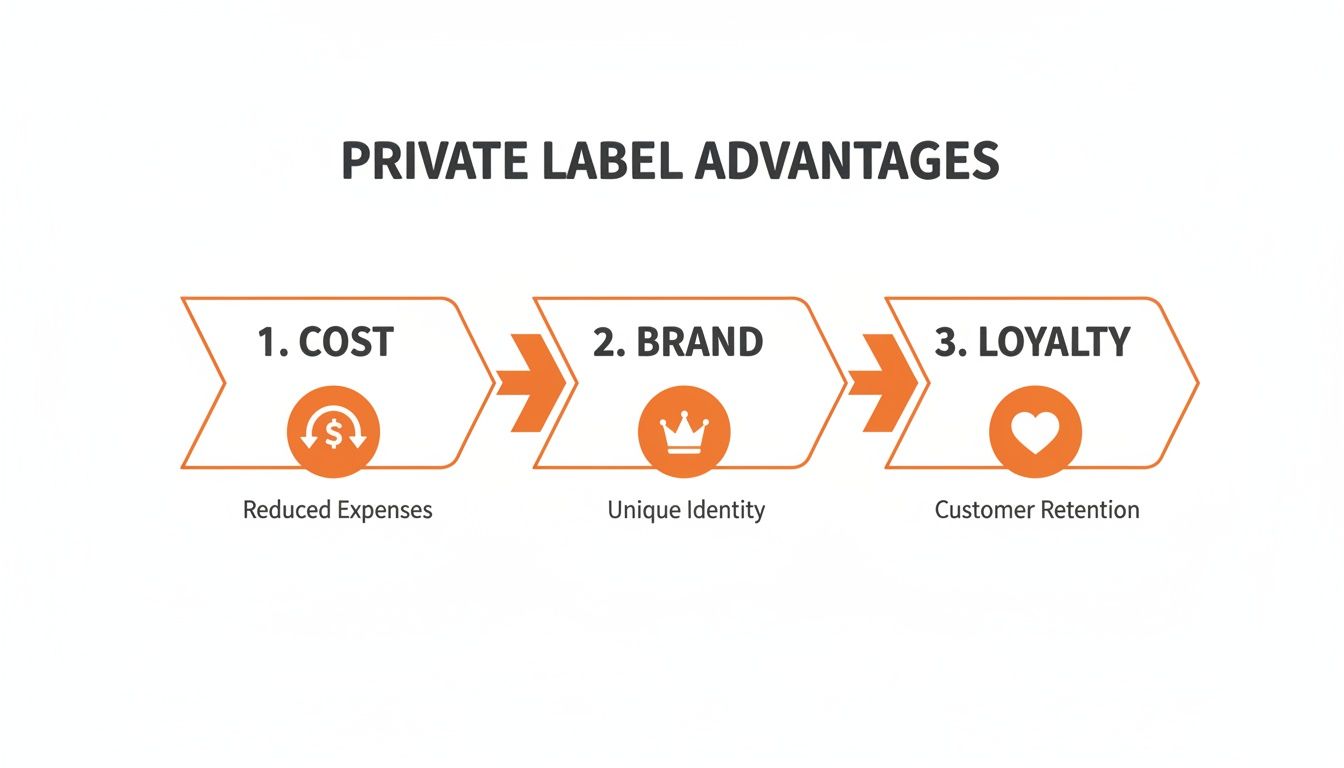
As you can see, this journey is all about achieving lower costs, building a standout brand, and earning the kind of customer loyalty that fuels long-term growth.
Your Vetting Checklist for Quality and Reliability
Okay, you've got a list of potential partners. Now comes the crucial part: vetting. This is where you separate the pros from the pretenders and protect your investment by making sure your final products are something you'll be proud to sell.
When you first reach out, be professional but direct. Introduce your brand, give them a clear idea of what you're looking for, and ask a few pointed questions. A simple email template is fine to start, but always add a personal touch to show you've actually looked at their work.
To help you assess each candidate, I've put together a checklist based on years of experience. Keep this handy as you start your conversations.
Manufacturer Vetting Checklist
Use this checklist to evaluate key criteria when assessing potential private label jewelry manufacturers.
| Criteria | What to Look For | Red Flags |
|---|---|---|
| Communication | Prompt, clear, and professional English. Eagerness to answer questions thoroughly. | Vague answers, one-word replies, long delays without explanation, language barriers. |
| Experience & Specialization | A portfolio that showcases jewelry similar to your style (e.g., sterling silver, gold plating). | A factory that makes everything from jewelry to car parts; lack of specific examples. |
| Material Sourcing | Transparency about where they get raw materials. Willingness to provide documentation. | Secrecy or evasiveness about their supply chain. "Trust us" is not an answer. |
| Quality Control Certifications | Certifications like SGS or compliance with standards like Prop 65. | No certifications or an unwillingness to discuss their internal quality control process. |
This checklist is your first line of defense. A manufacturer who openly and eagerly discusses their processes is showing you they have nothing to hide.
If a potential partner gets cagey when you ask about their material sources or quality checks, that’s your cue to walk away. A reliable manufacturer will be proud to show you how they work.
Ultimately, the real test comes down to one thing: the sample. A manufacturer who is confident in their craftsmanship will be excited to make you a sample. If they push back, demand a massive commitment upfront, or refuse to create a sample, it's a huge red flag. Don't ignore it.
That sample is your best insurance against poor quality, and it's completely non-negotiable. By carefully screening each potential partner, you'll build a shortlist of reliable private label jewelry manufacturers ready to help you grow your brand.
Getting Your Samples and Prototypes Right
I can't stress this enough: committing to a bulk order without ever seeing or touching the product is a huge mistake. This is where sampling becomes your single most important quality control step. It’s your chance to feel the weight, check the finish, and test the design to make sure the final product is exactly what you envisioned for your brand.
This whole stage is an exercise in crystal-clear communication. If you're vague, you're going to get disappointing results. The secret to getting it right is a detailed document called a tech pack. Think of it as the ultimate blueprint for your jewelry. It needs to include everything the manufacturer has to know, leaving zero room for interpretation.
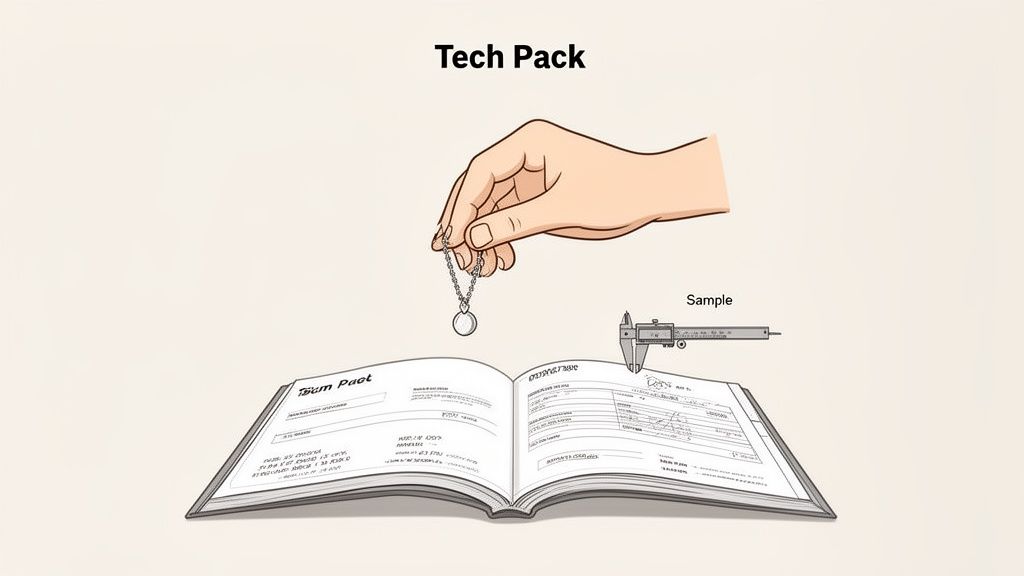
From Idea to Tangible Product
To get an accurate sample, your tech pack has to be obsessive about the details. Don't just ask for a "gold necklace." Specify everything: "18k gold plating over 925 sterling silver, 1 micron thick." Precision is your best friend here.
A solid tech pack should always include:
- Detailed Sketches or CAD Files: Show the design from multiple angles.
- Precise Measurements: List dimensions in millimeters for every single component, from the pendant’s height to the chain’s width.
- Material Specifications: Clearly state the base metal (e.g., hypoallergenic stainless steel) and any plating requirements.
- Finishing Details: Specify the exact finish you want, like polished, matte, or brushed.
- Reference Images: Got photos of similar products that capture the style or a specific detail? Include them.
This level of detail ensures that all the potential private label jewelry manufacturers are quoting on the exact same product. That’s how you accurately compare costs and capabilities.
Understanding Prototypes vs. Pre-Production Samples
It’s also crucial to know the difference between the types of samples you can request. A prototype is usually an initial, sometimes rough, version of your design. It's meant for testing the core concept, size, and overall feel. Prototypes are perfect when you're experimenting with a brand-new or particularly complex idea.
A pre-production sample (PPS), on the other hand, is the final version. It’s made with the exact materials and techniques planned for your bulk order. This is the sample you approve before giving the green light for full production.
Whatever you do, never skip the PPS. It’s your last opportunity to spot any issues with the metal's finish, the clasp's durability, or the quality of the stone setting.
Insist on a pre-production sample for every single design in your collection. The small upfront cost of the sample is a tiny investment compared to the massive financial risk of receiving a bulk order of flawed products.
Think of this stage as a collaborative process. When your sample arrives, give your manufacturing partner clear, constructive feedback. Use photos and markups to pinpoint exactly what needs to change. Good manufacturers actually appreciate this because it helps them deliver precisely what you want.
Typical Costs and Timelines
So, what should you expect? The cost and timeline for samples vary quite a bit. A simple design might cost you $50 to $150 and take 2-3 weeks to produce. More complex pieces that need custom molds or rare gemstones could be significantly more expensive and take over a month. Always build these costs and timelines into your launch plan.
This meticulous attention to detail is what allows smaller brands to hold their own in a massive market. Private label jewelry manufacturing is a huge part of the online sales boom, with the digital segment projected to hit $136.8 billion by 2033. The overall jewelry market is set to grow from $242.79 billion in 2025 to $343.90 billion by 2032, and Asia-Pacific manufacturing hubs are at the center of it all.
By mastering the sampling process, you're not just getting a product made—you're protecting your investment, guaranteeing quality, and building a strong foundation for a successful partnership with your manufacturer. For more on maximizing value, check out our guide on the benefits of sourcing factory direct jewelry.
Navigating Production Costs and Logistics
Alright, you've green-lit the samples and you're ready to go. This is the exciting part—where your vision starts turning into a real, sellable product. But it's also where you need to get serious about the numbers. Getting a handle on costs, payment terms, and shipping is non-negotiable if you want your private-label jewelry business to be profitable.
Price negotiation is a skill, but it’s not magic. The final cost per piece isn't just a number pulled out of thin air; it’s a direct reflection of your choices in materials, complexity, and order volume. The more you understand what goes into that number, the more power you have to source affordable fashion accessories without sacrificing quality.
Breaking Down Production Costs
At its core, the price you'll pay boils down to three things: how many you're ordering, what they're made of, and how tricky they are to make. A simple sterling silver ring is always going to be cheaper to produce than an intricate gold-plated necklace studded with custom-cut gems.
Here are the main ingredients of your final quote:
- Order Volume: This is your most direct lever for negotiation. The more you order, the lower your per-unit cost should be. It’s a classic economy of scale.
- Material Choices: The leap from stainless steel to 925 sterling silver, or from a standard flash plating to a thick 18k gold vermeil, will have a major effect on the price tag.
- Design Complexity: If your design needs a custom mold, a lot of hand-finishing, or delicate stone setting, you’re paying for skilled labor. Those extra hours add up.
When you get a quote, don't just accept it at face value. Ask for a breakdown. Seeing where the money is going gives you the footing to ask smart questions. Try things like, "What's the price break if we bump our order to 500 units?" or "How much does the cost change if we use a different clasp?"
Understanding MOQs and Payment Terms
For any new business, cash flow is king. That makes two little acronyms incredibly important: MOQ (Minimum Order Quantity) and your payment terms. MOQs are simply the fewest number of units a factory will agree to make in one run. For huge manufacturers, this can be 500 or even 1,000 pieces per style, which is often a deal-breaker for a startup.
The great news is that the industry has changed. Many modern private label jewelry manufacturers are now built to serve smaller brands, offering much more approachable MOQs—sometimes as low as 50-100 pieces. Some platforms even have no-MOQ setups, which are perfect for testing the waters with a new design.
Payment terms are just as critical for managing your budget. The industry standard is almost always a split payment.
A typical arrangement is 30% of the total cost upfront to cover materials and get the ball rolling, with the final 70% due when the order is complete but before it ships. This system protects both sides of the deal.
Whatever you agree to, get it in writing before a single dollar changes hands. This simple step prevents a world of headaches and misunderstandings later on.
Demystifying Timelines and Shipping
Knowing how long production will take is crucial. You can't plan a product launch or marketing campaign without a realistic timeline. A standard production run for a few hundred pieces can take anywhere from 4 to 8 weeks, depending on how busy the factory is and how complex your jewelry is. Always build this buffer into your calendar.
During this waiting period, you can get ahead. Great product photography is essential, and figuring out how to take professional product photos and cut costs while production is underway will save you a lot of time and stress.
Once your jewelry is ready, you have to get it from their factory to your door. If you're working with an overseas manufacturer, this means diving into the world of global logistics. You’ll hear a lot about Incoterms, which are standardized rules that define who is responsible for the shipment at every step.
The most common ones you'll see are:
- EXW (Ex Works): This puts everything on you. You're responsible for arranging pickup from the factory floor and managing the entire shipping process, including customs.
- FOB (Free On Board): A bit more balanced. The manufacturer gets your goods to the port in their country, and you take over responsibility from there.
- DDP (Delivered Duty Paid): This is the most hands-off option. The manufacturer handles everything—shipping, insurance, and customs—and delivers the goods right to your specified address.
For most people starting out, DDP is the simplest route, even if it costs a little more. Lastly, don't forget about customs duties and taxes! These are fees your country charges for importing goods, and they can be a nasty surprise if you haven't budgeted for them. Getting a firm grip on logistics is a cornerstone of a healthy business; you can learn more by exploring the basics of supply chain management to ensure everything goes smoothly.
Ensuring Quality and Building a Long-Term Partnership
Placing your first bulk order isn't the finish line; it’s the starting line for what should be a long and profitable relationship. The real secret to success with private label jewelry manufacturers is consistency. You need a rock-solid system to ensure every production run meets the quality standards your customers deserve, and a communication style that turns a simple supplier into a genuine partner.
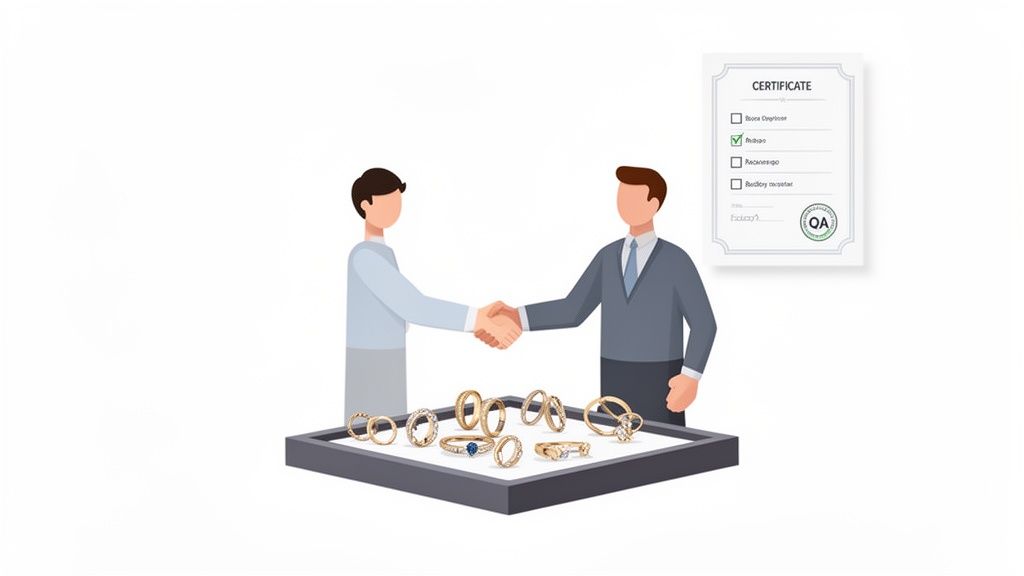
It’s this long-term focus that will allow you to scale with confidence. When you have a strong partnership, your manufacturer gets to know your brand, starts to anticipate your needs, and becomes invested in helping you grow. That foundation of trust is your single most valuable asset.
Your Quality Assurance Checklist for Every Order
Consistency never happens by accident. It's born from a clear, documented process. This is where a Quality Assurance (QA) checklist comes in—and it’s not a one-and-done document. You'll use this for every single order to make sure nothing slips through the cracks. The key is to share it with your manufacturer so they know exactly what you’ll be looking for upon delivery.
Your QA checklist has to be specific and measurable. Vague instructions only lead to disappointment.
- Plating Thickness and Finish: Don't just say "gold plated." Specify the exact micron thickness and confirm the finish (e.g., polished, matte, brushed).
- Clasp and Finding Functionality: Mandate a physical test. Every clasp, earring back, and closure needs to be opened and closed to ensure it’s secure and easy to use.
- Stone Setting Security: Require a check to confirm every gemstone is set firmly. Nothing should be loose or rattling.
- Dimension and Weight Tolerances: Define an acceptable variance, like +/- 0.5mm or +/- 0.1g, from the approved sample.
This checklist removes all subjectivity. If a piece fails a check, it isn't a matter of opinion—it's a clear deviation from the standards you both agreed on, making any issues much simpler to resolve.
Verifying Certifications and Ensuring Compliance
Beyond the look and feel, you have to be certain your products are safe and legally compliant. This is non-negotiable, especially if you plan to sell in markets with strict consumer protection laws. Verifying material certifications isn't just a good idea; it's a critical step in protecting your business.
Always ask for documentation. If you’re selling 925 sterling silver, you need to see a certificate of authenticity. For US-based brands, compliance with California's Proposition 65 is another big one, requiring warnings for products containing certain chemicals.
Don’t just take their word for it. Request copies of material certifications and any compliance testing reports. A reputable manufacturer will have this documentation ready and will be completely transparent about their sourcing and safety standards.
This due diligence protects your brand’s reputation and, more importantly, shields you from a world of potential legal headaches. It also shows your customers you’re committed to quality, which is something they’ll notice.
Turning Your Supplier into a Strategic Partner
The best manufacturing relationships are built on more than just purchase orders. They’re built on clear, consistent, and respectful communication. Start thinking of your factory contact as a key member of your extended team, not just a vendor.
A few simple communication habits can make all the difference:
- Regular Check-ins: Schedule brief check-ins during production. This keeps everyone aligned and helps you catch potential issues before they become major problems.
- Provide Constructive Feedback: When things go wrong (and they sometimes will), address them calmly. Explain the issue clearly, use photos, and reference your QA checklist.
- Share Your Successes: Let them know when a design is a bestseller! Sharing your wins helps them understand your market and makes them feel like they have a real stake in your success.
When you build this kind of trust, the entire dynamic shifts. Your manufacturer will become more proactive, maybe suggesting a new material or a more cost-effective production method. That collaborative spirit is what ultimately allows you to create high-quality, affordable jewelry that lets your business thrive.
Answering Your Top Questions About Private Labeling Jewelry
If you're thinking about launching your own private label jewelry line, you've probably got a few big questions swirling around. It's completely normal. Most people I talk to are concerned about the startup costs, how to protect their creative ideas, and just how complex the whole process really is.
The good news? It's more accessible than ever before. The industry has really opened up, and there are some fantastic partners out there who love working with startups and small brands to source high-quality and affordable fashion accessories. Let's tackle some of the most common questions head-on.
What’s a Realistic Minimum Order Quantity (MOQ)?
Minimum Order Quantities, or MOQs, can be all over the map, and this is a huge sticking point for new brands. The old-school, massive factories might demand you order 500 to 1,000 pieces of a single design. For most people just starting out, that's just not feasible.
Thankfully, that's not the only option anymore. Many modern private label jewelry manufacturers have built their businesses around supporting emerging brands. They get it. You’ll find plenty who offer much more manageable MOQs, sometimes as low as 50 pieces. Some even operate on a no-MOQ model, which is a game-changer for testing new designs without a massive financial commitment.
My advice? Make the MOQ conversation one of your first. Also, don't forget to ask about tiered pricing. Most suppliers will give you a better per-unit price if you order more, which is great to know for when you start to scale.
How Much Do I Really Need to Start a Private Label Jewelry Line?
This is the million-dollar question, but the answer really comes down to the choices you make. The beauty of private labeling is that you have a ton of control over your initial investment.
Your main costs will break down into a few key areas:
- One-Time Mold Fees: If you're creating a custom piece from scratch, the factory has to make a mold. Expect this to run anywhere from $50 to $200 per design.
- Sample Costs: This is non-negotiable. You must get a physical sample to approve before you even think about a bulk order. It's a small price to pay for peace of mind.
- Initial Inventory: This will be your biggest expense. The total cost is a simple equation: your MOQ multiplied by the per-piece cost.
You can be strategic here. Start with a small, focused collection. Choose simpler designs and stick with high-quality but affordable materials like sterling silver or stainless steel. If you find a partner with no MOQ, you could realistically launch your first collection for under $1,000. It's a smart, low-risk way to get your foot in the door.
How Do I Protect My Jewelry Designs From Being Copied?
This is a huge—and totally valid—concern. You've poured your creativity into a design, and the last thing you want is for the factory to share it or sell it to someone else. While a formal design patent is the ultimate legal shield, it's often expensive and takes a long time.
For a practical and highly effective first line of defense, you need an NNN agreement. That stands for Non-Disclosure, Non-Use, and Non-Circumvention. It’s different from a standard NDA because it's specifically designed for working with international manufacturers. An NNN legally prevents the factory from sharing your designs, using them for their own purposes, or going around you to sell your product to your competitors. It's an essential tool every single brand owner should have in their back pocket.
Ready to source high-quality, affordable jewelry for your business with confidence? With over 120,000 styles, no minimum orders, and factory-direct pricing, JewelryBuyDirect makes it easy to build a unique and profitable collection. Explore our catalog and start building your brand today at https://www.jewelrybuydirect.com.