






Arthur Lynch | Sat Nov 01 2025
Sourcing Wholesale Charms for Your Jewelry Business: A Guide to Quality and Profitability
Sourcing high-quality, affordable charms for jewelry making wholesale isn't about luck—it's about a smart business strategy. The secret lies in a three-step approach: deeply understanding your materials to manage costs, rigorously vetting suppliers to ensure quality, and mastering the logistics of buying in bulk to protect your profit margins. This guide will break down that exact strategy, giving your business a clear roadmap to successful sourcing.
Your Blueprint for Sourcing Wholesale Charms
For any jewelry business, charms are more than decorative elements; they are the heart of personalization and a key driver of your profit margins. Learning to source them effectively is a crucial business skill that directly impacts your brand's reputation, customer loyalty, and bottom line. A solid sourcing plan helps your business sidestep costly errors, maintain product consistency, and pave the way for sustainable growth.
This is about more than just finding the lowest price. It’s a strategic balance of cost, quality, and reliability, ensuring the charms you source align with your brand's unique style and financial goals.
The Core Sourcing Framework
To successfully source charms for jewelry making wholesale, your business needs to focus on three distinct stages. Think of it as a supply chain journey that takes a charm from a raw material to a finished component ready for your designs. Each step builds on the last, creating a solid foundation for your inventory. You'll be evaluating materials for cost-effectiveness, finding reliable partners to ensure quality, and managing delivery to keep operations smooth.
This visual gives you a great breakdown of the essential steps.
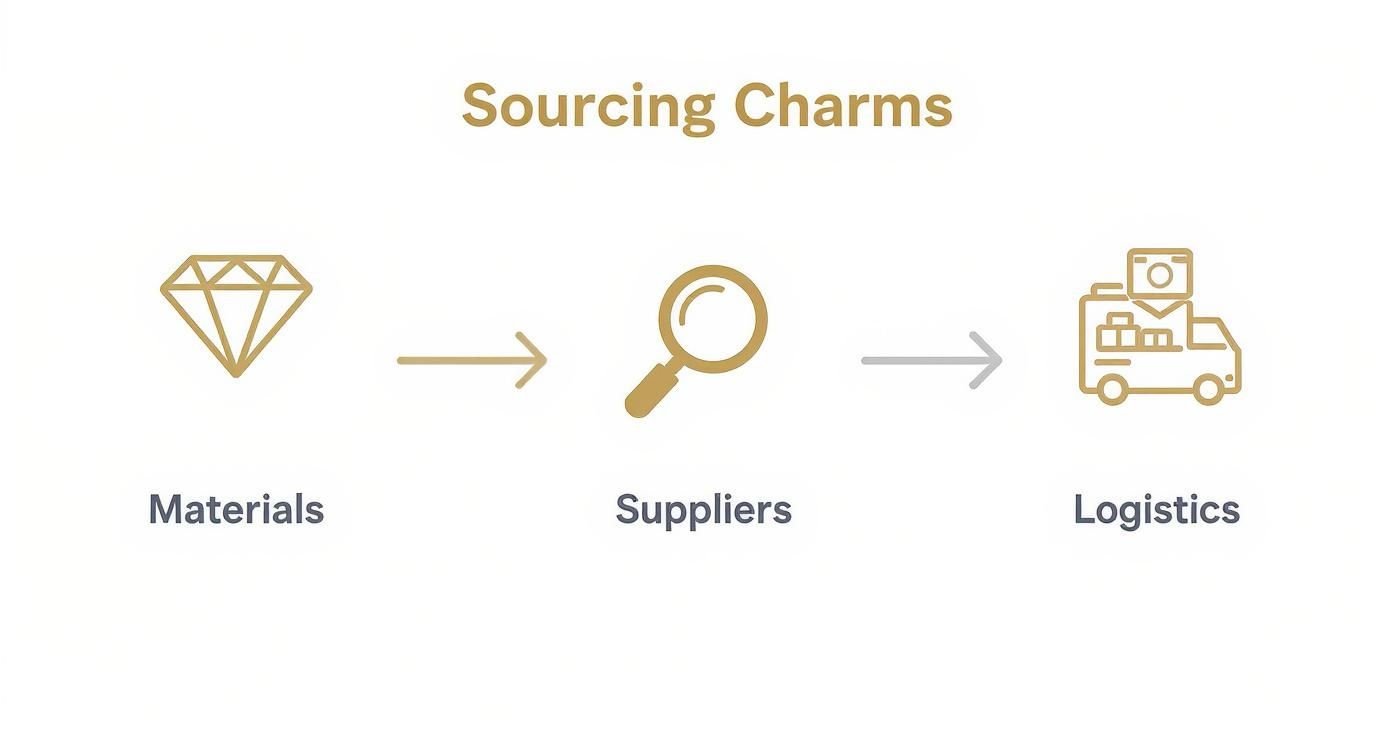
As the infographic shows, a successful sourcing plan for your business starts with deep material knowledge, moves into a thorough supplier check, and finishes with smooth and efficient logistics.
Understanding the Market Opportunity
The business opportunity for these components is immense. The global jewelry market is valued at around $348 billion, and the fashion or costume jewelry niche—where charms are a staple—represents a significant portion of that. This segment alone constitutes a $77 billion market, underscoring the incredible global demand from designers, retailers, and wholesalers. You can explore more of the 2025 jewelry industry statistics and trends to see the full picture.
A successful sourcing strategy isn't just about finding suppliers; it's about building a resilient supply chain that can adapt to trends, meet quality standards, and support your business's growth. It's the operational backbone of your creative vision.
To help you build that backbone, we've created a quick-reference table that summarizes the entire process from a business perspective.
Wholesale Charm Sourcing At a Glance
| Sourcing Step | Key Objective | What to Focus On for Your Business |
|---|---|---|
| Material & Design | Define your product's core identity and cost. | Choosing base metals, finishes, and designs that align with your brand's price point and quality promise. |
| Supplier Vetting | Find reliable, high-quality partners. | Verifying certifications, ordering samples for quality control, and confirming production capacity to meet your demand. |
| Pricing & Logistics | Secure the best value and ensure smooth delivery. | Understanding MOQs, negotiating bulk discounts to maximize profit, and planning for shipping and customs. |
This table serves as your high-level checklist as you move through each phase of sourcing for your business.
This guide will walk you through every critical stage, packed with actionable steps and insights. From selecting metals and finishes that resonate with your target market to navigating the complexities of international shipping, you'll gain the confidence to make smart, profitable decisions that elevate your entire jewelry line.
Choosing Your Charm Materials and Finishes
The materials you choose for your wholesale charms are the foundation of your jewelry line's quality and cost structure. This is where durability, profitability, and your brand's story begin. It’s not just an aesthetic choice—it’s a strategic business decision that balances cost against customer expectations. Get this right, and you're on the path to a profitable product line.
Think of the base metal as the chassis of a car; it provides the structural integrity. The finish is the paint job—it delivers the visual appeal and a protective layer. Both must work in concert to create a product that connects with your ideal customer, whether they seek an affordable fashion accessory or a durable, high-quality keepsake.
Comparing Popular Base Metals for Charms
When you start sourcing charms for jewelry making wholesale, you'll encounter a few core materials repeatedly. Each has distinct cost and quality implications, making them suitable for different price points and business models. Understanding these differences is crucial for your bottom line.
Let's break down the most common options for your business:
- Sterling Silver (.925): Composed of 92.5% pure silver, this is a classic choice for mid-to-high-end jewelry. It offers a brilliant shine and high perceived value. The tradeoff for your business is a higher material cost and the fact that it can tarnish, requiring customer education on care.
- Stainless Steel: The workhorse of the fashion jewelry world. It's exceptionally durable, hypoallergenic, and highly resistant to tarnish and rust. Its durability and affordability make it an excellent choice for everyday wear and trendy designs with healthy profit margins.
- Brass: An alloy of copper and zinc, brass provides a warm, golden tone that is an ideal base for gold plating. It's a cost-effective and versatile option for fashion jewelry. Be aware that raw brass can tarnish and may not be suitable for customers with sensitive skin, which could impact returns.
- Enamel: While not a base metal, enamel is a glassy coating fused over metals like brass or copper. It allows for vibrant, colorful, and intricate designs that offer high visual impact. For businesses targeting a playful or unique aesthetic, enamel is a valuable material choice.
Which one is right for your business? It’s a strategic calculation. If you're building a premium bridal line, the quality signal of sterling silver may be essential. However, if you’re launching a high-volume charm collection for a younger, trend-focused audience, the durability and lower cost of stainless steel or plated brass is the smarter business decision.
The Impact of Finishes and Plating
The right finish can dramatically elevate a charm's perceived value, turning an inexpensive brass base into a high-end looking piece. Plating—the process of bonding a thin layer of precious metal like gold onto a more affordable base—is the secret to creating beautiful, high-quality fashion accessories without the high cost.
The finish on a charm does more than just add color. It dictates its durability, heavily influences your final cost, and ultimately shapes your customer's experience. A quality plating job is the difference between a beloved piece and a customer complaint.
Gold plating, for example, is widely used to give brass charms a rich, solid-gold appearance at a fraction of the cost. The plating thickness, measured in microns, directly correlates to its durability and your unit cost. A thicker plate offers greater longevity but will increase your cost of goods sold. For a deeper analysis, you can learn more about the pros and cons of gold-plated brass jewelry.
Other common finishes include:
- Rhodium Plating: Often used over sterling silver to prevent tarnish and add a brilliant, durable shine.
- Antique Finishes: A chemical treatment that darkens recessed areas, providing a vintage look with enhanced depth.
- Matte or Brushed Finishes: These offer a modern, non-reflective surface that can hide minor scratches, potentially reducing customer returns for minor cosmetic issues.
Ultimately, your choice of materials and finishes sends a clear message about your brand's position in the market. Are you focused on accessible, on-trend fashion accessories? Plated brass and stainless steel will be your most profitable options. Building a brand around classic, lasting quality? Lean into sterling silver and thicker, more durable plating. By mastering these foundational elements, you can source charms for jewelry making wholesale with confidence, ensuring every piece meets your standards for both quality and profitability.
How to Find and Vet Wholesale Charm Suppliers
Finding the right supplier for your charms for jewelry making wholesale is more than a transaction; it's the formation of a critical business partnership. A great supplier ensures consistent quality, fair pricing, and reliable delivery. A bad one leads to production delays, quality issues, and dissatisfied customers. Your mission is to identify partners who understand your brand's vision and can reliably help you achieve it.
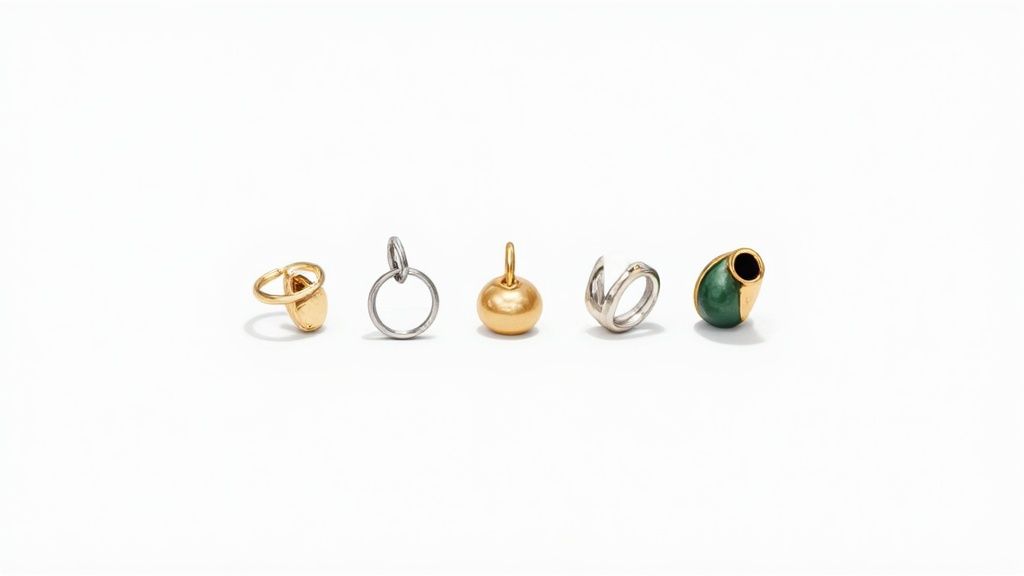
The process begins with knowing where to look. It’s about casting a wide net before zeroing in on the ideal partner. Different sourcing channels offer unique benefits, from the vast selection on global marketplaces to the specialized collections of niche suppliers.
Where to Discover Potential Suppliers
Your sourcing journey will likely span a mix of online platforms and traditional in-person events. Exploring multiple avenues gives your business the best chance of finding a supplier who aligns with your quality standards and business needs.
Here are the primary channels to begin your search:
- Large B2B Marketplaces: Giants like Alibaba and Global Sources offer an almost limitless selection. The advantage is variety and competitive pricing, but the challenge is the extensive due diligence required to separate top-tier manufacturers from unreliable sellers.
- Niche Jewelry Supply Websites: These are often the ideal solution for small to medium-sized businesses. Specialized suppliers typically offer lower Minimum Order Quantities (MOQs), curated collections, and a better understanding of the needs of jewelry businesses.
- Industry Trade Shows: Nothing replaces face-to-face interaction. Events like JCK Las Vegas or regional jewelry expos allow you to physically inspect products, assess quality firsthand, and build direct relationships with potential suppliers.
Using a combination of these methods provides a comprehensive view of market pricing, quality standards, and supplier responsiveness. As you search, you'll notice broader market trends. For example, the affordable beaded jewelry market, a major driver for charm sourcing, is projected to become a $6.41 billion industry by 2025. Much of this growth originates from artisanal hubs in India, Brazil, and Nigeria, which are emerging as key sourcing locations for wholesale charms.
Your Essential Supplier Vetting Checklist
Once you have a shortlist of potential suppliers, the critical vetting process begins. This is how you differentiate reliable partners from risky propositions. It involves looking beyond marketing claims to verify a supplier's ability to deliver on their promises. This process is your single best defense against quality control issues.
A supplier’s website is their digital storefront, but their communication is the real measure of their customer service. Quick, clear, and knowledgeable answers are a huge green flag for a professional and reliable operation.
Evaluate every potential partner against this checklist:
- Website and Online Presence: Does their site appear professional with high-quality, original images and detailed product specifications? A serious supplier invests in their digital presence.
- Communication and Responsiveness: Send a test email with specific questions about materials, MOQs, and lead times. A supplier worthy of your business will respond promptly and professionally. Vague or slow replies are a significant red flag.
- Business Credentials and Reviews: Look for business licenses, quality certifications (like SGS), and third-party reviews. Validate their reputation on industry forums or social media groups, not just on their own website. Our guide to finding the best wholesale charms suppliers has more tips on this.
- Manufacturing vs. Trading Company: Determine if you're dealing directly with the factory or a middleman. A manufacturer often provides better pricing and customization. A trading company might offer a broader selection from multiple factories but with a markup.
- Sample Policy: Any reputable supplier confident in their product quality will provide samples. You will likely pay for them, but it’s a small, necessary business expense to verify quality before committing to a large order.
Once you’ve identified a few solid suppliers, the next step is managing the product data they provide. For any e-commerce business, mastering supplier feed management is a critical operational skill. A structured vetting process like this will help you build a network of reliable partners you can count on for your business's success.
Understanding Pricing, MOQs, and Bulk Orders
You've identified promising suppliers. Now it’s time to focus on the numbers—the financial engine of your jewelry business. Mastering the cost side of sourcing charms for jewelry making wholesale is non-negotiable. It's not just about finding attractive designs; it's about ensuring those designs are profitable.
This is your financial game plan. Just as you perform quality checks on materials, you must scrutinize pricing structures. A firm grasp of this area will protect your profit margins and fuel your business's growth.
Decoding MOQs and Tiered Pricing
Two key terms you'll constantly encounter are Minimum Order Quantity (MOQ) and tiered pricing. An MOQ is the smallest order a supplier will accept for a specific item, ensuring they cover their production costs.
For a small business, a high MOQ can be a significant barrier. However, it's a standard industry practice. Understanding the "why" behind it helps you approach it as a negotiable term rather than an absolute roadblock.
Tiered pricing is a supplier's incentive for larger orders. The principle is simple: the more units you purchase, the lower the per-unit cost. This structure is a powerful advantage for businesses ready to buy in bulk, as it directly reduces your cost of goods sold and increases your potential profit margin.
Navigating High MOQs as a Small Business
What do you do when you find the perfect charm, but the supplier's MOQ is beyond your budget? This is a common challenge for boutique owners and emerging designers, but there are strategic ways to overcome it.
- Negotiate Creatively: Instead of simply asking for a lower MOQ on a single design, propose an alternative. Ask if you can meet their total minimum value or unit requirement by combining orders for several different charm styles. Many suppliers are flexible if the total order value is sufficient.
- Find Small-Batch Suppliers: Seek out manufacturers that specialize in working with smaller businesses. Many suppliers advertise low or no MOQs to attract this segment, allowing you to test new designs without significant capital investment.
- Group Buying: Partner with other trusted jewelry businesses. By pooling your orders, you can collectively meet a high MOQ and unlock better pricing for everyone involved.
A high MOQ doesn't have to be a deal-breaker. Think of it as the opening line in a conversation. A supplier who's willing to talk through options to find a solution that works for both of you is a keeper.
With strategic thinking, you can often find a viable path forward with suppliers whose initial terms might seem prohibitive.
The Art of Negotiating Bulk Discounts
Securing better prices on bulk orders is one of the most direct ways to improve your profit margins. As your business grows, so does your purchasing power—use it. Approach negotiation as a partnership, not a conflict. To understand how even a small discount impacts your bottom line, a specialized tool is invaluable. Learn more by reading our guide on using a wholesale profit margin calculator.
Before entering negotiations, do your homework. Research the market rate for similar charms and be prepared to discuss your projected purchasing volume over the next six to twelve months. Framing your request around a long-term partnership is always more effective, as it demonstrates mutual benefit.
The table below illustrates a typical tiered pricing structure, showing how your per-unit cost can decrease significantly as your order volume increases.
Sample Tiered Pricing Structure for Wholesale Charms
This table demonstrates how a supplier might structure their pricing. The price per charm decreases as the order quantity grows, offering substantial savings for larger business purchases.
| Order Quantity (Units) | Price Per Unit | Total Cost | Potential Savings |
|---|---|---|---|
| 50 | $1.20 | $60.00 | Standard Price |
| 250 | $1.00 | $250.00 | 17% ($0.20 per unit) |
| 1,000 | $0.85 | $850.00 | 29% ($0.35 per unit) |
| 5,000 | $0.70 | $3,500.00 | 42% ($0.50 per unit) |
As you can see, strategic bulk purchasing is a powerful tool for building a more profitable business. By learning to navigate MOQs and negotiate pricing tiers, you can source high-quality charms for jewelry making wholesale in a way that truly fuels your company's growth.
Quality Control: Your First Line of Defense is a Sample
Never place a large wholesale charm order without first inspecting a physical sample. This is your business's insurance policy against quality issues. It is the only step that protects your capital from a substandard shipment that could damage your brand's reputation.
Committing to thousands of units based solely on a website photo is a critical business error. A sample is not just a preview; it is a physical representation of the quality you should expect from the entire production run. It is your opportunity to assess the weight, inspect the details, and confirm that the product meets your brand's standards. This step is non-negotiable.
Getting Your Hands on Samples (and What to Do Next)
When requesting samples, be specific. Ask for the exact design in the precise material and finish you intend to order. Most reputable suppliers will provide them, though you will almost certainly cover the cost of the items and shipping. Consider this a small but essential business investment.
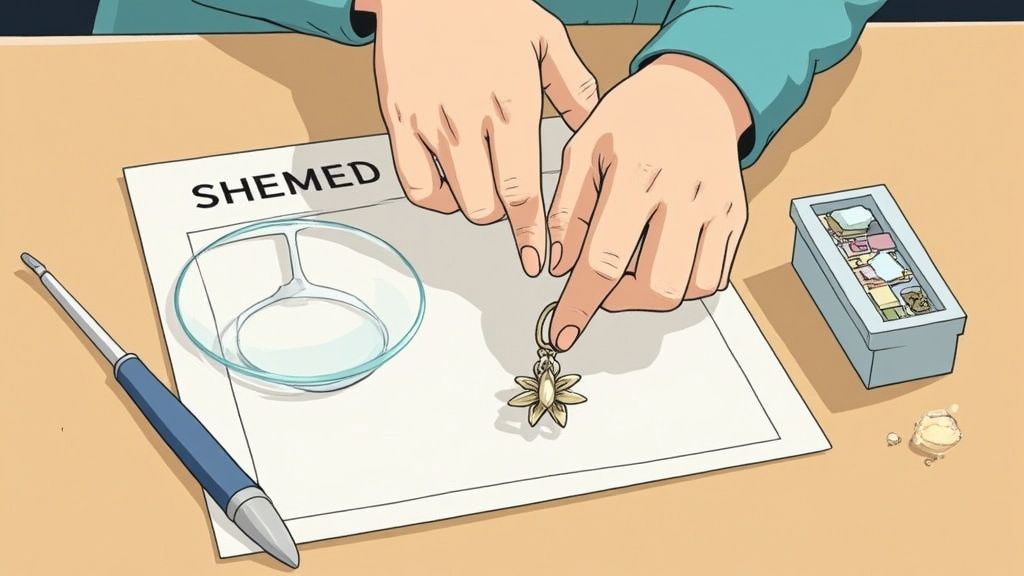
Once the samples arrive, the real work begins. It’s time for a thorough inspection. A cursory glance is not enough. The quality of that single piece is a direct reflection of the supplier's manufacturing standards.
I strongly recommend creating a simple checklist, especially when comparing samples from multiple suppliers. This removes subjectivity and helps you make a data-driven business decision.
Your In-House Inspection Checklist
Here is a template for your inspection checklist. Use this to conduct a detailed evaluation.
- Material Check: Does it feel correct? For sterling silver, look for the ".925" stamp. For stainless steel, it should have a substantial, solid weight.
- Plating & Finish: Examine it under bright light. Is the plating uniform and smooth, or are there bubbles, scratches, or inconsistent patches? Pay close attention to recessed areas, where poor plating is most evident.
- The Bail Test: The bail (the loop for hanging) is a common point of failure. Apply gentle but firm pressure. Does it feel sturdy and securely attached, or flimsy? A weak bail leads to lost charms and dissatisfied customers.
- Weight & Size: Use a digital scale and calipers. Do the charm's weight and dimensions match the supplier's specifications? Significant discrepancies may indicate they are using less material than promised.
- Detail Sharpness: Scrutinize intricate designs. Are the lines crisp and well-defined, or do the edges appear soft and blurry, like a poor casting?
This hands-on process is your best defense against receiving a product that is unsellable.
A sample is the most honest conversation you can have with a potential supplier. It tells you everything about their attention to detail, commitment to quality, and whether their promises match their production reality.
The global market for jewelry-making supplies is massive and expanding. It is projected to grow from $10.5 billion in 2023 to $16.7 billion by 2032. With such intense competition, ensuring your product quality is paramount. You can read more about the jewelry making supplies market and its trajectory to understand the competitive landscape.
Quick & Easy Durability Tests
Beyond visual inspection, you can perform simple, cost-free durability tests.
To test tarnish resistance on a plated charm, gently rub an inconspicuous area with a soft pencil eraser. If the plating flakes or wears away, it is a major quality red flag.
For safety, consider purchasing inexpensive at-home test kits to check for lead and nickel. Ensuring customer safety is crucial for protecting your business from liability.
8. Shipping, Lead Times, and Customs: The Final Stretch
Your samples have passed inspection, and you've placed your bulk order. Now for the final logistical challenge: transporting those charms for jewelry making wholesale from the factory to your business. A little foresight in this stage can save you significant time, money, and operational headaches.
Think of logistics as the bridge connecting your supplier to your business. A weak or unreliable bridge means late inventory, frustrated customers, and lost sales. A well-planned logistics strategy, however, keeps your operations running smoothly and your business profitable.
Cracking the Code on Lead Times
First, let's clarify lead time. This isn't just shipping time. It's the total duration from placing your order to receiving the goods. Miscalculating this can lead to stockouts during peak seasons, a costly mistake for any business.
Here's the complete breakdown you need to plan for:
- Production Time: The time required to manufacture your charms. This can range from a week for a stock item to over a month for a custom design. Always confirm this with your supplier before placing an order.
- Transit Time: The actual shipping duration. Your two primary options are sea freight, which is cost-effective but slow (30-40 days), and air freight, which is fast (5-10 days) but significantly more expensive.
The choice between them is a business decision based on urgency versus budget. If you are planning inventory months in advance, sea freight is the logical choice to minimize costs. However, if a bestseller unexpectedly sells out and you need an urgent restock, the higher cost of air freight may be justified to avoid lost sales.
Getting Through Customs Without a Hitch
If you are sourcing internationally, you must factor customs duties and taxes into your budget. Ignoring these costs can result in your shipment being held at the border, causing significant delays and disrupting your business operations.
I like to think of customs as a tollbooth on the global shipping highway. You know it’s coming, so you have to budget for the fee and have your paperwork ready. Trying to ignore it just causes a massive traffic jam for your business.
The best approach is to be proactive. Ask your supplier or a freight forwarder for an estimate of these costs upfront. They can help you classify your charms with the correct Harmonized System (HS) codes, which determine the applicable tax and duty rates.
Incorporate these costs into your landed cost calculation and per-unit pricing from the very beginning. This is the only way to protect your profit margins and ensure a smooth, predictable journey through customs.
Frequently Asked Questions About Wholesale Charms
https://www.youtube.com/embed/BB9FkeS6INA
Navigating the world of wholesale charms for jewelry making requires balancing quality, design, and cost to ensure profitability. Getting clear answers to common questions is the fastest way to make informed sourcing decisions for your business.
This section serves as a quick-reference guide to address the most frequent challenges and questions faced by jewelry businesses, from startups to established brands.
What Is a Reasonable MOQ for a Small Business?
For a small jewelry business or a solo designer, a reasonable Minimum Order Quantity (MOQ) typically falls between 50 to 200 pieces per charm style. This range is often offered by suppliers who specialize in serving smaller brands, allowing you to test new designs without a large capital outlay.
While some large manufacturers may require MOQs of 500 or 1,000 units, the key is to find a partner whose business scale aligns with yours. Negotiation is also an effective strategy. Propose meeting their total order requirement by mixing and matching several different charm designs—a common and effective workaround that many suppliers will accommodate.
How Can I Find Trustworthy Suppliers for Custom Charms?
When creating custom designs, your supplier search becomes more targeted. Use B2B platforms, but filter for manufacturers offering OEM/ODM (Original Equipment/Design Manufacturer) services. A strong indicator of a capable partner is a detailed portfolio showcasing their previous custom work.
Beyond their portfolio, the most critical factor is clear and consistent communication.
A supplier's willingness to create a high-quality, single physical sample before a full production run is one of the strongest indicators of their reliability and commitment to quality. It’s a small investment that protects your larger one.
To achieve the best results, provide them with a detailed technical packet specifying all dimensions, materials, Pantone colors, and finish types. Always invest in the custom mold and approve a physical sample before authorizing a full production run. This crucial step ensures they can accurately execute your vision.
What Are the Biggest Red Flags to Watch For?
While vetting potential wholesale partners, certain warning signs should prompt immediate caution. The most significant red flag is poor communication. Slow, vague, or unprofessional responses are often a preview of future service issues.
Also, be alert for these other indicators of a potentially unreliable supplier:
- An unprofessional website with low-quality or stock photos.
- Reluctance or refusal to provide samples, or charging an excessive price for them.
- A lack of verifiable business history or independent reviews outside of their own website.
A supplier genuinely interested in a long-term business partnership will be transparent about their pricing, processes, and credentials from the outset.
Ready to source high-quality, affordable charms with confidence? At JewelryBuyDirect, we offer over 120,000 styles with no minimum order quantity, factory-direct pricing, and free worldwide shipping on orders over $150. Explore our collection and start building your next bestseller today!