






Arthur Lynch | Sun Aug 17 2025
Your Guide to Gold Plated Brass Jewelry
Gold plated brass jewelry isn't just a budget-friendly alternative; it's a smart, strategic choice that brings the opulent look of genuine gold into the realm of accessible luxury. At its heart, the process is a beautiful fusion of materials. It starts with a base of brass—an alloy of copper and zinc—and finishes with a thin, electrochemically bonded layer of real gold.
This simple yet effective technique opens up a world of possibilities for both jewelry designers and consumers, allowing for rapid adaptation to the latest fashion trends.
The Smart Appeal of Gold Plated Brass
Think of it like this: you get the timeless, brilliant finish of gold without the hefty price tag. Brass provides a strong, reliable core, while that outer layer of gold delivers the classic, luxurious look we all recognize and love. It's a clever partnership that makes so much sense in the fast-paced fashion jewelry world.
For designers, brass is an ideal canvas. It's more malleable than stainless steel, which means it’s perfect for crafting the intricate, creative, and detailed designs demanded by current global trends. For customers, this translates to a wider selection of fashionable styles that feel substantial and look genuinely premium.
To put this into context, let's quickly compare where gold plated brass sits in the market.
Gold Plated Brass At A Glance
| Attribute | Gold Plated Brass | Solid Gold | Base Metal Fashion Jewelry |
|---|---|---|---|
| Appearance | Luxurious, genuine gold finish | Rich, deep golden luster | Varies, can look artificial |
| Durability | Good; plating can wear over time | Excellent; lifelong wear | Low; prone to tarnishing quickly |
| Cost | Affordable | High investment | Very low |
| Value | Excellent balance of look and cost | High intrinsic and resale value | Low, considered disposable |
| Hypoallergenic | Can be, depending on plating/base | Yes (14K or higher) | Often contains nickel, a common allergen |
This table shows exactly why gold plated brass hits the sweet spot—it offers a near-solid-gold look without the associated cost, easily outclassing typical base metal pieces.
A Growing Global Trend
This isn't just a niche material; it's part of a massive global trend. The demand for affordable luxury is skyrocketing, and the precious metal plating industry is growing right alongside it.
The market for processes like gold plating was valued at USD 215.04 million in 2023 and is on track to hit nearly USD 351.8 million by 2033. This isn't just a statistic; it’s an actionable insight for your business, proving that consumers want beautiful, well-made jewelry that fits a modern budget. You can dig into more data on the precious metal plating market to see the full picture.
At its core, gold plated brass democratizes style. It empowers consumers to experiment with bold statement pieces, delicate layers, and the latest runway looks without committing to the price of solid gold. This flexibility is key to capturing a trend-focused audience.
Key Benefits for Modern Jewelry Collections
So, what makes this material a true staple? Its value comes down to a few key advantages that align perfectly with what today's market wants.
-
Aesthetic Versatility: Brass has a naturally golden-yellow hue. This is a huge plus because if the plating ever wears down, the color revealed underneath is warm and similar, not a jarring silver tone. This helps the piece maintain its beautiful appearance for longer.
-
Creative Freedom for Designers: Since brass is a relatively soft alloy, it’s a dream to work with. It can be shaped, stamped, and detailed with ease, empowering designers to create complex, innovative pieces that would be prohibitively expensive or technically challenging to make in solid gold.
-
Accessible Price Point: This is the bottom line for many. It delivers the unmistakable luster of gold at a small fraction of the cost, making high-end, fashionable looks available to a much wider audience.
How Gold Plating on Brass Actually Works
Creating gold-plated brass jewelry is a fascinating process, a true blend of art and science that turns a sturdy base metal into a piece with a luxurious, high-end look.
It all comes down to a technique called electroplating. Think of it as using a highly controlled electric current to convince genuine gold particles to form a super-strong bond with the brass surface. It’s a meticulous, multi-step journey, and skipping a single step or cutting corners is the difference between a piece that lasts and one that quickly disappoints.
The Foundation: A Flawless Surface
Before a single speck of gold comes near the brass, the piece has to be prepared perfectly. This is arguably the most critical stage of the entire process. Why? Because any tiny imperfection on the base metal—a scratch, a pit, a bit of dust—will be magnified ten-fold once the bright gold layer is applied.
The journey starts with a deep, thorough cleaning to strip away any oils, dirt, or residues left over from manufacturing. From there, the brass is polished until it has a perfectly smooth, almost mirror-like surface. This ensures the gold plating goes on evenly, creating that brilliant, uniform shine we all look for. A poorly prepared base leads to a dull finish or, even worse, causes the gold layer to bubble or flake off down the line.
This visual breaks down the core stages from start to finish.
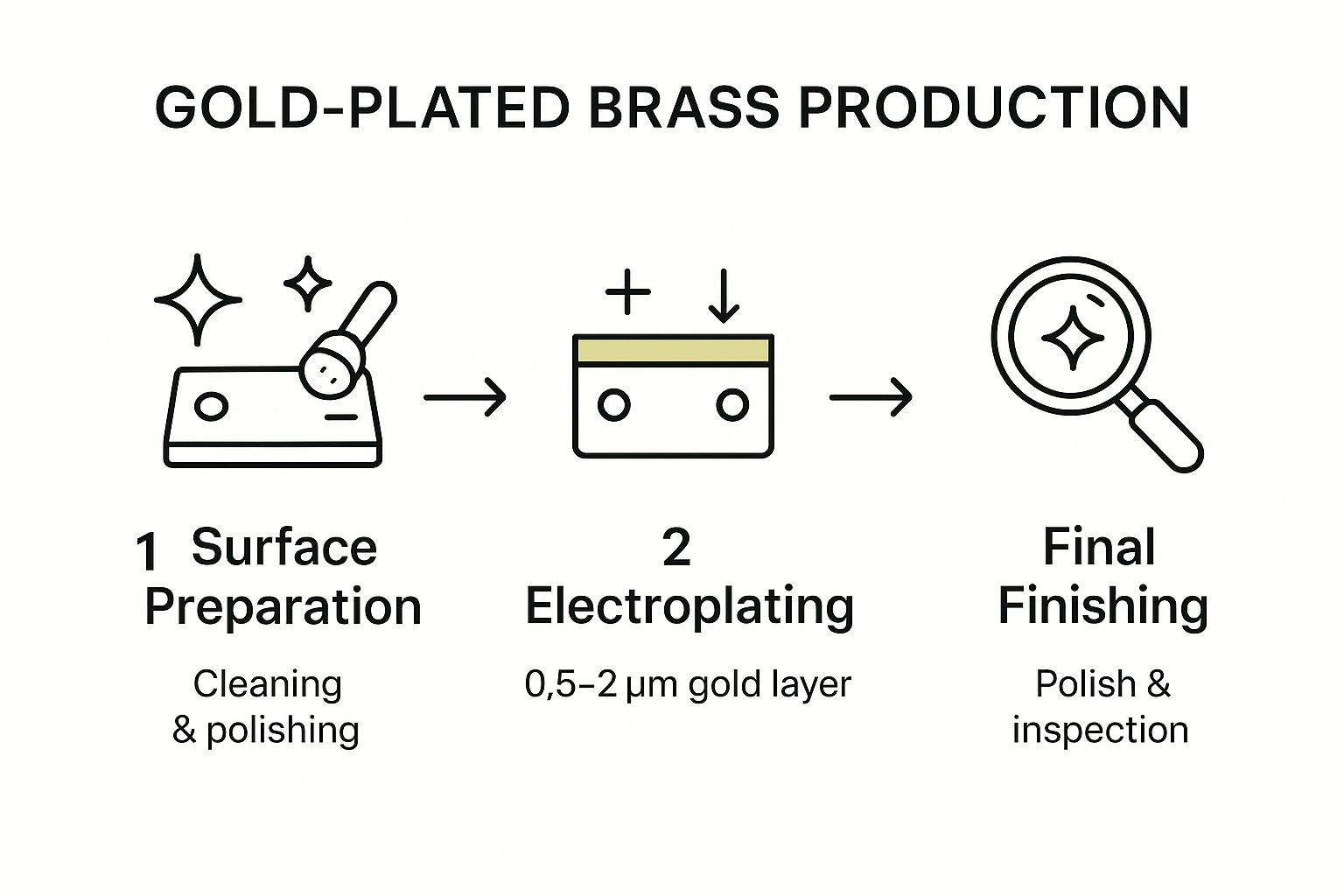
As you can see, it's a structured flow from preparation all the way to final inspection, with quality control being a major theme at every single step.
Building the Protective Barrier
With the brass prepped and polished, it's time for an intermediate layer—usually nickel. This barrier is absolutely essential, and here’s why. First, it stops the copper within the brass alloy from slowly "migrating" into the gold layer over time. That migration is a recipe for discoloration and tarnishing from the inside out.
Second, this middle layer just makes the jewelry tougher. It adds another line of defense against corrosion and actually strengthens the bond between the brass and the gold. Skipping this step is a common shortcut you'll find in lower-quality pieces, but it dramatically shortens the lifespan and beauty of the jewelry.
A proper barrier layer is the unsung hero of high-quality gold-plated brass. It acts as a gatekeeper, protecting the precious gold layer from the base metal and ensuring the piece maintains its vibrant color and integrity for years.
The Final Transformation: The Gold Bath
Finally, the piece is ready for its gold bath. It’s submerged in a special solution packed with dissolved gold ions, and then an electrical current is introduced. Here’s a simple breakdown of the magic:
- Immersion: The nickel-coated brass piece is carefully placed into the electroplating solution.
- Electrical Current: A low-voltage direct current is sent through the bath. This gives the brass piece a negative charge and the gold ions in the solution a positive charge.
- Attraction and Bonding: As we know, opposites attract. The positively charged gold ions are irresistibly drawn to the negatively charged brass, where they deposit onto the surface, atom by atom.
This highly controlled process builds up the gold layer to the exact thickness needed—typically between 0.5 and 2.5 microns for quality fashion jewelry. The result is a seamless, beautiful layer of genuine gold over a strong brass core, ready for one last polish and a final, rigorous inspection.
How to Identify High-Quality Pieces
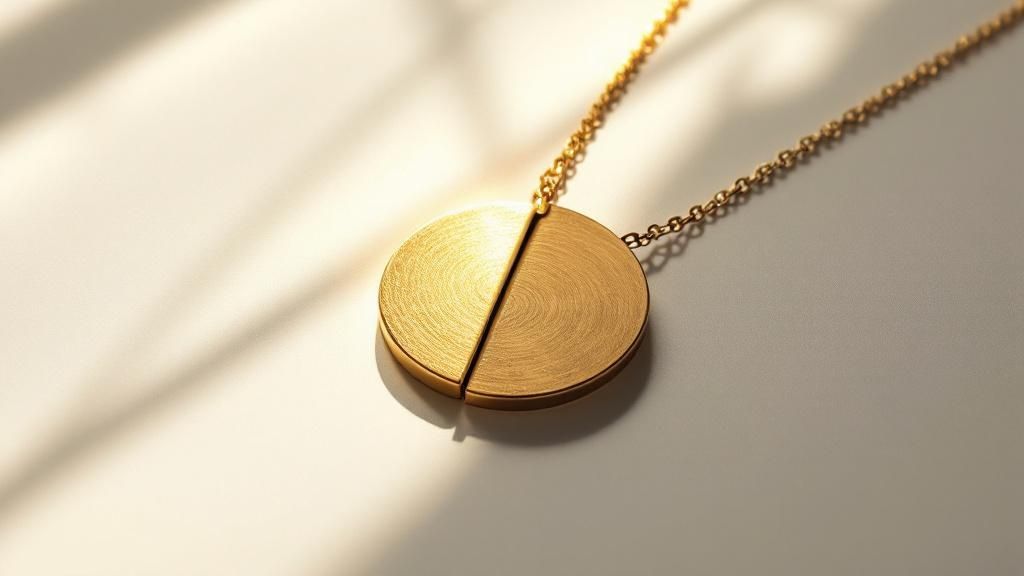
When you're sourcing inventory, how can you tell if a piece of gold plated brass is a quality find or something that will tarnish in a week? Knowing what to look for is an actionable skill that protects your brand's reputation and ensures customer satisfaction. A well-made piece feels substantial, has a seamless, even finish, and reflects light uniformly without dark spots. That flawless surface is your first clue that the maker invested in proper preparation.
The Critical Role of Plating Thickness
If there’s one number to focus on for actionable quality assessment, it’s the thickness of the gold layer. Measured in microns (µm), this is the single most important factor for durability. For jewelry retailers, knowing this number allows you to price items appropriately and educate your customers on their value.
In the world of jewelry, plating thickness can vary dramatically, and it directly impacts how a piece handles the rigors of daily wear.
-
Flash Plating (Under 0.5 µm): This is purely decorative and wears off quickly. Actionable insight: avoid sourcing rings or bracelets with flash plating, as they won't stand up to wear and can lead to customer complaints.
-
Standard Plating (0.5 to 1.5 µm): This is the sweet spot for most quality fashion jewelry. Actionable insight: This range offers the best balance of durability and cost, making it ideal for a core collection of earrings, necklaces, and other pieces that see regular wear.
-
Heavy Plating or Vermeil (2.5 µm+): This is top-tier quality, offering exceptional durability. Actionable insight: Position these pieces as premium, long-lasting items in your collection. They justify a higher price point and appeal to customers seeking investment-quality fashion jewelry.
When you're sourcing inventory, always ask your supplier for the plating thickness in microns. That number is your best indicator of quality and is essential for knowing how to value the piece and what to tell your customers.
Visual Clues of Superior Craftsmanship
Beyond the tech specs, you can learn a lot just by using your eyes. A high-quality piece will have a consistent, rich gold color. Avoid pieces with a cheap, overly bright, brassy-yellow hue. Check tricky spots like clasps, joints, and edges for even coverage—no dark spots or areas where the brass is peeking through.
Next, feel the surface. It should be smooth and mirror-like. A gritty texture is a red flag, indicating poor polishing before plating, which can lead to flaking. Nailing these quality checks is fundamental because they directly affect your bottom line. For more on this, our guide on how to price handmade jewelry is a great resource.
Global Trends in Gold Plated Brass Jewelry
One of the most exciting aspects of gold plated brass is its versatility, making it a global favorite that can be adapted to any fashion scene. It delivers a luxurious look at an accessible price, allowing it to align with diverse styles, from minimalist aesthetics in Europe to bold statements in North America. This material doesn't just follow trends—it helps create them.
The market data confirms this global appeal. The precious metal plating market was valued at USD 240.90 million in 2024 and is projected to reach USD 393.38 million by 2033. This growth is driven by massive demand in jewelry and high-tech industries, with the Asia-Pacific region leading the charge. You can get a deeper dive into these figures from the latest precious metal plating market research.
Regional Gold Plated Brass Jewelry Trends
The true power of gold plated brass is its ability to morph to fit local tastes and global fashion currents. What sells in New York differs from trends in Tokyo. Here’s an actionable look at how different regions are styling gold plated brass right now.
| Region | Dominant Style | Popular Pieces | Actionable Insight for Retailers |
|---|---|---|---|
| North America | Bold & Chunky | Thick chains, oversized hoops, signet rings | Stock high-impact, statement pieces to align with streetwear and influencer culture. |
| Europe | Minimalist & Layered | Fine chains, delicate pendants, stacking rings | Offer customizable and personalizable options; focus on delicate, high-quality finishes. |
| Asia-Pacific | Intricate & Symbolic | Charms, nature motifs, geometric designs | Curate collections with pieces that tell a story or feature detailed, artisanal craftsmanship. |
| Middle East | Ornate & Luxurious | Intricate patterns, filigree, coin jewelry | Source designs that reflect cultural heritage and offer a rich, opulent aesthetic. |
As you can see, the adaptability of this material allows it to meet a wide array of consumer demands, from bold self-expression to subtle, personal storytelling.
North American Street Style: Bold and Chunky
In North America, the current trend is "go big or go home." There's a huge demand for bold, impactful pieces that make a statement. Think thick, chunky chains, oversized hoop earrings that command attention, and heavy-looking signet rings.
This is where gold plated brass truly shines. It allows for the creation of substantial, impressive pieces that remain affordable and wearable. The vibe is confident, drawing heavily from hip-hop culture and modern street style, with high-polish finishes being key. For boutique owners, stocking these hero pieces is an actionable strategy to stay relevant. For more on this, check out our guide on selecting wholesale jewelry for boutiques.
European and Asian Markets: Delicate and Layered
In Europe, particularly Scandinavia, and many parts of Asia, the aesthetic shifts to a more delicate, personal touch. The layering trend dominates—multiple fine chains worn together, tiny, meaningful charm pendants, and stacks of minimalist rings. The focus here is on subtlety and intricate detail.
Gold plated brass excels in this arena, allowing for the creation of finely detailed and complex designs that would be prohibitively expensive in solid gold. It empowers consumers to build a versatile and personalized jewelry wardrobe.
Here, you’ll find that soft matte or brushed gold finishes are more prevalent, conveying understated elegance. Popular designs often incorporate nature, celestial themes, and clean geometric shapes, reflecting a refined taste. This demonstrates how one material can be skillfully adapted to entirely different fashion currents around the globe.
Simple Ways to Care for Your Jewelry
Taking care of gold-plated brass jewelry is a bit like looking after a prized possession—a little bit of consistent, gentle effort goes a long way in keeping it beautiful. The whole point is to protect that thin layer of gold from anything that might chip away at it. With the right care, you can keep your favorite pieces looking brilliant and prevent them from tarnishing or fading too soon.
It really just comes down to treating your jewelry with a bit of mindful respect. Think of that gold layer as a delicate, beautiful shield. Its biggest enemies are everyday chemicals, moisture, and friction. If you can build a few simple protective habits, you’ll easily extend the life and shine of your whole collection.
Daily and Weekly Care Routines
Believe it or not, your daily habits make the biggest difference in how long your gold-plated brass jewelry will last. If you remember nothing else, remember this one golden rule: your jewelry should be the last thing you put on and the first thing you take off. Just that one habit alone will cut down its exposure to a ton of damaging stuff.
When it comes to cleaning, stay away from harsh chemicals or abrasive cloths. For the most part, a quick wipe with a soft, lint-free cloth after you wear it is all you need to get rid of skin oils and dust.
- Avoid Moisture: Always take your pieces off before you hop in the shower, go for a swim, or work out. Water and sweat are notorious for speeding up wear on the plating.
- Steer Clear of Chemicals: Make sure you've already applied your lotions, perfumes, hairspray, and makeup before putting on your jewelry. The chemicals in these products can cause a bad reaction with the gold.
- Gentle Cleaning Only: If a piece needs a more thorough cleaning, just use a tiny bit of mild, non-abrasive soap mixed with lukewarm water. Gently clean it, then rinse and dry it completely with a soft cloth. Whatever you do, never soak your jewelry.
Think of your jewelry box as more than just storage; it’s a preservation chamber. Keeping each piece in its own soft pouch or a lined box is the best way to prevent the scratches and dings that happen when they're all tossed in together.
Smart Storage and Long-Term Preservation
How you store your jewelry is just as critical as how you clean it. The main goal is to create a safe, dry spot where your pieces won’t get scratched up, tangled, or exposed to the air and humidity that accelerate tarnishing.
Tossing an anti-tarnish strip or one of those little silica gel packets into your jewelry box can work wonders by soaking up extra moisture. It's also a great idea to keep pieces separate—especially delicate chains that seem to love getting tangled and damaged. Looking for ideas on how to style your beautifully maintained jewelry? Our article on minimalist geometric 18k gold plated bracelets has some fantastic inspiration for pulling together a chic, layered look.
At the end of the day, adopting these simple dos and don'ts puts you in control. You'll keep your gold-plated brass looking its absolute best, making sure it stays a cherished part of your collection for a long, long time.
Why Gold Plating Is Used Beyond Jewelry
It's fascinating to think that the same technology giving your favorite necklace its brilliant shine is also at work in some of the world's most advanced industries. Gold plating isn't just about looks; it's a high-performance process trusted for its sheer reliability and technical integrity. This wider application really speaks volumes about the quality potential you can find in well-crafted gold plated brass jewelry.
While jewelers value gold for its undeniable beauty, other industries prize it for its functional superpowers. Gold is a phenomenal electrical conductor and is incredibly resistant to corrosion and oxidation. When you apply that over a cost-effective and sturdy base like brass, you get components that are both dependable and economical.
Critical Applications in Electronics and Aerospace
Take a look at the smartphone in your pocket or the computer on your desk. Inside, there are countless connectors, pins, and circuits that need a perfect, uninterrupted flow of electricity to work. Gold plated brass is essential here, creating corrosion-proof contact points that guarantee data and power are transmitted flawlessly for years.
This level of reliability becomes even more critical when we look at the aerospace and automotive worlds.
-
Aerospace: In satellites and aircraft, every component has to endure extreme conditions without a hint of failure. Gold plated connectors are the standard for vital navigation and communication systems simply because they won't corrode or degrade over time.
-
Automotive: Modern cars are packed with a complex web of sensors managing everything from engine performance to safety features. Gold plating on brass components ensures these sensors deliver accurate, split-second readings—a non-negotiable requirement.
The fact that gold plating is a go-to in these mission-critical fields says a lot about its value beyond just decoration. It’s a testament to the process's durability and performance under pressure, qualities that also define top-tier jewelry.
The demand from these sectors is fueling some serious market growth. The global gold plating chemicals market was valued at around USD 522.91 million in 2024 and is on track to hit USD 814.96 million by 2034. This surge is heavily influenced by the expanding use of gold plated brass in high-tech industries. You can dive deeper into the gold plating chemicals market growth to see the numbers for yourself.
Got Questions About Gold Plated Brass? We've Got Answers.
When you're dealing with gold plated brass, a few questions always seem to pop up. Getting straight answers is key to buying smart, managing your inventory, and helping your own customers understand what they're getting. Let's tackle the most common ones.
How Long Does Gold Plated Brass Last?
Honestly, it depends. With the right care, a well-made piece can look great for several years. The two biggest factors are the thickness of the gold plating and how the jewelry is treated day-to-day. Constant contact with sweat, lotions, and perfumes will definitely speed up the wear and tear.
Think of it as a long-term investment in style. A little bit of care goes a long way in keeping that gold layer intact and shining.
Can You Wear Gold Plated Brass in the Shower?
I get this one all the time, and the answer is a firm no. It's a really bad idea to wear your gold plated jewelry in the shower. The combination of hot water, steam, soaps, and shampoos is a recipe for disaster for that thin layer of gold.
It’s a simple habit that pays off big: taking off your jewelry before you hop in the shower takes two seconds but can add years to its life.
It'll dull the finish quickly and expose the brass underneath, which is exactly what you want to avoid.
Does Gold Plated Brass Turn Your Skin Green?
This is a huge concern for many people. The short answer is, a high-quality piece of gold plated brass shouldn't turn your skin green. That dreaded green stain comes from a chemical reaction between the copper in the brass and your skin's natural oils and sweat.
A thick, intact layer of gold acts as a barrier, preventing that reaction. If you or a customer sees a green tint, it’s a dead giveaway that the plating has worn away and the brass is now in direct contact with the skin.
Ready to explore a vast collection of trend-driven wholesale jewelry? Discover direct-from-factory pricing and an incredible selection at JewelryBuyDirect. Source smarter and save more at https://www.jewelrybuydirect.com.