





Cathy Lopez | Mon Nov 16 2026
Box Chain vs Snake Chain: Which Holds Your Pendant Better
The usual advice, buy box chain because it's durable and snake chain because it's delicate, misses the buying decision that matters. Choose by how the chain moves, where it fails, and whether you can repair it economically. A necklace that looks affordable at checkout can become expensive stock if a minor snag means replacing the whole piece.
For pendant-led assortments, I'd start with box chain. For fluid, close-fitting fashion necklaces, I'd test snake chain selectively and budget for packaging that protects its shape. The useful box chain vs snake chain comparison isn't a beauty contest. It's a sourcing decision about pendant support, customer habits, and after-sales cost.
Box Chain vs Snake Chain Side by Side
The differences that matter between these two chains start at the link. The Jewelers of America chain glossary describes box chain as closely spaced square links made by machine from flattened wire, with polished or diamond-cut finishing options. Snake chain builds its surface from small curved plates fitted tightly into a tube. Every row in the table below follows from those two constructions.
Box chain and snake chain at a glance
| Criterion | Box chain | Snake chain |
|---|---|---|
| Construction | Square links interlocked in a straight, repeating structure | Curved plates fitted into a closed tube with minimal visible joints |
| Surface and look | Visible geometric links with a clean architectural line | Smooth, fluid, uninterrupted surface |
| Pendant suitability | Stable drape and centered support for most appropriately matched pendants | Suits light or close-fitting pendants; heavier pendants need care |
| Kink and damage | Resists kinking better; can stretch under heavy force | Can develop a permanent kink after sharp bends, crushing, or snagging |
| Repairability | Damaged section usually cut and resoldered | Generally cannot be straightened reliably |
| Typical finishes | Polished or diamond-cut | Polished tubular surface |
| Best for | Everyday pendants and repair-friendly assortments | Close-fitting styles for careful-wear customers |
Why the structures behave differently
Box chain's square links alternate orientation, each rotated 90 degrees relative to its neighbor, per the construction description in the Jewelers of America buying guide. Together they form a structured, nearly continuous square tube. Under load, that tube spreads pendant tension across interlocking contact points instead of letting it concentrate on a single link.
It also resists twisting, which is why box chain behaves predictably once a pendant is attached. The charm gets a defined path and a relatively stable drape. It stays where the wearer expects it to sit.
Snake chain reaches continuity the other way. Curved plates, bands, or star-shaped stampings sit edge to edge inside a tubular profile, leaving few visible joints. The buyer sees a smooth line rather than a repeated geometric pattern.
That smoothness changes how a pendant travels. A generously sized, polished bail slides along snake chain and settles toward the lowest point. A tight or rough bail scrapes and drags, pressing exactly where the chain needs freedom to curve.
Buying rule: Judge the pendant and chain as a working pair. A beautiful chain isn't a suitable pendant carrier if the bail binds against it.
What the appearance tells you
Box chain contributes visible structure to a design. Its angular surfaces suit geometric pendants and minimalist pieces where the chain should look intentional rather than disappear. Polished links give a cleaner line; diamond-cut surfaces create a more articulated sparkle.
Snake chain contributes continuity. The uninterrupted surface works best when the neckline itself is the design feature. Buyers choosing it are paying for that smooth effect, so a visible distortion undermines the product even while the necklace remains technically intact.
History explains these roles. The Muau snake-chain glossary traces the modern machine-made smooth snake chain to the twentieth century, contrasting its fluid styling with the Venetian square-link tradition behind box chain. Mechanized production made consistent, closely spaced box links practical, which cemented the style's role as a foundational pendant chain.
Don't turn the table into a strength rating
Every row follows from construction: gauge, solid or hollow build, alloy, soldering, and clasp quality. Those variables can flip the buying recommendation. An ultra-fine box chain is a worse purchase than a well-made, more substantial snake chain if its links are thin and its solder joints are soft.
Ask for close-up photographs of the links and end fittings; a styled shot of a necklace on a model reveals neither. Then inspect a sample with the intended pendant attached. Let it hang naturally, slide the pendant along the chain, and watch for catching or an uneven drape.
If your assortment needs a different balance of visible links and texture, our cable chain vs rope chain comparison gives you another useful sourcing benchmark. Forcing a box or snake chain into a design that needs a different construction costs more than choosing between them.
Find the table row that matches your pendant weight and wear pattern, then concentrate your inspection budget on that criterion.
Kinks, Stretch and Repairs After Damage
Durable versus delicate is too crude for handling returns. You need to distinguish a cosmetic kink from stretched construction, a broken link, and a failed clasp before deciding whether to repair or replace.
The Nobbier guide to chain construction and care explains the practical difference: individually defined box links can generally be cut and resoldered, while a snake chain's tightly joined segments can develop a permanent kink that's difficult to remove invisibly. Thin box chain can still stretch or stiffen after excessive pulling; snake chain isn't automatically weak, but it tolerates sharp bends and concentrated pressure poorly.
Use this visual comparison to identify the damaged area, then have a jeweler assess the actual construction before treating any repair outcome as guaranteed.
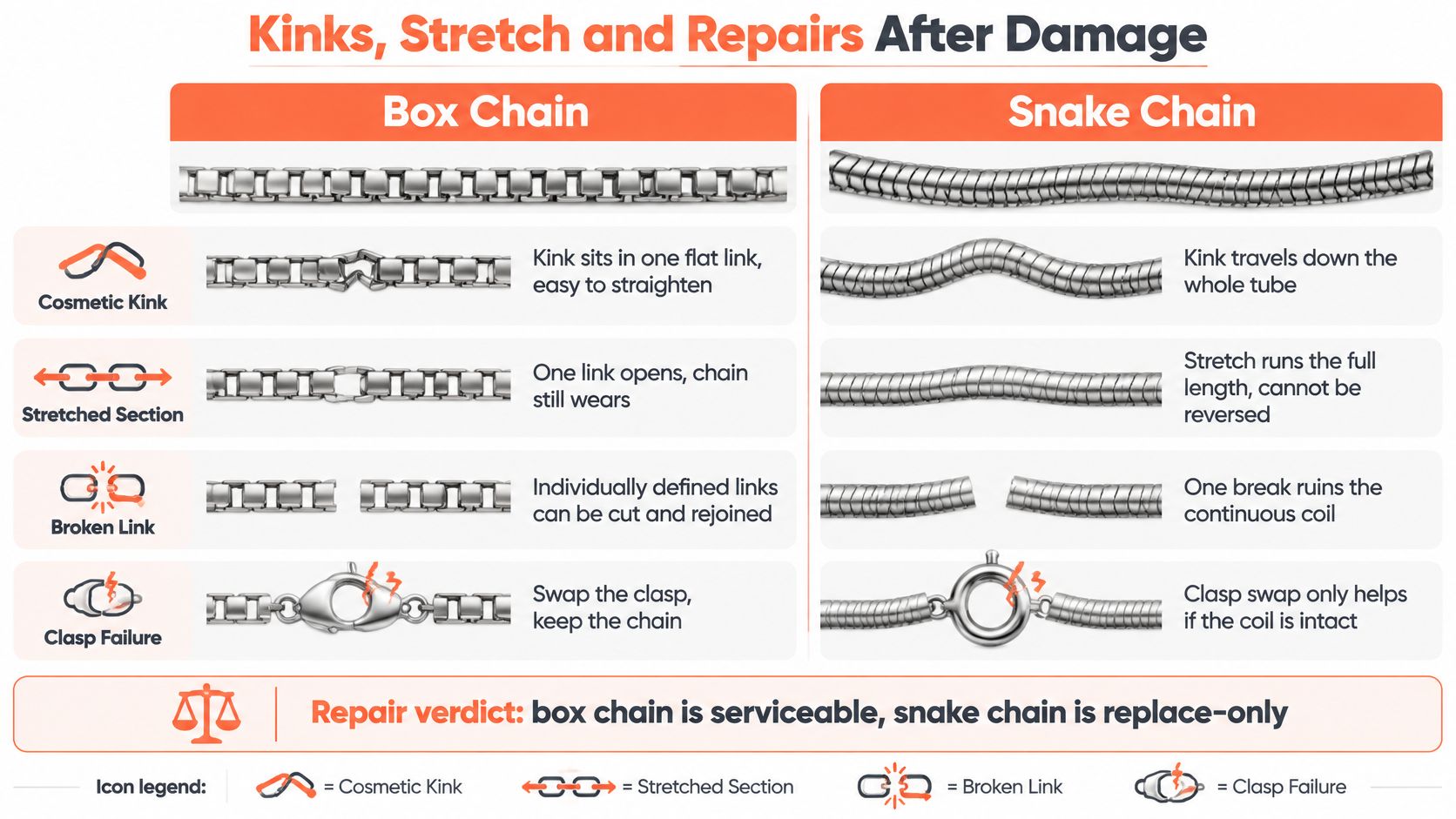
Separate appearance damage from structural failure
A cosmetic kink interrupts the line of the necklace. Don't assume it's harmless because the chain remains connected, and don't repeatedly bend it backward to make it look straight.
A stretched section shows distortion rather than a clean separation. Compare it with neighboring sections under magnification. A long stiff or elongated area deserves more caution than a clearly isolated damaged link.
A broken link may give a jeweler a localized repair point on box chain. A clasp failure is a separate problem: replacing sound chain because its clasp has failed wastes stock, but fitting a new clasp won't fix damaged chain or loose end caps.
Run a repair check before authorizing replacement
- Identify the failure type. Record whether it's a kink, stretch, break, or hardware problem. Photograph the item before anyone attempts to reshape it.
- Locate the extent. Establish whether damage affects a single defined link or a longer run. A neat localized repair and a visibly altered section aren't equivalent outcomes.
- Test the clasp and end caps separately. Check closure, attachment rings, soldered joints, and whether the end fitting moves independently of the chain.
- Compare repair cost with the pendant's value. Include replacement-chain cost and the risk of losing the pendant, not just bench labor.
For a box chain with an isolated broken link, repair is usually worth pricing. For an inexpensive snake chain with a set kink, replacement is generally the more sensible commercial choice. Neither judgment should become an absolute rule for valuable or unusual jewelry.
A successful repair must restore usable movement and acceptable appearance, not merely reconnect metal.
Put a repair profile and recommended pendant load on product pages. That gives staff and customers something more useful than an unsupported everyday-durable label.
Gauge and Solid Versus Hollow Specs That Matter
Gauge, construction and weight reference
| Specification | Typical value | Best use |
|---|---|---|
| Ultra-fine box chain, 0.45 mm | The finest gauge in this reference set | Lightweight layering and low-profile accents |
| Dainty everyday box chain, 0.5 mm | Standard dainty everyday width | Light pendants and daily wear, subject to load approval |
| Structural box chain, about 0.8 mm | Nearly twice the mass of ultra-fine gauges, in the John Atencio box-chain guide covering these widths | Regular pendant use |
| Solid box chain | More metal, greater crush resistance | Premium or pendant-bearing lines |
| Hollow box chain | Lighter and lower cost, thinner walls | Lower-price fashion lines with care instructions; LearningJewelry puts durability about 40% lower, a guide rather than a universal engineering standard |
| Box chain, 1 mm, 2026 Etsy listing | 2.0–4.1 g | Box-chain weight reference from the Etsy chain listing |
| Snake chain, 0.9 mm, same listing | 2.5–4.4 g | Snake-chain weight reference, with length and construction unmatched |
| Finish specification | Base metal, plating status, and polish or cut | Clear wear expectations and accurate product descriptions |
Buy the specification, not the silhouette
Treat the width bands as assortment categories. An ultra-fine gauge gives you a discreet layering product; a structural gauge gives you a more credible starting point for pendant lines. What a band cannot do is approve a load. That decision still needs the intended pendant, the chain length, and the complete construction.
The listing weights punish a common shortcut. Snake chain can weigh more than box chain at similar widths, and those ranges say nothing about which chain survives a kink or a crush. Length and individual construction have to match before weight means anything.
Solid construction means the chain is filled through. It says nothing about purity, and it says nothing about plating. Keep internal construction and metal composition as separate purchase-order fields.
Hollow construction lowers weight and cost, but thinner walls dent and crease under loads a solid chain absorbs. Treat the quoted durability reduction as a reason to inspect samples, never as a forecast for every supplier's product.
Match the construction to the line
- Pendant-bearing lines: Favor solid construction and a structural gauge, then confirm the pendant-load recommendation before approving the pairing.
- Lower-price fashion lines: Use hollow or ultra-fine products deliberately, with packaging and care instructions matched to their deformation risk.
- Sample inspection: Flex and compress a short length before committing. A wall that creases under finger pressure will crease in the customer's jewelry box.
Plating deserves its own field on the order. A plated surface can wear through and expose a different-colored base metal. An unplated solid-metal piece skips that coating-to-base transition, although it can still scratch, tarnish, or change appearance over time.
Record width in millimetres, construction, finish, and recommended pendant weight on every listing. Total necklace weight tells you shipping cost; pendant weight tells you what the chain can carry.
Which Pendant and Wearer Suits Each Chain
Start with the wearer's routine, then choose the weave. A customer buying a statement pendant for daily wear needs a different recommendation from someone choosing a smooth necklace for occasional evenings.
Match the necklace to normal movement
For a heavier or statement pendant worn daily, specify a box chain with a gauge, end fittings, and bail rated for the load. Match the chain gauge to the pendant weight, not to the outfit. An undersized box chain kinks at the same weak points as any other fine chain.
For commuters, customers caring for children, active workers, and frequent pendant changers, box chain earns the recommendation. Its advantage is forgiving handling: a hard pull is more likely to leave a localized, repairable break than a permanently flattened section. It still has no place around machinery, during sport, or wherever snagging creates a safety risk.
For a close-fitting choker or minimalist pendant worn alone, snake chain gives the cleaner visual result. The customer gets a continuous line that follows the neckline, free of visible square-link geometry.
Choose the movement you want to sell, then check whether the customer's routine will preserve it.
Treat layering and travel as separate use cases
In layered looks, snake chain's smooth surface slides against neighboring pieces, while box chain adds visible geometry and more textured contact. Neither arrangement is automatically tangle-free. Test the actual necklace combination rather than approving each piece separately.
For travel, give snake chain its own flat storage space rather than folding it into a small pouch with other jewelry. The USA Jewels snake-chain construction guide identifies sharp bending, crushing, and pressure as causes of lasting deformation and recommends flat storage.
Our Minimalist Heart Pendant Necklace in Titanium Steel with Plated Finish, Double-Layer Clavicle Chain, priced at $4.93, shows where these layering questions land in practice. Its heart styling makes drape and stacking behavior real buying criteria, but the listing doesn't isolate the pendant's weight, so treat it as a style example and verify the load pairing separately.
Before choosing either chain, check the opening and interior finish of the pendant attachment using our guide to gold pendant bails.
Use this quick customer test:
- Will the pendant strain a fine chain? Start with a solid, adequately gauged box-chain option and verify the pairing.
- Does the customer snag or stack necklaces? Favor forgiving handling and avoid delicate snake constructions.
- Should the neckline look fluid or geometric? Choose snake for continuity and box for visible structure.
Which Chain to Stock for Each Business Model
Match the chain to the pendant weight and the expected return rate. Buy for the customer you serve, including how you'll process a damaged item.
Treat the business-model guide as a merchandising prompt. No universal pendant-weight cutoff or absolute repair rule applies to every snake chain, so each product still earns its own load approval.
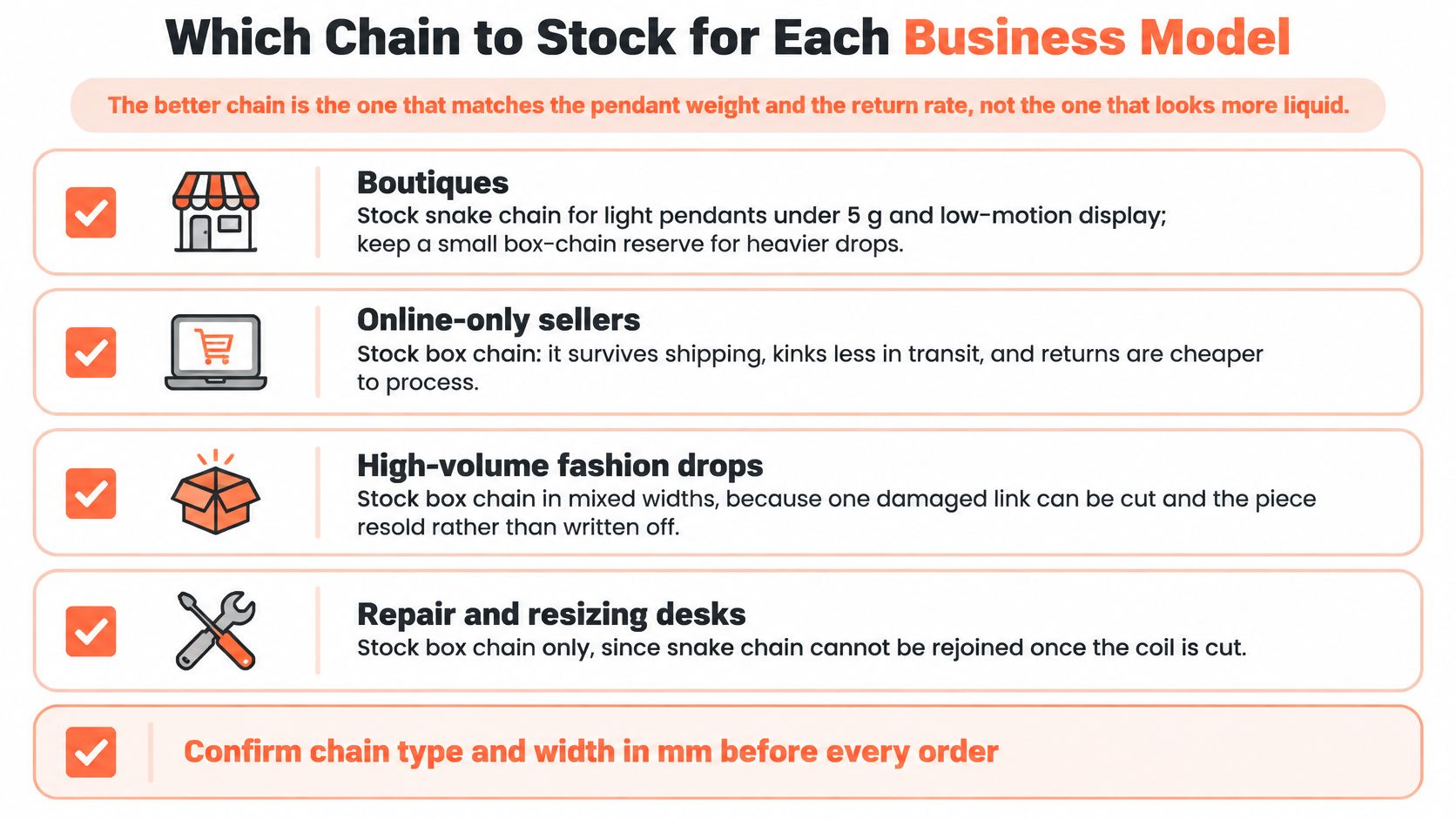
Build a core range before adding visual variety
Boutiques should make box chain the core pendant option, then add snake chain for fine, close-fitting lines. Staff can demonstrate the difference in hand: box shows visible structure and survives a squeeze that would crease a snake tube. A smaller, clearly explained assortment beats a wall of nearly identical necklaces.
Online sellers dealing with frequent damage returns should favor repairable box-chain pendant products. A localized break in a box link can often be rejoined at the bench, while a creased snake section usually means replacing a length of chain. Set a written inspection standard so staff separate a repairable break from an item that should stay off the shelf.
Social-commerce and live-selling vendors can lead with lightweight snake styles when fluid movement is part of the presentation. Snake chain moves continuously on camera where box chain articulates in segments. Show the necklace on the body, explain how it should be stored, and protect its curve during packing. A strong demonstration still carries the handling requirements with it.
Our Minimalist CD Letter Snake Chain Necklace for Women Made of Titanium Steel with Electroplating Finish is priced at $3.94. The price supports a fashion rotation. Confirm the construction separately before pairing it with a heavier replacement pendant.
Give makers a controlled comparison
Makers and private-label brands should settle width, internal construction, and target cost before choosing the final weave. Test a small snake-chain line in a single width against a box-chain line serving a comparable customer, then compare sell-through, damage claims, and replacement costs. A lower unit price stops being a saving once return handling erases the margin.
The Snake Bangle in the trending range follows the same logic at bracelet scale: snake construction earns its place where the customer wants a continuous surface, and it carries the same kink risk onto the wrist.
Before committing to stock, answer these buyer questions:
- Pendant load: What weight must the product carry?
- Wear pattern: How will the customer handle, layer, and store it?
- Return exposure: Can the business repair the likely damage economically?
- Price point: Which specifications can you sustain at the intended selling price?
Spec Your Chains Before You Order
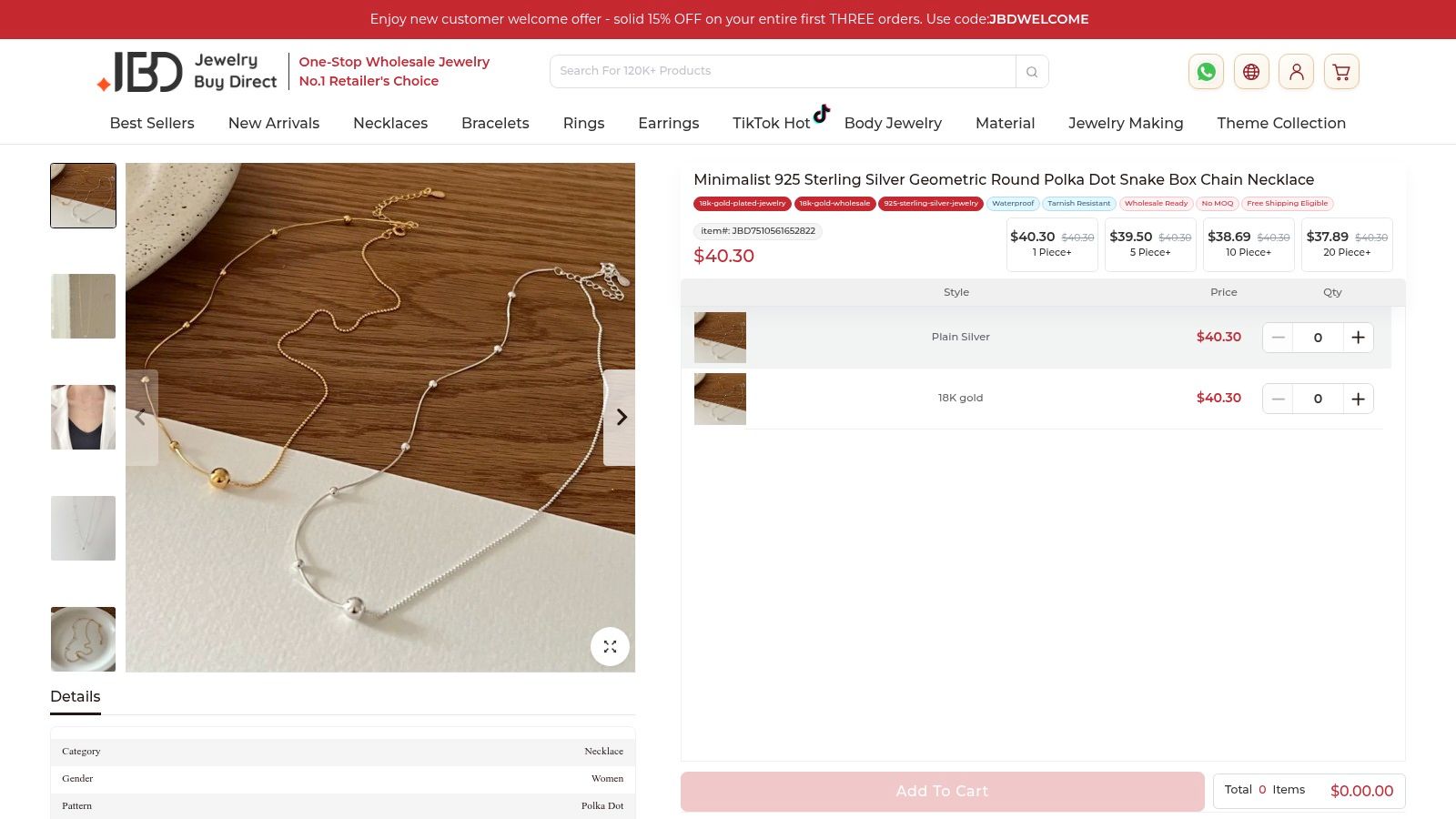
A listing title starts the file; it cannot approve a pendant-and-chain match. Before a reorder, put the sample through a bench check and record only what you can measure.
Use the listing view to identify which details are explicit and which still need a measured answer.
Put the order through a physical check
- Measure width in millimetres with calipers. Check three points without compressing the links.
- Flex the chain through a gentle arc. Watch where a crease forms, then release it and see whether the line relaxes or holds the bend.
- Run it through the pendant bail. Feel for drag, edge catch, twist, and any point where the chain hesitates.
- Loupe the hardware. Inspect clasp, end caps, jump rings, and solder joints, then open and close the clasp until the action is consistent.
- Do a drape test. Put it on a neck form or over your hand and check whether the pendant faces forward or rolls.
- Weigh the parts separately. Keep chain and pendant as two numbers so the record describes the actual load.
Our Minimalist Geometric Gold Ball Pendant Necklace 18K Gold Plated Stainless Steel Box Chain Pull-Adjustable Women Jewelry identifies a box-chain design. Treat it as a box-chain sample only; an equivalent snake chain needs its own measured sample.
Use our wholesale necklace-chain sourcing guide to keep those measurements consistent across suppliers.
Use the video beside the sample inspection, since motion shows catch points that still photos flatten.
Approve the chain from the measurement sheet. Let the written specification decide the order.
JewelryBuyDirect offers wholesale necklaces, jewelry-making components, and fashion accessories for building pendant-led and minimalist collections. Visit JewelryBuyDirect to compare box-chain and snake-chain designs, select samples, and build your order around measured construction, finish, and pendant fit.