






Jennifer Lopez | Wed Oct 21 2026
Gold Pendant Bails: Wholesale Buyer's Guide to Fit
Select gold pendant bails for full chain and clasp clearance, not chain diameter alone, and request an FTC compliant material disclosure before you discuss price. Fine chains of 0.8 to 1.2 mm typically suit lightweight pendants below approximately 3 g, while 1.3 to 1.7 mm bail openings better serve 2 to 6 g pendants on medium cable chains.
That advice runs against most catalog buying, where a buyer checks whether a chain fits through the hole and orders. I've rejected shipments for exactly that shortcut. The bail threaded onto the chain, then jammed at the clasp, ground against the pendant shoulder, or wore through its plating where metal kept rubbing metal. Treat the bail as an interface between chain, end hardware, and pendant, and your returns conversation changes immediately.
Why Most Gold Pendant Bail Sourcing Goes Wrong
Most first time buyers treat gold pendant bails as a cheap commodity. Pick a shape, pick a price, add a few hundred to the order. That's where margin leaks, because the smallest component controls whether the finished pendant can be worn, swapped, repaired, and described.
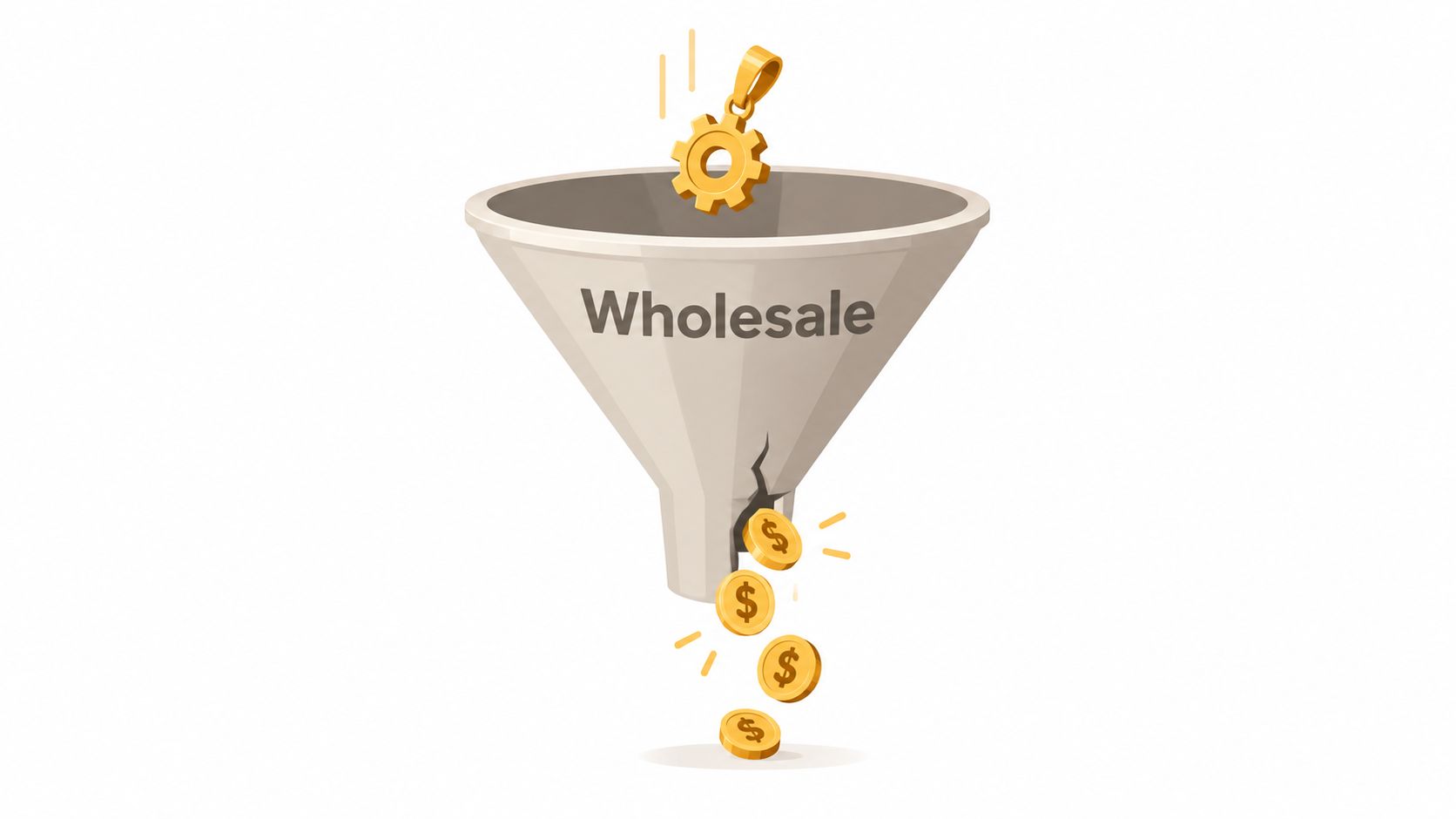
The Opening Width Trap
A bail can clear a chain's nominal diameter and still fail in your customer's hands. It also has to pass over a clasp, end cap, knot, or connector if the pendant is sold as interchangeable. If it can't travel over that hardware, your staff will force it, bend it, or tell the customer to bring a different chain. None of those outcomes protects a boutique margin.
The second failure happens slower. A tight aperture concentrates bending at the bail shoulders and creates constant friction at one narrow contact point. On plated stock, that's where finish disappears first, not evenly across the surface. Customers don't report it as an engineering problem. They say the gold rubbed off and ask for a refund.
Practical rule: Test the complete chain, clasp, bail, and pendant assembly before listing. A component that fits in isolation hasn't passed anything useful.
Gold Is Not a Specification
Reject any supplier sheet that says only gold. You need the base metal, whether the piece is solid alloy or surface coated, the karat fineness, and the plating method if there is one. Without that disclosure, you can't write lawful product copy, compare two quotes, or explain why one bail costs more than another.
Don't start with unit price. Start with assembly clearance and material disclosure. If a supplier can't document both, the low price isn't a bargain. It's unpriced risk you'll absorb through returns, rework, and damaged trust.
Core Anatomy of a Gold Pendant Bail
You can't negotiate geometry you can't name. Every production specification for gold pendant bails should state at least three dimensions, and you should refuse samples that arrive without them.
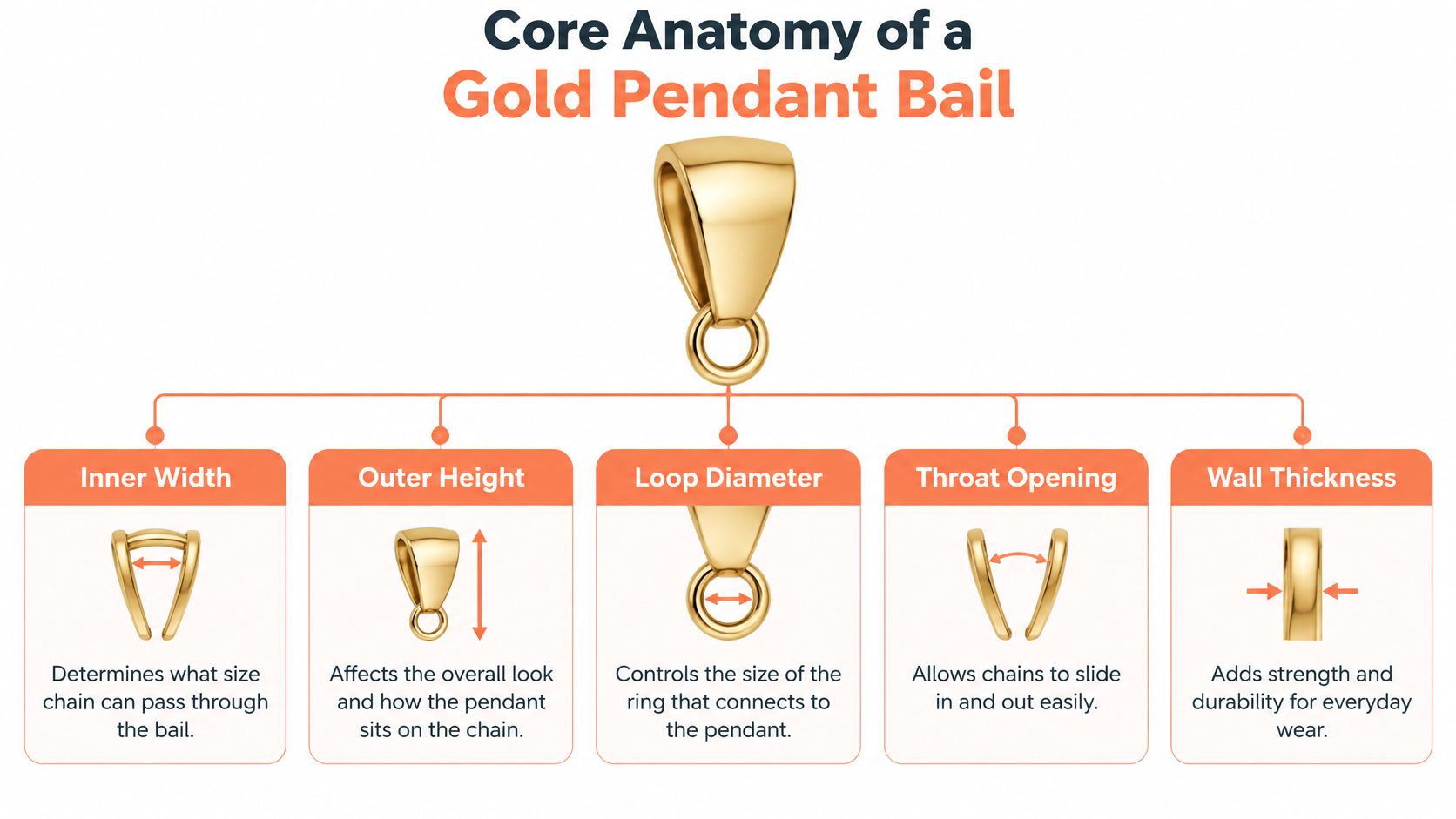
- Inner width: The usable opening the chain occupies. It must exceed the chain's maximum outside diameter enough to permit articulation, not just passage.
- Outer height: The vertical footprint above the pendant. It affects proportion, how the pendant hangs, and whether it flips during wear.
- Loop diameter: The lower connection that joins bail to pendant. It has to match the pendant's jump ring, drilled hole, or soldered attachment.
Add shoulder transition and wall thickness to that conversation. A sharp shoulder abrades chain links. A thin wall deforms when a customer catches a pendant on clothing.
Weight Pairings You Can Actually Use
Use published benchmarks as a starting screen, not as permission to skip testing. Fine chains around 0.8 to 1.2 mm are typically paired with lightweight pendants below approximately 3 g, while 1.3 to 1.7 mm bail openings are more appropriate for 2 to 6 g pendants and medium cable chains, as detailed in guidance on what joins a pendant to a necklace.
Karat choice is also mechanical. 14K gold, at 58.3% gold content, offers more deformation resistance than higher karat alloys while staying workable for forming and soldering. Its reported hardness of approximately 120 to 130 HV, versus 110 to 115 HV for 18K, is in that same source above and matters most above roughly 7 g.
Buy 18K for color and positioning if your customer values it. Don't buy it thin and expect it to behave like 14K hardware.
Comparing Solid Gold, Vermeil, Plated, and Alloy Bails
Don't rank these materials by price. Rank them by wear life, disclosure burden, and the customer you're selling to. A cheap bail on a keepsake pendant is false economy. A solid gold bail on a fast fashion charm can kill an otherwise workable price point.
The FTC distinguishes among solid gold, gold filled, gold overlay, rolled gold, and electroplated products, and notes that plating eventually wears according to wear frequency and layer thickness, as explained in FTC consumer guidance on buying platinum, gold, and silver jewelry. Under U.S. guidance, 14K contains 14 parts gold and 10 parts other metal, while electroplated gold must meet a defined minimum thickness and karat description. Use those distinctions in supplier documents, not loose marketing language.
Gold Bail Material Comparison
| Material | Relative Cost | Wear Life | FTC Labeling | Best For |
|---|---|---|---|---|
| Solid gold alloy | Highest | Longest | State karat fineness | Fine and keepsake pendants |
| Gold filled or overlay | Mid to high | Stronger than thin plating | State construction accurately | Better boutique lines |
| Vermeil | Mid | Depends on gold layer | Identify sterling base and gold layer | Silver based assortments |
| Gold plated base metal | Lowest | Shortest at friction points | State plating, base, and method | Fashion and trend pieces |
| Gold tone alloy | Lowest | Varies widely | Don't imply gold content | Costume assortments |
For a deeper retail framing, read a comparison of gold plated and solid gold jewelry before you set tier names for your shop.
Consider the Bohemian Geometric Tarot Card Necklace with Star and Eye Pendant in Gold-Plated Copper as a specification exercise. It's listed as a men's necklace in Bohemian, minimalist, and punk styles, weighs 8 g, and has 11 variants across three options. At that weight, I wouldn't assess the bail on appearance alone. I'd ask about base metal finishing, section thickness, and whether the bail moves freely without scraping the chain.
Attachment Methods and the Soldering Quality Question
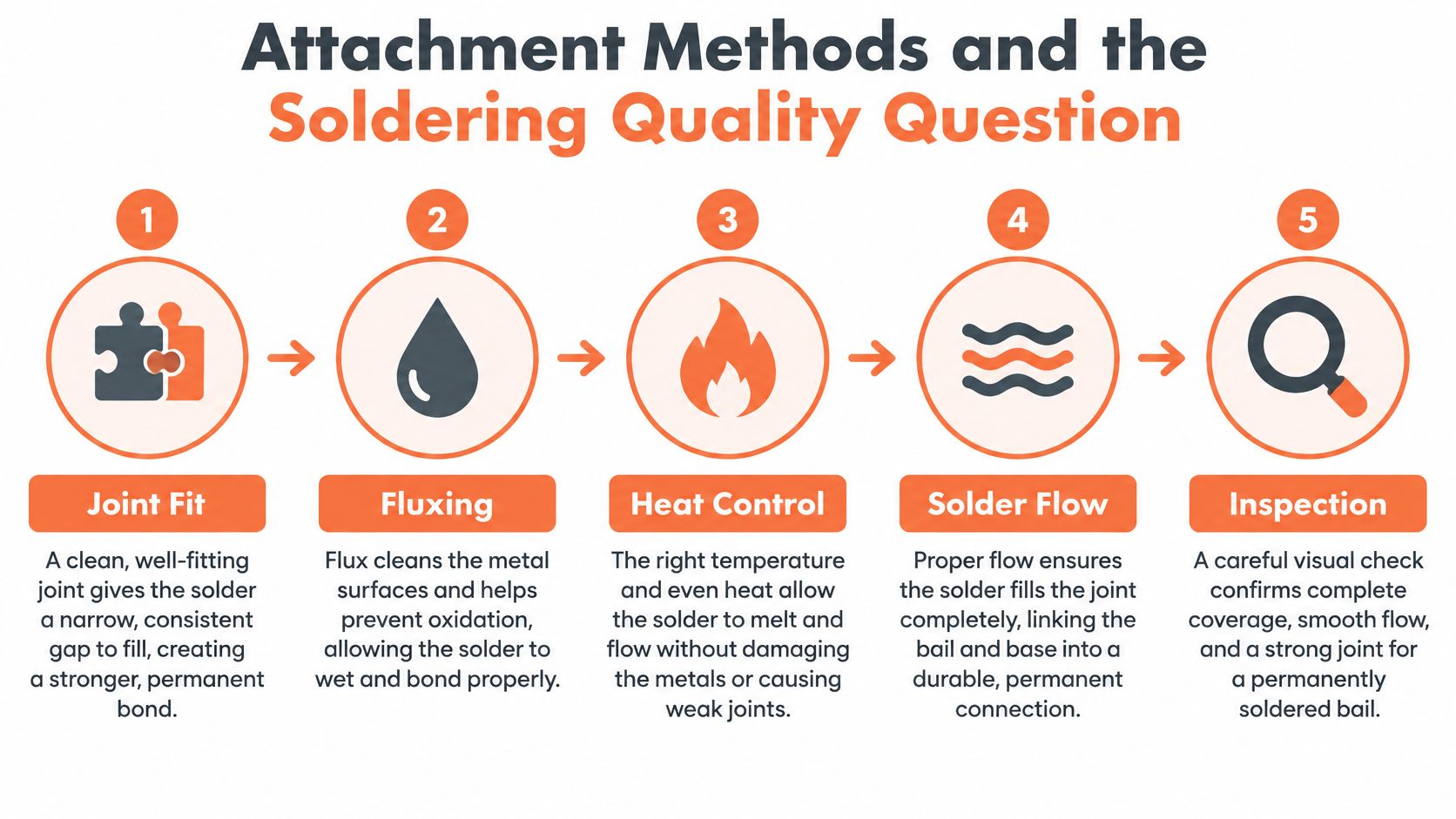
A beautiful bail attached badly is still a defective bail. Soldered attachment gives you a permanent metal to metal joint, but only when the jeweler controls fit, flux, and heat. Mechanical and threaded systems make more sense when interchangeable merchandising matters more than a fixed, uniform look.
What Good Soldering Looks Like
Demand this sequence from any factory making soldered gold pendant bails for your label:
- Align the parts: Confirm joint fit before heat touches metal.
- Apply flux: Protect the joint area and support solder flow.
- Heat both components evenly: Bring solder through the full joint, not just across the visible seam.
- Pickle and inspect: Check for incomplete flow under magnification.
- Rework, then finish: Correct defects before filing or sanding hides them.
Localized heating can leave a seam that looks closed but lacks proper wetting. Under repeated pendant motion, that partially fused interface opens. Your customer finds the flaw by losing the pendant.
Reported soldered bail tensile performance of up to about 220 N and service life of 8 to 12 or more years under suitable installation conditions appears in technical guidance on attaching a pendant to a necklace. Treat those figures as installation dependent benchmarks, never as a blanket promise for every supplier.
Reject samples with gaps, excess solder, overheating discoloration, or sharp transitions. Don't negotiate those defects down. Reject them out.
Write magnified junction inspection into your purchase order. If the supplier pushes back, you've learned something important before wiring a deposit.
Matching Bails to Chains and Pendants in Real Assortments
Compatibility isn't a guess based on chain width. It's a five measurement protocol you run in the sample room with the chains your customers own.
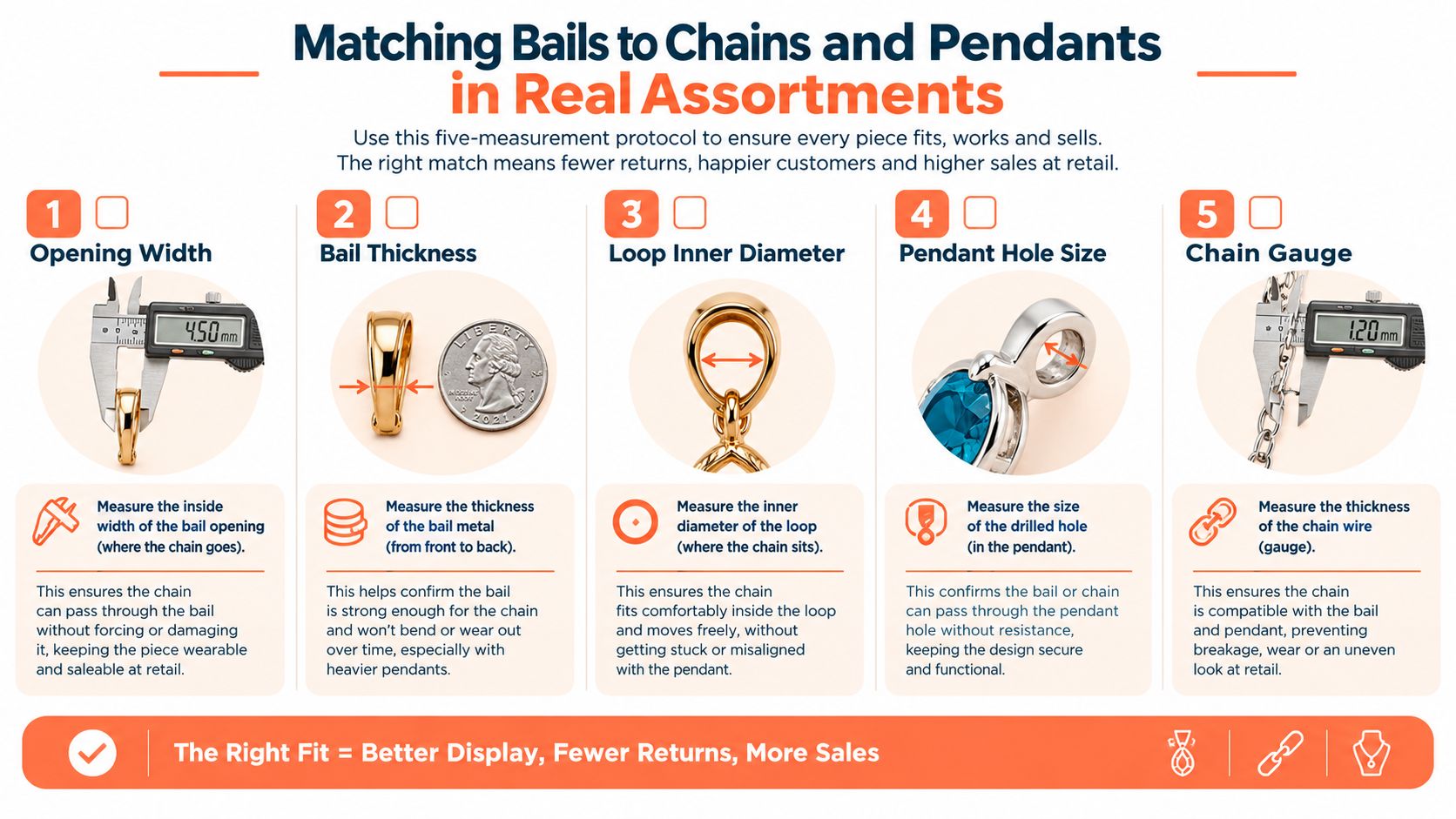
- Narrowest internal opening: Measure the tightest point, not the widest decorative curve.
- Chain thickness: Check the maximum outside diameter, including textured or twisted links.
- End hardware: Pass the bail over the clasp, end cap, knot, or connector it must clear.
- Pendant thickness: Confirm the lower loop closes without pinching or tilting the pendant.
- Movement during wear: Slide, swing, and rotate the assembled piece. Listen and look for scraping.
Where Assortments Break
The classic failure is a bail sized for a fine cable chain that won't pass a box clasp end cap. Another is a pendant that hangs correctly on a display bust but flips because the bail's outer height and loop position fight its center of gravity. A third is plating loss at the top inner curve, where the chain bears the load every day.
Build your test set from best selling chains, not from whatever sample chain the factory sends. If you're rebuilding that chain assortment, wholesale gold chain sourcing guidance can help you align chain styles with pendant programs.
Specify a clearance margin in writing. Passage isn't enough. You want smooth articulation, no shoulder bite, and no forced threading that bends the bail during a routine chain swap. That's the standard I'd apply to every mixed pack, every time.
Sourcing Signals That Separate Reliable Suppliers From the Rest
Price is the loudest signal in wholesale jewelry and usually the least useful. Vet gold pendant bails on documentation first. A supplier who can't document material can't protect your margin, your listings, or your reputation.
Three Documentation Layers
- Material and karat disclosure: Base metal, gold fineness, and whether gold is structural alloy or a surface layer.
- Plating specification: Thickness, karat description, weight ratio where relevant, and application method.
- Independent verification: Test reports or certification records that tie claims to the actual production lot, such as SGS style documentation where available.
Don't accept a catalog screenshot as evidence. Ask for specifications tied to the SKU, material batch, and production run you're buying. If a factory changes base metal or plating method between sample and bulk, your product copy can become wrong without anyone telling you.
Recycled content claims need the same discipline. The U.S. Geological Survey estimated 90 metric tons of new and old gold scrap were recycled in 2024, equal to about 45% of reported U.S. gold consumption, while domestic recycled supply declined 6% from 2023, according to the USGS mineral commodity summary for gold. That market context can affect availability and pricing. It doesn't prove that a specific bail contains recycled gold, and it doesn't replace product level documentation.
Supplier test: Ask one precise question about plating thickness and method. A reliable supplier answers with a document. A risky one answers with adjectives.
Apply the same standard to related findings. When you review matching hardware, gold lobster clasp sourcing considerations should be assessed alongside the bail so finish, disclosure, and mechanical feel stay consistent across the finished necklace.
Care, Finish, and Smart Pricing for Boutique Margins
A bail rarely fails all at once. It dulls, loosens, catches, then wears through at the friction zone. Price and position it for that reality instead of pretending every finish ages the same way.
Care Advice That Reduces Returns
Tell customers to remove plated pendants before swimming, showering, workouts, and perfume application. Store the pendant so the bail doesn't rub against harder chains or stones in a crowded pouch. Clean gently with a soft dry cloth, and don't use abrasive dips on coated findings unless the supplier confirms compatibility.
Train staff to inspect the top inner curve during repairs and exchanges. That's the load bearing contact zone. Early finish wear there tells you whether the chain pairing is too tight or the plating tier was wrong for the pendant's weight and intended use.
Pricing Without Inviting Trouble
Build margin from the complete offer, not from vague gold language. Charge for better material tiers, cleaner soldering, gift ready packaging, and tested chain compatibility. Those are benefits customers can see and you can defend.
Don't inflate copy to justify markup. FTC jewelry industry rules state that it's deceptive to misrepresent the presence, quantity, or karat fineness of gold or gold alloy, as well as the karat fineness, thickness, weight ratio, or application method of gold plating, covering, or coating, as set out in the FTC jewelry guides federal register notice.
Use gold plated, vermeil, and karat terms only when your supplier documentation supports them. Accurate labeling supports higher prices because buyers understand the tier. Sloppy labeling creates chargebacks, marketplace complaints, and repair promises you never intended to make.
For independent boutiques, I'd put tested, well documented bails in the core line and reserve the cheapest coated findings for clearly labeled fashion pieces. That segmentation protects both margin and credibility.
Your Four-Step Wholesale Bail Sourcing Checklist
Run this protocol before you approve any order of gold pendant bails. Don't let a deadline turn it into optional paperwork.
The Pre Order Protocol
- Confirm geometric specification: Get inner width, outer height, loop diameter, wall thickness, and shoulder finish in writing.
- Confirm material disclosure: Identify base metal, solid alloy versus coating, karat fineness, and any recycled content claim at product level.
- Confirm plating method: Record thickness, karat description, and application method where plating is used, plus the inspection standard for soldered joints.
- Confirm assembly compatibility: Test samples over your actual clasps and end caps, on your actual chains, with representative pendant weights.
An acceptable sample moves freely, hangs straight, shows no solder gaps under magnification, and matches its paperwork. Photograph it beside the chain and clasp used in testing so bulk production can be checked against a real approved assembly.
Handle listing images with the same precision. Prepare the website cover on a 383 to 204 proportion, approximately 1.877 to 1, with safe margins so the bail isn't cropped. Separately, Google Merchant Center recommends product images of 1,500 by 1,500 pixels or larger, with the product occupying 75% to 90% of the frame on a clean solid or light neutral background, while non apparel images must be at least 100 by 100 pixels and no larger than 64 megapixels at 16 MB, per Google Merchant Center product image guidance. Keep the banner and square feed image as separate assets.
Use the checklist on your next supplier call. If answers get vague, slow the order down.
Visit JewelryBuyDirect to source gold pendant bails, chains, clasps, and coordinated findings with specifications you can test against your own assortment before committing. Build your next order around documented materials, verified clasp clearance, and samples that pass the complete assembly test, not around the lowest unit quote.