





Cathy Lopez | Sat Nov 14 2026
Cable Chain vs Rope Chain: Which One to Buy
Search for cable chain vs rope chain and you'll hit the same advice in a dozen different fonts: rope is the strong one, cable is the pretty one, so hang your heavy pendant on rope and your charms on cable. That ranking is the least useful thing you can learn about a chain. It describes a link pattern and promotes it to a durability specification.
A chain's ability to survive a year on a customer's neck depends on the pendant's weight, the thickness of the wire or strip, whether the links are solid or hollow, whether the joints are soldered, and whether the clasp and end rings can carry the load. Two cable chains from two factories can differ more in strength than a cable and a rope from the same factory.
Buy the link pattern that suits the job, then test the build before you list it. That's the order that keeps returns down, and it's the order this guide uses.
Cable and Rope Chains at a Glance
Cable and rope differ in how the links are built and where a pendant's weight travels. Everything else follows from those two facts.
| Criterion | Cable chain | Rope chain |
|---|---|---|
| Construction | Identical oval links alternating at 90 degrees | Two or more smaller strands twisted into a spiral |
| Surface and shine | Open, simple link lines | Dense, faceted surface that reflects light from many angles |
| Drape and feel | Fluid and light, comfortable for layering | Heavier feel and more structured drape |
| Load on a pendant | Concentrates force at one link junction | Spreads load across overlapping contact points |
| Best starting use | Light pendants, charms and everyday basics | Heavier pendants, statement pieces and solo-wear designs |
Read the load row first, against the pendant you plan to hang. A cable chain passes force through one junction at a time. A rope chain shares it across the overlapping contacts in the spiral. That single difference explains most of what customers notice later, from how a pendant sits to where a chain eventually gives.
Cable is a line of identical oval links, each rotated 90 degrees from its neighbor. The pattern is old enough that museum records cited in Caligio's history of chain types place comparable interlocking gold chains in the eastern Mediterranean, Egypt, and Etruria before 500 BCE, with Roman examples from roughly the 1st to 4th centuries CE still showing the same recognizable geometry more than 1,500 years later. That continuity is a commercial fact, not a romantic one. The open, regular link is easy to produce, inspect, repair, and combine with different gauges and metals.
Rope twists two or more strands of smaller links around one another into a continuous spiral. The surface is denser, it throws light from more angles, and the chain feels more structured in the hand. Cable drapes fluid and light, which is why it layers so well under a charm or a second chain.
Start with cable for light pendants, charms, and everyday basics. Start with rope for heavier pendants, statement pieces, and solo wear where the chain is the design. Then remember that the pattern sets none of the strength on its own: wire diameter, alloy, link closure, soldering, and clasp design do. A thick, well-finished cable will outlast a fine rope every day of the week.
How Link Construction Shapes Each Chain
The link pattern shapes the look, but it does not determine durability. Buyers should compare the build: pendant weight, wire gauge, solder quality, and whether the chain is solid or hollow.
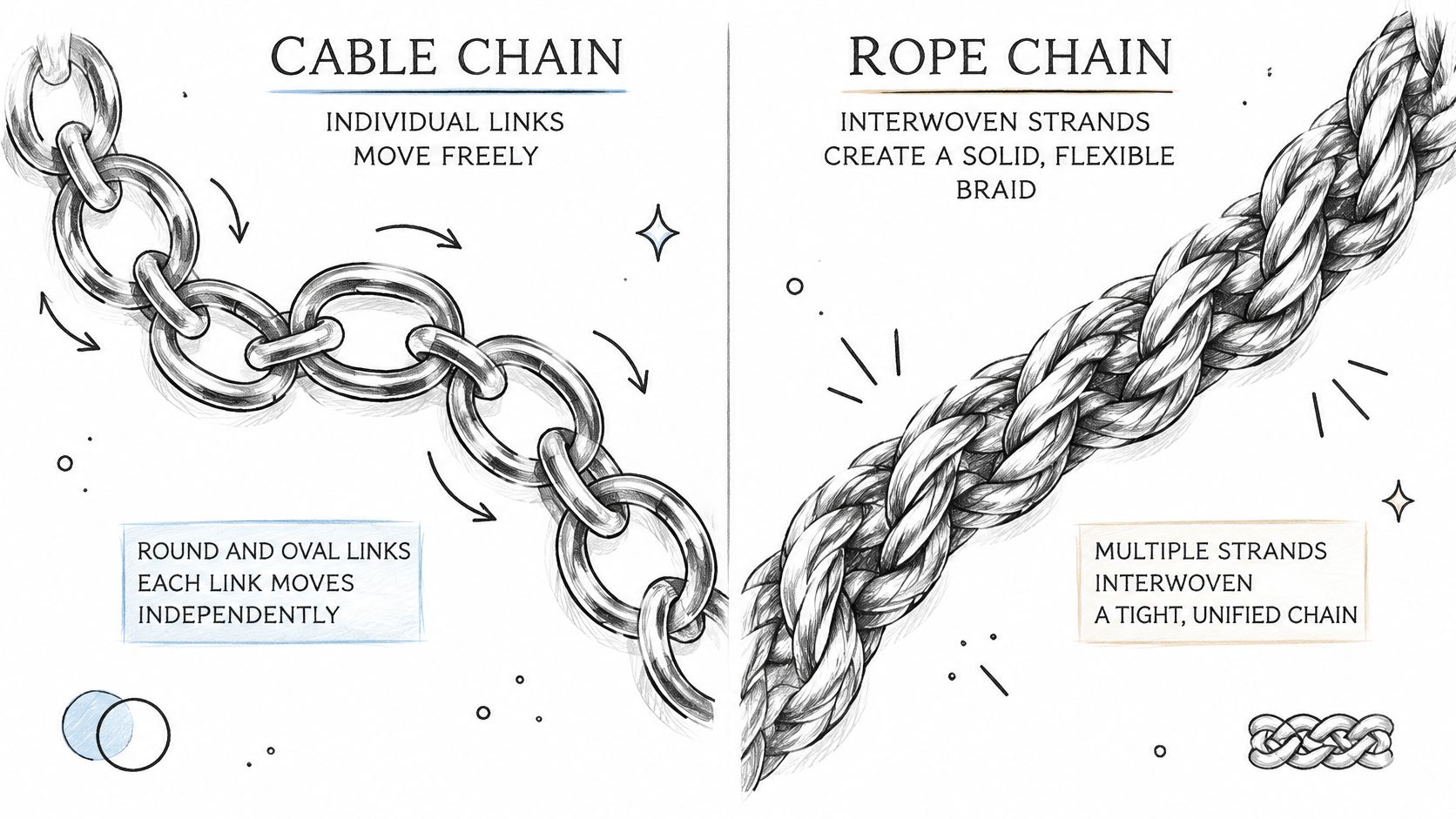
Cable's open, regular links give it a clean, understated look that suits charms and pendants. Rope's spiral surface catches light from multiple angles, so it reads as a more prominent design worn on its own. Choose by the effect you want, then check the specifications that determine whether the chain can handle its intended use.
Read the build, not the name. Link type, strand count, wire gauge, and solid or hollow construction belong on the spec sheet before the words “cable” or “rope” do.
An industrial tensile comparison found that a round-link chain failed at 18,049 pounds, while a conveyor cable failed at 4,723 pounds, about 3.8 times lower. The cable also stretched 2.4 times more, according to the MPE Chicago chain versus cable case study. These are not jewelry ratings. They show why a chain's visible pattern cannot stand in for its material and construction specs.
How Each Chain Handles Pendant Weight and Wear
Pendant weight sets the starting point, but the chain's measured gauge and construction decide whether it can carry that load. Ask for the wire or strip thickness in millimeters and whether the chain is solid or hollow. Avoid treating “light” or “heavy” as useful specifications without those details.
For a light pendant, either style can work when the gauge, soldering, clasp, and end rings are sound. For a heavier pendant, request those specifications before choosing a chain. A rope pattern alone does not make a fine-gauge chain suitable for a heavier load.
Match the weight first. Weigh the pendant, check the chain's gauge and construction, then confirm that the bail fits the end fitting.
Two weights, two verdicts
Treat the Minimalist Retro Hemp Braid Pendant Necklace as a style example, not a weight recommendation: its titanium steel chain has a textured rope design, but no pendant weight is specified. Confirm the complete piece's specifications before selling it for a particular use.
The same rule applies to the Retro Geometric Star Pendant Necklace with Tassel and Rope Chain. Its tassel places the pendant below the chain, so check the actual pendant weight and the chain's gauge rather than assuming the rope construction can support it.
Where each one fails
- Cable failure: A snag or pendant load can open or elongate a link, or fatigue its solder joint.
- Rope failure: Kinking, snags in hair or knitwear, and damage within the spiral can compromise wear.
- Check the full setup: Wire or strip thickness, link proportions, soldering, clasp, end rings, chain length, metal hardness, and solid or hollow construction all affect performance.
The bail must clear the chain's end fitting and slide without binding. Use this guide to gold pendant bail openings and chain fit to check compatibility. Reject any pairing where the chain's gauge and construction do not match the pendant's weight.
Repair and Quality Checks Before You Buy
A chain's link pattern tells you less about durability than its construction. Check the wire gauge, pendant weight, solder quality, clasp and end rings, and whether the chain is solid or hollow. Rope links can be harder to isolate and reassemble after a break than individual cable links, so include repairability in your buying decision. Hollow rope chains can dent and show wall wear.
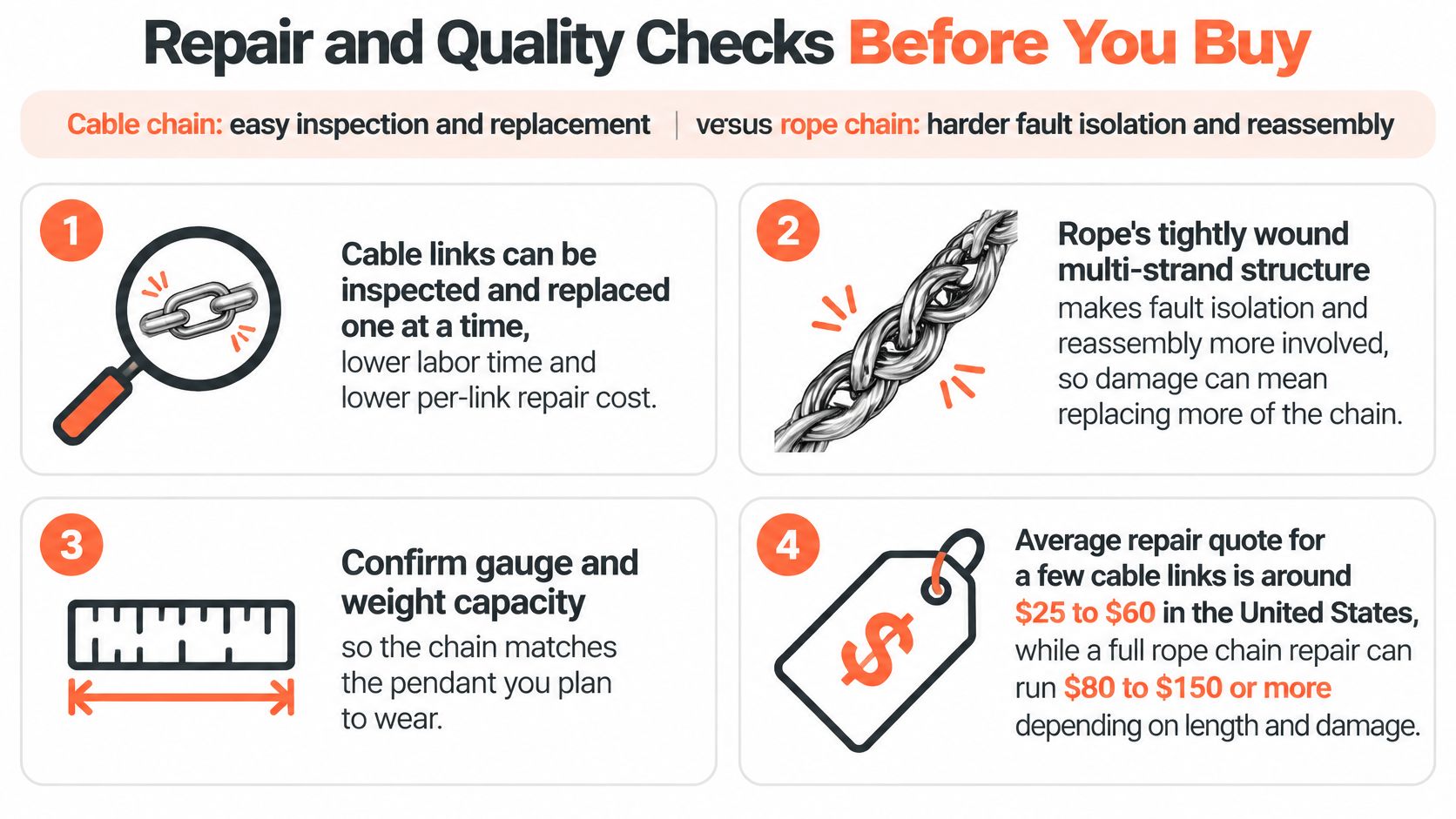
The six checks
- Confirm solid or hollow, then inspect the joints. Check whether the links are soldered, and ask for the construction spec in writing. Hollow builds save weight and cost, but give up dent resistance.
- Inspect the clasp and end rings as one system. Look for gaps, flat spots, and thin welds. A weak jump ring can fail before the chain does.
- Check the stated gauge against the pendant. Ask for the wire or link measurement in millimeters and compare it with the pendant's weight. “Medium” is not a specification.
- Bend and pull a sample. Gently bend a short section in both directions, then pull each end with steady hand tension. Watch for opening links, stretching, or new kinks.
- Re-inspect a rope sample after bending. Run it through your fingers and look for a section that no longer moves with its neighbors. Stiffness can signal damage hidden in the spiral.
- Record the result against the SKU. Log the gauge, construction, solder, clasp type, and pass or fail before listing the item.
Use the same checks for both styles. A cable or rope label cannot substitute for a construction specification, and a sound sample should match the chain you order.
Metal Labels and Price Trade-offs for Chains
A metal label is a claim you can verify, not a style note. Get it wrong on a product page and the problem isn't aesthetic.
The U.S. Federal Trade Commission states that "silver," "sterling," and "sterling silver" describe products containing at least 92.5% pure silver, and that the mark "925" means 925 parts per thousand are pure silver, in its guide to buying platinum, gold and silver jewelry. That gives you a benchmark to hold against supplier paperwork and the actual stamp on the piece.
| Metal label | What it means | Buyer check |
|---|---|---|
| 925 sterling silver | At least 92.5% pure silver, marked 925 | Confirm supplier documentation and the product stamp |
| Vermeil | Sterling-silver base, gold coverage on all significant surfaces, at least 10-karat gold, at least 2.5 microns of fine gold | Request base metal and gold thickness documentation |
| Silver plate | Silver layer applied over a base metal | List as silver plate, never as sterling |
| Gold-plated brass or copper | Gold layer over a base metal | Avoid implied solid gold; state plating method and karat |
| Stainless or titanium steel | Base metal with no silver content | Describe the material and finish accurately |
Where the price difference actually comes from
Vermeil is a construction category, not a synonym for gold plating. Under the FTC's jewelry guidance, vermeil must have a sterling-silver base, gold or gold-alloy coverage on all significant surfaces, gold of at least 10-karat fineness, and a minimum thickness equivalent to 2.5 microns of fine gold, as set out in the Federal Register's Guides for the Jewelry, Precious Metals, and Pewter Industries. Claim it only when the supplier can document both the 925 base and the gold thickness.
That threshold is what separates a higher-value plated chain from a cheap gold-plated piece over brass or copper. The price gap isn't about cable versus rope at all. A titanium steel snake chain with an electroplating finish in our catalog lists at $3.94, and an 18K gold plated titanium steel letter necklace lists at $1.57. Both sit in the accessible entry range on the strength of the base metal, not the link pattern. Compare a plated chain with a sterling one on metal content and weight, and our breakdown of what a silver chain costs shows how much of the retail price is actual silver.
Write the label into the product page
The FTC Jewelry Guides require marketers to represent jewelry truthfully across type, kind, grade, quality, quantity, metallic content, size, weight, durability, serviceability, origin, price, value, production, manufacture, and distribution. Treat that list as a product-page template. Name the plating method, the karat of the gold layer, and the dimensions in millimeters, and don't let a broad label imply more precious metal than the piece contains. A low factory price doesn't remove the obligation, and it won't survive a single customer complaint that the chain "looked gold" online.
Which Chain Fits Which Buyer and Use
A 2025 consumer survey found 43% of respondents likely to purchase necklaces in the following 12 months, alongside interest in bold chains, minimalist pieces, mixed metals, layering, and charm-based designs, according to Gifts & Decorative Accessories' fashion jewelry trend coverage. For buyers, that means choosing chain specifications to suit the pendant, finish, and intended wear, rather than relying on the pattern name.
Positioning that sells
Set the gauge against the pendant's weight, then check that the bail clears the link and end fitting. For layered styles, choose lengths with enough separation to limit contact between chains, especially when finishes are plated. The necklace chain length guide explains where 16-, 18-, and 20-inch lengths sit.
Build each offer around the specifications the buyer can assess:
- Charm bar or light-pendant assortment: State the gauge and chain length, and confirm the bail fits. A clear base-metal label helps buyers compare entry-price options.
- Everyday stack: Specify each length so the chains sit apart at the collarbone. Note the finish, since plated surfaces can wear where layers rub.
- Heavy-pendant offer: Match gauge to pendant weight. Include the clasp and whether the chain is solid or hollow in the product details.
- Gift worn alone: Choose a chain whose gauge and construction suit the pendant, and describe the metal and finish precisely.
- Mixed-metal set: Label each piece's base metal and plating separately. That gives buyers a useful comparison without asking the chain pattern to explain the whole set.
Treat contact points as part of the design. Check a sample for rubbing where the chains meet, and keep the product-page specifications consistent with the item being sold. A pattern can help shape the look, but gauge, clasp, construction, and accurate metal labeling make the offer easier to evaluate.
Confirm the Right Chain Before You Order
Record each chain as a specific SKU, not just as “cable” or “rope.” Put the link pattern, gauge in millimeters, solid or hollow construction, soldering, clasp style, metal label, and intended pendant weight in the product record. That gives buyers a clear basis for comparing samples and reordering the right specification.
JewelryBuyDirect carries necklaces, bracelets, rings, earrings, and body jewelry, including chain necklaces and pendants. Its no-minimum-order policy, 7-day returns, and damage protection let sellers assess a chain-and-pendant pairing before ordering in volume. Trending products include chain necklaces, luxury pendants, tennis bracelets, letter pendants, hoop earrings, vintage studs, zirconia rings, and snake bangles.
Keep the approved SKU record with the sample and purchase order. When a chain needs replenishing, the written specifications help ensure the replacement matches the one you approved.
Cable and rope both belong on your shelf, but choose them by pendant weight and written specifications. JewelryBuyDirect stocks chain necklaces, pendants, and jewelry-making components, with no minimum order and 7-day returns. Order samples in the specifications you intend to sell, compare them with the pendant, then reorder the combination that meets your requirements. Visit JewelryBuyDirect to review the catalog and place a test order.