






Jennifer Lopez | Sun Oct 25 2026
304 Stainless Steel Jewelry: What Retailers Need to Know
304 stainless steel is a durable, low-cost choice for everyday jewelry, but it isn't automatically hypoallergenic or built for repeated pool or seawater exposure. With roughly 8.0–10.5% nickel in the alloy, the documented grade, finished-piece nickel-release evidence, and finish decide whether a given SKU belongs in your assortment.
The popular advice to buy anything labeled stainless, hypoallergenic, and waterproof is too loose for a business buyer. Those words don't tell you what's underneath the coating, how the finished piece behaves against skin, or whether your customer can reasonably wear it swimming. Buy against a specification, not a string of reassuring adjectives.
Why 304 Stainless Steel Is the Retail Workhorse
A stainless-steel label names a family, not the grade a retailer is buying. 304 earns its place in everyday jewelry assortments through its bright appearance, formability, and corrosion resistance, while keeping pieces accessible without precious-metal pricing. The label still needs evidence behind it.
A 2026 Alibaba market guide reports a 2024 global stainless-steel jewelry market estimate of $7.3 billion, with a projection of $10 billion by 2032. These figures describe stainless-steel jewelry as a whole, not 304 specifically. They provide category context, but they do not establish demand for a particular 304 SKU or prove that its quality will meet customer expectations.
Buy the grade, not the family name
A polished product photo and a low wholesale price cannot confirm the alloy, coating quality, or suitability for prolonged skin contact. Ask the supplier to identify the grade and provide evidence for the finished piece.
Buying rule: A low purchase price is useful only when the supplier can explain exactly what you're buying.
Start with the material. Then check how the actual construction affects the buying decision: a bangle may pass a 304 chemistry check, while its plated clasp wears poorly. Grade and finish both matter to the product a customer receives.
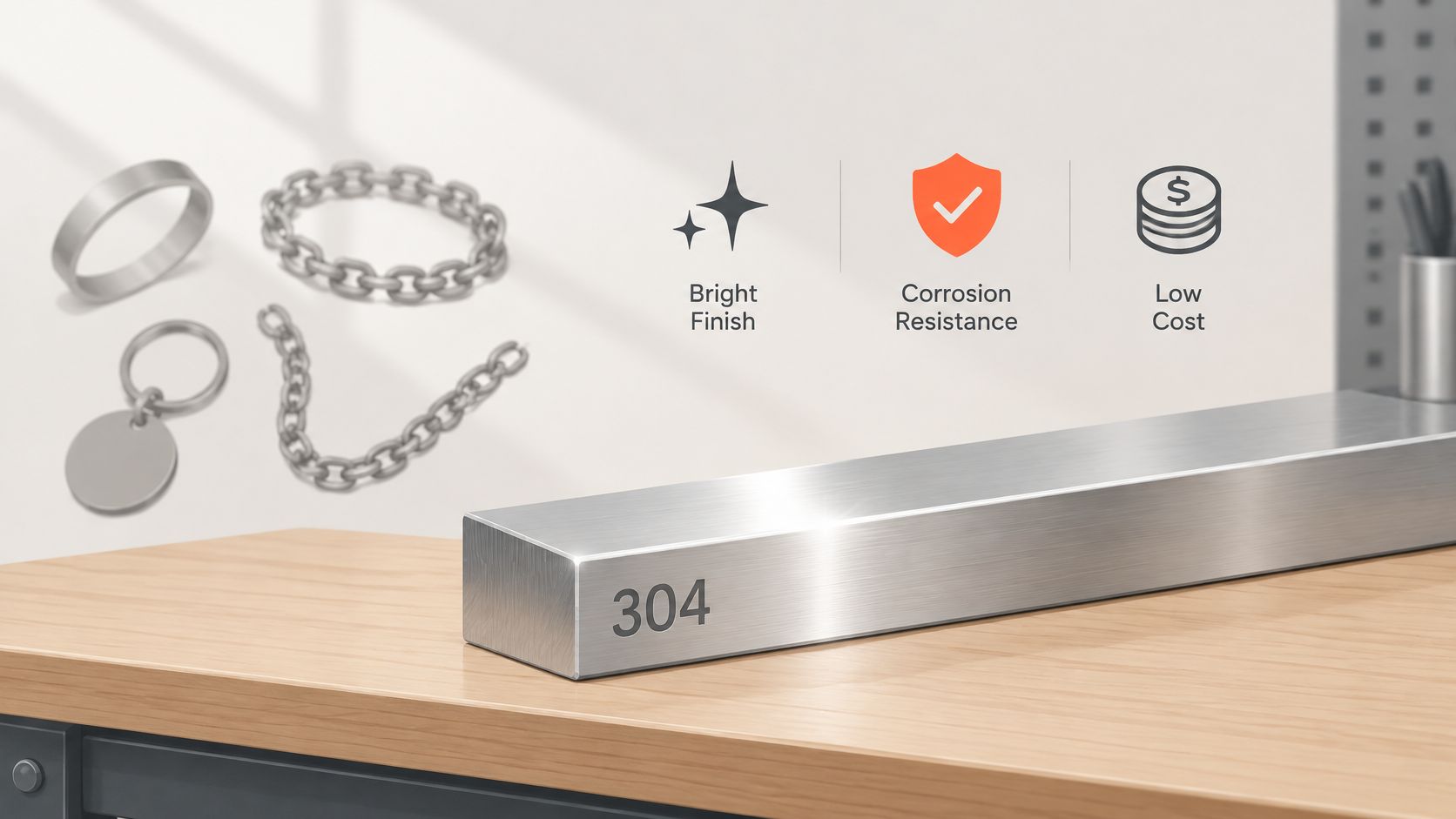
Match the SKU to its intended wearer and exposure conditions, then set a durability promise that the materials and finish can support. Ask what grade is used, what finish is applied, and how the finished piece is expected to hold up in its intended use.
Does this SKU have the right grade, finish, and exposure profile for the person who'll wear it?
What 304 Stainless Steel Is Made Of and What the Numbers Mean
304 is an iron-based austenitic chromium–nickel alloy. The following chemistry ranges and minimum mechanical values provide a useful purchasing benchmark, drawing on the thyssenkrupp 304 material data sheet and the commonly cited ASTM A240 composition specification.
| Property | 304 value | What it means for jewelry |
|---|---|---|
| Chromium | 17.5–19.5% | Builds the self-repairing film that resists tarnish |
| Nickel | 8.0–10.5% | Supports austenitic structure, bright appearance, and formability |
| Carbon | 0.08% maximum | A controlled chemistry requirement, particularly relevant around fabrication and welds |
| Iron | Balance | The base metal, which is why it's steel |
| Tensile strength, minimum | 515 MPa | A material benchmark for resistance to pulling forces |
| Yield strength, minimum | 205 MPa | A material benchmark for resistance to permanent bending |
| Elongation, minimum | 40% | Indicates ductility for forming, stamping, and bending |
The chromium–nickel 18-8 formulation has historical roots in the corrosion-resistant austenitic alloy patented by Krupp engineers Benno Strauss and Eduard Maurer on October 17, 1912, as described in thyssenkrupp's stainless-steel development history. For buyers, the important distinction is that corrosion resistance comes from the bulk alloy, not merely a decorative surface coating.
Translate the specification into a finished piece
Think of chromium's passive oxide film as a self-patching sealant. It can re-form after minor surface disturbance under suitable conditions, helping protect the underlying metal during ordinary atmospheric exposure. That doesn't make the surface immune to aggressive chemicals or trapped salts.
Nickel helps establish the austenitic structure that supports forming chains, hollow components, and stamped findings. Its manufacturing value and its skin-contact implications are separate questions.
Mechanical values also need context. Tensile strength matters when assessing thin chain links and clasps; yield strength matters when evaluating whether a ring or bangle takes a permanent set. Elongation tells the manufacturer how readily the material can be shaped without cracking.
None of those values guarantees a finished clasp will survive poor construction. Joint design, weld quality, component thickness, and finishing still matter. Request the material specification, then inspect the actual jewelry against it.
Where Each Grade Holds Up
Choose 304 for ordinary fashion wear and favor 316L when repeated chloride exposure is part of the intended use. Don't upgrade every item automatically, but don't sell an everyday fashion piece as swim jewelry just because it's stainless.
The useful distinction is repeated exposure, not whether a piece can ever get wet. Technical jewelry-care guidance comparing tarnish and corrosion behavior identifies 304 as more vulnerable than 316L to localized pitting during repeated pool or seawater contact.
| Factor | 304 | 316L | Practical impact |
|---|---|---|---|
| Chromium | As specified in the composition table | Confirm against the supplier's grade specification | Both rely on a self-repairing passive film |
| Nickel | As specified in the composition table | Confirm against the supplier's grade specification | Nickel content alone doesn't establish release |
| Molybdenum | Not specified here | Require documented alloy chemistry | Verify the composition behind the chloride-resistance claim |
| Repeated pool or seawater exposure | More vulnerable to pitting | More resistant | Favor 316L for frequent aquatic exposure |
| Everyday sweat and showers | Generally suitable with appropriate care | Generally suitable with appropriate care | Check the coating and construction too |
| Relative cost | Cost-effective everyday option | Budget for a possible premium | Compare actual landed quotations |
Exposure matters more than the waterproof label
Both grades depend on their protective surface condition. Scratches, prong gaps, hinge recesses, and plating defects can create places where chlorides remain concentrated.
A quick shower followed by drying isn't the same use case as regular ocean swimming. Likewise, light gym wear and prolonged contact beneath a tight, sweaty bracelet deserve different care guidance.
For a closer purchasing comparison, use this explanation of what 316L stainless steel jewelry is alongside the supplier's own documents. A general grade description doesn't replace confirmation of the item you're ordering.
Replace waterproof with a description of the exposure you're prepared to support.
For daily wear and gifting, documented 304 is a sensible commercial choice. For frequent swimmers and sea wear, specify 316L, check the finish, and price the item accordingly.
For body jewelry, neither grade name settles suitability. Treat it as a specialist purchase that requires finished-product evidence, not just a stronger corrosion-resistance claim.
The merchandising opportunity is straightforward: offer different products for different routines. Don't make the affordable everyday line carry promises that belong to a more demanding specification.
Nickel Release and Why 304 Is Not Automatically Allergy-Safe
The grade alone cannot establish how much nickel a finished piece releases. A European Commission technical review reported that tested low-sulfur AISI 304 examples released less than 0.03 µg/cm²/week in artificial sweat at pH 4.5. Those specimens had sulfur content no higher than 0.007%.
Treat that result as evidence about the tested specimens and conditions, not a guarantee for every necklace, post, or ring sold as 304. Surface finish, passivation, manufacturing quality, wear, and sweat chemistry can affect nickel release. Request evidence for the finished article, especially when coatings, joints, or mixed-material components are involved.
Understand the limit before approving the listing
The EU REACH nickel restriction for prolonged skin contact and piercing assemblies sets the limits below. Products exceeding the applicable threshold can't be placed on the EU market.
| Product type | EU limit, µg/cm²/week | Evidence to request |
|---|---|---|
| Earrings, necklaces, bracelets, chains, rings, watch cases | 0.5 | Nickel-release test report |
| Anklets and metal components used in clothing | 0.5 | Nickel-release test report |
| Pierced-ear posts and body jewelry inserted into piercings | 0.2 | Test report against the stricter limit |
| Decorative plated pieces without prolonged skin contact | Assess actual intended use before assigning the applicable requirement | Coating specification and supplier declaration |
The unit measures a release rate per contact area over time, specifically per square centimeter per week. Ask which limit applies to the item's actual use.
Check earring reports closely. The decorative body and the post may fall under different contact categories, so a broad report labeled “earrings” may not show that each component was assessed correctly.
Ask for a report that matches the product
Request an EN 1811 nickel-release report, product identification, test date, tested finish, and a clear link to the supplied SKU or batch. Confirm whether the report covers the complete item or only its raw material.
For shoppers and buyers, what nickel-free jewelry means depends on the claim and supporting evidence. Ask suppliers to define terms such as nickel-free, surgical steel, and hypoallergenic, then request the relevant documentation rather than treating those labels as product specifications.
The European review also warns about high-sulfur free-machining stainless grades in prolonged skin-contact applications. For someone with a diagnosed nickel allergy, a 304 grade label alone is not enough to establish suitability, and a compliant test result cannot guarantee personal tolerance.
Finishes and Plating Options That Change the Look and Lifespan
Buy the surface specification separately from the base-metal specification. Polishing and brushing change the steel's surface texture; plating and PVD add a coating. Calling all of them finishes is convenient, but they aren't the same construction.
A silver-colored sample can look excellent without proving anything about a gold-tone version from the same collection. Evaluate each finish you intend to sell.
| Finish | Buying appeal | What to inspect |
|---|---|---|
| Bare polished 304 | Cool silver appearance without a decorative color coating | Scratches, polishing consistency, sharp edges, and crevices |
| Brushed or satin 304 | Understated texture for everyday rings and bangles | Consistent grain and how sample wear changes the surface |
| Gold-tone, rose-gold-tone, or black PVD | Colored surface option for coordinated collections | Coating specification, adhesion evidence, and wear at contact points |
| Electroplated gold tone | Another route to a warm-colored assortment | Layer specification, edge coverage, and sample wear-through |
Don't buy a durability ranking without evidence
For an everyday silver-colored line, bare polished or brushed steel is a straightforward starting point. There's no decorative color layer whose loss changes the piece from gold tone to silver tone, although scratching and surface damage still require inspection.
Brushed finishes are worth sampling for friction-heavy designs because their texture may make everyday marks less conspicuous. With polished surfaces, inspect under ordinary store lighting rather than relying on edited product photography.
For coated pieces, don't accept PVD lasts longer as the whole specification. Use a guide to PVD coating on jewelry to frame questions, then ask for the supplier's actual wear and adhesion evidence.
Approval standard: The coating name tells you the process category. The sample and supporting test results tell you whether to buy.
Deep damage can expose the underlying steel, and high-friction edges deserve particular attention. Inspect ring undersides, bracelet contact points, clasp edges, and pendant loops.
The FTC Jewelry Guides require truthful representations of material, treatment, durability, and other product characteristics. Use wording such as gold-tone PVD on 304 stainless steel when that accurately describes the construction, rather than implying solid gold or sterling silver.
Ask the supplier: Which coating process is used, and what wear or adhesion results support this finish on this product?
Caring for 304 Stainless Steel and Fixing Common Problems
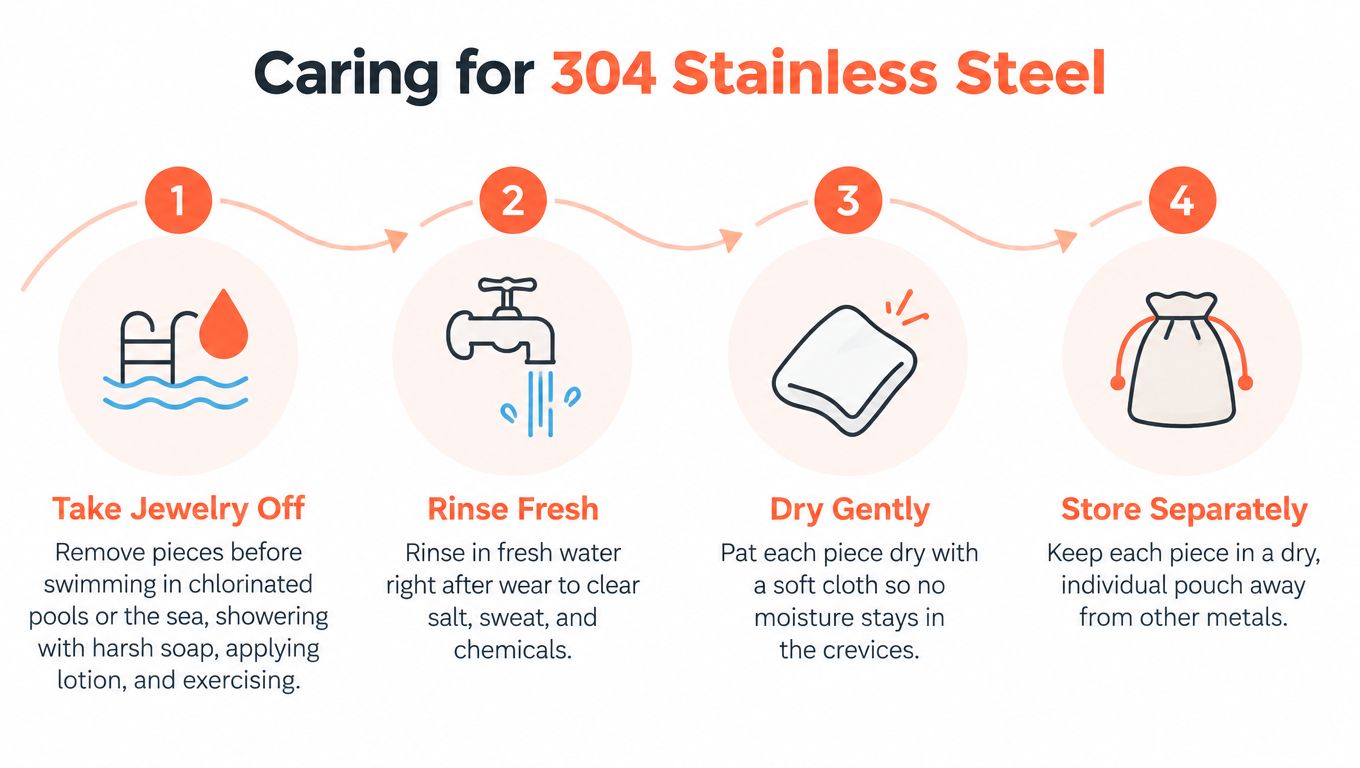
Give customers a simple care routine, and have staff follow the same steps when assessing complaints.
- Remove before aggressive exposure. Take jewelry off before swimming in pools or the sea, showering with harsh soap, applying lotion, or exercising when practical.
- Rinse promptly. After accidental chlorine or saltwater contact, rinse with fresh water so residue does not dry in crevices.
- Clean gently. Use mild soap and warm water. A soft brush can reach chain links and clasps without aggressive scrubbing.
- Dry completely. Use a soft cloth, including around hinges, jump rings, and other moisture traps.
- Store separately. Keep each piece in a dry pouch to limit rubbing against other jewelry.
- Avoid aggressive cleaners. Keep bleach, hydrochloric-acid cleaners, and abrasive products away from the piece.
Diagnose before offering a fix
Cloudiness and corrosion need different responses. Start with gentle cleaning and a close inspection under good light before recommending any fix. Check the item dry, then choose whether cleaning, polishing, replacement, or a different material is appropriate.
| Symptom | Likely cause | Fix |
|---|---|---|
| Dull or cloudy surface | Lotion, sweat film, or cleaner residue | Wash gently, rinse, and dry with a soft cloth |
| Small brown or dark pits | Possible chloride-related corrosion in crevices | Clean and inspect; permanent pits require replacement rather than removal as a deposit |
| Green or black skin mark | Possible coating residue, worn plating, or an undisclosed copper-containing component | Stop wear, clean and dry, then verify the complete construction |
| Gold tone worn to steel | Coating wear at friction points | Ask about professional refinishing or replace the piece; reassess the coating specification |
| White spots after drying | Possible mineral deposit | Rinse, dry promptly, and wipe gently |
A surface deposit can often be removed with gentle cleaning. A deep pit is missing material, and polishing cannot restore the original surface. Don't abrade a coated item to reach damage beneath its finish.
For skin discoloration, check the construction before recommending a fix. Ask about coatings, soldered parts, decorative components, and the actual base metal. Drying the piece and keeping it away from lotions can help identify residue as the cause. If irritation occurs, advise the customer to stop wearing the item and assess its construction before suggesting a replacement.
Matching 304 Stainless Steel to Your Retail Assortment
Choose products by how customers will wear them, then set approval checks around the likely wear points. Daily-use pieces, designs that rub against other jewelry, and items marketed for swimming need closer scrutiny than occasional fashion accessories.
| Assortment role | Sensible starting point | Approval priority |
|---|---|---|
| Everyday studs, huggies, and simple chains | Documented 304 with a consistent polished or coated finish | Check closures, smooth edges, joints, and skin-contact evidence |
| Layering necklaces and coordinated bundles | Components with matched finishes | Verify color consistency and accurate material descriptions |
| Bracelets and bangles | Brushed, polished, or coated samples assessed for wrist friction | Check contact-point wear and clasp function |
| Rings and gifting lines | A finish suited to the intended wear pattern | Assess shape retention, underside finish, and comfort |
| Beach-themed accessories | Position for everyday wear unless aquatic use is supported | State exposure guidance clearly |
| Body jewelry | Specialist sourcing and review | Confirm intended-use suitability and piercing-specific evidence |
Use catalog descriptions as a starting point
The Bohemian Luxury Geometric Stainless Steel 18K Gold Plated Pendant Necklace for Women DIY Charm Bar is cataloged as a women's necklace with Bohemian and Luxury styling. That tells you how it is presented for sale, not the precise steel grade, coating performance, or nickel-release result. Verify those details separately before using them in product claims.
Give each sales channel concrete evidence
- TikTok Shop: Add a water-exposure field to the product listing, with wording that matches the product's supported use.
- Live selling: Give presenters a written material and grade statement they can read accurately during demonstrations.
- Etsy: Fill in the materials field with the verified base metal and finish, rather than relying on style tags.
- Shopify: Include the supplier-supported alloy grade in the product specification field, and keep it aligned with the item being sold.
- Boutiques and pop-ups: Put the base material and finish on the hang tag so customers can check them before purchase.
These details make the assortment easier to evaluate without turning a style description into evidence of material performance. Give each product a clear role, verify the fields buyers will see, and reserve stronger claims for products with supporting documentation.
Confirm the Grade Before You Place a Wholesale Order
Before placing a wholesale order, run a wear trial on three SKUs across two categories. Test each for a week under the water, sweat, and everyday-use conditions you plan to describe to customers. Reorder only pieces that pass both the documentation check outlined earlier and this practical inspection.
Record each item's condition before and after the trial. Photograph surface changes and coating wear, and note clasp function and comfort. Keep this as an internal purchasing screen. It does not establish laboratory performance or regulatory compliance. Don't use personal allergy testing or put unverified jewelry in a fresh piercing.
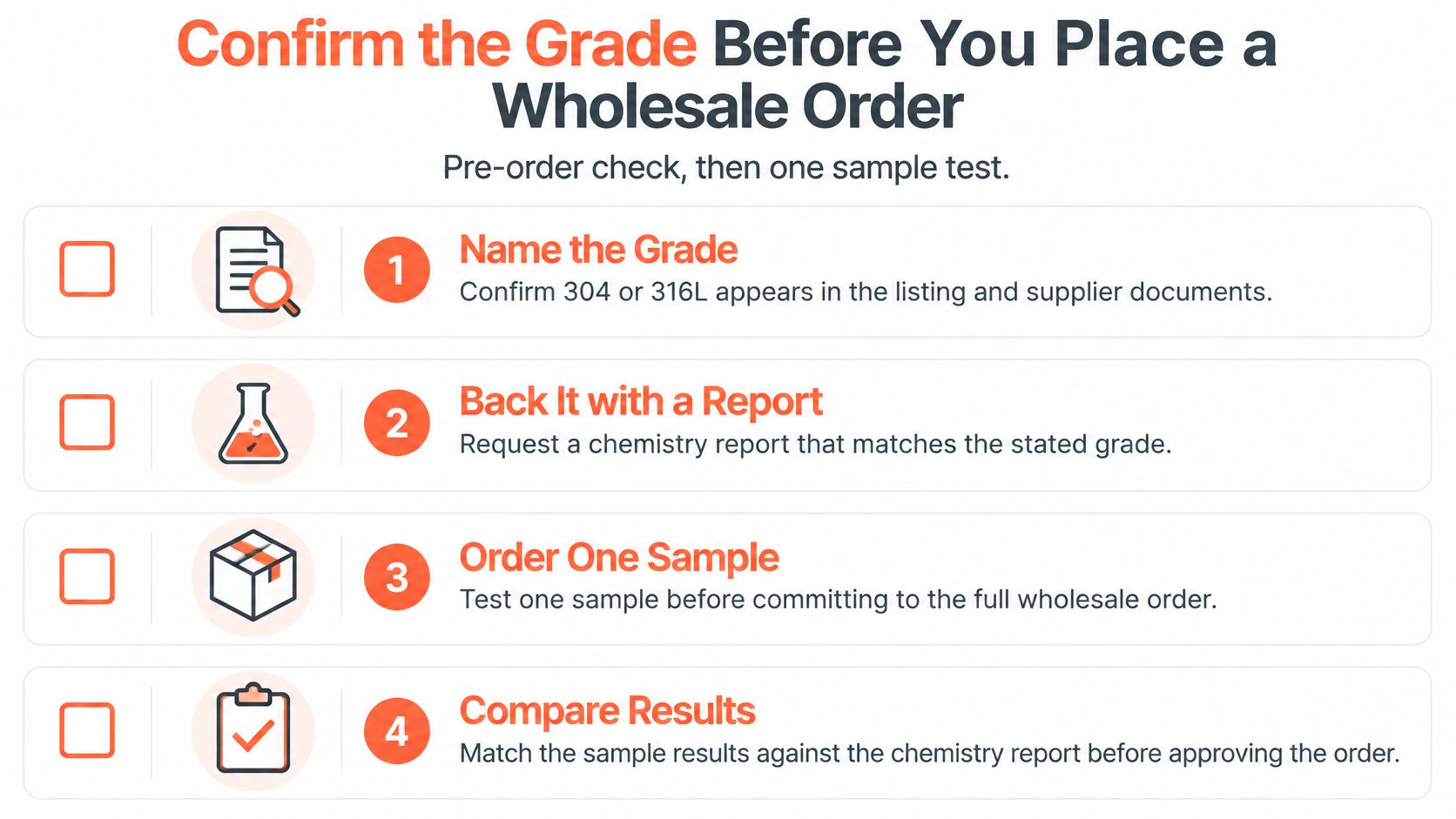
Use the earlier guidance on grade identity, nickel-release evidence, finishes, and care when reviewing the paperwork. Ask the supplier to connect the documentation to the exact SKU and construction you intend to sell. Resolve any mismatch before listing the item, and request grade and nickel-release records for each SKU before publishing it, not after a customer complaint.
JewelryBuyDirect offers wholesale jewelry, fashion accessories, and jewelry-making components for retailers building core and seasonal assortments. Visit JewelryBuyDirect to shortlist stainless-steel styles, then request the grade, finish specification, and relevant nickel-release evidence before committing to your order.