






Jennifer Lopez | Fri Oct 23 2026
Titanium Jump Rings: Grades, Sizing, and Sourcing Tips
Most buying guides tell you to grab titanium jump rings because the metal is light and "hypoallergenic." That advice stops too early. A word on a bag doesn't tell you whether the ring stays shut after you open it twice, or whether the color scrapes off where the pliers bite.
Treat the finding as a mechanical part plus a paperwork problem. You're buying closure behavior, surface wear, and a supplier who can name the alloy. Weight still matters. A ring that drags a layered necklace, or one that stains after a few weeks of sweat, comes back. The useful questions are what the metal does, which words on a listing mean nothing, and how you test a small lot before you scale.
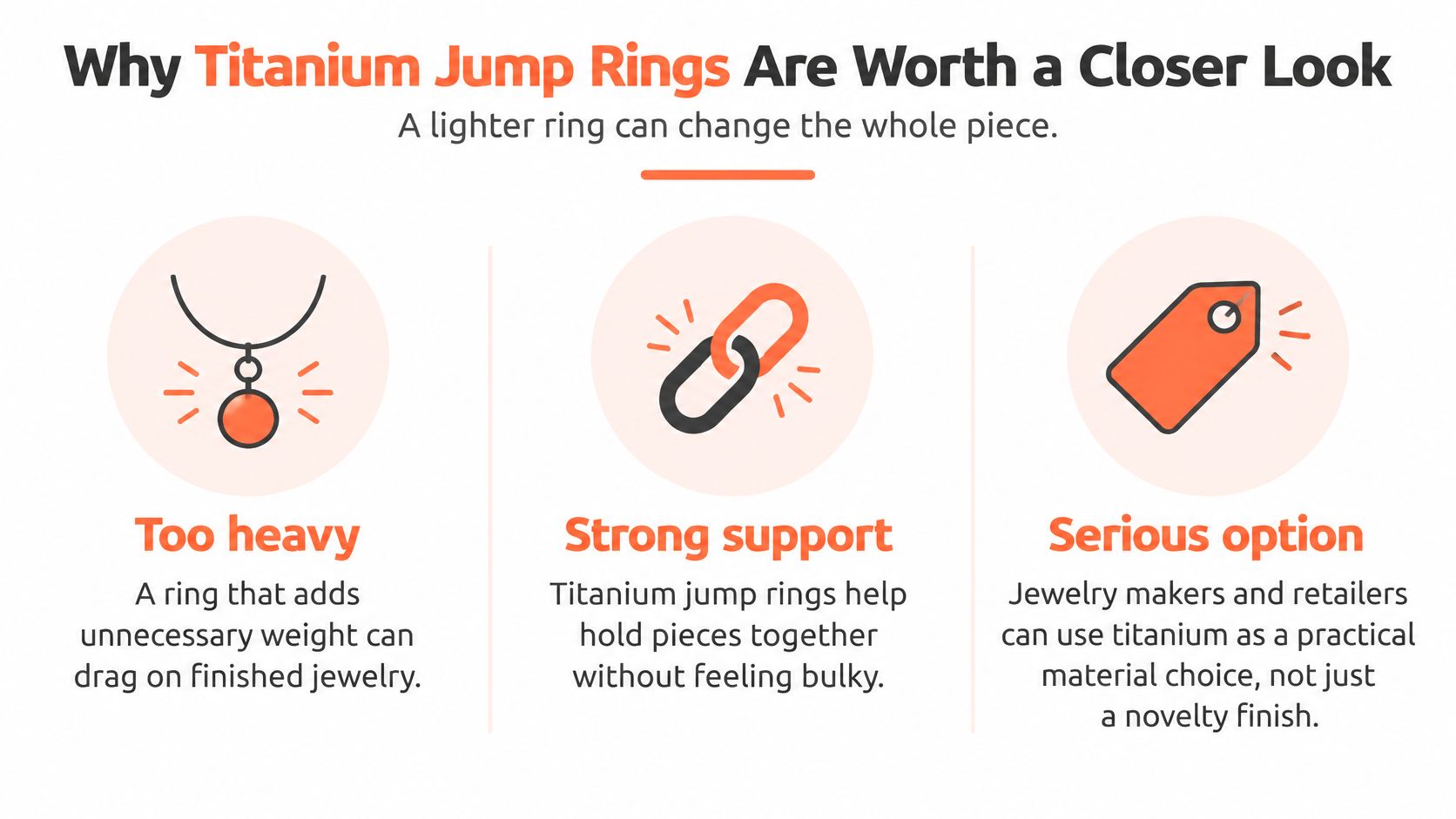
Why Titanium Jump Rings Are Worth a Closer Look
A heavy finding ruins a light design. I've watched a three-strand necklace sit wrong because one steel ring at the clasp pulled the stack forward. The other failure is quieter. A plated ring looks fine on the card, then darkens after sweat and a shower.
Titanium earns the spot for a plainer reason than the ads. Low density, high strength, and a stable oxide show up in the same metal. PubChem's titanium profile puts the density at about 4.5 g/cm³ at room temperature, against about 7.9 g/cm³ for typical steel, roughly 43 to 45 percent lighter by volume. That same profile describes titanium as approximately 45 percent lighter than steel while keeping comparable strength, and it notes the Britannica comparison that titanium is about half as dense as iron.
That gap is what your customer feels. A lighter connector keeps layered necklaces from sagging, and it keeps a large charm from feeling like hardware. You still get a high strength-to-weight ratio, so you aren't trading comfort for a ring that opens under a pendant.
Corrosion resistance is the second reason
The oxide film is the other half of the case. Titanium forms a passive layer that resists corrosion in moisture and body fluids. Commercially pure grades are reported in the 240 to 550 MPa tensile range, and Ti-6Al-4V can exceed 900 MPa depending on processing and heat treatment. Those are material benchmarks, not a promise for every ring. Wire diameter, cut quality, alloy, and whether you weld the ends or only close them all change the result.
A titanium jump ring is worth choosing when low mass, durability, and corrosion resistance matter more than cheap solder or a soft metal that forms easily.
Buy it when the design can't carry extra weight and the piece will see skin, sweat, or water. Skip it when you need easy soldering and the lowest unit cost. The next decisions are the label, the gauge, and the finish, because those decide whether the lightness you paid for actually stays on the necklace.
Reading Titanium Labels Before You Buy
A listing photo is not an ingredient list. A box of fruit snacks can show berries on the front and still be sugar and dye. Titanium-colored, titanium plated, and titanium steel work the same way. They describe a look or a coating. They don't prove a solid ring made from a documented titanium grade.
Solid titanium is the ring itself. Plated steel is a different metal with a thin coat that can wear at the cut and at the plier marks. "Titanium steel" is a trade name you should treat as steel until the supplier shows otherwise. If the paperwork doesn't name the alloy, you don't have titanium. You have a color story.
Two families you'll actually see
Buyers run into two families more than any others.
- Commercially pure titanium: Often sold against ASTM F67. This is the simpler composition, and it's the one I want named when a shop is assembling everyday jewelry.
- Ti-6Al-4V ELI: The alloy covered by ASTM F136 and ISO 5832-3. Stronger on paper, and common in implant talk. It isn't automatically the better jump ring.
Those standards set composition and impurity limits for medical-grade material. They do not certify the finished ring, the cut, the weld, or whatever someone put on the surface afterward. A mill cert on bar stock isn't a blessing on your 6 mm finding.
Why the medical history is on the listing
The medical reputation isn't a marketing invention from last season. Titanium was identified as an element in the 1790s. Its body-contact credibility jumped in 1952, when Swedish physician Per-Ingvar Brånemark saw bone fuse to a titanium chamber in a rabbit's leg, the effect later called osseointegration. In 1965 he placed the first titanium dental implant in a human patient, a milestone covered in this history of body jewelry materials. That path is why implant standards exist. It isn't why every colored ring in a marketplace photo is safe for a piercing.
Practical rule: If the listing can't say solid commercially pure titanium or name Ti-6Al-4V ELI plus a standard, don't write "implant grade" on your product page.
Ask for the alloy designation before you ask for a discount. A clear commercially pure ring with a mill note beats an attractive piece labeled only "surgical titanium."
Choosing Gauge and Size for a Secure Closure
Outside diameter is the least honest number on a jump ring. Two rings can share the same outer size and still close like different products. Grade, temper, wire diameter, and cold work change the force in your pliers and whether the ends stay put.
Grade 2 commercially pure titanium is the practical benchmark for rings you open and close by hand. It has enough ductility to take that bend without cracking the way a very hard, low-ductility alloy can. Its elastic modulus sits near 110 GPa, so it springs back less hard than steel. You feel a softer return. You also get less "snap" helping the ends find each other. That's a buying decision, not a trivia fact. If your staff closes dozens of rings a day, a softer spring-back means they must seat the ends on purpose.
Alleima's Grade 2 datasheet lists ASTM B338 minimums of 345 MPa ultimate tensile strength, 275 MPa 0.2% yield strength, and 20% elongation. Typical reported figures run near 530 MPa tensile, 380 MPa yield, and 39% elongation. Yield is the line where the bend becomes permanent. Yank a ring too wide and it stays oval. Closure gets sloppy, and a heavy pendant walks the gap open.
| Material or Standard | Reported Figure | What It Means for a Jump Ring |
|---|---|---|
| Grade 2, ASTM B338 minimum | 345 MPa tensile, 275 MPa yield, 20% elongation | Enough ductility to open and close, if you don't over-spread it |
| Grade 2, typical reported | About 530 MPa tensile, 380 MPa yield, 39% elongation | Real wire often runs stronger than the minimum, so ask temper, not just grade |
| Grade 2 elastic modulus | About 110 GPa | Less spring-back than steel, so ends need a deliberate seat |
| Any finished ring | Not guaranteed by the bar numbers | Wire diameter, ring diameter, cut, and weld decide the piece in your hand |
What to check on the lot
Specify grade, temper, wire diameter, and whether the wire is annealed or cold-worked. Identical outside dimensions can need very different closing force.
- Close and look: Cut ends should meet with no overlap and no visible gap.
- Cycle a sample: Open and close several rings from each lot, not one hero sample.
- Stop at yield: If you have to flare the ring wide to get it on a bail, order a larger inner diameter instead of stretching this one.
Match wire thickness to the load, then match inner diameter to the thickest thing it must pass over. A dainty ear wire wants a lighter gauge. A statement pendant wants more wire, not a bigger empty circle. For how findings sit in a full component order, see this guide to jewelry findings and components.
Finishes, Wear, and Hypoallergenic Claims
The metal can be right and the surface still fail. Customers touch the finish, not the mill cert. Anodizing, plating, and polishing are three different layers, and only one of them is the titanium itself.
Anodizing grows a color from the oxide already on titanium. It can look even and bright, and it still scratches where pliers grip or where a ring rubs a clasp. Plating is a deposited coat. It can be another metal entirely, which means the "titanium" color may be sitting on steel. Polishing doesn't add color. It changes how the cut ends and the outer wire catch light, and a rough cut will show even on a pretty anodized lot.
Sweat doesn't read your product page
Put the same ring in saltwater and daily sweat. The base titanium can stay dull-silver and uncorroded while the color layer thins at the contact point. That's the failure I see in returns: not a green neck, a bright ring that went patchy at the plier flats. Tell makers to grip on a part that won't show, or to accept that anodized color is a wear surface.
A generic titanium label doesn't name the alloy and doesn't prove biocompatibility. Healthline's overview of piercing with titanium is a reminder that implant-grade references are specific, not a vibe. Body-piercing use and ordinary necklace assembly are different jobs. A medical standard is stronger evidence than the word "hypoallergenic." It still doesn't bless every finished ring or its coating.
Ask the supplier for four things before you print a care claim:
- Alloy designation: Commercially pure grade or a named alloy, not "surgical."
- Applicable standard: ASTM F67, ASTM F136, ISO 5832-3, or whatever they meet.
- Batch or mill records: So a bad lot can be traced, not shrugged off.
- Color source: Anodized oxide or a plated coat.
I'd rather sell a clearly documented commercially pure component than an unnamed "surgical titanium" ring with a fashionable coat. If you're also editing earring copy, keep the same discipline in your titanium earring claims. Don't let one product page promise what the finding's paperwork can't support.
Where Titanium Jump Rings Fit in Real Designs
The right ring is the one whose wire and diameter match the parts it joins. Lightness only helps after the ends stay closed.
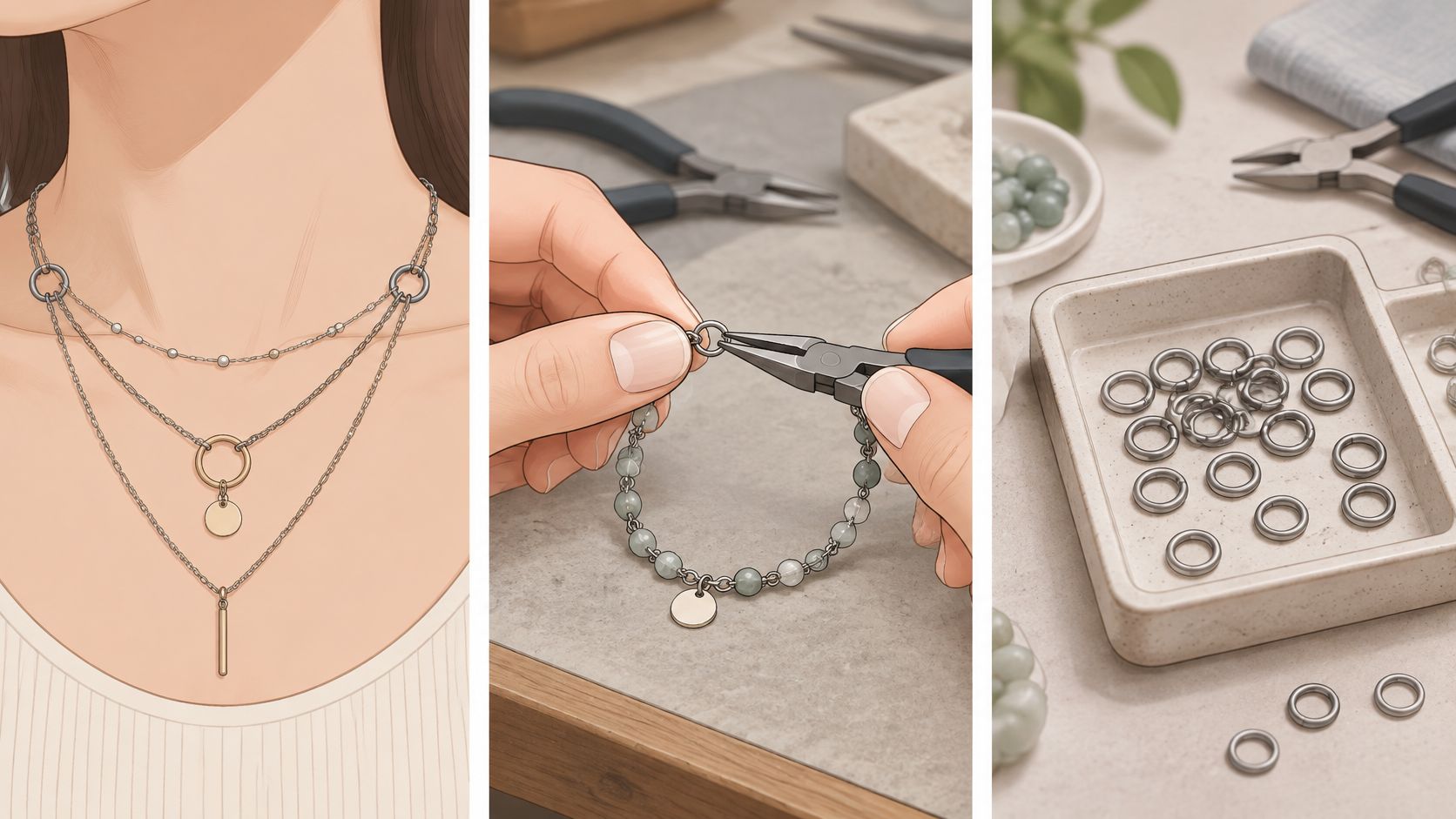
Three jobs on the bench
Layered necklace. Several fine strands meet one clasp. A heavy connector makes the stack pull to one side and leaves a red mark at the nape. Here a lighter titanium jump ring keeps the strands balanced. Use a gauge that can pass the clasp loop without being flared past its yield. If the strands are very fine, don't jump to a huge ring "for safety." A smaller, well-closed ring looks cleaner and snags less in hair.
Large charm. The charm has mass. The ring shouldn't add a second lump beside it. Step the wire up so the ends can't twist open, and keep the outer diameter only as large as the bail requires. Customers yank charms off sweaters. A pretty thin ring fails that pull even when the metal is a good one.
Body-jewelry assembly. Low mass and corrosion resistance both matter because the piece lives on skin. Here you separate a documented solid titanium component from a plated fashion ring. Color is optional. Traceability isn't. If the piece is a rotating comfort ring rather than a finding, look at how a finished titanium band is built, such as Tibetan-inspired jewelry with a rotating band, and notice that the maker names the metal instead of hiding behind a color word. Your jump rings deserve the same honesty.
Open ring or split ring
A simple open ring is enough when the load is modest and someone will close it once. A split ring is the better habit for a heavy pendant that gets tugged, because the double turn resists pull-out if one end shifts. Ask three questions before you pick:
- Will this pendant hang and swing all day?
- Can the wearer or a child pull it?
- Do you need to reopen it later for a repair?
Heavier wire for a statement pendant. Lighter wire for delicate earrings. Match the inner diameter to the thickest loop it must clear, then confirm the closed ends still meet. The video below shows the hand motion. Watch the gap, not the soundtrack.
If the ends need a heroic squeeze, the gauge or the temper is wrong for that design. Change the ring. Don't train your staff to muscle it.
Comparing Sourcing Options for Wholesale Buyers
Price per gross is a weak way to choose a finding. I compare three doors: specialist component makers, general wholesalers, and marketplace listings. Score each on documentation, minimum order, shipping terms, and what happens when a lot arrives damaged or mismatched.
Specialists usually know grade and temper. You pay for that in lead time and in a minimum a small boutique can't swallow. General wholesalers move faster and mix categories, and the word "titanium" on their line sheets is often a style name. Marketplace listings are convenient for a sample and thin on batch records.
A photo of a blue ring proves nothing about the alloy.
What to demand from any source
- Documentation: alloy, standard, and whether color is anodized or plated.
- Order size: a test quantity, or only a kilo.
- Shipping terms: who pays freight, and is damage covered in transit.
- Returns: how many days, and do they want the whole carton back.
JewelryBuyDirect sits in that middle tier as a B2B wholesale platform with more than 120,000 SKUs across jewelry-making components, no minimum order quantity, 15% off the first three orders, free worldwide shipping on orders of $150 or more, 7-day returns, and full damage protection. Its catalog carries titanium steel styles, which are plated steel and belong on a different line of your spec sheet from solid titanium. Verify alloy and finish on the specific SKU before you write a product page. For how metal choice shows up in what you charge, read the notes on titanium jewelry pricing.
A finished set is a different purchase from a finding. Something like the Bohemian Geometric Turquoise Pendant Necklace Set with Earrings Electroplated Iron Jewelry is a unisex bohemian jewelry set with a single variant across its options. Electroplated iron is a surface treatment on a finished product. It tells you nothing about the wire in your findings drawer, so keep that metal language off your jump ring page.
Landed cost and the photo that gets cropped
Duty isn't whatever the supplier typed in a chat. The USITC tariff disclaimer explains that goods are classified in the Harmonized Tariff Schedule, while legally binding classification, rulings, and customs treatment sit with U.S. Customs and Border Protection. The USITC tariff database publishes the schedule, and it says CBP administers entries and binding decisions. Document material, construction, and jewelry use, pick a candidate heading, and confirm it before you quote a delivered price.
Your cover art has a mechanical spec too. A 383:204 cover is about a 1.877:1 width-to-height ratio. Shopify's media editor guidance defines aspect ratio as width versus height and warns that banners and full-width sections crop images that don't match the frame. Build the file at 383 by 204 pixels, or larger at that same ratio, and set a focal point if a crop is unavoidable. Shopify's product media notes add that side-by-side product images look uneven unless featured images share a ratio. Uploads can go to 5,000 by 5,000 pixels or 25 megapixels, and 2,048 by 2,048 usually displays well for square shots. Keep lettering and the ring itself off the outer edges.
Placing Your First Titanium Jump Ring Order
Don't open with a carton. Open with a job description. Write down what the ring must hold, how often it will be opened, and whether color has to survive pliers. That one paragraph stops you from buying a pretty gauge that can't carry the charm.
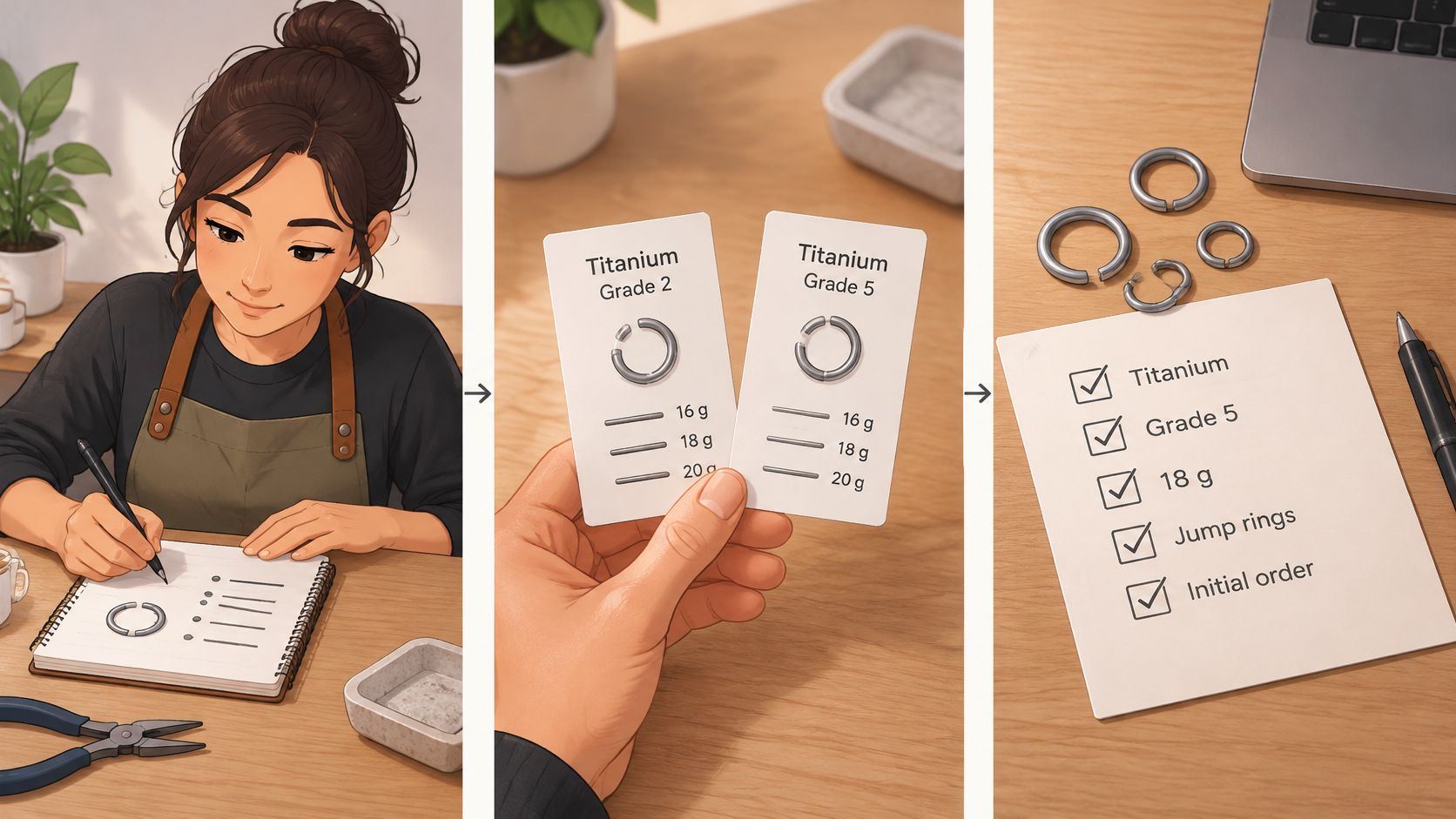
The sequence that protects margin
Name the job. Layered necklace, heavy charm, or body-jewelry connector. One sentence. If you can't say it, you aren't ready to pick a gauge.
Pick grade and gauge against closure and weight. Grade 2 when you need to open and close without cracking the wire. Heavier wire when the pendant swings. Don't reuse a number from a steel chart and assume the feel will match.
Request the paperwork before the wire ships. Alloy, standard, batch or mill record, anodized versus plated. If the answer is a slogan, buy elsewhere.
Order a small test lot. Close every sample. Look for gaps, overlap, and color loss at the plier marks. Wear one on a sample strand for a week of sweat. Scale only the lot that stays shut and still looks like the photo.
Use a no-minimum first order so a wrong temper costs a test, not a season. Check the return window and damage protection before you approve a volume reorder. Those terms matter more on findings than on finished fashion, because a bad cut is a production stop, not a single unsold necklace.
If you also sell to people who want to see metal in hand before they trust a listing, point them to a nearby maker through shop local on Loyaltie. A customer who has handled a solid titanium piece understands why you won't substitute a plated ring to save a few cents.
Close the test lot yourself. A supplier's photo can't show spring-back.
The outcome you want is boring, and boring is profitable. Jump rings that stay secure, color that matches what you advertised, and a unit cost you can defend after duty and returns. That's the order. Not a rainbow of unnamed "titanium" in a bulk bag.
JewelryBuyDirect supplies wholesale jewelry components and fashion pieces so boutiques can test titanium jump rings in small quantities before a large reorder. Use it to compare documented findings with everyday fashion styles, check return and damage terms, and keep landed cost honest. Visit JewelryBuyDirect and place a verified sample order before you commit the season's clasps to an unnamed alloy.