






Jennifer Lopez | Mon Oct 12 2026
Titanium Jewelry Price Guide for Wholesale Buyers
Most advice on titanium jewelry price starts in the wrong place. Buyers compare the cost of titanium by weight, see an inexpensive industrial input, and expect a finished ring, chain, or earring to sell for only a little more. That calculation ignores the work that turns a light, difficult-to-machine metal into a wearable product.
For an independent retailer, the useful question isn't “How cheap is titanium?” It's “What did this item cost after machining, finishing, shipping, compliance, defects, and channel margin?” Raw material is only one line in that calculation. The sections below give you a practical way to judge supplier quotes, position titanium beside other metals, and protect your margin without sacrificing quality.
The Raw Metal Myth In Titanium Pricing
Titanium jewelry isn't cheap just because titanium itself has a low commodity value. U.S. Geological Survey data put the average annual U.S. import price for titanium sponge at approximately $10.70 per kilogram in 2019, $10.60 in 2020, $11.20 in 2021, $11.10 in 2022, and about $12 in 2023, an increase of roughly 12% from 2019 to 2023. The 2023 estimate was approximately 8% higher than the 2022 level. These figures concern titanium sponge, an industrial intermediate, not finished jewelry. (U.S. Geological Survey titanium data)
A lightweight ring or pair of earrings contains only a small fraction of a kilogram. That means the raw titanium content usually contributes far less to the retail ticket than CNC time, cutting tools, polishing, anodizing, stone setting, inspection, packaging, freight, duties, wholesale margin, and retail markup. The metal may be inexpensive by weight, but the production process isn't.
Where the price really goes
A titanium ring with a plain profile may need relatively little finishing. Add an interior comfort fit, a stepped edge, a patterned surface, an anodized color, a gemstone setting, or a precise engraving, and the supplier must spend more time programming, cutting, deburring, polishing, treating, and inspecting the piece. Those costs apply even when the product remains physically light.
Design authorship also matters. A higher price doesn't automatically mean the item contains more titanium, a more valuable alloy, or a better resale asset. It may reflect original design development, a smaller production run, manual finishing, stronger quality control, or a brand's positioning.
One recent guide estimates that labor-intensive fabrication can represent 60–75% of final retail price, while simple machine-finished pieces may sell around $60–$180 and independent designer work around $380–$1,000. (Designsignal's titanium jewelry pricing guide) Treat those figures as market examples, not a universal price list.
Buying rule: Never approve a titanium assortment from the catalog price alone. Ask what the quoted price includes, then compare the finished specification and landed cost.
What to check in a catalog
Start by separating solid titanium from titanium-colored coatings or products described only as “titanium steel.” Request the grade, product weight, construction method, finish, coating or anodizing process, and inspection standard. A supplier that can't answer those questions clearly hasn't given you enough information to justify a premium.
For a useful consumer-facing explanation of titanium body jewelry, Timebomb Tattoo & Piercing's titanium guide provides helpful context on material selection and product considerations. For a broader metal comparison before you set your assortment, review stainless steel versus titanium rings, especially when deciding whether a design's comfort, finish, and durability support its price.
Your goal isn't to force every titanium item into the lowest price bracket. Your goal is to pay for visible, verifiable value. A simple, well-finished titanium hoop can be a profitable entry product. A complex ring should earn its higher ticket through documented material quality and manufacturing detail.
How Titanium Grades Dictate Manufacturing Costs
The word “titanium” doesn't tell you enough. Commercially pure grades and Grade 5 titanium can produce very different buying outcomes, even when two finished pieces look almost identical. Grade, alloy composition, machining requirements, surface treatment, and inspection all influence the supplier's quote.
Grade 5, also known as Ti-6Al-4V, contains aluminum and vanadium. It has an approximate density of 4.43 g/cm³, Vickers hardness near 350 HV, and tensile strength around 900 MPa. Its passive titanium-oxide surface layer provides strong resistance to corrosion in sweat, saltwater, and many household environments. (Grade 5 titanium jewelry properties)
That combination gives retailers a strong product story: light wear, high strength, and resistance to everyday corrosion. It also creates a production challenge. Hard, tough material takes more controlled cutting, drilling, polishing, and inspection than softer metals. A supplier may need specialized tooling, slower machining parameters, more finishing time, and tighter process control.
A practical grade comparison
| Titanium Grade | Key Properties | Machining Difficulty | Wholesale Cost Impact |
|---|---|---|---|
| Commercially pure titanium | Lower alloy complexity, light, corrosion-resistant | Generally more straightforward, but still requires titanium-aware tooling and finishing | Suitable for simpler designs and can support a lower quote |
| Grade 5, Ti-6Al-4V | High strength, approximately 4.43 g/cm³ density, near 350 HV hardness, around 900 MPa tensile strength | More demanding cutting, drilling, polishing, and inspection | Usually supports a higher quote when the grade and specifications are documented |
| Coated or titanium-colored base metal | Appearance depends on the underlying metal and coating system | Processing cost depends on the base metal and coating process | A low price may reflect coating, mass production, or limited finishing rather than solid titanium |
The table isn't a substitute for a supplier specification sheet. Ask whether the stated grade applies to the whole product or only a component. Confirm whether the quoted amount includes anodizing, coating, engraving, stone setting, packaging, and logistics.
Avoid paying for an unverified premium
A supplier may describe a product as “aerospace titanium” without providing a material certificate or test documentation. Don't pay extra for the phrase. Pay for a documented grade, a consistent finish, accurate dimensions, and a sample that matches the production order.
The physical properties also affect customer positioning. Grade 5 can support a premium message around strength and corrosion resistance, but customers won't see density or tensile strength on the display tray. They see the finish, comfort, color consistency, edge quality, packaging, and whether the piece holds up in daily use. Your merchandising should connect the technical specification to a visible or wearable benefit.
For additional context on material costs in the Australian market, Everti's titanium plate price ranges can help buyers understand why industrial material references don't translate directly into finished jewelry quotes. The supplier's production route remains the decisive factor.
Comparing Titanium To Alternative Jewelry Metals
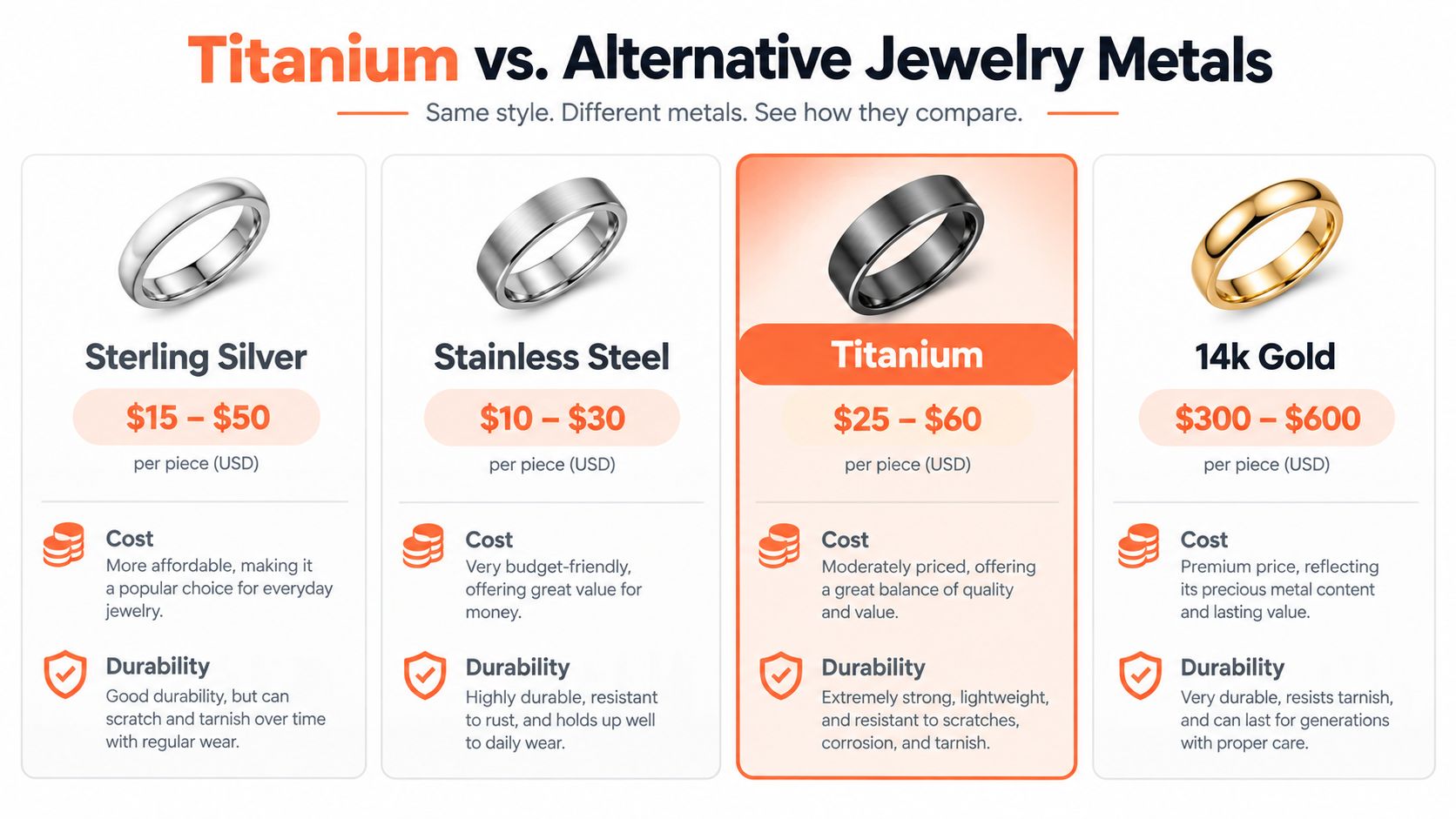
Titanium sits in an unusual position. It has a much lower raw-material benchmark than gold, but its machining can be more demanding than basic stainless steel production. Sterling silver offers precious-metal recognition and easier fabrication. Stainless steel often wins on simple, low-cost mass production. Titanium earns space when the retailer wants a lightweight, durable product with a modern technical identity.
U.S. Geological Survey historical data report U.S. titanium sponge import prices of approximately $9.50–$10.81 per kilogram at year-end 2018 and $10.61–$11.71 per kilogram at year-end 2019, while the 2024 annual average was near $13 per kilogram. (U.S. Geological Survey historical titanium data) Those benchmarks are useful for understanding the material market, but they aren't finished jewelry prices and shouldn't be used as a retail formula.
Choose the metal for the customer promise
Sterling silver is easier to shape, polish, repair, and communicate as a recognized jewelry material. It can carry a stronger precious-metal story, but it may require more care and can expose the retailer to changing metal input costs.
Stainless steel is a practical benchmark for accessible fashion jewelry. It works well for uncomplicated, high-volume designs and can deliver a low shelf price. The tradeoff is that a stainless steel item may not offer the same lightweight feel or titanium-specific performance story.
Titanium works best as a performance-led alternative. Lead with lightness, comfort, corrosion resistance, and modern design. Don't present it as a substitute for gold's material value or resale logic. Titanium's value is primarily in the finished product and the work invested in it.
Gold occupies a different commercial category. Its price and customer expectations are tied to precious-metal content, karat, cultural meaning, and potential material value. A titanium ring shouldn't imitate that promise. It should justify its price through design, wearability, finish, and documented construction.
Build a clear shelf architecture
Use stainless steel for entry-level volume, titanium for lightweight premium fashion, sterling silver for customers seeking a precious-metal step up, and gold for customers buying symbolic or asset-oriented pieces. That structure prevents titanium from competing only on price.
Two rings can look similar in a photograph while carrying different machining times, finishes, alloys, and defect rates. Compare like with like. A titanium design with a complex profile or anodized finish shouldn't be evaluated against a plain stainless steel band using material cost alone.
The best titanium jewelry price is the one that fits a deliberate customer promise. If the display says “lightweight, durable, engineered finish,” the product specification and quality control must support that message. If the piece is merely a low-cost coated accessory, price it fairly and don't borrow the credibility of Grade 5 titanium.
Calculating True Landed Costs For Wholesale Margins
A factory quote is not your cost. Your cost begins with the supplier's unit price and ends when compliant, sellable inventory reaches your operation. Freight, customs duties, insurance, testing, packaging, payment fees, and defect allowances can turn an attractive catalog figure into a weak margin.
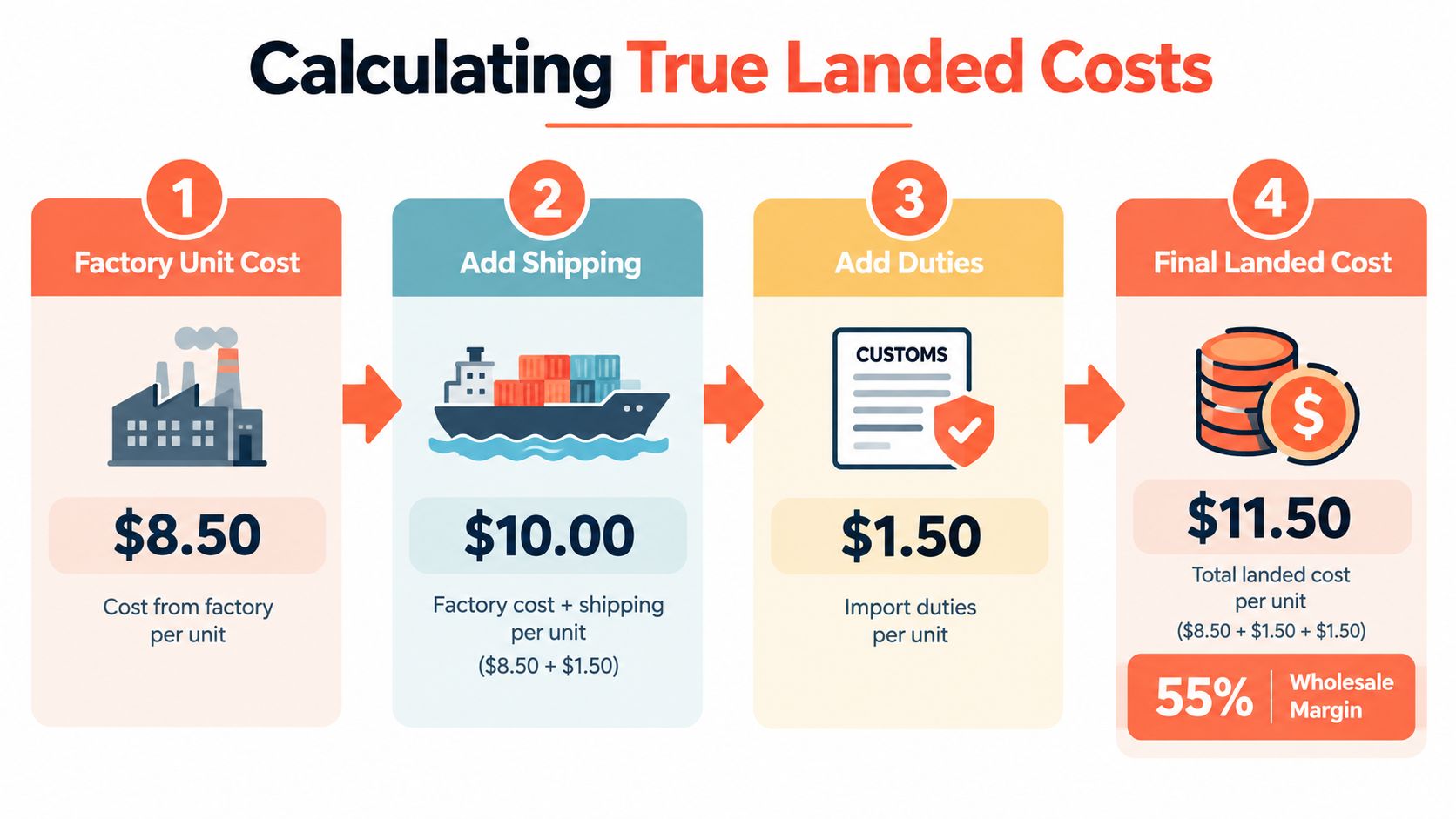
Use this formula for every supplier comparison:
Landed cost = product cost + freight + customs duties + insurance + testing and compliance expenses
Add packaging or relabeling when those costs aren't already included. If a supplier quotes a titanium ring at a low unit price but ships in a way that creates high per-unit freight, the quote isn't low for your business. You need the cost per sellable unit, not the number printed beside the product photo.
Work through the quote in order
- Confirm the product cost. Record the exact grade, weight, dimensions, finish, components, and quantity. A price for a plain ring isn't comparable to a price for an anodized, engraved ring with a stone setting.
- Allocate logistics. Divide freight, insurance, and handling across the units in the shipment. Keep the calculation tied to the actual order rather than a supplier's optimistic estimate.
- Add duties and testing. Customs treatment depends on the destination and product classification. Include laboratory testing and conformity work when the destination market requires it.
- Adjust for sellable inventory. Defective, damaged, or nonconforming pieces consume money even if they can't be sold. Build your purchasing decision around the inventory that can reach customers.
For example, the provided landed-cost visual shows a factory unit cost of $8.50, shipping that brings the running total to $10.00, duties of $1.50, and a final landed cost of $11.50, with a stated 55% wholesale margin. Use that visual as an illustration of the calculation sequence, not as a universal cost forecast for every order.
Margin discipline: Apply your markup to landed cost, never to the factory quote. Otherwise, logistics and compliance quietly consume the margin you thought you had.
One industry pricing guide recommends at least a 2-times markup for fine jewelry and a 3- to 5-times markup for fashion jewelry, calculated after landed costs are included. (Wholesale jewelry markup guidance) The correct multiplier still depends on your channel, returns policy, staffing, promotions, and customer acquisition cost.
For another practical way to inspect how extra charges affect profitability, review Zaro's explanation of hidden fees and margin erosion. Then compare your assumptions with a wholesale profit margin calculator before committing to a larger order.
The following video can provide additional visual context for landed-cost planning:
Protecting Margins Through Supplier Compliance
A low titanium jewelry price isn't a bargain if the inventory creates returns, recalls, marketplace restrictions, or regulatory exposure. Jewelry touches skin, so chemical safety and product documentation belong in the purchasing decision from the first sample, not after a customer complains.
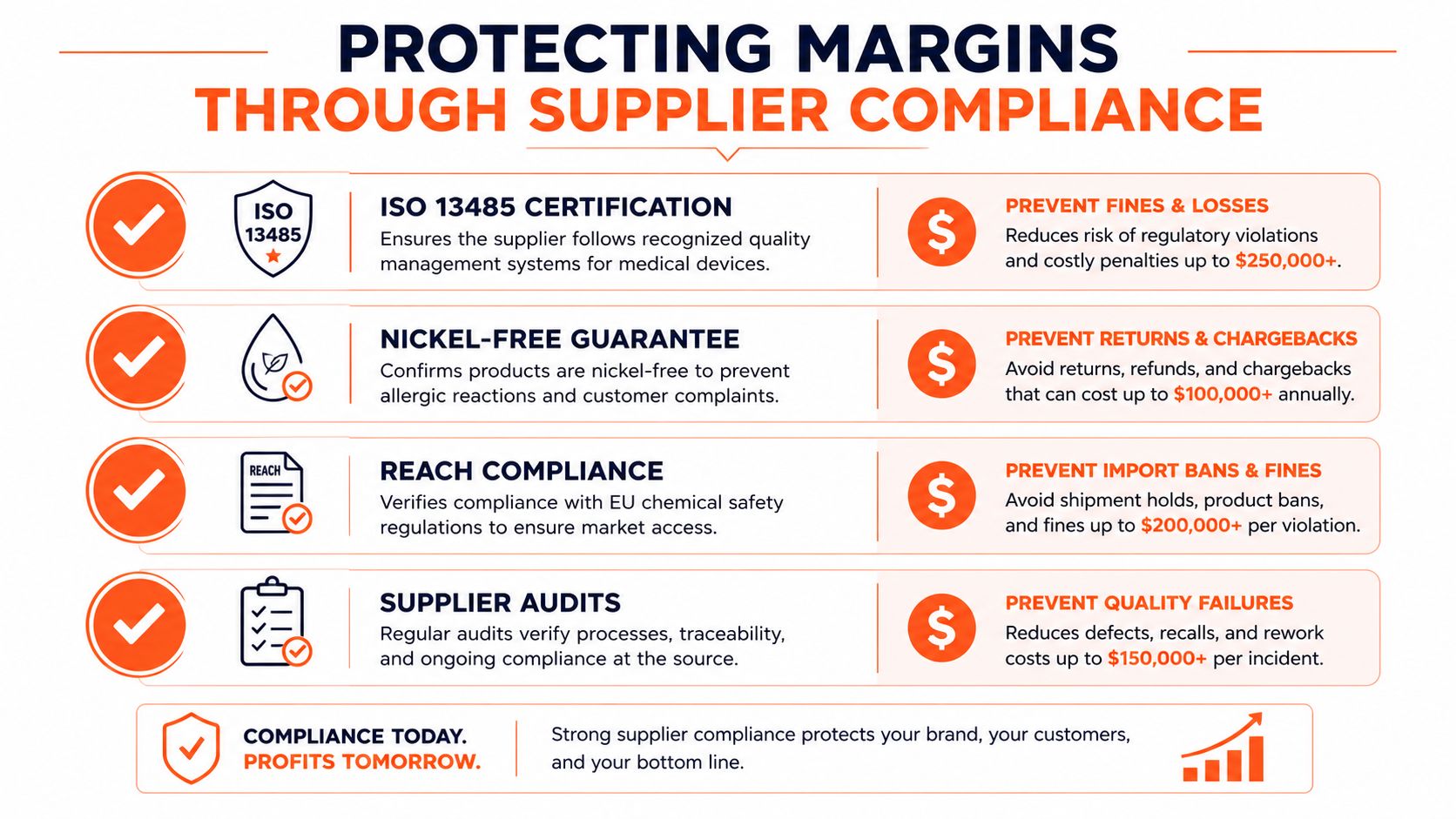
SGS identifies the U.S. Consumer Product Safety Improvement Act of 2008, CPSIA, and the European Union's REACH chemical-safety regulation as relevant frameworks for jewelry. SGS also lists supplier audits, product inspection, laboratory testing, certification, and training among its jewelry services. (SGS jewelry compliance services)
Request evidence before you order
Don't accept “hypoallergenic,” “nickel-free,” or “compliant” as unsupported marketing language. Ask the supplier for documents that match the actual product, material, finish, and destination market.
- Material specification: Confirm whether the item is solid titanium, a titanium alloy, or a coated base metal.
- Test documentation: Request relevant laboratory reports for the product or a clearly matching production specification.
- Process records: Ask how the supplier controls polishing, anodizing, coating adhesion, stone setting, and final inspection.
- Supplier oversight: Review audit information and clarify who performs testing, how often, and what happens when a batch fails.
The infographic includes ISO 13485 Certification, a Nickel-Free Guarantee, REACH Compliance, and Supplier Audits as verification points. Treat those labels as prompts for documentation, not automatic proof that a particular product meets every requirement in your market. ISO 13485, for example, shouldn't replace jewelry-specific testing or destination-market review.
Compliance is a margin control
Testing costs money, but nonconforming inventory costs more. A retailer may need to remove listings, contact customers, replace pieces, absorb return shipping, or discard stock. Those expenses can erase the apparent savings from a cheaper supplier.
For sourcing comparisons, use compliance evidence as a quality filter alongside grade and finish. JewelryBuyDirect's wholesale supplier guidance can support that evaluation, but you should still request product-specific documentation for each order and destination.
A responsible supplier should answer direct questions without evasive language. If the seller can't identify the material, testing basis, or corrective process, walk away. Affordable sourcing means reducing total risk, not accepting the lowest invoice.
Managing Inventory Risk With Flexible Sourcing
A profitable titanium assortment does not require a large opening order. Independent retailers should test designs, measure sell-through, and increase quantities only after customers show demand. This protects cash flow and prevents an attractive unit price from tying up capital in slow-moving colors, sizes, or finishes.
A jewelry-business cost guide estimates that a small handmade operation may launch with roughly $500–$2,000, while a physical jewelry store may require approximately $9,000–$50,000 or more, depending on location, displays, security, build-out, and initial inventory. Those figures illustrate why purchasing terms and inventory exposure matter as much as the product's unit cost.
Match the order to the evidence
Begin with samples or small quantities across a focused range. Select designs that test different customer needs, such as plain lightweight bands, colored anodized pieces, minimalist earrings, or fashion sets. Record the supplier's exact specification, machining or finishing details, and landed cost for each item. Compare sales performance against the margin you retain, not the supplier's quoted price.
No-MOQ sourcing lets a small seller test products without committing to a deep inventory position. Dropshipping can reduce the need to hold stock, while overseas manufacturing may provide lower costs and more factory choices for higher-volume businesses. Use these models only after checking delivery times, import responsibilities, quality control, and customer-service consequences.
A no-MOQ option is not automatically profitable. Check shipping speed, packaging quality, returns handling, stock reliability, and whether the supplier can reproduce the same finish after the test order. Flexible purchasing works only when fulfillment protects the customer relationship and the supplier can maintain consistent specifications.
Scale the winners, not the catalog
Once a design sells consistently, negotiate around repeat volume, packaging, finish consistency, and lead time. Ask whether a larger order improves landed cost without forcing an unsellable mix of colors or sizes. Bulk purchasing should follow demonstrated demand, not a discount attached to a large quantity.
Use a simple product scorecard:
- Demand: Which designs generate actual orders rather than saves or likes?
- Margin: What remains after product cost, freight, duties, testing, payment fees, and returns?
- Quality: Do samples match the specification and customer expectations?
- Reorderability: Can the supplier reproduce the same grade, finish, dimensions, and packaging?
- Cash exposure: How long will your money remain tied up before the stock sells?
If you want to test this approach without a large opening order, JewelryBuyDirect lists wholesale titanium steel jewelry with no minimum order quantity and factory-direct logistics. That makes it practical to run a small test assortment, compare landed costs, and scale only the designs that prove demand.