






Jennifer Lopez | Sat Oct 10 2026
Tennis Bracelet Wholesale Guide for Retailers
The popular advice in tennis bracelet wholesale is simple: find the lowest unit price and mark it up. That advice is incomplete, and it can damage your margin. Two bracelets can look almost identical in a product photo while differing sharply in stone consistency, clasp strength, plating behavior, disclosure requirements, return exposure, and customer trust.
A better buying decision starts with total landed cost and expected sell-through, not the supplier's headline price. Shipping, customs, inspection, packaging, payment fees, damaged units, returns, and aging inventory all belong in the calculation. The right bracelet isn't necessarily the cheapest one. It's the specification that gives your channel a dependable product, an honest listing, and enough room to absorb operational friction.
The category also has more history than its name suggests. Continuous gemstone bracelets were fashionable during the 1920s, and the modern name became closely associated with American tennis champion Chris Evert after her diamond line bracelet clasp broke during the 1987 U.S. Open, prompting officials to pause play while it was recovered. The style existed before that incident, but the event gave it broad visibility and a memorable retail story. Sotheby's history of the tennis bracelet provides useful context for merchandising the design as enduring occasion jewelry rather than a short-lived sports novelty.
Sourcing Tennis Bracelets Without Losing Your Margin
A low quote can hide an expensive product. If the stones look mismatched, the clasp feels weak, or the plating exposes its base metal after ordinary handling, you don't just lose the cost of one defective unit. You absorb customer service time, return shipping, replacement inventory, negative reviews, and weaker conversion on the listing.
Start with a landed-cost sheet for every supplier. Record the bracelet price, freight, customs, inspection charges, packaging, payment fees, expected damage allowance, and return handling. Then add an inventory-aging assumption. A style that sells slowly ties up cash even when its purchase price looked attractive.
Procurement rule: Never compare supplier quotes until every quote uses the same stone type, metal specification, dimensions, clasp construction, packaging standard, and delivery terms.
Build the specification before requesting quotes
Your request for quotation should identify the product in operational terms, not just as a “tennis bracelet.” Ask for:
- Stone identity: State whether the stones are cubic zirconia, another simulated stone, colored gemstone, moissanite, lab-grown diamond, or natural diamond.
- Metal content: Require the base metal, fineness, plating material, and plating thickness when available.
- Construction: Record the stone count, average stone diameter, total carat weight where applicable, setting style, link articulation, and clasp type.
- Evidence: Request supplier declarations, treatment details, batch records, photographs, and any applicable assay or testing documentation.
The classic construction uses a flexible linked band carrying a continuous row of individually set stones. Every joint, prong, hinge, and clasp introduces another potential failure point. That's why a bracelet with strong sparkle can still produce costly returns if it kinks, sheds stones, or opens during wear.
Treat quality as a margin control
Retailers often treat inspection as a delay. It's a buying tool. Compare samples physically, wear-test plated surfaces, flex the links, examine settings under magnification, and test the clasp before approving a larger order. These checks tell you whether the quoted product can survive your sales channel.
For a practical sourcing reference, review factory-direct jewelry sourcing guidance, then apply the same discipline to tennis bracelets. Supplier selection should end with a documented pass or fail decision, not an assumption based on catalog photography.
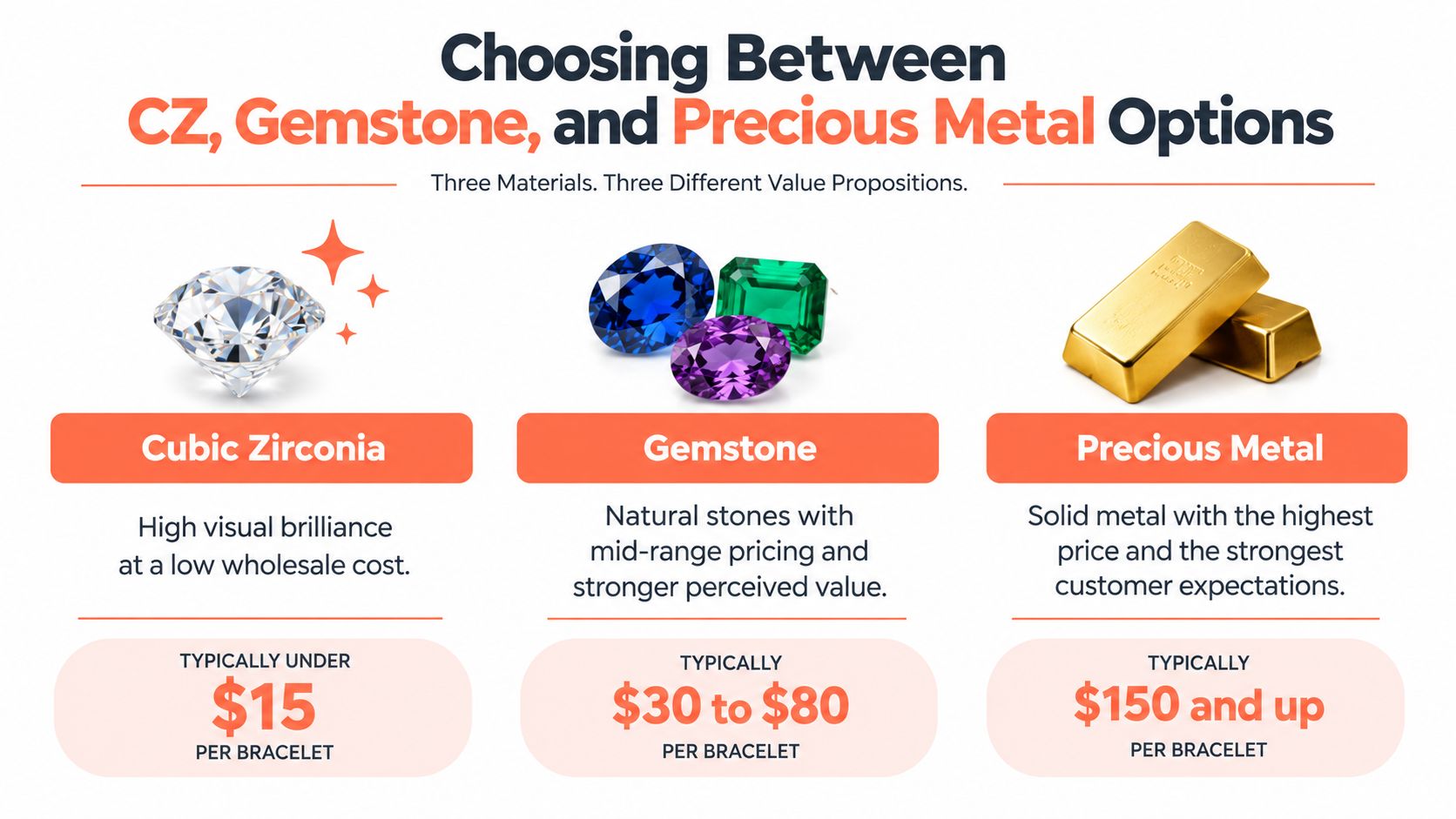
Choosing Between CZ, Gemstone, and Precious Metal Options
Material tiers create different customer expectations, even when online images make the bracelets look similar. Cubic zirconia can deliver strong visual impact at an accessible price, but shoppers usually buy it as fashion jewelry and expect the product page to describe it clearly. Gemstones and lab-grown stones occupy a more considered tier, where color consistency, stone identity, and documentation matter more. Precious-metal pieces carry the highest expectation for construction, disclosure, and long-term wear.
CZ works when the channel rewards visual impact
CZ is a sensible entry point for social commerce, impulse purchases, seasonal displays, and trend-led assortments. Its advantage is not just a low acquisition cost. It lets you test silhouettes, stone sizes, colors, and styling without tying up as much capital in a higher-value product.
The trade-off is disclosure. Call the stones cubic zirconia or simulated stones, not diamonds. Explain the metal accurately, especially when the item is silver-tone, alloy, stainless steel, or plated. A customer who understands the purchase may be satisfied with a fashion bracelet. A customer who believes they bought precious materials will feel misled and is more likely to return it.
Gemstone and lab-grown options need consistency
Colored gemstones can differentiate a collection, but variation is part of the product story and must be represented accurately. If your assortment uses matched stones, inspect color uniformity across the line. A bracelet with one visibly darker or cloudier stone can look unfinished even when its total stone weight appears competitive.
Lab-grown diamonds need especially careful naming and documentation. They aren't natural diamonds, and your listing should identify that status rather than relying on visual similarity. Current market commentary describes lab-grown diamond bracelets as substantially cheaper than natural-diamond equivalents while also noting weaker resale demand, so don't position them as an investment product. A wholesale CZ sourcing guide can help frame entry-level assortment decisions, but your own product data must control the final listing.
Precious metal raises the standard
For sterling silver, 925 means at least 92.5% pure silver. A gold karat mark communicates the proportion of pure gold in the alloy, while gold-plated, gold-filled, and rolled-gold products must be described according to their construction. Don't label a coated item as solid gold.
The FTC's consumer guidance on platinum, gold, and silver jewelry is a useful reference for checking metal claims. Choose precious-metal options when your channel can support stronger documentation and a higher customer expectation. Don't pay for that tier if your supplier can't prove what the product is.
Inspection Protocols for Quality Control
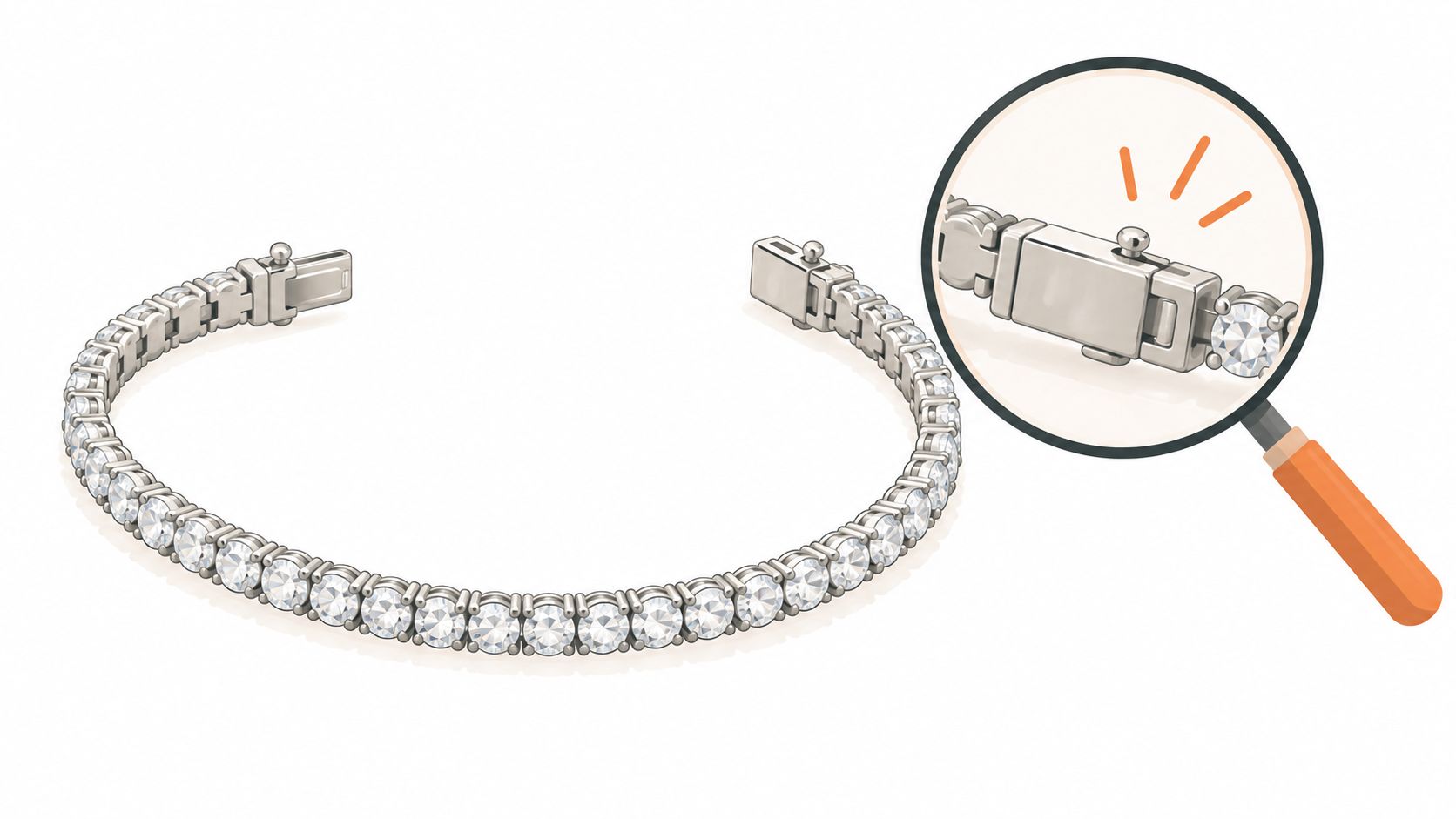
Approve samples as if they were customer returns. A catalog image can show brilliance, but it can't reveal whether the links articulate evenly, whether a prong is seated correctly, or whether a clasp opens under tension. The inspection process should focus on the points that turn a visually attractive bracelet into a service problem.
Inspect the metal and plating first
Record the metal mark on every sample and compare it with the supplier declaration. For gold, verify the karat designation before publishing specifications or setting a price. The FTC Jewelry Guides caution against using “gold” or a gold abbreviation for an alloy containing less than 10 karats, and coated items must be qualified to show that the gold is surface-applied. FTC Jewelry Guides explains the broader requirements around truthful representations.
Plating wear tends to appear first on high-contact areas, including links, prongs, and clasps. Rub-test or wear-test plated samples, then inspect them for color change or exposed base metal. If the supplier can't state plating thickness when available, treat durability as unverified rather than assuming the finish will hold.
Test the mechanics, not just the appearance
Flex the bracelet repeatedly across its full length. Look for kinks, stiff joints, uneven lateral movement, and links that don't return to alignment. A flexible line should bend smoothly rather than fold sharply around one weak section.
Use magnification to inspect stone seats and prongs. Check whether stones sit at consistent heights, whether prongs are symmetrical, and whether any stone moves under light pressure. Record clasp pull-test results and check whether the closure has a secure secondary mechanism. A bracelet that closes once in the showroom but opens during normal movement is not ready for resale.
- Stone consistency: Compare color, clarity, cut appearance, diameter, and spacing across the line.
- Setting security: Look for loose stones, uneven prongs, thin metal around seats, and rough finishing.
- Clasp redundancy: Confirm that the primary closure and safety feature engage cleanly.
- Documentation: Match the supplier's stated stone type, count, dimensions, treatment, and metal content to the physical sample.
Keep a repeatable approval record
Photograph the sample from the front, back, clasp, hallmark, and side profile. Save the batch identifier, supplier declaration, inspection date, test results, and any rejected conditions. These records help you compare reorders and support accurate customer service when a product question arises.
For additional testing discipline, use this guide to testing gold purity as a reference point. The goal isn't to create a laboratory in your stockroom. It's to prevent a weak sample from becoming a larger purchasing mistake.
Wholesale Cost Structures and Pricing Bands
A tennis bracelet's wholesale price only becomes meaningful after you define the specification behind it. Available wholesale guidance places a 7-carat simulated-stone bracelet at roughly $80 to $250 per unit, while a 925 sterling-silver version using lab-grown stones may range from about $60 to $150 in bulk orders. Wholesale tennis bracelet pricing guidance shows why a single category-level price is not enough for procurement.
Those ranges don't tell you which product will produce the strongest margin. Stone type, metal weight, clasp design, plating, order volume, freight, and customer expectations all change the economics.
Compare like with like
Suppose you receive two quotes for bracelets described as “7-carat.” One uses simulated stones in a plated alloy setting. The other uses lab-grown stones in 925 sterling silver. The total carat weight alone doesn't make them equivalent, because the materials, documentation, durability expectations, and likely return reasons differ.
Your comparison sheet should include:
| Cost or risk field | What to record |
|---|---|
| Product cost | Unit price by exact specification |
| Delivery cost | Freight, customs, duties, and delivery terms |
| Preparation | Inspection, packaging, labeling, and payment fees |
| Quality exposure | Damaged units, defects, and replacement handling |
| Sales exposure | Returns, markdowns, and aging inventory |
| Channel fit | Boutique, marketplace, social commerce, or dropshipping requirements |
A lower product price can lose if it creates more customer support and more returns. A higher-priced bracelet can be the better purchase when its documentation, finish, and construction support a stronger selling price and fewer disputes.
Set price from contribution margin
Calculate the amount left after landed cost and channel expenses, not just the difference between retail price and supplier price. Include marketplace fees where relevant, payment processing, packaging, promotional discounts, returns, and damaged inventory. Then set a reorder threshold based on actual sell-through, not enthusiasm at the buying stage.
Small-batch testing can reduce capital risk, but it may increase per-unit freight and distort the apparent price comparison. A no-MOQ supplier can therefore be valuable for testing, while a larger order may be more efficient once a style proves itself.
Marketing spend belongs in the same commercial model. If you're budgeting customer acquisition or retention campaigns alongside inventory, how much SMS marketing really costs offers useful context for separating product margin from promotional expense. Don't let a bracelet look profitable until both costs sit in the same spreadsheet.
Managing Inventory and Vendor Relationships
A dependable vendor relationship starts with a controlled test, not a large opening order. Use a small assortment to evaluate quality, delivery tracking, packaging, communication, and the accuracy of product data. Then compare the delivered product with the original listing and supplier declaration.
No minimum order quantity can lower the capital required to test new styles. It can also increase freight per unit, so compare the full delivered cost rather than assuming a small order is automatically cheaper. Keep the test focused on a few distinct material and price tiers instead of buying many near-duplicate designs.
Vet the vendor on evidence
Ask the supplier for documentation before you depend on its catalog language. Your file should include:
- Material records: Base metal, fineness, plating material, and coating details.
- Stone records: Stone type, total carat weight, count, average diameter, treatment, and lab-grown status where relevant.
- Batch records: Sample photographs, production identifiers, inspection outcomes, and invoice descriptions.
- Service terms: Damage protection, return conditions, replacement procedures, and reorder availability.
The FTC Jewelry Guides cover claims about type, grade, quality, quantity, metallic content, size, weight, treatment, durability, origin, price, manufacture, and distribution. Use those categories as a checklist when comparing suppliers. A product that arrives with incomplete information may require relabeling before you can list it.
Manage reorders as a quality test
A vendor that delivers one strong sample but changes the stones, clasp, plating, or dimensions on reorder creates more risk than a slightly more expensive supplier with stable specifications. Keep a retained sample or detailed reference photographs so incoming stock can be compared against the approved unit.
For independent retailers, merchant tips from Jimmy Clemmons Photographer offer broader operational context for managing product presentation and commercial decisions. Apply the same practical mindset to jewelry: document what the customer sees, what the vendor promises, and what your team must explain.
Use JewelryBuyDirect as one possible sourcing route for test orders and larger wholesale purchases. Its catalog supports tennis-bracelet purchasing without a minimum order quantity, with wholesale prices shown online, so you can compare small-batch and larger-order economics before committing.
Building a High-Margin Retail Assortment
A profitable assortment needs a deliberate ladder, not a random collection of bracelets that happen to photograph well. Use CZ for accessible entry points, sterling silver and gemstone styles for customers seeking more substance, and lab-grown or natural diamond products only when your documentation and sales process support the expectation.
The strongest assortment is usually narrower than the supplier catalog. Select core silhouettes that can be restocked, then add material variations only when they serve a clear customer or channel need. A boutique may prioritize polished sterling silver and gemstone color. A social-commerce seller may need visually dramatic CZ styles that explain themselves quickly on video.
Use a clear buying ladder
Build the range around customer intent:
- Entry assortment: Choose accurately described CZ or simulated-stone bracelets for impulse purchases and trend testing. Favor reliable clasps and even stone spacing over a larger advertised stone total.
- Core value assortment: Add 925 sterling silver, colored gemstones, or other documented alternatives for buyers who want a more substantial material story.
- Premium assortment: Stock lab-grown or natural diamond options only with clear stone identity, 4Cs information where relevant, total carat weight, and appropriate supplier documentation.
The FTC's Jewelry Guides require truthful representations about a product's materials, quality, quantity, size, weight, treatment, durability, origin, and other commercial characteristics. Use those fields to standardize every product page, invoice, care card, and sales script.
Choose the supplier that reduces risk
Catalog depth matters because it lets you test adjacent styles without opening multiple vendor relationships. It doesn't compensate for inconsistent quality or restrictive returns. Rank suppliers on exact-specification clarity, sample accuracy, quality records, tracking, damage protection, return handling, and reorder consistency.
Your product page should state the stone type, metal alloy, plating, dimensions, clasp construction, treatment, and care requirements. Don't use “diamond look” language that leaves the stone identity unclear. Buyers who understand what they're purchasing are more likely to trust the product and less likely to file a not-as-described complaint.
Retailers also benefit from thinking like consumer packaged goods operators. CPG marketing guidance can help frame assortment, packaging, positioning, and repeat-purchase decisions, but jewelry still demands precise material disclosure and physical quality control.
Finish the buying decision with a margin review. Select the bracelet that leaves enough contribution after landed cost, selling fees, returns, and marketing, then reorder only after the delivered product proves its quality.
JewelryBuyDirect offers no-MOQ wholesale tennis bracelets, upfront wholesale pricing, factory-direct sourcing, and a catalog covering sterling silver, stainless steel, plated styles, gemstones, and other jewelry categories. Test a small assortment, inspect the samples against your specification, and visit JewelryBuyDirect to compare products before placing a larger order.