






Jennifer Lopez | Tue Oct 20 2026
Gold Plated Jewelry for Men: A Retailer's Buying Guide
Gold plated jewelry for men is best understood as a coated base metal product whose lifespan depends on three buyer controllable variables, plating thickness in microns, karat of the gold layer, and the base metal beneath it. Ignore the popular advice to shop by color and shine alone, because two chains that look identical in photos can fail at completely different speeds once a customer wears them daily.
Most returns I see don't start with bad taste. They start with a vague spec sheet, a supplier who wouldn't put thickness in writing, and a retailer who priced an occasional wear piece as if it were built for the gym, the desk, and constant handwashing. Buy by measurable construction and you'll stock fewer problems.
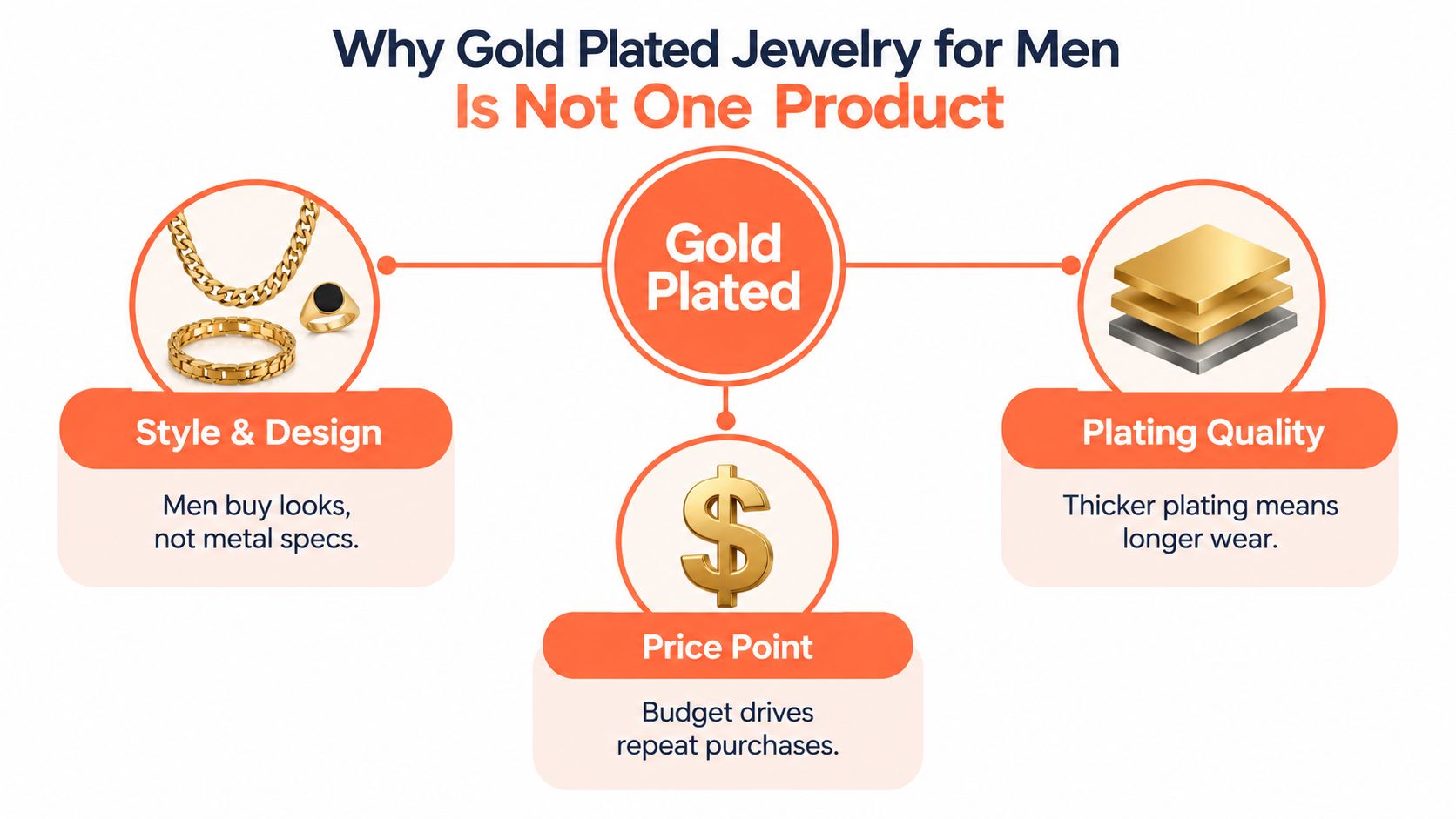
Why Gold Plated Jewelry for Men Is Not One Product
Stop treating gold plated as a single category. It's a label covering very different combinations of plating thickness, gold karat, and base metal, and those three variables drive durability and cost more than branding, packaging, or a polished model photo ever will.
A lightweight fashion chain and a heavier everyday bracelet can both carry the same description in a catalog. Put them on a man who types all day, catches a bracelet on a desk edge, washes his hands often, and wears a ring against metal gym equipment, and the weaker construction shows wear at friction points first. That isn't a mystery failure. It's a mismatched buy.
The commercial case for getting this right is strong. According to World Gold Council data on 2025 jewellery demand, global gold jewelry consumption reached 1,542.3 metric tonnes, down 18% from 1,866.9 tonnes in 2024, while the value of jewelry demand rose 18% to a record US$172 billion. Customers still pay for the gold look even when solid gold volumes fall.
What that means for your assortment
High solid gold prices make plated alternatives commercially useful, but only if you position them correctly. You're selling gold appearance, styling, and accessible pricing, not investment value and not permanent gold. Retailers who blur that line invite disappointed customers.
Buyers who control the three variables can build deliberate tiers instead of a random shelf of gold colored pieces.
- Everyday tier: Prioritize a stable base metal, thicker plating, rounded edges, and secure clasps for chains and bracelets meant for frequent wear.
- Occasional tier: Accept lighter construction where the piece is worn for events, layered briefly, or bought mainly for a look.
- Trend tier: Treat highly fashion driven styles as shorter cycle inventory, price them accessibly, and don't promise daily wear performance you haven't verified.
Practical rule: If a listing gives you color but no base metal, karat, or thickness, you don't have a product specification. You have a photograph.
That's the contrarian point most generic advice misses. A claim that plated jewelry lasts a fixed period is useless without knowing what's under the gold, how much gold sits on top, and where the piece rubs during normal wear. Start with those questions and your buying decisions get sharper immediately.
How Plating Thickness, Karat, and Base Metal Change the Buy
Read a spec sheet in this order, microns first, karat second, base metal always. Microns tell you how much gold layer must wear away before the customer sees what's underneath. Karat tells you the gold content of that layer. Base metal tells you what happens when wear, scratches, or poor adhesion expose the core.
The U.S. Federal Trade Commission defines gold electroplate as a base metal coated by an electrolytic process with gold that is at least 10 karat and at least 0.175 microns thick, distinguishing it from thinner gold flashed or gold washed treatments in its consumer guidance on buying platinum, gold, and silver jewelry. That floor matters because it gives you language to question vague supplier claims.
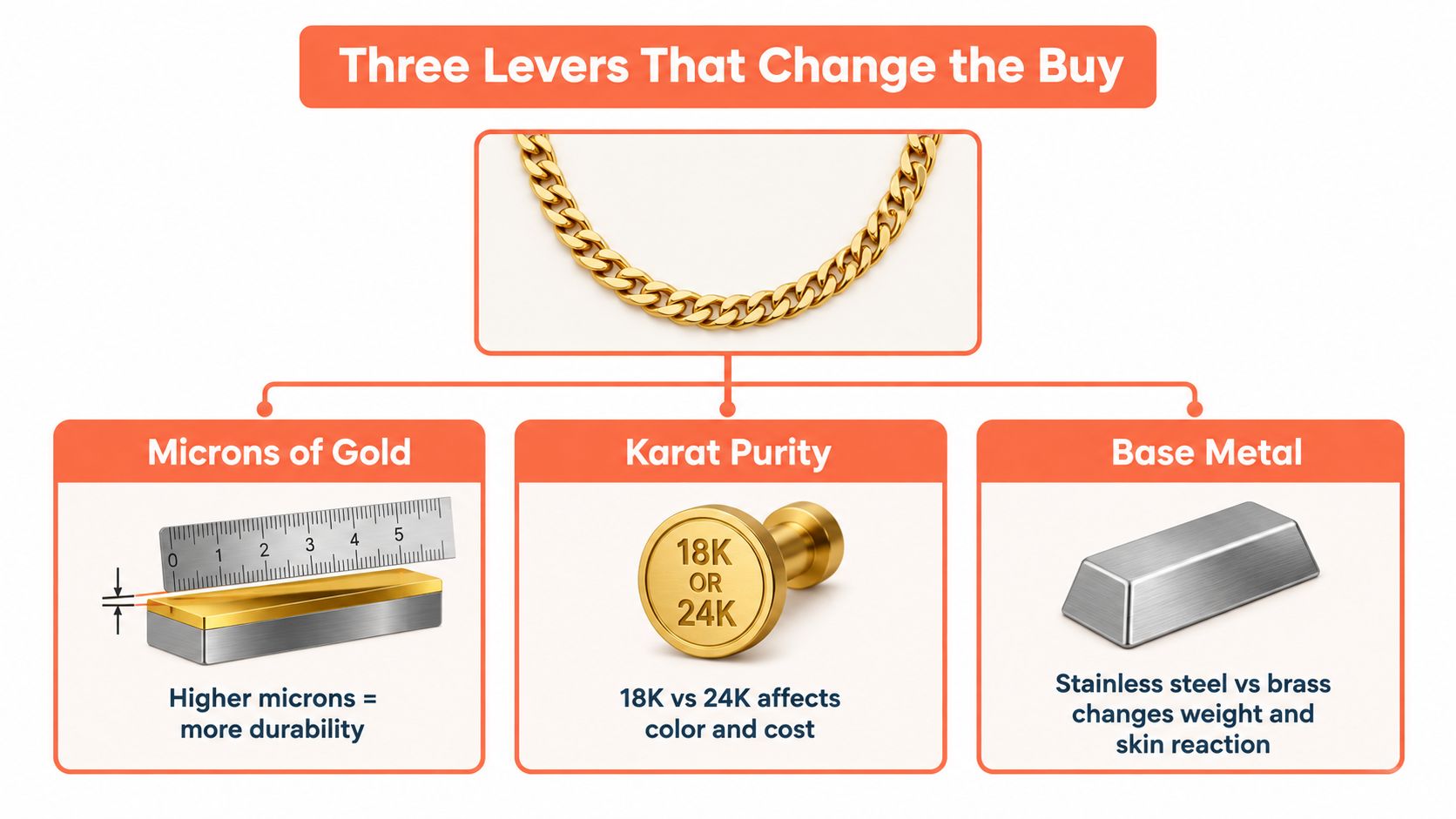
Use a chain to test the logic
Take a men's Cuban style chain. Links rub against each other, the clasp gets handled daily, and edges meet shirt fabric, skin, and sometimes another pendant. A thin coating on a reactive base can look perfect in a sample photo and still disappoint quickly at those contact points.
A thicker coating over a more stable core belongs in a different price and use tier. Don't merchandise both pieces as equivalents because they share a color. Your customer will discover the difference, usually after the return window becomes a conversation you didn't want.
For depth on wear timelines and care variables, review how long gold plating lasts under different conditions before you assign a piece to everyday wear. Then match your product copy to the actual construction, not to the lifespan you wish it had.
Base metal decides the failure mode
Stainless steel and titanium based cores deserve serious consideration for frequent wear men's pieces because the exposed core matters when plating thins. Brass, copper rich, or zinc based constructions need more caution, especially where skin contact, moisture, and friction combine. Ask what sits under the plating, whether there's an intermediate layer, and how sharp edges are finished.
Karat needs the same discipline. A higher karat designation signals a greater proportion of gold in the layer, but karat alone doesn't rescue a very thin coating or weak adhesion. Demand karat plus microns plus base metal in writing, every time. If a supplier answers only with a color name, move on or demote that SKU to your lowest expectation tier.
Plated, Vermeil, Gold Filled, and Flash Compared
Choose construction by job, not by what's cheapest on the quote sheet. Standard plated, vermeil, gold filled, and flash plating occupy different positions on cost, durability, skin contact expectations, and suitable SKU type. Retailers lose margin when they buy one construction and sell it with the promise of another.
The Federal Trade Commission distinguishes gold filled, gold overlay, and rolled gold plate as mechanically applied layers of at least 10 karat gold, rather than electrolytic coatings, and its guidance gives examples such as 14K gold overlay and 12K RGP in Federal Trade Commission guidance on gold quality markings. Use that distinction when you write listings. Customers deserve the method, not just a shiny adjective.
Before you commit to a construction ladder, compare the difference between gold plated and gold filled jewelry against your intended price tier. The right choice depends on how often the piece will be worn and how much friction its shape creates.
Construction Types at a Glance for Men's Jewelry Buyers
| Construction | Typical Base | Durability | Best Men's SKU | Price Band |
|---|---|---|---|---|
| Flash plating | Various base metals | Lowest, suited to short cycle fashion use | Micro pendants, trend earrings | Entry |
| Standard gold plated | Stainless steel, brass, or other stated base metals | Moderate when thickness and adhesion are verified | Fashion chains, bracelets, pendants | Entry to mid |
| Vermeil | Sterling silver | Stronger positioning where silver base and thicker gold layer are confirmed | Signet rings, refined pendants | Mid to premium fashion |
| Gold filled | Base metal with mechanically bonded gold layer | Highest among these options for repeated wear | Cuban links, core chains, signet rings | Premium fashion |
Match the construction to friction
Rings punish weak plating. Hands meet desks, doors, weights, soap, and pockets all day, so don't put your lightest construction on a wide signet ring and call it an everyday staple. Chains distribute wear differently, but clasps and link edges still need attention.
Earrings and small pendants face less broad surface abrasion in many wear patterns, though posts, clasps, and bail edges still rub. That's where a lighter tier can make commercial sense if your copy stays honest. Statement pieces worn occasionally can also carry a fashion tier construction, provided you don't price or describe them as heirloom substitutes.
My recommendation is blunt. Build your core men's range around constructions you can specify and verify, then use flash level pieces only where trend speed matters more than service life. That separation protects reviews, repeat purchases, and your credibility when a customer asks why one gold colored chain costs more than another.
Men's Categories That Sell and What to Stock First
Stock anchors before novelties. For most small retailers, chains, Cuban links, bracelets, and simple signet rings give you a clearer foundation than a scattered opening order built around whatever looked bold in a supplier catalog that week.
The collection below shows the core silhouettes to evaluate first, a Cuban link chain, an ID style bracelet, and a signet ring.
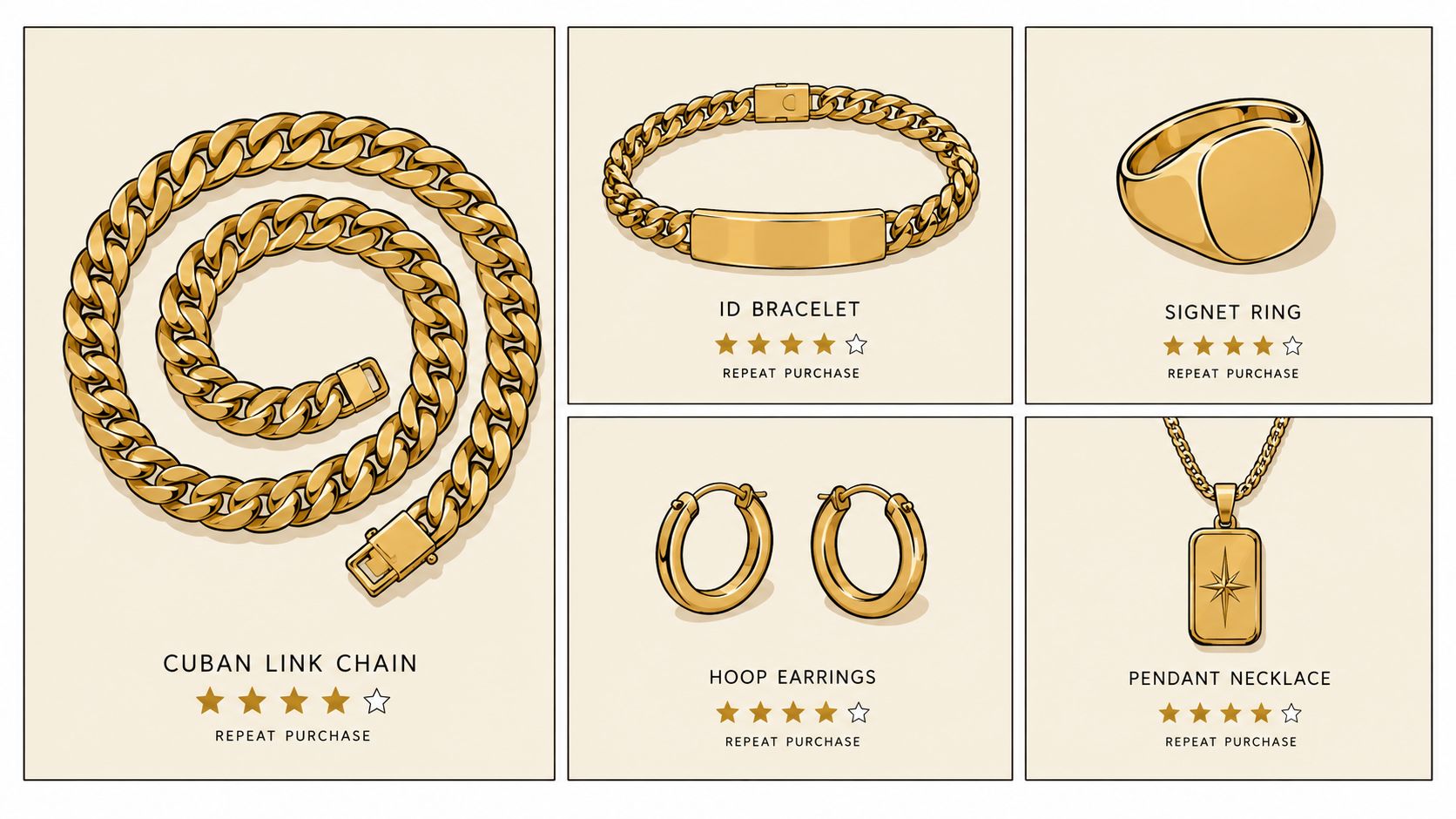
Chains earn anchor status because customers can wear them alone, layer them, or add a pendant later. A chain worn under a shirt faces skin and fabric contact, while one worn over a tee becomes the visible styling decision. Stock widths and lengths with intention, and check clasp strength on every sample because a good looking chain with a weak closure is still a bad buy.
Bracelets need harsher scrutiny. Wrists hit desks, watch cases, laptop edges, and gym equipment, so examine edges, link movement, and clasp security before you order depth. If you're building the wrist category, compare your shortlist with chain bracelet styles for men and how they wear, then divide your buy into an everyday tier and a trend tier.
Rings, earrings, and pendants need different logic
Signet rings sell on silhouette and presence, but they're your highest friction category. Buy conservative construction, inspect inner band finishing, and write care guidance that tells customers to remove rings for heavy manual work. Don't let a strong photo override a weak sample.
Earrings and pendants work well as add ons and trend tests. They're useful for refreshing an assortment without rebuilding your whole men's wall, but small findings still matter. Check posts, backs, bails, jump rings, and any point where plating can rub through and expose the base.
For cross category context on how plated pendant construction is presented in a catalog, a factual example is the Bohemian Luxury Geometric Stainless Steel 18K Gold Plated Pendant Necklace for Women DIY Charm Bar, listed as a Necklace for Women, in Bohemian, Luxury style, weighing 30g, with 1 variant across option1, option2, and option3. It's not a men's anchor SKU, but its listing shows why naming base material and plating in the product title helps buyers sort inventory quickly.
Watch how finished pieces move and catch light before you finalize an opening assortment, because stiffness, clasp action, and edge finishing are hard to judge from stills alone.
Start narrow, prove sell through, then widen. One dependable chain family, one bracelet family, and one ring silhouette in controlled tiers will teach you more than a broad first order with no clear performance standard.
Evaluating Suppliers Before You Place a Wholesale Order
Don't place a wholesale order on photographs and confidence. Run a sequence that produces evidence you can save, compare, and use when a reorder arrives looking different from the approved sample.
Industry technical commentary indicates that roughly 1 micron can provide reasonable life for costume jewelry, while very thin flash plating may fail quickly, and it recommends verifying thickness with X-ray fluorescence, or XRF, rather than assuming a gold colored finish proves quality, as discussed in technical commentary on gold plating thickness and XRF verification. That's the standard to bring into supplier conversations.
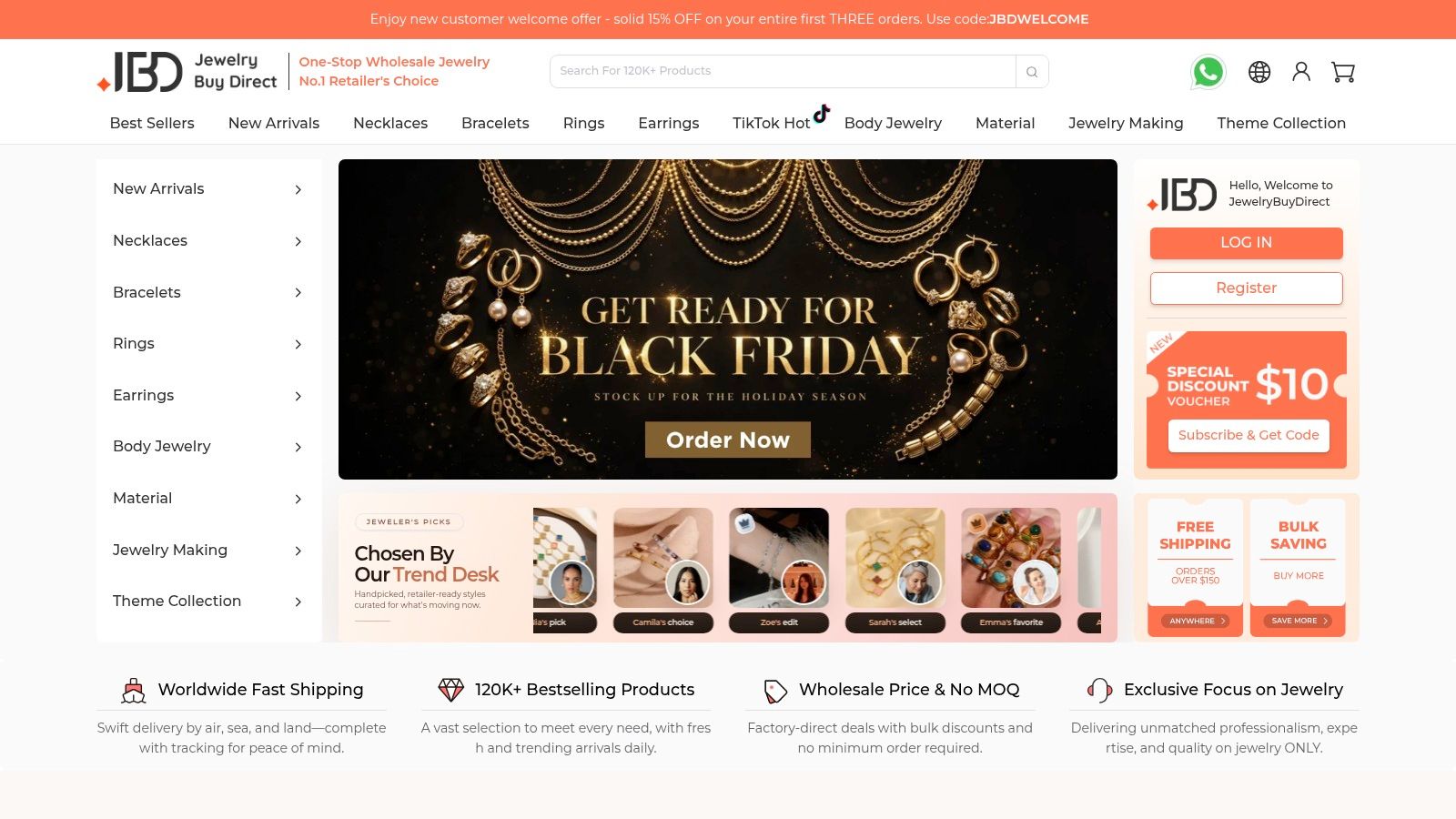
The screenshot below is a reminder to audit what a supplier publishes, not just what a sales rep promises in chat.
A supplier sequence that produces proof
- Order samples across tiers: Buy the exact chain, bracelet, and ring constructions you plan to sell, then handle clasps, edges, and inner surfaces yourself.
- Demand written specifications: Record base metal, gold karat, plating method, and stated thickness for every SKU, and photograph any stampings on the sample.
- Verify plating where feasible: Ask for a plating report or arrange XRF testing on representative samples, especially for core everyday SKUs.
- Stress the friction points: Open and close clasps repeatedly, check link movement, inspect sharp edges, and look for early color variation after handling.
- Audit commercial terms: Confirm minimum order flexibility, reorder consistency, lead times, defect handling, packaging, and whether the same construction will be used on replenishment.
Serious suppliers expect these questions. If a seller treats specification requests as an insult, you've learned something valuable before spending real inventory money. For a broader scoring method you can adapt to jewelry vendors, review how to evaluate suppliers and turn your findings into a repeatable scorecard.
Thicker plating alone doesn't guarantee durability. Poor adhesion, sharp edges, exposed reactive base metal, and constant friction can undermine a piece that looks strong on paper.
You can include JewelryBuyDirect among the B2B platforms you evaluate for gold plated men's assortments, but apply the same sample, specification, and verification discipline you'd apply to any factory or local wholesaler. Keep approved samples, dated photos, test results, and written specs together. That file is your advantage on reorders and your defense when quality drift appears.
Pricing Structure and Margin Levers for Small Retailers
Price from landed cost and expected wear tier, not from a competitor's screenshot. A men's plated piece carries more than a unit quote. You need to account for the item itself, findings, packaging, freight, duties or taxes where applicable, marketplace or payment fees, photography, returns, and the time your team spends handling defects.
Build a simple cost stack for every core SKU before you set a retail price. Separate product cost, plating related cost where quoted, findings, packaging, inbound shipping, and selling fees. Then decide what margin remains after a realistic allowance for discounts and returns. If the numbers only work at full price with zero problems, they don't work.
Where margin actually improves
Better margin usually comes from fewer avoidable losses, not from squeezing the first quote until construction suffers. A slightly stronger clasp, cleaner edge finishing, or more suitable base metal can protect reviews and repeat orders. Cheapening the parts customers touch every day is false economy.
- Bundle with purpose: Pair a chain with a compatible pendant or bracelet only when sizing, color tone, and wear tier match.
- Tier your price architecture: Give customers a clear entry option and a verified step up option, with construction differences stated plainly.
- Protect discount tolerance: Set your regular price so a planned promotion doesn't erase the margin on your best selling core pieces.
- Watch packaging cost: Presentation matters for gifting, but oversized or fragile packaging can raise shipping damage and storage costs.
Compliance belongs in the pricing conversation too. For U.S. bound inventory, federal origin marking rules require nearly every foreign made article, or its container when permitted, to display a conspicuous, legible, and permanent English statement of its country of origin, under federal origin marking rules for imported articles. Confirm that marking stays visible through fulfillment and resale, and factor relabeling or repackaging work into your landed cost if your supplier can't do it correctly.
Don't use a single markup habit across every construction. A trend earring, an everyday chain, and a gold filled ring carry different return risk, handling needs, and customer expectations. Price each tier for the job it performs, and review margin after fees and returns, not just on the day the invoice arrives.
Product Pages, Photography, and Merchandising That Convert
Your product page should answer the questions a careful buyer would ask in store. State the base metal, gold karat, plating category, stated thickness when available, dimensions, clasp type, and care instructions. Disclosure doesn't weaken a fashion product. It filters out mismatched expectations before they become returns.
Photography needs the same discipline. Product photography should be prepared to the required 383:204 aspect ratio, approximately 1.88:1, with a practical production size of 1,149 × 612 pixels, and Shopify's media editor supports custom aspect ratio cropping through its Freeform option, as described in Shopify guidance on using the media editor. Crop deliberately so clasps, edges, and scale details don't disappear in display.
Show scale, construction, and use
Men's jewelry converts better when customers can judge proportion quickly. Use clean on body photography for scale, close ups for link shape and clasp construction, and flat images that show the full piece without theatrical shadows. Pair chains with plain tees, open collars, denim, or knits so the customer sees a realistic outfit context.
Don't hide the back of a pendant, the inside of a ring, or the closure on a bracelet. Those are the areas customers inspect after delivery, and they're often where finishing quality becomes obvious. Showing them upfront builds trust and reduces surprise.
If you're rebuilding listings while you improve images, use a structured review of titles, descriptions, media, and internal links, such as the approach in optimize Shopify product pages, and apply it consistently across your men's range. Consistency helps customers compare tiers without decoding a new format on every page.
Merchandising moves that support the buy
Group products by wear promise as well as style. Label an everyday tier, an occasional tier, and a trend tier in language your customer understands, then back those labels with specifications. Cross sell a bracelet that matches a chain's tone and construction level, not just its color.
Care content should sit near the buy decision, not buried after checkout. Tell customers to keep plated pieces dry where appropriate, avoid harsh cleaners and fragrance contact, wipe them with a soft cloth, and store them separately. Clear care guidance won't save a weak product, but it will help a correctly bought product perform as intended.
A Practical Checklist for First-Time Buyers
Use this checklist before you approve a sample, chase a trend, or reorder a slow moving SKU. It keeps gold plated jewelry for men tied to measurable construction instead of hopeful labeling.
- Confirm microns: Get stated plating thickness in writing and verify core SKUs where feasible.
- Confirm karat: Record the karat of the gold layer alongside the plating method.
- Confirm base metal: Identify what customers will contact if the surface wears.
- Inspect friction points: Test clasps, link edges, ring interiors, posts, bails, and sharp corners.
- Assign a wear tier: Decide whether the SKU is everyday, occasional, or trend driven before pricing it.
- Check origin marking: Make sure required country of origin information remains visible through resale.
- Price from landed cost: Include packaging, fees, returns, and discount tolerance in the margin view.
- Photograph to ratio: Prepare cover imagery to the correct display shape and show scale plus construction details.
- Disclose on the page: Publish specifications and care guidance where the customer decides.
When you need additional visual variations for testing crops or lifestyle presentation, resources on ai fashion photography can sit alongside your own product shots, but they shouldn't replace accurate close ups of the actual piece you're selling. Customers still need to see the clasp, edges, and finish.
Buyer's standard: Color gets a click. Thickness, karat, base metal, and honest positioning earn the repeat purchase.
That's the framework. Buy fewer vague SKUs, verify the ones that anchor your range, and let your product pages say exactly what each piece is built to do.
Visit JewelryBuyDirect to source gold plated jewelry for men alongside chains, bracelets, rings, earrings, and fashion accessories for your store. Bring your specification checklist, compare base metals and plating categories before you order, and build a men's assortment with clear everyday, occasional, and trend tiers.