






Arthur Lynch | Sat Jan 17 2026
Difference between gold plated and gold filled: A Sourcing Guide for Businesses
When sourcing for your business, the key difference between gold plated and gold filled jewelry comes down to the amount of gold and how it’s applied. This distinction directly impacts product quality, durability, and cost—all critical factors for your bottom line.
Gold filled jewelry features a thick layer of gold that is mechanically bonded to a base metal core using heat and pressure. By law, this gold layer must constitute at least 5% of the item's total weight. In contrast, gold plated jewelry has an extremely thin layer of gold, often less than 0.05%, applied through electroplating. This thin coating is prone to wearing off relatively quickly, making it a less durable option.
Understanding the Sourcing Essentials for Your Jewelry Business
For any business sourcing jewelry, choosing between gold filled and gold plated items is a strategic decision. It directly influences your product quality, brand reputation, customer loyalty, and ultimately, your profitability. Both options provide the coveted gold look at an accessible price point, but their construction, durability, and value proposition are fundamentally different. Getting your sourcing right means understanding these differences to build a profitable inventory.
This guide is designed for jewelry business owners, retailers, and wholesalers who need to make informed purchasing decisions. We’ll break down the technical and commercial differences so you can stock your inventory with high-quality, affordable products that align with your brand and meet your customers' expectations.
A Quick Comparison for Business Sourcing
The most critical distinction for sourcing is the gold content, as it determines durability, value, and customer satisfaction. As noted, gold filled jewelry is legally required to have a gold layer that is 1/20th (or 5%) of the total weight, permanently bonded to a base metal like jeweler's brass. Gold plated items, however, have a microscopic gold content, often under 0.05%, which is known to wear away with use. For a deeper analysis to inform your sourcing, you can find more details on jewelry composition.
This chart provides a quick visual breakdown of how the two compare on key business metrics.
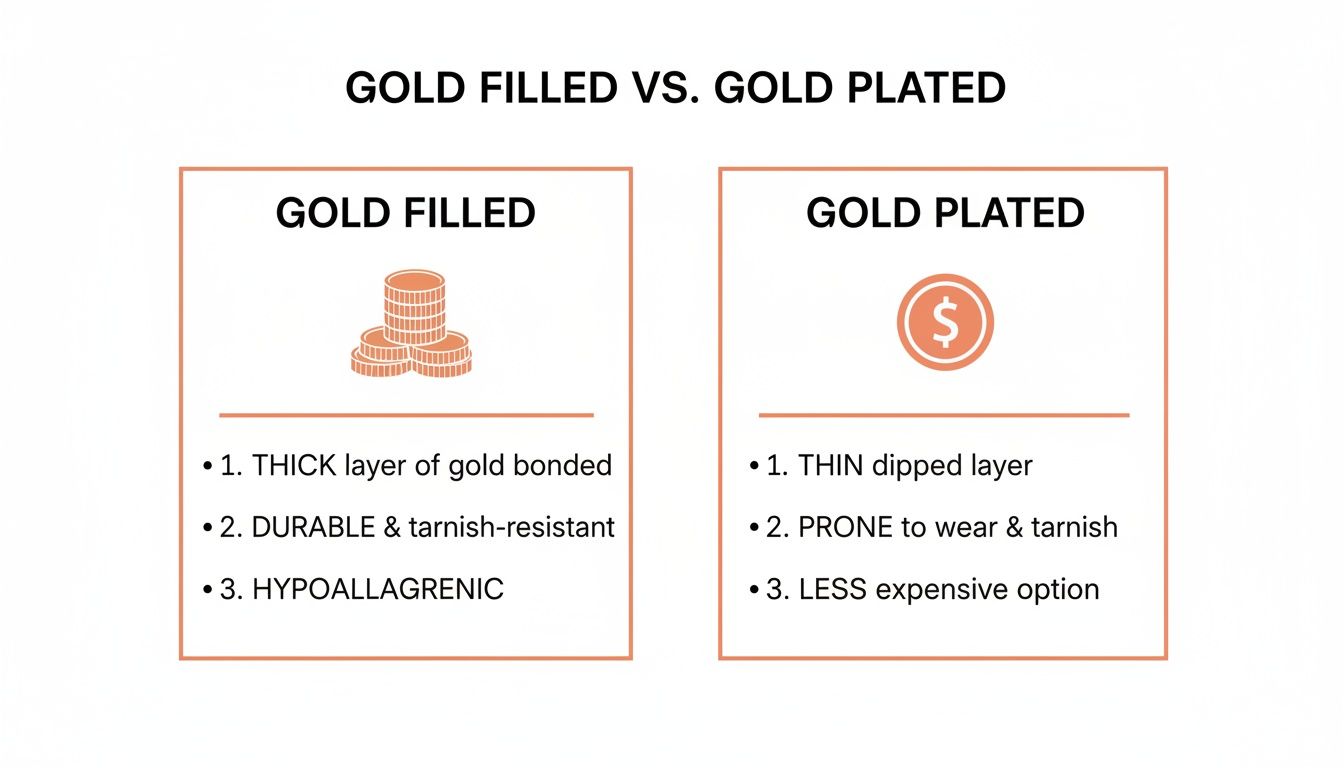
As you can see, gold filled represents a much more substantial investment in real gold, a quality that translates to greater product longevity and higher perceived value for your customers.
For businesses needing a clear, at-a-glance comparison, this table outlines the essential differences to consider when sourcing your inventory.
Gold Filled vs Gold Plated Key Differences for Sourcing
| Attribute | Gold Filled Jewelry | Gold Plated Jewelry |
|---|---|---|
| Gold Content | Legally must be at least 5% (1/20) of the item's total weight. | A minuscule amount, typically under 0.05% of the total weight. |
| Manufacturing | A thick sheet of gold is permanently heat-bonded to a base metal core. | A micro-thin layer of gold is electroplated onto a base metal. |
| Durability | High durability. Tarnish-resistant and designed for long-term wear. | Low durability. Prone to tarnishing, chipping, and flaking off quickly. |
| Ideal Customer | Seeks lasting quality, value, and pieces suitable for everyday wear. | A fashion-conscious shopper looking for trendy, affordable accessories for occasional use. |
| Wholesale Cost | Moderately higher upfront cost, reflecting superior gold content and durability. | Very low initial cost, ideal for high-volume, trend-driven fashion accessories. |
| Brand Positioning | Positions your brand as a provider of high-quality, durable, and valuable jewelry. | Aligns your brand with fast-fashion, offering accessible and trend-focused accessories. |
Understanding these distinctions is fundamental to curating a jewelry collection that not only sells well but also builds trust and loyalty with your customer base.
How They're Made: A Tale of Two Processes
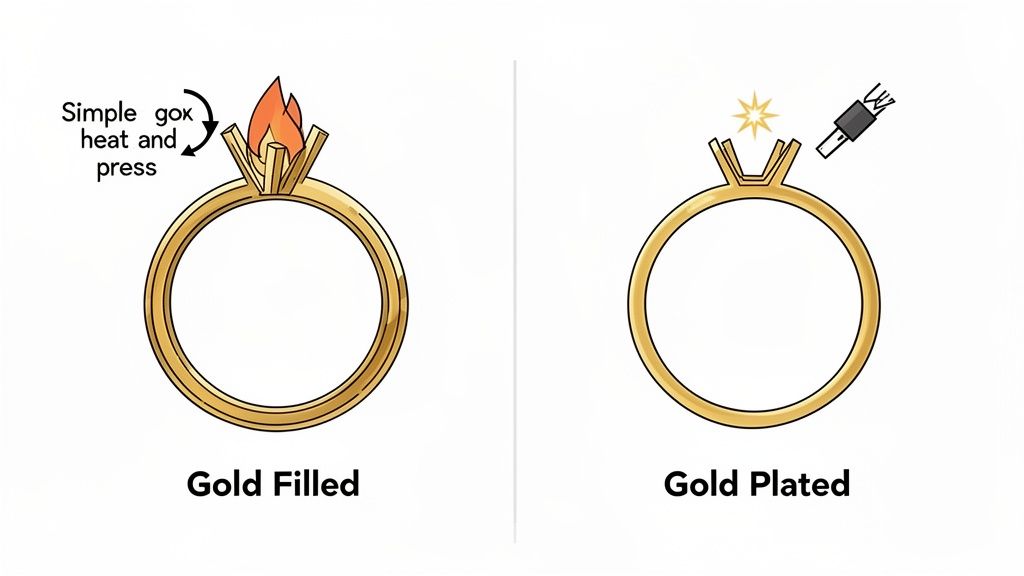
To truly grasp the difference between gold plated and gold filled jewelry from a sourcing perspective, you must understand the manufacturing processes. This isn't just a technicality—it's the primary factor determining a product's quality, durability, and wholesale price. For your business, knowing this difference is crucial for inventory selection, pricing strategies, and educating your sales team and customers.
At their core, the two methods are worlds apart. One relies on a mechanical bonding process, while the other uses an electrochemical reaction. This fundamental divide results in two distinct products tailored for different market segments.
The Gold Filled Method: Heat, Pressure, and Durability
Gold filled jewelry is manufactured by mechanically bonding a thick layer of solid gold onto a core of high-quality base metal, typically jeweler's brass. This creates a permanent, multi-layered material.
The process uses intense heat and pressure. Sheets of solid karat gold are layered onto the brass core, and the composite material is passed through rollers at high pressure and temperature. This action fuses the metals together at a molecular level, creating a single, durable sheet. It’s this thick, bonded layer that gives gold filled pieces their signature strength and long-lasting quality.
Key Takeaway for Sourcing: This heat-bonding process is what makes gold filled jewelry a high-quality, durable option. The resulting gold layer is up to 100 times thicker than that of standard gold plated items, making it highly resistant to tarnish and wear. This is a key selling point for customers seeking value.
When sourcing, note that gold filled pieces are often constructed from wires and chains rather than intricate cast designs, a clue to their manufacturing origin.
The Gold Plated Method: A Quick Dip with Electroplating
Gold plating uses a process called electroplating. A base metal piece—often brass, copper, or a nickel alloy—is submerged in a chemical solution containing gold particles.
An electric current is passed through the solution, causing the gold particles to adhere to the base metal's surface. This creates an exceptionally thin film of gold, frequently measuring less than 0.5 microns in thickness. For context, a human hair is about 70 microns thick.
- Speed and Cost: Electroplating is a rapid and inexpensive process, making it the preferred method for mass-produced fashion accessories.
- Minimal Gold: It uses a tiny fraction of the gold required for gold filled jewelry, significantly lowering production costs.
- Potential Sourcing Concerns: Unregulated factories may use hazardous chemicals, raising environmental and worker safety concerns. Partnering with reputable suppliers is essential.
This method is ideal for producing affordable, on-trend fashion accessories where longevity is not the primary selling point. As a business, understanding the electroplating process helps you set appropriate customer expectations regarding jewelry care. Our guide to caring for gold jewelry offers valuable tips to share with your customers.
Ultimately, the manufacturing process directly dictates product value. Gold filled jewelry is engineered for longevity, justifying its higher wholesale price. Gold plated jewelry offers an accessible, fast-fashion solution. Knowing this allows you to build a balanced and strategic inventory that serves diverse customer needs.
Comparing Durability, Lifespan, and Customer Satisfaction
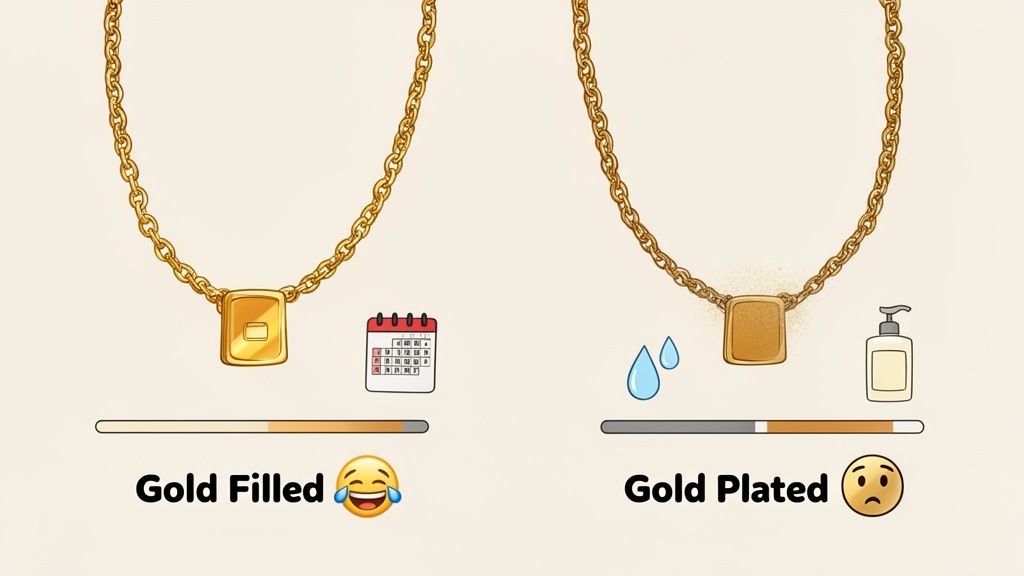
For any jewelry or fashion accessories business, product performance is directly linked to brand reputation. The goal is not just the initial sale but fostering long-term customer satisfaction. How your inventory holds up over time is fundamental to managing expectations, minimizing returns, and building a loyal customer base that drives repeat business.
The true difference between gold plated and gold filled jewelry becomes apparent with wear. A product's ability to withstand daily use, moisture, and contact with lotions is what separates a satisfied, repeat customer from a one-time buyer with a complaint.
Gold Filled Durability and Its Business Impact
Gold filled jewelry is engineered for longevity. Its thick, mechanically bonded gold layer creates a durable surface that is highly resistant to tarnishing, chipping, and fading. With proper care, a gold filled piece can last for years, maintaining its beautiful appearance.
This durability translates directly into positive business outcomes. By stocking high-quality gold filled items, you invest in customer satisfaction and your brand's future.
- Reduced Return Rates: Durable products lead to fewer complaints about tarnishing or wear, protecting your profit margins by minimizing costly returns and replacements.
- Enhanced Brand Loyalty: Customers who purchase jewelry that lasts are far more likely to trust your brand and make repeat purchases. Quality products are the foundation of high customer retention.
- Positive Reviews and Word-of-Mouth: Satisfied customers often leave glowing reviews and recommend your business to others, providing powerful and free marketing.
A strong business reputation is built on product consistency. Offering gold filled jewelry, especially for core collections, signals a commitment to quality that customers will recognize, appreciate, and reward with their loyalty.
Due to its resilience, gold filled jewelry is the ideal choice for everyday pieces like chain necklaces, hoop earrings, and classic bracelets. These are items customers integrate into their daily lives, and their durability ensures a positive long-term experience.
Gold Plated Lifespan and Strategic Sourcing
In contrast, gold plated jewelry has a significantly shorter lifespan. The electroplated layer is incredibly thin and highly susceptible to wear. Friction, sweat, water, and chemicals can quickly erode the fragile finish, exposing the base metal underneath.
This does not mean gold plated pieces have no place in your inventory. It simply requires a strategic approach to sourcing and marketing. These items are best positioned as what they are: trendy, affordable fashion accessories for occasional wear.
By marketing them as "costume" or "fast-fashion" jewelry, you align with customers seeking a specific look for an event or wanting to experiment with a trend without a significant investment. The key is to set clear expectations to prevent disappointment. When customers understand that a low-price item requires delicate handling and is not intended for daily, long-term wear, their satisfaction increases. This transparency is crucial for protecting your brand's integrity while capitalizing on the high-volume, trend-driven market.
Performance Under Real-World Conditions
To manage inventory effectively and ensure customer satisfaction, it is vital to understand how each type of jewelry performs in everyday situations. The table below outlines the practical implications for your business, helping you align your product offerings with real-world customer lifestyles.
| Wear Condition | Gold Filled Performance | Gold Plated Performance | Retailer Implication |
|---|---|---|---|
| Daily Wear (e.g., Office, Home) | Excellent. Withstands daily friction and light exposure to moisture without tarnishing or fading. | Poor. The thin gold layer will quickly wear off on high-contact areas like rings and bracelets. | Stock gold filled for your core "everyday" collections. Position gold plated strictly as occasional wear. |
| Exposure to Moisture | Good. Can handle occasional water exposure, though it's best to avoid chlorine and saltwater. | Very Poor. Water and chemicals will rapidly accelerate the degradation of the plated layer. | Clearly state in care guides that gold plated items must be removed before showering, swimming, or exercising. |
| Contact with Lotions & Perfumes | Fair to Good. Chemicals can dull the shine over time but won't cause immediate wear-through. | Very Poor. Alcohol and oils in cosmetics will break down the thin plating, causing discoloration. | Advise customers to apply all cosmetics before putting on any jewelry, especially plated pieces. |
| Customer with Sensitive Skin | Excellent. The thick gold layer provides a hypoallergenic barrier against reactive base metals. | Risky. Once the plating wears off, exposed base metals like nickel or brass can cause skin irritation. | Market gold filled as a safe, high-quality option for sensitive skin to build trust and cater to a wider audience. |
Ultimately, a successful jewelry business curates a balanced inventory. Gold filled pieces should form the backbone of your collection, offering reliable, lasting quality that builds customer loyalty. Gold plated items, when sourced and marketed transparently, allow you to capture the fast-paced trend market with exciting, affordable variety.
Analyzing the True Cost vs. Value for Your Business
When sourcing jewelry and fashion accessories, the initial wholesale cost per unit is a primary consideration. However, to make truly strategic inventory decisions, you must look beyond the price tag and evaluate the total cost of ownership and the long-term value each product type brings to your business.
The difference between gold plated and gold filled is a strategic business decision that impacts return rates, customer loyalty, and brand perception. A slightly higher upfront investment in quality can yield significant returns down the line.
Calculating the Lifetime Value of Your Inventory
The unit cost for gold plated jewelry is undeniably lower, making it an attractive option for businesses focused on high-volume sales and fast-fashion trends. A retailer can stock a wide variety of plated pieces with a minimal initial investment, appealing to customers seeking stylish, occasional-wear accessories. This strategy is effective for seasonal items where longevity is not the main selling point.
Gold filled jewelry requires a greater upfront investment due to its significantly higher gold content. While the initial cost is higher, its true value is realized through its durability and quality. This higher cost is often offset by long-term benefits that protect and enhance your profit margins.
For a business, value extends beyond the purchase price. It encompasses the entire product lifecycle, including the costs associated with returns, customer service, and the invaluable asset of your brand's reputation. Gold filled jewelry often delivers a higher return on investment by reducing these hidden expenses.
Consider this in terms of customer lifetime value (CLV). A customer who purchases a durable gold filled necklace and wears it daily for years is more likely to return for future purchases, leave positive reviews, and recommend your brand. In contrast, a customer whose plated ring tarnishes after a few weeks is more likely to request a refund or simply choose not to shop with you again.
The Hidden Costs of Low-Quality Stock
Focusing solely on the low wholesale price of gold plated items can introduce hidden costs that erode your profits over time. A realistic financial assessment must account for these potential expenses.
Consider these factors:
- Higher Return Rates: The short lifespan of plated jewelry often leads to increased customer complaints and returns. Each return incurs costs in shipping, labor, and potentially lost inventory.
- Customer Service Strain: Managing complaints about tarnishing and flaking consumes valuable time and resources that could be allocated to growth activities like marketing or product development.
- Negative Brand Perception: A reputation for selling low-quality items that do not last is difficult to overcome. It erodes customer trust and hinders your ability to attract and retain customers.
- Lost Repeat Business: A disappointed customer is unlikely to return. It is far more costly to acquire a new customer than to retain an existing one.
Market trends show a growing consumer demand for quality and sustainability. Gold filled jewelry, with its minimum 5% gold weight, is perfectly positioned in the "affordable luxury" segment, distinguishing it from plated items with less than 0.05% gold content. While the precious metal plating market is projected to grow, much of this is driven by disposable, low-end fashion. For a detailed look at these trends, consult the jewelry market analysis from Grand View Research.
Ultimately, choosing between gold plated and gold filled is a decision about your business model. Are you building a brand based on high-volume, trend-driven sales, accepting higher customer churn? Or are you focused on establishing a reputation for lasting quality that fosters loyalty and drives sustainable, long-term growth? The true value is realized when your inventory aligns with your brand promise.
Marketing Each Type to Your Customers Effectively
Successful jewelry sales depend on clear, honest communication. How you position your products shapes customer trust, manages expectations, and determines their likelihood of making repeat purchases. When marketing gold plated vs. gold filled jewelry, the objective is not just to make a sale but to ensure the customer understands exactly what they are buying.
With one, you are selling a durable, high-quality piece for everyday wear. With the other, you are offering an affordable, fashionable accessory for trying new trends. Mastering this distinction is key to building a trustworthy brand.
Crafting the Perfect Product Story for Gold Filled Jewelry
When marketing gold filled pieces, your narrative should focus on durability, quality, and long-term value. This is not just another accessory; it is a smart purchase designed to last. Your product descriptions and marketing language should reflect its superior construction.
Use compelling phrases that highlight its benefits:
- Affordable Luxury: This positions it as a high-value alternative to solid gold, offering a premium feel without the premium price.
- Daily-Wear Durability: This communicates a clear promise of quality, assuring customers they can wear the piece regularly without issue.
- Tarnish-Resistant and Long-Lasting: Be direct about its performance. This reassures buyers that it is a reliable choice for their core jewelry collection.
- A Smart Investment: This frames the purchase as a cost-effective decision, as they will not need to replace it after a few months.
This language educates the customer, justifies the higher price point, and builds the confidence needed to complete the purchase.
Positioning Gold Plated Jewelry for Success
The marketing strategy for gold plated jewelry must be entirely different. Transparency is paramount. Avoid misrepresenting the product and instead focus on its genuine strengths: affordability and trend-forward style.
Here are effective ways to describe your gold plated items honestly:
- On-Trend Style for Less: This appeals directly to fashion-conscious shoppers who enjoy experimenting with new looks without a large financial commitment.
- Perfect for Special Occasions: This positions the pieces as ideal accessories for events like weddings, parties, or nights out, where long-term durability is not the primary concern.
- Accessible Fashion Jewelry: Using terms like "fashion" or "costume" jewelry sets clear expectations, signaling that it is a fun, temporary item requiring gentle care.
By clearly defining gold plated items as accessible and trend-focused, you prevent the misunderstandings that lead to negative reviews. A customer who knows what they're buying is a happy customer, even if the item has a shorter lifespan.
Your product photography is equally important. High-quality images can capture the brilliant shine of a plated piece intended for an event or showcase the substantial, warm glow of a gold filled chain designed for everyday life.
A tiered approach is often most effective. Offer gold plated jewelry as your accessible, entry-level option for trend-seekers. Then, upsell customers seeking lasting quality to your gold filled collection. This dual strategy allows you to serve a broader audience, building a reputation for both fashionable variety and high-quality, dependable jewelry.
Your Sourcing and Quality Verification Checklist
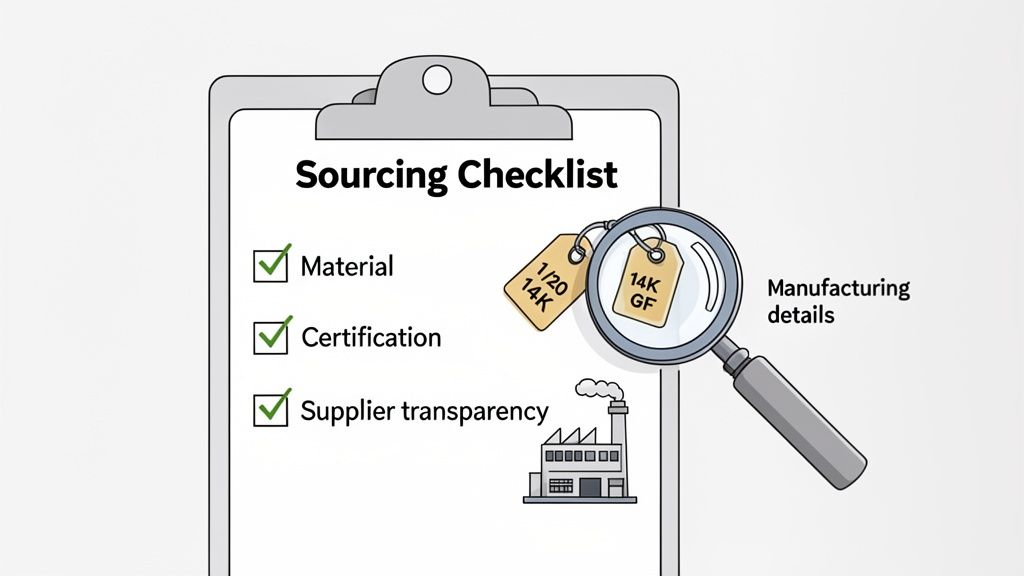
Sourcing high-quality and affordable jewelry requires a diligent verification process. Whether you are evaluating gold filled or gold plated items, a systematic approach to quality control protects your brand's reputation and your investment. Use this checklist as your guide for purchasing with confidence.
Begin by carefully reviewing supplier product listings. Vague terms like "gold tone" or "gold finish" are red flags. For gold plated jewelry, request the plating thickness in microns. For gold filled, confirm the gold content percentage and karat. Reputable suppliers provide this information upfront.
Decoding Quality Marks and Specifications
Understanding industry-standard markings is essential for verifying product authenticity. This is particularly important for gold filled jewelry, where the quality stamp is the primary indicator of authenticity and a key way to spot the difference between gold plated and gold filled pieces.
- 1/20 14K GF: This is the most common stamp on gold filled jewelry. It certifies that the piece is 1/20th (or 5%) 14-karat gold by weight.
- 14/20 GF: This is an alternative notation for the same standard, confirming that 14-karat gold constitutes 5% of the item's total weight.
- No Standard Marks for Plating: Gold plated items lack a standardized quality mark for gold content, making supplier transparency and trust paramount.
For more details on these markings, our guide on what gold filled means provides a comprehensive breakdown. Always ensure the product stamp matches the supplier's specifications.
Verifying Supplier Claims and Manufacturing Details
Beyond inspecting the product, you must thoroughly vet your supplier. The best partners are transparent about their manufacturing processes and can provide documentation to support their claims. Do not hesitate to ask for detailed information before placing a large order.
A reputable supplier views detailed questions as a sign of a serious business partner, not a nuisance. Your diligence in asking about base metals, plating methods, and certifications directly impacts your inventory's quality and your brand's reputation.
Finally, always request documentation. If a supplier claims their jewelry is hypoallergenic or meets specific industry standards, ask for third-party testing reports (e.g., from SGS) to verify these claims. This step helps you filter out unreliable suppliers and build lasting partnerships with trustworthy manufacturers, ensuring the products you sell are of a quality you can proudly stand behind.
Common Sourcing Questions Answered
When sourcing inventory, practical business questions arise quickly. These questions concern not just materials but also operations, customer communication, and brand strategy. Understanding the difference between gold plated and gold filled jewelry allows you to answer these questions confidently and build an inventory that aligns with your quality standards.
Here are answers to common questions from fellow jewelry business owners.
Which Type Is Better for Customers with Sensitive Skin?
For customers with sensitive skin, gold filled jewelry is the superior choice. The thick, pressure-bonded layer of real gold creates a durable, hypoallergenic barrier that prevents the base metal core from contacting the skin.
In contrast, the thin layer on gold plated pieces can wear away quickly, exposing the skin to base metals like nickel or brass, which are common allergens. By offering gold filled items, you can confidently market them as a safe, high-quality option for sensitive skin, resulting in fewer customer issues and greater brand trust.
Can I Advertise Gold Filled Jewelry as Real Gold?
While gold filled jewelry contains a significant amount of real gold, precise marketing language is crucial. The best practice is to label the product clearly as "gold filled."
You should highlight its quality by explaining that it has a thick layer of "14k real gold" bonded to a core metal. However, avoid misleading terms like "solid gold."
Using clear, educational language works wonders. Try phrases like "an affordable alternative to solid gold" or "features a long-lasting real gold layer." This sets the right expectations, shows the value, and makes your brand look trustworthy and knowledgeable.
This transparent approach builds confidence not only in your products but in your entire business.
How Do I Explain the Price Difference to My Customers?
When a customer questions the higher price of gold filled jewelry, shift the conversation from cost to long-term value and durability.
Explain the manufacturing process in simple terms: "Gold filled pieces have a much thicker layer of real gold that’s permanently bonded to the core, so they won't tarnish or wear off like plating does. It's really an investment in a piece that can last for years with good care." This reframes the cost as a smart purchase based on longevity and quality. To further substantiate your claims, you can learn more about how to test and verify gold purity.
At JewelryBuyDirect, we offer a huge selection of both gold plated and gold filled jewelry. This gives you the flexibility to build a diverse, high-quality inventory that meets every customer's needs and budget. Source with confidence at https://www.jewelrybuydirect.com.