






Jennifer Lopez | Mon Oct 19 2026
Wholesale Nose Studs That Sell a Practical B2B Guide
“All stainless steel is safe” is the most common shortcut in wholesale nose studs, and it's a poor basis for a reorder. A metal name or a “hypoallergenic” label doesn't tell you the exact grade, how much nickel the jewelry releases, or whether the finish will hold up in use.
Buy for evidence, not reassurance. The lowest-priced piece can become the expensive one if customers return it, react to it, or find its product claims challenged. For every SKU, ask what material documentation supports the intended use. That discipline matters whether you sell fashion jewelry for healed piercings or stock pieces intended for initial wear.
Why Most Wholesale Nose Stud Decisions Start With the Wrong Question
Many buyers open a supplier quote and go straight to price per piece. I'd start somewhere else: what documented material and compliance evidence backs this SKU? A label such as “surgical steel” doesn't identify a grade, while “hypoallergenic” doesn't prove how the product performs against a safety standard.
The distinction matters because nickel regulations focus on release, not purely how much nickel a metal contains. For body-piercing post assemblies, UK and EU rules set a limit of less than 0.2 micrograms per square centimeter per week; the limit for other jewelry intended for prolonged skin contact is 0.5 micrograms per square centimeter per week. A coating may restrict release, but the coating has to keep doing so during normal use. (UK guidance on jewelry metal content and nickel release)
That's why my first reorder question is about paperwork, not color or unit cost. Ask the supplier for the precise material grade, a relevant test report, and a clear statement of whether the piece is intended for a fresh piercing, a healed piercing, or fashion wear. Professional piercing guidance names specific grades, including ASTM F-136 or ASTM F-67 titanium and ASTM F-138 stainless steel, rather than treating every product labeled “titanium” or “steel” as equivalent.
Buyer's rule: If the supplier can't identify the grade and substantiate the claim, don't sell the claim.
The same discipline protects the listing. FTC guidance says jewelry marketing claims must accurately represent a product's metallic content and surface treatment, while EU nickel rules establish measurable release limits for piercing posts. Those aren't abstract compliance details. They help you choose what to buy, what to call it, and which customer it's appropriate for.
Hypoallergenic Materials Decoded for Wholesale Buyers
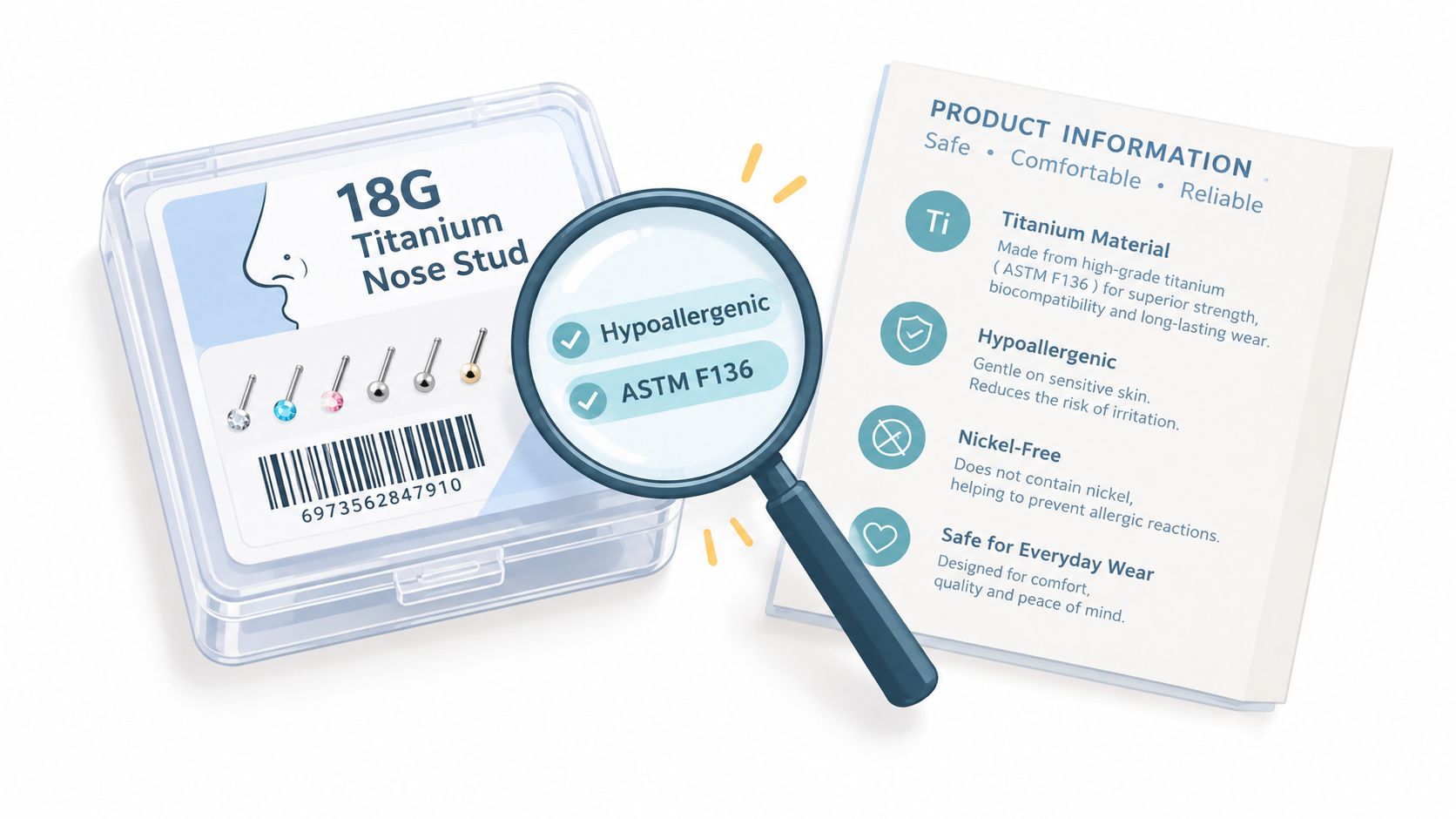
A useful material menu starts with intended use. Titanium compliant with ASTM F-136 or ASTM F-67 is a strong choice to investigate for fresh or healing piercings, provided the supplier identifies the exact grade and supplies supporting documentation. “Titanium” alone is not enough. The Association of Professional Piercers also identifies ASTM F-138 or ISO 5832-1 steel as relevant grades, and advises buyers to distinguish documented body-jewelry materials from unspecified alloys.
Nickel is a common cause of allergic reactions associated with piercing jewelry, and medical guidance lists titanium, niobium, surgical stainless steel, and 14- or 18-karat gold among lower-risk options. (Mayo Clinic's piercing and jewelry guidance) For buyers, the point isn't to treat every material in a category as interchangeable. It's to match the product to the use case and verify the supplier's description. Retailers explaining the term to customers can also link to this guide to what hypoallergenic jewelry means.
| Material | Biocompatibility note | Cost tier | Best fit customer | Document to request |
|---|---|---|---|---|
| Implant-grade titanium | Specify ASTM F-136, ASTM F-67, or the applicable ISO grade | Higher than basic fashion alloys | Fresh-piercing customers when the piece is suitable and documented | Material certificate naming grade and standard |
| ASTM F-138 stainless steel | A defined grade is more useful than “surgical steel” | Mid-range | Buyers seeking specified steel body jewelry | Mill certificate and nickel-release evidence |
| Niobium | Recognized as a lower-risk material option | Varies by design and supplier | Customers looking for an alternative to steel | Exact material declaration and supplier records |
| Solid 14- or 18-karat gold | Guidance identifies suitable solid gold as a lower-risk choice, with composition important | Premium | Curated boutiques and customers seeking precious metal | Karat and alloy-content declaration |
| Sterling silver | Better reserved for healed-piercing fashion than initial wear | Value to mid-range | Customers buying jewelry for healed piercings | Metal-content and surface-treatment details |
| Plated or unspecified alloy | Coating wear can expose a less suitable base metal | Often lowest | Fashion-only use, clearly described | Base-metal and plating disclosures |
Make the distinction visible in your assortment: fresh-piercing options, healed-piercing styles, and fashion-only pieces shouldn't share an ambiguous material label. For a customer-facing perspective on professional piercing choices, Timebomb Tattoo & Piercing studios can provide useful context. Your own supplier documents still need to establish what each SKU is made from.
Gauge, Post Length, and Closure Types That Actually Fit Customers
A stud can be beautifully finished and still come back because it doesn't fit. Build a fit matrix before you build a style wall. The available sizing guidance identifies 18G as a common nostril gauge, but anatomy and piercing placement vary, so don't promise one size will suit everyone. (Nose-screw gauge and sizing guidance)
Start by separating nostril, high-nostril, and septum products. They aren't interchangeable just because they share a decorative top. Ask suppliers to state gauge and wearable post length in millimeters, then make those dimensions easy to find on product pages. A flat-back labret, screw, L-shape, and bone each secure differently, so customers need a clear description and, where possible, a measurement diagram.
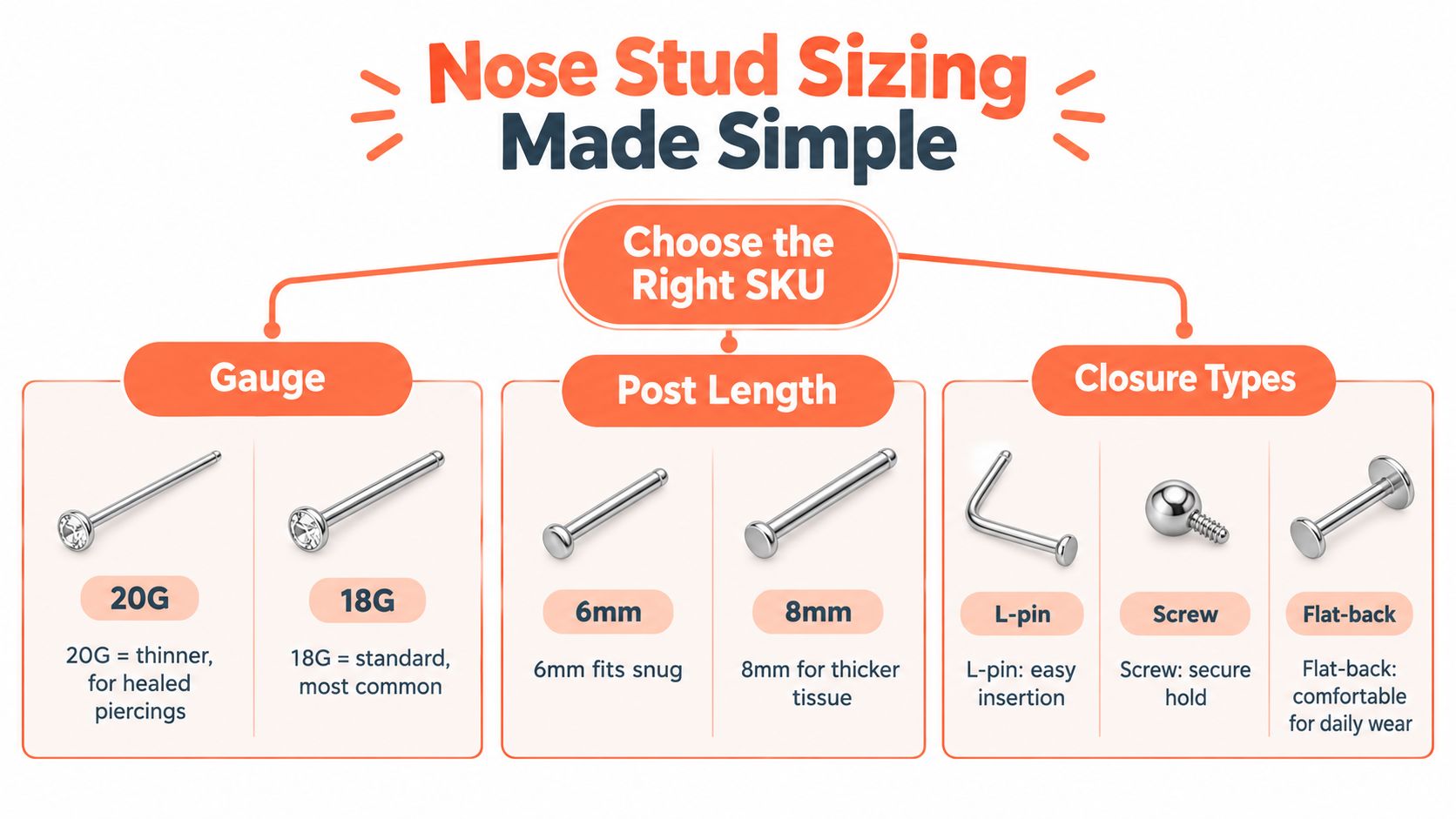
For a starter range, stock a deliberate selection rather than ordering a large run of a supposed “standard” size. Include common nostril gauges, more than one post length, and closure styles that serve different preferences. Keep septum and high-nostril products clearly separated in the catalog, and advise customers to confirm fit with a professional piercer.
| Fit decision | What to specify | Why it helps |
|---|---|---|
| Gauge | Exact gauge, not “standard” | Makes the post diameter clear |
| Post length | Wearable length in millimeters | Helps customers compare fit |
| Closure | Flat-back, screw, L-shape, or bone | Sets expectations for insertion and hold |
| Placement | Nostril, high-nostril, or septum | Prevents customers treating different placements as equivalent |
Sizing is a commercial decision, not a minor detail. The cited market estimate puts online fashion-jewelry returns at 22–28%, compared with 8–12% in stores, and says sizing issues account for about 28% of those returns. That makes accurate dimensions and a compact fit matrix a practical way to protect margin, not an inventory indulgence. For a concrete example of a listed post length, compare the measurement details on these 8mm nose studs from Piercing Near Me.
Compliance Documents Worth Requesting Before You Reorder
A supplier's answer should be a file you can verify, not a reassuring adjective. Request documentation tied to the actual SKU and, where available, its production lot. A generic PDF with no product identifiers is weak evidence, even if its logo looks official.
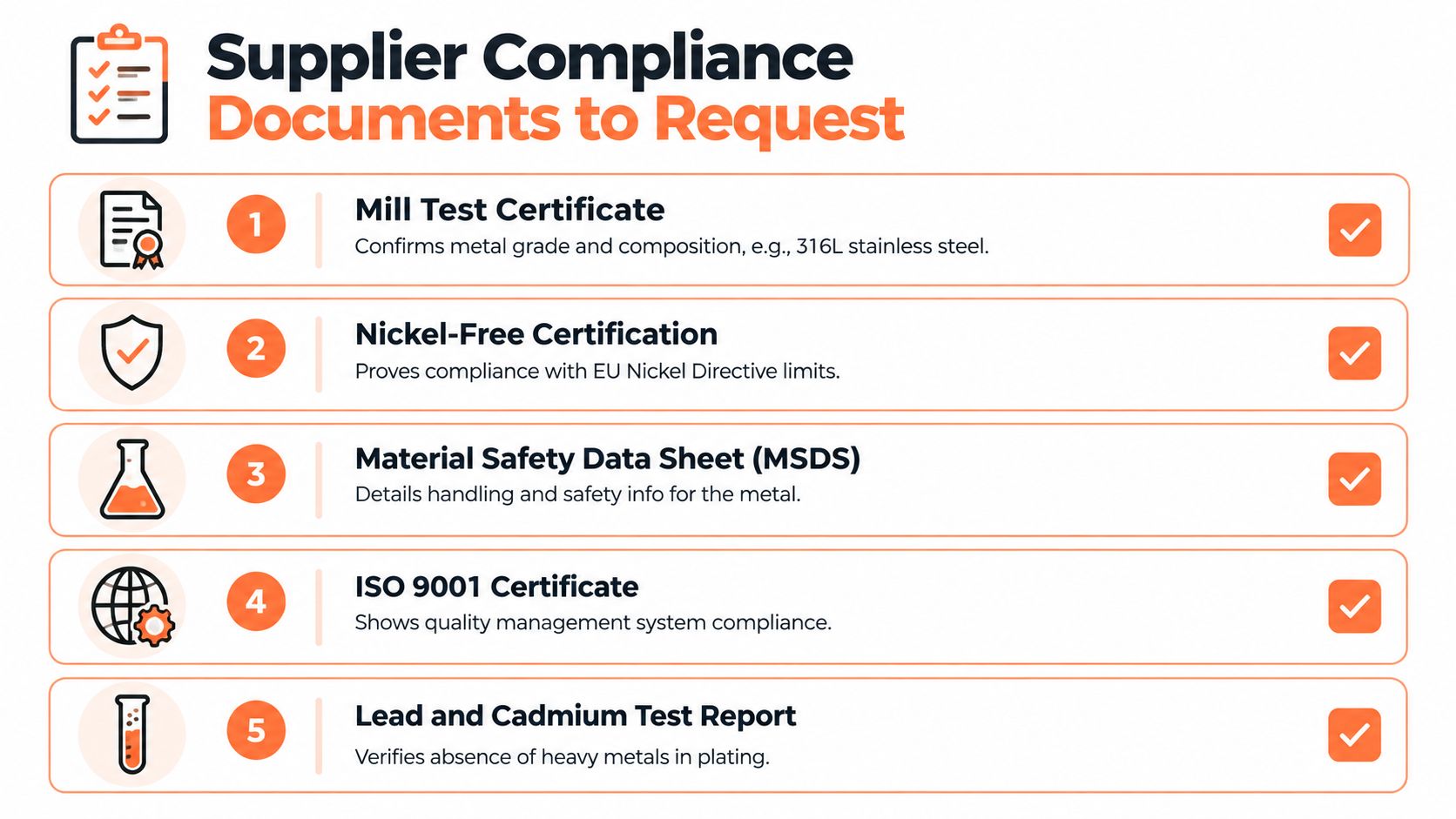
The core request is a mill test certificate naming the metal grade and applicable ASTM or ISO standard. Oregon's body-piercing rules offer a clear example of formal oversight: jewelry used for initial piercings must have a mill certificate identifying a specific ASTM or ISO grade, and the jewelry must be sterilized before use. For fresh-piercing inventory, ask for sterilization records as well. Those records don't replace material verification, but they address a separate part of readiness for use.
A nickel-release report should identify the tested product or material and the relevant test basis. If you source precious-metal or coated pieces, also request a supplier declaration that clearly distinguishes solid metal from plating, filling, or overlay. That gives your team a defensible basis for writing product titles and descriptions.
The following video can complement your document review, but it doesn't replace SKU-level evidence from your supplier.
Check relevance, not just presence
Before approving a report, compare the SKU name, grade, supplier or manufacturer identity, and any lot details against the item you're buying. Ask for clarification if the same certificate appears to cover unrelated materials or if the supplier can't explain what was tested. Vague “food-grade” wording, missing identifiers, and evasive answers about the grade are reasons to pause.
Keep the evidence with the SKU record. If a marketplace or retailer questions a claim, you'll want the supplier's documentation ready, not buried in an old email.
Pricing Tiers, MOQ Strategy, and Margin Math for Resellers
A low quote doesn't tell you whether two nose studs are comparable. Separate the assortment into value fashion pieces, documented steel or titanium, and premium body jewelry or solid gold. Then price each tier based on what the product is and what you can substantiate, not on the color of the finish.
The practical rule is simple: don't compare a plated alloy with documented implant-grade titanium as if they're substitutes. Their material, intended use, and claim requirements differ. Build product-page language that makes those differences clear, and keep your cost and retail targets separate by tier. A customer should be able to see why one stud costs more without relying on vague language like “premium quality.”
FTC Jewelry Guides require marketing claims to accurately represent metallic content, plating, and surface treatment. (FTC Jewelry Guides) That makes correct descriptions a compliance safeguard as well as a way to defend pricing. Before setting a retail price, record the supplier's material declaration, landed cost, packaging cost, and the margin you need for the channel where you'll sell.
Sample before you scale
Use small test orders to learn which materials and styles your customers choose. A no-minimum-order option can make that test easier, but it doesn't remove the need to inspect samples or verify claims. Compare the full buying terms, including minimums, shipping, returns, and the documents available for each SKU.
For the calculation itself, use a wholesale profit margin calculator to check whether your intended retail price leaves room for operating costs. Don't set one markup rule for every nose stud. A fashion-only item, a documented material, and a precious-metal product carry different customer expectations and different costs. Track them separately, then reorder the tier that sells without creating avoidable customer-service problems.
Packaging, Labeling, and Product Claims That Survive a Marketplace Audit
A compliant product can still become a listing problem if the title overstates the metal or the packaging hides important details. Treat the product card, pouch label, online listing, and supplier invoice as one claims system. If one says “gold” and another says “gold plated,” fix the inconsistency before the item goes live.
For precious-metal descriptions, be exact about construction. FTC guidance says terms such as “gold plate(d),” “gold filled,” “gold overlay,” and “rolled gold” should generally be supported by a gold-to-total-weight ratio of at least 1/40, and marketers should disclose the purity of a precious-metal coating when it's an alloy. (FTC guidance on gold-surface descriptions) For products containing multiple precious metals, list them in order from greatest to least by relative weight. Don't let a supplier's shorthand become your product claim without checking what it means.
Packaging should make stock control and customer understanding easier. Individual pouches or compartments can help prevent pieces from tangling; a lot sticker can connect inventory to supplier records; and a product card can state material, gauge, post length, and closure. Add country-of-origin information where applicable, and keep it consistent with supplier documentation.
Image presentation is part of the product explanation. A cover image prepared at 383:204 has a wide format, so a square or tall source may crop out the post, backing, packaging, or text when displayed. Shopify's media editor lets users choose a Freeform crop, reposition the frame, and save the selected composition. Design or crop to the display ratio and keep the important details away from the outer edges.
A Supplier Selection Workflow Retailers Can Run in a Week
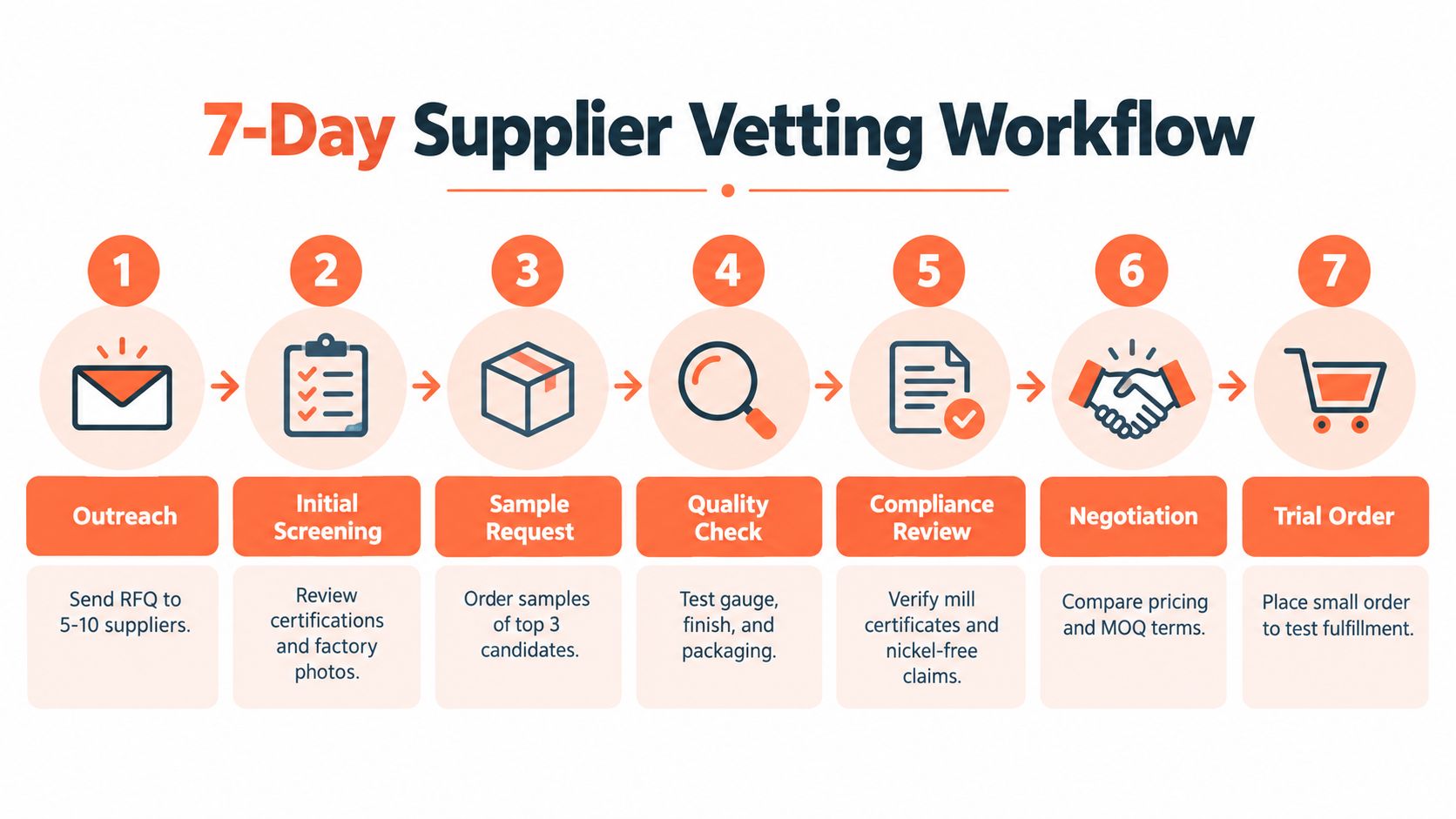
A repeatable buying routine beats a rushed reorder. Use a short supplier review to test communication, sample quality, and documentation before you commit to a larger assortment. The point isn't to create paperwork for its own sake. It's to make every supplier answer the same commercial questions.
Make the first pass consistent
Start with an RFQ that asks for the exact grade, intended use, nickel-release evidence, available sizes, sample terms, and MOQ. Suppliers who answer directly are easier to work with than those who keep repeating “hypoallergenic” without identifying a standard. If you're comparing no-minimum options, this guide to wholesale body jewelry with no minimum can help you assess smaller test orders.
When samples arrive, inspect the basics by hand. Check post straightness, end smoothness, finish consistency, and closure integrity. Professional piercing guidance calls for a mirror-polished surface free of nicks, burrs, scratches, and polishing residue, making a simple smoothness check a useful first screen. (Association of Professional Piercers guidance on jewelry quality)
Decide with evidence, not a discount
Keep a scorecard for each supplier. Record whether the supplier named a specific grade, provided relevant reports, matched the documents to the sample, answered questions clearly, and delivered the requested packaging. Score the sample's fit, finish, and construction separately from the price.
A price far below comparable offers isn't proof of a bad product, but it is a reason to investigate the material and documentation more carefully. Reject the order if the supplier won't identify the grade, sends certificates that don't match the SKU, or avoids questions about the product's intended use. Place a small trial order only after the sample and records line up, then review fulfillment and customer feedback before reordering.
Putting the Guide to Work With JBD's Wholesale Catalog
A catalog is useful only if it helps you test a product decision without forcing a large commitment. JewelryBuyDirect offers a broad B2B range that includes body jewelry, along with no-minimum ordering, so buyers can evaluate an assortment before scaling. Its platform describes manufacturing partners as SGS-certified, but buyers should still request SKU-specific material details and confirm that each document matches the nose stud they're considering.
Start with one use case, not a mixed basket of vague claims. Choose a material tier, request the exact ASTM or ISO grade where applicable, and compare the sample against its product description. Check the finish and fit, then track sell-through and customer response before expanding the order. If the evidence doesn't match the listing, don't scale the SKU.
Treat catalog images as part of that listing work. Prepare cover images at 383:204 and keep the stud head, post, backing, and any product text inside the safe central area, so the display crop doesn't remove details that support the sale.
The buying habit I recommend is straightforward: stop reordering by metal name alone. Reorder by documented grade, accurate dimensions, and a sample that passes inspection. A low unit price isn't a win if the product creates returns or forces you to walk back a claim.
JewelryBuyDirect offers wholesale jewelry with no minimum order quantity, giving retailers a way to test nose-stud styles before committing to a larger buy. Choose a tier, request the material documentation, and visit JewelryBuyDirect to build a sample order you can inspect before scaling.