






Jennifer Lopez | Fri Oct 16 2026
Wholesale Mood Rings: A Smart B2B Sourcing Guide
Most sellers still treat mood rings like throwaway novelty stock. That's lazy buying. The category has already proven it can explode fast, then vanish when wholesalers overcommit, and that same pattern is exactly why smart buyers should treat wholesale mood rings as a small-batch, trend-responsive line with tight controls, not a warehouse gamble.
The 1975 boom is the warning label and the opportunity at the same time. Reported cumulative sales reached about $15 million by December 1975, while other historical accounts put first-year sales closer to $20 million, which tells you the product moved fast enough that even the record-keeping couldn't keep up Mood ring history. The buyers who still make money from it are the ones who source carefully, test the response, and sell it beside stackable bands, Y2K pieces, and other visual accessories that move on social feeds.
Why Mood Rings Still Belong in a Wholesale Catalog
Mood rings didn't disappear because the concept failed. They disappeared because wholesalers flooded the channel, demand collapsed after oversupply, and unsold inventory turned into dead cash. That's not a reason to avoid the category, it's a reason to buy it properly.
The right mindset is simple. Wholesale mood rings are not a core basics line, they're a replenishable novelty with repeat visual appeal. That makes them useful for boutiques, marketplace sellers, pop-up vendors, and social-commerce stores that can test a small assortment, watch the response, and reorder only what sells.
Buy it like a trend, not like a permanent pillar
A buyer who treats mood rings as a “viral SKU” usually gets burned. A buyer who treats them as a trend-tide accessory has room to move. Put them next to stackable rings, mixed-metal pieces, colorful stones, and retro-looking bands, because that's where shoppers mentally file them anyway.
The product suits retailers who can handle quick assortment checks and fast merchandising changes. It works for stores that already rotate seasonal novelty, gifting, or impulse items. It's a weaker fit for merchants who want one evergreen hero SKU and never want to revisit it.
Practical rule: If you can't review a novelty line every season, don't overbuy mood rings.
The commercial thesis is blunt. Mood rings still belong in a catalog because they're easy to understand, easy to demonstrate, and cheap enough to test without betting the quarter. The three decisions that matter are what to buy, who to buy from, and how to sell it without turning a colorful idea into stale inventory.
How Mood Rings Work and What to Buy
Mood rings use cholesteric thermochromic liquid crystals, and those crystals shift the wavelength of reflected light as temperature changes. That creates a smooth color change, not a simple on-off effect. Surface temperature drives the color, so finger warmth, ambient air, contact pressure, and how long the ring sits on skin all influence the result.
Buy the build, not the buzzword. Ask for the liquid-crystal cabochon, the sealed dome, the opaque backing, and the band material. If a supplier cannot identify those parts clearly, the sample is already warning you that the production story is weak.
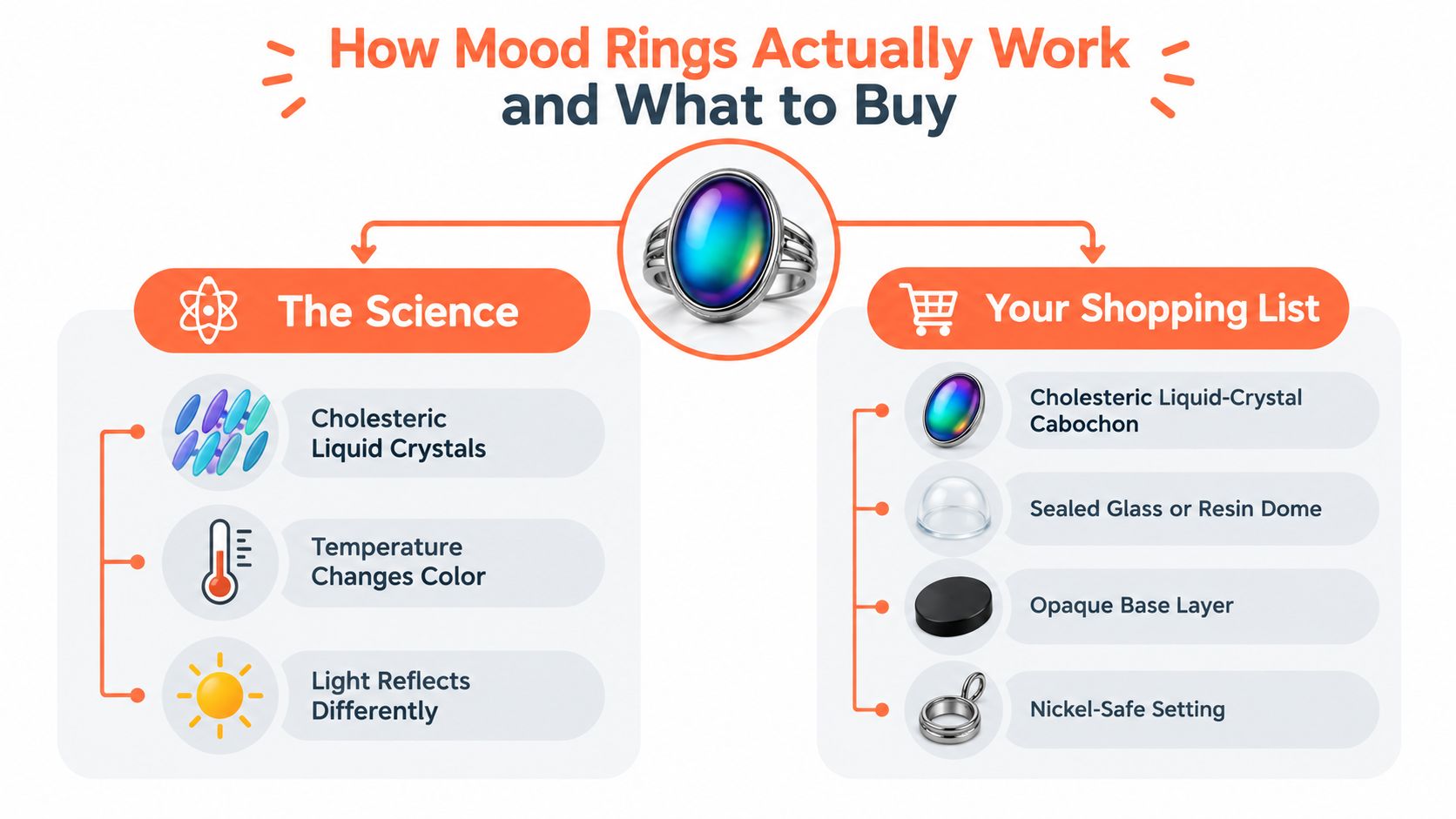
What a decent sample should show
A good ring should show a visible shift near skin temperature. A documented liquid-crystal blend designed for human skin temperatures changes from red to blue across about 89–94°F liquid-crystal lesson plan. That narrow window is what gives finger-worn mood rings their visible effect.
Before you place an order, get four answers. First, the nominal transition window. Second, the color-play bandwidth. Third, the viewing-angle requirements. Fourth, the UV resistance. If the supplier cannot answer cleanly, the ring will probably look better in the product photo than on a customer's hand.
Position the mood ring as temperature-reactive jewelry in all listings; never imply it reads emotions.
Mood Ring Material and Cabochon Specs at a Glance
| Component | Common Options | Buyer Note |
|---|---|---|
| Cabochon | Thermochromic liquid crystal, resin-filled stone | Prefer a clear, stable color shift near skin temperature |
| Dome | Glass, resin | Sealing matters more than flashiness |
| Backing | Opaque, reflective, dark | Opaque backing improves contrast and visibility |
| Band | Alloy, stainless steel, plated base metal | Ask for full material declaration, not marketing language |
A useful sample stays readable under normal retail handling. Thin color at the sample stage turns into customer complaints at the shelf. For merchandising context while you source, keep an eye on this mood-ring color guide, but use it as a sales reference, not a substitute for real material specs.
Choosing Between Factories, Trading Companies, and B2B Platforms
Buyers split into three paths for a reason. Direct factories give the tightest grip on production and the best shot at unit cost. Trading companies reduce friction when you want smaller runs, mixed sourcing, or faster communication. B2B platforms help you compare options fast, which matters when you are testing a novelty line instead of betting the season on it.
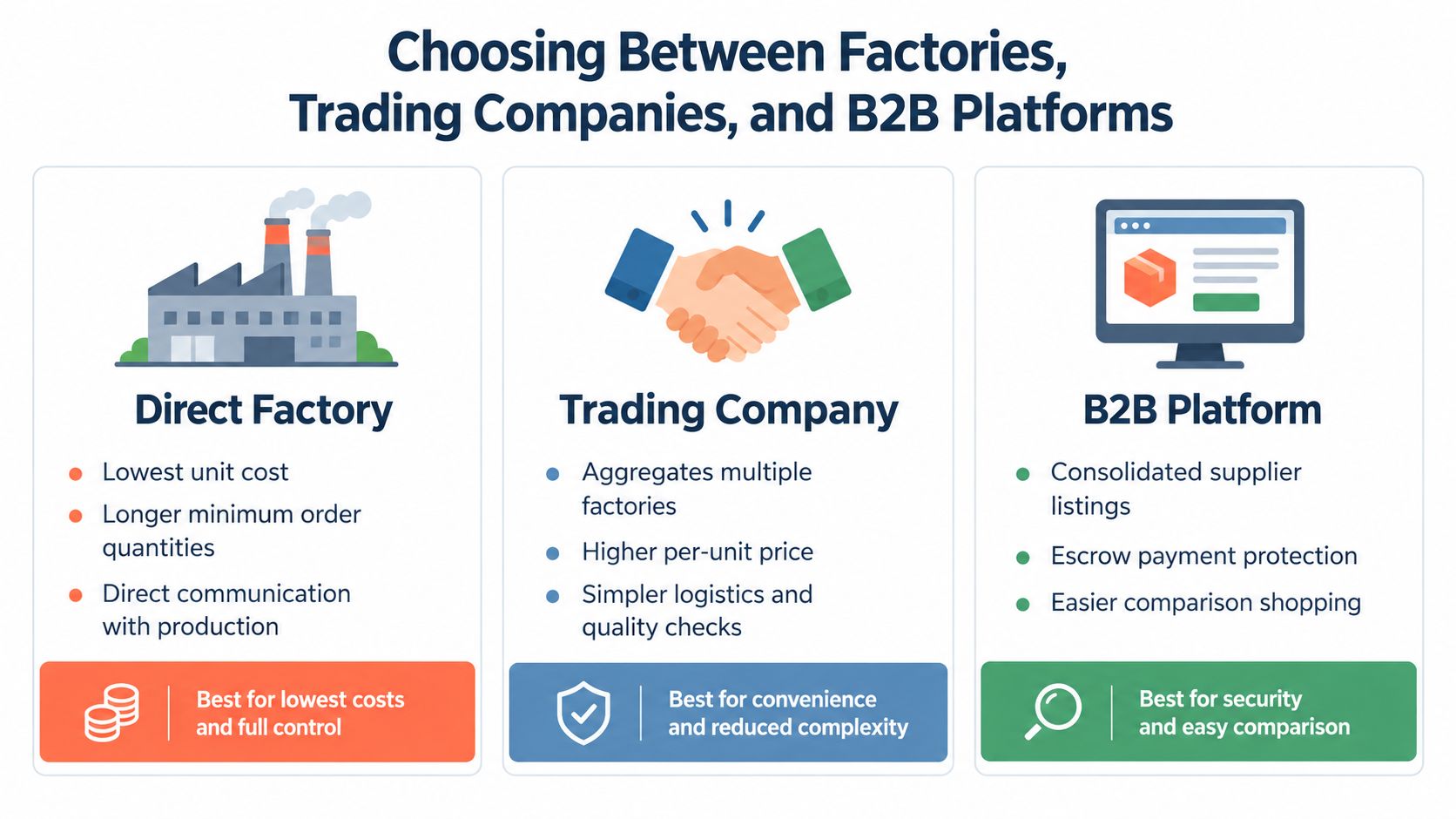
The three paths buyers use
Direct factory sourcing is the right move when you want real control over alloy choice, plating, and packing. You usually get better pricing discipline, but you also take on more of the back-and-forth, the defect chasing, and the minimum order pressure. If you are prepared to ask hard questions, this path gives you the cleanest view into how the ring is made.
Trading companies are useful when you need speed and flexibility. They can combine orders from different factories, which helps if you want to test several styles without coordinating every line yourself. The tradeoff is obvious. You often pay more, and the chain behind the ring can get fuzzy if the seller will not spell out who produced it.
B2B platforms work best as a discovery tool, not a trust signal. They let you compare listings, sort supplier claims, and move from browsing to samples without wasting weeks on dead-end messages. For a small mood-ring test, that speed matters.
What to ask before you trust any vendor
If a supplier dodges alloy composition, treat that as a warning sign. If they will not share lab reports or material declarations, they are pushing compliance risk onto you. If the price looks far below similar SKUs, assume the savings are coming from plating quality, backing quality, or weak after-sale support.
Use a sourcing benchmark outside jewelry if you need to see how disciplined vendor communication should look. A good apparel sourcing service shows the level of structure you should expect from any serious supplier conversation, especially when you are dealing with small test buys and repeat orders.
For a practical manufacturer search, keep how to find a jewelry manufacturer open while you vet replies. Use it to pressure-test response speed, documentation quality, and whether the seller behaves like a production partner or just a quote desk.
Red flag: If the seller cannot show a material declaration and a test report, you are not sourcing, you are guessing.
For a first run, choose the path with the clearest material documentation and the cleanest dispute trail, even if it costs 5–10% more per unit.
Running a Sample to Bulk Order the Right Way
A sample order is not a courtesy. It's the cheapest possible mistake you can make before buying inventory. Write the request like someone who expects to resell the ring, because that's exactly what you're doing.
What your written RFQ should include
Keep the request tight and specific.
- Product definition: Mood ring, intended size range, band finish, and whether you want adjustable sizing.
- Material ask: Band alloy, plating type if any, cabochon type, backing material, and whether the dome is glass or resin.
- Visual requirements: Desired color range, stone shape, and packaging style.
- Documentation request: Alloy declaration, batch test report, and any durability evidence available.
- Commercial terms: Sample price, sample lead time, bulk MOQ, and price breaks by quantity.
If the supplier answers with broad marketing language instead of exact specs, stop there. A strong sample request forces the factory to show its hand before you spend bulk money.
How to test the returned sample
Run the ring through warm-cool cycling, check it after simulated sunlight exposure, and inspect for bubbles, delamination, clouding, or delayed color recovery. Those failure points matter more than how shiny the ring looks in the first unboxing. The coating or sealed dome has to protect the liquid crystal from the kind of handling it will get in storage, shipping, and a customer's daily use durability guidance.
If the ring passes the visual test but loses contrast after handling, don't scale it. If the plating rubs off fast or the setting feels loose, don't scale it. If the color response is weak under ordinary wear, don't scale it.
How I'd scale the order
For a testable novelty line, treat 50, 250, 1,000, and 5,000 pieces as checkpoints, not automatic targets. Start small if you're testing a new style, then move up only after you've confirmed response, packaging, and customer interest. If the supplier pushes you hard for a huge opening order, that's often a sign they're managing their own risk onto you.
Payment terms should also match your risk. Use whatever trade protection you can get, and if you're commissioning custom molds or branded packaging, lock down ownership in writing before you pay for tooling. That's how you avoid paying twice for your own idea.
Compliance and Labeling Rules You Cannot Skip
Compliance is where cheap jewelry gets expensive. Mood rings sit on skin, which means the materials, coatings, and labels matter whether a seller likes it or not. If you ignore that, you'll eventually eat returns, delistings, or customs headaches.
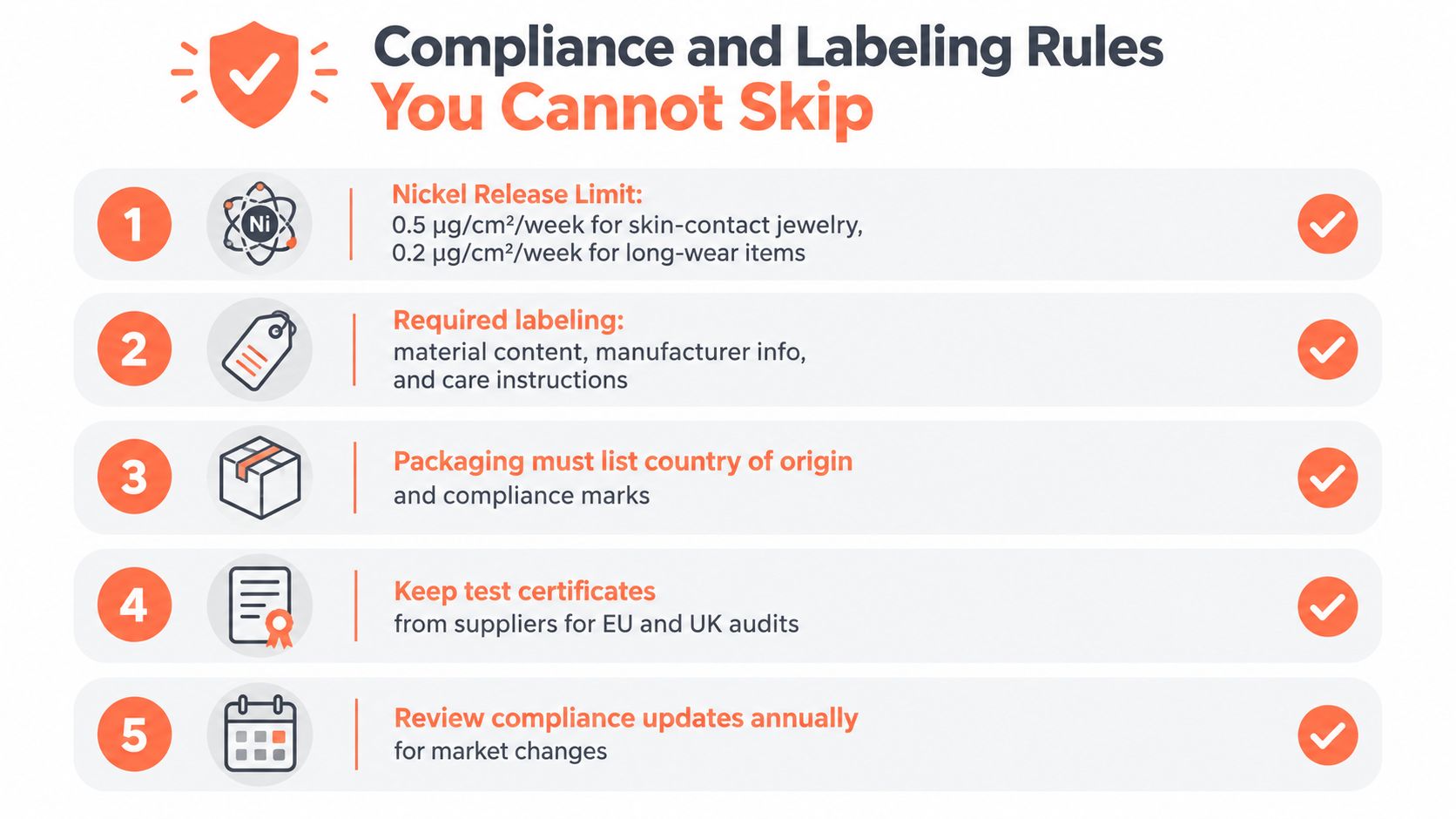
Nickel, lead, cadmium, and what the documents should show
EU and UK rules regulate nickel release, not just nickel content. Jewelry in direct and prolonged skin contact must release no more than 0.5 µg/cm²/week, while components inserted into piercings face a stricter 0.2 µg/cm²/week limit nickel-release guidance. That's why a glossy “hypoallergenic” label means very little by itself.
For China-market screening, SGS's summary of GB 28480 lists adult-jewelry lead at 1,000 mg/kg, cadmium at 100 mg/kg, children's-jewelry lead at 300 mg/kg, and cadmium still at 100 mg/kg GB 28480 summary. Those are the kinds of numbers that separate a serious supplier from a guesser.
What a buyer should keep on file
The documentation packet should include an alloy declaration, batch test reports, plating durability evidence, and product listings that match the documents exactly. The FTC Jewelry Guides also warn against misleading claims about composition or performance, and they expect material descriptions to be clear and prominent in sales copy FTC Jewelry Guides.
A supplier's “gold” or “silver” language is not enough. If it's plated, say plated. If it's alloy, say alloy. If the listing says one thing and the carton says another, you've created your own problem.
Buyer standard: If the paperwork doesn't match the product page, the product page is wrong.
The smartest wholesale move is to ask for compliance before price negotiation gets emotional. A cheap ring with weak paperwork is not cheap at all.
Merchandising Mood Rings for TikTok, Pop-ups, and Beyond
The color shift is the selling point, and it gives you a built-in demo for short-form video, which is why mood rings work better as a social-commerce item than many buyers expect.
Four merchandising angles that convert
Y2K nostalgia sells to younger shoppers who want a playful throwback. Use a clean product shot, a hand demo, and a caption that keeps the retro signal clear. Keep the assortment tight, because this audience buys on vibe first and detail second.
Festival and pop-up impulse purchase works best with bright displays and fast turnover. Put the ring near mirrors, accessory trays, or checkout zones, and keep the copy short. It fits shoppers who want a cheap, visible souvenir instead of a planned jewelry purchase.
Couples and friendship gifting gives you an easy bundle format. Sell two rings together, or pair a ring with a matching stackable band. Buyers in this lane respond to simple gift language and a clear emotional hook.
Custom or private-label collections suit sellers who want a branded angle, not just a novelty item. If your store already has a color story or a nostalgia shelf, mood rings fit as a repeatable mini-line instead of a one-off stunt.
If you're building UGC for a launch, Mastering TikTok UGC is a useful reminder that the first three seconds matter more than the caption. Show the color change immediately, and do not bury the demo under a slow intro.
For sellers who need stronger listing images, image ratio guidance helps keep the cover shot from getting cropped at the wrong edge.
Keep your product photos from getting cropped
Your cover image needs to respect the 383:204 ratio, or the platform may crop off the ring, packaging, or key visual details. At that ratio, a 1,500 px wide image should be about 798 px high, and a 1,200 px wide image should be about 639 px high image ratio guidance.
| Width (px) | Height (px) |
|---|---|
| 1500 | 798 |
| 1200 | 639 |
| 383 | 204 |
Keep the ring, the stone, and any packaging inside the safe center area. If the edges matter to your branding, they may not survive platform cropping.
Your 30-Day Mood Ring Launch Plan
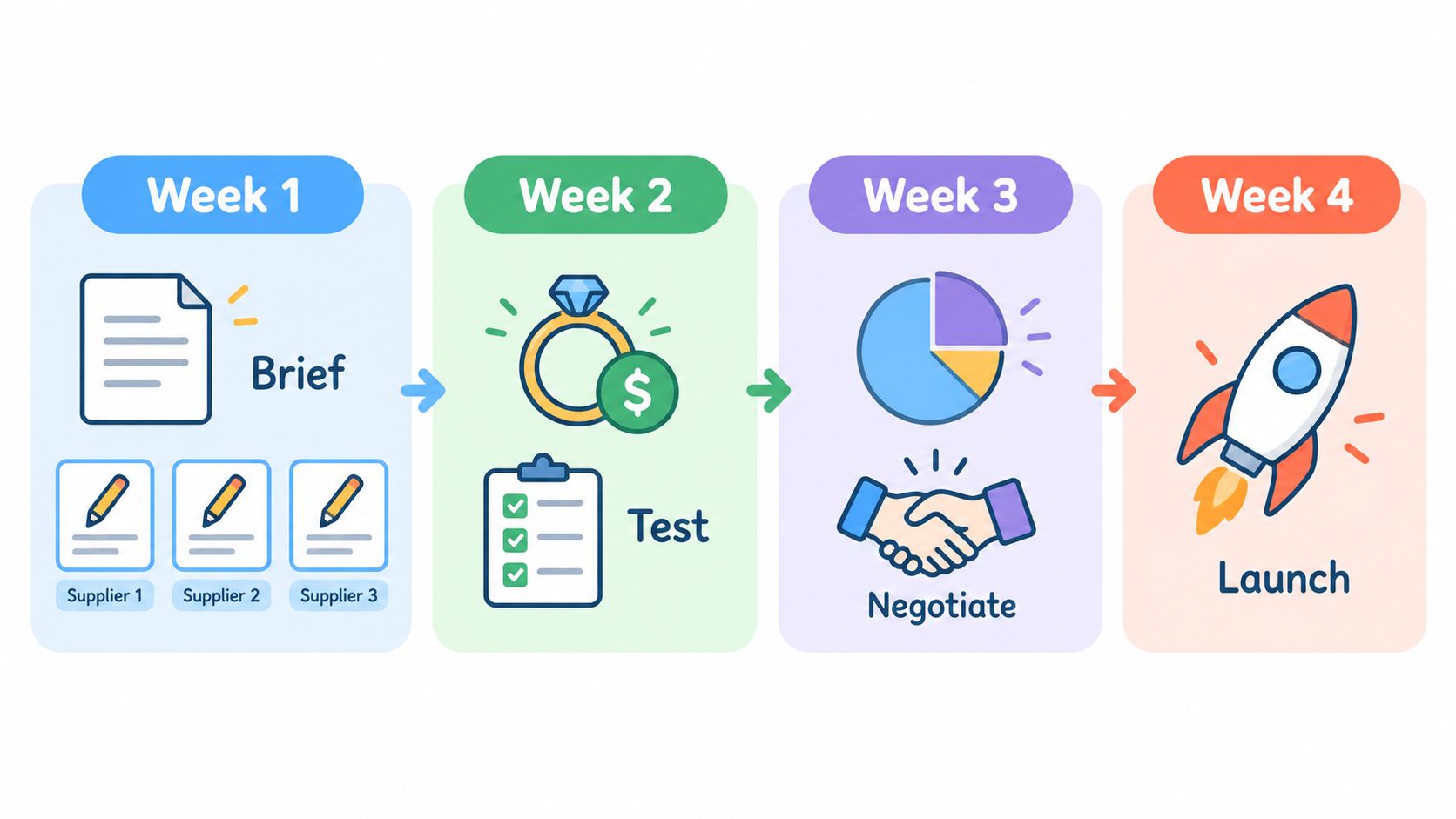
Week 1 should be admin, not excitement. Write a one-page brief, shortlist 3 to 5 suppliers, and send RFQs that ask for material declarations, sample pricing, and documentation. Don't fall in love with photos yet, because photos lie more often than sample reports.
Week 2 is sample week. Order paid samples, run the warm-cool checks, inspect the plating, and cut down to 2 finalists. If one supplier can't answer clearly, remove them. If both look weak, restart.
Week 3 is negotiation and control. Lock the MOQ, confirm compliance docs, and finalize packaging artwork. That is when you stop being a browser and start being a buyer.
Week 4 is launch and restraint. Place the first order conservatively, prepare the hero video assets, and go live on one main storefront plus one social-commerce channel. Use the launch to learn what moves, not to prove you're a genius.
Watch for three signals. Strong color response, low defect rate, and clean customer feedback mean you can reorder with confidence. Weak contrast, paperwork gaps, or inconsistent plating mean you pause and fix the source before scaling.
If you want a cleaner way to source mood rings without drowning in supplier noise, JewelryBuyDirect gives you a fast B2B path to test styles, compare materials, and move from sample to stock without overcommitting. Use it when you want to build a tighter fashion jewelry assortment and keep your first order disciplined instead of hopeful.