






Jennifer Lopez | Mon Oct 05 2026
Wholesale Jewelry Online: The Sourcing Playbook
The most popular advice about wholesale jewelry online is also the most expensive: find the lowest unit price, place a large order, and worry about the details later. That approach ignores defective plating, inconsistent sizing, slow replenishment, return handling, and styles that sit in your stockroom while cash remains locked in inventory.
A profitable buying strategy starts elsewhere. You need reliable quality, affordable landed costs, flexible ordering, and categories that customers can discover and buy quickly. The online jewelry channel has expanded from an optional sales outlet into a major retail channel. One estimate places global online jewelry sales at $48.1 billion in 2017, $105.6 billion in 2024, and a projected $166.0 billion by 2029 (online jewelry market figures). If you commission a cover image for this article, use a 383:204 ratio so the design and text aren't cropped on your website.
The Reality of Sourcing Wholesale Jewelry Online
Wholesale buying isn't a hunt for the cheapest catalog. It's a decision about which supplier can help you sell attractive products repeatedly without creating quality complaints, delayed orders, or dead stock.
The low-price supplier often looks profitable because the product page hides the costs that arrive later. A thin or uneven finish can lead to tarnish complaints. Weak clasps create replacements and refunds. Inconsistent stone settings create customer service work and reputational damage. A supplier that ships late can also leave you without the pieces customers expect for gifting occasions or a planned social commerce campaign.
Wholesale jewelry is commonly structured as a B2B model in which retailers buy in bulk from manufacturers, importers, or distribution centers at discounted rates, reducing retail markup and helping keep fashion jewelry affordable for business buyers (B2B wholesale jewelry model). The discount matters, but it only helps when the merchandise is sellable and the supplier performs consistently.
Treat the supplier as part of your operation
A dependable supplier should give you more than a product feed. You need clear material descriptions, sample access, realistic lead times, responsive communication, and a written process for damaged or defective pieces.
Look for a catalog that supports your full assortment rather than forcing you to manage several small vendors. Jewelry and accessory wholesalers commonly group earrings, necklaces, bracelets, rings, anklets, chokers, sunglasses, hair accessories, hats, and belts in one bulk-buy program (fashion jewelry and accessories categories). That breadth can simplify purchasing, but only if quality standards remain consistent across categories.
Practical rule: A supplier earns a larger order by proving consistency on a smaller one. Never reverse that sequence.
Your first order should test more than style appeal. Check packaging, dispatch communication, tracking, finish quality, clasp mechanics, product measurements, and the accuracy of the listing. Compare the delivered item with its photographs and specifications. If the supplier can't answer basic questions before payment, don't expect better support after a defect appears.
The strongest sourcing strategy aligns four decisions:
- Quality standard: Decide which materials, finishes, stones, and construction details your customers will accept.
- Cash commitment: Match minimum order quantities to your sales speed, not to a supplier's preferred order size.
- Assortment role: Separate evergreen basics from experimental trend pieces.
- Operational fit: Confirm the supplier can replenish successful products and resolve problems without friction.
That is the actual work behind wholesale jewelry online. You're not only buying products. You're choosing the reliability of the customer experience your boutique can deliver.
Evaluating Wholesale Jewelry Suppliers for Your Business
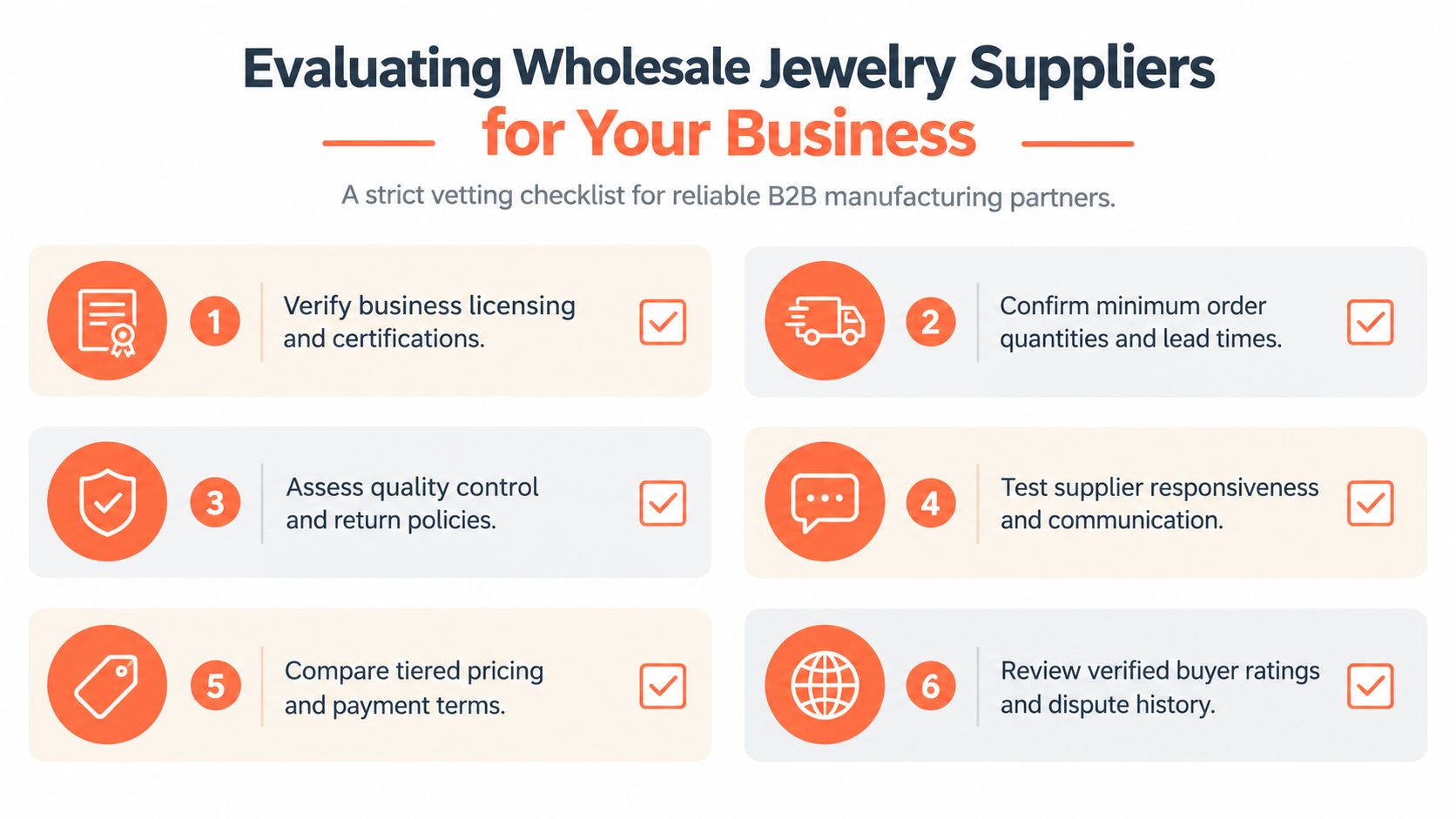
Finding a supplier takes minutes. Verifying a manufacturing partner takes discipline. Use a written checklist and score each candidate against the same criteria, because an attractive catalog can distort your judgment.
Start with business and supply-chain evidence
Ask for the supplier's registered business details, manufacturing relationships, quality documentation, and fulfillment location. A marketplace badge isn't proof of product quality, but it can be a useful starting signal when combined with buyer protections, clear dispute procedures, and direct communication tools.
Pay particular attention to manufacturing claims. If a platform references SGS-certified manufacturing partners, ask what the certification covers and whether it applies to the facility producing your selected items. Verify whether the supplier maintains an ISO 9001 quality system, rather than treating a vague “quality checked” statement as sufficient.
A practical review should include:
- Business verification: Confirm the legal business identity, contact details, operating location, and payment recipient.
- Buyer protection: Review trade-assurance style protections, dispute rules, refund conditions, and evidence requirements.
- Material coverage: Check whether the catalog clearly distinguishes 925 sterling silver, stainless steel, titanium steel, copper, alloy, gold-plated, gemstone, and pearl products.
- Order flexibility: Confirm MOQ by style and by order. A no-MOQ option can make testing new designs less risky.
- Fulfillment proof: Request realistic processing times, shipping methods, tracking availability, and an explanation of what happens during stockouts.
- Sample performance: Place samples before committing to a larger procurement order.
Test communication before you test scale
Send the same structured inquiry to each candidate. Ask about plating type, plating thickness, available sizes, stone specifications, packaging, defect credits, return windows, and replenishment. Judge the answer for clarity, not just speed. A fast response that avoids material questions is still a warning sign.
A centralized catalog can reduce administrative work, particularly when you need earrings, necklaces, bracelets, rings, or fashion accessories from one vendor. However, convenience shouldn't replace inspection. Use a wholesale supplier evaluation guide to organize your comparison, then verify the details directly with the supplier.
Request a sample invoice and packing list. Compare the product names, SKU codes, material descriptions, quantities, and shipping charges with what appears online. This catches catalog inconsistencies before they become receiving problems.
Finally, define your exit conditions before ordering. Decide what defect evidence you'll collect, how quickly you'll report discrepancies, whether the supplier offers replacement or credit, and who pays return shipping. A supplier that refuses to document these terms is asking you to absorb its production risk.
Calculating Margins and Leveraging Financing Options
A low unit price doesn't guarantee a strong margin. Your real cost is the amount required to receive a sellable item at your facility, prepare it for sale, market it, and handle the customer order.
Calculate landed cost before setting a retail price. Include the supplier price, international or domestic shipping, customs duties where applicable, payment processing, packaging, labeling, inspection labor, and an allowance for defective or unsellable units. If you sell through a marketplace, add its transaction and fulfillment charges. If you sell through your own store, include the cost of acquiring the customer and processing returns.
A simple working formula is:
Landed cost per sellable unit = total procurement and receiving costs ÷ sellable units received
Don't divide by the number of units ordered if some pieces arrive damaged or fail inspection. That artificially flatters the margin.
Use the matrix before you approve a purchase
| Cost Component | Impact on Margin | Mitigation Strategy |
|---|---|---|
| Product price | Sets the starting cost but can hide quality risk | Compare like-for-like materials, finishes, sizes, and packaging |
| Shipping and duties | Raises the delivered cost and can make a cheap item uncompetitive | Request a complete shipping quote and confirm customs responsibility |
| Payment processing | Reduces the amount retained from each sale | Compare payment methods and include fees in the pricing worksheet |
| Inspection and packaging | Adds labor before the item is ready to sell | Standardize receiving checks and negotiate packaging formats |
| Defects and returns | Creates replacement, refund, labor, and markdown exposure | Sample test first and negotiate a documented defect policy |
| Financing cost | Preserves cash but reduces profit on financed purchases | Use financing only when the inventory plan supports timely sell-through |
The right retail price must cover more than the wholesale invoice. Set a minimum acceptable contribution per item, then test the price against comparable products, your brand position, and the amount of customer acquisition required to generate a sale. Don't discount an item just because the supplier offered a low price. Discounting can turn a weak buying decision into a permanent margin problem.
Decide when financing makes sense
Paying upfront can make sense when the discount is clear, the items already have dependable demand, and the purchase won't reduce your ability to fund marketing, payroll, shipping, or replenishment. Financing is more appropriate when it preserves operating liquidity and the inventory has a defined selling plan.
Buy-now-pay-later tools can help spread the cash impact of procurement, but they aren't free capital. Review the repayment schedule, fees, missed-payment consequences, and whether the provider pays the supplier immediately. Use financing for a controlled assortment refresh, not to conceal overbuying.
Before placing an order, run two scenarios:
- Cash purchase: Calculate the discount received and the cash remaining for operations.
- Financed purchase: Calculate the financing cost and the cash retained for marketing, replenishment, and returns.
A margin worksheet such as this wholesale profit margin calculator can help you compare the scenarios. Approve the order only when the inventory plan works after landed costs, financing, and reverse logistics are included.
Implementing Quality Control and Compliance Checks
Supplier photographs aren't quality control. They show the item under selected lighting, at a selected angle, before it has passed through your receiving process or reached a customer.
Jewelry defects usually begin upstream with the wrong alloy composition, inconsistent plating, weak stone setting, poor finishing, or incomplete inspection. B2B sourcing guidance recommends checking verification badges, trade-assurance protections, and direct communication tools, then validating ISO 9001 quality systems and material-specific documentation such as CE/RoHS for compliance and GIA/IGI documentation for gem authenticity (jewelry supplier quality-control guidance).
Build a sample-testing protocol
Test samples as if you're trying to disprove the supplier's claims. Record the SKU, received date, stated material, finish, size, stone type, and the condition of the packaging. Photograph each sample before testing so you have a baseline if the bulk order differs.
Your inspection should cover:
- Material identity: Confirm the stated alloy or metal specification through appropriate testing and documentation.
- Plating performance: Ask for plating type and thickness. Check finish consistency, edges, areas around clasps, and early signs of discoloration or tarnish.
- Construction: Open and close closures repeatedly. Inspect jump rings, posts, backs, chain links, solder points, and stone settings.
- Surface finish: Run a fabric snag check over sharp edges and inspect for scratches, pits, bubbles, or uneven color.
- Markings: Verify engravings, stamps, logos, size marks, and packaging details against the approved sample.
- Wear resistance: Wear-test plated pieces and expose samples to normal handling before approving a repeatable product.
For a more formal receiving standard, document production quality specs that define acceptable finish, dimensions, materials, packaging, and defect tolerances. Give the supplier the approved sample or a detailed specification sheet. “Good quality” isn't measurable until you describe what passes and what fails.
Match documentation to the product
Require CE or RoHS documentation when the destination market and product category make those compliance records relevant. For gemstones, match GIA or IGI documentation to the specific stone and product, not merely to a similar item in the supplier's catalog.
Keep certificates, invoices, inspection photographs, and correspondence with the SKU record. If a customer questions authenticity or material content, your team should be able to locate the supporting evidence without contacting the supplier under pressure. For an additional practical reference, use this guide to test gold purity.
Don't scale an item because the first sample looks attractive. Scale it only after the sample passes your documented checks and the supplier confirms that bulk production will follow the same specifications.
Managing Logistics and Minimizing Return Costs
Returns deserve a place in your buying model before the order is placed. In online jewelry retail, returns are often reported at around 8%, and each return can cost roughly $10 to $65 after reverse shipping, inspection, restocking labor, and markdown risk (jewelry return cost guidance).
That cost is especially serious for jewelry because returned pieces can't always go straight back into sellable stock. Staff may need to inspect metal, verify stones, check certificates, assess wear, replace packaging, or route the item for repair. A return policy that looks generous to customers can still damage your margin if the intake process is loose.
Prevent avoidable returns before dispatch
Accurate product data is your first defense. Publish the actual measurements, material, plating description, stone information, color, weight where relevant, and closure type. Use clear photographs from multiple angles. Show scale when size could surprise the buyer, and don't describe plated jewelry as solid precious metal.
Build a dispatch checklist around the order itself:
- SKU match: Confirm that the picked item matches the ordered style, color, size, and material.
- Condition record: Photograph higher-value items and packages before dispatch.
- Certificate match: Match diamond or gemstone documentation to the exact product where certification applies.
- Packaging check: Confirm that protective packaging prevents scratches, tangling, and movement during transit.
- Tracking requirement: Use trackable shipping for every order where loss would materially affect the business.
- Signature control: Require a signature on higher-value shipments and retain delivery evidence.
Create a disciplined return intake
Photograph the package as it arrives, including the exterior, seal, contents, and product condition. Compare the returned item with your original dispatch record. Test metal claims where appropriate, match certificates, inspect clasps and stones, and check for wear or substitution before approving a refund or restock.
Separate returned units into clear outcomes: resellable, repairable, supplier-defective, customer-damaged, or unsellable. This prevents a damaged item from returning to inventory unnoticed and gives you evidence for supplier claims.
Choose suppliers that provide damage protection, practical return windows, and a clear process for defective merchandise. The right agreement shifts some operational risk away from your boutique, but it doesn't eliminate your responsibility to document every discrepancy. Your return policy should protect the business while explaining the process plainly enough that customers know what evidence and timelines apply.
Selecting Trending Categories to Scale Your Assortment
A category trending online is not automatically a category worth stocking. Generic “best seller” lists ignore your customer, price point, content strategy, replenishment speed, and tolerance for returns, defects, and unsold inventory.
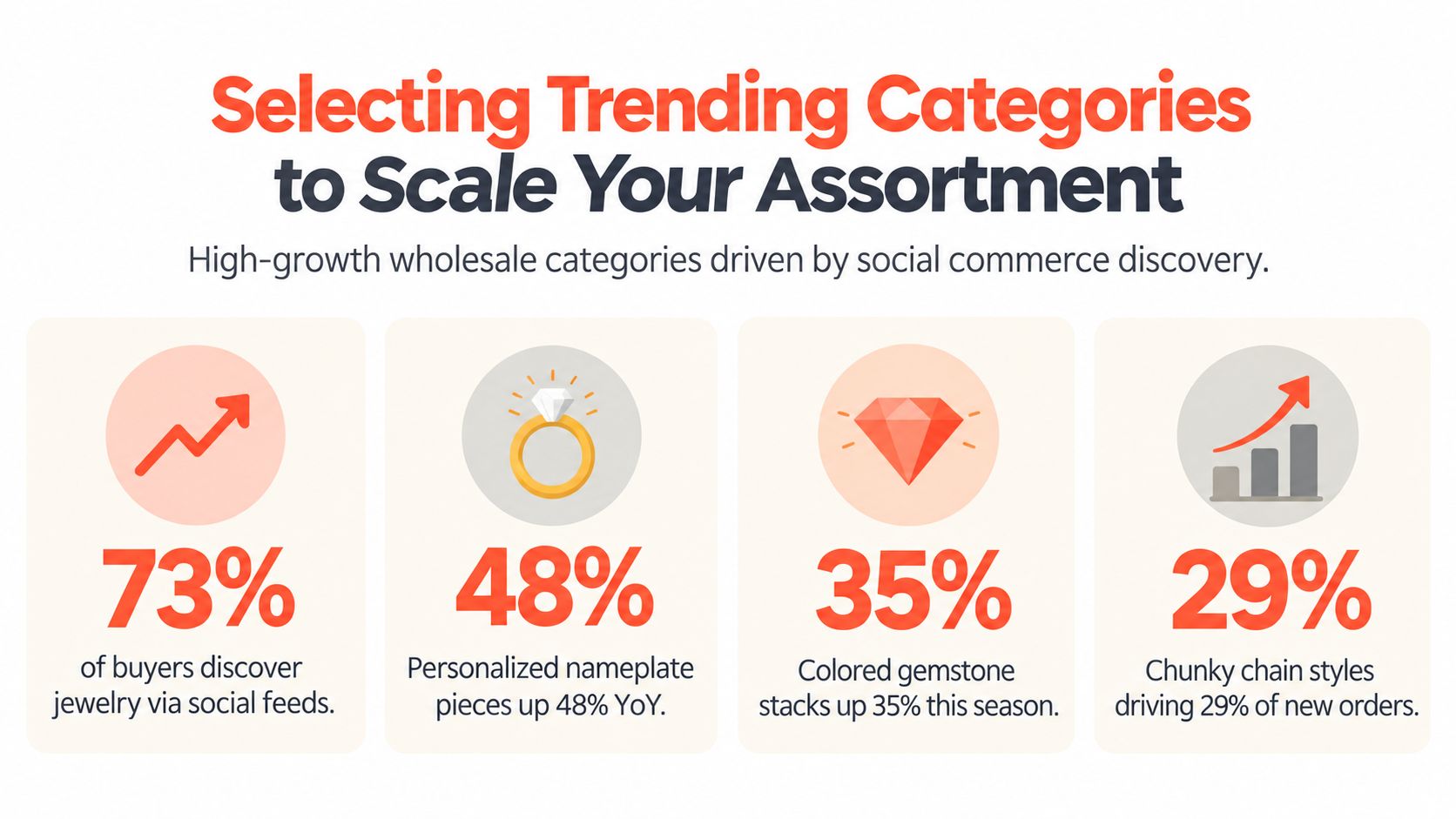
Category-level data gives you a better starting point. Recent wholesale data identifies earrings as a breakout category, with 601% year-over-year growth in 2025, while stacking rings, charm jewelry, and 18K gold PVD finishes also stood out (wholesale fashion jewelry trend data). Use that figure to prioritize testing, not to fill the stockroom with earrings. Fast growth can increase sourcing risk when sellers order identical designs or suppliers struggle to hold quality during a demand spike.
Buy for visual discovery, not just catalog search
Short-form video now shapes how shoppers find jewelry. Recent industry coverage says over 68% of jewelry purchases begin with short-form video, while buyers increasingly check provenance through certifications and studio transparency (social and provenance trends in jewelry).
Select products that perform in two places: on camera and on the product page. A piece should catch attention in motion, while its materials, construction, care requirements, and documentation remain easy to explain.
Test earrings first when movement, layering, scale, and styling can drive discovery. Order several design directions instead of committing to one shape. Use stacking rings to build outfit combinations, charm jewelry to support personalization and add-on sales, and 18K gold PVD finishes only when the supplier provides consistent specifications and sample evidence.
Build a balanced assortment
Divide buying decisions into three groups:
- Core pieces: Simple hoops, studs, chains, bracelets, and rings that match your customer profile and support repeat replenishment.
- Content-led pieces: Distinctive earrings, charm combinations, stacking sets, and finishes made for short-form demonstrations.
- Controlled experiments: Unusual shapes, colors, or materials purchased in limited quantities until your own sales data confirms demand.
Review each group by sell-through, return cost, defect rate, customer questions, repeat orders, and content response. A video view is not a buying signal by itself. Keep products that customers purchase, retain, and recommend.
Reject deep orders where material descriptions are unclear, settings are fragile, sizing is difficult, or replenishment is uncertain. Reverse logistics can erase the margin from a fast-selling item, especially when inspection, repackaging, repair, or disposal follows each return. Trend alignment creates value only when the supplier can reproduce the product accurately and your product page can set clear expectations.
Building a Sustainable Wholesale Sourcing Strategy
A sustainable wholesale strategy is not built by finding one supplier and placing larger orders. It depends on a repeatable buying rhythm that connects category demand, supplier performance, social discovery, and reverse logistics. Know which products support baseline revenue, which create attention, which suppliers cause operational friction, and which categories deserve another order.
Review the assortment on a fixed schedule. Compare SKU-level sales with returns, defects, customer questions, content response, stock coverage, and supplier lead-time reliability. A product that sells quickly but produces complaints, refunds, or repackaging work may be less valuable than a slower item with reliable repeat demand. Track the cost of each return, including inspection, replacement, repair, disposal, and customer service time.
Manage the relationship, not just the order
Give reliable suppliers precise feedback on sizing, packaging, finishes, and recurring defects. Share approved specifications and keep a reference sample. As order volume becomes consistent, negotiate terms that protect cash flow, including clearer replacement policies, faster replenishment, better price tiers, and packaging suited to your fulfillment process.
A successful delivery does not prove that production is under control. Recheck samples whenever the material, finish, factory, packaging, or production method changes. One batch can meet your standard while the next creates defects if the supplier has not documented and repeated the approved specifications.
Your operating scorecard should answer five questions:
- Can we sell the product at a healthy contribution after landed and return costs?
- Does the supplier reproduce the approved sample consistently?
- Can we reorder before the item goes out of stock?
- Does the product work in social and visual merchandising?
- Does the assortment balance dependable basics with measured experiments?
Social video can create discovery, but attention alone does not justify a purchase order. Product pages, videos, certificates, packaging, and customer service must present consistent information as buyers examine materials, quality, and certification more closely. Use category-level trend signals to choose what to test, then confirm demand through purchases, retention, repeat orders, and content response.
Wholesale jewelry online protects margins only when buying decisions include operational control. Vet suppliers, test samples, calculate landed costs, limit speculative inventory, document returns, and refresh categories using customer behavior. Price matters, but predictable quality and credible assortment decisions matter more.
JewelryBuyDirect offers an online B2B catalog covering necklaces, bracelets, rings, earrings, body jewelry, accessories, and jewelry-making components, with no minimum order quantity for testing products. Visit JewelryBuyDirect to compare styles, trial a focused assortment, and build a sourcing process that protects cash flow while you scale. The same trust and channel trends are discussed in jewelry channel and trust trends.