






Arthur Lynch | Sat Dec 13 2025
Wholesale Gold Plated Jewelry: Sourcing High-Quality, Affordable Pieces for Your Business
Sourcing wholesale gold plated jewelry is one of the smartest ways to offer your customers the luxurious look of gold at an affordable price point that moves inventory. For a business, this is a strategic move that lets you build a profitable, on-trend collection of fashion accessories that speaks directly to shoppers who crave style without the solid-gold price tag.
But to truly succeed, you need to know what you're buying. Understanding the nuances of gold plating is the first step toward curating a collection that ensures customer satisfaction and builds your brand's reputation for quality.
Building Your Foundation in Gold Plated Jewelry
For retailers and designers, stocking gold plated jewelry is a smart business decision. With solid gold prices continuing to climb, your customers are actively looking for beautiful, affordable alternatives. Gold plated pieces perfectly fill this gap, offering the timeless appeal of gold in a format that works for everything from fast-fashion accessories to classic, everyday staples. For your business, this translates to higher sales potential and a diverse product range that attracts budget-conscious shoppers.
The key to long-term success, however, is sourcing high-quality products. Not all gold plating is created equal, and the terminology can be confusing. There's a world of difference between a flash-plated earring and a durable gold vermeil necklace. Getting this right is crucial for stocking items that live up to your brand's promise, managing customer expectations, and building a reputation for offering affordable yet quality fashion accessories.
Understanding the Core Plating Types
The term "gold plated" is a catch-all for several distinct manufacturing processes. Each one creates a product with different levels of durability, appearance, and cost. Recognizing these variations is your first test in sourcing inventory that fits your business goals and customer profile.
You'll mainly encounter three categories when sourcing wholesale jewelry:
- Flash Plating: This is the thinnest and most affordable option, with a gold layer typically under 0.25 microns. It’s usually applied over a base metal like brass or copper for a quick, shiny finish. It's cost-effective for trendy, high-turnover fashion accessories, but the thin layer can wear off quickly with regular use.
- Heavy Gold Plating (HGP): This is a significant step up in quality. HGP involves a much thicker layer of gold, usually between 0.5 to 3.0 microns. This extra thickness provides significantly more durability and tarnish resistance, making it an excellent middle-ground for creating affordable jewelry that lasts.
- Gold Vermeil: This is the premium tier of gold plating, with strict industry standards. To be called gold vermeil, a piece must have a sterling silver base and be plated with a thick layer of gold—at least 2.5 microns of 10k gold or higher. This combination creates a high-quality, durable, and hypoallergenic piece that feels much closer to fine jewelry.
This chart is a great visual summary to help you keep these three categories straight.
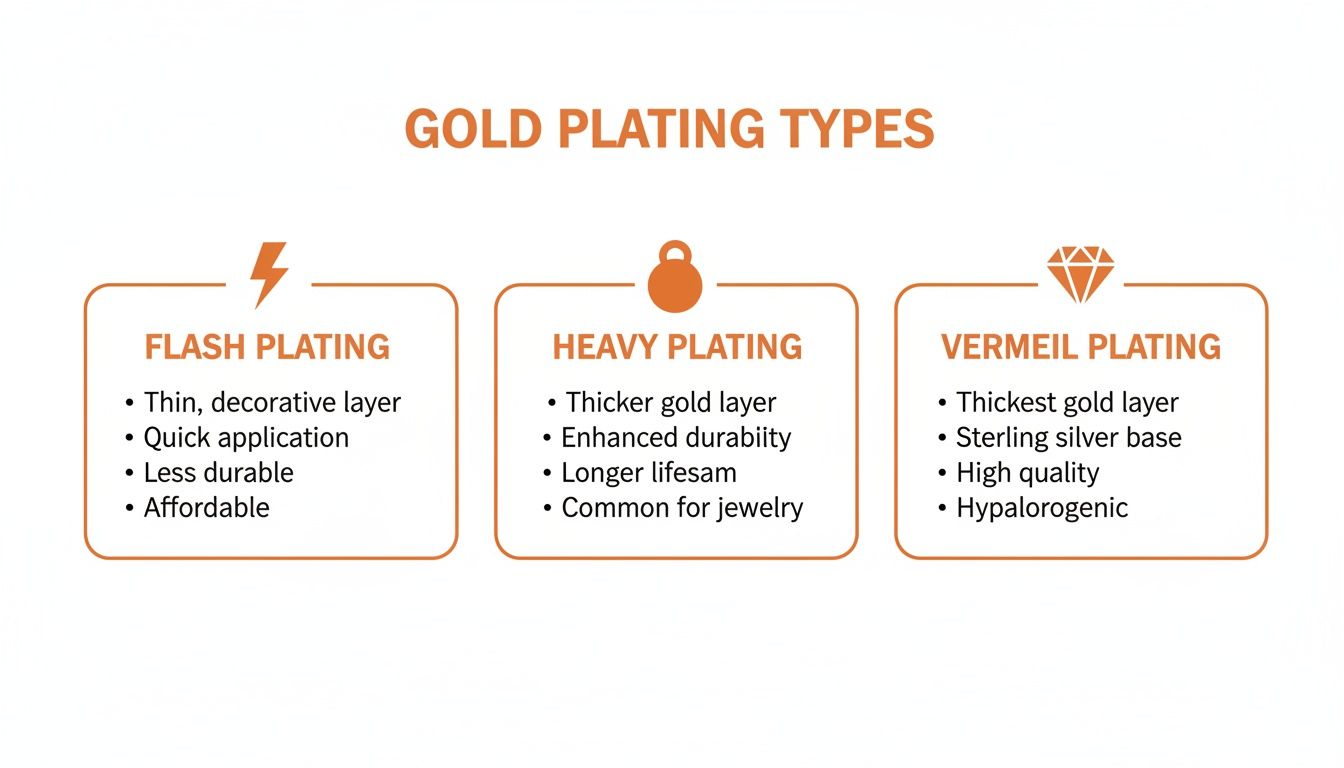
Each type serves a different purpose for your business, from a low-cost trendy earring to a durable, higher-value necklace that becomes a staple in a customer's collection.
To make it even easier to compare your sourcing options at a glance, here’s a quick reference table.
Gold Plating Quality and Durability Comparison
This table breaks down the key differences you need to know when evaluating potential wholesale pieces for your business.
| Plating Type | Plating Thickness (Microns) | Base Metal | Durability & Tarnish Resistance | Typical Wholesale Price Point |
|---|---|---|---|---|
| Flash Plating | < 0.25 microns | Brass, Copper | Low | $ |
| Heavy Gold Plating | 0.5 - 3.0 microns | Brass, Stainless Steel | Medium to High | $$ |
| Gold Vermeil | 2.5+ microns | Sterling Silver | Very High | $$$ |
Think of this as your cheat sheet for sourcing. It helps you quickly align a product's technical specs with your brand's quality standards and pricing strategy, ensuring you source high-quality yet affordable jewelry.
Why Gold Plated Jewelry Is a Growing Market
The demand for "affordable luxury" is a fundamental shift in consumer behavior. The global gold jewelry market was valued at a massive 175.4 USD billion and is on track to hit 230 USD billion by 2035. This is a powerful signal of gold's timeless appeal.
This huge market creates a golden opportunity for plated alternatives, especially in wholesale. You can dive deeper into these numbers and projections in a comprehensive industry report on the gold jewelry market.
Key Takeaway: By sourcing wholesale gold plated jewelry, you're tapping into a massive and growing market. You’re giving customers the look they want at a price they can justify—a winning formula for any retail business. Your ability to differentiate between plating types will be your biggest advantage in building a collection that perfectly balances quality, cost, and customer satisfaction.
How to Find and Vet Your Ideal Jewelry Suppliers
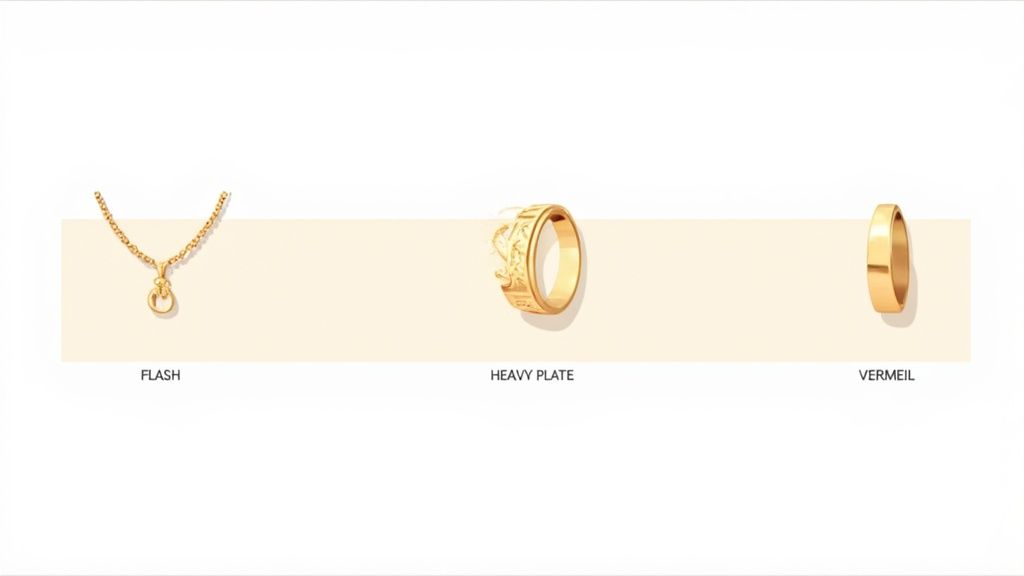
Your jewelry business is only as strong as its suppliers. Finding a partner who delivers consistent quality and affordable pricing is the backbone of a successful brand. This isn't about a quick search; it's about building a reliable supply chain you can count on as your business grows.
The hunt for the perfect wholesale gold plated jewelry supplier usually begins online, but knowing where to look is key. While general marketplaces can be a starting point, specialized B2B platforms and direct-from-manufacturer sources consistently yield the best results for sourcing high-quality and affordable fashion accessories.
Where to Discover Potential Partners
Your sourcing journey will be a mix of online research and hands-on exploration. Each avenue offers unique advantages, from the convenience of browsing online catalogs to the invaluable experience of attending a trade show.
Here are the most effective places to start your search for a supplier:
- Curated B2B Marketplaces: Platforms like JewelryBuyDirect are built for businesses like yours. They often pre-vet suppliers and showcase a massive range of styles. The key benefits for a business are factory-direct pricing and no minimum order quantities (MOQs), which is a huge advantage for testing new products without a large upfront investment.
- Industry Trade Shows: Events like JCK Las Vegas or Vicenzaoro in Italy offer a chance to meet suppliers face-to-face, inspect products in person, and build relationships. These connections can lead to better terms and first access to new designs, giving your business a competitive edge.
- Direct Manufacturer Outreach: For custom pieces or high-volume orders, going directly to the source is a game-changer. It provides maximum control over the product and often the best pricing. Our guide on the benefits of working with factory-direct jewelry suppliers dives deeper into this strategy.
The Critical Vetting Process
Once you have a shortlist of potential suppliers, the real work begins. Vetting is how you protect your investment and your brand's reputation. A slick website is meaningless if the product quality or service is subpar.
First, perform basic due diligence. A legitimate supplier will have a registered business number, a physical address, and clear contact details. Look for third-party certifications, like those from SGS, which verify their manufacturing standards.
Next, search for independent reviews on forums, social media, and B2B directories. A pattern of complaints about shipping delays, poor communication, or inconsistent quality is a major red flag for your business.
Expert Tip: Never place a bulk order without getting samples first. This is non-negotiable for any business sourcing fashion accessories. There is no substitute for seeing and feeling the jewelry yourself. This is your only chance to verify quality and ensure the pieces meet your standards before committing capital.
The demand for high-quality plated jewelry has exploded as solid gold prices rise, making beautiful, affordable alternatives essential for retailers. Thriving markets like Brazil (worth $3.5 billion) and Nigeria (worth $3 billion) show how savvy suppliers are helping local businesses flourish. This global shift highlights the importance of finding a reliable partner.
Key Questions to Ask Every Supplier
A strong business partnership is built on clear communication. Before committing, have a list of questions ready. Being thorough from the start will save you significant time and money later on.
Your initial conversation should cover these key business points:
- Minimum Order Quantities (MOQs): Do they have them? Ask what they are per style or total order. A supplier with low or no MOQs is ideal for testing new products and managing cash flow.
- Production and Lead Times: Get concrete timelines. How long does it take to manufacture and ship an order? You need different estimates for in-stock items versus made-to-order pieces to manage your inventory effectively.
- Quality Control (QC) Process: Ask them to describe their QC process. How do they inspect pieces before they leave the factory to ensure consistency and catch defects?
- Return and Damage Policy: What is their policy for incorrect or damaged goods? A reliable partner will have a straightforward process for returns, refunds, or replacements, protecting your business from loss.
Asking these questions helps you assess if a supplier is a good fit for your business. You're not just sourcing wholesale gold plated jewelry; you're building a supply chain that supports your brand's commitment to quality and affordability.
How to Inspect Samples for Quality and Value
So, your samples have arrived. This is the moment of truth—when you verify if the supplier's claims of quality and value hold up. A thorough, hands-on inspection is the single most important step you can take to protect your brand's reputation and ensure you're offering high-quality fashion accessories to your customers.
This isn't just a quick glance. You need a consistent process to identify the subtle flaws that separate a customer favorite from a future return. This is about being a smart business owner who refuses to compromise on quality to achieve an affordable price point.
Start with Your Eyes and Hands
Before any stress-testing, simply use your senses. High-quality jewelry often feels substantial, while poorly made pieces can feel flimsy or cheap.
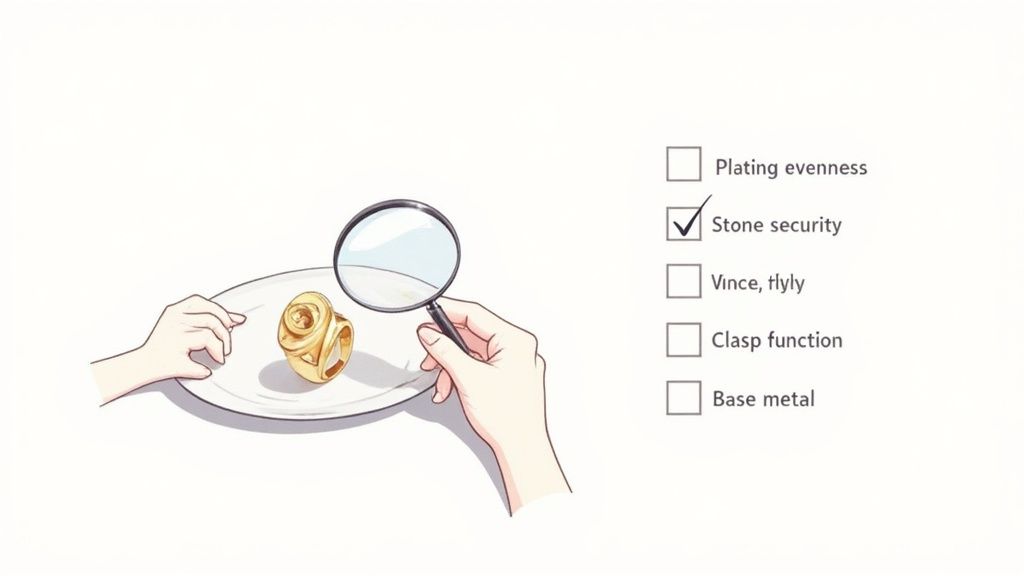
Pick up each sample and examine it under bright, natural light. Is the gold tone consistent across the entire piece? Any blotches, streaks, or thin areas are a bad sign of poor plating. You're looking for a uniform, rich color that indicates a well-controlled process.
Next, run your fingers over every surface. It should feel completely smooth. Any rough patches, sharp edges, or burrs are a major red flag. This points to a rushed finishing job and can be a source of customer complaints.
Check Every Moving Part
A beautiful necklace is worthless if the clasp breaks. Functional components like clasps and earring backs are where some manufacturers cut corners to lower costs, so you need to be extra diligent here.
On necklaces and bracelets, open and close every clasp at least 5-10 times.
- Lobster Clasps: The lever should have a snappy, responsive feel. If it's stiff or weak, it’s a low-quality component that is likely to fail.
- Earring Backs: These should slide onto the post with a firm, secure grip.
- Stone Settings: Gently press on any gemstones. They should be completely secure. Any movement means the stone will eventually fall out.
These small hardware components are often the first point of failure. Ensuring they are high-quality will save your business from dealing with future customer complaints and returns.
I’ve seen many new business owners fall in love with a design and forget to check the hardware. A beautiful pendant on a flimsy chain with a weak clasp is a customer service nightmare. Give the functional parts as much attention as the main design.
A Practical Checklist for Your Samples
Using a repeatable checklist is the best way to evaluate every sample fairly and consistently, ensuring you source high-quality jewelry for your business.
| Quality Inspection Checklist for Gold Plated Jewelry Samples |
| :--- | :--- | :--- | :--- |
| Inspection Point | What to Look For (Good Quality) | Red Flags (Poor Quality) | Testing Method |
| Color & Finish | Uniform, rich gold tone. Consistent luster. No visible base metal. | Streaks, blotches, discoloration, patchy areas, visible pitting. | Visual inspection under bright, natural light. Use a 10x jeweler's loupe. |
| Surface Texture | Smooth, polished feel on all surfaces, including edges and back. | Rough spots, sharp edges, burrs, uneven polishing. | Run your fingertip carefully along all surfaces and edges. |
| Clasps & Closures | Smooth mechanism, secure closure, snappy spring action. | Stiff, loose, or weak mechanism. Doesn't close securely. | Open and close the clasp/closure at least 10 times. Give it a gentle tug. |
| Chain & Links | Links are uniform, properly closed, and move freely. No kinks. | Open links, kinks, stiff movement, misshapen links. | Drape the chain over your finger; it should hang smoothly. |
| Stone Settings | Stones are set level and are completely immobile. Prongs are even. | Wobbly stones, uneven prongs, visible glue, crooked setting. | Gently press on each stone with a fingernail or tweezer tip. |
| Weight & Feel | Has a satisfying weight for its size. Feels solid, not flimsy. | Feels unusually light, hollow, or "plasticky." | Hold the piece in your hand. Compare its perceived weight to its size. |
| Plating Adhesion | No color transfer. Finish remains intact after gentle rubbing. | Color transfers to a cloth. Dulling or flaking is visible. | Gently but firmly rub an inconspicuous area with a soft, white cloth. |
Using a checklist like this for every sample provides the confidence that you're making a smart sourcing decision based on evidence, not just a supplier's pitch.
Simple Tests for Durability and Materials
You don't need a lab to get a good idea of a sample's durability. A few simple tests can tell you a lot.
The base metal is a huge factor in quality and affordability. Most reputable suppliers use brass as a base because it's strong, holds plating well, and is cost-effective. We dive deeper into why this is often the best choice for fashion jewelry in our guide to understanding gold-plated brass jewelry.
For a quick tarnish resistance check, take a soft white cloth and gently rub a hidden area of the jewelry. If significant color comes off or the spot dulls, it’s a sign of thin plating that won't last. A well-plated piece should withstand this light friction without any change, indicating a higher-quality product for your business to sell.
Mastering Pricing and Profit Margins for Your Collection
Sourcing high-quality, affordable jewelry is exciting, but pricing it correctly is the key to a sustainable business. Nail this, and you’ll create a healthy cash flow that fuels growth. Get it wrong, and you could find yourself working hard for very little profit.
Pricing your wholesale gold plated jewelry is a strategic balance between your costs, your brand's value, and what your customer is willing to pay. Before setting a retail price, you must know your true cost for each item.
Calculating Your True Landed Cost
Your landed cost is the total expense to get a piece of jewelry from your supplier to your business, ready to sell. It's always more than the invoice price. A common mistake for new business owners is forgetting to factor in all the associated costs.
To get your true landed cost per item, you need to calculate:
- Item Cost: The base price paid to the supplier.
- Shipping Fees: The charge to ship the bulk order to you.
- Duties and Taxes: Any import tariffs or taxes.
- Packaging Costs: The cost of your branded boxes, pouches, and mailers.
Divide this total by the number of items in the shipment. That final number is your landed cost per piece—the foundation for all your pricing decisions.
Key Insight: Never base your retail prices on the item cost alone. Calculating the full landed cost is essential to ensure every sale is profitable and covers all your business expenses.
Choosing the Right Pricing Strategy
With your landed cost determined, you can select a pricing model. The right one for your business will depend on your brand, audience, and market position.
Let’s review two of the most effective approaches for gold-plated fashion accessories.
The Keystone Markup Model
This is a classic retail method known for its simplicity. You simply double your landed cost to get your retail price. If a necklace has a landed cost of $15, you sell it for $30. This 2x markup is called keystone pricing.
It's straightforward and guarantees a consistent 50% gross margin. While easy to apply, it doesn't account for brand value or competitor pricing, which means you might be underpricing your products.
Value-Based Pricing
This strategy is often more profitable. Instead of focusing only on cost, you price your jewelry based on its perceived value to the customer. This considers factors like your brand's story, the uniqueness of your designs, and the quality of your customer experience.
For example, a pair of gold vermeil earrings with a $20 landed cost could be priced at $60 (a 3x markup) if you've built a premium brand. You’re pricing based on what the market will bear. This requires more research but can lead to significantly higher profit margins for your business.
To optimize profitability, look beyond just the pricing formula. You can discover proven strategies to increase e-commerce sales that work hand-in-hand with a smart pricing model.
Putting It All Together
Ultimately, a successful pricing strategy requires analyzing your brand, customers, and competition. A simple keystone markup might be perfect for a high-volume business, while a curated boutique will benefit from a value-based approach.
Don’t be afraid to test different price points. For a deeper dive and an interactive tool to help you crunch the numbers, check out our guide with a wholesale profit margin calculator. It’ll help you find the sweet spot where profitability and customer value meet, setting your business up for long-term success.
Streamlining Your Ordering and Logistics
Once you've found a great supplier and set your prices, you need a smooth process for getting your jewelry from their workshop to your customers. As your business grows, your ordering and logistics system becomes the backbone of your operation. This is about creating a reliable system that prevents expensive mistakes and keeps your customers happy.
A rock-solid system for managing your wholesale gold plated jewelry orders is your best defense against miscommunication. It ensures you get exactly what you paid for, on time, preventing frustrating delays that impact your business's bottom line. It all starts with a detailed purchase order.
Structuring Your Purchase Orders for Clarity
Treat your purchase order (PO) as a formal business agreement. The more specific you are, the less room there is for error. A vague PO can lead to mistakes in quantity, style, or plating quality.
Every PO you send should include:
- A unique PO number for easy tracking.
- Your supplier's and your business's full contact information.
- Detailed item descriptions, including SKUs, product names, plating type (e.g., 18k HGP), base metal, and dimensions.
- High-quality images attached for every item.
- The agreed-upon unit pricing and total cost.
- Clear delivery deadlines and shipping dates.
This level of detail protects your business. It creates a paper trail that is invaluable for accountability and settling any potential disputes.
A quick story: A detailed PO once saved my business when a supplier sent flash-plated rings instead of the heavy gold plate I'd ordered. Because my PO explicitly stated "1.5-micron HGP," I had clear proof and received a full, no-cost replacement. What could have been a costly mistake was just a minor hiccup.
Navigating International Shipping and Customs
Sourcing the best wholesale gold plated jewelry often means working with international suppliers. This provides access to a wider range of high-quality, affordable designs but also involves international shipping and customs. Getting this right is critical; one mistake can lead to delays and fees that erase your profit.
Before the order ships, insist on a tracking number and clarify the shipping terms (incoterms). This defines who is responsible for the product at each stage. To optimize your operations, it's worth reading up on how to improve supply chain efficiency.
Be prepared for customs by having your commercial invoice and a detailed packing list ready. Never under-declare the value of your goods to save on duties; this can result in fines or seizure of your entire shipment.
The jewelry market is rapidly shifting online, with projections showing online sales growing by 78 billion USD between 2024 and 2029. This trend is ideal for gold-plated jewelry, as its lighter weight keeps shipping costs low. As you can read about how technology is shaping jewelry trends on goodstoneinc.com, this digital boom makes having a streamlined logistics process more critical than ever for your business.
Smart Aftercare and Customer Service Strategies
The sale is just the beginning of the customer relationship. It’s what you do after the purchase that turns a one-time buyer into a loyal fan. Excellent aftercare and a fair service strategy are essential tools for building a trustworthy brand.
This is about proactive education and reliable support. Giving customers clear instructions on how to care for their gold-plated jewelry is your first line of defense. When they know how to keep their pieces looking great, the jewelry lasts longer, which enhances your brand's reputation for offering high-quality fashion accessories.
Crafting Simple Aftercare Instructions
Never assume customers know how to care for plated jewelry. A small, branded care card included with every order is an affordable addition that provides immense value. This simple touch helps manage expectations and empowers customers to protect their purchase, dramatically reducing complaints about tarnishing or wear.
Keep your care instructions brief and clear:
- Avoid Moisture: Remind them to remove jewelry before showering, swimming, or exercising.
- Steer Clear of Chemicals: Perfumes, lotions, and cleaning agents can damage gold plating. Advise them to apply products before putting on jewelry.
- Store Properly: Suggest keeping pieces in a soft pouch or a separate jewelry box compartment to prevent scratches.
This small educational effort significantly boosts customer satisfaction and extends the life of the wholesale gold plated jewelry you sell.
Key Takeaway: Proactive customer education is one of the best forms of customer service for a business. When you teach customers how to care for their jewelry, you prevent future issues and show that you value their purchase. The result is happier customers and fewer returns.
Developing a Fair and Transparent Return Policy
Returns are a normal part of business. Your return policy should be clear, fair, and easy for customers to find. Think of it as a confidence-builder; a good policy can encourage a hesitant buyer to complete a purchase.
Be upfront about the return window (a standard 14 or 30 days is common), the required condition of the item, and who is responsible for return shipping costs.
When a customer contacts you with an issue, see it as an opportunity to provide excellent service. A fast, empathetic response can turn a negative experience around. Listen to their concern, offer a clear solution (like a replacement or refund), and make the process as painless as possible. This approach shows you stand behind your products and value your customers, which is how you build a stellar reputation and earn repeat business.
Your Questions, Answered
When sourcing wholesale gold plated jewelry for your business, it's natural to have questions. Here are clear answers to some of the most common inquiries from retailers.
How Long Does Gold Plating Last?
This depends on the plating thickness and customer care.
-
Flash plating (under 0.25 microns) is for short-term, trendy fashion accessories and may only last a few months with regular wear.
-
A good heavy gold plating (0.5 to 3.0 microns) offers real durability. With proper care, these pieces can last for several years, providing great value.
-
Gold vermeil is the top tier. With a thick layer of at least 2.5 microns of gold over sterling silver, it is the most long-lasting and high-quality option.
What Is The Best Base Metal For Gold Plated Jewelry?
For the ideal balance of quality and affordability in fashion jewelry, brass is an excellent choice. It is a durable, corrosion-resistant metal that provides a strong bond for the gold layer.
This allows you to offer a high-quality, long-lasting product at an affordable price point, which is ideal for most retail businesses.
How Can I Identify A Reputable Wholesale Supplier?
Finding a great supplier requires diligence. Look for established businesses with a solid track record and positive independent reviews. A professional and transparent website is also a good sign.
The real test? Ask for samples. A trustworthy supplier who is confident in their product quality will have no problem sending you pieces to inspect. This is a non-negotiable step for any business before placing a bulk order.
Don't hesitate to ask for their business credentials or details about their quality control process. Clear and professional communication is a huge green flag—it shows they are a serious business partner. Finding a reliable supplier is the first step to successfully sourcing high-quality, affordable wholesale gold plated jewelry for your business.
Ready to source high-quality, on-trend jewelry with confidence? Explore over 120,000 styles at factory-direct prices with JewelryBuyDirect. With no minimum orders, free shipping over $150, and SGS-certified quality, we make it easy to build a profitable collection. Discover your next bestsellers today at https://www.jewelrybuydirect.com.