






Arthur Lynch | Mon Oct 27 2025
Sourcing wholesale charms and bracelets for higher profits
Sourcing wholesale charms and bracelets is one of the smartest ways to build a profitable jewelry business. Why? Because you get high margins and the ability to offer your customers endless ways to express themselves. This isn't just theory; this guide is your hands-on playbook for getting it right—from sourcing and negotiating to actually selling your products.
Your Blueprint for Wholesale Jewelry Success
So, you're ready to jump into the world of wholesale jewelry. Fantastic. Let's get straight to what works. We're skipping the fluff and diving into the practical steps that give you a real edge in today's market.
Consider this your strategic briefing before you spend your first dollar. We'll cover everything from spotting the next hot trend to building the kind of supplier relationships that become the backbone of your business.
Understanding the Market Opportunity
Let's talk numbers for a second, because they tell a powerful story. The demand for customizable jewelry isn't a fleeting fad—it's a massive, stable market. The global jewelry market hit a valuation of around $348 billion in 2025, and costume jewelry (where most charms and bracelets live) carved out a huge 22% of that pie.
That comes out to a staggering $77 billion market share. This isn't just noise; it’s proof of a deep, consistent consumer appetite for these kinds of accessories. You can dig into even more jewelry industry statistics to see the full picture. For a retailer, this means you're stepping into a market with a proven track record and plenty of room to grow. Success is all about knowing how to navigate it.
Key Focus Areas for Success
To turn this opportunity into profit, you have to be disciplined. There are a few core areas where your attention will pay the biggest dividends, taking you from sourcing your very first batch to scaling up your entire operation.
Think of these as the pillars of your business. Get them right, and you'll build something that lasts.
Key Focus Areas for Wholesale Jewelry Buyers
This table breaks down exactly where you should be putting your energy. Master these, and you're well on your way.
| Focus Area | Why It Matters | Actionable Tip |
|---|---|---|
| Trend Analysis | Your inventory has to match what people actually want to buy. Outdated styles are dead weight. | Use Google Trends to compare search volume for "chunky gold hoops" vs. "dainty silver chains." Monitor TikTok hashtags like #jewelrytrends to see what's gaining real-time traction. |
| Supplier Vetting | Your entire business—from product quality to on-time delivery—depends on who you partner with. | Never commit blind. Always order samples from at least three different suppliers to feel the quality for yourself. |
| Cost Management | Profit isn't just about sales price; it's made or lost in negotiations, shipping, and smart pricing. | Before placing a big order, map out every single expense in a cost-of-goods-sold (COGS) worksheet. |
| Logistics | A shipment stuck in customs or a delay from your supplier can bring your business to a grinding halt. | Don't go it alone. Partner with an experienced freight forwarder who knows how to handle international shipping and customs. |
Nailing these four areas isn't optional—it's the foundation of a resilient and profitable jewelry business. Everything else you do will build upon the work you put in here.
How to Spot Jewelry Trends Before They Go Mainstream
Staying ahead in the fashion world is all about feeling out what customers will be clamoring for next. When it comes to wholesale charms and bracelets, you have to get past basic trend-watching. It requires a proactive, almost forensic approach—piecing together clues from social media buzz, runway reports, and cold, hard market data to predict the next big hit.
The real money in today's jewelry market is made by understanding the big shifts in what people value. There's a huge wave of demand for personalization, a serious lean towards sustainable materials, and the timeless appeal of minimalist design. This isn't just a hunch; the global jewelry market is projected to rocket from $379.6 billion in 2025 to a massive $843.75 billion by 2034, and it's these evolving tastes that are driving the growth. This directly shapes your wholesale strategy. Things like customization and ethical sourcing aren't just nice-to-haves anymore; they're essential.
Get a Handle on Global Fashion Movements
Big-picture trends give you the main themes for your inventory. Right now, three powerful movements are shaping the charm and bracelet world. If you get these right, your bulk buying decisions will be much smarter.
-
Hyper-Personalization: We're way beyond simple initial charms now. People want pieces that tell their story. Think birthstones, zodiac signs, and little symbols that mark personal milestones. When you offer a deep well of these charms, you empower customers to create endless combinations, and that’s what keeps them coming back.
-
Sustainable and Artisanal Materials: The story behind the jewelry is often as important as the piece itself. Materials like recycled metals, lab-grown gems, and handcrafted elements like unique ceramic beads are really catching on. Making it clear that your components are ethically sourced can be an incredibly powerful selling point.
-
Minimalist Layering: The "less is more" vibe is still going strong. You absolutely need to stock dainty chains, delicate bracelets, and tiny, meaningful charms designed to be worn together. This trend is a winner because it appeals to a huge audience looking for versatile jewelry they can wear every single day.
Zero in on Regional Tastes
While global trends provide the blueprint, regional preferences are what drive sales. What sells in Seoul might sit on shelves in São Paulo. Your job is to translate global movements into locally relevant products.
- North America: Consumers often favor bold, statement pieces alongside personalized items. Think chunky link bracelets, Western-inspired motifs like turquoise and silver, and charms related to personal identity (initials, zodiacs).
- Europe: There's a strong preference for classic, understated elegance. In places like France and Italy, you'll see more demand for delicate gold chains, timeless pearl accents, and vintage-inspired designs. Scandinavian markets lean heavily into clean, minimalist aesthetics.
- Asia-Pacific: Trends can vary dramatically. In South Korea and Japan, "kawaii" (cute) culture drives demand for playful, whimsical charms (animals, food items). In India, there is a strong cultural preference for intricate gold pieces and colorful gemstones, reflecting traditional aesthetics.
- Latin America: Vibrant colors and natural materials are key. Expect to see high demand for brightly colored beaded bracelets, handcrafted wooden charms, and pieces that incorporate religious or spiritual symbols.
Actionable Insight: Use social media location tags to research what's popular in your target city. Search Instagram for hashtags like #LondonStyle or #NYCFashion to see what jewelry real people are wearing. This is your ground-level market research.
For more ideas on what to look for, our guide on choosing the right wholesale charms for your jewelry line can help. By blending global awareness with local intelligence, you build a collection that isn't just on-trend—it's profitable.
How to Find and Vet Reliable Suppliers
Let's be blunt: your supplier can make or break your entire jewelry business. A great one is a partner who fuels your growth with fantastic products and on-time delivery. A bad one? They'll sink you with delays, defects, and endless headaches. That's why learning how to properly find and vet partners for wholesale charms and bracelets is less of a step and more of a survival skill.
Your hunt will likely start online on massive B2B platforms like Alibaba or, if you can swing it, at industry trade shows. I'm a big fan of trade shows because nothing beats meeting someone face-to-face. Regardless of where you look, the mission is always the same: find a dependable source that won't let you down.
Your Supplier Vetting Checklist
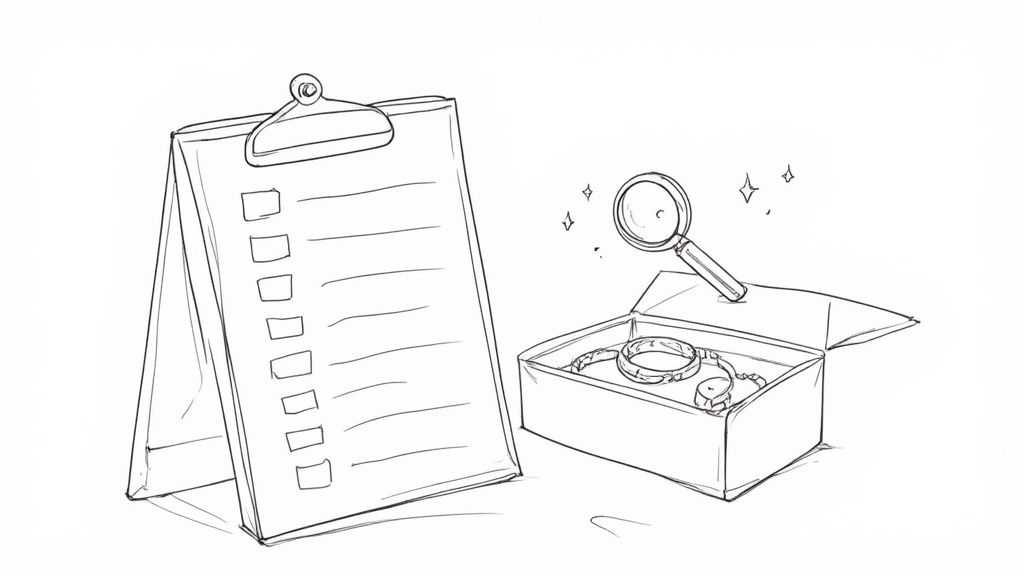
Don't even think about placing a large order until you've done your homework. A quick decision here is almost always a bad one. I recommend creating a simple checklist to grade every potential supplier by the same standards. It removes the emotion and forces you to look at the hard facts.
Here are the absolute must-asks for any potential partner:
- Production Capacity: Can they actually handle your order size? Ask them straight up: "What's your monthly output?" and "What's the lead time for an order of 5,000 pieces?" You need to know if they can grow with you.
- Quality Control Processes: How do they stop bad products from leaving the factory? Do they have their own QC team? Better yet, can they provide third-party inspection reports from a company like SGS?
- Communication Style: This is a huge one. How fast and how clearly do they reply to your emails? If they're slow and vague before you've even spent a dollar, imagine what it'll be like once they have your money.
- Track Record: How long have they been around? Ask for references or case studies from clients in your market (like the US or Europe). A factory with a history is a factory with experience.
Think of this as a partnership, not just a transaction. You're looking for transparency and clear communication from day one. Those are the signs of a reliable, long-term partner who actually cares about your success.
Judging Product Quality from a Distance
Here's the trickiest part: how do you know if the quality is good without physically being at the factory? Simple. You always order samples first.
Never, ever place a bulk order without getting your hands on the actual product. It’s a non-negotiable rule.
When the samples arrive, it's time to play detective. Don't just give them a quick look—put them under a microscope.
What to Look For in Your Samples:
- Material and Weight: Does the charm feel cheap and flimsy, or does it have some heft? If they claim it's sterling silver, look for the .925 stamp and check if the weight feels right.
- Plating and Finish: Hold it up to the light. Is the color even? Is the finish smooth? Check for any tiny bubbles, chips, or weird discoloration, paying close attention to the clasps and jump rings where plating often fails first.
- Construction and Details: Work the clasps. Are they secure? Are the tiny details on the charms sharp and clear, or do they look blurry and poorly molded?
This hands-on inspection is your single best defense against getting stuck with a shipment of junk. To get a better feel for what a top-notch supplier looks like, checking out a curated list of proven wholesale charm suppliers can give you a solid baseline. Putting in this effort now ensures the inventory you ultimately sell is something you can be proud of.
Negotiating Bulk Pricing and Better Terms
Getting a great price isn't just about haggling. It's an art. When you're dealing with wholesale charms and bracelets, smart negotiation is about building a strong, long-term partnership that benefits you both. You need to walk into that conversation with confidence, backed by solid market research and a rock-solid understanding of your own costs.
Before you even pick up the phone or send that first email, you have to know your numbers cold. The single most important thing you can do is learn how to calculate wholesale prices for your own business. This is your foundation. Without it, you're flying blind and could easily agree to terms that kill your margins before you even sell a single piece.
Key Negotiation Points Beyond Per-Unit Price
The price tag is just the starting line. The real value—and your real profit—is buried in the details of the agreement. A savvy business owner knows this is where you can create a huge advantage, turning a decent deal into a fantastic one.
Make sure you're focusing your energy on these critical terms:
- Minimum Order Quantities (MOQs): Suppliers set MOQs to ensure their production runs are profitable. But what if their standard MOQ is just too high for your budget or current storage? Don't give up. Propose a smaller test order, or ask if you can meet the threshold by mixing and matching different styles.
- Payment Terms: The industry standard is often 30% upfront and the remaining 70% upon completion, right before shipping. Your job is to negotiate terms that work for your cash flow. See if you can get them to a 50/50 split. Once you’ve built some trust, you might even be able to get Net 30 terms.
- Lead Times and Production Schedules: This is a big one. Exactly how long will it take from the moment you pay until your order is on a boat? Get a firm, written timeline. This is absolutely essential for planning your inventory, launching new collections, and running your marketing campaigns.
A successful negotiation isn't about one person "winning." It's about crafting a deal where everyone feels they got value. When you and your supplier are both set up for success, you're not just buying products—you're building a profitable, lasting partnership.
Real-World Negotiation Tactics
Let's walk through how this looks in the real world. Say a supplier quotes you $1.00 per charm with a steep MOQ of 5,000 units. Instead of just pushing back with "Can you do better?", a strategic approach will get you much further.
Sample Scenario:
Your response could be something like this: "Thanks for the quote. We're very interested in moving forward, but for our initial launch, we need to test the market with a smaller run of 2,500 units. If we can start there, and the quality is what we expect, we're prepared to place a follow-up order for 7,500 units next quarter."
This kind of response is powerful for a few reasons:
- It demonstrates you have a clear business strategy.
- It offers a creative solution to their MOQ hurdle.
- It incentivizes them with the promise of larger, recurring business.
Suddenly, you've shifted the dynamic from a simple price haggle to a collaborative business discussion.
Before you jump into your next negotiation, use this checklist to make sure you've covered all your bases.
Supplier Negotiation Checklist
| Negotiation Point | What to Aim For | Common Pitfall to Avoid |
|---|---|---|
| Per-Unit Pricing | A tiered structure where the price drops as your order volume increases. | Focusing only on the initial price and ignoring long-term volume discounts. |
| MOQs | A lower MOQ for your first order, or the ability to mix SKUs to meet the minimum. | Accepting a high MOQ that ties up too much cash in slow-moving inventory. |
| Payment Terms | Moving from a 30/70 split to a more favorable 50/50 or even Net 30/60 terms over time. | Not asking for better terms as the relationship grows; staying with the initial agreement forever. |
| Lead Time | A guaranteed, written production and shipping timeline with clear deadlines. | Accepting a vague "4-6 weeks" estimate without any commitment. |
| Shipping & Freight | FOB (Free On Board) shipping terms and clarity on who pays for transit insurance. | Overlooking shipping costs, which can dramatically increase your total cost per unit. |
| Defect/Return Policy | A clear, simple process for getting credit or replacements for damaged goods. | Assuming they have a fair policy without getting the specific details in writing. |
Having this framework in mind helps you stay focused on creating a comprehensive deal, not just a cheap one.
As you plan your product line, remember to think about how different styles can work together. Exploring complementary items, like bulk beaded bracelets, can give you great ideas for creating a diverse collection that appeals to more customers. By mastering these negotiation skills, you're not just buying jewelry—you're building the foundation for a thriving business with healthy margins and strong supplier relationships.
Managing International Shipping and Logistics
You’ve found the perfect wholesale charms and bracelets and negotiated a solid price. Now for the final piece of the puzzle: getting all that beautiful inventory from their factory to your warehouse.
International logistics can feel like a maze, but it’s entirely manageable once you know the key steps. Let’s break down how to handle shipping, customs, and delivery without any of those nasty, expensive surprises.
First things first, you need to be crystal clear on who is responsible for what. This is all laid out in the Incoterms—a set of universal trade terms that define where the seller's responsibility ends and yours begins. A very common one you'll see is FOB (Free On Board). In this scenario, your supplier gets the goods to the port of departure, and from that moment on, the cost and risk are all on you.
Choosing Your Shipping Partner
The good news? You don't have to go it alone. A good freight forwarder is worth their weight in gold. Think of them as your logistics quarterback; they'll handle booking space on a container ship or cargo plane and wrangle all the mind-numbing paperwork. Trust me, this saves a monumental amount of time and headaches.
When you're vetting forwarders, make sure to find one who has direct experience with jewelry or other small, high-value goods. They’ll know the ins and outs of proper packaging, insurance, and how to get these items through customs smoothly.
The same negotiation skills you used to get a great price on your charms apply here. It's a process of doing your homework, having a conversation, and coming to a solid agreement.
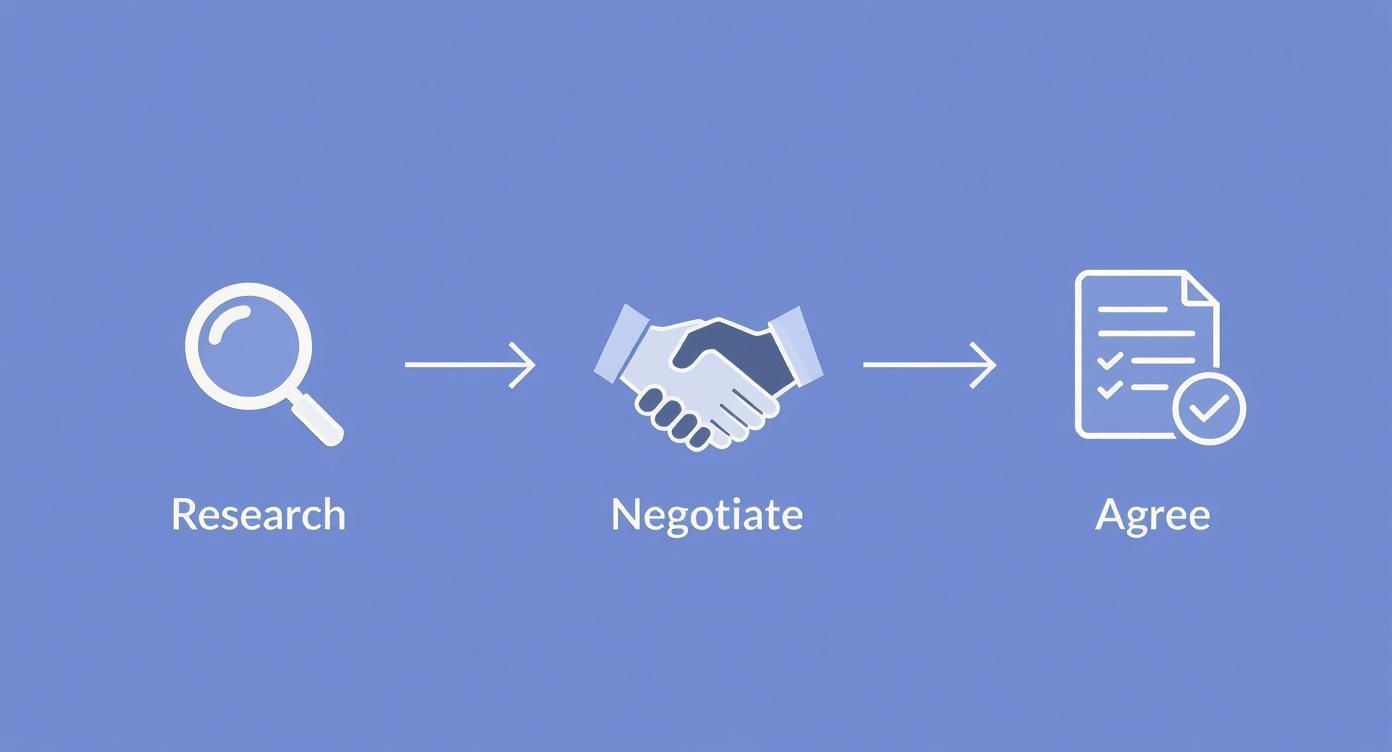
A structured approach like this ensures every detail, especially shipping terms, is locked in before a single box leaves the factory.
Navigating Customs and Duties
This is the stage where a lot of first-time importers get tripped up. Every item you import needs a specific Harmonized System (HS) code. This little number tells customs officials what the product is, and it determines the exact import duties and taxes you'll have to pay. Get this code wrong, and you're looking at major delays and potentially hefty fines.
Cargo insurance isn't just a good idea; it's non-negotiable. For a tiny fraction of your inventory's value, you can protect yourself from the catastrophic loss of a shipment due to damage, theft, or some other disaster at sea. Don't skip it.
It also pays to know where your products are coming from. The Asia-Pacific region is the powerhouse of the wholesale jewelry world, owning over 60% of a global market valued at more than $200 billion. This means most charm shipments originate there, so you'll need to be familiar with the specific trade rules and documents for that part of the world.
Finally, let's talk about packaging. It’s your last line of defense. Be firm with your supplier about using sturdy boxes, plenty of protective cushioning, and waterproof wrapping. Your investment has a long, bumpy journey ahead of it.
Once your goods arrive, a smooth fulfillment process is key. Brushing up on e-commerce shipping best practices will help you get those beautiful charms out to your customers efficiently.
Your Top Questions About Sourcing Wholesale Jewelry, Answered
Jumping into wholesale charms and bracelets always stirs up a few big questions. If you're feeling a little uncertain, you're not alone. Let's walk through the most common hurdles I see new buyers face, so you can build your sourcing strategy with total confidence.
What’s a Realistic Starting Budget?
This is the big one, isn't it? While it really depends on your goals, a smart starting point for a new online shop is somewhere between $2,000 and $5,000. Think of this as your all-in fund, not just your product budget.
That initial investment needs to stretch across a few critical areas:
- Your First Big Inventory Order: This will be your largest single expense, and you'll need to have enough to meet the supplier's Minimum Order Quantities (MOQs).
- Samples: Never, ever skip this. You need to budget for ordering samples from several potential suppliers to feel the quality for yourself.
- Shipping & Import Fees: These can sneak up on you, often adding a hefty percentage to your total cost. Plan for it.
- Business Setup: This bucket covers things like setting up your website, buying basic packaging, and a small marketing budget to attract your first wave of customers.
Here's a little inside baseball: sourcing from a domestic supplier might seem cheaper because of lower shipping costs, but your price-per-piece will likely be higher. Going straight to an overseas factory often gets you better long-term margins, but you’ll probably need to place a larger initial order to hit their MOQ. It's a classic trade-off.
How Can I Actually Verify Quality From My Desk?
You can't just hop on a plane to visit a factory, so you have to become your own remote quality control expert. It takes a bit of discipline, but it’s completely doable.
First up, always insist on a detailed product spec sheet. This isn't just a nice-to-have; it's essential. It should clearly list the base metal (is it sterling silver or brass?), the plating material (like 18k gold or rhodium), and—this is the key part—the plating thickness in microns. A good supplier will have this information ready for you. If they hesitate, that's a red flag.
Next, get those samples in your hands. Once they arrive, it's time to play detective.
- The Feel Test: Does it feel substantial and weighty, or light and cheap? You can often feel quality.
- Get Up Close: Use a magnifying glass or your phone's camera to inspect for flaws. Look for uneven plating, pits, or rough edges.
- The Wear Test: Wear a piece for a few days straight. See if it tarnishes, scratches easily, or causes a skin reaction. This is the ultimate test.
Finally, a great tie-breaker is to look for suppliers with third-party certifications. An SGS report, for example, is an independent verification of their quality and safety standards. It’s an extra layer of peace of mind that can make all the difference.
What are the Most Common (and Costly) Sourcing Mistakes?
I've seen new buyers make the same few mistakes over and over. Avoiding these common traps can save you a world of frustration and thousands of dollars right from the get-go.
The absolute biggest error is not creating a rock-solid purchase order (PO) and contract. Your PO is your legal safety net. It needs to spell out every single detail: SKUs, quantities, the exact price you agreed on, material specs, how you want things packaged, and the shipping terms (like FOB Shanghai). If it's not in writing, it didn't happen. Ambiguity will cost you.
Another classic blunder? Skipping the pre-production sample approval. You have to sign off on one final, perfect sample before the factory starts churning out hundreds or thousands of them. This simple step ensures what you get is exactly what you wanted. No nasty surprises.
Lastly, please don't pay 100% upfront. You give up all your leverage. The industry standard is a much safer 30-50% deposit to get production rolling. The final balance should only be paid after the order is finished and you have proof—like a quality inspection report—that everything is up to snuff.
Ready to source with confidence? At JewelryBuyDirect, we eliminate the guesswork by connecting you with over 30 certified manufacturers, offering direct-from-factory pricing and no minimum orders. Explore over 120,000 styles and start building your profitable collection today at https://www.jewelrybuydirect.com.