






Arthur Lynch | Mon Dec 22 2025
A Business Owner's Guide to Sourcing the Right Stone for Jewelry
Choosing the right stone for your jewelry line is the heart of the business. It's a delicate balancing act, finding that sweet spot between breathtaking quality, customer appeal, and a price point that makes sense for your bottom line. For any business sourcing jewelry and fashion accessories, the secret to profitability is finding beautiful gemstones that are both high-quality and affordable.
This guide will give you a solid game plan for sourcing an inventory that shines, attracting a wide range of customers and budgets.
Building Your Profitable Jewelry Stone Inventory
Sourcing stones isn't just about picking pretty things—it’s a critical business decision that directly shapes your success. The goal is to create a collection that doesn't just look good in a display case but actually flies off the shelves. That means taking a smart approach to buying, mixing timeless classics with pieces that capture the latest fashion trends.
And the timing couldn't be better. The global gemstones market is booming, valued at around $37.48 billion and expected to climb to $52.67 billion. This isn't just a fleeting trend; it reflects a deep, sustained love for these natural treasures. You can discover more insights about the gemstone market growth and see how your business can claim a piece of this expanding industry.
Key Factors for Smart Sourcing
To curate an inventory that truly sells, you need to think about what drives customer desire and what protects your profit margins. A well-rounded collection has something for everyone, hitting different styles and price points.
Here’s what to keep in mind:
- Durability and Wearability: Always think about how your customer will wear the piece. A stone set in an everyday ring has to be tough (think sapphires), but something more delicate can work beautifully in a pair of earrings worn on special occasions.
- Market Demand: Keep your finger on the pulse. What are people asking for right now? Are classic blues all the rage, or are customers leaning toward unique, earthy tones? Pay attention to fashion and accessory trends.
- Versatile Alternatives: Don't sleep on brilliant yet affordable options like natural zircon. Stocking high-quality alternatives next to traditional gemstones lets you appeal to shoppers on a budget without compromising on sparkle.
By thoughtfully curating a diverse mix of stones—from perennial favorites to stunning, cost-effective alternatives—you build a powerful inventory that maximizes both appeal and profit. Think of this strategy as your roadmap to a collection that sells itself.
What Makes a Gemstone Valuable, Anyway?
Before you can source the perfect stone for a piece of jewelry, you have to get a feel for what gives it value in the first place. Think of it like a seasoned chef picking out produce—they know exactly what makes a tomato perfectly ripe or a cut of meat exceptionally tender. For us, that foundation is built on the classic "4 Cs": Color, Clarity, Cut, and Carat. But there's a fifth, equally crucial element we need to talk about: durability.
Nailing these concepts is what separates a hobbyist from a professional. It gives you the confidence to look at a supplier's inventory and know what you're seeing, market your jewelry accurately, and steer your customers toward a piece they'll treasure for years. You stop being just a seller and become a trusted guide.
The Four Cs in the Real World
Most people hear "the 4 Cs" and immediately think of diamonds, but these principles are just as critical for colored gemstones—we just apply them with a slightly different emphasis. Each "C" has a direct impact on a stone's beauty and its wholesale price, so getting this right is fundamental to making smart business decisions.
- Color: For colored stones, this is almost always king. You're looking for a rich, even saturation—a deep, consistent hue. A vibrant, well-distributed color is infinitely more desirable than one that looks pale, patchy, or so dark it appears black.
- Clarity: Let's be real: unlike diamonds, most colored gemstones have natural inclusions. That's part of their character. The real question is how visible they are. Minor inclusions that you can't easily see and that don't compromise the stone's structure are perfectly acceptable and, frankly, expected.
- Cut: A great cut is what breathes life into a stone, unlocking its brilliance and fire. This isn't just about the shape (oval, round, pear). It’s about the skill and precision of the faceting that catches the light and bounces it back to your eye. A clumsy cut can make a spectacular piece of rough look disappointingly dull.
- Carat: This is all about the stone's weight, not its physical size (though they're related). While bigger stones are naturally rarer and often carry a higher price tag, don't get hung up on size alone. A smaller stone with breathtaking color and a masterful cut can easily outshine—and be worth more than—a larger, lower-quality one.
Think of the 4 Cs as a constant balancing act. When you're sourcing for your business, the goal isn't always to find a flawless, museum-quality gem. It's about finding that sweet spot—the best combination of these qualities that fits the style and price point your customers are looking for.
Durability: The Key to Practical, Wearable Jewelry
Beyond all the sparkle, practicality is paramount. Your go-to guide here is the Mohs scale of hardness, which ranks minerals from 1 (talc-soft) to 10 (diamond-hard). This simple scale is one of the most important tools in your kit for matching a stone to its purpose.
Here's why it matters so much: a sapphire, which scores a solid 9 on the Mohs scale, is incredibly tough. That makes it a fantastic choice for something like an engagement ring that's going to see daily wear and tear. On the other hand, a stunning opal, which only ranks between 5.5 and 6.5, is a much softer, more delicate stone. It's gorgeous, but you'd be wise to set it in a pair of earrings or a pendant where it's protected from constant bumps.
Getting this right isn't just about good design; it's about happy customers. It prevents frustrating returns and builds the kind of trust that brings people back.
Top Gemstones Every Jewelry Business Should Stock
When you're building a jewelry inventory, it's about more than just picking pretty stones. The real art is in striking a balance between timeless appeal and what’s currently catching everyone’s eye. A smart selection of stones ensures your collection doesn’t just look good, but actually sells.
Before we dive into specific gems, it's crucial to understand the fundamentals that give a stone its value and make it suitable for a piece of jewelry. The trifecta—Color, Cut, and Hardness—is what it all comes down to.
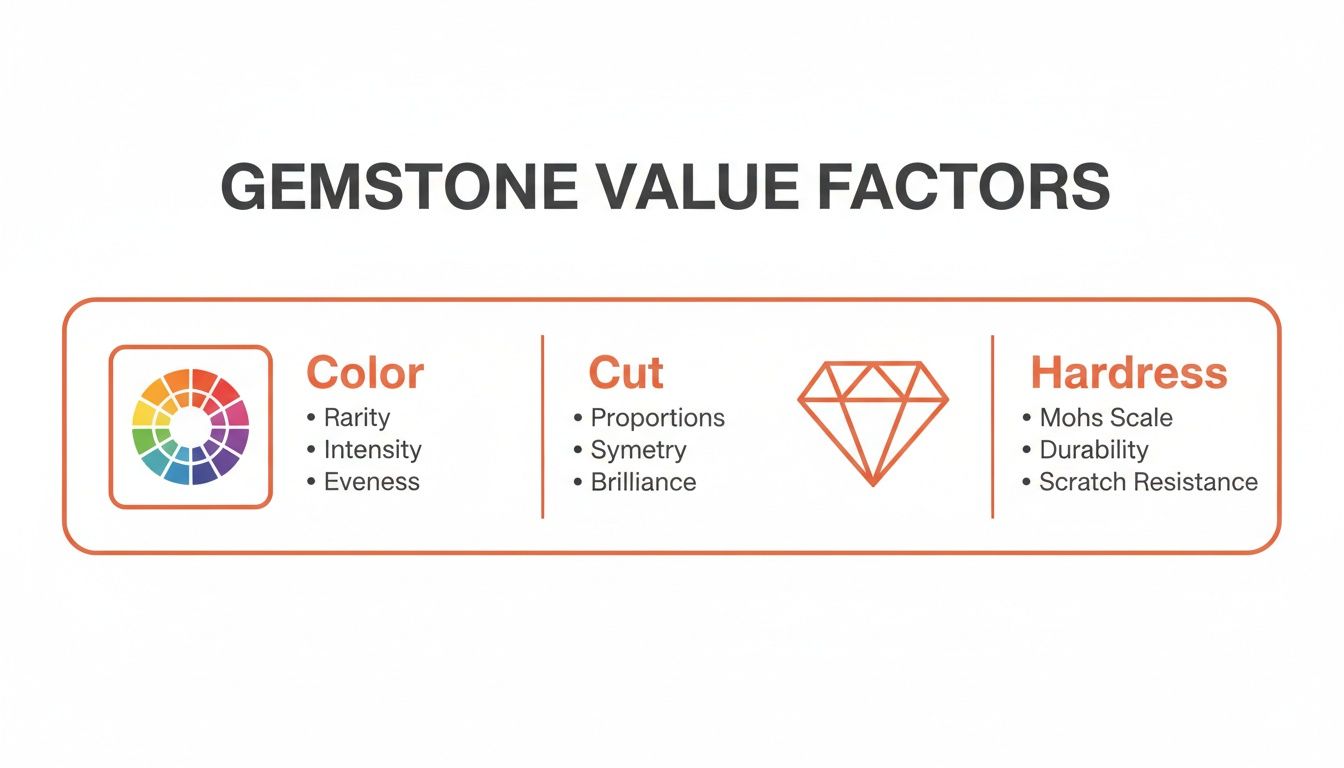
Getting a feel for how these three factors interact is the key to making savvy buying decisions that meet quality standards and, more importantly, what your customers are looking for.
The Classics: Enduring Demand And Value
Some gemstones are the foundation of the industry. Their demand is unwavering, making them the safest and most reliable additions to any jewelry business. Think of these as the blue-chip stocks of your inventory.
-
Sapphire and Ruby: These two are powerhouses from the corundum family, boasting a Mohs hardness of 9. That makes them incredibly tough and perfect for pieces that see daily wear, like engagement rings. While classic blue sapphires and rich red rubies are always in demand, don't overlook unique variations. Stones like the delicate pink Padparadscha sapphires or multi-toned "parti" sapphires are huge right now, appealing to buyers who want something special.
-
Emerald: Nothing says luxury quite like the deep, vibrant green of an emerald. With a Mohs hardness of 7.5-8, it's a bit softer and best reserved for jewelry that's less likely to get knocked around, such as pendants and earrings. Having emeralds in your collection signals a premium, high-end offering. Our guide to natural stone necklaces is a great place to see how these stunning gems can be showcased.
Trending Stones: Capturing Modern Tastes
While the classics keep the lights on, trendy stones are what create buzz and bring in new customers. We're seeing a massive shift, especially with younger buyers, toward unique colored gemstones as an alternative to the traditional choices.
Natural diamonds still lead the market with $42.6 billion in global sales, but colored gemstones are catching up fast, showing an impressive 28% annual growth. This isn't just a fleeting trend; it’s a fundamental change in customer preference.
Stocking a mix of classic and trending gemstones isn't just about variety; it's a strategic move to capture different market segments. The steady profit from a classic sapphire can fund your investment in a trendier stone like morganite, creating a balanced and resilient inventory.
High-Margin Alternatives: The Smart Business Choice
A truly profitable inventory needs stones that deliver a big visual impact without the massive price tag. This is where high-quality, accessible alternatives shine, giving you more flexibility and better margins.
-
Aquamarine and Morganite: These gems are in the same beryl family as emeralds but come in soft, dreamy pastel shades. Aquamarine's sky blue and morganite's peachy-pink hues are incredibly popular for fashion-forward pieces. Their romantic feel and affordable price point make them a win-win.
-
Zircon: Don't mix this one up with the synthetic cubic zirconia! Natural zircon is a brilliant, fiery gemstone that sparkles almost like a diamond. It comes in a whole spectrum of colors and gives customers that high-end look for a fraction of the cost—a perfect choice for affordable luxury.
Popular Gemstone Sourcing Guide for Jewelry Businesses
To help you visualize your inventory strategy, here’s a quick-glance table comparing some popular gemstones. This overview focuses on the key characteristics—durability, price, and market appeal—that are most important when you're sourcing for your business.
| Gemstone | Mohs Hardness | Typical Price Range (Per Carat) | Best For (Jewelry Type) | Market Trend |
|---|---|---|---|---|
| Sapphire | 9 | $300 - $2,000+ | Engagement Rings, All Jewelry | Stable, with rising interest in fancy colors |
| Ruby | 9 | $500 - $10,000+ | Rings, Fine Jewelry | Perennially strong, especially for high-quality stones |
| Emerald | 7.5 - 8 | $500 - $5,000+ | Pendants, Earrings, Occasion Rings | Strong demand for high-clarity stones |
| Aquamarine | 7.5 - 8 | $50 - $300 | Fashion Rings, Pendants, Bracelets | Growing popularity for its soft, versatile color |
| Morganite | 7.5 - 8 | $75 - $400 | Engagement Rings, Fashion Jewelry | High demand, especially in rose gold settings |
| Zircon | 6.5 - 7.5 | $50 - $250 | Earrings, Pendants, Rings (with care) | Niche but growing as a diamond alternative |
Choosing the right mix of these stones allows you to cater to a wide range of customers, from those seeking timeless investment pieces to shoppers looking for the latest trend. A well-rounded inventory is a profitable one.
Zircon: Your Brilliant and Budget-Friendly Alternative
When we talk about affordable gems, one name almost always causes a bit of confusion: zircon. Let’s clear this up right away—we're talking about natural zircon, a genuine gemstone with a rich history, not its lab-grown lookalike, cubic zirconia. For centuries, zircon has been cherished for its incredible sparkle and fire.
This natural stone for jewelry is one of the industry's best-kept secrets for getting that dazzling, "diamond-like" look without the hefty price tag. For a jewelry business, this is a golden opportunity. You can offer customers a stunning, brilliant piece that feels truly special, all while protecting your profit margins and keeping your prices competitive.
The Business Case for Zircon
What makes zircon so compelling? It all comes down to its optical properties. Zircon has a high refractive index, which gives it that exceptional brilliance, and its strong dispersion creates a fiery rainbow of colors that can honestly give more expensive stones a run for their money. This knockout visual appeal makes it an easy choice for customers who want affordable elegance.
While you can find zircon in a whole spectrum of gorgeous colors, the colorless variety is the most popular diamond substitute. It has a respectable hardness of 6.5 to 7.5 on the Mohs scale, which means it’s plenty tough for everyday pieces like pendants and earrings that don't take a lot of direct hits.
Sourcing High-Quality Zircon
To really make zircon shine in your collection, you have to focus on finding well-cut stones. The cut is everything. A masterfully cut zircon will explode with fire and light, turning an attractive stone into a showstopper.
Here’s what to look for when you're adding zircon to your inventory:
- Cut is King: Always prioritize stones with excellent faceting. This is what maximizes light return and gives zircon its signature sparkle. A poorly cut stone will just look dull, completely missing the point.
- Heat Treatment: It's common for zircons, especially the blue ones, to be heat-treated to bring out their best color. This is a standard and accepted practice, just make sure your supplier is upfront about any treatments.
- Marketing Angle: Position zircon the right way. It’s not a "fake diamond." Frame it as what it is: a beautiful and valuable natural gemstone with its own history and unique, fiery brilliance.
The brilliance of zircon offers a strategic advantage. It lets you build a product line that delivers the high-end sparkle customers crave at a price point that encourages impulse buys and repeat business. It's the perfect bridge between affordability and luxury.
While natural zircon is a fantastic choice, it’s also smart to understand its synthetic counterpart. To get the full picture of lab-created alternatives, take a look at our detailed guide on wholesale cubic zirconia jewelry. Knowing the ins and outs of both helps you cater to a much wider range of customers and budgets.
How to Build a Reliable Gemstone Supply Chain
Your jewelry business is only as strong as its weakest link, and that weak link is often the supply chain. Finding the perfect stone for jewelry is one thing, but consistently getting that quality at the right price is what separates a hobby from a profitable business. This is about moving beyond one-off buys and creating a strategic network of partners you can truly count on.
The opportunity here is massive. Gemstone demand in the United States alone is valued at $12.7 billion and is expected to climb to an incredible $23.4 billion. This isn't just a fleeting trend; it’s a clear signal of sustained consumer love for gemstone jewelry, making a solid supply chain absolutely essential. You can explore the full forecast on the U.S. gemstone market to get a better handle on these trends.
Choosing Your Sourcing Channels
So, where do you actually buy your stones? There's no single right answer, and most successful businesses use a mix of channels, each with its own pros and cons. Understanding the landscape of your supply chain is one of the most important basics of supply chain management for any growing business.
- Trade Shows: Think of events like the massive Tucson Gem and Mineral Show. They’re fantastic for getting your hands on an incredible variety of stones and meeting suppliers face-to-face. Nothing beats seeing a stone in person. The downside? The travel costs can add up, and the sheer number of vendors can be a bit much if you're not prepared.
- Wholesale Suppliers: Working with established wholesalers is all about consistency and convenience. They’ve done the hard work of sourcing and importing, and they often offer credit terms that can be a lifesaver for cash flow. You'll pay a bit more per carat, but you're paying for reliability and less logistical hassle.
- Direct from Mines/Cutters: This is the path to the best possible pricing, but it’s not for the faint of heart. Going direct means you're handling international shipping, quality control, and building relationships from the ground up. It takes a lot of expertise and typically requires buying in serious volume, so it’s a route best left for larger, more established companies.
Vetting Suppliers and Ensuring Transparency
Once you’ve got a few potential suppliers in mind, the real work begins. You have to do your homework. This is all about building trust and verifying that the stones you’re buying are exactly what the supplier claims they are.
A great supplier is more than just a vendor; they are a partner in your success. They should be transparent about gemstone treatments, provide accurate grading, and stand behind their products. This transparency is the foundation of a healthy, long-term business relationship.
When you're testing the waters with someone new, always start small. A trial order lets you check out their product quality, how they communicate, and how reliable their shipping is without risking a huge amount of capital.
Don't be shy about asking for references or digging into their policies. A reputable dealer will have no problem disclosing treatments—like heat for sapphires or oil for emeralds. That kind of honesty is what you're looking for, because it's the bedrock of a supply chain that's dependable, ethical, and profitable.
Answering Your Top Questions About Sourcing Stones
Diving into the world of sourcing gemstones can feel a bit overwhelming. Just when you think you've got it all sorted, a new question pops up. It's a critical step in building an inventory that actually sells, so getting straight answers to the tough questions is the only way to buy with confidence and build a collection that makes you money.
Let’s tackle some of the most common hurdles I see business owners run into, from telling a real stone from a convincing fake to figuring out the maze of international shipping. The goal here is to give you practical advice you can use right away to make smarter, more secure buys.
How Can I Spot a High-Quality Fake or Imitation Stone?
Telling a natural gem from a well-made imitation can be tricky, but there are definitely a few tells you can look for. First off, let's just get this out of the way: if a price seems way too good to be true, it almost certainly is.
Beyond the price tag, get up close and personal with the stone itself:
- Look for perfection (or a lack of it): Lab-grown stones and glass fakes often look too perfect. They're missing the tiny natural inclusions or slight shifts in color that give a genuine stone for jewelry its unique personality.
- Check the sparkle and weight: Glass is a common stand-in, but it just doesn't have the same brilliant "fire" you'd see in a real gem like zircon. It can also feel lighter in your hand and warmer to the touch than a natural stone.
- Examine the edges (carefully): While a scratch test works, it also damages the stone. A better, non-destructive trick is to look at the facet edges with a jeweler's loupe. Glass and other soft materials often have tiny nicks or slightly rounded edges from being handled. Harder gems, like a sapphire, will have clean, sharp lines where the facets meet.
Honestly, the single best way to know what you're getting is to build a solid relationship with a reputable supplier. Someone who provides full disclosure and stands behind their product is worth more than any at-home test you can do.
What Is the Difference Between Treated and Synthetic Stones?
This is a huge one, and it directly affects a stone's value and how you should describe it to your customers. Getting this right is all about being transparent.
A treated gemstone started its life as a natural stone but has had a little work done to improve its look. Think of things like heating sapphires to make their blue pop or oiling emeralds to fill in tiny natural fractures. These are accepted practices in the industry, but they must be disclosed by the seller.
A synthetic gemstone, on the other hand, was grown in a lab. While it has the exact same chemical and physical makeup as the natural version, it was made by people. A synthetic ruby, for example, is still a ruby in chemical terms, but it didn't come from the earth. This is what makes them a much more affordable alternative.
What Should I Know About International Shipping and Customs?
Sourcing stones from other countries can unlock incredible variety and better prices, but it definitely comes with its own set of logistical headaches. The trick is to be ready for them.
First, get familiar with Incoterms (International Commercial Terms). These are the universal rules that spell out who's responsible for what—shipping, insurance, duties, etc. Your supplier will use terms like FOB (Free on Board) or CIF (Cost, Insurance, and Freight).
Next, always budget for customs duties and taxes. They're an unavoidable part of the cost and can add a pretty significant chunk to your total bill. Working with a good customs broker can make this whole process a lot less painful by ensuring your paperwork is right and your shipment doesn't get stuck in limbo. And please, always, always choose a trackable shipping option. You need to be able to follow your valuable investment every step of the way.
Building a jewelry business you're proud of starts with sourcing the right materials with total confidence. At JewelryBuyDirect, we make it simpler by giving you factory-direct pricing on a huge selection of SGS-certified stones and jewelry components. With no minimum orders, fast worldwide shipping, and a completely transparent supply chain, you can build your dream inventory with less risk and more profit. Explore our collection and start sourcing smarter today at https://www.jewelrybuydirect.com.