






Jennifer Lopez | Thu Oct 15 2026
Sterling Silver Safety Pin: A Wholesale Buyer's Guide
You're at a wholesale show with a box of safety-pin jewelry in one hand and a supplier catalog in the other. The pieces look polished under the display lights, but the price is low enough to raise a question: is the entire finding sterling silver, or is only the visible wire carrying the claim? A clasp, spring, jump ring, or decorative attachment can change the product's material story, customer experience, and compliance risk.
For a boutique, a sterling silver safety pin isn't a simple impulse accessory. It's a small mechanical product with a precious-metal specification. The right buy must close reliably, resist distortion, suit the intended styling use, and support an honest product listing. This buyer's guide gives you the checks I'd use before approving a sample, placing a first order, or reordering a style that has started to sell.
Why Sterling Silver Safety Pins Need a Buyer's Eye
At a wholesale table, the first pass is visual. You compare the shine, wire thickness, clasp shape, and overall finish across several boxes. That's useful, but it isn't enough. A polished surface can conceal plated parts, a mixed-metal assembly, or a spring that loses tension after repeated opening.
The safety pin's apparent simplicity creates the problem. Buyers often inspect the visible stem and assume the rest of the item matches it. In practice, the 925 promise needs to be checked against the complete assembly, especially where the pin is used as a brooch, charm carrier, clothing fastener, or body-adjacent accessory.
Practical rule: Treat the stamp as a starting point, not a complete quality report.
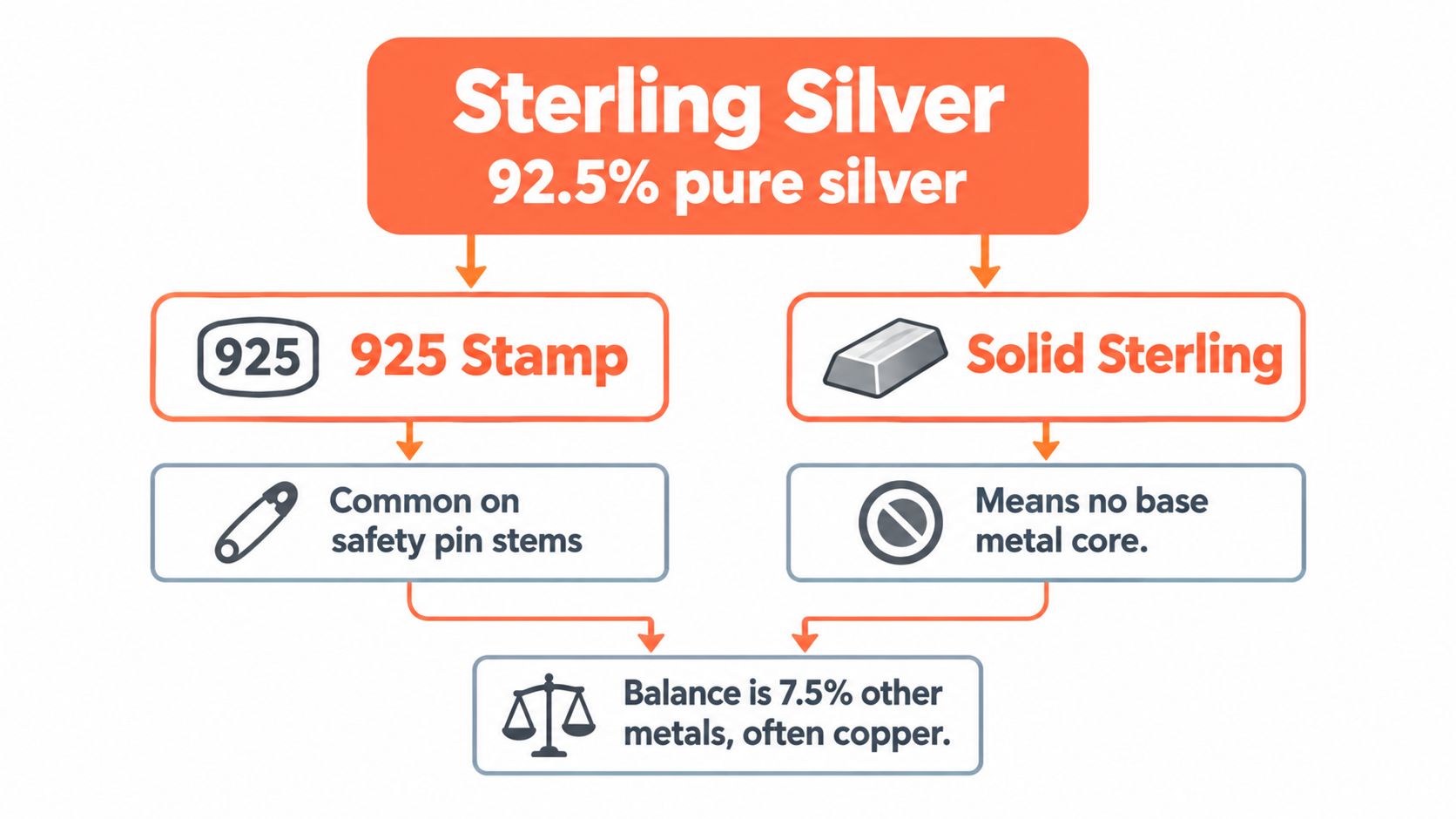
Sterling silver means a minimum fineness of 925 parts per 1,000, so a sterling-silver safety pin should contain at least 92.5% silver by weight and typically about 7.5% strengthening alloy, most commonly copper. That standard gives you a clear material baseline, but it doesn't automatically prove that every component is sterling, that the item is well made, or that the supplier's description applies to the whole product. You can review the fineness background in this overview of silver hallmarks.
The five checks I make before approving a sample
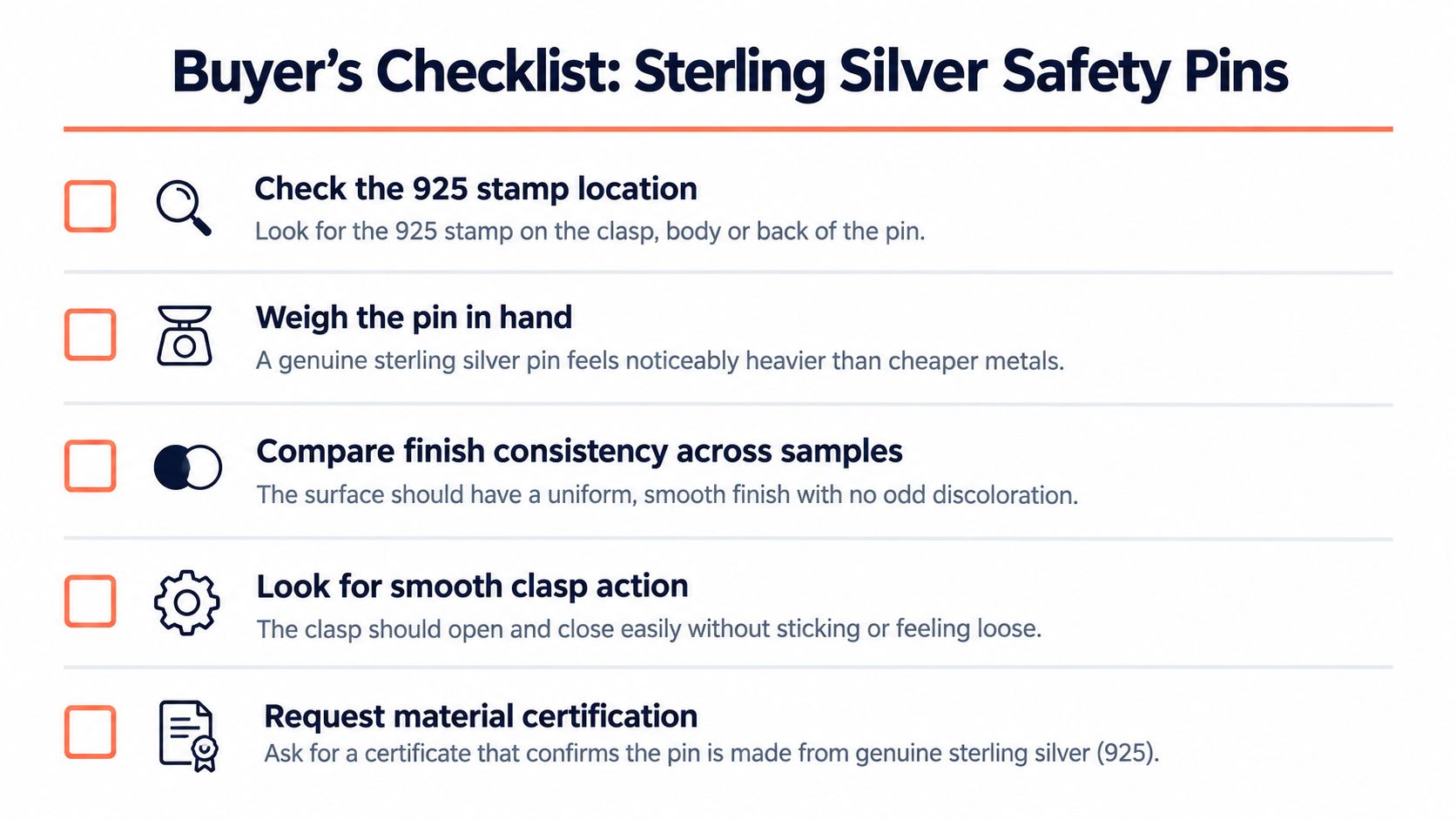
I start with the mark, but I don't stop there. Check whether the 925 stamp is legible and placed on the represented part, then inspect the clasp, coil, tip, and any attached charm separately. A supplier should be able to explain the material of each part without hiding behind a general “silver color” description.
Next, open and close the pin repeatedly. The point should enter the clasp cleanly, the coil should return the wire to position, and the clasp shouldn't wobble. Run a fingertip carefully over the edges, because rough finishing creates snagging and customer complaints even when the metal content is accurate.
Finally, compare samples from different production lots when possible. Inconsistent color, weight, solder marks, or clasp geometry usually signals that the supplier's quality control needs more scrutiny. The sample that looks acceptable in a catalog thumbnail may not be the sample you want to reorder.
What 925 Really Means on a Safety Pin
A 925 mark is a fineness claim. It communicates that the represented silver part contains 925 parts pure silver per 1,000. For a U.S. buyer, the Federal Trade Commission's jewelry guidance gives you a practical checkpoint when comparing supplier listings, samples, and invoices.
The terminology matters. The FTC jewelry guidance allows “Solid Silver,” “Sterling Silver,” “Sterling,” and “Ster.” only for items containing at least 925 parts per 1,000 pure silver, and the designation must apply to the represented part rather than imply that every component is sterling. A supplier calling a pin “silver” doesn't necessarily give you the same measurable assurance as a properly supported sterling claim.
That distinction becomes important when a pin includes a decorative plate, charm, spring, clasp, or jump ring. Ask the supplier to state whether the stem, clasp, coil, and attachments share the 925 composition. If only the body is sterling, your product copy should say so clearly instead of suggesting that the complete assembly is sterling silver.
A mark doesn't tell you everything
Hallmark systems can identify more than fineness. Depending on the country, they may also identify the maker, assay office, and sometimes the manufacturing date. In the United States, however, “sterling silver” and “925” generally communicate the 92.5% threshold, not a guaranteed origin, manufacturing standard, or level of workmanship.
That's why I'd ask for documentation before treating the mark as proof. Request the material declaration, the supplier's invoice wording, and confirmation of any non-silver components. For a meaningful quality check, arrange X-ray fluorescence testing on multiple components or production lots where the order value justifies it. A visual mark and a supplier photograph aren't substitutes for component-level verification.
For a plain-language explanation you can use when training staff, see this guide to what 925 sterling silver means.
The Mechanism Behind the Style
The safety pin's commercial value comes from its mechanism, not just its appearance. On April 10, 1849, American mechanic Walter Hunt received U.S. Patent No. 6,281 for a “dress pin,” the design now recognized as the safety pin. It used one piece of wire to combine a coil spring with a clasp that shielded the sharp point when closed, as documented in this history of the safety pin.
That design still gives you the right inspection framework. A good sample should have a coil with controlled tension, a clasp aligned with the point, and enough resilience to return to its closed position without looking distorted. The wire needs to be formable during production but stable enough to resist permanent bending during ordinary use.
What to test on the sample tray
Open and close every sample several times. Don't force the mechanism, but don't test it once and assume it's fine either. Look for four practical signals:
- Clasp alignment: The point should sit fully inside the protective clasp rather than riding against an edge.
- Spring return: The coil should bring the wire back into position without excessive looseness.
- Surface finish: The clasp and coil should have no burrs that can catch fabric or skin.
- Wire consistency: The gauge should look uniform from stem to coil, with no visibly thin transition.
A loose clasp is a return waiting to happen. An overly stiff coil is also a problem, particularly when the item is sold as a wearable fashion accessory rather than a stationary decorative piece. If the safety pin will carry a charm or sit on a garment, test it with the intended load and fabric before approving the design.
For assortment planning, the Bohemian Pink Beaded Butterfly Shell Pendant Necklace Set for Children Handmade Jewelry is listed as a unisex, bohemian necklace weighing 20g, with two variants across option1, option2, and option3. It isn't a safety pin, but it illustrates why the component or accessory's stated category, style, and weight should remain distinct from assumptions about metal construction.
When you compare findings and components, use a dedicated jewelry findings and components reference alongside your own physical inspection. The mechanism should earn its place in the assortment independently of the 925 mark.
Matching the Right Style to Your Shop
A single sterling silver safety pin can serve very different retail purposes. A large brooch needs visual presence and dependable closure. A small ear-pin style needs a different comfort and contact assessment. A charm carrier needs enough structural strength for the attached element without overwhelming the chain or garment.
Don't order one mixed pack and hope the customer decides how to use it. Match the design to the styling behavior you expect, then select finish, length, and wire profile around that use.
| Style | Typical Length | Best Retail Use | Recommended Channel | Price Band |
|---|---|---|---|---|
| Oversized brooch pin | Long | Statement styling on jackets, knitwear, bags, and scarves | Shopify, boutiques, pop-ups | Premium |
| Small ear cuff or ear-pin style | Short | Minimalist ear styling and curated fashion edits | Etsy, Instagram, boutiques | Mid to premium |
| Charm carrier | Medium | Holding pendants, beads, or small decorative elements | Jewelry makers, Etsy, Shopify | Mid |
| Traditional clothing fastener | Medium to long | Garment repair, textile styling, and functional fastening | Brick-and-mortar shops, craft sellers, marketplaces | Entry to mid |
Choose the use before the finish
Oversized brooch pins earn shelf space when your shop sells statement dressing. The closure must feel secure, because customers will attach the item to moving fabric and expect it to stay in place. A highly polished finish suits a clean contemporary range, while a textured or oxidized look can work better with vintage-inspired merchandise. Don't let decoration compensate for a weak clasp.
Smaller ear cuffs and ear-pin styles require tighter scrutiny around comfort and skin contact. Any sharp edge, rough solder point, or questionable attached finding deserves rejection. If the supplier can't document the complete contact assembly, remove sensitive-skin language from the listing.
Charm carriers should be judged with the intended charm attached. The pin needs enough spring control to manage movement without twisting out of alignment. It's also the category where mixed-metal attachments can hide most easily, so request a component list before you describe the item as fully sterling.
Traditional clothing fasteners are the most functional choice. Buyers often care less about ornament and more about reliable closure, smooth handling, and protection against snagging. For a first assortment, I'd prioritize a small number of mechanically dependable styles over a broad collection of nearly identical finishes.
The Hypoallergenic Question Most Listings Skip
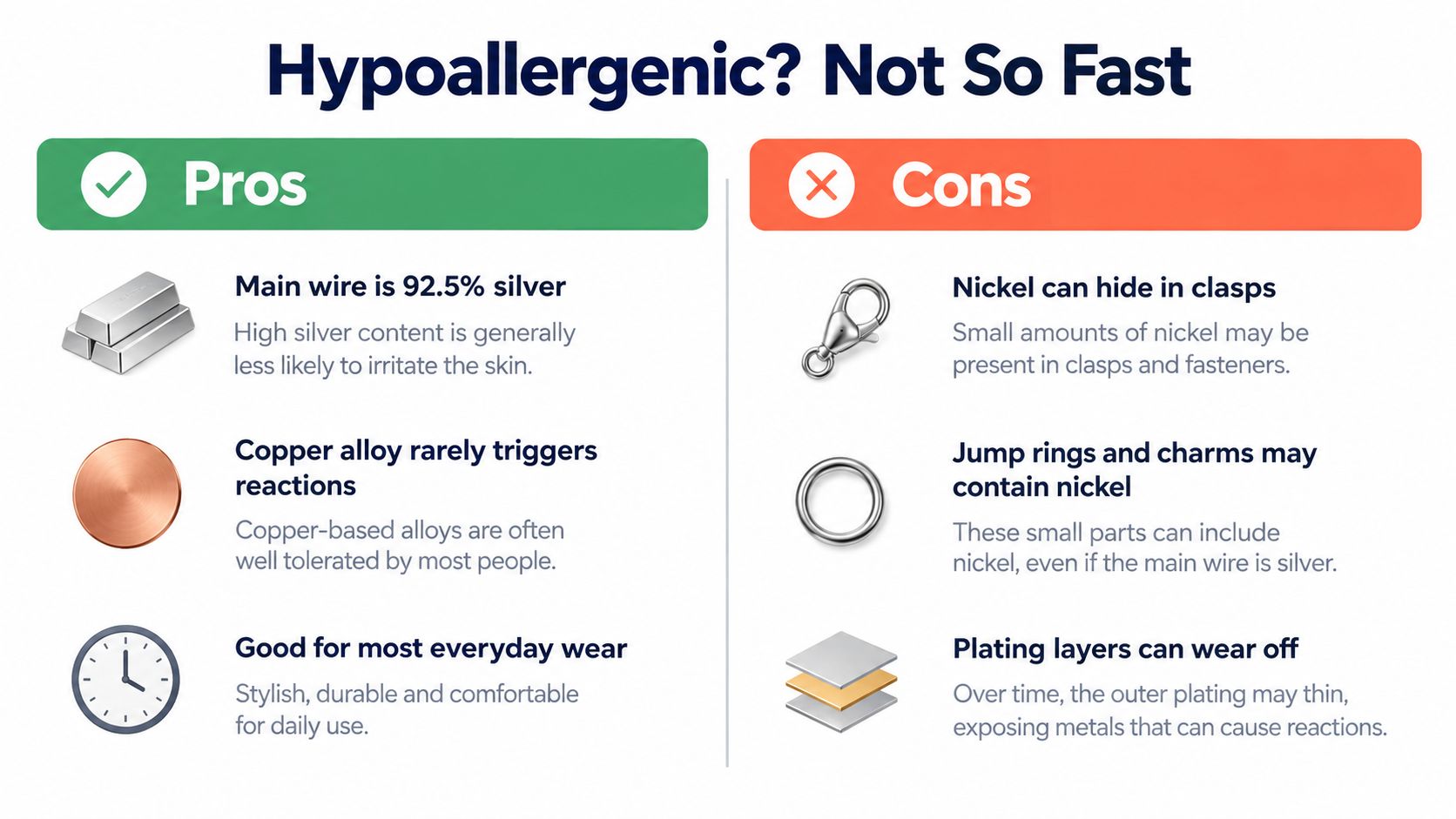
“925 sterling silver” does not automatically mean “hypoallergenic.” Sterling silver is mostly silver with a strengthening alloy, commonly copper, but nickel can still appear in attached findings, clasps, jump rings, charms, or plating layers. The complete item, not just the main wire, determines what a customer's skin contacts.
That distinction matters for Etsy, Amazon, and TikTok Shop listings. A casual claim such as “safe for sensitive skin” can create a compliance problem if the supplier has tested only the visible stem or has no evidence about the finished assembly.
Ask for release evidence, not reassurance
EU rules limit nickel release to 0.5 µg/cm²/week for prolonged skin contact and 0.2 µg/cm²/week for items inserted into pierced body parts, with compliance assessed through standardized release testing rather than a simple “nickel-free” claim. The requirements and testing context are explained by the Finnish Safety and Chemicals Agency.
A “nickel-free coating” isn't the same as a compliant finished assembly. Plating can wear through at a clasp, coil, or friction point, exposing the underlying material. Ask the supplier for:
- Component declarations: Include the wire, clasp, coil, jump rings, charms, solder, and plating.
- Finished-assembly testing: Request nickel-release evidence relevant to the intended use.
- EN 1811 documentation: Use standardized release testing as the reference point rather than relying on a verbal guarantee.
- Listing boundaries: If the evidence is incomplete, describe the metal accurately and omit hypoallergenic language.
A clothing pin may have intermittent contact, while a decorative pin worn against skin experiences sweat, friction, and repeated handling. Copper can also matter to individual customers, so “sterling” should never become a blanket promise about every wearer's reaction.
Tarnish, Storage, and a Care Card That Sells
Sterling silver tarnishes primarily through sulfur corrosion, not ordinary oxidation. Hydrogen sulfide and similar compounds react with silver to create a dark silver-sulfide layer, so a safety pin can lose its bright appearance while sitting in inventory even when the metal content is genuine. The underlying chemistry and storage implications are discussed in this technical explanation of silver tarnish.
Your storage routine should protect both the product and the margin. Tarnished stock takes staff time to clean, photographs poorly, and can trigger an avoidable customer complaint.
A practical inventory routine
- Seal each unit or small batch: Use low-sulfur packaging rather than leaving pins exposed in open trays.
- Add anti-tarnish protection: Place anti-tarnish paper or an appropriate corrosion-inhibiting insert inside the packaging.
- Separate reactive materials: Keep pins away from rubber, wool, treated paper, perfumes, and polluted air.
- Control the display environment: Avoid humid, light-exposed displays for long periods.
- Inspect contact zones: Check the clasp, coil, and tip, where handling deposits and crevices can retain moisture.
- Clean conservatively: Use a mild method compatible with the finish, because aggressive polishing can remove texture, plating, or fine clasp detail.
For customer education, link your care card to a useful guide to whether sterling silver tarnishes. The card should turn maintenance into part of the product experience, not an apology for a defect.
Care card text: “Your sterling silver accessory may darken over time as the surface reacts with sulfur compounds in the environment. Store it closed in its protective pouch with the anti-tarnish insert, and keep it away from perfumes, rubber, wool, and damp air. Clean gently with a silver-safe cloth. Don't force the clasp or wear the pin open.”
That message sets a realistic expectation while reinforcing safe handling. Tell customers to keep the pin closed during storage to reduce snagging and accidental puncture.
Sourcing Checklist for a Confident First Order
A low unit price doesn't protect your margin if the first shipment contains mixed-metal parts, inconsistent mechanics, or unclear return terms. Use the same vetting routine for every supplier, whether you're buying a single test batch or building a repeat assortment.
Verify the material before you compare prices
The FTC defines “sterling” and “sterling silver” as products containing at least 92.5% pure silver, which gives you a concrete checkpoint for comparing supplier listings, samples, and invoices. Ask the supplier to state exactly which components meet that threshold. If the description says “925 body” but says nothing about the clasp, spring, charm, or jump ring, treat the product as partially documented.
For higher-confidence purchasing, request:
- XRF checks: Test multiple components or production lots where feasible, not just the easiest visible surface.
- Material declarations: Require a component-by-component statement covering the complete assembly.
- Assay documentation: Match the wording on the certificate, product page, sample, and invoice.
- Nickel-release evidence: Request EN 1811-related testing when the item is intended for prolonged skin contact or major-market sales.
- Sustainability proof: If the supplier says “recycled silver,” ask for the recycled-content percentage, chain-of-custody or supplier documentation, alloy composition, and independent certification where available.
“Recycled silver” doesn't prove responsible labor, traceability, lower total impact, or consistent alloy performance. Silver recycling rose 6% in 2024 to 193.9 million ounces, according to Silver Institute data cited in market coverage of the silver jewelry sector, but that broad market figure doesn't establish the recycled origin of any particular safety pin. Treat sustainability as a documentation question, not a green adjective.
Protect the order economics
Review packaging, damage protection, shipping conditions, and the returns window before you approve the purchase. Confirm whether the supplier supports a low or no minimum order quantity, whether free shipping depends on an order threshold, and how defective findings are credited. Those terms matter more than a small unit-price difference when you're testing an unfamiliar style.
Put every answer in writing. A useful line sheet should show the product name, material claim, component notes, dimensions, finish, ordering terms, and care information in one place. For a practical format, use NanoPIM's line sheet guide to organize the information your team and retail partners need.
JewelryBuyDirect offers a B2B catalog that includes sterling silver jewelry and jewelry-making components, alongside other material categories, with no minimum order quantity, documented product options, and wholesale ordering support. Visit JewelryBuyDirect to compare sterling silver safety-pin styles, request the component details that matter, and build a first order around verified specifications rather than catalog photography alone.