






Arthur Lynch | Fri Dec 12 2025
A Business Owner's Guide to Sourcing Sterling Silver 925 Jewelry Wholesale
Before you even think about contacting a supplier, let's talk about the groundwork. Nailing down your sourcing strategy from the get-go is the difference between a thriving jewelry business and one that’s constantly struggling with unsold inventory and surprise costs. This is the foundation for sourcing high-quality, affordable sterling silver and fashion accessories that will delight your customers and grow your bottom line.
Building Your Foundation for Profitable Sourcing
Jumping into supplier catalogs without a clear plan is a recipe for disaster. I've seen too many retailers get excited by trendy pieces, only to end up with a random assortment of jewelry that doesn't tell a cohesive brand story or, worse, doesn't sell.
A successful sourcing strategy for your business starts right here, with three deliberate decisions that will shape your brand and protect your profit margins. Let's break down what you need to do before you place that first wholesale order.
First, Define Your Brand and Product Focus
You have to know who you are before you can find the right jewelry. Who is your customer? What's their style? Trying to sell a little bit of everything to everyone is a classic business mistake that leaves you with a forgettable collection and wasted capital.
Instead, zero in on a specific aesthetic. This focus makes every other decision, from marketing to sourcing high-quality and affordable jewelry, infinitely easier.
- Minimalist & Dainty: Are you about delicate chains, tiny stud earrings, and rings perfect for stacking? Your customer values subtlety and affordable everyday wear.
- Bohemian & Eclectic: Maybe your brand is more about natural stones, hammered textures, and free-spirited, organic shapes.
- Classic & Timeless: Perhaps you're sourcing elegant staples like freshwater pearl pendants, simple silver hoops, and classic solitaires that never go out of style.
When you have a crystal-clear vision, you're not just buying inventory; you're curating a collection. This makes it a thousand times easier to find the perfect sterling silver 925 jewelry wholesale partners who specialize in exactly the quality and price point you need for your business.
Understand the '925' Stamp—Your Non-Negotiable Quality Standard
That tiny "925" stamp is everything. It’s your promise of quality to your customer. True sterling silver is an alloy composed of 92.5% pure silver and 7.5% other metals (usually copper) to give it strength. Without that alloy, pure silver would be far too soft for everyday jewelry.
This standard is what separates genuine, lasting pieces from cheap, plated fashion accessories that tarnish in a week or, even worse, cause skin reactions.
A Note from Experience: Never, ever compromise on the 925 standard. It’s the bedrock of your business's reputation. One bad experience with a green-tinged "silver" necklace can lose you a customer for life. Sourcing affordable jewelry should never mean sacrificing quality.
When you start talking to suppliers, be direct. Ask about their materials and if they can provide any verification. A trustworthy partner will be completely transparent about this.
Craft a Realistic 'Landed Cost' Budget
Your budget is more than the price tag on a necklace. New business owners often make the mistake of only looking at the per-unit cost, completely forgetting about all the other fees that pile up. This is where profit margins get destroyed.
You need to calculate your landed cost—the true, total cost to get that jewelry from the supplier's warehouse to your shelf, ready to sell.
Your business budget absolutely must include:
- The Per-Unit Cost: The base price for each piece of jewelry.
- Shipping & Freight: The expense of getting the order from them to you.
- Customs & Duties: If you're importing, these taxes and fees are unavoidable.
- Quality Control Checks: Any costs for third-party inspections or even just ordering and shipping samples.
Figuring this out upfront allows you to price your products for real-world profitability, not just on-paper margins. This financial planning is essential for sourcing affordable jewelry that remains profitable.
To help you stay on track, we've put together a simple checklist summarizing these critical first steps for your business.
Sterling Silver Sourcing Checklist for Businesses
| Action Item | Key Objective | Why It's Critical |
|---|---|---|
| Define Your Brand Niche | Identify your target customer and aesthetic (e.g., minimalist, bohemian). | A focused collection is easier to market and attracts loyal customers. It prevents buying random, unsellable inventory. |
| Commit to the 925 Standard | Source only genuine 92.5% sterling silver with a 925 stamp. | Protects your business reputation, ensures product quality and longevity, and builds customer trust. |
| Calculate Landed Costs | Budget for the total cost: unit price + shipping + duties + QA. | Avoids unexpected expenses that can erase your profit margins. Ensures you price your products for real-world business profitability. |
Treat this checklist as your starting point. Getting these three pillars right will make the entire process of sourcing high-quality and affordable jewelry smoother and far more profitable.
Finding and Vetting Your Wholesale Partners

Your business is only as good as the suppliers you work with. Finding trustworthy partners is the single most important part of building a supply chain that won't let you down. It means going beyond a simple Google search to really dig in and protect your brand, your investment, and your ability to source high-quality, affordable fashion accessories consistently.
Mastering this vetting process is what separates thriving businesses from those constantly putting out fires—dealing with quality issues, shipping delays, and unhappy customers. Let's break down how to find and qualify the right partners.
Where to Find Potential Suppliers
A quick search for "sterling silver 925 jewelry wholesale" will flood you with options, but the real gems for your business are usually found through more focused channels. A blended approach works best, giving you a solid list of potential suppliers to start vetting.
- B2B Marketplaces: Platforms like Alibaba, JewelB2B, and FashionGo are great launchpads for businesses. Think of them as directories for initial research, not the final word. Look for suppliers with a long track record, verified credentials, and consistently good reviews.
- Industry Trade Shows: Nothing beats face-to-face interaction. Events like JCK Las Vegas or Vicenzaoro in Italy let you meet suppliers in person, handle the jewelry, inspect the craftsmanship, and build a real business connection.
- Professional Networks: Don't overlook the power of a good referral. Jump into forums or social media groups for non-competing jewelry business owners. They can often point you toward vetted partners they trust, which can save your business a world of time and risk.
Once you’ve got a shortlist, the real work begins.
Scrutinizing Business Credentials and Certifications
A reputable supplier won't shy away from proving their legitimacy. They should be transparent and ready to provide documents that back up their claims about quality and ethics. If you get vague answers or a flat-out refusal to share information, consider it a massive red flag for your business.
Key Takeaway: A supplier's willingness to show you their paperwork speaks volumes. If they hesitate to share certifications or audit reports, it often means there's something they don't want you to see. Trust your gut and walk away.
Start by asking for their business license and any third-party factory audit reports. These audits give you an unbiased look at their manufacturing process, working conditions, and quality control systems.
Also, look for compliance with key industry standards. For example, sustainability credentials like Responsible Jewellery Council (RJC) compliance now influence 30% of buyer decisions in major Western markets. An RJC-certified supplier shows a commitment to ethical sourcing—a powerful story you can pass on to your customers.
The Importance of Ordering Samples
Never, ever place a bulk order without seeing the product with your own eyes. Photos can be incredibly deceiving. A sample order is a small, non-negotiable investment to verify the quality of the jewelry you're sourcing for your business.
When the samples arrive, go over them with a fine-tooth comb:
- Check the 925 Stamp: Is it there? Is it clear and legible?
- Evaluate the Finishing: Look for smooth edges, secure stone settings, and a high-quality polish.
- Test the Clasps & Components: Open and close everything. Does it feel sturdy or like it will break after a few uses?
- Assess the Weight & Feel: Does the piece have a satisfying weight, or does it feel flimsy and cheap?
This hands-on inspection is your best line of defense. If a supplier refuses to send samples or tries to charge an outrageous price for them, it's a clear sign to move on. This process is also a great way to explore options from a few of the best wholesale jewelry suppliers for your business.
As you build these business relationships, you'll also need to talk about the Minimum Order Quantity (MOQ). A high MOQ can be a roadblock for a new business, but don't be afraid to negotiate. Many suppliers are flexible, especially if they see the potential for a long-term partnership.
Mastering Negotiation to Protect Your Margins
Sourcing isn't just about finding beautiful pieces. It’s about securing them on terms that actually let your business grow. This is where negotiation comes in, and it's how you protect your profit margins from day one. Many business owners get nervous about this part, but think of it less as a confrontation and more as building a solid, long-term business partnership.
When you approach these conversations with a clear strategy, you can drastically improve your bottom line. You'll be talking about everything from the price per piece to when you have to pay for it, and every little win adds up to a more affordable and profitable inventory.
Setting the Stage for Successful Price Discussions
Before you even throw out a number, do your homework. Get a real feel for the market for sterling silver 925 jewelry wholesale. This gives you a realistic baseline to work from. Check the current spot price of silver and see what other suppliers are charging for similar quality and styles.
When you walk into a negotiation armed with this knowledge, you're not just hoping for a better price—you're collaborating based on facts. You can clearly explain why a certain price point makes sense for your business, which is a much stronger position.
A great way to open the conversation is to ask about their pricing structure. Try questions like:
- "What do your price breaks look like for an order of 100 units versus 500 units?"
- "Do you have preferential pricing for businesses who place regular orders?"
This immediately frames you as a serious business owner thinking about growth and a long-term relationship, not just a one-time buyer looking for a cheap deal.
Tackling the Minimum Order Quantity Hurdle
The Minimum Order Quantity (MOQ) can feel like a huge roadblock, especially for smaller businesses. A high MOQ can lock up a ton of your cash in just one or two styles, which is a big risk if a piece doesn't fly off the shelves. But that number is almost never set in stone.
Pro Tip: Don't get scared off by a high MOQ right away. Most suppliers are willing to be a bit flexible, especially if they see potential in you as a new business client. The key is to show them your potential without blowing your budget.
If a supplier’s MOQ is just too high, try proposing a smaller, paid "test order." It's a great way to see how customers react to the new pieces and check the quality for yourself without a massive financial commitment. Another move is to ask if you can meet the total order value by mixing and matching several different SKUs.
This shows them you're serious but also that you're smart about your business's cash flow. For a deeper dive into these kinds of strategies, our guide on how to negotiate with suppliers has even more practical tips.
Negotiating Favorable Payment Terms
Your payment terms directly affect your business's cash flow, so this is a big one. Many suppliers, particularly with new accounts, will ask for full payment upfront. But once you start to build a relationship, you can often get more flexible terms.
It really helps to know the lingo:
| Payment Term | How It Works | Cash Flow Impact |
|---|---|---|
| 100% Upfront | You pay the entire invoice before anything ships. | Tough on business cash flow. It can be a risky move with a supplier you haven't worked with before. |
| 50/50 (Deposit/Balance) | You pay 50% to get production started and the final 50% when the order is ready to ship. | This is a great middle ground. It balances the risk and is much easier on your business bank account. |
| Net 30/60/90 | You have 30, 60, or 90 days to pay the invoice after you've received the jewelry. | This is the gold standard for cash flow, but it's usually reserved for established, trusted business partners. |
For your first order, aiming for a 50/50 split is a perfectly reasonable and professional request. After you've placed a few orders and always paid on time, you can circle back and ask to move to Net 30 terms. It’s a natural progression that shows your business partnership is growing stronger.
Getting Your Jewelry Home: Logistics and Quality Control
You’ve found a great supplier, negotiated terms, and placed your order. Fantastic! But the job isn't done yet. Getting your high-quality jewelry from their workshop to your business is the final, and arguably most critical, hurdle.
This is where logistics and a sharp eye for detail come into play. A slip-up in shipping or a missed quality check can easily wipe out your profits and damage your business's reputation. Let's walk through how to manage this final stage, making sure every piece of sterling silver 925 jewelry wholesale you ordered is absolutely perfect.
Choosing Your Shipping Path
How you get your order from point A to point B directly affects your final cost and how quickly you can get new items in front of your customers. For international orders, you're generally looking at two main choices: express air freight or sea freight. Knowing which one to use is crucial for managing your business's inventory flow and budget.
- Express Air Freight (Think DHL, FedEx, UPS): This is your best bet when speed is the name of the game. It’s perfect for smaller, higher-value shipments or when you need to restock a hot-selling design fast. Yes, it's the pricier option, but the reliability and quick turnaround (usually 5-10 days) often make the investment worthwhile for your business.
- Sea Freight: When you're placing a large, heavy order and have time on your side, sea freight is your most cost-effective friend for sourcing affordable inventory. The savings are significant, but you have to plan way ahead. Transit times can easily stretch from 30 to 60 days, so this requires serious foresight.
Part of managing your logistics is also understanding the local landscape. For instance, successfully finding a cheap and reliable courier for Australian shipping involves the same principles you'd use anywhere: compare costs, check transit times, and make sure their tracking is solid. It's all part of protecting your bottom line.
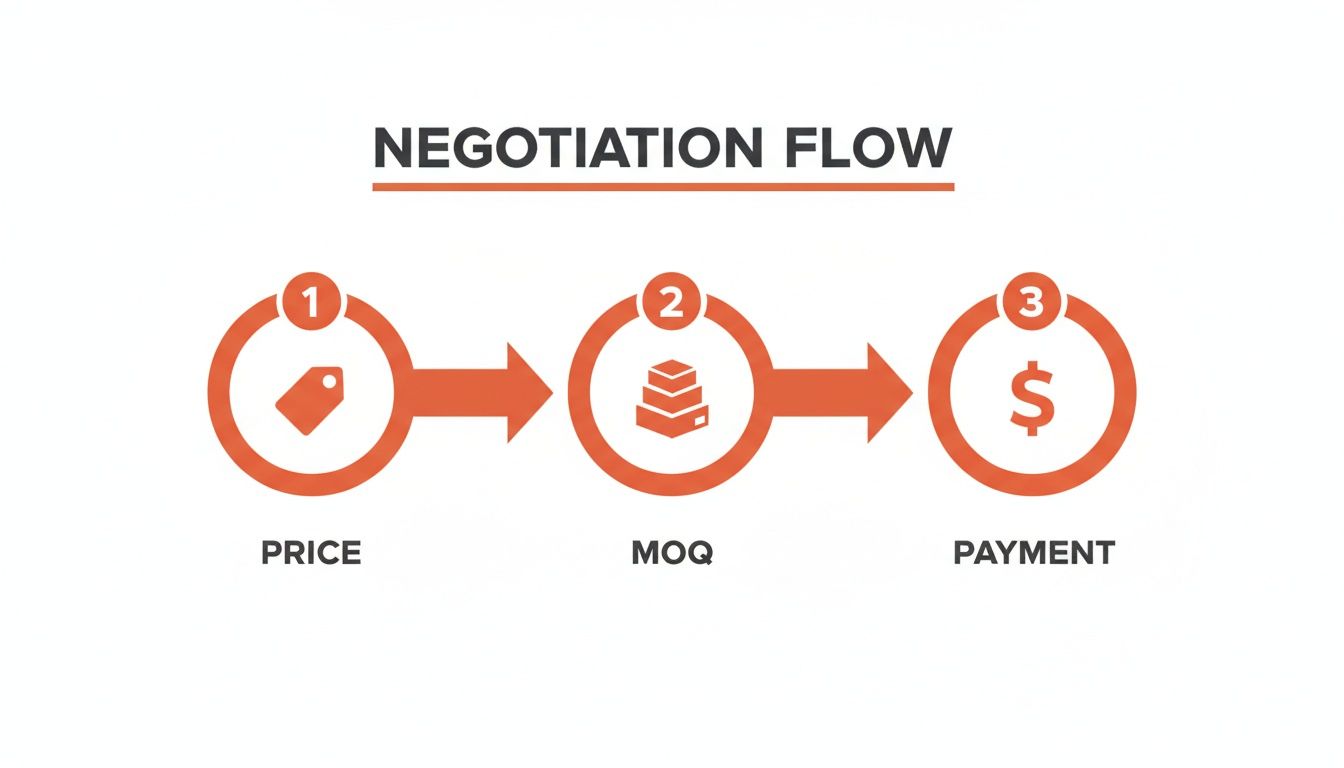
As this shows, your shipping and logistics decisions are the last piece of the puzzle, flowing directly from the price, quantity, and payment terms you've already locked in with your supplier.
Before we dive into the nitty-gritty of inspections, here’s a quick rundown of what to expect from different shipping methods.
Wholesale Shipping Options Compared
| Shipping Method | Average Cost | Typical Transit Time | Best For |
|---|---|---|---|
| Express Air Freight | High ($$) | 5-10 Days | Small, urgent orders or high-value items needing secure, fast delivery for your business. |
| Standard Air Freight | Medium ($$) | 10-20 Days | A good balance of speed and cost for medium-sized orders. |
| Sea Freight | Low ($) | 30-60 Days | Large, bulk orders where cost savings are the top priority and your business can plan far in advance. |
| E-Packet/Postal | Very Low ($) | 15-40 Days | Very small orders or samples only; tracking can be less reliable. |
Choosing the right option really comes down to balancing your immediate inventory needs against your business's budget for that specific order.
The Make-or-Break Quality Assurance Check
Your shipment has arrived! Don't start celebrating just yet. A thorough quality assurance (QA) inspection is absolutely non-negotiable. I've seen too many business owners get excited and skip this part, only to find problems weeks later. Catching issues the moment the box lands is the only way to resolve them without losing money.
Your inspection process needs to be methodical. Grab the approved sample you received earlier—that’s your gold standard. You'll want to inspect a meaningful portion of the shipment, not just one or two pieces. I always recommend checking at least 10-15% of each design (SKU) against this list.
Your Go-To QA Checklist:
- Is the "925" Stamp Clear? Look for the "925" or "Sterling" mark. It should be crisp and easy to read. A missing or sloppy stamp is a red flag for product quality.
- Test Every Clasp and Closure. Open and close the clasps on every necklace and bracelet you inspect. They need to feel solid and snap securely. Anything flimsy, stiff, or loose is a defect.
- Are the Stones Secure? For any pieces with gemstones, give each stone a gentle push with your fingernail. It shouldn't wiggle. Check for loose prongs or any signs of glue.
- Check the Polish and Finish. Hold the piece up to the light. The surface should have a consistent, bright polish. Be on the lookout for any scratches, dull spots, or rough edges.
- Do the Specs Match Up? Pull out your calipers and a scale. Compare a few pieces to the original specs and your sample. Do the dimensions and weight match what you ordered?
What to Do When You Find Defects
Even with fantastic suppliers, mistakes happen. It's how you handle it that matters for your business. When you find defects, your mission is to document everything perfectly and communicate professionally.
My Golden Rule: Never, ever throw away defective items or the packaging until the issue is fully resolved with your supplier. Your evidence is your leverage. A crystal-clear photo of a broken chain is a thousand times more effective than an email just saying "some necklaces were broken."
I keep it simple: create a spreadsheet to log the problems. List the SKU, how many units are defective, and a short note on what's wrong. Snap high-resolution photos or even a quick video showing the problem.
Then, send a single, organized email to your supplier contact right away. Frame it collaboratively, like "We've run into a small issue with these pieces, can you help our business find a solution?" A good partner will work with you to make it right, whether that means a partial refund, a credit on your next order, or shipping out replacements.
Pricing and Merchandising Your Jewelry for Maximum ROI
Sourcing incredible wholesale jewelry is a huge win, but that’s really just the first step. Now comes the part where you turn that carefully chosen inventory into actual profit for your business. This is where smart pricing and even smarter merchandising come together to make or break your success.
Profitable pricing isn't just about covering your costs; it’s about understanding and capturing the perceived value of your collection in the eyes of your customer, ensuring every high-quality piece contributes to your bottom line.
Crafting a Winning Pricing Strategy
Most new business owners start with keystone pricing—basically, just doubling the wholesale cost. It’s a simple rule of thumb, but honestly, you're often leaving money on the table. This is especially true with high-quality sterling silver 925 jewelry wholesale pieces that have unique designs or intricate details.
A much better approach for your business is a value-based model. This means you’re also factoring in things like craftsmanship, design complexity, and current market demand when you set your final price. A simple, machine-made silver chain won't command the same markup as a handcrafted pendant with a unique stone, even if their wholesale costs are nearly identical.
At a minimum, your final price has to cover:
- Landed Cost: The total price you paid to get the item in your hands, including the piece itself, shipping, and any import duties.
- Overhead: All your business expenses—marketing, website fees, packaging, software, you name it.
- Profit Margin: The actual money your business pockets from the sale.
Looking at it this way ensures your business isn't just getting by, but actually growing. To really get a grip on your numbers, it's essential to understand how to calculate profit margins for your jewelry business.
It's also critical to keep an eye on market fluctuations. For instance, even with silver spot prices jumping nearly 50% from $27/oz in 2024 to an expected $40/oz in 2025, the market has stayed strong. This is because silver holds its value well and remains much more affordable than gold. Wholesalers can often absorb some of these costs through efficient bulk sourcing, which helps keep prices stable for retailers like you.
Merchandising to Drive Sales and Desire
Great merchandising is really just storytelling. It’s what transforms a simple silver ring on a screen into a must-have piece. Your goal is to spark an emotional connection that makes a customer feel like they need that item from your business.
It all starts with your product photography. Your photos are your digital storefront, and they have to be flawless. Use soft, natural light, show the jewelry from multiple angles, and always include a shot of the piece being worn. This gives customers a real sense of scale and helps them picture it on themselves.
Merchandising Tip: Don't just list the features—sell the feeling. Instead of "Sterling silver necklace, 18 inches," try something like, "Your perfect everyday layer. This elegant sterling silver chain rests beautifully right on your collarbone." You're creating a narrative and making your product instantly relatable.
Beyond great photos and descriptions, start thinking about how you can increase your Average Order Value (AOV). Bundling is a classic for a reason—it works for businesses.
Effective Bundling Examples
- The "Stacking Set": Put three complementary rings or bracelets together and offer them at a slight discount compared to buying them all separately.
- The "Curated Ear": Bundle a pair of hoops, a cool stud, and an ear cuff to create a ready-to-wear, on-trend look. It takes the guesswork out for the customer.
- The "Go-To Gift Box": Combine a popular necklace and matching earrings in beautiful packaging. This makes it an easy, high-value purchase for birthdays and holidays.
These strategies don't just bump up your revenue for each sale; they also introduce customers to more of your collection. You'll start turning one-time buyers into loyal fans of your business.
Answering Your Top Sterling Silver Sourcing Questions
Jumping into the world of sterling silver 925 jewelry wholesale can feel overwhelming for a business owner. You’re trying to balance your budget, vet potential partners, and figure out which high-quality, affordable fashion accessories will actually sell.
This last section is all about tackling the most common questions from business owners just like you. The goal is to give you clear, practical answers so you can navigate the sourcing process with confidence.
Where’s the Best Place to Find Reliable Wholesale Suppliers?
Honestly, there’s no single magic bullet for finding a great supplier for your business. It’s more of a strategic hunt using a few different channels.
A good starting point is the big B2B marketplaces like Alibaba, JewelB2B, or FashionGo. Think of these as huge directories. Use them to build an initial list of potential suppliers, but definitely don't stop there.
From that list, you need to do some real digging. Look for suppliers who have been around for a while, have genuinely positive reviews from other businesses, and are transparent with their company info. Another fantastic way to find partners is by going to major industry trade shows like JCK Las Vegas or Vicenzaoro in Italy. Nothing beats meeting someone face-to-face and holding their jewelry in your hands.
Finally, don't underestimate your own network. Jump into online forums or private social media groups for non-competing jewelry retailers. You'd be surprised how often you can get a trusted recommendation for a supplier that fits your business needs.
My Two Cents: No matter how you find a supplier, that first contact is just the beginning. The most crucial step is always to vet them thoroughly. Ask for their business certifications, and never, ever commit to a big purchase before you’ve ordered and inspected samples.
How Do I Handle Returns or Damaged Items with a Supplier?
Dealing with returns and defects starts way before you even place an order. It's something you must clarify during your initial negotiations. A good, reputable business partner will have a clear, straightforward policy for handling damaged or incorrect pieces. Make sure you get that policy in writing.
The second your shipment lands, it's time for a thorough inspection. If you find any problems, document everything immediately. Take clear, high-resolution photos and write down a detailed description of what's wrong with each piece.
Then, reach out to your supplier representative right away with all the evidence you’ve gathered. It’s important to keep the conversation professional. You’re not accusing them; you’re presenting a mutual problem that needs solving. Any legitimate wholesaler wants to build a long-term business relationship, so they'll work with you to make it right.
What Are the Biggest Mistakes to Avoid When Buying Wholesale?
One of the most common—and most expensive—mistakes is skipping the due diligence on both the product and the supplier. A classic blunder is not ordering samples to check the quality before placing a massive order. This gamble can leave your business with a pile of inventory you can't sell.
Another trap is ignoring the total landed cost. So many new buyers get mesmerized by a low per-item price and totally forget to account for shipping, customs duties, and taxes. These hidden costs can easily chew up your profit margins or even put your business in the red.
Finally, don't put all your eggs in one basket. Relying on a single supplier is a huge risk to your business. If they have production delays, their quality slips, or they go out of business, your entire operation grinds to a halt. It’s always smart to have relationships with at least two or three fully vetted suppliers.
What Sterling Silver Jewelry Trends Should I Be Focusing On?
Keeping your collection fresh and current is one of the best ways to drive sales for your business. Right now, there's a huge demand for pieces that offer "everyday glam"—high-quality, affordable accessories your customers can wear from the office straight to a night out.
For instance, simple sterling silver necklaces, especially delicate chains with small gemstone charms, are consistent best-sellers. And the trend that just keeps giving? Stackable jewelry. It’s a hugely profitable category for any jewelry business.
- Stackable Rings: Think thin bands, textured rings, and dainty gemstone rings that customers can mix and match.
- Layered Necklaces: Offer a variety of chain lengths and styles so people can create their own unique look.
- Bangle Sets: Curate sets of bangles with colorful stones or mixed metals for an easy, stylish statement.
Not only do these stackable styles appeal to modern tastes, but they also naturally increase your average order value. On top of that, more and more customers care about sustainability. Jewelry made from recycled silver or featuring ethically sourced stones is gaining a lot of traction and gives you a powerful brand story. Keep an eye on trend forecasts—which are currently pointing to things like micro hoops and raw stone accents—to stock inventory that’s relevant, desirable, and sells fast.
Ready to source high-quality, on-trend sterling silver jewelry with confidence? JewelryBuyDirect offers over 120,000+ factory-direct styles with no minimum order, free worldwide shipping on orders over $150, and full damage protection. Explore our extensive collection and build your profitable inventory today at https://www.jewelrybuydirect.com.