






Arthur Lynch | Sun Jan 18 2026
Finding High-Quality, Affordable Handmade Jewelry Suppliers for Your Business
Finding the right handmade jewelry supplier is so much more than a simple transaction. It's about building a partnership that consistently delivers high-quality, unique jewelry and fashion accessories your customers will love. The goal for any business is to find that sweet spot: exceptional, on-trend pieces at an affordable price that protects your profit margins.
Why Sourcing High-Quality Handmade Jewelry Is a Smart Business Move
Let's be honest, the market is flooded with mass-produced everything. Choosing to stock handmade jewelry and accessories isn't just a preference; it’s a strategic move that taps directly into what modern shoppers want. People are actively looking for high-quality products that feel personal, have a story, and show a human touch. This is a massive opportunity for any business looking to stand out.
And this isn't just a fleeting trend. The global handmade jewelry market is booming—it was valued at a staggering USD 156.26 billion in 2024 and is expected to grow by 13.3% every year through 2030. That growth is driven by shoppers who would rather buy a hand-hammered silver necklace or a custom gemstone ring than something that rolled off an assembly line.
With online sales making up over 60% of the market, the platforms that connect your business directly to these makers are more important than ever. You can dig deeper into these numbers in the full industry report on GlobeNewswire.com.
Finding the Right Type of Supplier for Your Business
Before you start your search, you need to know who you're looking for. Different types of suppliers offer very different benefits, and the right one depends entirely on your business model and your need for quality, affordability, and scale.
-
Individual Artisans: This is your go-to for truly one-of-a-kind pieces. Think of scrolling through Etsy or Instagram to find a creator whose style perfectly matches your brand. It's fantastic for unique, high-margin items, but be prepared for potential challenges with scaling up if a piece suddenly takes off.
-
Wholesale Platforms: A B2B platform like JewelryBuyDirect is a different beast altogether. It connects your business directly with multiple vetted, SGS-certified manufacturers. Here, you get affordable, factory-direct pricing on high-quality jewelry, a huge catalog of fashion accessories to choose from, and the confidence that you can scale your orders as your business grows.
The real secret is finding a supplier that aligns with what your business needs most—whether that's exclusivity, affordability, or the ability to grow. I've seen many businesses succeed with a hybrid approach, sourcing a few show-stopping artisan pieces to complement a core collection from a reliable wholesale partner.
Let's Talk Profitability and Affordability
Sourcing directly from the people who make the jewelry is one of the single best ways to protect your profit margins. When you cut out the middlemen—distributors, importers, agents—you get closer to the true cost of the product. That savings goes straight to your bottom line, making high-quality items more affordable for your business.
This is especially powerful when you find partners that offer no minimum order quantities (MOQ). That kind of flexibility is a game-changer for a business. It means you can test new styles of jewelry and fashion accessories without tying up a ton of cash in inventory. You minimize your risk while maximizing your ability to give customers what they want.
Of course, getting an affordable price is only half the battle. You still need to price your pieces correctly to make a profit. We break down exactly how to do that in our guide on how to price handmade jewelry.
Mapping Out Your Sourcing Strategy
Finding the right handmade jewelry suppliers is less about luck and more about a strategic approach. Your sourcing strategy is your roadmap—it's what will guide you to partners who deliver on high quality, style, and an affordable price point that makes sense for your business.
Think of it this way: you could spend weeks sifting through bustling online marketplaces, or you could find a hidden gem of an artisan on Instagram. Both are valid paths, but they serve different business needs. The goal here is to build a curated list of potential partners who can supply quality goods affordably.
This is all about connecting the dots between consumer demand, your profit margins, and the supplier relationships that make it all work.
When you nail these three pillars, you build a sustainable business. A surge in demand is great, but only if you have dependable partners who can keep up without sacrificing quality.
To get started, let's compare the most common places to find suppliers. Each channel has its own rhythm and rules, so understanding the trade-offs is key to making the right choice for your business.
Handmade Jewelry Sourcing Channel Comparison
| Sourcing Channel | Best For | Pros | Cons |
|---|---|---|---|
| Online Wholesale Marketplaces | Businesses needing scale, efficiency, and affordable, high-quality products. | Pre-vetted suppliers, massive catalogs, factory-direct pricing, and streamlined ordering for quality jewelry and accessories. | Less opportunity for unique, one-of-a-kind pieces; can feel impersonal. |
| Artisan Communities & Social Media | Boutiques focused on unique stories, exclusivity, and one-of-a-kind items. | Find truly unique artisans, build personal relationships, and source exclusive designs. | Scalability is a major challenge; production capacity is often very limited. |
| Trade Shows & In-Person Events | Businesses that want to inspect product quality firsthand and build strong personal connections. | Touch and feel products, meet makers face-to-face, and discover new trends. | High cost of travel and attendance; time-consuming and requires careful planning. |
Each of these channels can work, but they work differently. Let's dig a little deeper into what your business can expect from each one.
Go Big with Online Wholesale Marketplaces
For most businesses, online B2B marketplaces are the most practical place to start for sourcing affordable, high-quality jewelry. Think of them as massive, digital convention halls filled with pre-vetted manufacturers. You get access to thousands of products without having to qualify every single factory on your own.
Platforms that connect retailers directly to the global supply chain can be a huge advantage, especially when it comes to your bottom line. Cutting out middlemen is a classic way to protect your profit margins and source affordably.
The market is certainly there. In North America alone, jewelry revenue is projected to hit an incredible $68.87 billion in 2025. Today's shoppers are looking for that sweet spot between modern trends and classic craftsmanship—think pearl earrings or gold-plated bracelets made with ethical practices. By tapping into Asia's global supply chain, suppliers can offer high-quality materials like 925 sterling silver at a 15-30% savings, a massive competitive edge for U.S. businesses.
Find Hidden Gems in Artisan Communities and on Social Media
If your brand is built on unique stories and one-of-a-kind pieces, then artisan-focused platforms are your best friend. Places like Etsy, or even just diving into Instagram and Pinterest, are absolute treasure troves for discovering individual makers with a strong, distinct point of view.
You can uncover some incredible talent by searching hashtags like #handmadejewelry or #silversmith. These are often artisans who aren't on the big wholesale sites. The relationships you build here are far more personal, but be realistic about scale. A single artist working from their home studio simply can't fulfill a massive order overnight.
My advice? Try a hybrid approach. Source your core, high-volume collection from a reliable wholesale platform. This gives you scalability, high quality, and keeps your costs affordable. Then, sprinkle in a few exclusive, high-margin pieces from individual artisans to give your brand a unique voice and character.
Get Hands-On at Trade Shows and In-Person Events
Don't write off the old-school approach just yet. While online sourcing is efficient, nothing beats seeing and feeling the quality of a piece in person. Trade shows let you do just that.
Meeting suppliers face-to-face is also one of the quickest ways to build trust and a real, lasting business relationship. But it's an investment. The costs of travel, tickets, and time away from your business can add up, especially for smaller shops. If you decide to go, go with a plan. Research the vendors ahead of time, book appointments, and walk in knowing exactly what you're looking for.
No matter which path you choose, always keep supply chain optimization principles in mind to make your operations smoother. The end goal is the same: find great, dependable partners who will help your business grow. And if you’re sourcing components to make your own pieces, you can also check out this guide on buying jewelry-making supplies in bulk: https://www.jewelrybuydirect.com/blog/jewelry-making-supplies-bulk?articleId=610784542806.
Vetting Suppliers for Quality and Reliability
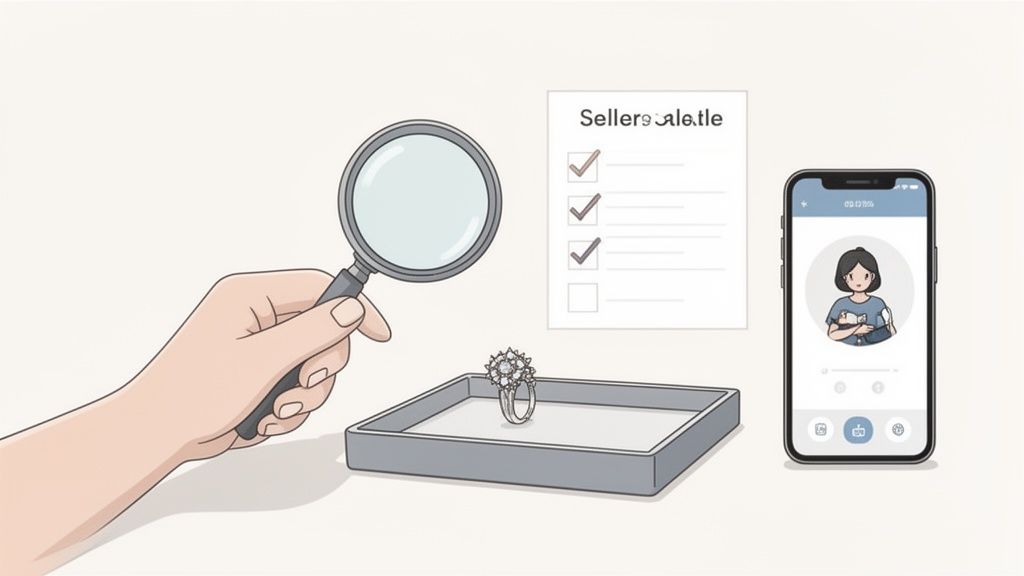
You've whittled down your list of potential handmade jewelry suppliers. Now comes the critical part: vetting. This is where you separate the true partners from the potential headaches. Think of it less as an interrogation and more as a methodical process to build confidence that you're sourcing high-quality goods. A great supplier relationship is built on trust, and that trust begins with solid verification.
You need to be sure they can deliver the quality pieces your brand is built on, consistently and without drama.
Start with a Digital Deep Dive
Before a single dollar changes hands, it's time to play detective. The first clues about a supplier's quality and professionalism are all over their digital footprint. You just have to know where to look.
Start with their product photography. Is it sharp, well-lit, and consistent across their entire catalog? If you see blurry photos or the same ring looking like a different shade of gold in three separate pictures, that's a huge red flag. A supplier who is proud of their quality invests in showing it off properly.
Drill down into their product descriptions. Vague terms like "metal alloy" or "gemstone" are lazy and unacceptable for a business sourcing high-quality items. You need concrete details.
- Material Composition: Is it 925 sterling silver or just silver-plated brass?
- Plating Thickness: High-quality suppliers will specify the micron thickness for their gold-plated pieces.
- Gemstone Details: Are they natural, lab-created, or just glass? What are the exact dimensions?
- Weight and Sizing: Precise measurements show a real attention to detail that often carries over into their craftsmanship.
Investigate Their Reputation and Social Proof
A supplier's history tells a story. Look for independent verification beyond their own slick website.
Of course, read the reviews and testimonials on their site, but don't stop there. Search for their name on third-party platforms if you can. Are you seeing patterns? A few glowing reviews are nice, but 20 businesses all praising the fast shipping and excellent finish? That’s what you want to see. Likewise, if multiple buyers complain about earrings tarnishing after a week, listen to them.
Check out their social media. An active, engaged profile is a sign of a healthy, breathing business.
- Engagement: Do they actually reply to comments and questions? Or is it a ghost town?
- Content: Are they showing behind-the-scenes shots of their process? This builds authenticity.
- Follower Quality: A quick scan can tell you if their audience is genuine or just a bunch of bots.
A supplier with a strong, positive online presence is actively managing their brand's reputation. This usually translates to better accountability and a higher standard of service because they have more to lose from unhappy customers.
Don’t be shy about asking for references from other businesses they work with. A supplier who stands by their quality will have no problem connecting you with a few happy clients.
The All-Important Sample Order
Digital research gets you in the ballpark, but you can't truly know the quality until you hold it in your hands. Ordering samples is the single most important step in this entire process. It’s your chance to see, touch, and test everything for yourself.
Don’t just order your one favorite design. Be strategic. Get a small but diverse selection of jewelry and fashion accessories—a ring, a necklace with a clasp, a pair of earrings. This lets you assess their consistency across different types of products.
What to Test in Your Sample Order:
- Workmanship and Finish: Get the piece under a bright light. Look for clean solder joints and secure stone settings. Are there any scratches, tool marks, or rough edges?
- Material Authenticity: Does that "sterling silver" have the right weight and feel? Does the gold plating look rich, or is it thin and brassy? Wear a plated piece for a few days straight—see if it holds up.
- Durability: Gently tug on the chain. Open and close the clasp 10 times. Do the earring posts feel sturdy or like they could bend in a heartbeat? A weak clasp is a classic sign of cutting corners on quality.
- Packaging and Presentation: How did it arrive? Thrown in a flimsy bag, or secured in a box to prevent damage? This small detail says a lot about their overall standards.
As you go through this, pay close attention to their communication. How fast and how clearly do they answer your questions? Vague responses or long delays now will only get worse when you have a real issue. For retailers thinking about creating their own unique line, it's also worth understanding the specifics of vetting private label jewelry manufacturers as part of this process.
Negotiating Terms Without the Stress
You've found a supplier and the sample quality is fantastic. Now comes the part that makes a lot of business owners nervous: talking money. But negotiating isn't about haggling; it’s about finding an affordable price that works for your business. It's a completely normal, expected step in building a healthy business relationship.
Think of it as finding a sweet spot where both you and your supplier can build a profitable, long-term partnership. Getting these terms right from the start is what protects your profit margins and sets your business up for success. A little preparation and a confident, professional approach go a long way.
Talking Price and Building a Partnership
The goal here is simple: get the best possible affordable price without compromising the high quality you just verified. The good news is that most handmade suppliers have some flexibility, especially for business partners who show potential for repeat orders.
The key is how you start the conversation. Instead of coming in with a hard demand for a discount, frame it as an exploration of a partnership. You want to sound like a serious business buyer who's in it for the long haul, not a one-time bargain hunter.
A great way to open the door is by leading with genuine praise.
Pro Tip: Try an opener like this in your email:
"Hi [Supplier Name],
We were absolutely blown away by the sample quality—the craftsmanship is exactly what our customers will love. As we map out our first big order, could you walk us through your pricing tiers for business partners? We’re a growing business looking to build a long-term relationship with consistent, regular orders."
See the difference? This positions you as a valuable future partner and naturally opens up a discussion about volume discounts or other incentives to make sourcing more affordable.
Tackling Minimum Order Quantities (MOQs)
For a small business or boutique, a high Minimum Order Quantity (MOQ) can feel like a brick wall. Tying up a huge chunk of your cash in a new, unproven product line is a massive risk. But don't assume the listed MOQ is set in stone.
If a supplier's minimums are out of reach, don't just give up. Propose a smaller, paid trial order. It's a reasonable request that shows you're a serious business but also smart about your inventory risk.
You could say something along the lines of:
"Your MOQ of 200 units is a little more than we can start with for a brand new collection. To get things moving and test these high-quality designs with our audience, would you consider an initial trial order of 50 units? If the launch goes as well as we expect, we'd be ready to place a much larger reorder that easily meets your standard MOQ."
This is a win-win. Your business gets to test the market with less risk, and the supplier gets their foot in the door with a promising new client. Most will see the long-term value and agree.
Moving Beyond Old-School Payment Terms
Don't forget to talk about payment terms! This conversation directly impacts your cash flow, which is the lifeblood of your business. The classic 50% up front and 50% on completion is still common, but it’s not your only option.
Asking about more modern, flexible arrangements can free up capital your business needs for marketing, new photography, or other growth initiatives. It's a standard business practice, so don't be shy about bringing it up.
Here are a few modern options to ask about:
- Net 30/60 Terms: This is a game-changer. It means you have 30 or 60 days to pay the invoice after you receive the goods. This gives your business a window to actually sell some of the jewelry before the bill is due.
- Buy-Now-Pay-Later (BNPL) for B2B: Wholesale is catching up to consumer trends. Ask if they work with B2B financing platforms that let you split a large invoice into smaller, often interest-free installments.
Bringing these options to the table shows you're a savvy, forward-thinking business owner. It’s one more way to build a professional, mutually beneficial partnership that’s built to last.
Finalizing Your Partnership and Managing Logistics
You’ve done the hard work of vetting and negotiating, and now you’re on the home stretch. This is where you shift from being a potential buyer to becoming a genuine business partner. It’s all about formalizing your relationship and nailing down the critical details of logistics and compliance. Getting this part right is what builds a smooth, predictable supply chain that protects both your investment and your brand's reputation for high quality.
This final stage is less about haggling and more about clear documentation and communication. You’re essentially setting the ground rules for how you'll work together—from how an order gets from their workshop to your business, to what happens if something goes wrong. This isn't just bureaucratic paperwork; it's the very foundation of a resilient, professional relationship with your new supplier.
Decoding Shipping and Customs
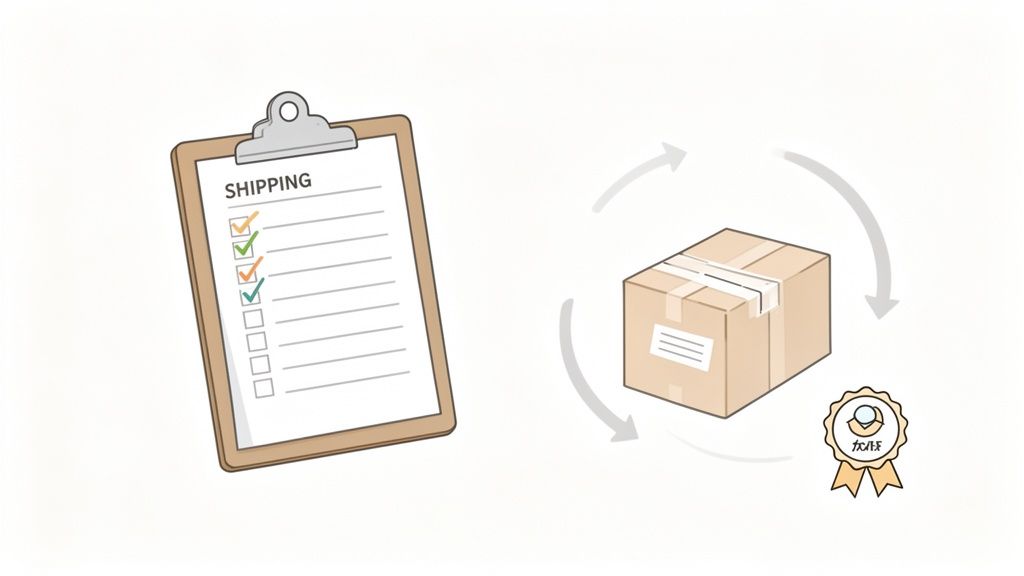
One of the biggest pitfalls for businesses is getting hit with surprise shipping costs, especially when sourcing internationally. Before you commit to your first large order, you need absolute clarity on the entire process. Otherwise, you risk watching your profit margins evaporate, making your products less affordable.
Start by confirming the Incoterms (International Commercial Terms) with your supplier. It sounds technical, but it’s just a set of rules that defines who is responsible for the shipment at every stage. For most businesses, the gold standard is DDP (Delivered Duty Paid). This means the supplier handles everything—shipping, insurance, and import duties—right to your doorstep. If they don't offer DDP, you need a crystal-clear breakdown of who pays for what, and when.
Make sure you also iron out these specifics:
- Preferred Carriers: Which companies do they use? Whether it's DHL, FedEx, or a local carrier, this directly impacts delivery speed, cost, and reliability.
- Tracking Information: This is non-negotiable. You must get a tracking number as soon as the order ships to manage your inventory and customer expectations.
- Insurance: Is the shipment insured against loss or damage? If it's not standard, find out what it costs to add it. It's usually worth it.
- Customs Paperwork: An experienced supplier will know how to handle this seamlessly. They should provide the correct HS (Harmonized System) codes for jewelry to ensure a smooth customs clearance process without delays.
Getting these details documented upfront is your best defense against confusion and hidden fees.
Establishing Clear Return and Damage Policies
Even with the best partners, things can go wrong. A clasp might be faulty, a stone could come loose in transit, or you might simply receive the wrong design. A truly professional supplier will have a clear, fair process for fixing these problems. Your job is to understand that process before you ever need to use it.
And get it in writing. A verbal agreement just won't cut it when there's an issue with product quality.
A strong return policy isn't just about getting a refund; it's a direct reflection of a supplier's confidence in their own quality and their commitment to their business partners. A supplier who makes returns difficult is often a supplier who cuts corners elsewhere.
Your returns checklist should cover these key points:
- Timeframe: How many days does your business have to inspect the order and report issues? A 7-14 day window upon receipt is a reasonable standard.
- Proof of Damage: What do they need from you? Usually, clear photos or a quick video of the damaged item will do the trick.
- Resolution Options: Will they offer a replacement, a credit toward your next order, or a full refund for defective items?
- Return Shipping: If a product needs to be sent back, who pays for the shipping? For defective, low-quality goods, it should be the supplier.
Protecting your investment means having a plan for when things aren't perfect. This policy is that plan.
Ensuring Compliance and Quality Control
When you're selling accessories that come into direct contact with skin, compliance isn't just a box to check—it's a critical step that protects your business and your customers. Certifications aren't just fancy logos; they're proof that a supplier meets global standards for quality and safety.
Try to find suppliers who work with third-party inspection services like SGS. An SGS certification, for instance, verifies that a manufacturer’s processes and products meet internationally accepted standards. It's a powerful signal that you're dealing with a reliable, quality-focused partner for your business.
Beyond formal certifications, your business should establish its own quality control (QC) expectations. This can be as simple as a shared document outlining your standards for things like plating thickness, clasp functionality, or acceptable variations in the finish. A good partner will welcome this kind of clarity. As you build these relationships, remember that understanding essential vendor relationship management best practices is the key to fostering successful long-term partnerships.
Onboarding Your New Supplier
With all the details sorted, it's time to make it official. A simple onboarding process can formalize everything and prevent misunderstandings down the road. Just create a shared document or folder that acts as a single source of truth for your new business partnership.
Your onboarding guide should include:
- Contact Information: Names, emails, and phone numbers for your primary contacts.
- Agreed Terms: A summary of the final pricing, MOQs, and payment terms.
- Logistics Plan: The shipping, returns, and customs details you just finalized.
- Quality Standards: Your QC checklist and a record of any relevant certifications.
- Ordering Process: Step-by-step instructions on how to place an order, expected lead times, and communication protocols.
This simple act of organization sets a professional tone from day one and ensures both you and your supplier are perfectly aligned as you kick off what will hopefully be a profitable and lasting partnership for your business.
Common Questions About Sourcing Handmade Jewelry
Even the most well-laid business plans hit a few bumps. When you're dealing with handmade jewelry suppliers, questions and challenges are just part of the process. From making sure quality stays consistent to figuring out how to handle order minimums, let's tackle some of the most common hurdles businesses face.
How Do I Ensure Consistent Quality with Handmade Jewelry Orders?
This is the big one. The very word "handmade" means there will be slight variations, which is part of the charm. But your business still needs a baseline of quality your customers can count on. It all comes down to setting clear standards and having a solid verification process.
It starts with the sample order. Don't just order one of each item you're interested in. Instead, order three or four of the exact same piece. This is the only way to see the natural variation in their work. Are the sizes, colors, and finishes all within a range your business is comfortable with?
If the samples look good, the next step is to create a simple Quality Assurance (QA) sheet with your supplier. This is just a checklist that makes sure your businesses are on the same page.
- Acceptable Tolerances: Spell out how much wiggle room is okay for size, color, or finish.
- Material Specs: Double-confirm that every piece will use the agreed-upon high-quality materials (e.g., 925 sterling silver, specific plating thickness).
- Key Checkpoints: List your non-negotiables, like making sure clasps work smoothly or that stones are set securely.
For any significant commitment, I always recommend placing a small batch order after the samples. Think of it as your final real-world test for quality consistency before you go all in. You can also lean on platforms that work with pre-vetted, SGS-certified manufacturers, as they've already done much of this auditing work for you.
What Can a Small Business Do About High MOQs?
High Minimum Order Quantities (MOQs) can feel like a brick wall for small businesses. It’s a classic Catch-22: you need the stock to make sales, but you can’t afford to sink all your cash into one style that might not sell. The good news is, your business has options.
First off, always try to negotiate. You'd be surprised how many suppliers are more flexible than their listed terms suggest, especially if they see potential in a new business partnership. Just be professional about it. Explain that you're testing high-quality new products and propose a smaller trial run.
Another fantastic strategy is to actively seek out suppliers who have no MOQ policies. This is a total game-changer for managing inventory and sourcing affordably, letting your business test a dozen different styles with very little financial risk. It's also worth asking if the supplier will let you meet the MOQ by mixing and matching different products instead of buying a huge quantity of a single item.
The goal is to minimize your business's risk while you gather real sales data. A supplier who's in it for the long haul will often work with you on a smaller initial order to build that relationship.
How Do I Manage International Shipping and Import Duties?
Getting products from overseas can sound complicated, but it's really just a matter of getting all the information upfront so your business can source affordably. You want to avoid any nasty, expensive surprises when your package is waiting at customs.
Start by confirming the shipping terms, often called Incoterms, so it’s crystal clear who is paying for what. Any experienced supplier should be able to give you the Harmonized System (HS) code for jewelry. This is a universal code that customs officials use to determine the import duty rate you'll have to pay.
To make your life infinitely easier, look for suppliers who offer 'Delivered Duty Paid' (DDP) shipping. This is the gold standard for businesses. It means every single cost—shipping, insurance, and import fees—is bundled into the price you pay upfront. You pay once, and the goods show up at your door. No extra math, no surprise bills.
What Is the Real Difference Between an Artisan and a B2B Platform?
Choosing whether to work with an individual artisan or a B2B wholesale platform really comes down to what your business is trying to build and how fast you want to grow.
Sourcing directly from a maker on a site like Etsy can get you truly unique, often one-of-a-kind pieces. This is amazing for creating a powerful brand story. The main drawback here is scalability. An artisan working solo can only produce so much.
On the other hand, a B2B wholesale platform is built for business efficiency and growth. It gives you access to a huge, curated catalog of high-quality jewelry and fashion accessories from multiple vetted factories. You get affordable, factory-direct pricing, built-in quality control, and the ability to reliably reorder your bestsellers. It’s the go-to choice for businesses that are focused on scaling up, maximizing profitability, and building a dependable supply chain.
Ready to find high-quality, affordable jewelry for your business without the stress of high MOQs? At JewelryBuyDirect, we offer over 120,000 on-trend styles with no minimums, factory-direct pricing, and free worldwide shipping on orders over $150. Explore our wholesale catalog today!