






Arthur Lynch | Mon Jan 19 2026
Finding High-Quality, Affordable Dropshippers for Jewelry
Finding the right dropshippers for jewelry isn't just about sourcing products—it's about finding a business partner who can deliver high-quality, affordable pieces that will define your brand. You need a supplier who provides beautiful, well-made jewelry and fashion accessories at a price that protects your margins, all while delivering a reliable experience for your customers. This guide is your roadmap to sourcing that perfect inventory and setting your business up for success.
The Challenge of Sourcing High-Quality, Affordable Jewelry
The online jewelry market is booming, which is fantastic news for entrepreneurs. But with that opportunity comes a huge hurdle: sifting through countless suppliers to find genuinely reliable dropshippers who offer quality products at a fair price. It's a common story for new business owners to get stuck with partners who deliver subpar, cheap-feeling accessories and offer terrible service.
This kind of partnership can torpedo your brand before it even gets off the ground, leading to a flood of customer complaints and tanking your reputation.
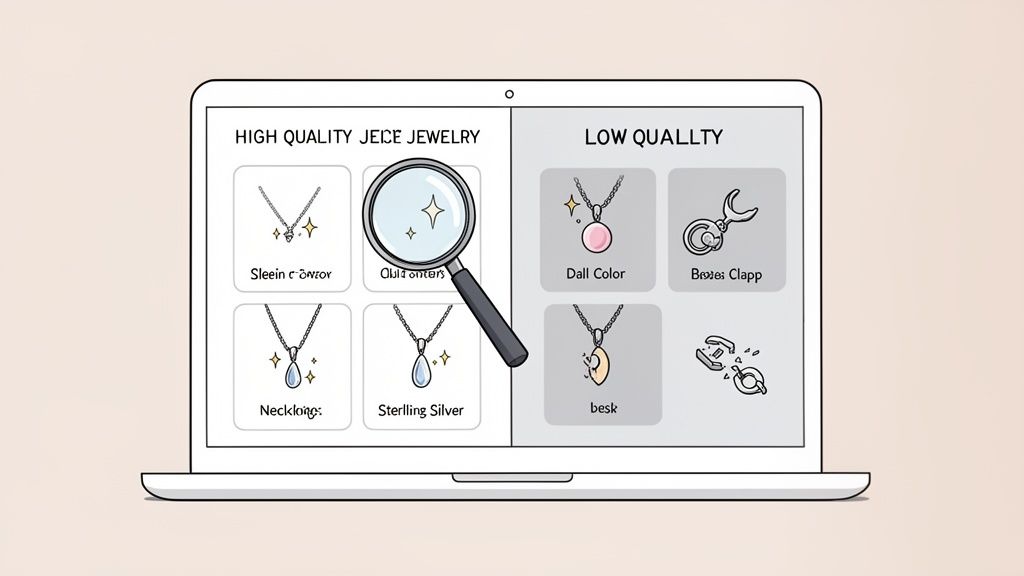
We're here to help you cut through that clutter. I'm going to walk you through a practical, business-focused process for identifying, vetting, and partnering with top-tier jewelry suppliers who specialize in high-quality yet affordable pieces. Forget the generic advice—these are the strategies that actually work to build a profitable brand founded on a trustworthy supply chain.
Understanding The Market Opportunity
Let's look at the numbers for a second, because they really drive home why sourcing the right quality at the right price is so critical. The global online jewelry market hit a massive $105.6 billion in 2024, and it's on track to reach an incredible $166 billion by 2029. That explosive growth shows a huge shift in how people buy jewelry, with online stores taking center stage.
For a dropshipping business, a solid supply chain is everything. You aren't touching the product, so your supplier's performance is your customer's experience.
A great dropshipping partner doesn't just ship boxes; they're an extension of your brand. Their quality is your quality. Their reliability is your reliability. Sourcing cheap, low-grade jewelry might seem like a win for affordability, but it’s a short-term play that rarely builds a sustainable, profitable business. The key is finding the sweet spot between quality and price.
Why Quality And Presentation Matter for Your Business
Without a physical store, the only things shaping your customer's perception of value are your website and the product that shows up at their door. High-quality jewelry not only looks better and lasts longer, but it also justifies a better price point. That means healthier margins for your business and much happier customers who feel they got great value.
But the physical product is only half the battle. Your online presentation has to do the heavy lifting. This is where professional photos and videos become non-negotiable. They need to be sharp, clear, and accurately show off the materials, size, and sparkle of every single piece. If you want to learn more about this, check out this great resource on the importance of high-quality media for digital advertising.
Ultimately, when you get your sourcing right, you're not just selling an accessory—you're selling confidence and value. By ensuring your jewelry and fashion accessories meet a high standard of quality at an affordable price, you build the kind of trust that leads to repeat business and glowing reviews. That’s the real foundation of a thriving ecommerce brand.
Where to Find Your Perfect Jewelry Partner
Knowing you need a great dropshipping partner is the easy part. Actually finding one that balances quality and affordability? That's a whole different game. If your strategy is just typing "jewelry dropshipper" into Google, you're going to drown in a sea of questionable results.
The secret is knowing where to look from the get-go. Instead of relying on a single source, which is always a risky move for a business, you need to explore a few key channels. This approach helps you build a solid pipeline of potential partners, from established veterans to hidden gems.
Dedicated B2B Sourcing Platforms
Your first and most direct stop should be dedicated B2B platforms. These aren't sprawling consumer marketplaces like Amazon or Etsy; they are curated ecosystems built specifically for businesses to connect with suppliers. Think of them as a pre-vetted talent pool for your store, focused on wholesale and dropshipping.
These platforms are great because they often handle a lot of the initial legwork for you. They usually have verified supplier profiles, quality control measures, and sometimes even direct integration with ecommerce platforms like Shopify. This lets you quickly filter down the options based on what truly matters for your business:
- Material Specialization: Is the supplier focused on quality materials like 925 sterling silver, stainless steel, or the gold-plated items you want to sell?
- Minimum Order Quantity (MOQ): For dropshipping, you absolutely need suppliers with no MOQ.
- Location: Filtering by country or region can help you manage shipping times and costs right from the start.
Using these filters turns an overwhelming list into a manageable shortlist of real contenders. If you're just starting your business, getting familiar with these platforms is a fantastic first step. You can get a better sense of the landscape by checking out our guide on where to buy wholesale jewelry.
Curated Supplier Directories
Next up are the big supplier directories, like SaleHoo or Worldwide Brands. These are essentially massive, curated databases of pre-screened wholesalers, manufacturers, and dropshippers. They don't offer the slick, built-in integration of B2B platforms, but their value is in the sheer volume and variety of suppliers they list.
On one hand, you get access to tons of options, including niche suppliers you might never find otherwise. On the other hand, you have to do more of the vetting yourself. A directory hands you a contact list, but it's on you to reach out and build that business relationship from scratch.
This is a space worth exploring, especially given the market's trajectory. Jewelry and watches made up 282,333 dropshipped products on Shopify alone back in 2021, and the broader fashion accessories category accounts for a massive 30% of the entire dropshipping market. You can find more on these dropshipping statistics and market trends to see just how big the opportunity is.
Pro Tip: Your search query is your most powerful tool. Don't just search for "jewelry dropshipper." Get specific. Use business-focused, long-tail phrases like "sterling silver wholesale no MOQ" or "private label fashion accessories USA" to cut through the noise and find partners who are a perfect fit for your brand's quality and price point.
Professional Networks and Virtual Trade Shows
Finally, don’t underestimate the power of professional networking, even if it's online. LinkedIn can be a goldmine for finding jewelry dropshippers. Look up jewelry manufacturers or wholesalers and check their company pages for any mention of dropshipping programs. Even better, connect directly with their sales managers or business development reps. A personal connection can go a long way in business.
Virtual trade shows have also become a fantastic resource. These online events let you "walk" digital booths, browse catalogs, and chat with supplier reps in real-time—all without the expense and hassle of travel. It's an incredibly efficient way to make business connections and see what's new in high-quality, affordable jewelry and fashion accessories.
By combining these methods—platforms for speed, directories for variety, and networking for those exclusive opportunities—you build a sourcing strategy that’s both deep and wide. This ensures you’re not just finding a supplier, but the right supplier to build a profitable and respected business.
Your Vetting Checklist for High-Quality Suppliers
A stunning website and professional product photos are just the starting point. If you want to find reliable dropshippers for jewelry, you have to look past the pretty pictures and dig into the operational details that determine both quality and affordability. A systematic vetting process is your best defense against sourcing subpar products and facing logistical headaches.
This isn't about finding a "perfect" supplier—they don't exist. It's about finding the right business partner whose strengths and processes align with your goals for quality and profit. This turns sourcing from a shot in the dark into a data-driven decision, ensuring the jewelry you offer is something your business can be proud of.
This visual gives you a bird's-eye view of the entire process, from initial discovery to the final vetting stage.
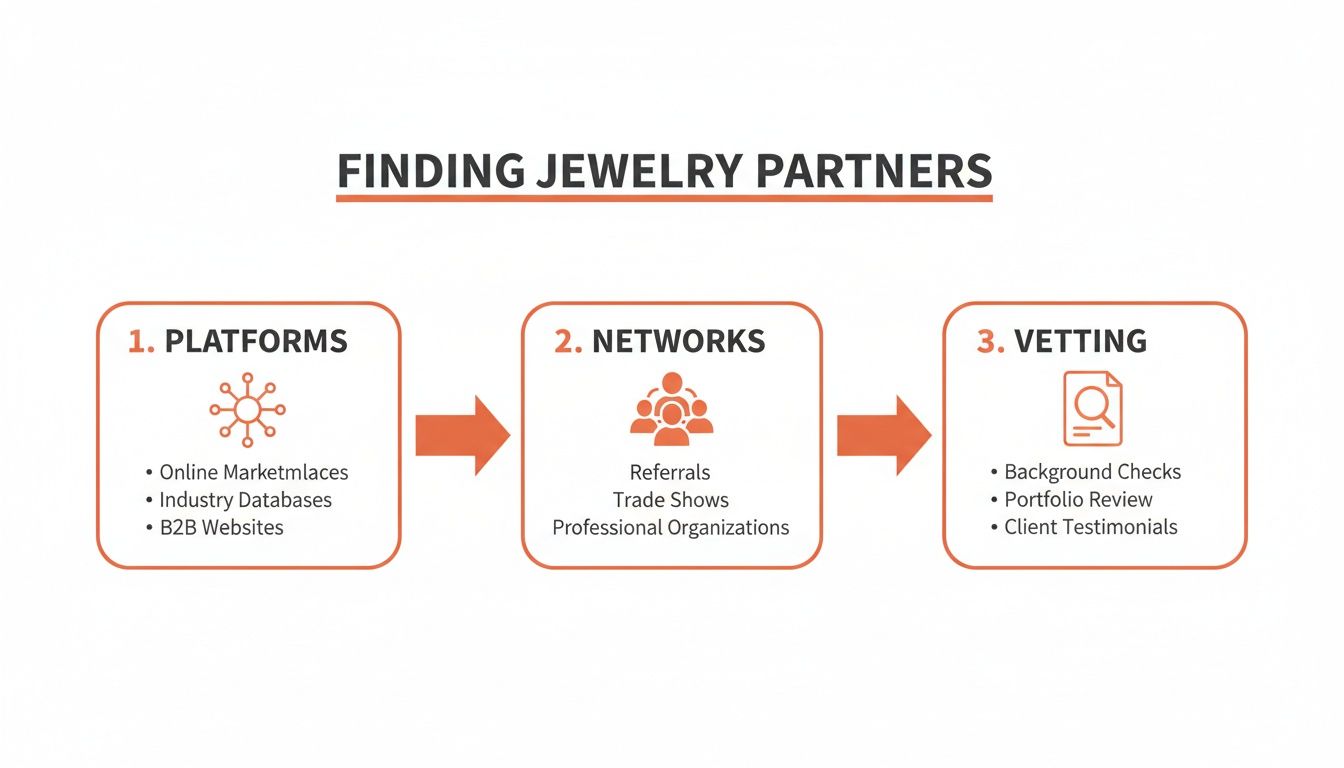
The idea is to start broad with platforms and networks, then systematically narrow down your options until you find a partner you can truly trust to deliver quality goods for your business.
Evaluating Product Quality and Material Integrity
First things first: the jewelry itself. Your business's reputation is on the line with every piece you sell, and in dropshipping, you're placing that reputation squarely in your supplier's hands. You absolutely cannot take their word on quality—you have to verify everything.
Start with their product descriptions. Are they specific? A supplier listing a necklace as just "gold" is a lot less credible than one who details it as "18k gold-plated over 925 sterling silver." That level of detail shows they know their product and are confident in its quality.
Key Takeaway: Vague material descriptions are a massive red flag. If a supplier can't—or won't—tell you exactly what their jewelry is made of, it's usually because it's a cheap alloy that will tarnish or cause skin irritation, destroying your brand's credibility.
To properly vet potential partners, you need to understand every tool at their disposal. It helps to review some examples of the detailed features of dropshipping platforms to know what to look for.
Shipping, Fulfillment, and Logistics
Even the most gorgeous piece of jewelry is worthless to a customer if it arrives late, damaged, or with no tracking. Your supplier's logistics are your logistics, period. Before you commit to a business partnership, you need crystal-clear answers about their entire fulfillment workflow.
Don't be shy—ask direct questions and expect specific answers:
- Order Processing Time: How long does it take them to get an order out the door after it's placed? A solid benchmark is 24-48 hours. Anything more than that and you'll start hearing from antsy customers.
- Shipping Carriers and Times: Who do they ship with? What are the realistic delivery times to your main markets? Reliable, end-to-end tracking is non-negotiable for a professional business.
- Packaging: How does the jewelry arrive? Is it in a branded box, a simple pouch, or a cheap plastic bag? The unboxing is a huge part of the customer experience and perceived value.
If a potential partner gets defensive or vague about these details, it's time to move on. A professional operation has these systems dialed in and will be happy to show them off.
Unpacking the True Cost and Pricing Structure
The wholesale price of an item is just one part of the equation. Hidden fees can sneak up and devour your profit margins, turning what looked like a great deal into a money pit. You need a complete breakdown of all costs before signing anything to ensure you can price your products for profit.
Make sure you get clarity on these points to understand your true cost per order:
- Per-Order Fees: Do they charge a handling or dropshipping fee on top of the product cost for every single order?
- Subscription Costs: Is their service part of a platform that requires a monthly or annual subscription?
- Return Policies: Who eats the shipping cost for returns and exchanges? If it's on your business, that has to be factored into your pricing.
A transparent partner will have no problem providing an itemized list of all potential charges. For a deeper dive into how these costs fit into your overall business model, our guide on how to buy wholesale jewelry can provide some extra context.
To keep your evaluations objective, I highly recommend using a simple scorecard. It forces you to compare suppliers on the same metrics, taking emotion out of the equation.
Supplier Vetting Scorecard
| Vetting Criteria | Supplier A Score (1-5) | Supplier B Score (1-5) | Supplier C Score (1-5) | Notes & Red Flags |
|---|---|---|---|---|
| Product Quality (Sample) | 4 | 5 | 2 | Supplier C sample felt cheap, plating was thin. |
| Material Transparency | 5 | 5 | 3 | Supplier C was vague about silver purity. |
| Processing Time (Claimed vs Actual) | 5 (24h) | 4 (48h) | 3 (72h+) | Supplier B was a bit slow; C was unacceptable. |
| Shipping & Tracking | 5 | 4 | 4 | All provided tracking, but A was fastest. |
| Packaging Experience | 4 | 5 | 2 | Supplier B had premium boxes; C used plastic bags. |
| Pricing & Fee Structure | 4 | 3 | 5 | C was cheapest but had hidden handling fees. |
| Communication & Support | 5 | 4 | 2 | Supplier C support was slow and unhelpful. |
| TOTAL SCORE | 32 | 29 | 21 |
This kind of side-by-side comparison makes the best choice for your business obvious. It’s not just about the highest score, but about seeing where each supplier's strengths in quality and affordability lie.
The Litmus Test: Ordering Samples
You can read reviews and analyze data all day, but nothing beats holding the product in your hands. Ordering samples is the single most important step in this entire process. It’s your chance to assess the quality-to-price ratio and experience everything your customer will—from product feel to shipping speed and packaging.
When the samples arrive, put on your most critical customer hat. Check for these things:
- Clasp and Finding Strength: Do the clasps feel sturdy and secure? Are earring backs tight? This indicates quality manufacturing.
- Plating Durability: Give the item a gentle rub with a soft cloth. Does any of the plating flake, or does the color rub off?
- Weight and Feel: Does the piece have a nice heft, suggesting quality materials, or does it feel flimsy and cheap?
- Accuracy: How does the real thing compare to the professional photos on their website? Look for discrepancies in color, size, and detail.
This hands-on test is the ultimate proof. It takes your evaluation from theoretical to tangible and gives you the confidence you need to move forward with a partner who actually meets your standards for high-quality, affordable jewelry.
Building a Partnership That Actually Works
You've done the hard work of vetting potential partners. Now, it's time to shift gears from evaluator to collaborator. Finding great dropshippers for jewelry is a huge step, but the real magic—and profit—comes from forging a solid professional relationship. It all starts with that first email.
Think about it from the supplier's perspective. They get flooded with dozens of generic, low-effort messages daily. To them, most inquiries look the same. Your first contact is your chance to immediately stand out and prove you're a serious business owner, not just another window shopper.
Crafting a Professional First Contact
The goal here isn’t just to get a price list; it's to open a real business conversation and position yourself as a partner they want to work with. A well-crafted message shows you've done your homework and you're ready to build something real.
Start by introducing your business and what makes it unique. Don't just say you sell jewelry—explain your niche (e.g., "affordable, high-quality fashion accessories for young professionals"). Then, tell them why you chose them. Did their focus on sterling silver at a great price point catch your eye? Do you love their minimalist designs? Specific compliments show genuine interest.
Your initial outreach should hit these key points:
- Who You Are: A quick intro to your business and your target customer.
- Proof of Research: Mention a specific product line of theirs you admire.
- Your Potential: Briefly touch on your marketing plans or where you'll be selling (e.g., your Shopify store, Instagram, etc.).
- Clear Next Steps: Ask about their dropshipping program, how to open a business account, and if there's a specific person you'll be working with.
This approach instantly signals that you're organized, strategic, and ready to do business. It puts you in a different league from the competition.
Negotiating Terms and Clarifying Policies
Once you’ve started a dialogue, it’s time to get into the details. This is where you lay the groundwork for a profitable partnership by getting crystal clear on pricing, policies, and what to expect. A frank conversation now will save you from massive headaches down the road.
Pricing is the obvious place to start. You might not have the sales volume to command big discounts right away, but you should absolutely ask about their pricing tiers. Frame the question around your future growth.
Pro Tip: Try using this phrase: "As we scale our marketing efforts, what kind of sales volume would our business need to reach to qualify for your next pricing tier?" This shows you're thinking long-term and are serious about growth.
Beyond the numbers, you absolutely must clarify their operational policies. The two most important areas are returns and damaged goods. Get the exact process. Will they send a return label for a defective product? What kind of photo evidence do they need if an item arrives broken? Your store's return policy needs to be perfectly aligned with theirs from day one—this is non-negotiable for protecting your business's margins and reputation.
Setting Clear Expectations for a Smooth Workflow
A great partnership runs on clear, mutual expectations. Before you list a single piece of their jewelry, you both need to agree on how the day-to-day will function. This means setting standards for communication and order fulfillment.
Find out who your main point of contact is and ask about their typical response time. Knowing you can get an answer within 24 hours for an urgent customer issue is incredibly valuable for a business. In the same vein, get a firm commitment on their order processing time. A top-tier supplier should be able to get an order out the door within 24-48 business hours.
Here's a sample snippet you can adapt for your own email:
"To ensure we can provide a great experience for our customers, could you confirm your standard order processing timeline? We'd love to promise a 'ships within 24 hours' timeframe on our site. Also, what's the best way to flag an urgent order inquiry to make sure our business can get timely updates?"
This kind of proactive communication sets a professional tone from the start and makes sure there are no surprises when the orders start flowing. By defining these terms upfront, you’re not just finding a supplier—you’re building a reliable and profitable business relationship for the long haul.
Scaling Your Jewelry Dropshipping Operations
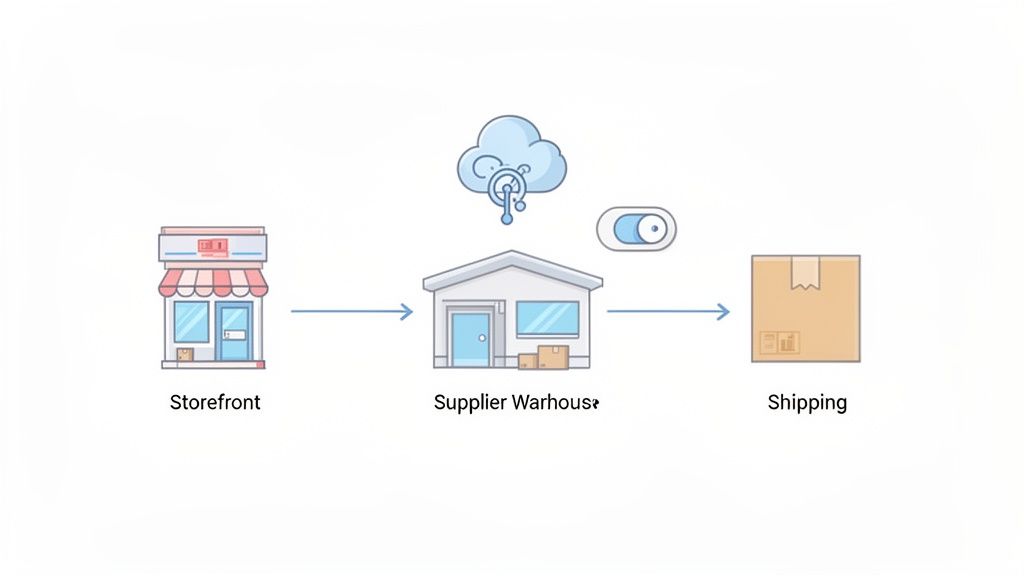
You’ve found a solid partner. Now the real work begins. It’s time to shift your focus from finding suppliers to building a smooth, scalable operational engine for your business. This is all about connecting the dots between your supplier’s warehouse and your customer’s checkout cart, creating a system that handles everything from orders to inventory without constant hand-holding. A frictionless workflow is what separates a hobby store from a legitimate, growing brand.
Integrating Products Into Your Store
Getting your supplier's product catalog onto your site is one of the first technical challenges your business will face. There are really only two ways to go about this, and the one you choose will have a huge impact on your daily workload.
The old-school method is a manual CSV upload. Your supplier sends you a spreadsheet with all the product data—SKUs, titles, descriptions, prices, image links—and you manually import it into your e-commerce platform, whether that's Shopify or WooCommerce. This works fine if you’re only listing a handful of items, but it quickly becomes a tedious, error-prone nightmare as you grow your business.
The far smarter approach is to use an automated integration app or API. Many modern suppliers have built dedicated apps that plug directly into your store. This puts product imports, description updates, and—most critically—inventory management on autopilot.
Key Takeaway: Manual uploads might seem easy to start, but they don't scale. For any serious dropshipping business, automated syncing is the only way to go. It prevents overselling and frees up hundreds of hours you’d otherwise spend on mind-numbing data entry.
Mastering Inventory Synchronization
If there's one thing you absolutely have to get right in dropshipping, it's inventory synchronization. Nothing kills your brand's reputation faster than taking a customer’s money for a product that’s already out of stock. It's a classic rookie mistake that leads directly to canceled orders, angry customers, and a flood of negative reviews.
The only real solution here is a real-time inventory sync. When your supplier’s stock for a particular necklace drops to zero, your website needs to know immediately. This stops a customer from buying that last unit just moments after someone else snatched it up. A good supplier integration makes this process completely seamless, protecting your business's reputation and your bottom line.
Managing Shipping and Customer Expectations
When you're working with international suppliers, managing customer expectations around shipping is everything. Long delivery times are just part of the game for many dropshippers, but they don’t have to be a deal-breaker if you handle it with total transparency.
Be brutally honest about estimated shipping times. Put it on your product pages, at checkout, and in your order confirmation emails. Never promise two-day shipping if you know your supplier takes a week just to get the product out the door.
Here are a few things your business should be doing from day one:
- Send Tracking Numbers Proactively: The moment an order ships, get that tracking number to your customer. This single action provides massive peace of mind and drastically cuts down on "Where is my order?" support tickets.
- Create a Detailed Shipping Policy Page: Clearly outline your average processing and delivery windows for different countries. This page sets expectations and builds trust.
- Offer Tiered Shipping Options: If your supplier supports it, offer a standard (slower, cheaper) and an expedited (faster, more expensive) shipping option. Giving customers a choice puts them in control.
Getting these operational details right is critical because the opportunity is massive. The global jewelry market was valued at an astonishing $348 billion in 2025, and the United States consumes nearly a quarter of that. This insane demand, paired with the dropshipping model, is exactly why you need a rock-solid system to claim your piece of the pie. You can dig into these 2025 jewelry industry statistics and trends to see just how big this market really is.
Questions I Get All the Time About Finding Jewelry Dropshippers
Diving into jewelry dropshipping, especially when you're set on sourcing quality, affordable pieces, always brings up a ton of questions. Getting straight answers is the only way to make good business decisions and dodge the common mistakes that can sink a business before it even gets going.
Let's walk through some of the most common questions I hear from new jewelry entrepreneurs. These answers should help you build a much stronger foundation and start sourcing with real confidence.
What Jewelry Actually Sells and Makes a Profit?
It's so easy to get distracted by flashy, fast-moving trends, but the real money for your business is usually in consistency and perceived value. Think about timeless categories that offer high quality at an affordable price—things like 925 sterling silver necklaces, delicate gold-plated earrings, and durable stainless steel rings. These are always in demand, have a massive audience, and let you build in healthy profit margins without your customers feeling like they're overpaying.
A huge part of the jewelry market is driven by gifting, so focus on pieces that fit that need. A great pro-tip is to just go look at the "best-seller" sections on any supplier platform you're vetting. That's real data showing you what's already working. To make your life easier in the beginning, I'd also suggest steering clear of anything super fragile or oversized. It just simplifies your shipping and keeps damage rates down.
How Do I Handle Returns and Quality Issues?
This is a big one for any business, and you have to get it sorted out in your supplier agreement before a single sale happens. Any dropshipper worth partnering with will have a clear, fair policy for replacing or refunding items that show up damaged or have obvious factory defects. They'll almost always ask for a photo from your customer as proof, which is a standard and reasonable request.
But you have to draw a line between the supplier's responsibility and the customer's choice.
- Supplier Fault: This is on them. If an item is damaged, the wrong thing was sent, or it has a manufacturing flaw, the supplier should cover it.
- Customer Discretion: Things like "I just changed my mind" or "it's not what I expected" will almost always be your business's responsibility to handle.
Your public-facing return policy on your website must be a mirror image of your supplier's internal policy. If your supplier doesn't take back items for discretionary reasons but you promise that to your customers, your business is the one eating that cost.
Are There Hidden Costs I Should Be Looking For?
Oh, absolutely. The wholesale price you see for a piece of jewelry is just the starting line. A bunch of other costs can pop up and quietly chip away at your profit margins if you aren't paying attention. Always, always ask for a complete cost breakdown from any potential dropshippers for jewelry.
Here are the usual suspects to watch out for:
- Platform Subscription Fees: Many supplier directories or the apps that connect them to your store charge a monthly or annual fee.
- Per-Order Handling Fees: Some suppliers tack on a small fee for every single order they have to pick, pack, and ship. This is on top of the product and shipping costs.
- Payment Processing Fees: Your payment gateway, whether it's Shopify Payments or PayPal, is going to take a slice of every sale.
- Customs and Import Duties: If you're selling internationally, these taxes can be a nasty surprise for your customers. You need to clarify with your supplier who is responsible for them. It’s usually the customer, but you must state this clearly on your site to avoid angry emails and chargebacks.
Can I Actually Build a Real Brand by Dropshipping?
Yes, and you'd be crazy not to. Your brand is so much more than the products you sell. It's the story you tell, the specific collection of high-quality, affordable pieces you curate, and the entire feeling a customer gets when they interact with your business. Dropshipping is just the fulfillment engine—it doesn't limit your brand's potential one bit.
To build a brand that stands out, you need a unique identity. Don't fall into the trap of trying to sell a little of everything to everyone. Instead, curate a collection around a very specific vibe—maybe minimalist designs, bohemian styles, or fashion accessories made from sustainable materials. Pour your energy into creating unique marketing content and providing personal, memorable customer service.
Some dropshippers are even starting to offer custom packaging or private labeling, which is a game-changer for branding. But even if yours doesn't, your website's design, the personality in your emails, and the quality of your curated collection are what will ultimately set your business apart and earn you a loyal following.
Ready to source high-quality jewelry with confidence? JewelryBuyDirect offers over 120,000 styles with factory-direct pricing, no minimum orders, and reliable global shipping. Start building your dream jewelry business today by exploring our catalog.