






Arthur Lynch | Fri Aug 15 2025
Where to Buy Wholesale Jewelry: An Actionable Guide
Finding the right wholesale jewelry supplier is the bedrock of a successful retail business. Your options are vast, stretching from massive online B2B marketplaces to exclusive international trade shows. The best path for you boils down to your business model, budget, and the specific inventory you want to build. This guide provides actionable insights on where and how to source jewelry that aligns with global trends and your brand's unique vision.
Where to Actually Find Wholesale Jewelry
Knowing where to start looking is half the battle in building a profitable inventory your customers will love. The global wholesale market can feel complex, but it can be broken down into a few key channels. Each option has unique perks, whether you're after the convenience of online platforms or the exclusive finds at industry-only events. Understanding these differences is crucial for making smart, strategic sourcing decisions.
The global jewelry wholesale market is a vast network spanning 195 countries, including trade agents and manufacturing distributors. This scale alone highlights the immense opportunity for retailers who know where to look.
Getting to Know Your Sourcing Channels
Your sourcing journey starts with picking the method that fits your brand. Let's dig into the main avenues you can explore.
- Online B2B Marketplaces: Giants like Faire or Alibaba are goldmines for new businesses or anyone wanting to test a product line. How to buy: Create an account, use specific keywords like "gold vermeil hoops" or "boho beaded necklace," filter by supplier location and rating, and start with small test orders.
- Direct from Manufacturers: Best for established brands, going straight to the source offers the best pricing and customization. How to buy: Identify manufacturers in your niche through trade directories or online searches. You'll need to contact them directly with a professional inquiry, including your business license and projected order volume, to request a catalog and pricing.
- Trade Shows: Events like JCK Las Vegas are invaluable for networking and seeing products firsthand. How to buy: Register for the event in advance (they are industry-only), plan your visit by reviewing the exhibitor list, and be prepared to place orders on-site for future delivery.
- Local Wholesalers: Don't overlook suppliers in your own backyard for convenience and faster shipping. How to buy: Search for "jewelry wholesale district [your city]" or visit local jewelry marts. This allows for in-person inspection and immediate purchasing, ideal for quick restocking.
As you can see, necklaces often carry a higher wholesale price point. This is crucial information to have when you're planning your budget and figuring out your retail markups.
Wholesale Jewelry Sourcing Channels at a Glance
To make it even clearer, let's compare these options side-by-side. Every business has different needs, and this table can help you quickly pinpoint which channel aligns best with your goals.
| Sourcing Channel | Best For | Pros | Cons |
|---|---|---|---|
| Online B2B Marketplaces | New businesses, testing products, wide variety seekers. | Huge selection, competitive prices, easy to browse and compare. | Quality can be inconsistent, less personal connection with the supplier. |
| Direct from Manufacturers | Established brands with high order volumes. | Best pricing, customization options, direct relationship. | High minimum order quantities (MOQs), longer lead times. |
| Trade Shows | Networking, discovering new trends, and quality assessment. | See products in person, build relationships, find unique designers. | Travel costs, can be overwhelming, orders placed far in advance. |
| Local Wholesalers | Quick restocking, smaller orders, supporting local economy. | Fast shipping, low or no MOQs, easy communication. | Limited selection, potentially higher prices than direct sourcing. |
Ultimately, choosing the right channel—or even a mix of them—comes down to what you're trying to achieve. You can dive even deeper into this with our detailed guide on sourcing wholesale jewelry for boutiques.
Finding Your Niche in the Global Jewelry Market
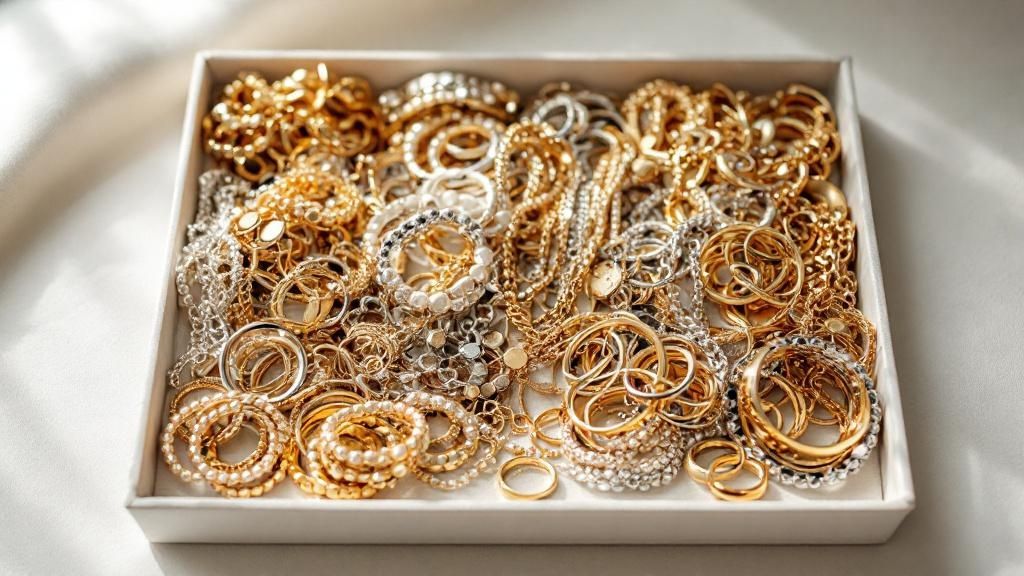
Every jewelry brand has its own unique personality. Your sourcing strategy should be a direct reflection of that. Finding where to buy wholesale jewelry isn't just about tracking down a supplier; it’s about finding the right partner in a part of the world that aligns with your brand's aesthetic and your customers' tastes.
The world is a massive marketplace, and different regions have carved out their own specialties. Knowing this global landscape is your first step toward building a collection that truly stands out, giving you a strategic edge to curate an inventory that feels authentic and exciting.
Exploring Key Sourcing Hubs
You'll save time and money by zeroing in on the right geographical area from the start. Some regions are known for mass-produced trends, while others are revered for handcrafted, artisanal work.
- Asia's Manufacturing Giants: For scale, think China and India. China is a powerhouse for trendy, affordable fashion jewelry, perfect if your model relies on keeping up with fast fashion. India is a world leader in intricate fine jewelry, mastering detailed gold work and gemstone setting.
- Europe's Luxury Craftsmanship: Italy and France are synonymous with high-end, luxury pieces. Italian artisans are famed for their gold chains and classic designs, while Parisian ateliers often set the tone for avant-garde fine jewelry. This is where to look if your brand is built on timeless quality.
- Emerging Artisanal Markets: For unique, handcrafted designs, explore regions in Latin America (like Mexico for silverwork or Colombia for beaded pieces) or Southeast Asia (like Thailand for detailed silver and Bali for organic, spiritual styles). These markets offer jewelry with a powerful cultural story.
The Asia-Pacific region dominates the industry, holding a 39.28% market share in 2024, which translates to $91.49 billion. That scale, largely thanks to manufacturing leaders in India and China, makes it an impossible region to ignore. For a deeper dive into these numbers, the analysis from Fortune Business Insights is a great resource.
Tapping Into Global Fashion Trends
Sourcing globally isn't just about production—it's about getting a jump on regional fashion trends before they hit the mainstream.
For example, Scandinavian design remains focused on minimalism and sustainability, featuring recycled sterling silver and lab-grown stones. In contrast, African fashion jewelry often incorporates bold colors, natural materials like bone and wood, and statement silhouettes. Meanwhile, South Korean trends lean towards delicate, stackable pieces and playful asymmetry.
By sourcing pieces from different regions, you can cater to multiple customer profiles at once. This strategy helps you build a collection that feels thoughtfully curated and globally inspired, setting your brand apart from competitors who source from a single, predictable location.
The Modern Retailer's Digital Sourcing Toolkit
Forget needing a passport to build a world-class jewelry inventory. The most powerful sourcing tools are on your desk, connecting you with unique collections and reliable partners globally. Mastering where to buy wholesale jewelry online is about leveraging the digital landscape.
From sprawling B2B marketplaces to niche social media communities, these tools give small boutiques access to the same global suppliers as major retailers. It’s all about knowing where to look and how to search.
Navigating Major B2B Marketplaces
Think of big B2B platforms as the online equivalent of a massive trade show. They're an incredible starting point for exploring a huge variety of styles and price points without a large commitment.
- Alibaba: This is the heavyweight for direct-from-manufacturer pricing. Ideal for high volume and the lowest cost per unit. Be ready for high minimum order quantities (MOQs) and longer shipping times from Asia.
- Faire: A game-changer for unique, handcrafted pieces. It’s a curated marketplace highlighting small-batch and artisanal goods. They offer fantastic perks like net 60 terms and free returns on opening orders, which reduces the risk of trying a new supplier.
- Handshake: Shopify's own wholesale marketplace, a solid choice if you prioritize faster shipping and want to support US-based brands. It connects Shopify store owners with a handpicked list of suppliers.
Actionable Tip: When browsing these sites, look past the price tag. Pay close attention to supplier ratings, customer reviews, and response times. A highly-rated supplier with great communication is always a better bet than a rock-bottom price from an unresponsive one.
Uncovering Hidden Gems on Social Platforms
Some of the best finds come from unconventional channels. Social media has become an incredible tool for discovering independent designers and up-and-coming brands. Platforms like Instagram and Pinterest are visual search engines for style.
Actionable Tip: Search with intent. On Instagram, use specific hashtags like #WholesaleJewelry, #JewelryMaker, or even location-based tags like #BaliSilverSupplier. Many designers who offer wholesale will mention it in their bio or use a specific tag like #FaireWholesale.
When you find a designer whose aesthetic clicks with your brand, send a professional message asking for their wholesale catalog or linesheet. This direct outreach takes more effort, but it's how you discover unique pieces that will make your customers ask, "Where did you get this?" These direct relationships often become your most valuable partnerships.
How to Vet and Select the Right Wholesale Partner
Finding potential suppliers online is easy. The real work—the part that protects your business—is the vetting process. A great partner offers more than just products; they provide reliability, consistent quality, and clear communication. They are the backbone of your supply chain. This is where you turn a list of names into a trusted partner by asking the right questions and getting your hands on samples.
Your Vetting Checklist: The Questions You Must Ask
Before placing an order, have a real conversation with any potential supplier. Their answers, and how they answer, will tell you everything.
Here are the critical questions to ask:
- Material Sourcing: "Can you provide documentation on the origin and composition of your metals and gemstones?" This verifies that the 925 sterling silver is genuine and stones are what they claim to be.
- Ethical Production: "What are your labor standards? Are you certified by organizations like the Responsible Jewellery Council (RJC)?"
- Lead Times and Capacity: "For an order of X units, what’s your typical lead time? What is your monthly production capacity?" This tells you if they can scale with your business.
- Return and Damage Policy: "What is your process for handling damaged or incorrect items in a bulk order?" A clear, fair policy is non-negotiable.
A supplier who is vague, dismissive, or won't answer these questions is a massive red flag. Transparency is the bedrock of a good partnership. A trustworthy wholesaler will have this information ready to share.
The Art of Evaluating Samples
Never place a bulk order without first getting samples. A product photo can hide many flaws; a sample is your only true preview of the quality you'll be selling. When samples arrive, scrutinize them.
Pay close attention to details that separate quality from mass-produced junk:
- Weight and Feel: Does it feel substantial or flimsy? Quality metals have a certain heft.
- Clasps and Closures: Test them repeatedly. Are they secure and easy to operate? This is a common failure point.
- Setting and Finish: Look closely. Are stones set securely? Is plating even, or are there thin patches, tarnish, or other imperfections?
Remember, the global jewelry market is projected to be worth around $348 billion in 2025. Fine jewelry makes up a staggering $237 billion of that (68% of the market), while fashion jewelry accounts for 22%. You can dig into these stats at CaratTrade.com. Knowing these numbers helps you align your quality standards with your customers' expectations.
For a complete walkthrough, from first search to final order, check our full guide on how to buy wholesale jewelry.
Placing Your First Order and Building a Partnership
You've done the hard work, researched, vetted, and found a supplier that feels right. Now comes the exciting part: placing your first order. This isn't just a transaction; it's the first step in a long-term partnership. Getting the logistics right from the start sets the stage for a smooth relationship.
Nailing the Logistics of Your First Order
Before confirming, get every detail ironed out. Ambiguity is the enemy. Extra communication now prevents major headaches later. Always request a formal purchase order (PO) to get everything in writing.
Here are the non-negotiables to confirm:
- Payment Terms: A 50% upfront deposit is standard, with the balance due upon shipment. Ask about other options, but be prepared for this structure.
- Shipping and Incoterms: Know exactly who pays for shipping and when the inventory becomes your responsibility. Terms like FOB (Free on Board) or EXW (Ex Works) significantly impact your final cost. Clarify these upfront.
- Customs and Duties: If your supplier is overseas, this is critical. Ask them how they handle customs paperwork. Surprise duties and taxes can wipe out your profit margin.
A great partnership is built on clarity. A supplier who is patient and helps you navigate these details is a fantastic sign. Think of this first order as a test of their customer service and reliability.
From Transaction to Partnership
Finding a source for wholesale jewelry is one thing; building a solid supply chain is what sets successful businesses apart. The relationship with your supplier shouldn't end when you pay the invoice.
Once your jewelry arrives, inspect it thoroughly and share feedback. If the quality is amazing, let them know! If you spot minor issues, bring them up professionally. This open communication shows you’re serious about quality and helps them meet your expectations next time.
Cultivating a strong supplier relationship can lead to:
- Priority Access: An early look at new collections.
- Better Terms: More flexible payment options or better pricing over time.
- Collaborative Opportunities: The potential to create custom designs exclusively for your brand.
This is how you turn a vendor into a partner who is invested in your growth. For a deeper dive into making smart buying decisions, check out our complete guide to wholesale jewelry for resale.
Answering Your Top Jewelry Sourcing Questions
When you first dive into buying wholesale jewelry, questions pop up. Getting straight answers is the only way to feel confident about where you put your money. Let's walk through some of the most common questions from retailers like you. This is your cheat sheet for navigating order minimums to international shipping.
What’s a Realistic Minimum Order Quantity?
The term you'll see everywhere is MOQ, or Minimum Order Quantity. It varies widely across the industry. A large manufacturer in Asia might require 50-100 pieces of a single style, while an independent designer on Faire might have no minimum at all.
This difference is a huge deal for your business.
- High MOQs usually mean the best price per piece but demand a big upfront investment and carry the risk of unsold inventory.
- Low or No MOQs give you the freedom to test new designs without betting the farm, a major perk of curated B2B marketplaces.
Always ask about the MOQ early on. If a supplier's minimum feels too high, it never hurts to ask if they'd consider an exception for a first order. Some will bend the rules to bring on a new customer.
Actionable Tip: Your perfect supplier is one whose MOQ matches your cash flow and sales reality. A high MOQ isn't a "good deal" if it ties up all your capital in one necklace style.
How in the World Do I Handle Customs and Import Duties?
If you're buying from another country, you must factor in customs and duties. These are taxes your government charges on imported goods and can be a nasty surprise if unplanned. The cost is typically a percentage of your order's value and varies by product and origin. For example, the United States has different tax rates for fine gold jewelry versus fashion brass jewelry.
To sidestep any surprises, here’s what you do:
- Ask the Supplier First: A good international wholesaler can give you a solid estimate of duties for your country and explain how they handle paperwork.
- Consider a Customs Broker: For larger shipments, a customs broker navigates the red tape for you, ensuring compliance.
- Check Official Government Sites: Your country’s customs agency website is the ultimate source for duty rates and import regulations.
Knowing these costs beforehand is the only way to accurately calculate your true cost per item and set a retail price that makes you money.
Where Can I Find Suppliers for Specific Materials?
Sometimes you need something specific, like ethically sourced sapphires or high-quality sterling silver. General marketplaces are a decent start, but for specialty items, you have to dig deeper.
- For Sterling Silver: Look for suppliers in regions known for silver work, like Thailand. Many Thai manufacturers are certified by groups like the Responsible Jewellery Council (RJC), which provides assurance of quality and ethical standards.
- For Ethically Sourced Gemstones: This requires diligence. Find suppliers who can provide documentation tracing stones from the mine. Specialized gem and mineral trade shows are great for meeting reputable dealers face-to-face.
- For Custom Components: If you're a designer seeking unique beads, clasps, or chains, a dedicated jewelry supply wholesaler is your best bet.
Actionable Tip: Get super specific in your online searches. Try "wholesale RJC certified silver manufacturer Thailand" or "fair trade gemstone supplier Brazil" to cut through the clutter and find the experts.
Ready to skip the sourcing headaches and find a partner who offers a massive selection with total flexibility? JewelryBuyDirect gives you direct-from-factory pricing on over 120,000 styles with no minimum order requirements. Explore our collections and start building a more profitable inventory today.