






Jennifer Lopez | Sat Oct 17 2026
Gold Letter Charms: A Retailer's Sourcing and Selling Guide
The most popular advice about gold letter charms is to carry every initial and let personalization sell itself. That's how boutiques end up with slow-moving letters, unclear product descriptions, and customers who thought “gold” meant solid gold. The smarter play is to buy for the customer and occasion, verify what the charm is made of, and describe it plainly.
The gold look is easy to source. The harder work is matching material, construction, plating depth, and supplier accountability to your price point and return tolerance. A low unit cost doesn't protect your margin if the finish wears quickly or a listing overpromises what the charm contains.
The Gold Letter Charm Trap Most Retailers Fall Into
Retailers often treat gold letter charms as one product category with a single quality level. In practice, an identical-looking initial could be solid gold, gold-filled, vermeil, or gold-plated, with very different price points and care expectations. Your buying decision should start with the construction, not the photograph.
Karat measures the proportion of gold in an alloy, not how gold-colored the surface looks. 24K is 24/24 parts gold, 18K is 75.0%, 14K is 58.3%, and 10K is 41.7%; the remaining mass consists of metals added to increase hardness because pure 24K gold is comparatively soft (U.S. jewelry guidance). That trade-off matters for a small charm that rubs against a chain, clasp, clothing, and skin. Higher karat means more gold and generally richer color, while lower-karat alloys can better withstand repeated contact.
A sound sourcing philosophy protects the promise you make to shoppers. Before you compare unit prices, decide what the charm needs to withstand, what the customer expects at that price, and how much return risk your store can tolerate. A delicate fashion initial and an heirloom-style pendant shouldn't share the same material claim just because they share a letter.
Buyer's rule: Treat every listing as a materials question first and a design question second.
That mindset gives you four useful checkpoints: material, construction, plating depth, and supplier accountability. The visual effect may win a click, but clear specifications are what help the shopper choose confidently and come back.
What Gold Actually Means in a Letter Charm
A gold-colored finish doesn't tell you what's underneath. Ask the supplier which construction you're buying, then make that distinction visible to customers. The four common options serve different budgets and expectations.
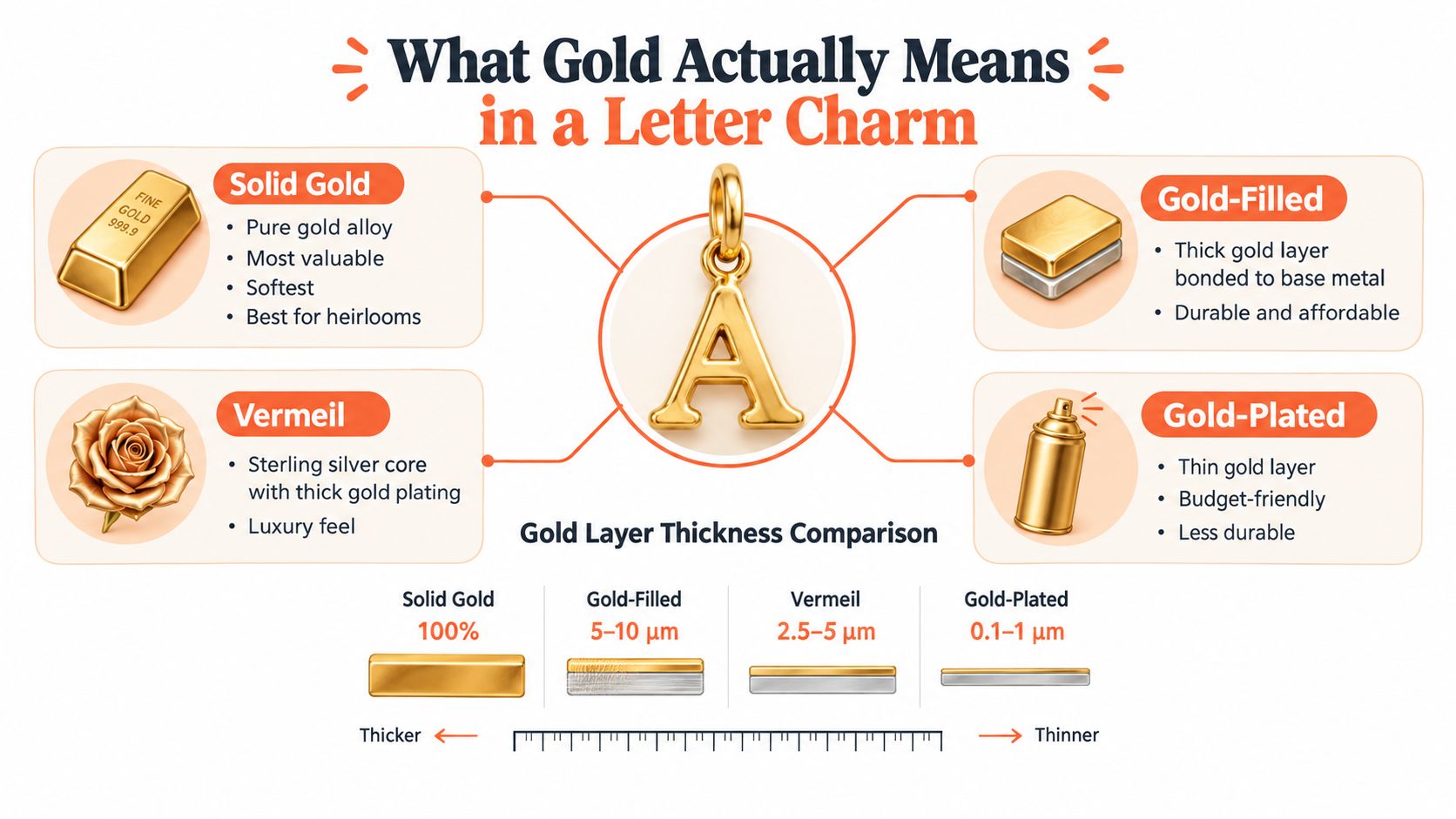
Solid gold means the charm is made of a gold alloy throughout, rather than wearing gold only on its surface. State the karat accurately. It's the clearest fit for buyers seeking a lasting piece, though its higher material value may not suit an impulse-price display.
Gold-filled construction bonds a layer of gold to a base metal. Think of it as a thick gold layer attached to a core, rather than a light surface coat. The FTC recognizes gold-filled or gold-overlay terminology in relation to a 1/20 gold-to-total-metal weight ratio, and identifies weight ratio, thickness, and application method as facts sellers must not misrepresent (FTC jewelry guidance). Don't use the term unless the supplier's documentation supports it.
Vermeil has a sterling silver core with gold plating. It offers a precious-metal base and a gold surface, but it's still a plated product. Gold-plated charms have a gold coating over another substrate; the base metal and coating details affect how the item performs and how you should price it.
For a teen building a fashion stack, a clearly described plated charm may be the right entry point. A shopper choosing a keepsake for frequent wear may want solid gold or a documented gold-filled piece. For a closer breakdown of construction terminology, consult this guide to gold-plated versus solid gold jewelry.
Product-copy rule: Name the construction precisely. Say “18K gold-plated stainless steel” when that's what the supplier can verify. Don't let “gold” imply solid-gold composition when it isn't.
Karat, Plating Thickness, and the Durability Equation
A higher karat does not automatically make a tougher charm. In solid gold, alloy metals can increase hardness compared with pure gold. For plated pieces, durability depends on the coating, substrate, surface preparation, and points of repeated contact. Treat construction details as buying criteria, not fine print.
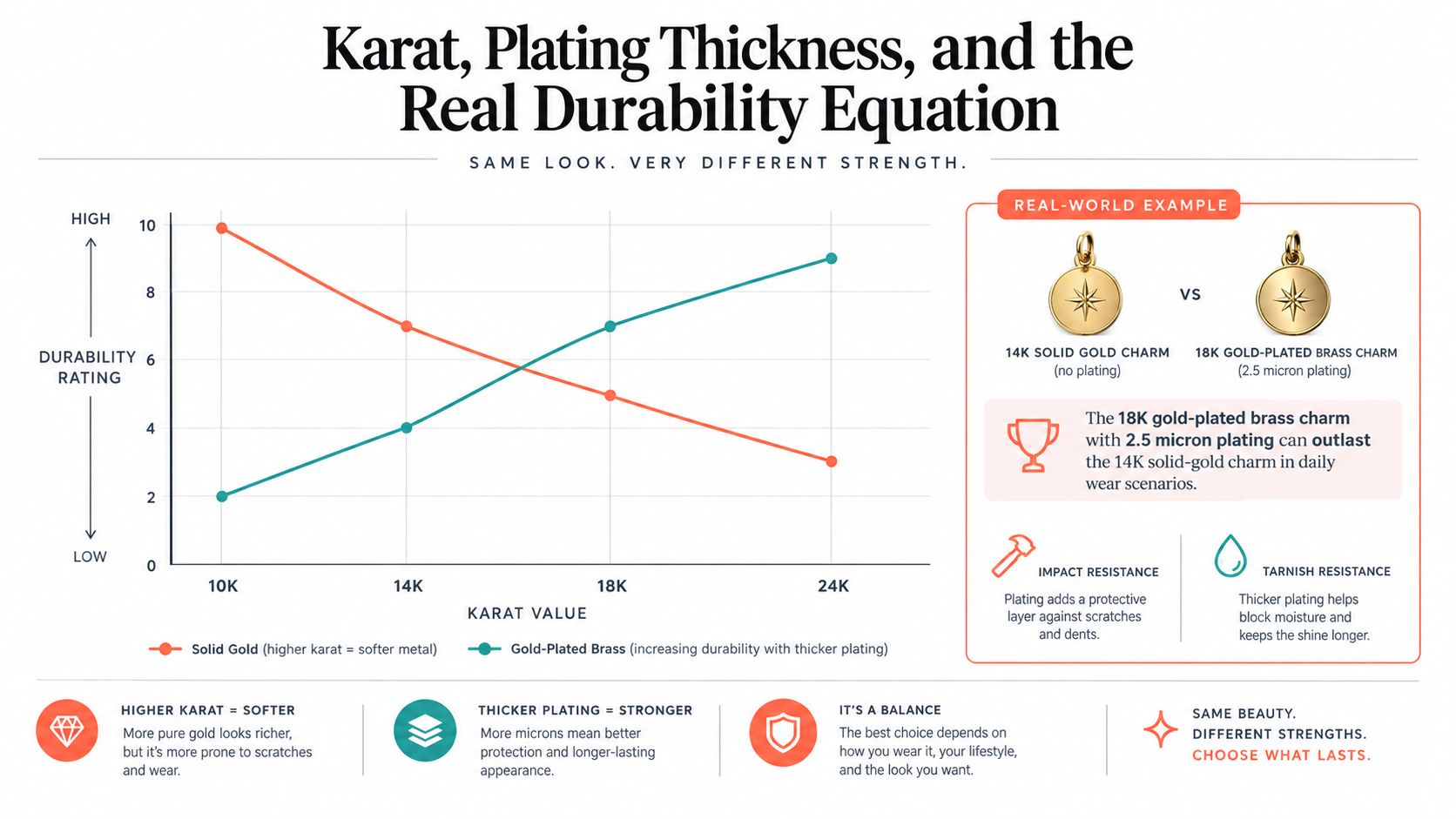
On plated charms, raised letter edges, the jump-ring interface, and other contact points often show wear first. A thicker coating generally resists abrasion, corrosion, and chemical exposure better, but thickness alone cannot guarantee adhesion or lasting performance. Ask suppliers for specifications and test documentation. A gold-colored sample is not proof of how long the finish will hold.
| Construction | Price band | What determines wear life | Best customer |
|---|---|---|---|
| Solid gold | Premium | Alloy, design, and care | Keepsake or frequent-wear buyer |
| Gold-filled | Mid to premium | Construction and use | Buyer seeking a gold layer bonded to a base |
| Vermeil | Mid to premium | Coating and wear | Shopper seeking a sterling-silver core |
| Gold-plated | Entry to mid | Coating, substrate, and abrasion | Trend-led or occasional-wear shopper |
Use this table to guide merchandising, not to replace supplier specifications. For karat-marked goods, the FTC advises buyers to look for a company name or U.S.-registered trademark near the karat mark, and to avoid items without that identifying mark (FTC advice on buying precious-metal jewelry). For shoppers weighing precious-metal choices, direct them to this comparison of platinum or gold for your ring.
For every plated style, request the base metal, coating thickness in microns, any barrier layer, and wear-test documentation. The FTC's jewelry guidance says sellers must not misrepresent material facts such as coating thickness, weight ratio, or application method. Use a guide to how long gold plating lasts to set care expectations, then describe each charm according to the supplier's documented specifications.
Sizing, Jump Rings, and Personalization Options That Sell
A charm can meet the material spec and still disappoint if it doesn't fit the chain or bracelet your customer owns. Don't order from a product photo alone. Get the charm dimensions and attachment details in writing before approving a sample.
Start with three measurements: charm height and width, opening or hole size, and jump-ring dimensions. Confirm whether the measurements include the bail or ring, and whether the charm arrives with a jump ring attached. Then check that the opening works with your intended chains, bracelet links, and display hooks. If you sell matching chains, test the actual charm on those chains rather than assuming compatibility from a listing description.
The clasp matters too. A tiny charm paired with an oversized lobster clasp looks unbalanced; a fragile attachment on a heavier chain can compromise the whole piece. Keep a sample chain and bracelet at the counter so staff can demonstrate fit and explain whether the charm is intended as a pendant, bracelet accent, or both.
Personalization changes the look as much as the letter does. Stamped letters give a pressed, tactile impression. Laser-engraved lettering can deliver crisp detail, while enamel-filled or hand-painted letters add color and may need more careful handling. Font choice affects legibility at small sizes, so check the finished sample at the scale customers will wear, not only in a magnified product image.
If you offer build-your-own options online, make the configuration easy to understand. A useful reference on CRO testing for product configurators can help you think through how customers select and review custom combinations.
Quality Checks Before You Buy
A supplier's listing is a starting point, not an incoming inspection. When the order arrives, compare the goods with the specification you approved and keep a record of any mismatch. That habit makes it easier to resolve problems before a customer finds them.
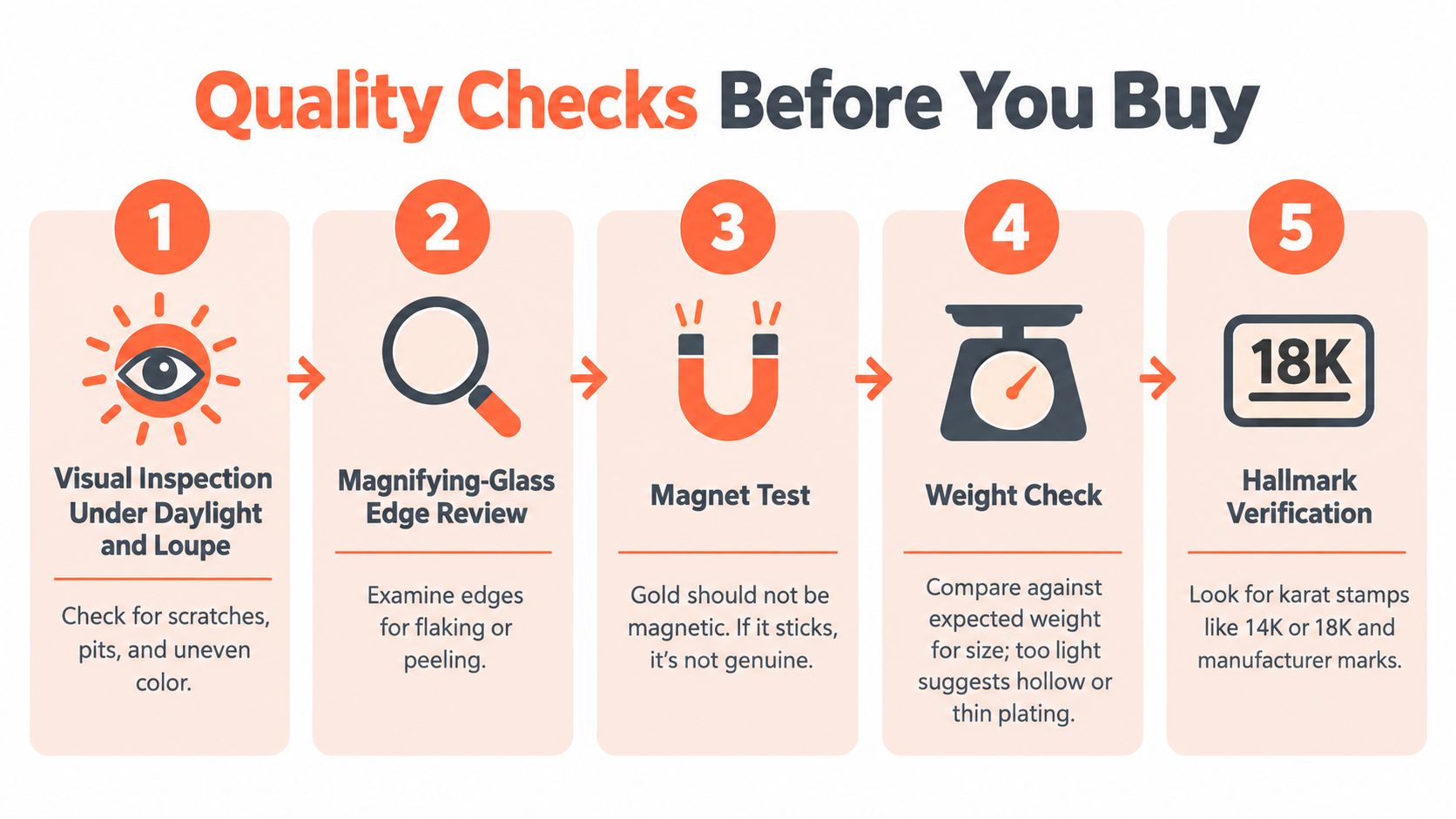
Use a repeatable receiving check
- Inspect the finish in good light. Look for uneven color, pits, scratches, and rough edges. A loupe helps you spot defects that disappear in a product photo.
- Examine the attachment. Check the jump ring and soldered connection for gaps, sharp edges, or signs of weak assembly. A charm that separates from its chain becomes a return, not a sale.
- Ask for plating evidence. Request the specified thickness, base metal, and test documentation. A casual saltwater or sweat simulation isn't a validated quality test, so don't use it as proof of performance or promise customers a wear life based on it.
- Use the magnet cautiously. A magnet can flag some magnetic components, but it can't establish karat, plating thickness, or overall authenticity. Treat it as a preliminary screen, not a pass-or-fail test.
- Match marks to paperwork. Check the karat mark and responsible company mark where applicable, then compare them with supplier documents. For plated styles, ask for coating details and country-of-origin information where available.
Set the documentation standard
A responsible supplier should be able to explain what the charm is made of and support its product description. For solid-gold items, ask for the stated fineness and identifying mark. For plated items, request the substrate, plating thickness in microns, any barrier layer, and available test records. Reject vague answers before you place a larger order.
Use the same checklist for samples and replenishment shipments. If the delivered batch differs from the approved sample, pause sales until the supplier clarifies the discrepancy. That's more effective than trying to explain a mismatch after a shopper has already bought the charm.
Wholesale Pricing, MOQ Reality, and Margin Math
A low factory quote can hide a high landed cost. Compare suppliers by adding the unit price, each order's share of sample costs, freight, duty, and an allowance for expected returns. A vendor with cheaper charms may cost more once shipping a small order is included. Use the same cost categories for every quote.
| Construction | Example factory cost | Suggested retail | Approx. gross margin |
|---|---|---|---|
| Solid gold | Quote required | Set from landed cost | Calculate from actual figures |
| Gold-filled | Quote required | Set from landed cost | Calculate from actual figures |
| Vermeil | Quote required | Set from landed cost | Calculate from actual figures |
| Gold-plated | Quote required | Set from landed cost | Calculate from actual figures |
Populate the table with your supplier quotes. Calculate gross margin as retail price minus landed cost, divided by retail price. Choose your target margin first, then check whether the resulting retail price fits what customers expect for that construction. Don't use invented costs or a blanket markup across materials.
Compare order economics, not just MOQs
A no-minimum order lets you test initials, colors, or a new supplier while limiting cash tied up in stock. A low-MOQ bulk order can reduce the unit price, but only when you expect to sell through the quantity. Slow-moving letters can leave cash sitting in inventory past the season. Compare the full invoice, shipping terms, and the risk of unsold stock before choosing.
JewelryBuyDirect is one wholesale option for retailers comparing letter-charm styles and order quantities. Pair its wholesale jewelry charms guide with your own landed-cost worksheet when reviewing the assortment.
Supplier reliability affects the cost of an order. Check whether the vendor documents materials clearly, resolves defects, and can replenish styles consistently. A lower quote won't protect your margin if descriptions change between orders or popular letters are unavailable when you need to restock.
Seasonal Forecasting and the Smart Letter Assortment
Personalization may be appealing year-round, but search interest doesn't stay level. “Monogram necklace” searches reached a normalized 82 in November 2024 and fell to 27 by March 2025; “letter charm necklace” searches reached 91 in December 2025 before declining in January 2026 (search trend data). Those figures point to a practical buying lesson: keep the category available year-round, but don't buy every initial at equal depth.
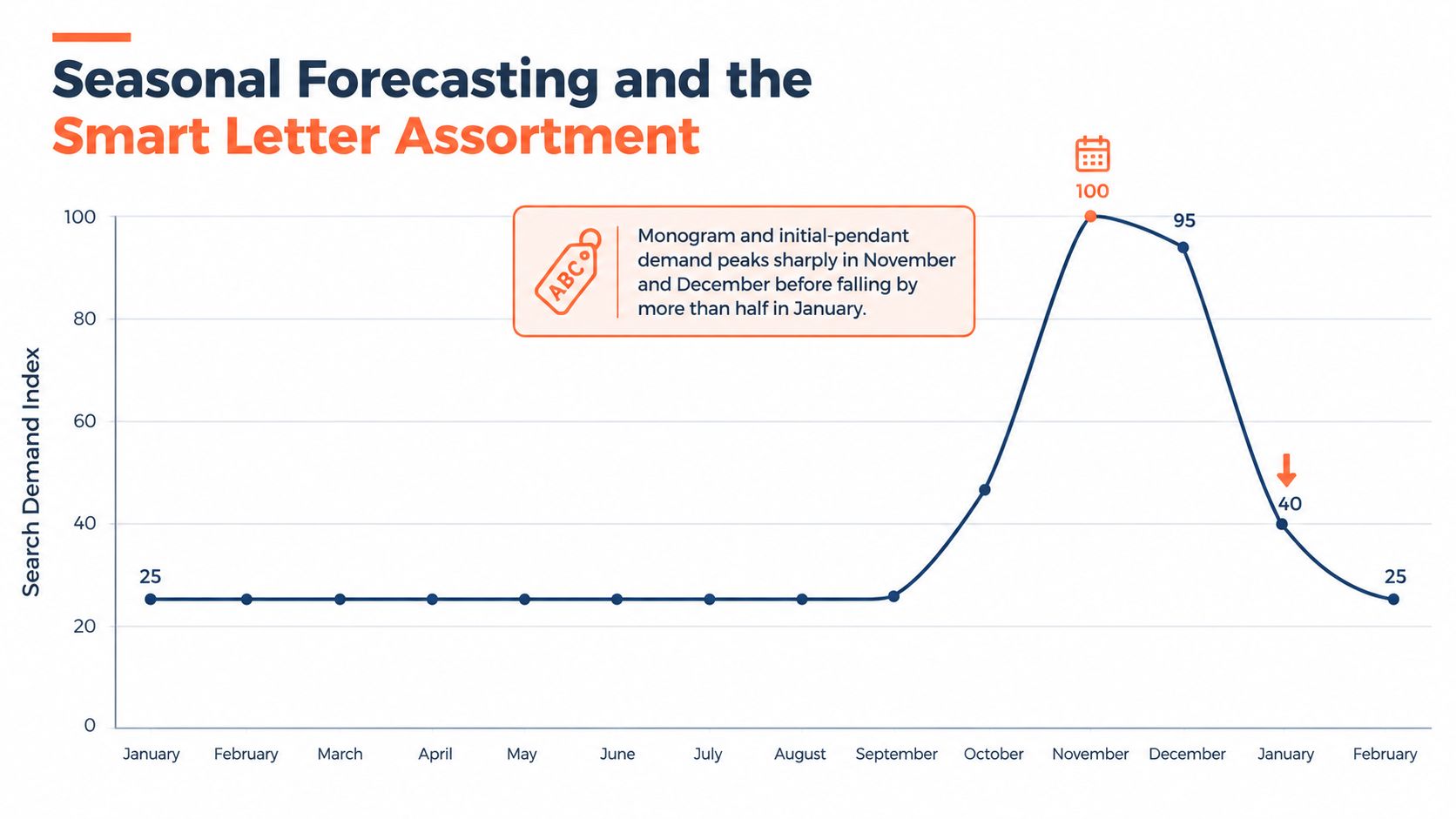
Keep a broad but shallow alphabet as your baseline. Before gifting periods, increase depth only where your own sales, customer requests, and local audience justify it. Don't assume a popular letter in one neighborhood or customer group will perform the same way in another.
Buy for occasions, then adjust to sell-through
Graduation and holiday gifting give shoppers a reason to choose initials, but your store should use its own sales history to decide when to replenish. Review which letters sell, which sit, and which customers ask for combinations you don't carry. If a preferred initial is unavailable, offer a related birthstone, zodiac, heart, or name-inspired charm rather than buying deep across every letter in advance.
For a visual check on the range of available initial designs, browse this personalized charm letters collection. Use examples like these to guide your assortment, not as proof that every style or letter will sell in your market.
Set a simple routine: maintain the core display, review sell-through before major gifting periods, and replenish according to actual demand. After the peak, resist the urge to keep buying at the same depth. A flexible letter assortment protects cash and leaves room for adjacent products that can satisfy shoppers when their first-choice initial is out of stock.
Merchandising, Photography, and Upsell That Converts
Make gold letter charms easy to browse, easy to try, and easy to understand. An initial wall helps shoppers find their letter quickly. A try-on bar with sample chains lets them judge scale and layering, while gift-ready packaging gives staff a natural way to position a charm as a present without implying that every construction is precious metal.
Your images should answer questions before they become returns. Photograph each letter on a complementary chain, include a view that shows scale, and state the material construction near the product name. Don't rely on a warm background or bright lighting to carry the “gold” message. Customers need to know whether they're buying solid gold, gold-filled, vermeil, or a plated finish.
Build the add-on around the initial
Offer a matching bracelet, a name plate, or a personalizable chain or anklet as an adjacent choice. Keep the suggestion relevant to the customer's intended use: a delicate initial pendant can pair with a fine chain, while a gift buyer may respond better to coordinated packaging or a complementary charm. Buy-now-pay-later options may suit some stores, but present them as a payment choice, not a substitute for clear product information.
Use a short operating plan to turn the assortment into a routine:
- This week: Check product titles, material details, and photos. Remove any wording that could make plated goods sound solid gold.
- Next month: Review which letters customers ask for and compare that demand with current stock.
- Before the next gifting season: Confirm supplier specifications, order only the depth your sales support, and prepare a display that makes alternatives easy to shop.
A charm earns its place when the material claim is accurate, the attachment works, and the letter is available when a customer wants it. Treat those as one buying decision, not separate tasks.
If you're sourcing gold letter charms for a boutique or online store, compare construction, documentation, and order flexibility before you commit. Visit JewelryBuyDirect to browse wholesale jewelry and fashion accessories for your assortment.