






Arthur Lynch | Thu Sep 04 2025
A Retailer's Actionable Guide to Sourcing Wholesale Moissanite Jewelry
Sourcing wholesale moissanite isn't just about finding a diamond look-alike; it’s about making a smart, strategic move into a market that’s booming, thanks to savvy shoppers and seriously attractive profit margins. For jewelers, this is your chance to meet the growing demand for gems that deliver on brilliance and durability without the ethical baggage or the sky-high cost of traditional stones.
This guide provides actionable insights to help you navigate the market and build a profitable inventory.
Getting Started in the Wholesale Moissanite Market
Jumping into wholesale moissanite means you first have to grasp why it's become so popular. You're not just adding a cheaper option to your display case. You're aligning your business with a huge shift in what customers actually want: beauty and ethics, hand-in-hand.
Today’s jewelry buyer does their homework. They compare options, and they really care where their products come from. This is precisely where moissanite stands out. As a lab-created gemstone, it completely bypasses the environmental and ethical mess tied to traditional mining. That gives your brand a powerful and honest story to tell.
Reading the Market's Pulse
The demand for moissanite isn't just a flash in the pan—it’s a market with real, sustainable growth. A few key things are fueling this global trend:
- Conscious Buying: Shoppers, especially millennials and Gen Z, are actively looking for products that are kinder to the planet and have a clean supply chain. Moissanite’s lab-grown origin is a massive selling point.
- Accessible Luxury: It lets your customers get that big, brilliant stone they've been dreaming of, but without the intimidating price of a diamond. This opens the door for you to offer stunning, high-impact pieces to a much wider audience.
- Built to Last: Moissanite scores a 9.25 on the Mohs hardness scale, making it second only to diamond. It's tough enough for daily wear, which is exactly what people want for engagement rings and wedding bands.
These factors have created a seriously strong market. In fact, the global moissanite jewelry market is projected to hit around $68.9 million by 2025 and is expected to grow at a compound annual rate of about 7.5% through 2033. This isn't just a niche; it's a clear signal of changing consumer tastes. You can get a deeper look at the numbers in the complete moissanite market research on archivemarketresearch.com.
Know What Sells, Where It Sells
Winning in the moissanite business means stocking what people actually want to buy, and that can change drastically from one place to another. A generic, one-size-fits-all approach is a surefire way to get stuck with inventory that just won't move.
Actionable Insight: Don't just order the basics. Actively research regional fashion trends using social media insights (e.g., monitoring regional hashtags like #UKjewelry or #SingaporeBridal) and local fashion publications. This will help you sell through your inventory faster and avoid tying up cash in pieces nobody wants.
In North America, for example, the demand for classic, minimalist designs is rock-solid. We're talking timeless solitaire rings, simple pendants, and classic stud earrings—often in white gold or platinum settings. These are the bread-and-butter pieces that always sell well.
Meanwhile, over in the Asia-Pacific markets, there's a growing taste for more ornate and personalized jewelry. Think bold settings, sparkling halo designs, and unique, fancy-cut stones, often set in warmer yellow or rose gold. Shoppers there often want something that makes a statement. In parts of the Middle East, this trend is amplified, with a preference for larger carat weights and elaborate, multi-stone designs.
Getting a handle on these differences is key to building a collection that’s both profitable and in-demand right from your first order.
Finding and Vetting Reliable Manufacturers
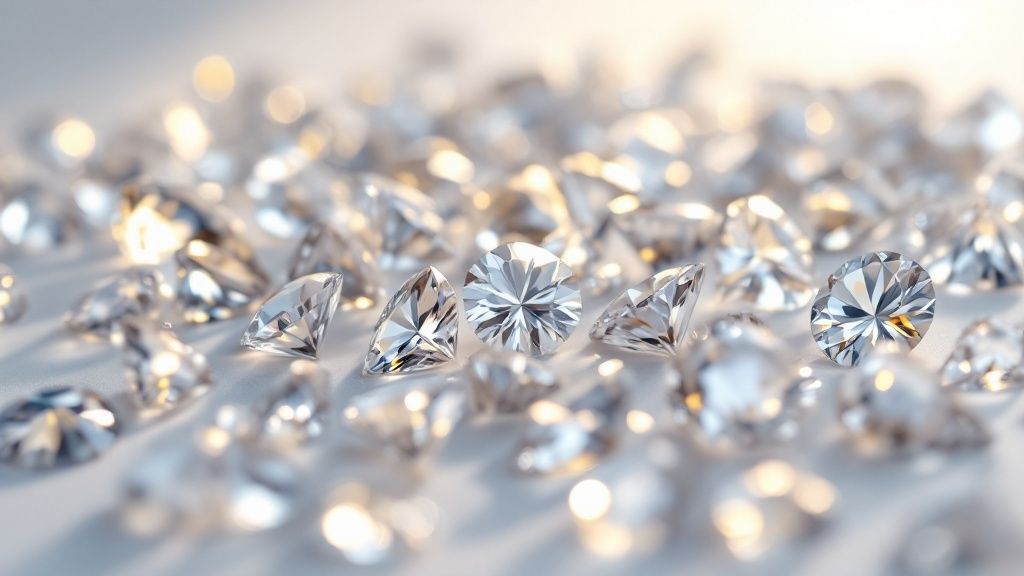
If you want to maximize your profit margin on wholesale moissanite jewelry, going straight to the source is the single best move you can make. It cuts out the layers of middlemen, giving you direct control over the final product's quality and design.
But this path isn’t a shortcut. It demands a sharp eye and a rock-solid vetting process because, let's be honest, not all suppliers are cut from the same cloth. The goal here is to build a lasting, reliable partnership, not just to snag a one-time deal.
Most searches start online, on massive B2B platforms. You'll likely find yourself scrolling through giants like Alibaba, which is a great place to get a feel for the market. For a more focused search, industry-specific sites like JewelryGo can connect you with manufacturers who live and breathe fine jewelry.
Think of these platforms as a huge, unfiltered phone book. They get you a list of names, but the real work starts when you begin narrowing down the prospects who actually fit your brand.
The Power of In-Person: Navigating Trade Shows
As useful as online platforms are, nothing beats meeting someone face-to-face. Industry trade shows are an absolute goldmine for this. Making the trip to an event like the JCK show in Las Vegas or the Hong Kong International Jewellery Show lets you shake hands with potential partners.
This is your chance to physically hold their jewelry, feel the weight of it, and see the craftsmanship up close. It’s an experience you just can't replicate through a screen. You can gauge their professionalism, see how they present their work, and have real, candid conversations about what they can do for you. It's often in these moments that you find a partner who truly understands your vision.
Your Due Diligence Checklist
Once you’ve got a shortlist, it's time to dig in. This is the crucial stage where you verify every claim and make sure you’re dealing with a legitimate, capable, and trustworthy operation. Rushing this part is the fastest way to lose money.
Here’s a practical checklist to run through with every potential manufacturer:
- Ask for Credentials: Request copies of their business license and any relevant export licenses. A legitimate company will have these ready and won't hesitate to share them.
- Insist on GRA Certification: This is non-negotiable for moissanite. Every stone should come with a Gemological Research Academy (GRA) certificate. If a supplier balks at this or can't provide one, walk away. It’s a massive red flag.
- Talk Production & Timelines: Don't accept vague answers. Ask specific questions like, "If I order 200 solitaire rings and 150 pairs of stud earrings today, what's your realistic lead time?" Their answer tells you a lot about their capacity and honesty.
- Clarify Minimum Order Quantities (MOQs): You need to know their MOQ for the total order and for each individual style. This ensures their business model fits with your buying power, which is especially critical for smaller operations. Our guide to sourcing wholesale jewelry for boutiques dives deeper into navigating this.
A great manufacturing partner is an open book. They should be able to clearly explain their processes, timelines, and quality control. If you feel like they're dodging questions, trust your gut.
Spotting Red Flags in How They Communicate
Pay close attention to how a potential supplier talks to you. Their communication style—or lack thereof—is often a direct reflection of their business practices. Are they responsive? Clear? Willing to get into the details?
Let's play out a common scenario. You ask about a specific halo engagement ring you saw in their catalog. You want to know the moissanite’s grade, the metal purity, and the total carat weight.
A good supplier will come back with specifics: "The center stone is a 1.5ct D color, VVS1 clarity moissanite. The setting is solid 14k white gold."
A questionable supplier might say something like, "It's a high-quality stone in a good setting." That kind of vagueness is a warning sign that they're either hiding something or just don't know their own product.
Finally, there’s the sample test. Always, always order samples before you commit to a bulk purchase. A manufacturer who refuses, stalls, or tries to charge a crazy price for them is likely hiding poor quality. A supplier who is proud of their work will be eager for you to see it for yourself. Taking the time to build this foundation will save you a world of headaches later on.
How to Assess Moissanite Quality Like a Pro
Not all moissanite is created equal, and trust me, your customers will notice the difference. If you want to build a reputation for quality in the wholesale moissanite jewelry game, you have to learn how to assess gems like an expert. This means going deeper than a textbook understanding of the '4 Cs' and really zeroing in on what makes a stone pop.
A masterfully cut stone just explodes with fire and life. A mediocre one? It looks dull and flat, no matter how big it is. Your ability to spot the difference is what will make your inventory stand out and keep people coming back for more. It all starts with the raw material itself.
Distinguishing Moissanite Types
Before you even start thinking about color or clarity, you need to know what kind of silicon carbide (SiC) the moissanite is made from. This isn't just technical jargon—the crystal structure of the raw material has a massive impact on the final gem’s stability and how it plays with light.
For jewelry, there's one type that stands head and shoulders above the rest: 4H-SiC.
This specific crystal structure, or polytype, is the gold standard because it has superior thermal conductivity and consistently produces the most brilliant, colorless gemstones. Other polytypes exist, but they're often less stable and can result in stones with an undesirable yellow or green tint.
Actionable Insight: When you're talking to a potential manufacturer, ask them this one simple question: "Do you use 4H-SiC for your moissanite production?" A good supplier will say "yes" without hesitation. If they get vague or try to dodge the question, that's a huge red flag that they might be cutting corners with inferior materials.
Asking that one question can save you from a massive headache and a warehouse full of subpar inventory that just doesn't have that crisp, diamond-like sparkle your customers are looking for.
This side-by-side comparison shows you what I mean about moissanite's unique visual pop.
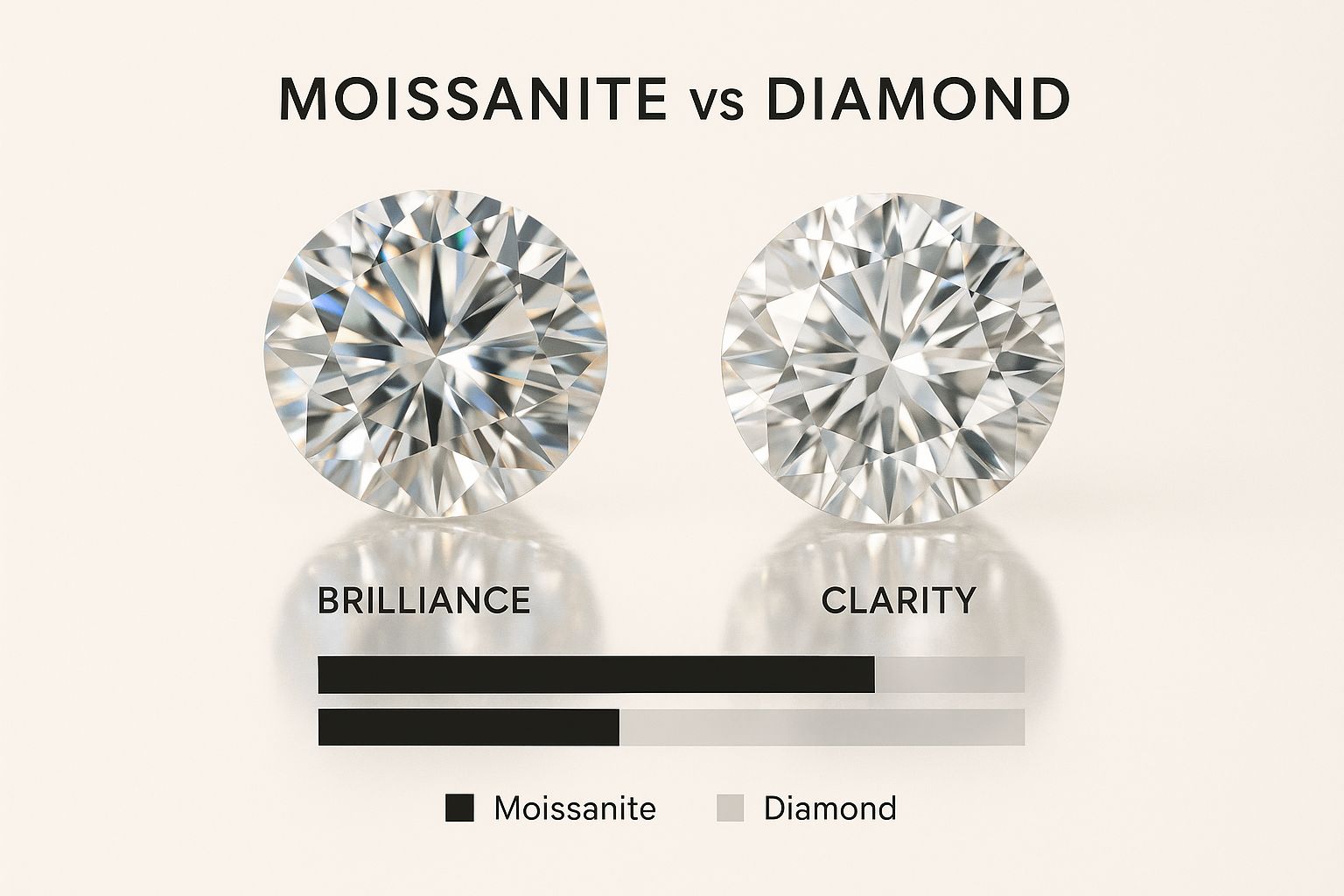
You can see how moissanite's higher dispersion creates those intense, rainbow-colored flashes of light. For many buyers, that "fire" is the main event.
Decoding the GRA Certificate
Any legitimate wholesale moissanite you buy should come with a Gemological Research Academy (GRA) certificate for each significant stone. Here’s a common rookie mistake: assuming this certificate is an ironclad guarantee of top-tier quality. It's not. Think of it more like a passport than a five-star review.
A GRA report confirms that the stone is, in fact, moissanite and lists its basic stats—the 4 Cs. What it doesn't tell you is anything about the precision of the cut, the quality of the polish, or the overall craftsmanship. I've seen two stones with identical GRA reports that looked worlds apart in person, all because of tiny differences in how they were faceted.
So, use the certificate as your starting point. It's there to verify the basics, but always, always trust your own eyes to judge the stone's real beauty and brilliance.
A Practical Guide to Grading
While the 4 Cs (Color, Clarity, Cut, and Carat) are your foundation, they apply a little differently to moissanite than to diamonds. When you're building your inventory, mastering color and clarity is where you'll get the most bang for your buck.
Here’s a quick reference I use to help choose stones that align with brand standards and customer expectations for high-quality wholesale moissanite jewelry.
Moissanite Quality Grading at a Glance
This table breaks down the most common grades you'll encounter. It's a simple cheat sheet to help you quickly decide which stones fit your inventory needs and price points.
| Grade | Color Description | Clarity Description | Best For |
|---|---|---|---|
| D-E-F | Colorless: The top of the line. These stones are icy-white and look just like high-grade diamonds to the naked eye. | VVS1-VVS2: Very, Very Slightly Included. Any inclusions are microscopic and only visible under 10x magnification. Visually perfect. | Premium engagement rings and high-end pieces where perfection is non-negotiable. This grade carries the highest price tag. |
| G-H-I | Near-Colorless: You might see a hint of warmth in certain lighting, but it's basically invisible once set in jewelry. | VS1-VS2: Very Slightly Included. Minor inclusions are tough to spot even with 10x magnification and are totally invisible to the naked eye. | The "sweet spot" for value. You get fantastic visual quality for a more accessible price, making it perfect for a wide range of jewelry. |
| J-K | Faint Color: A noticeable yellow or gray tint is visible, especially in larger stones. | SI1-SI2: Slightly Included. Inclusions are easy to see under magnification and can sometimes be spotted with the naked eye. | Budget-friendly pieces or designs that call for a warmer tone. I'd recommend using these for smaller accent stones, not the main event. |
At the end of the day, your goal is to find that perfect balance between quality and cost for your specific audience. By starting with the right material (4H-SiC), knowing what a GRA certificate actually tells you, and getting a good handle on color and clarity grading, you'll be well on your way to curating a collection that truly shines.
Tapping Into Global Jewelry Trends
Finding a great source for wholesale moissanite jewelry is a huge win, but it's only half the job. The real challenge—and where the profit lies—is stocking pieces that people actually want to buy. A smart inventory is built on knowing what consumers are looking for, and believe me, that changes a lot depending on where you're selling.
This isn't about guesswork. It’s about making strategic decisions so your money isn’t just sitting in a display case collecting dust. Understanding the subtle (and not-so-subtle) differences in style preferences is your key to building a collection that connects with your customers and moves quickly.
West vs. East: A Tale of Two Tastes
Jewelry preferences are anything but universal. If you want to maximize your sales, you have to tailor your inventory to the specific market you're targeting.
In North America and Europe, the prevailing trend has always been classic, understated elegance. These are the timeless designs that never seem to go out of style.
- Classic Solitaires: You can't go wrong with a single-stone engagement ring. It's the gold standard for a reason—its simple sophistication is always in demand.
- Minimalist Settings: Think thin bands, hidden halos, and delicate details. These styles are perfect for everyday wear and really let the moissanite stone take center stage.
- Simple Studs and Pendants: These are the bread and butter of any jewelry collection. They’re versatile, essential pieces that everyone needs.
Now, shift your focus to markets in China and Southeast Asia, and the picture changes completely. Here, there's a growing desire for more elaborate and eye-catching designs. Shoppers want pieces that make a statement.
- Intricate Halo Settings: Designs with a "halo" of smaller stones circling the main moissanite are incredibly popular. They add a ton of sparkle and visual weight.
- Unique Cuts: While the round brilliant cut is a classic, fancy cuts like pear, oval, and emerald are surging in popularity as buyers look for something different.
- Bold, Ornate Designs: Jewelry with detailed metalwork, multiple stones, and a more substantial feel is what many customers are after.
The Asia-Pacific region is a true giant in the moissanite world. The market skyrocketed from $183.9 million in 2021 and is projected to hit $291.2 million by 2025. China is leading the charge, expected to command roughly 38.6% of the market share in 2025. You can dig into the numbers yourself in the full moissanite market report on cognitivemarketresearch.com.
Color and Customization are King
Beyond the regional divide, two massive trends are sweeping across the entire moissanite industry: a love for colored stones and a powerful move toward custom, personalized jewelry.
The days of only offering colorless, diamond-like moissanite are over. A whole new generation of buyers is falling in love with colored stones, which add a modern, unique feel to any piece.
Actionable Insight: Capitalize on emerging color trends. Monitor fashion forecasting services and even celebrity styles. Currently, champagne, gray, and light blue moissanite are in high demand. Offering these unique hues allows for more creative and personalized designs that truly stand out from competitors.
This push for individuality is also what’s driving the demand for custom designs. People don’t just want to buy jewelry off the shelf anymore; they want to be part of creating it. By offering bespoke services—letting customers pick their own stone, choose a specific setting, or even design a piece from the ground up—you can tap directly into this powerful trend.
By keeping your finger on the pulse of these trends—from the classic styles loved in the West to the ornate designs popular in the East, plus the universal desire for color and personalization—you can build an inventory that's not just beautiful, but also incredibly profitable. It's all about anticipating what your customers want and telling a story they’re excited to be a part of.
Negotiating Terms for Your First Order
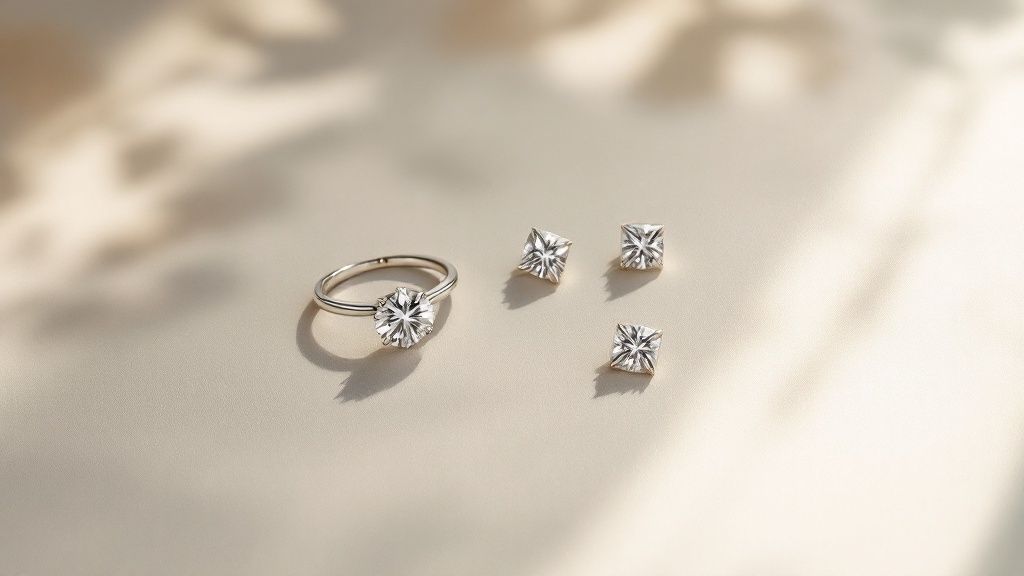
Alright, you've found a manufacturer you trust and you're happy with their quality. Now comes the critical part: the negotiation. This is where you shift from evaluating their work to protecting your own bottom line. Getting this right isn't just about haggling over price; it's about building a deal that secures your profit margins and gives you a predictable supply chain.
Think of this conversation less like a battle and more like building a partnership agreement. The best deals are win-wins, where both you and the supplier feel like you've been treated fairly. Building a little rapport can go a long way and often opens the door to flexibility you wouldn't get in a cold, transactional exchange.
It's Not Just About the Per-Unit Price
Your main goal here is to lock in favorable terms across the entire deal. Sure, the cost of each piece of wholesale moissanite jewelry matters, but other factors can have a much bigger impact on your cash flow and how smoothly your business runs.
Instead of getting hyper-focused on a few dollars per piece, put your energy into these key areas:
- Minimum Order Quantities (MOQs): A high MOQ can be a cash flow killer, tying up your money in inventory that might not move quickly. Don't be shy about negotiating this. A manufacturer will often lower their MOQ, especially for a first order, if you can show them you have a solid plan for future, larger buys.
- Payment Terms: The industry standard is typically 30% down to start production and the remaining 70% when the order is complete (before it ships). This is a fair setup that protects both of you. If a supplier asks for 100% upfront on a significant order, that’s a major red flag.
- Lead Times: Get a firm, realistic production timeline from them and make sure it’s in writing. You need this to manage your own inventory and plan your marketing efforts.
Nailing down these points creates a much stronger foundation for your business. For a broader look at the basics, our guide on how to buy wholesale jewelry is a great resource that covers many of the core principles.
Getting a Handle on Shipping Logistics
Shipping terms can seem like a foreign language, but they directly affect your final costs and what you're responsible for. The two acronyms you'll see most often are FOB and CIF.
Actionable Insight: I always, always push for FOB (Free On Board) terms. This means the manufacturer is only responsible for getting your order to the port in their country. From the moment it's on the ship, it's your responsibility. This gives you the power to choose your own freight forwarder, which is almost always cheaper and offers better tracking and service.
With CIF (Cost, Insurance, and Freight), the supplier handles everything, but they'll bake a nice markup into the shipping and insurance fees. FOB puts you in control and can save you a surprising amount of money.
The Purchase Order: Your Non-Negotiable Safety Net
I can't stress this enough: never, ever move forward with an order based on a verbal promise or a few casual emails. A formal, detailed Purchase Order (PO) is your legal protection. It clears up any potential confusion and makes sure everyone is on the same page.
Your PO needs to spell out every single detail of your agreement. Think of it as your ultimate backup if anything goes sideways.
It must include:
- Exact Product Specs: List every item with model numbers, moissanite grades (e.g., D color, VVS1), metal types (e.g., 14k gold), and precise quantities.
- Confirmed Pricing: Itemize the cost for each unit and the total value of the order.
- Payment & Shipping Terms: Re-state the agreed-upon payment schedule (30/70) and shipping terms (FOB).
- Delivery Deadlines: Include the final date by which the order must be ready to ship.
A Real-World Negotiation Scenario
Let's walk through a common situation. A manufacturer quotes you $55 per unit for a popular halo ring, but their MOQ is 100 units of that one style. For a new business, that's a big commitment for a single design.
Instead of just asking for a lower price, try proposing a bundled order.
You could say something like, "I can't commit to 100 units of just the halo ring right now. But what I can do is place an order for 50 halo rings, 50 solitaire rings, and 75 pairs of your classic stud earrings. That brings my total order to 175 pieces. Can we move forward with those quantities at the quoted prices?"
This shows them you're serious about volume but allows you to test more products. If they still push back on the MOQ for individual styles, a great counter-offer is to agree to their terms but ask for a small discount (5-7%) on the total order value as a goodwill gesture for placing a larger overall order. This kind of collaborative approach usually gets you to a deal that works for everyone and starts the relationship off on the right foot.
Common Questions on Sourcing Moissanite
Even with a solid game plan, jumping into the world of wholesale moissanite jewelry is going to stir up some questions. I've been there. Let's walk through some of the most common hurdles and questions I see from new buyers, so you can sidestep the rookie mistakes and source with confidence from day one.
Is All Wholesale Moissanite Basically the Same?
Not even close. This is probably the biggest misconception out there. The quality of a finished moissanite stone hinges on everything from the raw silicon carbide it’s grown from to the precision of the cut and the final polish. I've seen two stones with identical GRA certificates that look like completely different gems in person.
Top-tier manufacturers insist on using high-quality 4H-SiC crystal polytype. This is what gives you those brilliantly clear, colorless stones. Others cut corners with cheaper materials, and you end up with moissanite that has a noticeable, and undesirable, yellow or gray tint. This is precisely why vetting your supplier and always ordering samples is a non-negotiable part of the process.
Can I Order Custom Designs in Bulk?
Absolutely, and this is where you can really set your brand apart. Most established wholesale manufacturers have robust custom design programs. You can work directly with their teams to bring your unique vision to life, creating pieces that are completely exclusive to your business.
Actionable Insight: Be ready to get specific. For any custom job, you'll need to prepare detailed CAD files or professional sketches. Clarify lead times for mold creation, any one-time setup costs, and a separate Minimum Order Quantity (MOQ) just for your exclusive design. It's more work upfront, but the payoff is a unique product your competitors can't touch.
For a deeper look into building a profitable collection, our guide on buying wholesale jewelry for resale is packed with more strategies.
How Can I Verify a Supplier's Quality Remotely?
Seeing jewelry in person at a trade show is ideal, but it’s not always practical. Thankfully, you can do some very effective vetting from your desk. A supplier worth their salt will be an open book, ready to provide whatever you need to feel comfortable.
Here’s what I recommend:
- Request High-Resolution Videos: Don't just settle for photos. Ask for videos of their moissanite under various lighting conditions (sunlight, office light, etc.). This is the only way to truly judge a stone's fire and brilliance from afar.
- Check Their Paperwork: For any significant stone, a GRA certificate is a must. Also, ask for a copy of their business license. A legitimate, professional operation will have this information on hand and won't hesitate to share it.
- Get on a Video Call: Schedule a quick video chat. Ask for a tour of their workshop or just a chance to meet the team. You can learn a massive amount about their professionalism and the scale of their business from a simple 15-minute call.
What is a Realistic Defect Rate to Expect?
Look, even with the most stringent quality control, a minor issue can slip through now and then. In the wholesale jewelry business, an acceptable defect rate is typically around 1-3%. We're talking about small things—a slightly loose prong, a tiny scratch on the metal, or a small imperfection in a tiny accent stone.
The key is how the supplier handles it. Before you place a large order, make sure you have a crystal-clear understanding of their policy for returns, replacements, or credits for defective items. This protects your investment and proves you’re working with a partner who stands behind their product.
Should I Buy Loose Stones or Finished Jewelry?
This really comes down to your specific business model. There’s no single right answer.
- Finished Jewelry: This is the most straightforward route. You get pieces that are ready to sell the moment they arrive. It’s perfect if your primary focus is on marketing and retail, allowing you to get new products to market quickly without needing any in-house production.
- Loose Stones: Buying loose moissanite is the way to go if you offer custom design services or have your own bench jewelers. It gives you total creative freedom and can be more cost-effective if you have the means to set the stones yourself.
Many of the most successful jewelers I know do a little of both. They carry a core collection of finished pieces for quick sales and also source loose stones for high-margin custom projects. This hybrid model lets you serve the widest possible range of customers.
Ready to source high-quality, trend-forward pieces with confidence? At JewelryBuyDirect, we connect you directly with certified manufacturers, offering a massive selection of wholesale moissanite jewelry with no minimum order requirements. Explore our catalog and start building your dream inventory today at https://www.jewelrybuydirect.com.