






Arthur Lynch | Thu Nov 27 2025
Sourcing High-Quality, Affordable Wholesale Mexican Jewelry for Your Business
If you’re looking to add unique, high-quality pieces to your inventory, authentic Mexican jewelry is a fantastic choice for your business. These aren't just fashion accessories; they're handcrafted pieces of art that tell a story, and customers are actively seeking that kind of uniqueness. This guide will walk you through exactly how to find the best suppliers, ensure you’re sourcing top-quality and affordable jewelry, and build a profitable collection that flies off the shelves.
The Business Opportunity in Wholesale Mexican Jewelry
For boutique owners and retailers searching for standout fashion accessories, Mexico is a goldmine—or, more accurately, a silver mine. The country’s deep-rooted artisanal traditions, especially in silverwork, mean you can source high-quality products that genuinely stand out in a saturated market. It’s a chance to move beyond generic, mass-produced items and offer your customers pieces with real cultural soul at an affordable price point.
The demand is booming. In 2024 alone, the Mexican jewelry market hit a value of roughly $7.7 billion, a staggering 77% jump from the previous year. This growth signals a massive consumer appetite for jewelry that serves as both a beautiful accessory and a cultural statement. You can dig deeper into these numbers over at indexbox.io.
Why Sourcing from Mexico is a Smart Business Move
Importing jewelry from Mexico is more than just stocking pretty items—it's a savvy business strategy to acquire high-quality, affordable inventory. Here's why:
- Authenticity Sells: Today's shoppers want products with a backstory. A handcrafted silver cuff from Taxco or a beaded necklace from Oaxaca has a narrative that no mass-produced trinket can compete with, allowing for better profit margins.
- Access to Quality Materials: Mexico is world-renowned for its high-grade .925 sterling silver. This isn't just a detail; it's a promise of quality that builds customer trust and justifies a premium price point.
- Incredible Variety for Your Business: You can find almost any style imaginable. From timeless sterling silver classics and intricate, colorful Huichol beadwork to delicate filigree work, this variety allows you to curate a diverse collection that appeals to a broad customer base and various price points.
When you source wholesale Mexican jewelry, you're not just buying a product. You're investing in artistry and tradition—a story that connects with people tired of the ordinary and searching for something real.
In the next sections, we’ll get into the practical steps of the sourcing process, from finding the perfect supplier for high-quality, affordable goods to handling the logistics of your first international order. I’ll share actionable advice to help you build a distinctive and profitable jewelry line.
How to Find the Right Mexican Jewelry Suppliers
Finding a reliable supplier is the foundation of a successful jewelry business. A great partner delivers consistent quality at an affordable price, but a bad one can lead to production delays, poor quality, and unhappy customers. To find the artisans and manufacturers who will make your collection stand out, you need to look beyond a simple Google search.
The key is to explore different channels, from specialized online marketplaces to in-person trade shows. Each avenue connects you with different types of suppliers, from high-volume manufacturers to small artisan groups. Your business needs—including order volume, target cost, and brand story—will guide you to the right source.
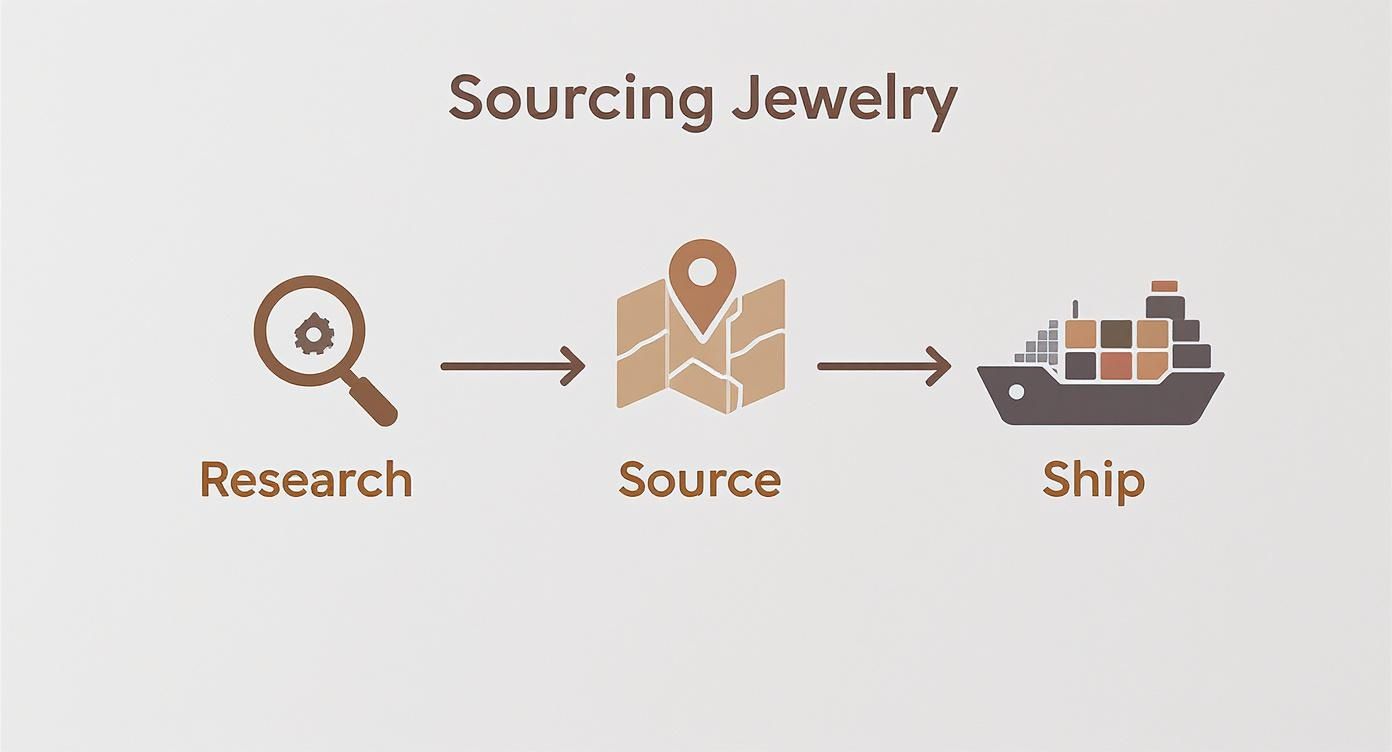
Successful sourcing is a strategic process. It starts with thorough research to find quality and value, and ends with your products safely in hand, ready for sale.
Digital Sourcing Strategies for Finding Value
The internet is your first tool, but you must be strategic. Generic searches are often flooded with middlemen, not the direct sources you need for the best prices and authentic connections.
- B2B Platforms: Websites built for wholesale are a solid starting point. They gather numerous manufacturers and artisans in one place, letting you efficiently compare styles, quality, and prices. Look for platforms that specialize in handcrafted goods or have a strong Latin American presence to find the best value.
- Social Media Scouting: Instagram is a visual goldmine for discovering emerging talent. Use hashtags like #joyeriamexicana, #hechoenmexico, and #artesaniamexicana to find small artisan collectives and independent designers. This approach helps you find unique, story-rich pieces that aren't available from massive distributors.
When you find a potential partner on social media, investigate further. Check their comments, see if other businesses are tagging them, and then reach out directly to inquire about their wholesale process. This direct outreach often builds the strongest, most cost-effective business relationships.
The Power of In-Person Connections
While digital sourcing is efficient, nothing replaces meeting suppliers face-to-face. Attending a trade show allows you to physically handle the jewelry, assess the craftsmanship up close, and build a real rapport with potential partners.
The must-attend event in Mexico is Expo Joya in Guadalajara. It’s a massive gathering of manufacturers, designers, and artisans. Walking the floor provides an incredible overview of the market, from high-volume silver producers offering competitive pricing to small-batch craftspeople with unique designs. You can often negotiate deals on the spot and identify emerging trends.
The state of Jalisco, where Guadalajara is located, is the industry's heart, producing 70% of Mexico's jewelry. This makes events like Expo Joya a critical hub for any business serious about sourcing high-quality, affordable pieces.
Choosing Your Supplier: Large Manufacturers vs. Artisan Cooperatives
The type of supplier you partner with will define your business model. There’s no single "best" choice; it all comes down to what fits your brand's needs for quality, price, and volume.
- Large-Scale Manufacturers: These are your best bet for high volume, consistent production, and competitive pricing. They can handle large orders and typically offer lower per-unit costs but require higher Minimum Order Quantities (MOQs). If you’re stocking a retail chain or a high-volume online store, a manufacturer provides the scale you need.
- Artisan Cooperatives: These are small groups of artisans who collaborate to produce and sell their work. Sourcing from a co-op is ideal for boutiques that prioritize unique, high-quality handmade items. The pieces offer a powerful story to tell, but prices may be slightly higher and production capacity lower. The trade-off is exclusivity and authenticity.
Before proceeding with any supplier, understand which partner aligns with your business model. This table breaks down the key differences.
Comparing Supplier Types for Wholesale Mexican Jewelry
| Supplier Type | Best For | Typical MOQ | Price Point | Customization Level | Pros & Cons |
|---|---|---|---|---|---|
| Large Manufacturers | Businesses needing high volume, consistency, and low per-unit costs. | High (e.g., 100-500+ units per style) | $$ | Moderate to High (with sufficient volume) | Pro: Scalable, affordable. Con: Less unique, high initial investment. |
| Artisan Cooperatives | Boutiques and brands focused on unique, high-quality, handmade items. | Low to Moderate (e.g., 10-50 units per style) | $$$ | High | Pro: Unique designs, authentic story. Con: Limited capacity, higher cost. |
| Online B2B Platforms | New businesses testing the market or those needing a wide variety of suppliers. | Varies Widely | $$-$$$ | Low to Moderate | Pro: Convenient, easy to compare. Con: Quality varies, may include middlemen. |
Choosing the right fit from the start saves time and money. If you need low MOQs and unique pieces, focus on artisan co-ops rather than large factories.
My biggest piece of advice: Ask about MOQs and production capacity in your very first conversation. A beautiful piece of jewelry is useless to your business if the supplier can't produce the quantity you need or requires an order that exceeds your budget.
Many successful businesses use a blended approach. They source their core, best-selling items from a large manufacturer for cost efficiency, then add unique pieces from artisan cooperatives to keep their collection fresh. This strategy provides both stability and a creative edge. For more general advice, check out this guide on how to find the best wholesale jewelry suppliers.
Verifying Supplier Legitimacy and Product Quality
You’ve shortlisted promising suppliers. Now comes the most critical step: the vetting process. This is about protecting your investment and your brand’s reputation. A stunning product photo is worthless if the jewelry that arrives is low-quality or the supplier disappears after you’ve paid.
Let's focus on how to distinguish a reliable partner from a potential risk. Your goal is to build confidence that they can deliver high-quality, affordable products consistently. This means checking their business credentials and physically inspecting their jewelry.

Assessing Business Credentials and Reputation
Before discussing samples, perform a background check. A legitimate, professional business will be transparent.
Start by asking for their business registration details. In Mexico, this is often their Registro Federal de Contribuyentes (RFC) number, their tax ID. While verifying it from abroad can be difficult, their willingness to provide it speaks volumes. Hesitation is a red flag.
Next, search for them online beyond their own website. Look for reviews on industry forums, business directories, or social media. Are other international buyers satisfied? A pattern of complaints about poor quality or missed shipments is a clear warning sign.
A supplier’s refusal to provide business details or references is one of the biggest warning signs. Trustworthy artisans and workshops are proud of their reputation and are usually happy to connect you with other satisfied buyers. If they get defensive, it's time to move on.
Drilling Down on Material and Production Quality
Now let's focus on the product itself. The quality and value of wholesale Mexican jewelry depend on the materials and craftsmanship. You need to know what to look for and what questions to ask.
When discussing materials, be specific.
- For Sterling Silver: "Is your silver stamped with ‘.925’?" This is the non-negotiable standard, certifying the piece is 92.5% pure silver. Anything less cannot be legally called sterling silver.
- For Gemstones: "Are these stones natural, synthetic, or treated? Where are they sourced?" A reputable supplier will disclose if a turquoise stone is genuine from Sonora or a dyed howlite substitute. This transparency is key to ensuring you get the quality you pay for.
- For Plated Jewelry: "What is the base metal, and what is the plating thickness in microns?" Thicker plating ensures durability and longevity, which is a crucial quality indicator for fashion accessories.
Inquire about their production process. Ask them to describe how they make their pieces, from casting and soldering to stone setting and final polishing. This provides insight into their expertise and commitment to quality.
The Critical Importance of Requesting Samples
This is the golden rule: Never place a bulk order without seeing samples first. Samples are your only way to truly assess if the quality, feel, and craftsmanship meet your brand's standards and justify the price.
Order a small but diverse selection representing what you plan to sell. If you’re interested in silver rings, beaded necklaces, and earrings, get one of each to evaluate their skills across different techniques.
When the samples arrive, inspect them methodically.
Your Sample Inspection Checklist:
- Weight and Feel: Does it feel substantial or light and cheap? Real sterling silver has a distinct heft.
- Craftsmanship: Examine solder points, stone settings, and engravings up close. Are the lines clean and precise, or do they look rushed?
- Clasps and Closures: Test every clasp and hook multiple times. A weak clasp is a common failure point and a guaranteed customer complaint.
- Finish: Hold it to the light. Is the polish even and bright? Check for any scratches, pits, or blemishes.
This upfront diligence helps you shift from hoping for a good supplier to knowing you have one. It prevents costly mistakes and lays the foundation for a profitable, long-term partnership in sourcing high-quality wholesale Mexican jewelry.
Negotiating Prices and Payment Terms Like a Pro
You've found a supplier and confirmed their quality. Now it's time to talk numbers. This is a business-to-business negotiation, so the goal is to establish a respectful, long-term partnership that benefits both parties. A fair deal ensures you get affordable pricing while your supplier can maintain their quality standards.
Professionalism and fairness will get you much further than aggressive lowballing. Remember, they want your repeat business just as much as you want their reliable, high-quality products.
Understanding How Pricing Works
When sourcing wholesale Mexican jewelry, prices are rarely fixed. Most suppliers, especially direct manufacturers, use a tiered pricing model: the more you buy, the lower the per-piece cost.
This volume-based discounting is standard practice. It provides the supplier with a larger, more efficient production run and gives your business a healthier profit margin. Don’t hesitate to ask for their price sheet or discount tiers upfront—any serious supplier will have this information ready.
The goal isn't just to get the lowest price on a single order. It's to secure a fair price that allows both your business and the artisan's workshop to thrive. A sustainable partnership is always more profitable in the long run than a one-time "win."
Key Factors to Discuss Beyond Price Per Piece
A smart negotiation covers more than just the sticker price. The terms you agree on will directly impact your cash flow and inventory management. Ensure your discussion includes these critical points:
- Minimum Order Quantities (MOQs): This is the smallest order a supplier will accept. If their MOQ is 500 units per style but you only need 50, they may not be the right fit. For a first order, you can often negotiate a lower MOQ, sometimes for a slightly higher per-piece cost. It's always worth asking.
- Payment Schedules: This is crucial for managing your cash flow. A common arrangement is 50% upfront to cover material costs and start production, with the final 50% due upon completion before shipping. This split is fair and widely accepted.
- Turnaround Times: Ask, "Once I place my order and pay the deposit, how long until it's ready to ship?" This timeline is essential for planning your marketing campaigns and managing inventory.
These elements are as important as the price itself. For a deeper dive into negotiation strategies, check out this guide on how to negotiate effectively with your suppliers.
Choosing the Right Payment Method
Once terms are agreed upon, you need to select the best way to send money. Your choice affects fees, transaction speed, and your level of protection. Here’s a breakdown of common options for paying suppliers in Mexico.
| Payment Method | Security Level | Associated Fees | Best For |
|---|---|---|---|
| International Wire Transfer | Moderate to High | Can be high ($25-$50 per transaction) | Larger, established orders with trusted suppliers. |
| Third-Party Platforms (e.g., PayPal, Wise) | High (with buyer protection) | Lower (often a percentage of the transaction) | First-time orders, smaller payments, and when buyer protection is a priority. |
For your first order with a new supplier, I strongly recommend using a platform like PayPal or Wise that offers buyer protection. The fee may seem high on a small order, but the security it provides is invaluable. As your relationship develops and orders grow, switching to a direct bank wire often becomes more cost-effective. Always confirm which payment methods your supplier accepts.
Navigating International Shipping and Customs
Getting your jewelry from a workshop in Mexico to your business may seem daunting, but it's a manageable process with a clear plan. Once you've approved samples and paid your deposit, the next step is getting your products across the border safely, legally, and affordably.
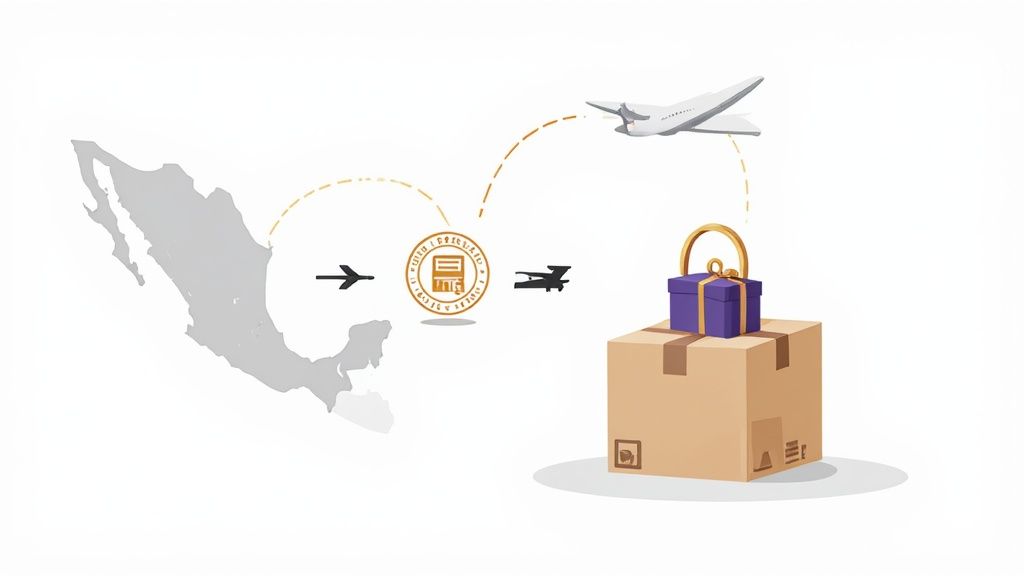
You have two main options for shipping your wholesale order: using a major international carrier or hiring a specialized freight forwarder. The right choice depends on the size and value of your shipment.
Choosing Your Shipping Partner
For your first few smaller orders, using major carriers is often the simplest and most sensible route.
- Express Carriers (DHL, FedEx, UPS): These companies offer a seamless, door-to-door service. They handle both transportation and customs clearance, which is a huge advantage for new importers. Their excellent tracking systems also provide peace of mind.
- Freight Forwarders: Once your orders become larger and heavier (think 50-100 kg or more), a freight forwarder will almost always save you money. These logistics specialists find the most efficient routes and can negotiate bulk shipping rates that you can't get on your own.
A good strategy is to start with a carrier like DHL for your initial orders to learn the process. As your order volume increases, get quotes from freight forwarders to see when it makes financial sense to switch.
The Essential Paperwork for Customs Clearance
This is the part you absolutely cannot get wrong. Proper documentation is essential for clearing customs, regardless of your shipping method. Accurate paperwork is the single best way to avoid delays, unexpected fees, or having your shipment seized.
Your supplier should provide these documents, but you are ultimately responsible for their accuracy. Review them carefully before anything leaves the workshop.
Key Documents You'll Need:
- Commercial Invoice: This is a detailed bill of sale listing the seller, buyer, a clear description of each jewelry item, quantity, unit price, and total value. Customs officials use this to calculate duties and taxes.
- Packing List: This document details the contents of each box in your shipment, including weights and dimensions. It helps customs agents verify the shipment's contents against the invoice.
- Certificate of Origin (COO): This official form certifies that your jewelry was made in Mexico. Depending on your country's trade agreements, this document can sometimes qualify you for lower import duties.
I can't stress this enough: always review these documents for accuracy before your supplier ships the order. A simple typo in a product description or a mismatched value can snowball into a massive customs headache. Double-check everything.
Calculating Your True Landed Cost
To ensure profitability, you must calculate your landed cost. This is the total cost to get a product from your supplier's door to your shelf, ready to sell. Many new importers make the expensive mistake of forgetting this crucial calculation.
The basic formula is:
Landed Cost = Product Cost + Shipping Cost + Customs Duties + Import Taxes + Broker Fees
Let’s use a real-world example. Suppose you order $2,000 worth of sterling silver rings. Shipping with DHL is $250. Your country charges a 5% import duty and a 10% value-added tax (VAT).
- Product: $2,000
- Shipping: $250
- Duty: $2,000 x 5% = $100
- VAT: ($2,000 + $250 + $100) x 10% = $235
Your total landed cost is $2,585, not $2,000. Knowing this number is the only way to price your jewelry correctly and guarantee your business is profitable.
Finally, mastering international logistics is critical, especially if you use services like Fulfillment by Amazon. For more insights, check out this practical guide to shipping products for FBA. Although focused on China, the principles for documentation and cost calculation are universally helpful for any e-commerce seller.
Building a Collection That Sells
Sourcing isn't just about finding suppliers; it's about thoughtful curation. To build a profitable business, your collection needs a clear point of view that attracts and retains customers. This is how you transition from a simple reseller to a sought-after brand.
The key is to build a collection that tells a story. Explore the incredible diversity of wholesale Mexican jewelry beyond the obvious. Consider blending iconic silverwork from Taxco with vibrant Huichol beadwork or delicate filigree designs from Oaxaca. Each style adds a unique chapter to your brand's narrative and appeals to different customer segments.
Balancing Timeless and Trendy Pieces
A successful collection offers a strategic mix of classic staples and on-trend pieces to cater to different tastes and budgets.
Here’s a practical approach to building your inventory:
- Sterling Silver Staples: These are your core products. Think classic hoops, simple chains, and elegant stacking rings. They provide consistent sales and establish your shop as a source for high-quality essentials.
- Artisanal Showpieces: These are your "wow" pieces that draw customers in. A detailed, hand-beaded Huichol necklace or elaborate filigree earrings justify a higher price tag and set your brand apart.
- Affordable Fashion Accessories: Never underestimate the power of trendy, accessible costume jewelry. These items are perfect for impulse buys and offer an easy entry point for customers to engage with your brand.
Mexico’s wholesale costume jewelry market is booming. In 2024, it was valued at $517.01 million and is projected to reach $947.65 million by 2033. Earrings are the largest segment, making them a smart addition to any wholesale order. It’s worth taking a moment to learn more about these market trends to inform your buying decisions.
By curating a smart mix of styles, you create a collection that feels both timeless and fresh. This strategy transforms your inventory from a simple product list into a compelling, shoppable story that keeps customers coming back.
Once your collection is curated, you need to market it effectively. Video is a powerful tool for showcasing your beautiful pieces. If you're new to video marketing, check out this ultimate guide to small business video marketing.
Clearing Up Your Top Questions About Sourcing Mexican Jewelry
Diving into the world of wholesale Mexican jewelry is exciting, but it can also bring up questions, especially for new importers. Addressing these concerns from the start will help you move forward with confidence.
Fortunately, most challenges are easier to overcome than you might think. With a little preparation, you can navigate the process like a pro.
What If I Don't Speak Spanish?
This is a common concern but rarely a deal-breaker. While many smaller workshops primarily speak Spanish, most larger, export-focused suppliers have English-speaking staff.
Even when they don't, you have options. Tools like Google Translate work well for emails. For critical negotiations or video calls, you can hire a freelance interpreter on a platform like Upwork for a reasonable hourly rate. A genuine effort to communicate is always appreciated.
Politeness and patience are universal languages. A simple "por favor" (please) and "gracias" (thank you) can do more to build a strong partnership than you might imagine.
How Much Money Do I Actually Need to Start?
You can start sourcing without a huge investment. A realistic starting budget to begin sourcing high-quality jewelry is typically between $500 and $2,000.
What does that budget cover?
- Sample orders: Test the quality from 2-3 different suppliers.
- Your first small wholesale order: Enough to meet a reasonable Minimum Order Quantity (MOQ) with your chosen supplier.
- Shipping and customs fees: Don't forget to budget for the cost of getting the goods to your door.
Starting small is the smartest approach. It allows you to test the market and verify a supplier's reliability before committing significant capital to inventory. It's a low-risk strategy for building your business.
Ready to source beautiful, high-quality jewelry without the high costs and logistical headaches? At JewelryBuyDirect, we offer over 120,000 on-trend styles with no minimum order, factory-direct pricing, and free worldwide shipping on orders over $150. Start building your dream collection today at https://www.jewelrybuydirect.com.