






Arthur Lynch | Thu Sep 11 2025
A Guide to Wholesale Jewelry in China
Sourcing wholesale jewelry in China isn't just a business transaction; it's a strategic decision that can completely reshape your brand. You're tapping directly into the global epicenter of jewelry manufacturing, which means incredible selection, sharp pricing, and advanced production capabilities all at your fingertips. Think of this guide as your insider's map to navigating this powerful market successfully.
So, Why China for Wholesale Jewelry?
Looking to China for your jewelry supply is about much more than just finding a cheaper price tag. It’s a smart play to give your business a serious competitive advantage. The scale of production here is staggering, giving you access to a practically endless variety of styles. Whether you're after timeless classics or the hottest new trends, it’s all here, produced within a single, massive manufacturing ecosystem. This lets you build out a unique collection that truly speaks to your ideal customer.
What's really happening on the ground is that China's manufacturing game is incredibly sophisticated. They’re using advanced production techniques that would cost a fortune elsewhere, allowing you to source high-quality, intricate designs without blowing your budget. At the end of the day, that efficiency means healthier profit margins for you and the ability to offer great prices to your own customers.
A World of Choice at Your Fingertips
The sheer production capacity is one of the biggest draws. Need a small test run of 100 rings? No problem. Need to scale up to 10,000 necklaces for a bestseller? They can handle that, too. This kind of scalability is a game-changer for a growing business, letting you pivot your inventory based on real-time sales data and what's trending. You can start small, experiment with new looks, and then go all-in on your winners.
For retailers, this means you'll never be late to a trend. Chinese factories can pivot to new styles—from delicate, gold-plated pieces to bold, vibrant statement jewelry—at a speed that lets you keep your collection fresh and exciting all year round.
Tapping into a Market That's Only Getting Bigger
The numbers back it all up. China's position as a jewelry sourcing hub isn't just strong; it's set for major growth. The wholesale jewelry market here is projected to swell to around $150 billion by 2035. That's not just a big number; it signals a stable, healthy industry you can build a business on.
By sourcing from this expanding market, you're positioning your brand for long-term success and ensuring you always have access to the latest innovations. You can learn more about these market projections and see how they can directly impact your business strategy.
Identifying Key Chinese Jewelry Trends
If you want to succeed in sourcing wholesale jewelry from China, you need to do more than just hunt for the lowest price. It takes a keen eye for what’s actually selling right now. Staying ahead of the curve isn't about guesswork; it's about knowing the styles, materials, and design trends that are capturing shoppers' attention and making smart buys based on that intel.
The Chinese jewelry market is a fascinating mix of global fashion and unique local tastes. When you tune into these trends, you can curate a collection that feels fresh, relevant, and genuinely exciting to your customers. Knowing what's in demand is your single biggest advantage.
Global Trend 1: Statement Pieces and Maximalism
While minimalism has its place, the dominant global trend is a shift towards jewelry that demands attention. We're seeing oversized hoops, chunky chain necklaces, and bold cocktail rings making a major comeback. In China, this translates into an explosion of vibrant, expressive designs that use color and scale to make an impact. This isn't about quiet accessorizing; it's about jewelry as the main event.
Actionable Insight: When browsing supplier catalogs, filter for "statement," "chunky," or "oversized" pieces. Look for manufacturers experimenting with unconventional shapes and dramatic silhouettes. These "hero" pieces are perfect for social media marketing and will stand out in your online store.
Today’s shoppers want jewelry that tells a story and says something about who they are. When you source bold, unique pieces from China, you're tapping directly into that desire for self-expression with designs they just can't find anywhere else.
Global Trend 2: Mixed Materials and Sustainable Choices
The market is buzzing with creative combinations that create incredible textures and visual interest, moving beyond simple, single-material designs.
- Mixed Media: Seek out designs that merge classic metals like gold-plated silver with modern materials like colorful resin, polished acrylic, or even natural wood. This trend is huge across North America and Europe.
- Eco-Conscious Sourcing: Sustainability is no longer a niche concern. Ask suppliers about their use of recycled metals or ethically sourced stones. This is a powerful selling point you can use in your marketing.
- Organic Shapes: Pieces featuring natural elements like baroque pearls, raw-cut gemstones, and freeform shells are performing exceptionally well. They align with a global desire for authenticity and connection to nature.
The infographic below shows just how much the demand for innovative and unique jewelry from China is growing.
The data here points to a clear trend: product innovation and brand building are what’s driving the industry forward.
This move toward creative and responsible materials isn't just a fad. The whole market is embracing unique styles, bigger sizes, richer colors, and mixed materials, all while responding to the growing demand for sustainable options. These aren't just small changes; they signal real long-term growth driven by fresh ideas. You can find more details on these foreign trade industry trends and see where the market is headed.
Regional Trend 3: Personalization and Modern Heirlooms
Customization has evolved from a simple add-on to a core expectation, particularly in Western markets. Chinese manufacturers are highly adept at offering scalable personalization options.
Actionable Insight: Focus your sourcing on items that can be easily personalized:
- Engravable Surfaces: Prioritize suppliers offering simple pendants, signet rings, and bar bracelets perfect for initials or dates.
- Modular Designs: Look for charm-based systems or necklaces with interchangeable pendants that allow customers to build their own story.
- Birthstone Jewelry: A perennial bestseller. Source collections that offer a full range of birthstones, not just a select few.
By focusing on these key trend areas—bold designs, mixed materials, and personalization—you can build a collection of wholesale jewelry from China that is globally relevant and highly profitable.
How to Find and Vet Reliable Suppliers
When it comes to sourcing wholesale jewelry in China, finding the right partner is everything. Think of your supplier as the manufacturing arm of your business, not just some faceless vendor. The quality of this relationship directly shapes your product, your timelines, and ultimately, your brand's reputation with customers. You need a solid game plan to find and qualify the partners who will consistently deliver.
The search starts with knowing where to look. You’ve basically got two main avenues: online B2B marketplaces and old-school, in-person industry trade shows. Each has its own rhythm and is better suited for different business needs.
Exploring Key Sourcing Channels
Most people’s first stop is an online platform like Alibaba. It makes sense—you get access to a massive directory of manufacturers without ever leaving your desk. You can filter by product, check out certifications, and skim through supplier ratings to quickly build a long list of potential partners.
But here's the catch: a slick online profile can hide a lot. It’s tough to get a true feel for a factory’s scale, their real quality standards, or even their working conditions just by looking at a screen. That’s exactly why seasoned buyers make a point to attend major trade shows in China, like the Hong Kong International Jewellery Show or the China International Gold, Jewellery & Gem Fair. These events let you meet people face-to-face, hold the products in your hands, and start building genuine relationships that you just can't get through email.
The smartest approach? Use both. Start your search on the big marketplaces to cast a wide net and do your initial research. Then, try to meet your top contenders at a trade show to seal the deal. This two-pronged strategy gives you both efficiency and confidence.
Navigating these channels can be tricky, so let's break down the pros and cons of each.
Comparing Supplier Sourcing Channels
| Channel | Pros | Cons | Best For |
|---|---|---|---|
| Online B2B Marketplaces | Massive selection, convenient, easy to compare prices and create a long list of potential suppliers. | Difficult to verify quality and factory conditions, risk of dealing with traders instead of manufacturers, can feel impersonal. | Initial research, finding a wide range of options quickly, and businesses on a tight travel budget. |
| Industry Trade Shows | Meet suppliers face-to-face, inspect product quality firsthand, build personal relationships, discover new trends. | Requires travel time and budget, can be overwhelming, you only see suppliers who attend. | Serious buyers ready to place orders, finalizing partnerships, and networking with industry insiders. |
| Sourcing Agents | Local expertise, handles communication and negotiation, can manage quality control on your behalf. | Adds a commission fee to your costs, you have less direct control over the relationship with the factory. | Newcomers to sourcing, businesses that need on-the-ground support, and those looking to save time. |
Ultimately, the best channel depends on your budget, experience, and how hands-on you want to be.
An Actionable Checklist for Vetting Suppliers
Once you have a shortlist of potential suppliers, the real work begins. Rushing this part is a rookie mistake that can cost you dearly. A thorough vetting process will save you from headaches like production delays, shoddy quality, and financial loss down the road.
Your mission is to see past the marketing fluff and get a clear picture of their real capabilities. Here’s a practical checklist to guide you:
-
Verify Business Credentials: First things first, ask for their business license and any export licenses. A legitimate manufacturer will have this ready to go. This simple request is a great first filter to weed out inexperienced middlemen or sketchy operators.
-
Assess Production Capacity: Get a feel for their Minimum Order Quantity (MOQ) and their maximum output. You need to know if they can handle your first small test order and, just as importantly, if they can scale with you when your business takes off.
-
Check Quality Control Certifications: Keep an eye out for internationally recognized standards like ISO 9001. This isn't just a piece of paper; it shows the supplier has a formal quality management system, which is a strong indicator of their commitment to consistency.
-
Evaluate Communication and Responsiveness: This one’s huge. How do they communicate? Are their emails clear, professional, and timely? You can work through language barriers, but a supplier who is slow or confusing from the start is a major red flag for how they’ll be to work with later.
This image gives you a glimpse of the incredible variety you can source—from classic pendants to on-trend bracelets—once you lock in the right manufacturing partner.
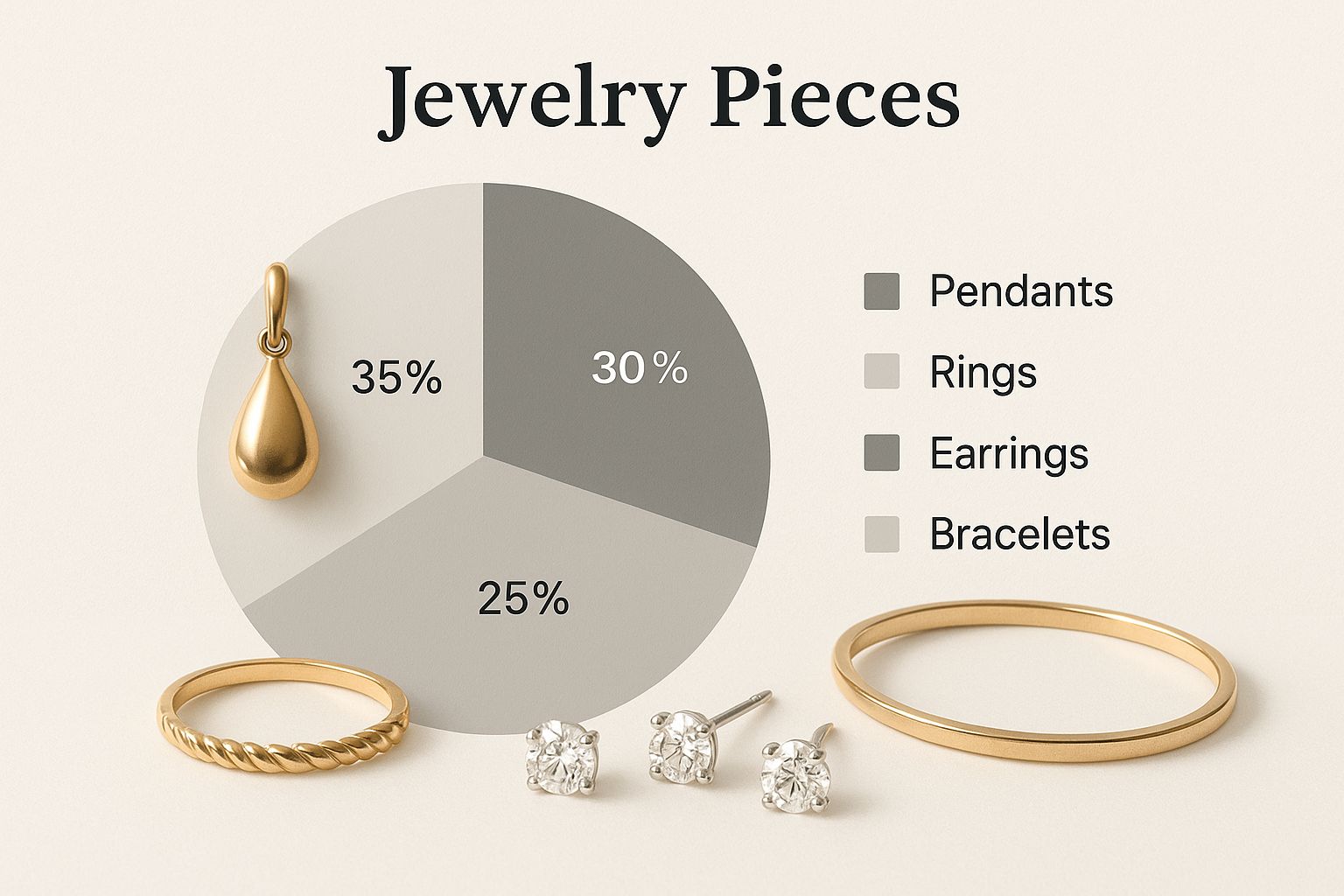
It’s a good reminder of why vetting a supplier’s ability to handle different materials and complex designs is so critical to your success.
The Non-Negotiable Sample Order
No matter how great a supplier seems on paper or how well your first few calls go, ordering samples is a non-negotiable step. This is your one chance to physically hold the product, check the finishing, and confirm the materials are what you asked for. It is, without a doubt, the best way to see if they can walk the walk.
When the samples arrive, be ruthless. Check the weight, inspect the plating, test the clasps, and look closely at any stone settings. Compare the real thing to their photos and your spec sheet. This is your final exam before you commit to a full production run. For more specific tips, this guide on finding wholesale jewelry for boutiques has some great insights.
Follow these steps, and you’ll build a solid foundation for a profitable partnership, turning a factory in China into a trusted extension of your own brand.
Putting a Rock-Solid Quality Control Process in Place
When you're sourcing wholesale jewelry in China, you can't just cross your fingers and hope for the best. Quality isn't a happy accident; it’s the result of a deliberate, well-executed process. A strong quality control (QC) plan is your best defense against defects, shipping delays, and the kind of bad reviews that can sink a brand.
Without a solid QC strategy, you’re essentially flying blind. You won't know there’s a problem until a wave of returns comes in from unhappy customers. By then, the damage is already done. This is about shifting from reacting to problems to preventing them from ever happening.
Start with the Blueprint: Your Specification Sheet
Before the factory even thinks about production, you need to hand them a detailed technical specification sheet, or "tech pack." Think of it as the architectural blueprint for your jewelry. It’s your single source of truth that leaves absolutely no room for interpretation or cultural misunderstandings.
A vague request like "gold-plated necklace" is an open invitation to disaster. A proper spec sheet, on the other hand, provides crystal-clear instructions and acts as your quality contract with the supplier.
Your spec sheet needs to nail down every last detail:
- Precise Measurements: Specify everything in millimeters—chain lengths, ring diameters, pendant dimensions, you name it.
- Material Breakdown: State the exact base metal (like 925 sterling silver or brass) and plating requirements (e.g., 18k gold plating at 1.0 micron thickness).
- Colors and Finishes: Use Pantone codes for any enamel work and clearly describe the finish you want (polished, matte, brushed, etc.).
- Component specifics: Don't forget the little things. Specify the exact clasp type, earring back, or chain style.
- Packaging Instructions: Explain how every single piece should be wrapped and boxed to prevent scratches or damage during its long journey.
This document is your ace in the hole. If a product doesn't match these specs, you have clear, documented proof to back up your request for a correction or rework.
The Three Make-or-Break Inspection Stages
Quality control isn't a one-and-done deal at the end of the line. Relying solely on a final inspection is a huge gamble. By that point, fixing widespread issues can be incredibly expensive and cause massive delays. The smart move is to build checkpoints into the entire production timeline.
1. Pre-Production Inspection (PPI)
This first check happens before mass production kicks off. An inspector’s job here is to verify that the factory has the right raw materials and components ready to go. They'll confirm that the sterling silver meets the 92.5% purity standard or that the gemstones match your order. Catching a mistake here, like the wrong type of alloy, saves the entire batch from being made incorrectly.
2. During Production Inspection (DPI or DUPRO)
When your order is about 20-50% complete, it's time for a mid-production check. This is your early-warning system. Inspectors pull items right off the assembly line to hunt for any recurring defects. It's the perfect time to spot and fix a systematic problem—like a bad soldering joint or inconsistent plating—before it impacts thousands of pieces.
3. Pre-Shipment Inspection (PSI)
This is the final hurdle. The PSI happens once the order is 100% finished and at least 80% packed for shipping. Using a statistical sampling method called AQL (Acceptance Quality Limit), the inspector randomly pulls a selection of products and gives them a final, thorough review against your spec sheet. This is your last chance to give the green light before the goods leave the factory and you send the final payment.
Think of a multi-stage inspection process as your eyes and ears on the factory floor. It transforms quality from a final-gate check into something that’s woven into the very fabric of production, protecting your investment and brand.
Whether you fly over to do these checks yourself, trust your supplier's internal team, or hire a third-party inspection service, the goal is the same. A robust QC process gives you the power to enforce high standards, keep your customers happy, and build a brand that people trust for its quality.
Mastering Shipping and Customs Clearance
You’ve found your supplier and the final samples look perfect. Now for the last mile—getting your jewelry from the factory in China to your warehouse. This part of the journey can feel a bit intimidating, but it’s really just a logistics puzzle. Once you break it down, it's a clear and predictable process.
Success here boils down to two things: picking the right shipping method and getting the paperwork right.
Think of it like choosing how to travel. You could take a private jet, a commercial flight, or a cruise ship. Each serves a different purpose, and the best choice depends on how much you have, how fast you need it, and what you're willing to spend.
Choosing Your Shipping Method
When shipping wholesale jewelry from China, you’ll generally choose from three main options. Each one offers a unique trade-off between speed and cost.
-
Express Couriers (The Private Jet): Services like DHL, FedEx, and UPS are your fastest, simplest choice. They handle everything from the factory door to yours, including customs. This is perfect for small, high-value orders or urgent samples when speed is everything. Naturally, that convenience comes at the highest price per kilogram.
-
Air Freight (The Commercial Flight): This is the happy medium. It's much faster than shipping by sea but more affordable than an express courier. Air freight is ideal for orders that are too big for a courier but are still time-sensitive. It usually takes about 5-10 days and moves your goods from one airport to another. You'll likely need a freight forwarder to manage the ground transport on both ends.
-
Sea Freight (The Cruise Ship): For large, heavy orders, nothing beats sea freight on price. It's the most economical way to move bulk inventory, but it's also the slowest, often taking 30-40 days or even longer. If you can plan your inventory well ahead of time and your main goal is keeping costs down, this is your best bet.
Making the right choice here is a strategic business decision that directly impacts your profit margins and how quickly you can restock your bestsellers.
Decoding Essential Logistics Terms
As you start getting shipping quotes, you'll run into a bunch of industry acronyms. These are called Incoterms, and they simply define who is responsible for the shipment at every stage of its journey.
Incoterms are like the rules of the road for international shipping. They clearly state where the seller's responsibility ends and the buyer's begins, preventing costly misunderstandings about who pays for what and when.
The two you'll encounter most often are:
- EXW (Ex Works): With this term, your responsibility starts the moment the goods leave the factory doors. You arrange and pay for everything—pickup, transport to the port, shipping, customs, and final delivery. It gives you total control, but it's also the most hands-on approach.
- FOB (Free On Board): This is incredibly common and often the best option for new importers. The supplier is responsible for getting the goods to the port in China and loaded onto the ship. From that point on, you take over all costs and risks. FOB is a great balance, leaving the local Chinese logistics to your supplier while you control the main international leg of the journey.
Your Partner in Logistics: The Freight Forwarder
Unless you're a seasoned pro in international shipping, you’ll want a freight forwarder on your team. Think of them as a travel agent for your cargo. They don't own the planes or ships, but they have the network and expertise to manage the entire process for you.
A good forwarder will find you the best rates, book the space, handle all the mind-numbing paperwork, and make sure your shipment clears customs without getting stuck.
Working with a reliable forwarder removes a massive headache, freeing you up to focus on growing your business while they handle the complexities of getting your wholesale jewelry from China to your door. For more context on finding the right partners, our article covering where to buy wholesale jewelry can offer additional insights.
Navigating Customs and Documentation
This is one area where you can't afford to cut corners. Proper documentation is absolutely non-negotiable. Inaccurate or missing paperwork is the #1 reason shipments get delayed, racking up storage fees and causing major frustration.
Here are the essential documents you’ll need to have in order:
- Commercial Invoice: This is the official bill for your goods. It details the transaction, describes the jewelry, states its value, and lists the quantity. Customs officials use this to calculate the duties and taxes you owe.
- Packing List: This document gives a detailed breakdown of what's inside each box, including weights and dimensions. It helps customs verify the contents of your shipment without having to open every single carton.
- Bill of Lading (B/L) or Air Waybill (AWB): This is your contract with the shipping company. It acts as a receipt for your goods and is the legal document you need to claim your shipment when it arrives.
By getting a handle on these key elements—shipping methods, Incoterms, and documentation—you can build a reliable and cost-effective supply chain that keeps your business running like a well-oiled machine.
Sourcing from the High-End Jewelry Market
Step away from the high-volume world of fashion accessories, and you'll discover a completely different side of wholesale jewelry in China. This is the realm of high-end manufacturing—a place where master craftsmanship and premium materials intersect to produce true luxury pieces. Sourcing here isn't like standard wholesale; it's a different game altogether.
The focus here isn't on cranking out thousands of units at top speed. Instead, it’s all about artistry, precision, and exclusivity. You'll find yourself working with manufacturers that supply some of the world's top luxury brands, so their standards for quality and design originality are incredibly high. This part of the industry is built for consumers who want investment-grade jewelry and collections that tell a unique story.
What Sets the High-End Market Apart
Diving into luxury jewelry sourcing demands a meticulous eye for detail. It's not just about the finished necklace or ring. It's about the entire journey—from ensuring your gemstones are ethically sourced to crafting the narrative that makes your collection special.
A few things really make this market stand out:
- Design Exclusivity: Don't even think about bringing a copy of someone else's work. These manufacturers expect you to arrive with your own unique designs or collaborate with their in-house teams to create something one-of-a-kind. Intellectual property isn't just a buzzword; it's deeply respected.
- Material Integrity: The obsession with quality starts with the raw materials. Think high-purity precious metals like 18k gold and platinum, and gemstones evaluated for exceptional clarity and cut. There are no shortcuts here.
- Superior Craftsmanship: Techniques that require incredible skill, like micro-pavé setting, flawless hand-polishing, and complex metalwork, are the norm. The finish on every single piece is expected to be perfect.
Sourcing high-end jewelry is less of a transaction and more of a partnership. You are collaborating with artisans to create pieces that command a premium price and build a reputation for quality and distinction.
Navigating the Luxury Supply Chain
You won't find these elite suppliers on the usual B2B platforms. The best high-end manufacturers often operate through word-of-mouth referrals and showcase their work at exclusive trade fairs. Panyu, for example, is a city renowned for its world-class gemstone processing and fine jewelry production, making it a key hub for anyone serious about luxury sourcing.
And this market is absolutely thriving, thanks in large part to a growing middle class with an appetite for premium goods. In fact, China’s luxury jewelry market is on track to hit an estimated $68.24 billion by 2029. That kind of growth signals a massive opportunity for businesses that are ready to meet the demands of a more sophisticated customer.
If you want to understand the potential, it's worth reading up on the resilience of China's luxury market. Breaking into this space successfully means building a brand that embodies exceptional quality, ethical practices, and a story that truly connects with people.
Common Questions About Sourcing Jewelry in China
Diving into sourcing wholesale jewelry in China can feel like a huge leap, and it’s completely normal to have a long list of questions. Getting straight answers is the first step to building confidence and a solid plan.
Let's walk through some of the most common hurdles and concerns that pop up for businesses just starting out. We'll cover everything from order sizes to making sure your money is safe.
What Is a Typical Minimum Order Quantity?
This is usually the first question on everyone's mind: "How much do I have to buy?" The short answer is, it depends. There's no one-size-fits-all minimum order quantity (MOQ). It really comes down to the supplier and the type of jewelry you're after.
For simple, mass-produced pieces like basic chains or simple studs, you’ll often see MOQs starting in the hundreds per style. But if you’re looking at more complex or custom designs that need new molds or detailed hand-setting, factories are usually more flexible. In those cases, you might see MOQs as low as 50 units for a single design.
The key is to bring this up early. You want to make sure a potential supplier is a good match for your business before you get too far down the road.
How Can I Pay Chinese Suppliers Safely?
Sending a large sum of money halfway around the world can be stressful. The good news is, there are well-established, secure ways to handle payments that protect you.
- Alibaba Trade Assurance: This is a fantastic safety net, especially for your first few orders. It works like an escrow service—your money is held by Alibaba until you confirm that you’ve received your products and they meet your standards.
- Bank Transfers (T/T): The most common method by far is a Telegraphic Transfer. The industry-standard deal is a 30% deposit to kick off production, with the final 70% balance paid once the goods have passed inspection but before they ship out.
- Avoid Risky Methods: For any order of significant value, never use irreversible methods like Western Union. They offer you virtually zero protection if something goes wrong.
Are There Specific Jewelry Hubs in China?
Absolutely. China’s manufacturing landscape is highly specialized, with different cities and regions acting as hubs for specific types of jewelry. Knowing where to look can save you a ton of time.
Guangzhou is a powerhouse for both fashion and fine jewelry. Down the road, Panyu has earned a reputation for its incredible gemstone work and high-end manufacturing. And then there's Yiwu, home to a world-famous, sprawling wholesale market that's the go-to destination for costume jewelry and fast-fashion accessories.
How Do I Protect My Unique Designs?
This is a big one. If you've poured your creativity into unique designs, protecting your intellectual property (IP) is crucial. You need a solid legal agreement that actually holds up in China.
Before you even think about sending over your designs or tech packs, get your potential supplier to sign a Non-Disclosure, Non-Use, and Non-Circumvention (NNN) agreement. This isn't your standard NDA. An NNN is specifically designed for China's legal system and gives you real teeth to stop them from copying your designs or selling them to your competitors.
Registering your designs in China provides another strong layer of legal defense. For a deeper dive into these strategies, our guide on buying wholesale jewelry for resale has some great tips. Getting these protections in place from day one is one of the smartest things you can do.
At JewelryBuyDirect, we take the guesswork out of sourcing. You get direct-from-factory pricing, no minimums, and instant access to thousands of on-trend styles. We're here to help your business grow. Explore our collections and start saving today. https://www.jewelrybuydirect.com