






Arthur Lynch | Wed Sep 03 2025
Your Guide to Sourcing Profitable Wholesale Crystal Jewellery
Welcome to the sparkling world of wholesale crystal jewellery—a dynamic intersection of stunning aesthetics and smart business. If you're looking for a venture with tangible growth potential, you've found it. This guide is your complete roadmap, designed to provide actionable insights for building a successful business from the ground up.
We'll explore why this market is booming, driven by a powerful blend of fashion trends and the global wellness movement. Consider this your first step toward building a thriving, trend-aware jewellery brand.
Starting Your Wholesale Crystal Jewellery Journey
Entering the wholesale crystal jewellery market isn't just about launching another business; it's about tapping into a rapidly expanding global industry. Today’s consumers seek more than just accessories—they want pieces that offer personal meaning and align with current fashion sensibilities.
The massive global interest in wellness and mindfulness has propelled crystals like amethyst, rose quartz, and clear quartz into the mainstream. What were once niche spiritual items are now essential fashion statements. This cultural shift presents a significant opportunity for entrepreneurs who can strategically source and market these pieces.
Buying wholesale is your primary competitive advantage. It provides access to direct-from-factory pricing, enabling you to build a diverse and profitable inventory. This model is the financial engine of successful retail, creating the margins necessary for sustainable growth.
Understanding the Market Dynamics
While the appeal of crystal jewellery is universal, consumer preferences vary dramatically across regions. For example, shoppers in North America and Europe currently favor minimalist designs with raw, unpolished stones that emphasize natural beauty.
In contrast, markets in Asia and the Middle East often show a preference for more ornate, polished pieces featuring vibrant crystals set in elaborate metalwork. Actionable insight: To succeed, you must analyze these regional trends and curate your inventory to match the specific aesthetic of your target audience.
Another critical factor is ethical sourcing. Modern consumers are highly conscious of where their products originate. Studies indicate that nearly 60% of shoppers prioritize buying from brands transparent about their supply chains. This means your success hinges on partnering with suppliers who provide verifiable proof of authenticity and ethical sourcing.
The most successful retailers don't just sell products; they sell stories. For crystal jewellery, that story is a powerful mix of personal wellness, timeless style, and ethical consciousness.
Setting the Stage for Success
This guide will walk you through every critical step. We'll cover everything from spotting profitable trends and finding trustworthy suppliers to nailing your pricing strategy. Each section is packed with actionable advice you can use right away.
By building on a strong foundation, you'll be ready to navigate this exciting industry with confidence. For a great look at what comes next, learning how to sell jewelry online is the perfect way to turn your beautiful inventory into real sales. Let's get started.
Understanding Global Jewellery Trends and What Sells
To build a competitive edge in the wholesale crystal jewellery business, you must adopt the mindset of a trend forecaster. Success isn't about stocking what you personally find beautiful; it's about deeply understanding global consumer demand and anticipating future shifts. Your ability to translate these insights into a curated collection will define your success.
Fashion is a global conversation with distinct regional dialects. A design that becomes a bestseller in a New York boutique might fail to resonate with shoppers in Mumbai. The key is to identify these nuances to build a collection that feels both globally relevant and locally specialized.
The global crystal jewellery market is on a strong upward trajectory, with forecasts showing a compound annual growth rate (CAGR) of approximately 5.5% between 2024 and 2031. Notably, the Asia Pacific region is projected to lead this growth with an impressive 7.5% CAGR, driven by cultural traditions and rising disposable incomes. North America (3.7%) and Europe (4%) show steady growth, but the data points to significant opportunities in emerging markets. If you want to dig into the data yourself, you can explore the full crystal jewellery market report.
The image above showcases the raw, natural stones—like amethyst and quartz—that are central to many current trends. This earthy, authentic aesthetic is a major purchasing driver, particularly in Western markets where consumers seek a connection to nature.
Contrasting Global Style Palettes
Actionable insight: treat your inventory as a curated gallery where each piece is chosen to resonate with a specific cultural and regional aesthetic. In North America and much of Europe, the dominant trend is minimalism and authenticity. Shoppers are drawn to raw, unpolished stones in simple settings, such as a single clear quartz point on a delicate silver chain or rough-cut amethyst studs. The focus is on the inherent beauty of the stone itself.
However, in many parts of Asia, particularly India and China, the aesthetic shifts towards vibrancy and intricacy. Here, you will find a higher demand for polished, brightly coloured stones set in elaborate, often traditional, designs. This includes intricate beadwork, multi-stone statement pieces, and bold, eye-catching jewellery that signifies status and cultural heritage.
To truly succeed, stop selling to a region and start curating for a culture. Understanding the 'why' behind a trend—be it a desire for minimalist calm or celebratory vibrancy—is the key to unlocking its sales potential.
To give you a clearer picture, let's break down these regional tastes.
Global Crystal Jewellery Trend Snapshot
Here's a look at how styles, stones, and shopper motivations differ across major markets.
| Region | Dominant Style Trend | Popular Crystals | Key Consumer Driver |
|---|---|---|---|
| North America | Raw, Minimalist, Earthy | Clear Quartz, Amethyst, Selenite | Authenticity, Wellness, Connection to Nature |
| Europe | Chic Minimalism, Vintage-Inspired | Rose Quartz, Moonstone, Labradorite | Understated Elegance, Personal Style, Storytelling |
| Asia Pacific | Intricate, Bold, Colourful | Jade, Carnelian, Citrine | Tradition, Status, Good Fortune, Vibrant Expression |
| Latin America | Vibrant, Statement Pieces, Layered | Turquoise, Agate, Pyrite | Cultural Expression, Colour, Festive Spirit |
This table provides an actionable framework for inventory planning, demonstrating why a one-size-fits-all sourcing strategy is ineffective. Each region demands a tailored approach.
The Rise of Conscious Consumerism
Beyond aesthetics, a powerful global trend is reshaping the industry: ethical and sustainable sourcing. Today’s consumers are informed and discerning. They demand transparency about the origins of their jewellery: Where was the crystal mined? Were workers treated fairly? Is the packaging eco-friendly?
This is no longer a niche concern but a mainstream expectation. Actionable insight: Make transparency your competitive advantage. Actively seek out suppliers who can verify their ethical practices and feature this commitment in your marketing. This builds profound trust and positions your brand as one that consumers can feel good about supporting.
Tapping into Future Color and Crystal Trends
To stay ahead of the curve, you must monitor emerging trends. Colour forecasting provides valuable clues. For 2025, trend analysts are highlighting rich, earthy tones like "Mocha Mousse," a warm, grounding brown.
This gives you a direct signal about which crystals are poised for increased demand. Actionable insight: Proactively stock stones that align with this future colour palette to position your business as a trend leader.
- Smoky Quartz: Its translucent brown hues perfectly capture a cozy, grounding energy.
- Brown Tourmaline: With deep, chocolatey tones, this stone offers an understated elegance that feels both natural and luxurious.
- Tiger's Eye: The mesmerizing golden-brown bands bring a dynamic warmth that is both bold and versatile.
By balancing your inventory to meet established regional tastes while simultaneously anticipating future trends, you create a winning strategy. This ensures your collection remains fresh, relevant, and highly sellable.
How to Find Reliable Wholesale Suppliers
Your wholesale crystal jewellery business is only as good as the suppliers you work with. This isn't just a transaction; it's a partnership. Finding reliable, ethical, and high-quality sources is the single most important step in building a brand that lasts. Think of your suppliers as the foundation of a house—if it’s weak, everything you build on top of it is at risk.
This is where the real work begins. It’s a hands-on process of research, communication, and careful vetting to find partners who consistently deliver authentic, beautiful products your customers will adore. This process separates the thriving businesses from the ones constantly battling quality issues and empty shelves.
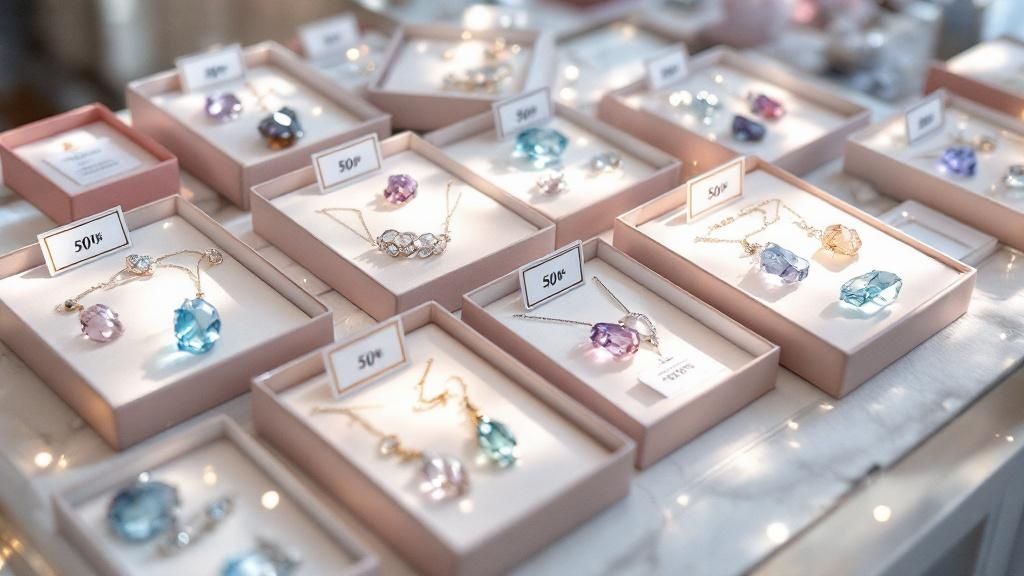
The goal is to move beyond simply finding a vendor. You want to build a true supply chain partnership. A great supplier relationship means a steady stream of high-quality, authentic products that reflect your brand’s values and make your customers happy.
Comparing Your Sourcing Options
There are several roads you can take to source your crystal jewellery, and each has its own pros and cons. The right choice really boils down to your business size, budget, and how willing you are to travel.
- Direct from Mines and Manufacturers: Going straight to the source can slash costs by cutting out the middleman. The catch? This route often demands huge minimum order quantities (MOQs) and might mean international travel and navigating complex logistics.
- International Trade Shows: Events like the Tucson Gem and Mineral Show or the Hong Kong International Jewellery Show are absolute gold mines. You can meet hundreds of suppliers in one spot, hold the products in your hands, and forge real, personal connections.
- Online B2B Platforms: Sites like Alibaba, Global Sources, and even Etsy Wholesale give you access to a massive directory of suppliers from your desk. It’s convenient, but you have to do extra homework to verify who’s legit and whether their quality is up to par.
For many small and mid-sized businesses, a hybrid approach is the sweet spot. You can use online platforms for your initial digging and then attend a trade show to meet your top contenders in person. This gives you the best of both worlds: the efficiency of online research and the confidence that comes from a face-to-face meeting.
Your Supplier Vetting Checklist
Okay, so you've got a list of potential suppliers. Now comes the vetting process. Don't skip or rush this part. A bit of thorough evaluation now will save you from massive headaches down the line.
A supplier isn't just a transaction; they're an extension of your brand. The quality of their products and the integrity of their practices directly reflect on you. Choose partners who align with the promises you make to your customers.
Use this checklist to put every potential partner under the microscope:
- Request Samples: This is completely non-negotiable. Photos can lie, and you need to physically inspect the jewellery. Check the crystal quality, the metal settings, the clasps—everything. How does it feel?
- Verify Certifications: Ask for proof of authenticity and ethical sourcing. A legitimate supplier won't hesitate to provide documentation, like GIA reports for certain stones or certifications for ethical labour practices.
- Assess Communication: How do they talk to you? Are they responsive, clear, and professional? If communication is a struggle now, imagine what it’ll be like when there’s a problem with an order.
- Check Their Reputation: Do some digging. Look for online reviews, testimonials, and industry references. How long have they been around? Do they have a professional website?
- Understand Their Capacity: Talk about their production capacity and lead times. Can they handle your order volume if your business takes off? Vague answers are a red flag for future inventory nightmares.
This methodical approach will help you trim a long list of possibilities down to a shortlist of reliable partners you can actually build a business with.
Asking the Right Questions to Avoid Pitfalls
The questions you ask can reveal everything you need to know about a potential supplier. Go beyond just asking for a price list—dig deeper to protect your business.
Key Questions to Ask Potential Suppliers
- "Can you detail your ethical sourcing policies and provide any supporting documentation?"
- "What is your process for quality control before products are shipped?"
- "What are your exact Minimum Order Quantities (MOQs), and is there any flexibility for a first-time order?"
- "Can you provide a detailed breakdown of all costs, including shipping, duties, and any hidden fees?"
- "What is your policy for handling damaged or defective items upon arrival?"
Asking direct, specific questions like these helps you spot transparent, professional suppliers and weed out the ones who aren't. Building a strong foundation is crucial, and you can learn more about finding the right partners in our guide to sourcing wholesale jewelry for boutiques. By investing time upfront to find the right partners, you create a resilient supply chain that becomes a true competitive advantage.
Spotting Authentic Crystals from Fakes
In the crystal jewellery business, your reputation is everything, and it’s built on one thing: authenticity. The market is flooded with clever fakes, and knowing how to tell a genuine stone from an imitation is a skill you absolutely must master. This isn't just about quality control; it's about earning the trust of your customers, who count on you to sell them the real deal.
Think of this as your field guide for separating the treasures from the trash. A few key principles will protect your investment, your brand, and the relationship you have with your customers. It’s what turns a one-time buyer into a lifelong fan.
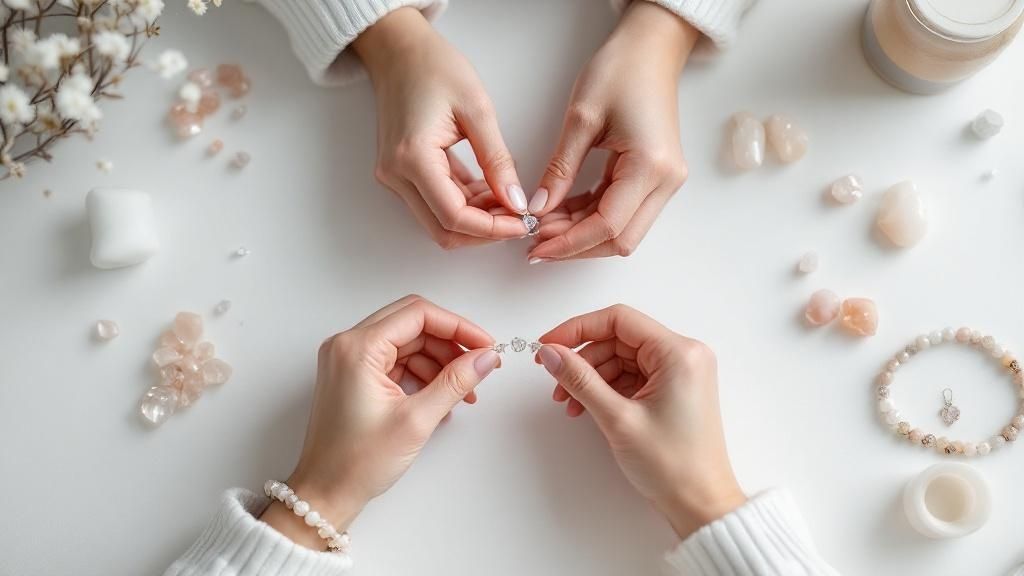
The 4 Cs of Crystal Evaluation
The diamond world gave us the "4 Cs," and it’s a brilliant framework for assessing crystals, too. While the rules aren't as rigid for crystals, thinking in terms of Clarity, Colour, Cut, and Carat will train your eye to spot quality and value in any piece of wholesale jewellery.
-
Clarity: This is all about the crystal's internal and external features. In real stones, you'll find inclusions (inside) and blemishes (outside). A perfectly flawless crystal is incredibly rare and usually comes with a sky-high price tag. Tiny bubbles, little fractures, or specks of other minerals are often the tell-tale signs of a genuine, earth-formed stone. Glass imitations, on the other hand, are often too perfect or contain perfectly round air bubbles.
-
Colour: Natural crystals almost never have perfectly even colour. A real amethyst, for example, will have patches of deep purple alongside lighter, almost clear zones. If a stone’s colour is shockingly uniform and vibrant, it's a red flag for dye. Look closely for colour pooling in tiny cracks—that’s a dead giveaway.
-
Cut: The cut is what brings a crystal to life. It dictates how light bounces off the facets. A great cut makes a stone sparkle, while a clumsy one can make even the best crystal look dull and lifeless. This is hugely important for faceted stones in your collection.
-
Carat: Carat is simply the weight of the stone. Bigger isn't always better. A small, high-clarity rose quartz with a beautiful, natural pink hue is far more valuable than a huge, cloudy piece that's been artificially coloured.
Simple Hands-On Tests for Common Fakes
You don't need a gemologist's lab to catch the most common fakes. These quick, practical tests are perfect for checking samples or new inventory on the spot.
1. The Temperature Test Real crystals are naturally cool to the touch, even on a warm day. Glass and plastic, however, warm up to room temperature very quickly. Touch a piece of amethyst or quartz to your cheek; if it feels cool, that's a good sign.
2. The Hardness Scratch Test This is a classic. Genuine quartz has a hardness of 7 on the Mohs scale, while glass is only around 5.5. That means a real quartz crystal should easily scratch a piece of glass. If your "quartz" can't leave a mark on a glass bottle, it's probably glass itself. Just be sure to test on a small, hidden spot!
3. Visual Inspection for Inclusions Grab a jeweller's loupe or even a strong magnifying glass and take a look inside the stone.
Natural inclusions are like a crystal's fingerprint—unique imperfections that tell the story of its formation. Perfectly spherical air bubbles, however, are a classic sign of man-made glass.
Learn to love the imperfections. Those tiny internal lines and mineral deposits are your best evidence that a stone is the real deal.
Identifying Treated and Imitation Stones
Beyond outright fakes, you'll also encounter treated crystals. These stones are often real, but they've been altered to enhance their appearance. The key here is transparency.
- Heat-Treated Crystals: A huge amount of the "citrine" on the market is actually amethyst that has been heat-treated to turn it a golden yellow. It's still a beautiful stone, but it should be priced much lower than rare, natural citrine.
- Dyed Stones: Porous stones like howlite are often dyed blue to look like turquoise. If you suspect a stone is dyed, a quick swipe with an acetone-soaked cotton swab on an inconspicuous area will often lift some of the colour.
Developing this expertise is a journey, not a destination. To get a fuller picture of the buying process, you can explore our guide on how to buy wholesale jewelry, which dives deeper into sourcing. When you combine smart supplier vetting with these hands-on quality checks, you'll be well on your way to building a collection you can stand behind.
Crafting Your Wholesale Pricing Strategy
Making a real profit in the crystal jewellery game doesn't just happen. It's something you build, piece by piece, with a smart pricing strategy. Think of it as the foundation of your business—get it right, and you’ll have the cash flow to cover costs, grab new inventory, and actually grow. Let's break down a practical, numbers-first way to build a pricing structure that truly works for you.
So many new business owners fall into the same trap: they only look at the price they paid for an item. But to really get ahead, you need to understand your Cost of Goods Sold (COGS). This is the real cost, the full picture.
Calculating Your True Cost of Goods Sold
Imagine COGS as every single penny it took to get one piece of jewellery from your supplier's workshop into your hands, ready to sell. It's way more than just the price on the invoice.
To get a real COGS number, you have to add up all these pieces:
- Unit Cost: The actual price you paid the supplier for each item.
- Inbound Shipping: What it cost to get the bulk order shipped from them to you.
- Import Duties & Taxes: Any government fees or tariffs you had to pay to get your shipment into the country.
- Packaging Materials: The cost of your boxes, little pouches, labels—anything you use to present the item.
Once you have the grand total for a shipment, just divide it by the number of items you received. That final number is your true COGS per piece. This is your absolute floor. Price anything below this, and you're literally paying customers to take your jewellery.
Choosing the Right Pricing Model
Okay, now that you have your COGS, you can start thinking about how to price your items. There's no single magic formula here. The best approach is often a mix of different methods, tailored to the specific pieces in your collection.
Pricing is more than just a number—it’s a signal of value. Your strategy should reflect not only your costs but also the perceived worth of your unique crystal jewellery pieces, the story behind them, and your position in the market.
Keystone Pricing is the classic starting point in retail. It's dead simple: you just double your COGS. If a rose quartz bracelet has a true COGS of $10, its Keystone price is $20. This gives you a solid 50% margin, which is a healthy industry standard to cover your other business expenses and leave you with a profit.
But don't feel locked into that. For those truly special pieces, you can turn to Value-Based Pricing. Let's say you score a unique labradorite necklace with an absolutely breathtaking flash. Its perceived value is way higher than what it cost you. For showstoppers like this, you can price based on what the market will bear, often hitting margins of 70% or even more.
Finally, you'll want to use Tiered Discounts to encourage people to buy more from you. This is a must if you're selling to other businesses. It's a simple way to incentivize bigger orders. For instance:
- Orders of 1-10 pieces: Standard wholesale price (Keystone, for example).
- Orders of 11-50 pieces: 10% discount off the wholesale price.
- Orders of 51+ pieces: 20% discount off the wholesale price.
This kind of structure makes your brand much more appealing to larger retailers and helps you move inventory a lot faster.
It also helps to know where you fit in the bigger picture. The global jewelry market was valued at a staggering $348 billion in 2025. While the fine jewelry world takes the biggest slice of that pie, costume jewelry—which is where most crystal pieces fall—is still a massive $77 billion segment. As you can learn from these global jewelry industry statistics on carattrade.com, there's plenty of room for unique, well-priced crystal jewellery to find its audience.
By combining a razor-sharp COGS calculation with a flexible pricing model, you're not just selling jewellery—you're building a profitable, sustainable business.
Managing Your Orders and International Shipping
Alright, let's talk about the part that trips up a lot of new business owners: getting your beautiful crystals from the supplier to your doorstep. This is where the rubber meets the road. A smooth logistics process is the real secret sauce behind a successful wholesale crystal jewellery business. Once you've picked your suppliers and nailed down your pricing, mastering the ordering and shipping workflow is the last piece of the puzzle.
Getting this right prevents those gut-wrenching delays, surprise fees, and the nightmare of damaged goods. Think of it as building a reliable bridge between your supplier and your business—a bridge you'll be crossing again and again.
The Ordering Workflow: Getting It Right From the Start
Placing your first order can feel intimidating, but it all comes down to being crystal clear (pun intended) and knowing when to negotiate.
- Be Specific, Not Vague: Create detailed order sheets. I’m talking SKU numbers, exact quantities, which crystals you want, and the specific metal finishes. Leaving anything open to interpretation is just asking for trouble.
- Don't Be Afraid to Talk MOQs: The Minimum Order Quantity (MOQ) is the smallest order a supplier is willing to take. If their number is way too high for your first run, speak up! Many are surprisingly flexible, especially if they see the potential for a long-term partnership.
- Protect Your Money: Never, ever send a wire transfer into the void. Always use a secure payment method that offers protection. Services like Alibaba Trade Assurance or PayPal Goods & Services are your best friends here. They basically hold your money in a safe place until you confirm you've received what you paid for.
Untangling the Web of International Shipping
Once the order is packed and ready, it has to make the journey to you. International shipping isn't just about slapping on a label; it's a whole global dance. The wholesale jewelry market is a massive, sprawling network, with market studies covering 195 countries and regions. The main manufacturing and distribution hubs are concentrated in Asia, the Americas, and Europe, creating a complex system of channels. You can get a deeper look into these global wholesale jewelry distribution networks on marketresearch.com.
Think of customs as a border checkpoint for your goods. Having all your paperwork correct is like showing up with the right passport and visa—it guarantees a smooth, quick passage instead of getting stuck in administrative limbo for weeks.
Here’s how to handle the key steps:
- Pick a Shipping Partner: For speed and detailed tracking, you can't beat express couriers like DHL or FedEx. If you're placing a massive order and aren't in a huge rush, air or sea freight can save you a significant amount of money.
- Get Your Paperwork in Order: This is the big one. You'll absolutely need a commercial invoice and a packing list. Sometimes, a certificate of origin is required, too. An incorrect or missing document is the number one reason shipments get held up at the border.
- Plan for Import Taxes and Duties: These are not optional. Your country’s government will want its cut, and the amount is based on the value of your shipment. The worst thing you can do is forget about them. Factor these costs into your product pricing from day one so they don’t eat into your profits later.
Mastering this flow builds a resilient supply chain. It's what keeps your shelves stocked, your business running smoothly, and your customers coming back for more.
Got Questions? We’ve Got Answers.
Diving into the world of wholesale crystal jewellery can feel a little overwhelming at first, but don't worry—most people starting out have the exact same questions. Let's clear up some of the most common ones so you can get started with confidence.
Think of this as your personal FAQ for building your crystal jewellery business. We'll tackle the big three: legal stuff, money, and rookie mistakes.
Can I Start Without a Formal Business License?
The short answer is... sort of, but you shouldn't. While some suppliers might let you browse or even make a small purchase as an individual, any serious wholesaler will require a resale certificate or business license number.
This isn't them being difficult; it's the law. This little piece of paper is what proves you're a legitimate business and allows you to buy products tax-free with the intent to resell them. Getting your business registered is the first real step toward being taken seriously in this industry.
How Much Money Do I Really Need to Start?
This is one of the best parts about the crystal jewellery market: you don't need a fortune to get in the game. Many fantastic suppliers have low or no Minimum Order Quantities (MOQs). This means you can start with a small, hand-picked collection for just a few hundred dollars.
The smartest way to begin is to start small and focused. Pick a handful of pieces you know will sell, test the waters, and then use your earnings to buy more inventory. This approach keeps your risk low and lets you grow at a comfortable pace.
Just remember, your starting budget isn't just for the jewellery itself. You'll also need to account for things like packaging, shipping materials, and any fees for the platform you sell on.
What's the Biggest Mistake I Should Avoid?
If there's one pitfall that trips up new sellers more than any other, it's miscalculating the true Cost of Goods Sold (COGS). It’s so easy to just look at the price you paid for a necklace and double it, but that's a recipe for disaster.
Your real cost includes the item price plus international shipping, import taxes, packaging, and any other fees. Forgetting to add these in can completely wipe out your profit margin. Before you price a single item, do the math and figure out your actual COGS. It’s the single best thing you can do to build a healthy, profitable business from day one.
Ready to build your dream inventory with high-quality, trend-forward pieces? At JewelryBuyDirect, we offer direct-from-factory pricing on over 120,000 styles with no minimum order. Start sourcing with confidence today.