






Arthur Lynch | Sun Jan 11 2026
What Does Nickel Free Mean for Your Jewelry Business?
When sourcing for your business, the question "What does nickel free mean?" is more than just a customer query—it's a critical sourcing standard. The answer isn't as simple as "it has no nickel in it." For businesses in the wholesale jewelry and fashion accessories space, that label is a promise: a guarantee that a piece releases nickel at a rate below legally defined safe limits. It’s less about a zero-nickel policy and more about protecting your customers and your brand's reputation.
What "Nickel Free" Really Means for Your Business
As a business owner sourcing jewelry and fashion accessories, understanding this distinction is crucial for profitability and trust. The term "nickel free" isn’t just marketing fluff; it's a technical standard tied directly to product safety and your brand’s integrity.
A common misconception is that nickel-free items contain absolutely zero nickel. The reality is that the term almost always refers to compliance with strict safety regulations, like the EU Nickel Directive. This is the global benchmark for high-quality, safe fashion accessories.
The directive doesn't actually ban nickel. Instead, it puts a hard limit on the rate of nickel release—the amount of nickel ions that can migrate from the jewelry to the skin over time. This is the crucial detail for any business. An item can contain nickel deep within its base alloy, but if it's properly plated or formulated to release less than 0.5 micrograms per square centimeter per week, it can be marketed as nickel-safe or compliant.
Why This Distinction Matters for Sourcing
That subtle difference has huge implications for how you source high-quality and affordable inventory. It opens up a wider world of durable, cost-effective products without forcing you to compromise on safety. Many of the best alloys for fashion jewelry contain trace amounts of nickel because it improves their strength and finish.
Focusing on the nickel release rate instead of its absolute absence is a game-changer for sourcing. It empowers your business to:
- Source confidently: You can work with suppliers who provide certified, compliant products that meet global standards.
- Expand your inventory: You gain access to a broader range of high-quality, affordable materials beyond expensive traditional options.
- Build customer trust: When you can accurately explain what "nickel free" means, you demonstrate transparency and expertise, solidifying your brand's reputation.
Understanding this concept is the first step to building a reliable supply chain. It shifts the sourcing conversation from a simple “yes or no” to a much more informed discussion about certified safety standards. Ultimately, it helps you confidently select high-quality, affordable wholesale jewelry that keeps your customers happy and your business protected.
Why Nickel Allergies Are a Major Customer Concern
Imagine a customer buys a new pair of earrings from your store. A day later, an itchy, red rash appears. That's Nickel Allergic Contact Dermatitis (NACD), and it's a negative experience that can damage your brand's reputation and lead to lost sales.
This isn't an infection but an immune system overreaction. Tiny nickel ions leaching from jewelry can trigger the immune system to mistakenly treat them as a threat. The resulting rash is simply the body's defense mechanism at work, turning a beautiful accessory into a source of discomfort.
Understanding the Scale of the Problem
Nickel allergy is one of the most common contact allergies in the world, representing a significant customer segment actively seeking safe products. For a savvy business, this is a massive market opportunity.
A major meta-analysis found a combined nickel allergy prevalence of 11.4% across the general population. Other reports estimate that roughly 15% of women and 2–5% of men have a nickel sensitivity. The higher rate in women is often linked to greater exposure from pierced earrings and fashion jewelry. Discover more about the prevalence of nickel allergies and the impact they have on consumers.
When you view this as a fundamental customer health issue, the demand for nickel-free products becomes a clear business driver. A simple sourcing decision transforms into a powerful way to build brand loyalty and trust.
From Health Concern to Business Opportunity
The sheer number of people with NACD points to an undeniable market need. Every customer who has experienced a reaction is now a careful shopper, scrutinizing product details and seeking guarantees of safety.
This is where offering properly sourced, nickel-compliant jewelry isn't just about minimizing returns—it's about directly serving a large and highly motivated customer base.
When you can confidently stock and market high-quality, affordable accessories as safe for sensitive skin, you're doing more than just selling a product. You're offering a solution. You earn the loyalty of customers who have struggled to find jewelry they can wear without a painful reaction. By prioritizing your customers' well-being, you set your business apart as a trustworthy and caring choice in a crowded market.
Navigating Global Nickel Safety Regulations
Sourcing jewelry and accessories globally can feel like navigating a maze of rules. When it comes to nickel safety, different regions have different standards. For your business, this means understanding where your supplier is based and which standards they follow directly impacts the safety and quality of your inventory.
The world of nickel regulation is split between regions with strict, mandatory laws and others with more voluntary standards. Understanding this difference is a huge advantage when sourcing affordable inventory that doesn't compromise on quality. Knowing which rules to follow protects your customers and, just as importantly, your brand's reputation.
The flowchart below breaks down exactly how nickel in a piece of jewelry can trigger an allergic reaction.
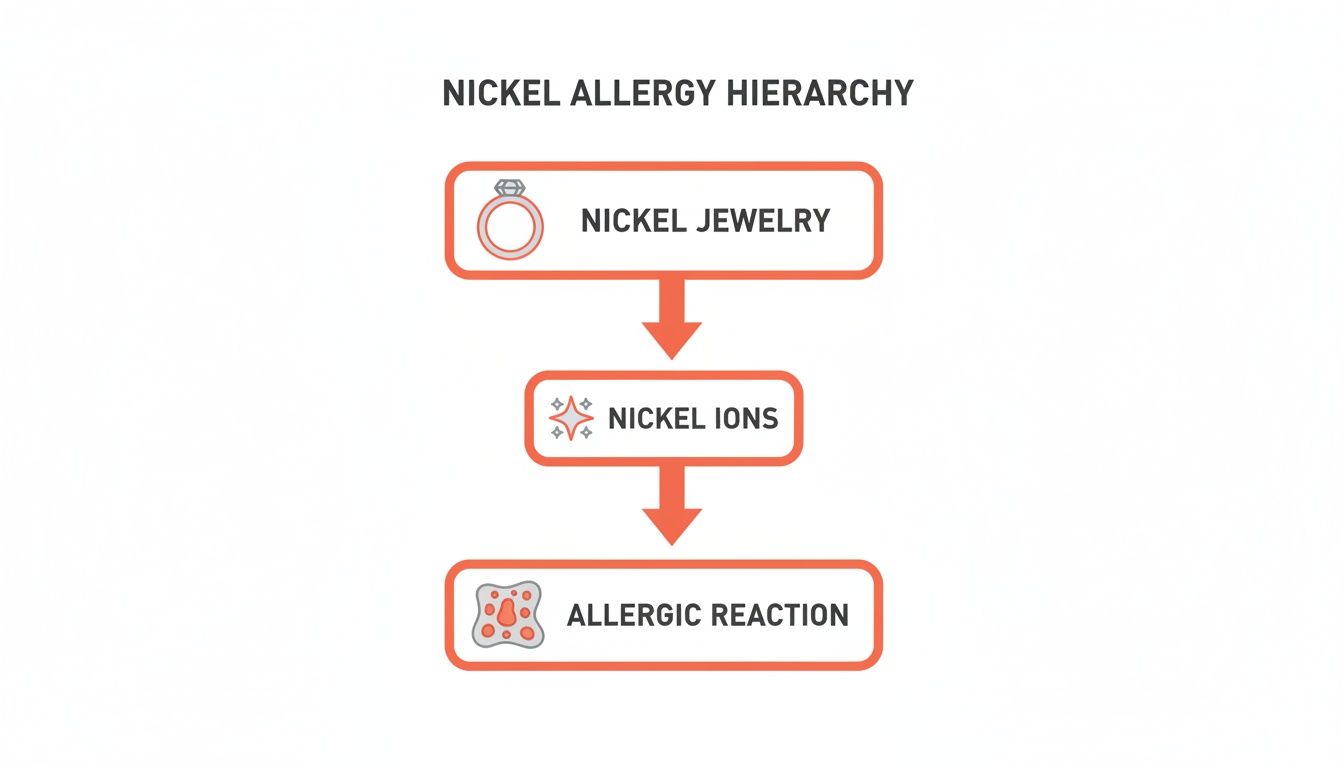
This simple chain of events is precisely why robust regulations are so critical for keeping consumers safe and why savvy businesses adhere to them.
The European Union: Setting the Gold Standard
When it comes to nickel safety, the European Union's REACH Nickel Directive is the global benchmark. It’s a mandatory law for any jewelry sold within the EU and the 'gold standard' that forward-thinking businesses worldwide strive to meet.
The key to the EU's approach is its focus on nickel release, not just the total nickel content in an alloy.
The EU’s REACH regulation limits nickel release from jewelry with prolonged skin contact to 0.5 micrograms per square centimeter per week (μg/cm²/week). For posts used in body piercings, the limit is even tighter at 0.2 μg/cm²/week.
This scientific benchmark provides a clear and reliable way to measure product safety. China wisely adopted the same 0.5 and 0.2 μg/cm²/week limits in its GB 28480-2012 standard. You can discover more insights about these global standards on zearrow.com. This alignment between major manufacturing hubs and strict regulators makes sourcing compliant, high-quality, and affordable products much more straightforward for your business.
The Patchwork Approach in North America
In North America, the regulatory landscape is less clear. There is no single, mandatory federal law comparable to the EU’s REACH directive. Instead, there's a mix of voluntary standards and state-level rules, like California's Proposition 65, which focuses on warning labels rather than setting firm release limits for allergens.
This creates a murkier sourcing environment. Without a universal benchmark, terms like "hypoallergenic" and "nickel free" are used inconsistently. For a jewelry business, this regulatory gap is precisely why choosing suppliers who voluntarily meet the strict EU or Chinese standards is such a powerful strategic move. It ensures a consistent level of safety and quality, no matter where you sell your products.
Global Nickel Regulation Cheat Sheet
This quick-reference guide helps you compare major regulations, providing a cheat sheet for sourcing safe and high-quality accessories strategically.
| Region/Standard | Nickel Release Limit (General Jewelry) | Type | What It Means for Your Business |
|---|---|---|---|
| European Union (REACH) | 0.5 µg/cm²/week | Mandatory | The strictest standard. Sourcing compliant products is a must for EU sales and a strong quality indicator for other markets. |
| China (GB 28480-2012) | 0.5 µg/cm²/week | Mandatory | Aligns with EU standards, simplifying the process of sourcing high-quality, compliant products from a top manufacturing hub. |
| United States (ASTM) | No mandatory federal limit; voluntary standards | Voluntary | Lacks a unified federal law. Sourcing to EU/China standards is the safest strategy to ensure quality and avoid liability. |
| Canada | 0.5 µg/cm²/week for some items | Mandatory | Applies to items intended for piercing. Broader regulations are less strict than the EU's comprehensive approach. |
This table highlights why aiming for EU-level compliance is the smartest path for any business. By partnering with suppliers who can certify their products to these higher global standards, you're not just buying jewelry—you're investing in quality assurance. It’s a proactive strategy that lets you market your pieces with confidence, build customer trust, and set your brand apart.
Choosing The Best Nickel-Free Materials For Your Collection
Knowing what "nickel-free" means is the first step. The next is translating that knowledge into a collection that’s safe, beautiful, and profitable. Choosing the right materials for your business involves balancing cost, durability, safety, and customer appeal.
Think of yourself as a product curator. Your job is to build an inventory of high-quality, affordable accessories that gives every customer a comfortable, worry-free experience. Let’s explore the most reliable and popular materials to help you make smarter sourcing decisions.
The Workhorse Metals: Stainless Steel and Titanium
For a dependable, affordable, and durable option, 316L surgical stainless steel is an industry standard. While most stainless steel grades contain nickel for strength, the "L" in 316L signifies low carbon content. This creates an incredibly stable alloy that effectively traps nickel particles, keeping the release rate well below the strictest EU standards.
Titanium is in a class of its own. As a pure element, it is 100% nickel-free and one of the safest metals you can offer, especially for customers with severe sensitivities. It is lightweight, exceptionally strong, and corrosion-resistant, making it a top-tier choice for body jewelry and earrings. Learn more about its advantages in our guide to the best titanium earrings on jewelrybuydirect.com.
A helpful analogy for sourcing: 316L steel is like a reliable work vehicle—it's affordable, safe, and gets the job done. Titanium is a high-performance machine—it offers superior safety and strength at a premium price point.
Precious Metals: Sterling Silver
Sterling silver is another excellent choice for a nickel-free line. By definition, it must be at least 92.5% pure silver, with the remaining 7.5% typically being copper to enhance durability. No nickel is required. This makes it a trusted, classic option for hypoallergenic jewelry.
The main business considerations for sterling silver are cost and maintenance. It is more expensive than steel and can tarnish over time, requiring occasional polishing. However, customers perceive its value as much higher, allowing you to position it as a premium offering in your nickel-safe collection.
Affordable Alternatives: Plated Brass and Copper
For fast-fashion and trend-driven pieces, base metals like brass or copper offer an incredibly cost-effective foundation. The key to making them safe is high-quality plating. A thick layer of a nickel-free precious metal—like gold, rhodium, or palladium—creates a barrier between the customer's skin and the base metal.
When sourcing plated jewelry for your business, insist on these details:
- Thick Plating: Demand a substantial layer of a precious metal. This barrier is essential for preventing skin contact with the base metal.
- Nickel-Free Barrier: Verify that no nickel layer was used as a primer under the final finish—a common industry shortcut to avoid.
- Certified Compliance: Always require suppliers to provide test reports confirming the final products meet EU nickel release standards.
By insisting on superior plating, you can stock a wide variety of affordable, stylish designs without compromising your "nickel-free" promise. This strategy allows you to build a diverse, high-quality collection for every taste and budget.
Comparing Popular Nickel-Free Jewelry Materials
This cheat sheet helps you weigh the pros and cons of these materials for your business. Consider your brand identity, target customer, and price points to decide which options are the best fit for your inventory.
| Material | Hypoallergenic Rating | Durability | Cost-Effectiveness | Best For Sourcing |
|---|---|---|---|---|
| 316L Stainless Steel | Excellent | Very High | Excellent | Everyday wear, men's jewelry, high-quality fashion pieces |
| Titanium | Superior | Exceptional | Moderate | Body jewelry, premium earrings for sensitive ears |
| Sterling Silver | Very Good | Good | Moderate | Classic designs, fine jewelry collections |
| Plated Brass/Copper | Good (with quality plating) | Fair | Excellent | Trend-focused fashion accessories, costume jewelry |
A well-rounded collection often includes a mix of these materials. Offering both the reliability of surgical steel and the accessible style of well-plated brass allows you to cater to a wider audience and build trust across different segments of the market.
How to Confidently Verify Nickel Free Jewelry
When sourcing for your business, a supplier’s promise that their products are “nickel free” isn't enough. You need proof. Verifying these claims is how you protect your customers, your brand, and your bottom line. It’s the critical step that separates hoping an item is safe from knowing it is.
Shift your role from a simple buyer to a savvy sourcing professional. Instead of taking a supplier at their word, ask for the right documents and spot red flags before they become costly, reputation-damaging problems. This builds a supply chain based on trust backed by tangible evidence.
Asking for the Right Proof
The most reliable way to confirm a product is safe is to obtain official third-party lab reports. Do not settle for vague assurances; you need to see the data.
A legitimate report from a globally recognized testing service like SGS (Société Générale de Surveillance) is your best tool. These documents provide scientific proof that a piece of jewelry meets strict regulatory standards.
When vetting a potential supplier, be direct and ask for:
- A Recent SGS Test Report: Specifically request a report showing compliance with the EU Nickel Directive, which should reference the test method EN 1811.
- The Correct Batch or Style Number: Ensure the report corresponds to the exact products you intend to purchase. A report for one style does not guarantee the safety of another.
- A Relevant Date: Check the test date. A report from five years ago is insufficient if the supplier has since changed their manufacturing process or materials.
This documentation should be a non-negotiable requirement for any serious supplier. If a vendor hesitates or cannot provide these reports, it’s a major red flag.
Reading and Understanding Test Reports
Once you have a report, you need to know what you’re looking at. The most important section shows the results of the nickel release test, measured in micrograms per square centimeter per week (μg/cm²/week).
Look for a clear "Pass" or "Fail." For a "Pass," the numbers must be below the legal limit—0.5 μg/cm²/week for standard jewelry or the stricter 0.2 μg/cm²/week for piercing posts. This confirms the item is safe according to the toughest global standards. If you're curious about which materials consistently pass these tests, our guide on what 316L means in jewelry is a great resource.
By making certified testing a mandatory part of your sourcing checklist, you systematically reduce risk. This isn’t just about compliance; it’s about building a brand that customers trust for offering genuinely safe, high-quality, and affordable fashion accessories.
Marketing Your Nickel-Free Jewelry to Boost Sales
You've done the hard work to source beautiful, safe, affordable, and compliant jewelry. Now, it's time to turn that effort into sales by clearly communicating its value to your customers.
Effective marketing in this space is about building trust. It's about translating a product feature into a tangible benefit for the wearer. Your message should be simple, confident, and reassuring.
Simple Language Makes the Biggest Impact
Use language that connects emotionally and solves a problem. Most shoppers don't care about the EU Nickel Directive; they just want to know if a pair of earrings will cause a rash.
Frame the benefit in terms your customers will instantly understand. Weave these benefit-driven phrases across your marketing:
- On Product Pages: Instead of just "nickel-free," use powerful statements like "Safe for sensitive skin" or "Designed for worry-free wear."
- In-Store Signage: A simple sign stating, "Our Collection is Nickel-Compliant for Your Comfort," communicates quality and care.
- Social Media Posts: Create content around comfort and confidence. A caption could read, "Love the look without the irritation. Our earrings are perfect for sensitive ears!"
This simple shift in language transforms a technical detail into a major selling point. It helps you attract and retain loyal customers who prioritize safety and quality.
Your commitment to sourcing high-quality, nickel-safe jewelry is a powerful story. Tell it with confidence. Frame it not just as a feature, but as a core value of your brand—a promise of quality and care for your customers' well-being.
To truly drive growth, this unique selling proposition should be part of a larger business plan. Exploring proven ecommerce growth strategies can help you scale your business effectively. When you highlight your certified, nickel-safe inventory as part of a smart, well-executed strategy, you don’t just make a sale—you build a brand known for its integrity and quality.
Answering Your Top Questions About Nickel-Free Jewelry
If you're in the business of sourcing jewelry, you likely have practical questions about going nickel-free. Getting the right answers is key to building a trustworthy and profitable brand. Let's tackle a few of the most common queries from business owners.
"Is 'Hypoallergenic' the Same as 'Nickel-Free'?"
No, and this is a critical distinction for any business. "Hypoallergenic" is a marketing term, not a scientific or regulated one. It suggests a product is less likely to cause an allergic reaction, but it offers no guarantee. A piece labeled hypoallergenic can still contain enough nickel to cause a problem.
On the other hand, a "nickel-free" or "nickel-compliant" claim, when backed by standards like the EU's REACH directive, is a much stronger assurance of quality. It means the jewelry has been tested and meets a strict, measurable threshold for nickel release. For your customers' safety and your business's reputation, always prioritize verified nickel-compliant products over vague hypoallergenic claims.
"Will Sourcing Nickel-Free Jewelry Hurt My Margins?"
This is a valid business concern, but the answer is no—not with smart sourcing. While premium metals like titanium or solid gold have higher costs, there is a wide range of affordable and completely safe alternatives.
High-quality materials like 316L surgical-grade stainless steel or properly plated brass are both beautiful and cost-effective. The key is to partner with reputable suppliers who provide lab certifications for their products. This allows you to offer safe, high-quality fashion accessories at competitive price points without sacrificing profit margins.
"What's the Best Way to Handle a Customer Who Has a Reaction?"
Even with the best sourcing precautions, a rare reaction can occur. If a customer contacts you, listen with empathy. Reassure them, and immediately offer a full refund or an exchange.
Then, use it as a learning moment for your business. Contact your supplier and request the lab certifications for that specific product batch. Being transparent, responsive, and committed to your customers' well-being builds incredible brand loyalty. A problem handled with grace can turn a frustrated customer into a lifelong advocate for your brand.
For a massive selection of SGS-certified, affordable wholesale jewelry, explore the catalog at JewelryBuyDirect. Source with confidence and build your collection today at https://www.jewelrybuydirect.com.