






Arthur Lynch | Thu Dec 11 2025
Sterling Silver Wholesale Jewelry: Sourcing High-Quality, Affordable Pieces for Your Business
Sourcing jewelry for your business can feel like a high-stakes gamble. This guide is designed to take the guesswork out of the process, giving you a clear strategy for success. We're diving straight into the biggest challenge for retailers: finding high-quality, affordable sterling silver wholesale jewelry that delights your customers and boosts your bottom line.
Building Your Business on Sterling Silver
The products you source are the foundation of your brand. In the world of fashion accessories, sterling silver hits the perfect balance between a premium feel and an accessible price point. It avoids the high cost of gold while offering a significant upgrade from low-quality plated jewelry. This makes it the ideal material for building a profitable and reputable collection for your business.
By choosing sterling silver, you’re tapping into a massive and growing market. The global jewelry sector is an economic powerhouse, valued at approximately $232.94 billion in 2024. Projections show it expanding to nearly $344 billion by 2032, with a compound annual growth rate of about 5.1%. This indicates strong, consistent consumer demand you can build a business on.
Why Sterling Silver is a Smart Business Move
Basing your jewelry business on sterling silver is a strategic decision. It targets a specific customer segment: shoppers who demand quality and durability without the fine jewelry price tag. By sourcing intelligently, you can meet this demand and build a loyal customer base.
- Perceived Value: As a precious metal, sterling silver has an inherent value that costume jewelry lacks, allowing for better retail margins.
- Durability and Longevity: Unlike plated pieces that tarnish or chip, sterling silver is a durable material built for longevity, reducing customer complaints and returns.
- Versatile Style: Silver is a versatile canvas for design, adapting to any trend from minimalist to statement pieces, allowing you to cater to a broad audience.
To give your business a competitive edge, exploring a proven e-commerce growth strategy playbook can provide actionable insights for today's market.
The secret to a successful jewelry business is making sourcing decisions that reinforce your brand’s promise of quality. Every piece you select is a direct reflection of that commitment.
This guide is your road map. We'll cover how to establish a reliable supply chain, understand the fundamentals of quality, and make smart sourcing decisions that position your business for long-term success.
What Every Retailer Must Know About Silver Quality
Not all silver is created equal. Understanding the differences is your greatest advantage when buying sterling silver wholesale jewelry. This knowledge isn't just technical—it's what allows you to vet suppliers effectively, price your products for profit, and build customer trust by speaking confidently about your inventory.
The industry standard is "925 Sterling Silver." This is a precise measure of purity, indicating the piece is made of 92.5% pure silver, with the remaining 7.5% comprised of other metals, usually copper. Think of the 7.5% alloy as a necessary ingredient for business. Pure silver is too soft for everyday wear, making it impractical for a commercial jewelry line. The alloy provides the strength and durability needed for a marketable, long-lasting product.
That 7.5% alloy is what gives the metal the resilience to withstand daily life without bending, denting, or scratching easily, ensuring customer satisfaction and reducing the likelihood of returns.
Understanding Metal Grades and Common Alloys
While copper is the standard alloy, it's not the only one. Different metal combinations can alter the silver's properties, such as its luster or tarnish resistance. Some premium alloys may include elements like germanium to create a more tarnish-resistant product. Asking a potential supplier about the specific composition of their alloy is a key part of your due diligence.
A hallmark stamp—such as "925," "STER," or "SS"—is the universal indicator of genuine sterling silver. Verifying this mark is your first and most basic quality control step, confirming the piece meets the legal standard for purity.
This stamp is a promise of quality, but your evaluation shouldn't stop there. The finish applied over the sterling silver is equally crucial, directly impacting the jewelry's appearance, durability, and your final cost.
Demystifying Plating and Finishes
After a piece is cast in 925 sterling silver, most suppliers apply a finish to enhance its look and lifespan. These finishes vary in quality and cost, and understanding them helps you source the right products for your target market and price point.
Here's a breakdown of the most common finishes you'll encounter when sourcing fashion accessories for your business.
Comparing Common Sterling Silver Finishes
| Finish Type | What It Means for You and Your Customer | Impact on Wholesale Cost | Best For |
|---|---|---|---|
| Rhodium Plating | Provides a bright, luxurious, mirror-like finish. Rhodium is hypoallergenic and highly resistant to tarnish and scratches. | $$$ (Highest) | High-end collections and premium pieces that can command a higher retail price, justifying the increased cost. |
| Gold Vermeil | A thick layer of gold (at least 2.5 microns) over a sterling silver base. Offers the look of solid gold at a more accessible price. | $$ (Medium-High) | Fashion-forward collections targeting customers who want a luxury look with quality materials. A strong value proposition. |
| Gold Plating | A thinner layer of gold electroplated onto the silver. Provides the look of gold but is less durable than vermeil. | $ (Low-Medium) | Trendy, high-turnover fashion pieces where a lower price point is a key selling factor. Durability is not the primary focus. |
| E-Coating | A clear polymer layer that seals the silver from air, significantly slowing down tarnish. | $ (Lowest) | Everyday jewelry where affordability and low maintenance are key. A great cost-effective solution for anti-tarnish protection. |
As you can see, the finish is a strategic business decision. A supplier offering rhodium-plated items is targeting a different market than one specializing in e-coated jewelry. This knowledge helps you source the right products for your customers and brand positioning.
By mastering these details, you transition from being just a retailer to an expert curator. This enables you to source higher-quality, more profitable jewelry and build a collection that drives repeat business. For more on the science, our article on what causes sterling silver to tarnish is a valuable resource.
Finding and Vetting Wholesale Jewelry Suppliers
Sourcing high-quality, affordable sterling silver is the bedrock of any successful jewelry business. Finding a reliable supplier requires more than a simple online search. You're not just buying a product; you're forming a partnership that will directly impact your reputation and profitability.
A trustworthy supplier delivers consistent quality, fair pricing, and reliable service. This partnership frees you to focus on growing your business—marketing and selling beautiful jewelry—instead of managing supply chain issues and customer complaints.
Your search begins by knowing where to look. While a generic search for sterling silver wholesale jewelry will yield thousands of results, the best partners are found in more focused channels where professionalism and quality are the standard.
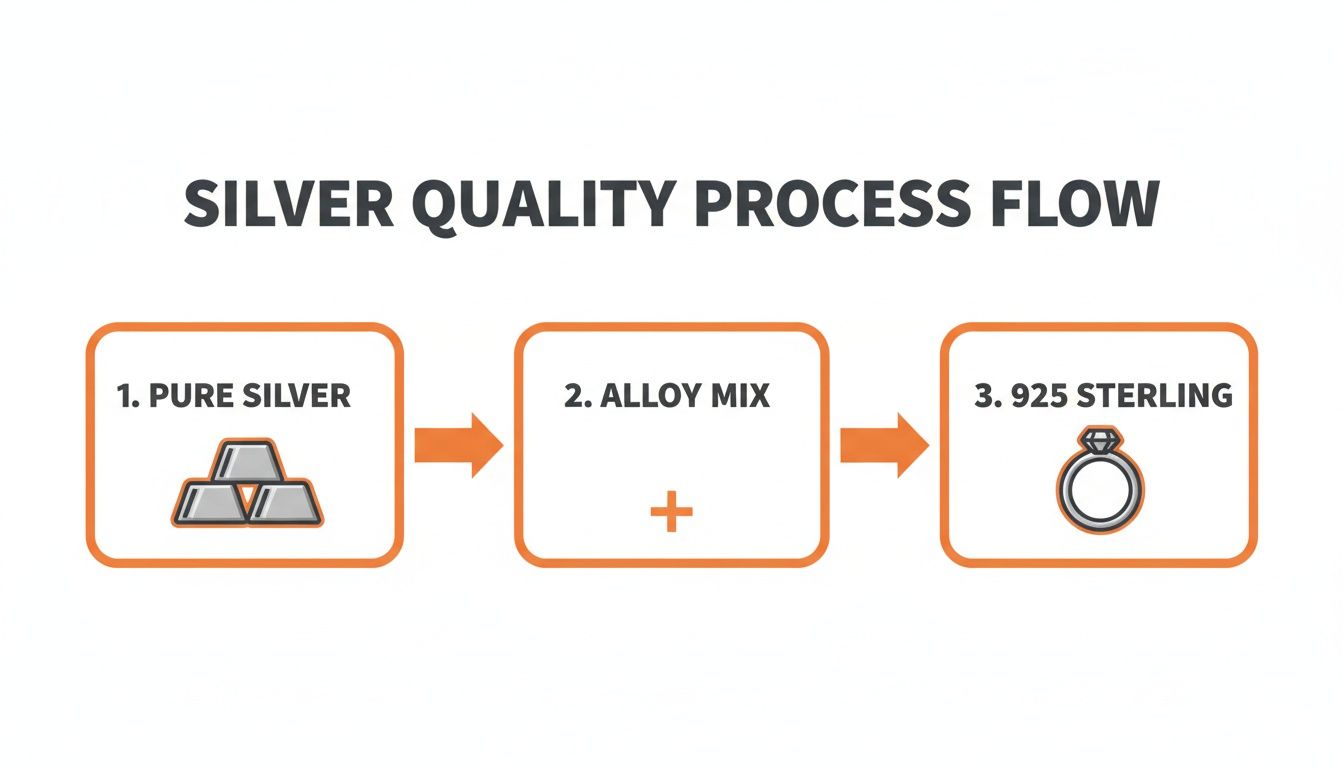
This image illustrates that quality is a multi-step process. Sourcing from a supplier who respects every stage, from raw materials to the finished product, is critical for your business.
Identifying Potential Wholesale Partners
The first step is to cast a wide but strategic net. Instead of hunting for the lowest price, focus on platforms and events designed for serious business owners. These venues often feature pre-vetted suppliers, saving you time and reducing risk.
Here are the most effective channels for your search:
- B2B Wholesale Platforms: Websites like JewelryBuyDirect, Faire, and Alibaba are built for wholesale sourcing. They provide tools to filter suppliers by location, minimum order quantity (MOQ), and product specialty, helping you efficiently find partners that fit your business model.
- Industry Trade Shows: Events like JCK Las Vegas or Vicenzaoro in Italy are invaluable. They offer the opportunity to meet suppliers in person, inspect the quality of their jewelry firsthand, and build crucial business relationships that you can't replicate online.
- Professional Networks: Leverage your industry community. Join online forums for retailers, participate in social media groups, and connect with local business associations. Fellow entrepreneurs are often willing to share supplier recommendations—or warn you about unreliable ones.
Performing Essential Due Diligence
Once you have a shortlist of potential suppliers, the real work begins. Vetting is a critical business process that protects your investment and brand. Think of it as a background check for your business partners, separating professional operations from unreliable ones.
A supplier's willingness to provide documentation and answer detailed questions is a strong indicator of their transparency and professionalism. If a potential partner is evasive when asked for proof of quality, consider it a major red flag and move on.
Approach due diligence methodically. Use a checklist to ensure you cover all critical points before placing a significant order. This allows you to compare suppliers objectively, basing your decision on facts rather than a sales pitch. Understanding the advantages of working with factory-direct jewelry suppliers can also provide a framework for what to look for in a top-tier partner.
Your Due Diligence Checklist
Use this framework to systematically evaluate every potential supplier. This process is about verifying claims and ensuring you partner with a legitimate, quality-focused operation.
- Verify Business Credentials: Ask for their business license or registration number. Any legitimate company can provide this to prove they are a legally operating entity.
- Request Assay Reports: This is non-negotiable for sourcing sterling silver. An assay report is a lab document that scientifically verifies the metal composition. It is the ultimate proof that you are buying genuine 925 sterling silver. Reputable suppliers will provide these reports upon request.
- Confirm Hallmarks and Stamps: Inquire how their pieces are marked. True sterling silver should be stamped with "925," "STER," or a similar hallmark. Ask if they comply with international hallmarking conventions.
- Inquire About Compliance: You must protect your customers and your business. Ensure their products meet safety standards for your market, such as being lead and nickel compliant. This is especially critical for selling in regions with strict regulations, like California's Proposition 65.
Sourcing internationally adds another layer of complexity. To ensure a smooth process from their factory to your inventory, get familiar with international supply chain management. Mastering logistics is key to building a reliable and efficient supply chain.
Mastering the Financials of Wholesale Buying
In retail, profit is made when you buy, not just when you sell. Smart sourcing is the financial foundation of a healthy business. Mastering the numbers behind your sterling silver wholesale jewelry purchases is what separates thriving brands from struggling ones. Get this right, and you can offer competitive prices, protect your margins, and grow your business with confidence.
The first step is to look beyond the per-piece price. To understand your true investment, you need to calculate your landed cost—the total, all-in price to get a piece of jewelry from the supplier's warehouse into your inventory, ready for sale.
Calculating Your True Landed Cost
Your landed cost is the complete and final price of your inventory. It starts with the product cost but must include all the additional fees that accumulate along the supply chain. Ignoring these costs will give you a dangerously inaccurate view of your profitability. A "cheap" product can become expensive once all expenses are accounted for.
To calculate your landed cost per item, sum up these key expenses:
- Product Cost: The base price paid to the supplier for the jewelry.
- Shipping & Freight: The cost to transport the order from the supplier to you.
- Customs & Duties: Taxes and tariffs levied on imported goods.
- Insurance: Protection against loss or damage during transit.
Divide the total of these costs by the number of items in the shipment. The result is your true landed cost per piece. This is the number you must use for all pricing and profit calculations.
A common mistake is to base retail prices solely on the supplier's unit cost. This ignores shipping and import fees, which can easily consume 10-20% of your potential profit before a single sale is made.
Setting Smart Retail Prices for Profit
With an accurate landed cost, you can set retail prices that guarantee a profit. A common starting point is keystone pricing, which simply means doubling your landed cost (a 100% markup).
While keystone is a solid rule of thumb, a flexible pricing strategy is often more effective. Your pricing should also consider your brand positioning, the uniqueness of the item, and what the market will bear.
For example, a basic sterling silver chain might be priced close to keystone. However, a unique, handcrafted piece with gemstones could support a higher markup of 2.5x to 3x its landed cost. This approach allows you to stay competitive on common items while maximizing profit on your most distinctive pieces. For a more detailed guide, the wholesale profit margin calculator is an excellent resource.
This financial planning is crucial in a volatile market. For instance, in 2025, the sterling silver market saw significant cost increases due to a rise in the spot price of silver. One analysis noted that popular sterling silver items experienced an average 42% retail price jump from the previous year, highlighting how raw material costs can impact your business. Learn more about these price fluctuations and their causes on Italiachains.com.
Navigating Minimum Order Quantities
Finally, let’s discuss Minimum Order Quantities (MOQs). This is the smallest order a supplier will accept and can be a significant hurdle for new or small businesses with limited cash flow. A high MOQ can force you to invest heavily in a single style, a major risk if it doesn't sell well.
However, don't be immediately deterred by a high MOQ. Many suppliers are willing to negotiate, particularly if they see the potential for a long-term business relationship.
You can also seek out suppliers who cater to smaller businesses. Some, like JewelryBuyDirect, have no MOQ, allowing you to test new styles with minimal financial risk. This provides the flexibility to manage your cash flow and inventory with greater agility.
Creating a Bulletproof Quality Control System

You can find a great supplier and perfect your financials, but none of it matters if the product quality disappoints your customers. A systematic quality control (QC) process is your final line of defense, ensuring every piece you sell enhances your brand's reputation rather than causing costly returns.
This process begins long before you place a bulk order. It starts with sample evaluation. Getting samples is the single most important step in vetting a supplier. It's your opportunity to move beyond marketing photos and physically inspect, touch, and test the product.
Think of it as a test drive for your inventory. A small investment in samples can prevent a massive financial mistake on a bulk order of sterling silver wholesale jewelry.
The Anatomy of a Sample Inspection
When samples arrive, it's time for a thorough inspection. Don't just give them a quick look—put them through a rigorous evaluation. You are looking for the details that differentiate quality craftsmanship from rushed, low-cost production.
Your inspection must be hands-on and methodical. Examine each piece under good lighting, paying close attention to functional components. This initial review will reveal nearly everything about a supplier’s manufacturing standards.
Here’s a simple checklist for your business:
- Clasps and Closures: Operate them repeatedly. Do they feel secure and function smoothly, or are they flimsy? A weak clasp is a common point of failure and a primary source of customer complaints.
- Stone Settings: Gently check any set stones. Are the prongs tight and evenly spaced, holding the gem securely? A loose or crooked setting indicates poor workmanship.
- Finish Consistency: Scan the entire surface for an even finish. Are there patches of discoloration, uneven plating, or rough spots? The quality of the finish directly impacts the perceived value of the piece.
- Solder Joints: Examine where components are joined. Solder points should be clean and nearly invisible. Messy or weak joints are prone to breaking and reflect poorly on your brand.
Your QC system isn't about finding a "perfect" supplier—it's about ensuring consistency. A minor, one-off flaw may be acceptable, but recurring issues across multiple samples are a major red flag about their production standards.
Scaling Up to Bulk Shipment Reviews
After approving a sample and placing your bulk order, the QC work continues. When the shipment arrives, you cannot assume every piece will match the sample's quality. Production runs can have variations, so you need a system to spot-check your inventory.
You don't need to inspect every single item. Instead, pull a random sample from the shipment, approximately 5-10% of the total order. Run these pieces through the same rigorous checklist used for the initial sample. This provides a statistically sound overview of the entire batch's quality.
Document everything. Take clear photos of any defects, such as a broken clasp or flawed plating. This evidence is crucial if you need to address a quality issue with your supplier for a return or credit. A professional, evidence-based approach makes these necessary conversations more productive.
By implementing this straightforward system, you ensure the sterling silver wholesale jewelry you sourced lives up to its promise, protecting your investment and building a brand known for quality.
Turning Your Inventory into Profit
Sourcing beautiful, well-priced jewelry is a major achievement, but it's only the first step. The ultimate goal is to convert that inventory into consistent revenue. This requires combining smart buying with even smarter selling, transforming your collection of high-quality, affordable sterling silver fashion accessories into a profitable business.
The key is stocking what your customers want to buy now. Keeping up with trends is a fundamental inventory management strategy. When you source pieces that align with current consumer demand, your products sell faster, improving cash flow and profitability.
This means you’re not just buying sterling silver wholesale jewelry; you're investing in items with proven demand, which dramatically reduces the risk of overstocking and the need for margin-killing clearance sales.
Stocking What Sells by Analyzing Trends
You don’t need a crystal ball to identify popular trends. It simply requires paying attention to the right signals. Monitor the styles gaining traction on Instagram and TikTok, and observe what fashion influencers are wearing. These are your earliest indicators of a rising trend.
For example, market analysis for 2025 indicates a strong consumer preference for durable, practical pieces suitable for everyday wear. Simple silver chains and necklaces are in high demand due to their versatility. Simultaneously, silver stone bangles with vibrant gemstones are making a comeback, especially as gift items. You can find a deeper analysis of what's selling and why over at 925silverjaipur.com.
The ideal inventory strategy balances timeless, core pieces with a curated selection of current trends. This approach retains your loyal customers while attracting new shoppers seeking the latest styles.
Marketing Sterling Silver with a Story
Once your inventory is sourced, it's time to market it effectively. Selling sterling silver is different from selling generic fashion accessories. You are offering a precious metal with lasting value, and your marketing must convey that.
Build your marketing around the concept of "affordable luxury." High-quality photography and compelling social media content are your most powerful tools.
- Invest in Top-Notch Visuals: Professional, beautifully lit photos and videos are non-negotiable. Showcase the shine of the silver, zoom in on design details, and highlight the quality of the finish. Lifestyle shots are particularly effective, as they help customers visualize wearing the pieces themselves.
- Educate Your Audience: Use product descriptions and social media posts to explain why sterling silver is an excellent choice. Talk about the "925" stamp, the metal's durability, and proper care. This builds trust and positions your business as an expert source.
- Hammer Home the Value: Emphasize that customers are getting a high-quality, long-lasting piece of jewelry for a fraction of the cost of gold or platinum. Frame it as a smart investment in their style, not a disposable accessory.
By aligning your inventory with consumer demand and telling a powerful story about its quality and value, you create a sustainable sales engine. This is how you transition from simply moving products to building a beloved and profitable brand.
Frequently Asked Questions
When sourcing sterling silver wholesale jewelry for your business, questions are inevitable. Getting the right information is key to making profitable decisions. Here are answers to some of the most common queries from retailers.
How Can I Be Sure the Sterling Silver I Buy Is Genuine?
Verifying authenticity requires a two-pronged approach. First, look for a hallmark stamp on the jewelry, such as "925," "STER," or "SS." This is the industry standard for genuine sterling silver.
However, since stamps can be forged, your second step is to work only with transparent suppliers. Ask them to provide third-party assay reports. These are lab documents that scientifically confirm the metal composition is 92.5% pure silver. When testing a new supplier, always place a small sample order first to physically inspect the quality, weight, and markings before committing to a larger inventory purchase.
What Is a Good Profit Margin for Sterling Silver Jewelry?
A standard profit margin for sterling silver jewelry is between a 2.0x to 3.0x markup on your landed cost (a 100% to 200% markup). The most common starting point is a 2.0x multiple, known in the industry as Keystone pricing.
This is a guideline, not a strict rule. Your final pricing strategy should depend on your brand positioning, operating expenses, and the competitive landscape.
For example, unique, handcrafted pieces can often support a higher margin, closer to 3.0x. For more common styles with high competition, staying near the 2.0x mark is often necessary to remain competitive.
What Is the Biggest Mistake to Avoid When Sourcing Wholesale?
The single biggest and most costly mistake is choosing a supplier based on price alone. An unusually low price is almost always a red flag for poor quality.
Extremely low prices often indicate substandard materials, counterfeit metal content (such as silver-plated base metal sold as sterling), or unethical production practices. While choosing the cheapest option may seem like a good way to save money upfront, it almost always leads to higher costs in the long run from customer returns, complaints, and damage to your brand's reputation. Prioritizing a supplier's quality, reliability, and transparency over the lowest price is a business strategy that always pays off.
Ready to source high-quality, on-trend jewelry with confidence? Explore over 120,000 styles at JewelryBuyDirect and discover why thousands of retailers trust our factory-direct pricing and no-MOQ policy to build their businesses. Get started today at https://www.jewelrybuydirect.com.