






Arthur Lynch | Wed Nov 26 2025
Discover jewelry wholesale from china: tips & trends
If you're looking to stock your business with high-quality, on-trend, and affordable jewelry and fashion accessories, sourcing jewelry wholesale from China is one of the smartest moves you can make. This isn't just about finding cheaper products; it's about tapping into a massive, sophisticated market that can offer your business a serious competitive edge by delivering both quality and value.
Why China Is The Unrivaled King of Wholesale Jewelry
When business owners talk about sourcing, China inevitably comes up first. There's a good reason for that. Over decades, the country has built an incredible infrastructure that supports just about every link in the global supply chain, and they've become absolute masters when it comes to accessories and jewelry.
This isn't a simple story about low labor costs anymore. What makes the Chinese market so powerful for businesses is a potent mix of skilled craftsmanship, advanced technology, and a scale of production that's hard to comprehend. Sourcing from China gives you access to a mature manufacturing ecosystem that can produce anything from simple alloy earrings by the million to intricate, custom-designed sterling silver pieces, all at a price point that supports healthy profit margins.
It All Starts With Advanced Manufacturing
A huge part of China's dominance comes from its heavy investment in manufacturing technology. Factories there are kitted out with modern equipment that can produce incredibly complex designs with a level of precision and consistency that’s frankly mind-blowing. This is how your business can source pieces that look and feel high-end without the premium price tag.
- Precision on a Massive Scale: Sophisticated machinery makes it possible to replicate detailed work, like micro-pave settings or delicate filigree, perfectly across thousands of units, ensuring consistent quality for your customers.
- Deep Material Expertise: These suppliers have been working with a huge range of materials for years. Whether you need 925 sterling silver, durable stainless steel, high-quality gold plating, or specific gemstones, they know how to source and handle it affordably.
- Quick Turnaround Times: Well-oiled production lines and an experienced workforce mean they can manufacture your order fast. This lets your business jump on a new trend and get it in your store while it’s still hot.
This manufacturing firepower is exactly why so many global brands—from the biggest fast-fashion names to small boutique designers—build their businesses on Chinese supply chains.
A World of Variety and Instant Access to Trends
The wholesale market in China isn't just big; it's dizzyingly diverse. You can find a specialist for literally any niche you can think of, whether it's minimalist stainless steel rings, boho-chic beaded bracelets, or high-end cubic zirconia pieces that look just like the real thing.
This incredible variety is fed by a direct line to global fashion trends.
Think about it: the sheer volume and speed of production in manufacturing hubs like Guangdong and Zhejiang mean that a new style spotted on a runway in Paris can be available for wholesale order in a matter of weeks, not months.
This lightning-fast reaction time is your ticket to keeping your inventory fresh, exciting, and profitable. The country's wholesale jewelry market has soared to around $130 billion, with experts projecting 6-8% growth each year. While gold jewelry still makes up about 60% of that, the real action is with younger consumers who are hungry for personalized and unique designs—a demand Chinese manufacturers are perfectly set up to fulfill. A deeper dive into China's jewelry demand and consumer preferences can show you just how fast these trends are moving.
How to Find and Vet Reliable Jewelry Suppliers
Finding a supplier for your jewelry business is one thing; finding a partner who delivers consistently on quality, price, and schedule is a different beast entirely. Honestly, the success of your entire brand hinges on getting this right. It’s not about a quick search—it’s about a methodical approach built on deep vetting and establishing real trust.
This isn't just about browsing B2B platforms. You need to become a pro at spotting middlemen, identifying the subtle red flags on supplier profiles, and understanding the massive value of real-world connections. A solid vetting process is what protects your investment and lays the groundwork for a profitable, long-term business relationship.
This diagram gives you a bird's-eye view of what makes the Chinese jewelry supply chain so powerful, from its manufacturing muscle to its incredible design flexibility.
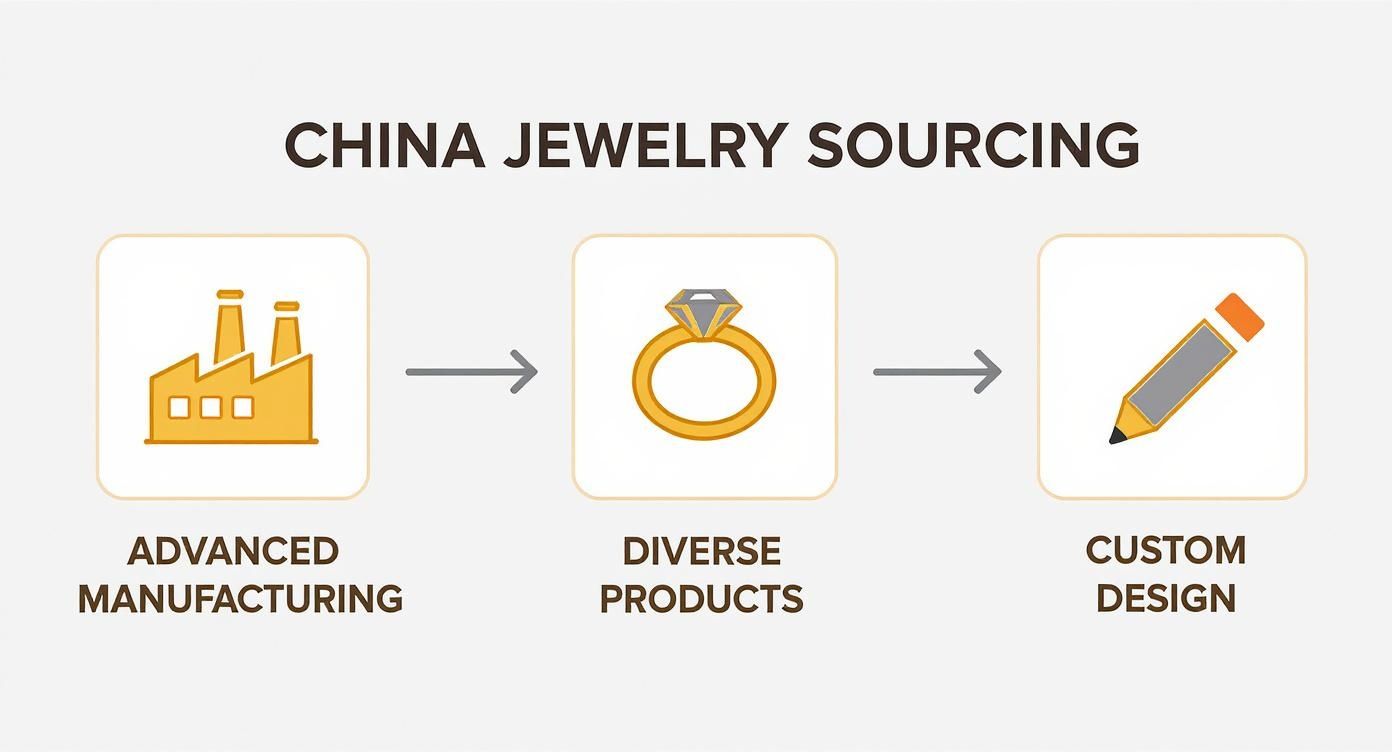
As you can see, it’s an entire ecosystem built around advanced production, a massive product range, and the ability to handle custom designs, which is a huge advantage for any business looking to stand out.
Mastering B2B Sourcing Platforms
Let’s be real—online B2B marketplaces like Alibaba and Made-in-China.com are where most of us start when looking for jewelry wholesale from China. But using them effectively to find high-quality, affordable suppliers means you have to dig deeper than the surface-level listings.
The trick is to leverage their advanced filters. Don't just type "sterling silver necklaces" and scroll. Instead, immediately filter for suppliers who are "Verified Suppliers" or "Gold Suppliers" and have been in business for a decent amount of time. I usually look for five years, minimum. This simple step alone helps weed out a surprising number of inexperienced sellers and trading companies masquerading as factories.
Once you land on a supplier's profile, put on your detective hat. You’re looking for a few key things:
- Business Type: Does it say "Manufacturer" or "Trading Company"? While trading companies aren't always bad, going direct to a manufacturer almost always gets your business better pricing and way more control over customization.
- Certifications: Keep an eye out for quality management certifications like ISO 9001. More importantly for jewelry, ask about compliance with standards like REACH (for the EU) or CPSIA (for the US), which regulate materials like lead and cadmium, ensuring your products are safe.
- Response Rate: A high response rate (I look for over 85%) and a quick response time (under 24 hours) are good signs you’re dealing with a professional and attentive sales team. Slow responses from the get-go are a major red flag for a potential business partner.
Due Diligence Beyond the Profile Page
Okay, you've got a shortlist of potential suppliers. Now the real work begins. You're moving from just browsing to actively verifying, which is a non-negotiable step to manage your business's risk. I can't stress this enough: never, ever commit to a large order based on a slick profile and a few emails.
Start by asking for a copy of their business license. This document is a goldmine of information—it has their official registered name, address, and, crucially, their scope of operations. For a small fee, you can use third-party services to verify the license's authenticity. It’s a small price to pay for peace of mind.
If things go south with an international supplier, it's also smart to know your legal options for business litigation in China to protect your business.
The Power of Samples and Trade Shows
The single most critical step in this whole process? Ordering samples. Photos lie. Descriptions exaggerate. There is simply no substitute for holding a piece in your hands to inspect its quality yourself. This is your chance to test everything.
- Material Quality: Is that "sterling silver" actually silver? Is the gold plating even and durable, or will it flake off in a week? This directly impacts your brand's reputation.
- Workmanship: Look closely at the details. Check the clasp strength, the stone settings, and the overall finish. Is it clean or sloppy?
- Packaging: How did it arrive? Professional, secure packaging shows they care about the details and protecting your investment.
- Communication: How was the sample ordering process? Were they responsive and easy to work with?
While online vetting is essential, nothing beats attending industry trade shows like the Hong Kong International Jewellery Show. Meeting people face-to-face helps build genuine relationships, lets you inspect tons of products firsthand, and helps you discover amazing new suppliers you'd never find online.
We cover more on this in our detailed guide to finding top-tier jewelry manufacturers in China. Building those personal connections can translate into better terms, priority production, and a partnership that lasts for years.
Selecting Products That Actually Sell
Your entire sourcing strategy hinges on one simple truth: you have to pick high-quality, affordable jewelry people actually want to buy. Jumping into the Chinese market without a plan is a recipe for disaster. It's overwhelming. To build a profitable business, your product choices need to perfectly align with your brand, your customers, and the specific strengths of China's various manufacturing hubs.
This means looking past fleeting trends and getting into the nitty-gritty of the market. It’s about knowing which product categories have real staying power and, just as importantly, where to find the absolute best suppliers for each style. This focused approach is what separates a successful sourcing trip from a costly mistake.
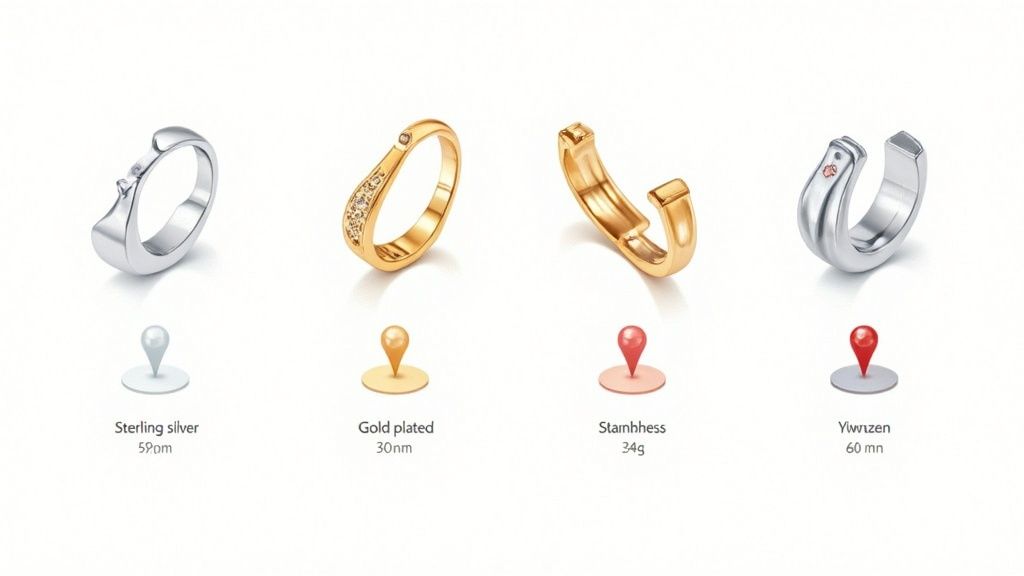
Decoding China's Main Product Categories
The sheer variety of jewelry wholesale from China is staggering. It's a huge advantage, but it can also lead to decision paralysis. The trick is to break it all down into manageable categories that fit your brand’s specific vibe and price point.
A smart place to start is with the hard numbers. China's jewelry market pulled in USD 90,044.5 million in revenue and is set to grow by 5.5% annually. The ring segment is the undisputed champion, accounting for a massive 34.13% of the market, with necklaces and earrings trailing behind. This tells us that classic pieces are a reliable foundation for any business collection. You can dig deeper into these market insights over on grandviewresearch.com.
Let's break down the main product types your business will be dealing with:
- Sterling Silver (925): This is the workhorse of high-quality, affordable jewelry. It’s a classic, durable choice for customers who want lasting pieces without the solid gold price tag. It's fantastic for everything from minimalist designs to intricate, stone-set pieces.
- Gold-Plated Jewelry: This is how you offer the luxe look of gold without the intimidating cost. Quality here can be all over the map, so you must specify the plating thickness (in microns) with your supplier to avoid pieces that tarnish after a few wears. This category is a bestseller for trendy, of-the-moment fashion accessories.
- Stainless & Titanium Steel: Hugely popular for men's jewelry and sleek, modern designs. These materials are a practical powerhouse—hypoallergenic, tarnish-proof, and incredibly tough, making them perfect for everyday wear and a great value proposition for customers.
- Fashion & Costume Jewelry: This is the fast-paced, trend-driven corner of the market. Usually made from alloys like brass or copper, these pieces are designed for seasonal collections and allow your business to test new styles without a massive financial risk.
Matching Products to Manufacturing Hubs
Here’s a crucial piece of advice for sourcing smart: not all manufacturing hubs in China are the same. Different cities have spent decades honing their skills in specific areas. Understanding these specializations will save your business an incredible amount of time and connect you with true experts.
Knowing where to go for what you need is half the battle. This table breaks down the key regions and what they do best.
Major Chinese Jewelry Hubs and Their Specializations
| City/Region | Primary Specialization | Best For | Key Benefit |
|---|---|---|---|
| Shenzhen | High-end sterling silver, fine jewelry, OEM/ODM | Businesses needing custom, high-quality production | Advanced technology and skilled craftsmanship |
| Yiwu | Fashion jewelry, accessories, costume jewelry | Businesses focused on fast-fashion and affordability | Massive variety and competitive pricing |
| Guangzhou | Gemstone jewelry, cubic zirconia, high-volume | Retailers focusing on gemstone-centric designs | Access to the world's largest gemstone markets |
| Qingdao | Costume and fashion jewelry | Buyers looking for trend-driven, low-cost items | Strong export logistics and diverse suppliers |
For instance, if your brand is all about high-end, custom silver work, you head straight to Shenzhen. The artisans and factories there are second to none. But if you’re a fast-fashion brand needing trendy, low-cost items with a quick turnaround, the sprawling markets of Yiwu are where your business needs to be.
The secret to efficient sourcing isn't just knowing what you want, but knowing where to find it. Aligning your product needs with a region's specialty connects you with suppliers who have the right skills, materials, and machinery for the job.
By making these kinds of informed decisions, you graduate from simply "buying stuff" to strategically building a catalog that your customers will love. You’ll be able to spot profitable niches, maximize your ROI, and curate a collection that truly stands out. To keep your finger on the pulse, check out our guide on the top jewelry trends to watch.
Talking Shop and Making a Deal
You’ve got a shortlist of potential suppliers. Now comes the part that separates the pros from the rookies: building a real partnership. This isn't just about placing an order; it's about clear communication and smart negotiation. Get this right, and you're not just buying jewelry—you're building a profitable, long-term collaboration for your business.
A lot of first-timers sourcing jewelry wholesale from China get hung up on the language barrier. It’s a valid thought, but it’s more manageable than you think. You don't need to be fluent in Mandarin. You just need to be crystal clear.
Getting Your Point Across (Without Getting Lost in Translation)
The name of the game is eliminating ambiguity. One small misunderstanding can snowball into a costly mistake for your business, whether it's the wrong material or a missed shipping deadline. The easiest way to avoid this is to keep things simple, direct, and visual.
Ditch the complex sentences and fancy industry jargon. Use short, straightforward English.
- Get Specific: Don’t say, “I want a good gold finish.” Instead, state exactly what your business needs: “I require 18k gold plating with a thickness of 1.0 microns.” There’s no room for misinterpretation there.
- Show, Don't Just Tell: A picture is your best friend. Always back up your written specs with detailed photos, sketches, or even links to similar products. A clear visual reference cuts through any language gap.
- Confirm, Confirm, Confirm: After you explain something important, ask your contact to repeat it back to you. It might feel a little awkward at first, but this simple check-in ensures you're both on the same page before you move on.
Nailing this clear communication style from the start makes every other step in the process go much more smoothly.
Negotiation Is More Than Just the Price
Negotiating, especially across cultures, is a delicate dance. The single biggest mistake I see new importers make is trying to squeeze every last penny out of the unit price. Price is obviously important, but a truly great negotiation is about creating long-term value for both businesses.
If you push too hard on price, you might force the supplier to cut corners on materials or quality control just to make the numbers work. A much better approach is to negotiate on the entire package.
The best deals are partnerships where both you and your supplier feel like you've won. This builds the goodwill you need for a successful long-term business relationship, and that's worth more than a few cents off each unit.
Think beyond the price tag and consider these points:
- Minimum Order Quantity (MOQ): If a supplier's MOQ is higher than your business is ready for, don't just walk away. Ask if they’d consider a smaller trial order. Frame it as a way to test the market and kick off what you hope will be a long-term partnership.
- Payment Terms: The standard deal is often a 30% deposit to start production and the final 70% when it’s done, but before it ships. Try to negotiate for terms where that final payment is due only after a successful quality control inspection. This gives you huge leverage to make sure the final product is perfect.
- Production Timelines: Get a realistic production schedule in writing. This isn't just a single "ship by" date. It should break down key milestones for sourcing materials, sample approval, mass production, and final inspection.
From Sample to Purchase Order: Getting It in Writing
The sample is your most powerful quality control tool. This is where your idea becomes a real, physical product. To get it right, your business needs to provide an incredibly detailed specification sheet, or "spec sheet." This document needs to be airtight.
Here’s what your spec sheet absolutely must include:
- Materials: Be precise. Specify the exact metal (e.g., 925 sterling silver, 316L stainless steel), the type of stone (e.g., AAAAA-grade cubic zirconia), and all plating details.
- Dimensions: Give exact measurements for every part of the piece—length, width, thickness, stone sizes, everything.
- Visuals: Include clear photos or technical drawings from multiple angles, with notes pointing out key details.
- Branding: Lay out any requirements for custom logos, tags, or packaging.
When you get the sample back, your feedback needs to be just as detailed. Take high-quality photos and mark up any areas that need tweaking. Be constructive. "The clasp feels cheap" isn't helpful. "Please use a lobster clasp that is 2mm thicker for better durability" is actionable feedback that ensures quality.
Once you’ve perfected the sample, you lock it all in with a Purchase Order (PO). This is your contract. A solid PO summarizes everything you've agreed on—specs, quantity, pricing, payment terms, and timeline. It's your ultimate protection. Never, ever let production begin without a signed PO.
Managing Shipping and Ensuring Quality Control
Getting your beautifully crafted, affordable jewelry from a factory floor in China to your warehouse is the final, crucial puzzle piece. This is where your investment becomes real, but it's also a stage packed with potential pitfalls if you're not careful. Nailing your logistics and quality control isn’t just about getting products; it’s about protecting your profit and your brand's reputation.
Essentially, it all boils down to two things: international shipping and rigorous quality assurance. One gets the product to you, and the other ensures it's actually worth selling. Dropping the ball on either can turn a promising order into a very expensive lesson for your business.
Making Sense of International Shipping
Your first big decision here is choosing between air and sea freight. This choice isn't just about cost—it directly impacts your delivery speed and your entire business logistics strategy. There's no single "best" option; the right call really depends on the specifics of your order.
-
Air Freight: This is your express lane. It's perfect for smaller, high-value orders or when you need to restock a hot-selling item in a hurry. While it's significantly more expensive, getting your product in 5-10 days can be a massive competitive advantage.
-
Sea Freight: When cost is king and you're placing a large, bulky order, sea freight is the undeniable winner. It's much slower, often taking 30-45 days from port to port, but the savings are huge. This is the standard choice for stocking up on your core inventory well ahead of time to maximize profit margins.
Beyond the shipping method, you'll need to understand Incoterms. These are standardized trade terms that spell out exactly who is responsible for what during the shipping process. The two you'll see most often are:
-
FOB (Free On Board): With FOB, your supplier handles everything to get the goods to the port in China and loaded onto the ship. Once it's on board, your business takes over responsibility for the main sea journey, insurance, and customs clearance.
-
EXW (Ex Works): Here, the supplier’s only job is to have your product ready for pickup at their factory door. Your business is responsible for everything else—from trucking it to the port in China to the final delivery. EXW often looks cheaper upfront, but it puts a lot more logistical work on your plate.
If you’re selling on a platform like Amazon, getting this process dialed in is absolutely critical. In fact, this Step-by-step guide to shipping from China to Amazon FBA is a fantastic resource that breaks down how to manage freight, customs, and costs effectively.
Your Final Line of Defense: Quality Control
I can't stress this enough: never release your final payment until you are 100% certain the products meet your quality standards. Quality control isn't something you do when the boxes arrive at your door; it's a critical step you take before the goods ever leave the factory. This pre-shipment inspection is your most powerful piece of leverage.
For larger orders, hire a third-party inspection company in China. For smaller ones, you might get by with asking your supplier to send detailed photos and videos of the finished batch. While the DIY video route saves money, a professional inspector provides an unbiased, detailed report that is well worth the investment for any significant order.
Your Purchase Order (PO) must explicitly state that final payment is contingent upon a successful pre-shipment inspection. This one clause is your ultimate protection against receiving a shipment of flawed or incorrect products.
Create a detailed QC checklist based on the sample you approved. This is no time for vague instructions. Get specific.
- Material Verification: Check for the correct metals (e.g., does it have the 925 sterling silver stamp?) and stones to ensure you received the quality you paid for.
- Plating and Finish: Inspect for consistent color, thickness, and any signs of scratches, pits, or blemishes.
- Functionality Check: Test every single clasp, closure, and adjustable part on a random but meaningful sample of items.
- Packaging Review: Make sure each piece is packed exactly to your specifications to prevent damage during the long journey.
To learn more about how all these moving parts fit together into a cohesive strategy, check out our guide on the basics of supply chain management. Taking a proactive approach here ensures the beautiful, affordable jewelry you worked so hard to source arrives safely and ready to delight your customers.
Common Questions on Sourcing Jewelry From China
Diving into jewelry wholesale from China can feel like a massive undertaking, and it's totally normal to have a long list of questions. Getting straight answers to the most common worries is the best way for your business to move forward feeling confident. We’ll tackle the questions we hear all the time from business owners starting this exact journey.
What Are The Biggest Mistakes To Avoid?
The most common trap for a business is getting laser-focused on the lowest possible price. I've seen it time and time again—chasing that rock-bottom unit cost almost always means you're sacrificing quality, whether you realize it at first or not.
Another huge, and surprisingly common, mistake is skipping the sample order. It seems like a way to save time and money, but it’s your single best opportunity to feel the materials and see the craftsmanship up close before you commit to thousands of dollars in inventory.
Vague communication is another profit killer. If you don't provide a crystal-clear spec sheet and a formal Purchase Order (PO), you're leaving the door wide open for mix-ups on materials, dimensions, and finishes. And don't forget to account for shipping and import duties; underestimating those costs can completely erase your profit margin before the products even land.
The smartest importers I know don't treat their suppliers like faceless vendors; they build partnerships. They sidestep the biggest mistakes by making clear communication, deep vetting, and fair negotiation their priorities—not just the price tag.
How Can I Pay Chinese Suppliers Safely?
Protecting your business's cash is priority number one. Your safest bet is always a payment method that gives you some form of buyer protection. When you’re buying through a platform like Alibaba, using their Trade Assurance service is a no-brainer. It essentially acts as an escrow, holding your money until you confirm you've received what you paid for.
When you're dealing directly with a factory, wire transfers (T/T) are the standard. The key is to structure the deal to limit your risk. Here’s a fair and common arrangement:
- 30% Deposit: You pay this upfront so they can buy materials and start production.
- 70% Final Payment: This is the crucial part—you only pay this after the goods have passed a quality control inspection but before they ship out.
For smaller orders and samples, PayPal works well because it's fast and easy. But the fees can really add up, making it less than ideal for large wholesale purchases. Whatever you do, steer clear of irreversible methods like Western Union. If something goes wrong, your money is gone for good.
Do I Need A Special License To Import Jewelry?
This is a really common question, and the answer is location-specific. In the United States, for instance, you don't typically need a dedicated "import license" to bring in jewelry. Your business just needs to be legally registered. The responsibility for customs, duties, and taxes falls squarely on you, the importer.
For any business new to this, the simplest path is to hire a customs broker or a freight forwarder. Think of them as your logistics experts. They navigate the maze of international shipping regulations, handle all the complex paperwork, and ensure you're paying the correct duties. Using a pro saves you from headaches and costly mistakes.
What Is A Realistic Timeline From Start To Finish?
In international sourcing, patience isn't just a virtue—it's a business strategy. Rushing things is how you make expensive errors. A realistic timeline, from finding your supplier to getting the product into your warehouse, is usually somewhere between two and four months.
Here’s a practical breakdown of how that time gets spent:
- Supplier Research & Vetting: 2–4 weeks
- Sample Ordering & Review: 3–5 weeks
- Mass Production: 4–6 weeks (this can stretch depending on how big or complex your order is)
- International Shipping & Customs: 1–2 weeks for air freight, or a longer 4–6 weeks for sea freight
Don't be tempted to cut corners on any of these stages. Skimping on your vetting process or rushing to approve a so-so sample will almost certainly create much bigger, more expensive problems later on.
Ready to source high-quality, on-trend jewelry with confidence? JewelryBuyDirect offers over 120,000 styles with no minimum order, factory-direct pricing, and free worldwide shipping on orders over $150. Start building your collection today at https://www.jewelrybuydirect.com.