






Arthur Lynch | Sat Dec 27 2025
A Guide to Sourcing High-Quality Jewelry Charms in Bulk for Your Business
Sourcing jewelry charms in bulk isn't just a cost-saving tactic; it's a foundational strategy for any jewelry or fashion accessories business aiming for agility and profitability. For business owners, this approach is the key to maintaining stock of bestsellers, capitalizing on emerging trends, and significantly improving your profit margins.
The Strategic Value of Sourcing Jewelry Charms in Bulk
For a jewelry designer, retailer, or online brand, your charm inventory is your creative and commercial lifeblood. A well-stocked assortment allows your business to assemble new products—like a custom initial necklace or a seasonal charm bracelet—without operational delays. You avoid the inefficiency and higher costs of placing small, frequent orders and are never caught waiting on a supplier.
This agility is crucial in the fast-paced fashion accessory market, where a social media trend can cause a specific charm style to sell out overnight.
When a trend hits, you want your business to be positioned for immediate fulfillment. Having the right charms in stock means you can capture that surge in demand instantly, gaining a critical advantage over competitors who are still waiting for their shipments.
Building a Competitive Edge for Your Business
When you source jewelry charms in bulk directly from a manufacturer or a specialized wholesaler, you effectively bypass intermediaries. Eliminating these middlemen removes their markups, giving your business a powerful competitive advantage in the market.
This direct sourcing model unlocks several key benefits for your business:
- Higher Profit Margins: The most direct benefit is a lower cost per unit. Reducing your cost of goods sold (COGS) is the fastest way to increase the profitability of every sale. This additional capital can be reinvested into marketing, new product development, or business growth.
- Stock Consistency: For a business, stockouts mean lost sales and customer frustration. Bulk purchasing ensures your most popular items are always available, which enhances customer satisfaction and encourages repeat business.
- Creative and Commercial Freedom: A deep and affordable inventory provides the flexibility to innovate. You can experiment with new combinations, develop themed collections for specific seasons or holidays, and test new design concepts with minimal financial risk.
The business principle is straightforward: purchasing larger quantities reduces your per-unit cost. This allows you to offer competitive retail pricing to your customers while securing a healthy profit margin for your business. It is a fundamental aspect of smart inventory management.
Working directly with factories also provides access to a much wider array of unique, high-quality fashion accessories that are often unavailable through standard retail suppliers. To refine your business's procurement process, review our detailed guide on how to buy jewelry in bulk for resale.
Ultimately, mastering bulk sourcing keeps your brand competitive and your customers engaged—essential components for success in the accessories market.
How to Identify Quality Materials for Your Business
Your brand's reputation is built on the quality of the products you sell. When buying jewelry charms in bulk, the choice of materials is paramount—it dictates product longevity and shapes customer trust in your business. Differentiating between a charm that will tarnish quickly and one that will become a lasting accessory is key to building a loyal customer base.
Consider materials as the foundational components of your product line. A top-tier chef wouldn't use inferior ingredients, and your business shouldn't settle for substandard metals. This knowledge empowers you to ask suppliers the right questions and ensure every charm aligns with your brand's quality promise.
A sound sourcing strategy, beginning with high-quality materials, creates a positive feedback loop for your business. It ensures consistent stock, enables rapid response to trends, and ultimately drives higher profit margins.
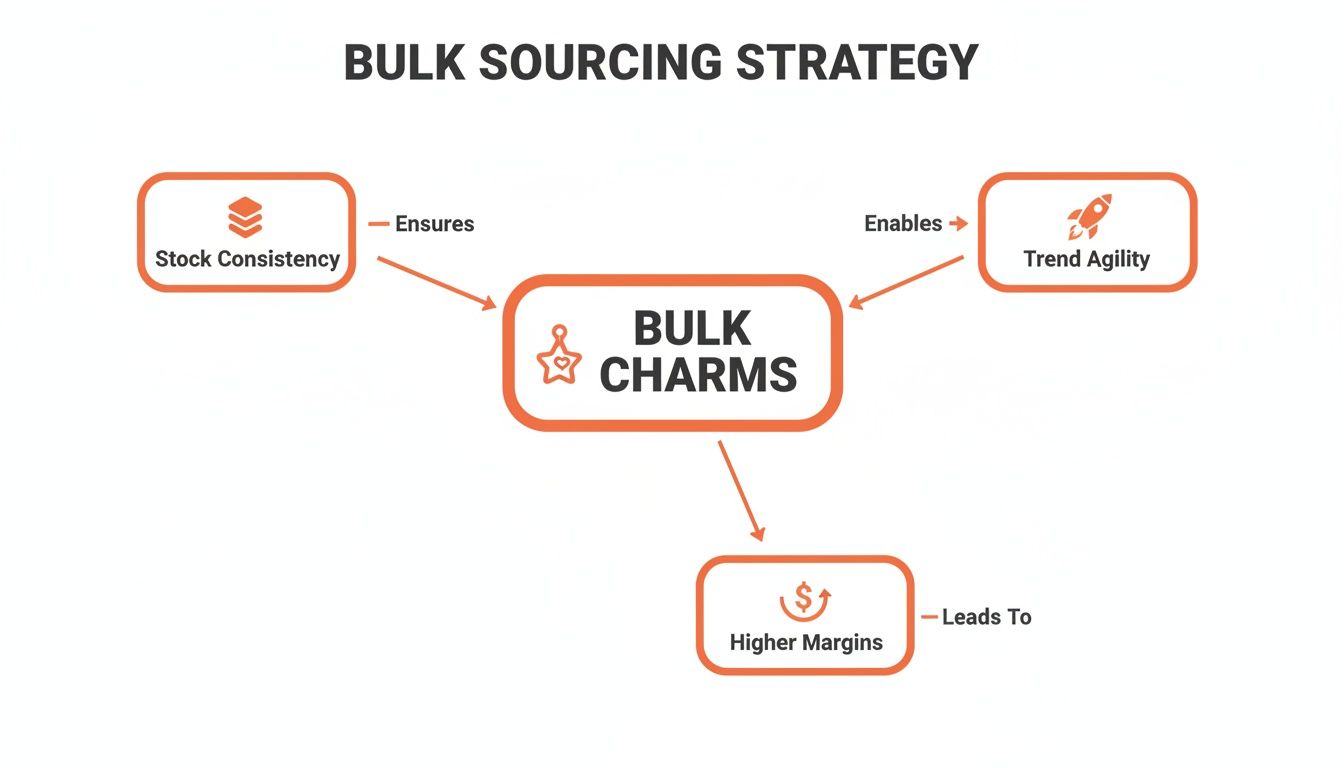
As illustrated, strategic sourcing is a continuous business cycle. Each phase, from material selection to achieving higher margins, supports the next, creating a sustainable and profitable business model.
Understanding Key Materials for Jewelry & Fashion Accessories
Navigating the world of jewelry materials can be complex, but a few core options are industry standards because they offer an optimal balance of quality, durability, and cost-effectiveness for businesses.
The right material choice depends on your brand's positioning, target market, and pricing strategy. Here is a business-focused overview of common materials you will encounter.
Comparing Common Materials for Bulk Jewelry Charms
| Material | Key Business Benefits | Best For | Average Cost (Bulk) |
|---|---|---|---|
| 925 Sterling Silver | High perceived value, hypoallergenic, retains value. | Premium collections, bridal jewelry, and milestone gifts. | $$ - $$$ |
| Stainless Steel | Highly durable, tarnish/rust resistant, hypoallergenic. | Everyday fashion jewelry, men's accessories, durable/affordable lines. | $ |
| Titanium | Stronger than steel yet lighter, highly biocompatible. | Modern/minimalist designs, high-performance accessories, sensitive skin lines. | $$ |
| Gold-Plated Metal | Offers the look of gold at a lower cost, great for trends. | Fashion jewelry, seasonal collections, fast-fashion accessories. | $ - $$ |
Each material serves a distinct market segment. Stainless steel is an excellent choice for durable, high-volume, everyday pieces. For a technical breakdown of one of the most reliable options, you can learn more about 316L stainless steel in jewelry. Conversely, sterling silver provides the classic, high-quality appeal expected in more premium product lines.
How to Assess Quality Craftsmanship
Excellent material is only part of the equation. The manufacturing quality of the charm distinguishes a premium product from a low-cost alternative. When you receive samples, conduct a thorough quality control inspection.
A well-manufactured charm has a solid feel and a flawless, consistent finish. Critically examine the loop, or bail, where it attaches to a chain or finding. It must be securely closed with no gaps. These small details are the most reliable indicators of a supplier's commitment to quality.
Run your fingers over the surface to detect any bumps, scratches, or inconsistencies in plating. These are immediate quality control failures. For plated items, check for discoloration, particularly around edges or in detailed areas. If the construction feels weak or the bail is flimsy, it will not withstand regular wear, leading to customer complaints and costly returns for your business.
Finding and Vetting Your Ideal Wholesale Supplier
Sourcing jewelry charms in bulk is analogous to selecting a strategic business partner. The right supplier can be a significant asset, enhancing your brand with consistent quality and reliable service. The wrong one can lead to operational bottlenecks and dissatisfied customers. This selection process is one of the most critical steps in building a successful jewelry and accessories business.
Your initial search may be online, but the critical work is in the vetting process. You must look beyond product photography and assess their operational capabilities. A reputable supplier will be transparent about their product origins and manufacturing processes.
Key Questions to Ask Potential Suppliers
Before committing to an order, you must conduct due diligence by asking suppliers critical questions about their logistics and quality control. Treat this as an interview for a key role in your supply chain. Their responses will reveal their level of professionalism and suitability as a business partner.
Here are essential questions that directly impact your operations and bottom line:
- Production and Shipping: What is your standard lead time for a bulk order? Do you provide global shipment tracking, and what is a realistic delivery timeframe?
- Quality Assurance: Are your manufacturing facilities certified by third-party organizations like SGS? Can you detail your quality control process from production to shipment?
- Policies and Support: What is your policy for damaged or incorrect shipments? Is there a dedicated business support contact for issue resolution?
A supplier's policies on returns and shipping are not just contractual details; they reflect their commitment to customer service. Clear, fair, and business-friendly terms are a strong positive indicator.
The Strategic Advantage of Flexible Terms
For small and growing businesses, managing cash flow is paramount. A supplier's ordering terms can either facilitate growth or constrain it. The single most valuable term to look for is a no minimum order quantity (MOQ) policy.
This flexibility is a strategic game-changer for a business. It allows you to test new charm designs and market trends without significant capital risk. You can diversify your product offerings without tying up all your capital in a few SKUs. When a new trend emerges, you can react immediately.
Instead of being forced to purchase hundreds of a single charm, you can order smaller quantities of various designs. This strategy keeps your inventory dynamic, reduces financial risk, and improves your ability to respond to market demands.
Of course, sourcing is only one part of the equation. Selling effectively is the other. For more on this, the ultimate guide to sourcing and selling Amazon wholesale products is a valuable resource. By partnering with suppliers who offer flexible terms and transparent practices, you are not just buying inventory; you are building a resilient foundation for sustainable business growth.
Navigating Pricing and Maximizing Your Budget
Managing the financial aspects of buying jewelry charms in bulk is critical for profitability. For a business, understanding pricing structures and calculating the true cost of goods is essential for financial health. Mastering concepts like tiered pricing and landed cost per unit will ensure every dollar of your procurement budget is maximized.
This is especially relevant given the rapid growth of e-commerce in the jewelry sector. Bulk jewelry charms are a significant driver of this trend. Online jewelry sales are projected to grow at a CAGR of 7.9% through 2033, far outpacing the overall market. As mobile commerce grows, personalized items like initial and zodiac charms have become market leaders, now accounting for 22% of the costume jewelry segment. This market dynamic makes sourcing affordable, high-quality charms a top priority for any accessories business. To understand the market fully, you can explore the full jewelry market research from Grand View Research.
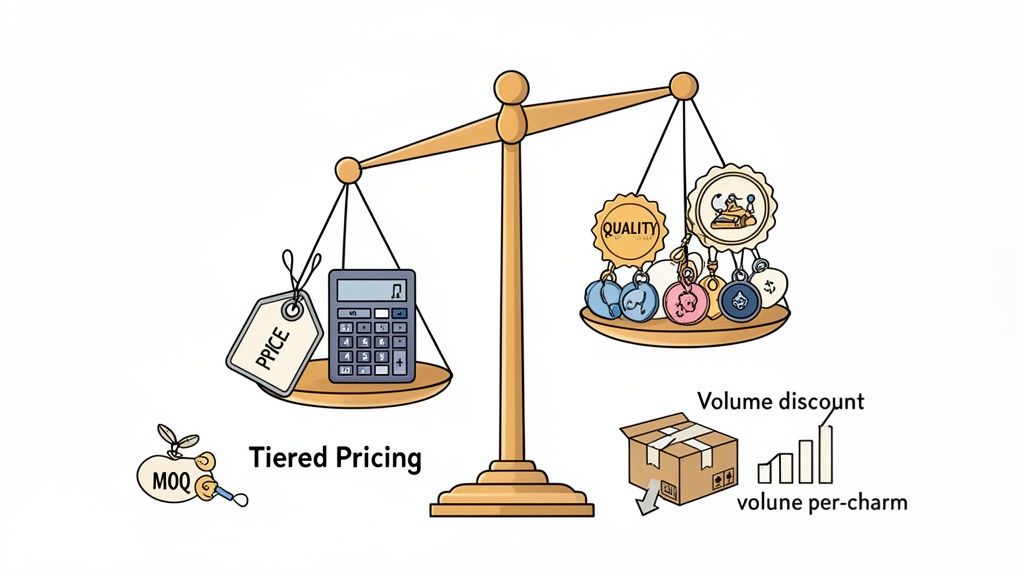
Unpacking Tiered Pricing and MOQ
In supplier negotiations, you will frequently encounter two terms: tiered pricing and Minimum Order Quantity (MOQ). Tiered pricing is a volume-based discount structure: the more units you purchase, the lower the price per unit. For example, a supplier might offer a charm at $1.00 for an order of 50, but the price could drop to $0.75 for an order of 500.
MOQ is the minimum quantity a supplier requires for an order. A high MOQ can be a significant barrier for small businesses, as it requires a substantial capital investment in a single product before its market viability is proven.
The ideal supplier for a growing business offers attractive tiered pricing combined with a low—or no—MOQ. This provides the optimal balance: the flexibility to test new products with minimal financial exposure and the ability to achieve better unit economics as you scale up successful designs.
Calculating Your True Cost Per Charm
The supplier's list price is not your final cost. To set accurate retail prices and understand your true profit margins, you must calculate the total landed cost, which includes all expenses incurred to get the charms into your inventory. Overlooking these additional costs is a common error that can erode profitability.
Use this formula to determine your true cost:
(Total Product Cost + Shipping Fees + Customs/Duties) / Total Number of Charms = True Cost Per Charm
For example, consider an order of 1,000 charms. The product cost is $500, shipping is $50, and customs fees are $25. The calculation is:
- ($500 + $50 + $25) / 1000 = $0.575 per charm
This figure, $0.575, is your actual cost basis for pricing. To streamline this process, use our wholesale profit margin calculator to ensure every product is priced for profitability. Diligent tracking of these costs enables smarter purchasing decisions that support your business's financial health and growth.
Turning Your Bulk Charms into Bestselling Products
You've established a reliable sourcing process and secured an inventory of high-quality, affordable jewelry charms. This is a critical operational achievement. However, the real business value is realized when you transform these components into unique, desirable products that drive sales. This is where creative merchandising meets business strategy.
The market for personalized jewelry is expanding rapidly, outpacing the growth of the overall global jewelry market, which was valued at $348 billion in 2025. This demand is driven by consumers' desire for products that tell a personal story. Women, who represent 68% of the fine jewelry market, are particularly drawn to pieces that symbolize memories, personal identity, or life milestones. This trend presents a significant commercial opportunity for your business.
From Components to Collections
Shift your business mindset from selling individual components to curating complete product collections. By grouping charms into themed collections, you create a narrative, add perceived value, and simplify the purchasing decision for your customers.
Consider these product strategies for your business:
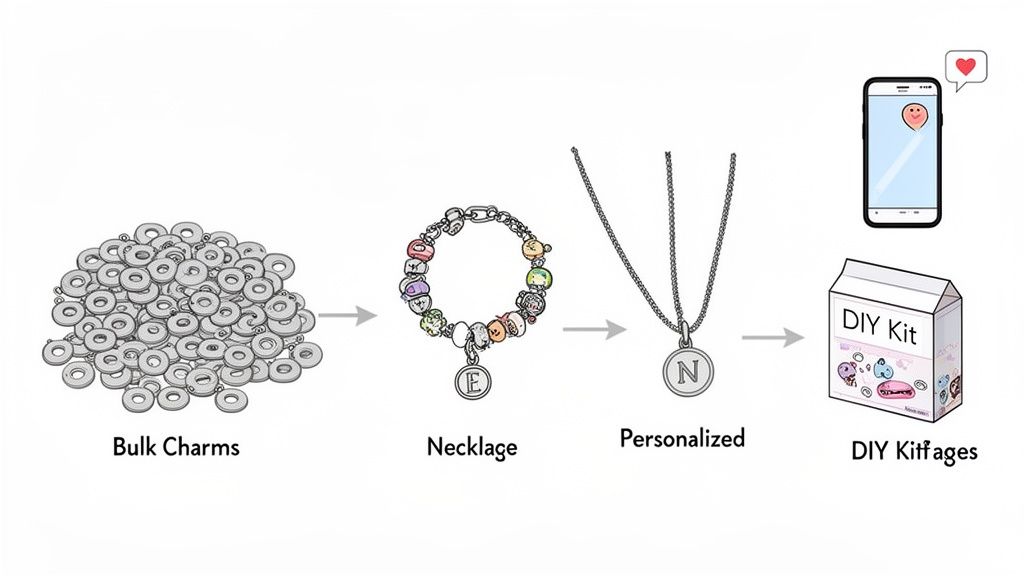
- Themed Charm Bracelets: Develop pre-designed bracelets for key gifting occasions. Examples include hearts for Valentine's Day, seashells for summer collections, or celestial charms for astrology enthusiasts. These products serve as instant, high-margin gifts.
- Personalized Initial Necklaces: Alphabet charms are consistent top-performers. Offer necklaces that accommodate single or multiple initials, targeting customers looking to represent family members or partners. This category is a reliable revenue driver for birthdays and anniversaries.
- Curated DIY Kits: Cater to the growing craft and personalization market by packaging complementary charms with a blank bracelet or necklace. This product taps into the consumer desire for creating unique, one-of-a-kind items.
Merchandising and Marketing Your Creations
The presentation of your charm-based products is as crucial as the products themselves. High-quality photography and compelling product descriptions are essential for converting browsers into buyers. Invest in professional, well-lit photos that highlight the details of each charm.
Focus on selling the emotion, not just the product. A social media campaign for a "Wanderlust Collection" featuring travel-themed charms will resonate more deeply with consumers than a simple product image and price.
Your business goal is to become the go-to source for attractive, customizable jewelry and fashion accessories. To maximize sales from your bulk charms, you need to understand your customer base. Analyzing customer engagement metrics that drive growth is a powerful tool. These insights allow you to refine your collections, increase your average order value (AOV), and build a loyal customer base that drives long-term revenue.
Answering Your Top Questions About Sourcing Bulk Charms
Embarking on sourcing jewelry charms in bulk can seem complex, particularly when the goal is to find high-quality, affordable accessories that will drive your business forward. It's natural for business owners to have questions. This section addresses the most common concerns, providing practical, business-focused answers to help you source with confidence.
Consider this your final operational checklist. We have covered strategy, materials, and finance; now, let's address the final questions that may be preventing you from moving forward.
What Is a Reasonable Price to Pay for Bulk Charms?
There is no single answer to this question. A "reasonable" price is a variable that depends on the material, design complexity, and order volume. The objective is to find the optimal price point that aligns with your brand's quality standards and pricing strategy.
For example, stainless steel or gold-plated alloy charms will always be more cost-effective than those made from solid 925 sterling silver. A simple stamped initial charm has a lower production cost than a detailed, multi-color enamel piece.
Here is a general pricing framework:
- Stainless Steel/Alloy: Bulk prices often range from a few cents to just over a dollar per unit for basic designs.
- 925 Sterling Silver: Prices typically start at one to two dollars per unit and increase based on weight and complexity, reflecting the commodity value of the metal.
The key is to conduct a like-for-like comparison. Obtain quotes from multiple suppliers for the same material and a similar design to establish a fair market price range. Be cautious of pricing that seems unusually low, as it can be an indicator of inferior quality or unethical manufacturing practices.
How Can I Test Charm Quality Without a Large Investment?
Never commit to a large purchase order without first physically inspecting the product. Fortunately, there are low-risk methods for conducting quality assurance. The most effective strategy is to partner with a supplier that understands the needs of a growing business.
Seek out suppliers with a no Minimum Order Quantity (MOQ) policy. This is the most powerful tool for risk-free product testing. It allows you to order small quantities of various styles for hands-on evaluation. You can essentially create your own custom sample kit tailored to your business needs.
When the charms arrive, perform a few simple quality checks. Assess the weight—does it feel substantial or flimsy? Inspect the bail (the loop) to ensure it is securely closed. For plated items, you can perform a gentle scratch test in an inconspicuous area to assess the durability of the finish.
A supplier's willingness to accommodate small test orders is a strong indicator of their confidence in their product quality. It demonstrates a commitment to building a long-term business partnership rather than securing a single large sale.
Are Overseas Suppliers Reliable for Sourcing Jewelry?
Sourcing directly from overseas manufacturers can provide significant benefits, including factory-direct pricing and access to a broader range of designs. However, reliability is determined by a company's operational standards, not its geographic location. The key is not where they are, but how they operate.
To ensure you are partnering with a credible international supplier, look for these trust signals:
- Industry Certifications: Look for mentions that their manufacturing partners are audited by recognized third-party organizations like SGS. This verifies adherence to quality control and ethical production standards.
- Transparent Policies: A professional supplier will have clear, easily accessible policies regarding returns, shipping, and handling of damaged goods.
- Genuine Reviews: Seek out independent reviews and testimonials from other business owners. A high repeat customer rate (e.g., 85%) is a strong indicator of consistent quality and service.
- Responsive Support: Test their customer service. A prompt, professional response to an inquiry is a sign of a well-run support operation, which is critical for a business partnership.
What Are the Most Popular Charm Styles I Should Stock?
While it is important to stay current with trends, a sound inventory strategy is built on a foundation of evergreen styles that have consistent consumer demand. These are the core themes that customers actively search for year-round.
Begin by building your inventory around these core categories:
- Personalization: Initial/letter charms and zodiac signs are perennial bestsellers and essential stock for any accessories business.
- Symbolic and Spiritual: Motifs such as hearts, stars, crosses, and evil eyes have timeless, cross-cultural appeal.
- Nature-Inspired: Designs featuring flowers, leaves, animals, and celestial bodies (sun, moon, stars) are consistently popular.
- Milestones and Hobbies: Charms representing travel, personal passions, or family create strong emotional connections that drive purchasing decisions.
By building your collection around these foundational styles, you create a versatile and commercially viable inventory. This provides a solid base from which you can strategically add trend-driven or seasonal pieces to keep your offerings fresh and exciting.
Ready to source high-quality, affordable jewelry charms in bulk for your business? JewelryBuyDirect offers over 120,000 on-trend styles with no minimum order, factory-direct pricing, and SGS-certified quality your business can trust. Explore the collection and start building your bestselling jewelry line today.