






Arthur Lynch | Fri Aug 22 2025
How to Start an Online Jewelry Store
So, you're ready to start an online jewelry store. The first, and most crucial, part of this journey has nothing to do with websites or suppliers. It’s all about laying the groundwork—defining who you are, what you stand for, and who you're selling to. Think of it as building the soul of your business before you even have a single product to list. Get this right, and you'll stand out in a very crowded, very sparkly market.
Building Your Brand Beyond the Bling
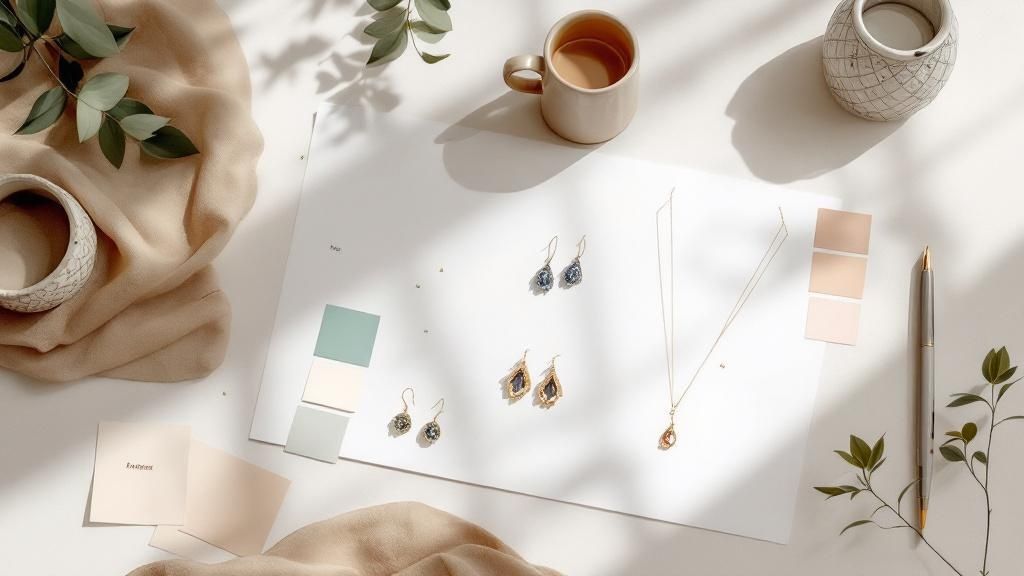
Anyone can sell a pretty necklace. What people truly buy into, however, is a story, a mission, and an identity they can connect with on an emotional level. Your job isn't just to sell accessories; it's to create a memorable experience that makes someone feel seen and understood.
And the opportunity is massive. The global jewelry market was valued at roughly $348 billion in 2025, with fine jewelry making up a whopping 68% of that. While the U.S. is a huge consumer, the real explosion in growth is happening in the Asia-Pacific region, opening up incredible possibilities for new online brands. You can dig deeper into these numbers and explore the potential of the global jewelry market on carattrade.com.
Find Your Profitable Niche in Global Trends
The first actionable step is to find your corner of the market. Don't just follow your own taste—you have to figure out where customer demand is actually heading. A great way to do this is by looking at what’s happening globally, because these trends offer powerful clues for finding your unique angle.
Here's a quick look at actionable insights from current regional trends:
- Western Markets (North America & Europe): The big story here is ethics and sustainability. Shoppers are actively looking for lab-grown diamonds, recycled metals, and brands that are transparent about their supply chain. Actionable Insight: Build your brand around "conscious luxury." Feature certifications, tell the story of your recycled gold, or partner with ethical gem suppliers. This isn't just a feel-good move; it's a powerful market differentiator.
- Latin America: People here often lean towards bold, artisanal pieces that celebrate their cultural heritage. Think big, colorful statement earrings, intricate metalwork, and vibrant gemstones that pop. Actionable Insight: Curate a collection featuring natural materials like tagua nuts or brightly colored textiles alongside metal. Use rich, warm photography and tell the story of the artisan or the cultural inspiration behind each piece.
- Asia-Pacific Markets: This region is a fascinating mix of old and new. In India, traditional, ornate gold designs are always in demand. Meanwhile, in China and Japan, there's a huge surge in minimalist "everyday luxury" and branded fine jewelry. Actionable Insight: Focus on delicate, layerable 14k or 18k gold pieces—thin chains, small charm necklaces, and stackable rings—for the East Asian market. This trend is about subtle status and daily wearability.
The goal isn't to please everyone. Instead, you need to zero in on a specific vibe or set of values. Are you going to be the go-to for simple, everyday gold hoops? Or will you be the expert in ethically sourced, one-of-a-kind engagement rings?
Your niche isn't just about the type of jewelry you sell; it's about the story you tell. A strong brand narrative can turn a simple pair of earrings into a symbol of empowerment, sustainability, or personal expression.
Before moving on, let's nail down these foundational steps. This checklist breaks down the essential actions you need to take to build a solid base for your brand.
Your Jewelry Brand Foundation Checklist
| Action Item | Key Consideration | Why It Matters |
|---|---|---|
| Pinpoint Your Niche | What specific style, material, or value will you focus on? (e.g., minimalist, ethical, vintage) | A clear niche helps you attract a dedicated audience and stand out from generic competitors. |
| Define Target Audience | Who is your ideal customer? Think age, style, income, and values. | Knowing your customer guides every decision, from product design to marketing messages. |
| Craft a Brand Story | What is the "why" behind your brand? What inspired you to start? | A compelling story creates an emotional connection and makes your brand memorable. |
| Develop a Visual Identity | What will your logo, colors, and fonts look like? | Visual consistency across your website and social media builds recognition and trust. |
| Handle Legal Setup | Have you registered your business name and obtained the right permits? | This protects you legally and establishes your business as a legitimate entity from day one. |
Completing this checklist ensures your creative vision is built on a solid, legally sound foundation, setting you up for long-term success.
Crafting a Memorable Brand Identity
Once you know your niche, it’s time to bring your brand to life visually and emotionally. This identity needs to be rock-solid and consistent everywhere—your website, social media, even your packaging. It’s what makes a customer remember you long after they’ve clicked away.
Start by thinking about your brand’s personality. Is it:
- Elegant and sophisticated? You'd likely use clean fonts, a muted color palette, and crisp, professional product shots.
- Bohemian and free-spirited? Think earthy tones, fonts that feel handwritten, and lifestyle photos shot in beautiful, natural settings.
- Modern and edgy? This might call for bold typography, a stark black-and-white color scheme, and sharp, graphic visuals.
Everything—your logo, your color choices, the way you write your product descriptions—should flow from this core personality. A brand selling vintage-inspired lockets should look and feel completely different from one that specializes in futuristic, 3D-printed rings.
This consistency is what builds trust and makes your brand instantly recognizable. Lastly, don't forget the less glamorous but equally important stuff: get the legal essentials sorted out. Register your business name and secure any necessary permits to operate. A brilliant creative vision needs a solid legal foundation to truly thrive.
Sourcing and Curating Your Collection
With your brand identity locked in, it’s time for the exciting part: bringing your vision to life with the actual jewelry. Your collection is the physical embodiment of your brand's story, and how you choose to source these pieces will shape everything from your quality and profit margins to your ability to grow.
This is a foundational decision. Are you the artisan, meticulously crafting each piece by hand? Or are you the sharp-eyed curator, sourcing brilliant designs from others? Maybe you're the brand manager, working with manufacturing partners to produce your unique concepts. Each path is valid, but they all come with their own set of rules and challenges.
Choosing Your Sourcing Model
There’s no single "best" way to get your inventory—the right choice hinges on your brand, your skillset, and the cash you have on hand. Handcrafting gives you total creative freedom but is incredibly tough to scale. On the other end of the spectrum, dropshipping costs almost nothing to start but hands over control of quality and customer experience to someone else.
Let's break down the most common paths people take.
-
Handcrafting Your Pieces: This is the heart and soul of brands built on artistry. It lets you offer truly one-of-a-kind items and tell a compelling story about your craft. The catch? You're the bottleneck. Production is limited by the hours in your day, making growth a real puzzle.
-
Partnering with Manufacturers: If your dream is to scale up with consistent, high-quality products, working directly with a factory is a fantastic route. You provide the designs, they handle the heavy lifting of production. This requires crystal-clear communication and a rigorous quality control process to make sure what you get is what you envisioned.
-
Buying Wholesale: This is often the quickest way to get to market. You curate a collection by selecting from a supplier's existing designs. For new boutique owners, knowing how to pick winners is the name of the game. If this sounds like your path, getting some solid advice on sourcing wholesale jewelry for boutiques can help you build an inventory that flies off the shelves.
-
Dropshipping: As the most accessible entry point, dropshipping means you hold zero inventory. A customer orders, and a third-party supplier ships it directly to them. While it dramatically lowers your financial risk, you'll likely see smaller profit margins and have to navigate potential hiccups with shipping times and product quality.
Your sourcing decision is more than just logistical; it's strategic. It defines your operational backbone, your brand's promise of quality, and your potential for growth down the line.
Tapping Into Global and Regional Trends
A killer collection is a masterful blend of your unique brand vision and what customers are actually searching for. Keeping a pulse on global and regional fashion trends is vital for making sure your inventory feels fresh and relevant. You don't have to jump on every fleeting fad, but being aware of the bigger picture helps you make smarter buying decisions.
Here's how to translate trends into actionable inventory choices:
- Trend: Dopamine Dressing. Globally, fashion is embracing bold, mood-boosting colors. Actionable Insight: Source or create pieces with vibrant enamel, colorful gemstones like turquoise and amethyst, or even playful beaded designs. Market them as "jewelry that makes you smile."
- Trend: Modern Pearls. Forget grandma's classic strand. Today's trend is all about baroque, uniquely shaped pearls used in modern settings. Actionable Insight: Look for wholesale suppliers offering asymmetrical pearl earrings, single pearl pendants on delicate chains, or pearls mixed with chunkier gold hardware.
- Trend: Personalization. From zodiac signs to initial pendants, customers want jewelry that tells their personal story. Actionable Insight: Offer engraving services or stock a deep inventory of initial and birthstone charms. This adds immediate value and makes your products highly giftable.
Seeing these patterns allows you to fine-tune a collection that truly connects with a specific audience, moving beyond generic styles to offer something timely and desirable.
Vetting Suppliers and Building Partnerships
No matter which model you choose, your suppliers are your business partners. Building strong, trustworthy relationships isn't just nice—it's non-negotiable. Before you commit to anyone, you have to do your due diligence.
I always recommend starting with a simple vetting checklist. You need to know:
- Material Quality & Sourcing: Where do their materials come from? Can they show you certifications for precious metals or gemstones? Get specific.
- Ethical Practices: Don't be shy about asking about their labor standards and environmental impact. Today’s customers care, and you should too.
- Production Capabilities: What are their minimum order quantities (MOQs)? What’s a realistic lead time from order to delivery?
- Communication & Support: How easy are they to get a hold of? Is there a dedicated person who will actually answer your emails?
Negotiating terms that protect your business is just as important. Hash out the policies for damaged goods, payment terms, and even the possibility of getting exclusive rights to certain designs. A great partner will work with you. And remember, the cheapest supplier is rarely the best one. Reliability, quality, and good communication are always worth paying a little extra for.
Designing Your Digital Boutique
Your website is more than just a place to list products—it's your digital storefront. It's the home for your brand and, frankly, the most critical tool you have for turning curious visitors into loyal customers.
In the world of online jewelry, this is everything. Customers can't physically touch your pieces or try them on, so you have to create an experience that’s immersive, trustworthy, and visually breathtaking. This is where you pour your brand's soul into a captivating online boutique.
Getting this right can pay off, big time. The global online jewelry market is absolutely booming, valued at around $46.1 billion in 2024 and projected to skyrocket to nearly $129 billion by 2032. This surge is driven by a massive shift to online shopping and new tech that makes buying jewelry online easier and more engaging than ever. You can dive deeper into these powerful online jewelry market trends to see what this means for sellers like you.
Choosing Your E-Commerce Platform
The foundation of your digital boutique is the e-commerce platform you build it on. This one decision influences everything from your site's aesthetics to how you'll manage orders and scale up down the road. While there are plenty of options out there, platforms like Shopify and BigCommerce are popular for a reason—they're built from the ground up for retailers.
-
Shopify: I often recommend Shopify to beginners because it’s incredibly user-friendly. You can get a stunning store running in no time, with a massive library of themes perfect for visual products like jewelry. Plus, its app store is a goldmine for adding features like virtual try-on tools.
-
BigCommerce: This platform is a powerhouse when it comes to built-in features and scalability. If you have a large product catalog or have ambitious growth plans, it’s a solid choice that won’t force you to rely on tons of third-party apps to get the job done.
Think about your own tech-savviness, your budget, and where you see your business in a few years. My best advice? Sign up for a free trial on both. See which one feels right.
Your e-commerce platform is like the architectural blueprint for your store. A solid foundation from a platform like Shopify or BigCommerce allows you to focus on the beautiful details—your products and brand story—without worrying about the structural integrity.
Crafting a High-Conversion Product Page
Okay, so a customer has clicked on a product. You now have just a few seconds to convince them to buy. Every single element on this page—from the photos to the "Add to Cart" button—needs to work in harmony to build desire and trust. This is where you make the sale.
High-Impact Product Photography
Your photos are, without a doubt, your most powerful selling tool. Since people can’t hold the jewelry themselves, your images have to do all the heavy lifting.
- Stick to a Clean, Consistent Background: A simple white or light gray backdrop makes the jewelry the star of the show and gives your whole store a cohesive, professional feel.
- Show Every Angle: Don't be shy. Include shots from the front, side, and back. A close-up macro shot is non-negotiable for showing off intricate details like stone settings or delicate engravings.
- Bring in a Human Element: Photos of the jewelry on a model are crucial for showing scale. It helps customers immediately visualize how that necklace or ring will actually look on them. Lifestyle shots go a step further, telling a story by showing the piece in a real-world context.
- Consider 360-Degree Views: For your pricier or more complex items, a 360-degree view is a game-changer. It allows shoppers to virtually "hold" the piece and inspect it from every angle, which dramatically boosts their confidence in the purchase.
Writing Descriptions That Tell a Story
Beyond the specs, your product descriptions need to sell the feeling behind each piece. Don't just list the materials. Talk about your inspiration, the craftsmanship, or how you want the piece to make the wearer feel.
For instance, instead of writing "14k gold necklace with a pearl," try something more evocative: "Capture the timeless elegance of the sea with our Lumina Pearl Necklace. A single, ethically sourced freshwater pearl dangles from a delicate 14k gold chain, designed to rest gracefully at the collarbone." See the difference? A narrative approach turns a product into a personal treasure.
Finally, take a step back and look at the entire journey. From browsing on a phone to checking out, the process must be seamless. Every click should feel intuitive, guiding the customer effortlessly from discovery to purchase with multiple payment options at their fingertips.
A Marketing Strategy That Gets Noticed
Let’s be honest: a stunning jewelry collection sitting unseen is just a beautiful hobby. To turn your passion into a profitable business, you need a marketing plan that doesn't just list products but actually captures attention and creates desire. This is where you move beyond simply selling and start building a brand.
Your marketing is how you give your brand a personality. It’s how you find and connect with the people who won’t just buy your jewelry, but will truly love it. Think of it as creating a world around your pieces that customers are excited to become a part of.
Visual Storytelling On Social Media
Jewelry is intensely visual, which makes platforms like Instagram and Pinterest your absolute best friends. But success here isn't about posting endless, sterile product shots on a white background. It's about creating a cohesive, aspirational vibe that tells your brand’s story with every single image and video.
Think about what’s trending globally and how that fits your brand. For example, the global trend of "quiet luxury" translates perfectly to jewelry. Actionable Insight: Create Instagram Reels showing how to style a single, high-quality herringbone chain for five different occasions, from the office to a dinner date. This positions your product not as a flashy purchase, but as a versatile, smart investment. Use hashtags like #everydayluxury and #capsulejewelry.
Here’s how to make that happen:
- Product in Context: Style your pieces! Show how your minimalist gold necklaces look layered over a simple white tee for that perfect casual-chic look. Help customers envision wearing your jewelry in their own lives.
- Behind the Scenes: People love seeing how things are made. Share short clips of your design process—the initial sketch of a new ring, the careful setting of a stone. This builds a powerful personal connection and showcases your craftsmanship.
- User-Generated Content (UGC): This is gold. Encourage your customers to share photos of themselves wearing your jewelry and then feature them on your feed. It’s powerful social proof that builds instant trust with new visitors.
Your social media isn't a catalog; it's a lookbook. Each post should contribute to a larger narrative, making followers feel like they're getting an exclusive peek into a beautiful lifestyle—one your jewelry helps create.
Driving Traffic With SEO and Content
While social media is fantastic for discovery and grabbing attention, Search Engine Optimization (SEO) is how you capture customers who are already looking to buy. When someone types "handmade silver hoops" into Google, you want your store to be one of the first things they see. This means strategically using keywords—the exact phrases your ideal customer is searching for—in your product titles, descriptions, and all over your website.
But don't stop at basic on-page SEO. Content marketing is a brilliant way to establish yourself as an authority and pull in organic traffic. Start a blog on your site that offers real value to your audience. This does wonders for your SEO and positions you as the expert they want to buy from.
For instance, you could write articles like:
- "How to Choose the Perfect Necklace for Any Neckline"
- "A Guide to Stacking Rings Like a Pro"
- "Lab-Grown Diamonds vs. Natural: What You Really Need to Know"
This kind of content helps you show up in more search results and, more importantly, builds a loyal community around your brand. If you're looking for more great ideas, our in-depth guide on how to sell jewelry online is packed with practical advice.
Choosing the right marketing channels is crucial. This table breaks down some of the most effective options for a new jewelry brand.
Marketing Channel Comparison for Jewelry Brands
| Channel | Best For | Key Metrics | Example Tactic |
|---|---|---|---|
| Building a visual brand, community engagement, influencer marketing | Engagement Rate, Follower Growth, Website Clicks | Host a giveaway with a micro-influencer in your niche to drive followers and engagement. | |
| Driving long-term traffic, visual discovery, reaching shoppers | Outbound Clicks, Saves, Monthly Views | Create visually appealing pins for "gift guides" or "style inspiration" that link back to product categories. | |
| SEO/Blog | Capturing high-intent buyers, building authority, organic growth | Organic Traffic, Keyword Rankings, Conversion Rate | Write a detailed blog post on "Caring for Sterling Silver Jewelry" to attract people looking for expert advice. |
| Email Marketing | Nurturing leads, driving repeat purchases, announcing new collections | Open Rate, Click-Through Rate, Conversion Rate | Send an exclusive "early access" email to your subscriber list before launching a new collection. |
Each channel has its strengths, but a smart strategy often involves a mix of two or three that align perfectly with your brand and target audience.
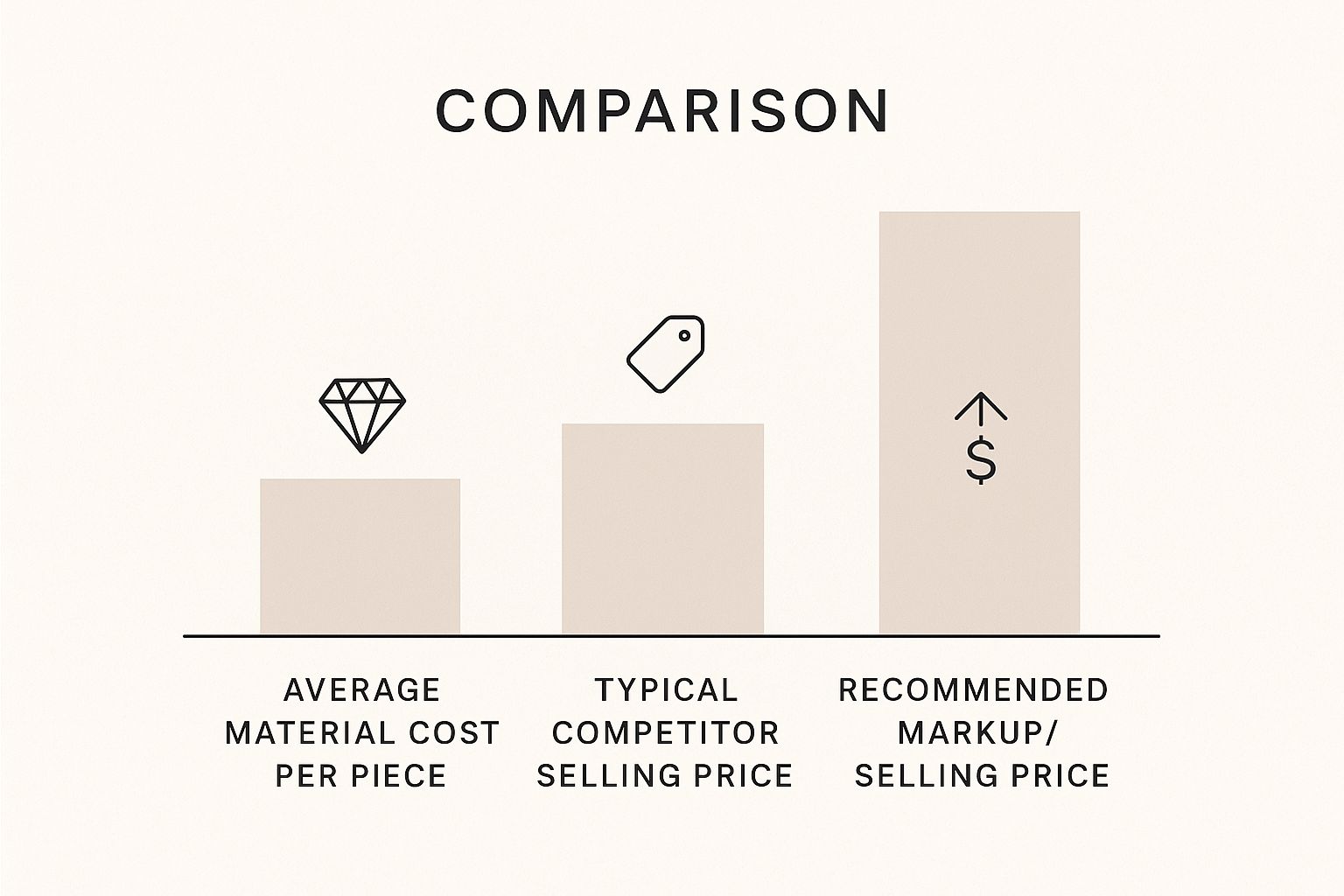
The image above provides a great visual breakdown of how to think about pricing. A healthy markup is essential—it’s not just about covering your material costs. It needs to fund your marketing, cover your operational expenses, and ultimately, ensure your business can grow.
Tapping Into Regional Market Growth
Having a good sense of regional market dynamics can give you a serious competitive edge. The online jewelry market is growing differently all over the world, which opens up some unique opportunities.
Take the Asia-Pacific region, for example. By 2025, it's estimated to command 21.5% of the global market, reaching a projected value of $20.06 billion. That market is expected to grow by a massive 77.6% between 2021 and 2025.
Similarly, while South America currently holds a smaller market share, its projected growth is an impressive 81.3% in the same period, with Brazil leading the charge. Keeping an eye on these trends can help shape where you focus your marketing efforts as you expand.
Nailing Your Business Operations
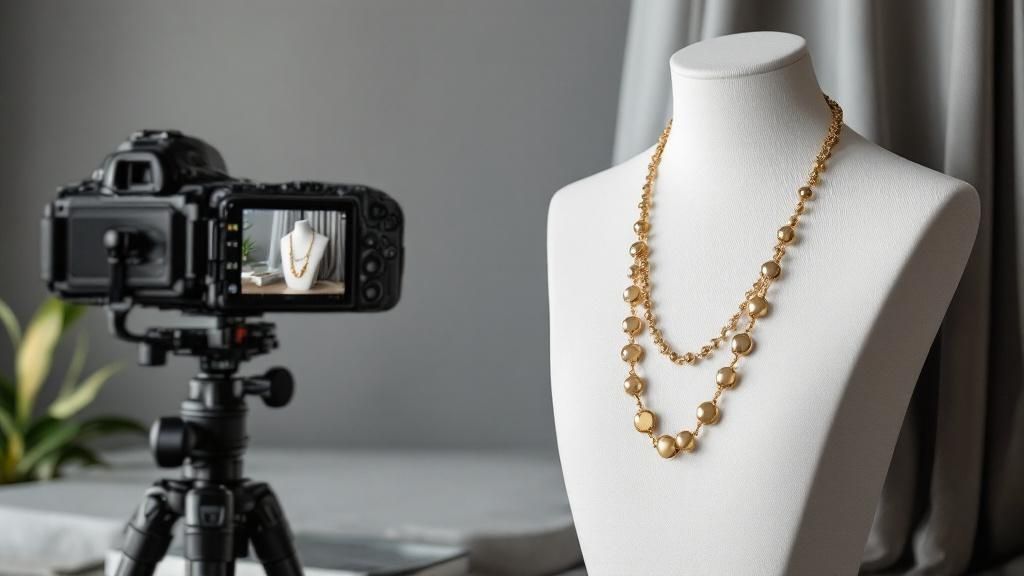
The orders are starting to roll in. That initial rush of excitement is fantastic, but it’s quickly followed by a new reality: you have to manage it all perfectly. This is the moment where your behind-the-scenes systems become your secret weapon. Solid business operations are the invisible engine that keeps customers happy and builds a reputation people can trust.
A gorgeous website and a killer marketing campaign will get someone to click "buy," but what happens after that click is what truly defines your brand. Everything from managing stock levels to the final package landing on a customer's doorstep has to be on point.
Keep a Tight Grip on Your Inventory
There's no faster way to break a customer's trust than to sell them something you don't actually have. Mismanaging your inventory can lead to overselling your most popular pieces, which means you're left dealing with disappointed buyers.
Your e-commerce platform, whether you're on Shopify or BigCommerce, will have built-in tools to track inventory. That’s a great start. But as you scale, you’ll find yourself needing a more robust system that gives you a clearer picture.
Here’s what I’ve learned is non-negotiable:
- Use SKUs From Day One: Don't skip this. Assign a unique SKU (Stock Keeping Unit) to every single product variation—that means a different SKU for a size 7 ring versus a size 8, or a 16-inch chain versus an 18-inch one. This simple step keeps everything organized and trackable.
- Set Up Low-Stock Alerts: Dive into your platform's settings and create alerts that ping you when an item's quantity dips below a certain number. This gives you a heads-up to reorder from your supplier or start crafting more pieces before you completely run out.
- Do Regular Physical Counts: Even the best software isn't perfect. I recommend doing a physical inventory count—monthly or quarterly—to make sure your digital records are a perfect match for what's actually on your shelves.
The Magic of Shipping and Unboxing
Shipping is so much more than just getting a product from your workshop to a customer. It's one of your most powerful branding opportunities. Think about it: the moment a customer opens that package is a peak emotional moment with your brand.
First, you’ll need to pick the right shipping partners. Spend some time comparing rates and reliability from major carriers to see who makes the most sense for your budget. It's also a great idea to offer customers a few choices at checkout, like standard and expedited shipping, to give them a sense of control.
The "unboxing experience" is a huge deal in e-commerce, especially for a visual product like jewelry. Thoughtful packaging can turn a simple delivery into a genuinely memorable event, one that people are excited to share online.
Don't just throw your beautiful pieces in a plain mailer. Branded boxes, custom tissue paper, a handwritten thank-you note, or even a small card with care instructions can make the entire experience feel special. This kind of attention to detail screams quality and makes your customers feel truly appreciated.
Smart Policies and Standout Service
Your policies are the foundation of a good customer relationship. Your return and exchange policy needs to be easy to find and written in plain English. Clearly state the return window, the condition items need to be in, and who is responsible for return shipping costs. A fair, clear policy removes hesitation and helps people feel confident buying from you.
Customer service is your direct line to the people buying your jewelry. Whether it's answering a question via live chat or handling a return over email, every single interaction needs to be professional, empathetic, and quick.
Positive feedback is gold. Gently encourage your happy customers to leave reviews on your product pages or share photos on social media. This user-generated content is powerful social proof that builds incredible trust with new shoppers.
The way you run your store is just as vital as how you source your pieces and market your brand, a point we dive into in our guide on how to start a boutique business. By getting these operational details right, you're not just selling jewelry; you're building the kind of reliable business that's set up for long-term growth.
Taking Your Jewelry Business to the Next Level
Getting your online jewelry store off the ground is a huge accomplishment, but the real challenge? Turning that initial spark into a roaring fire. Success in the long run isn’t about just keeping the lights on; it’s about building a business that can truly grow. This is where you graduate from founder to CEO.
This next phase is all about data and knowing your customer inside and out. It’s time to stop guessing and start making strategic, informed decisions. Watching what your customers actually do on your site gives you a clear map of where to go next.
Let Your Sales Data Do the Talking
Your sales data is more than just numbers; it's a story about what your customers love. Don't just glance at what's selling—you need to dig in and figure out why. This is hands-down the best way to make smart calls on your inventory, marketing budget, and even future designs.
- Pinpoint Your Winners: This sounds basic, but you'd be surprised how many people overlook it. Which pieces fly off the shelves every time? These are your superstars. Make sure they’re always in stock and front-and-center in your ads and on your homepage.
- Identify the Dust-Collectors: Just as important is knowing what isn’t moving. Don't let those pieces just sit there, tying up your cash. It might be time to run a flash sale or discontinue them to make room for something that will actually sell.
- Watch How People Shop: Look for patterns. Are customers who buy a certain pair of earrings often coming back a week later for the matching necklace? That’s a clear signal to start bundling those items or creating a targeted "Complete the Look" email campaign.
When you get into a rhythm of checking this data, you stop reacting to inventory problems and start planning ahead. You’ll be able to anticipate what your customers want, letting you put your money where it will make the biggest difference.
Grow Your Collection, But Be Smart About It
Adding new products feels like a natural next step, but it has to be a calculated move. Don't just throw new designs at the wall to see what sticks. You need to blend direct customer feedback with a sharp eye for trends to make sure your new pieces actually land with your audience.
Your next bestseller is often hiding in your customer emails and DMs. When you get multiple people asking for a certain style, gemstone, or metal, that’s not just a suggestion—it's a clear sign of what to make next.
Keep an eye on what’s happening in the wider world of fashion, both globally and closer to home. For instance, if you see bold, architectural silver pieces blowing up on the runways in Europe, maybe it's time to test a small, curated collection. If your customers love it, you can go all in. This approach lets you experiment without risking a ton of capital, keeping your brand fresh and exciting.
Reinvest Profits to Fuel More Growth
When the money starts coming in, it’s tempting to pocket it all. But the founders who build lasting brands are the ones who put a good chunk of their profits right back into the business. The trick is knowing where that money will have the most impact.
- Level-Up Your Marketing: Earmark funds for more powerful campaigns. Maybe that means finally diving into paid ads on Pinterest, collaborating with a well-known influencer, or hiring an SEO pro to get your site ranking higher on Google.
- Invest in Better Tech: Think about tools that make shopping with you a better experience. This could be anything from an augmented reality (AR) app on your Shopify store that lets customers "try on" earrings, to a more sophisticated email platform that helps you send hyper-targeted messages.
- Hire Your First Team Member: You can’t do it all yourself forever. Reinvesting in your first hire—even a part-time social media manager or a virtual assistant for customer service—is one of the best things you can do. It frees you up to think about the big picture again.
A Few Common Questions Answered
Diving into the world of online jewelry is thrilling, but it's natural to have a few questions buzzing around. Getting a handle on the practical side of things, from legal paperwork to startup costs, can make the whole process feel much more manageable. Let’s clear up some of the most common hurdles new sellers face.
Do I Really Need a Business License to Sell Jewelry Online?
Yes, you almost certainly do. The exact permits you’ll need depend on where you live—your city, county, and state all have their own rules. Think of it this way: operating as a registered business isn't just about following the law; it's about building trust. It shows suppliers and, more importantly, your customers that you're a serious, legitimate brand.
On top of that, if you plan to buy your supplies or finished pieces wholesale, you'll likely need a reseller's permit or tax ID number. Most suppliers require this to prove you're a real business, which also allows you to buy inventory without paying sales tax on it. Your best bet is to check with your local Small Business Administration office or chat with a legal professional to get your ducks in a row.
What's the Real-World Cost to Start a Jewelry Business?
This is the million-dollar question, but the answer can range from a few hundred dollars to tens of thousands. It all comes down to the kind of business you're building.
-
Scrappy Start (Under $1,000): If you're hand-making simple pieces with affordable materials or starting with a dropshipping partner, you can get going on a lean budget. Your main costs will be your e-commerce platform subscription, a domain name, and maybe a small ad budget to get the word out.
-
Serious Hobbyist to Business ($1,000 - $5,000): This budget opens up a lot more possibilities. You can invest in higher-quality materials, professional branding (like a great logo), decent photography gear, and a solid first order of inventory from a wholesaler.
-
Fine Jewelry or Major Launch ($5,000+): Working with precious metals and gemstones? Planning a large-scale manufacturing run? Your startup costs will naturally be higher. This budget level can cover specialized equipment, a substantial inventory, and a proper marketing launch.
Don't forget the "hidden" costs! Your budget needs to account for more than just the jewelry. Factor in website fees, custom packaging, marketing expenses, and business registration fees to see the full picture.
What Are the Must-Have Tools for a New Jewelry Maker?
The tools you absolutely need depend entirely on what you're making. Someone assembling jewelry with beads and charms has a very different shopping list than someone soldering silver.
Here’s a quick guide to getting started:
-
For Simple Assembly: A good set of pliers is non-negotiable. Get yourself a pair of round-nose, chain-nose, and flat-nose pliers, along with some quality wire cutters. This little kit will handle the vast majority of tasks for beaded and charm-based designs.
-
For Metalwork: If you're ready to get your hands dirty with metal, you'll need to step up your game. A jeweler's saw, a set of files, a soldering kit (torch, solder, flux), and something for polishing (like a flex shaft) are the foundational pieces of your workshop.
-
For Every Maker: No matter what you create, you can't work on tiny, detailed pieces without great lighting and some form of magnification. A well-organized storage system for all your findings, beads, and supplies will also be a lifesaver, trust me.
The key is to start with the essentials for your craft. You can always invest in more specialized tools as your skills and product line expand. There's no need to buy everything at once.
Ready to find the perfect pieces for your new collection? At JewelryBuyDirect, we offer direct-from-factory pricing on over 120,000 styles with no minimum order requirements. Explore our wholesale jewelry collection and start building your dream inventory today.