






Arthur Lynch | Sun Oct 26 2025
How to Sell Jewelry and Build a Profitable Brand
So, you're ready to turn that sparkle in your eye into a real, thriving jewelry business? Excellent. Selling jewelry online is a fantastic venture, but it’s more than just listing pretty things and hoping for the best.
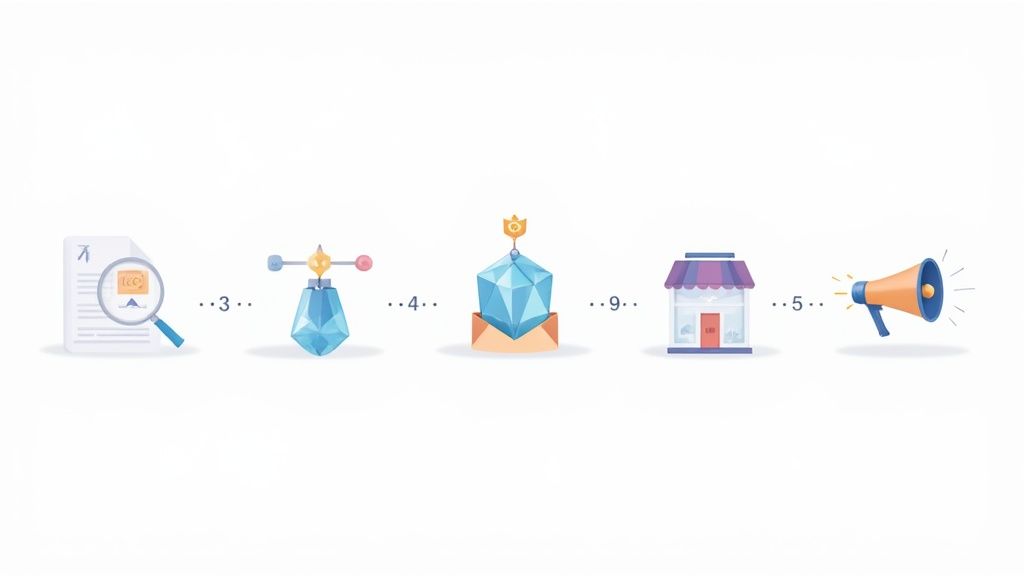
The whole process really boils down to five critical parts: finding your unique corner of the market, sourcing or creating an incredible collection, building a brand people fall in love with, picking the right places to sell, and then, of course, telling the world about it. If you can learn how to sell jewelry by balancing that creative spark with some smart business moves, you’ll be well on your way.
Think of this guide as your complete playbook, walking you through every actionable step from that first flicker of an idea to hearing the cha-ching of your first sale.
Your Blueprint for a Thriving Jewelry Business
Let's get down to business. The global jewelry market is a giant, clocking in at around $348 billion. But here's the secret: you don't need to capture all of it. You just need to find your slice and make it entirely your own.
This all starts with some serious market research—and I don't mean a quick scroll through Instagram. You need to get into the heads of today's buyers and figure out what makes them tick. That means understanding the big-picture trends while also zeroing in on the specific tastes of the audience you want to reach.
Understanding Today's Jewelry Buyer
Shoppers these days are savvy. They aren't just buying a product; they're buying a story, a set of values, and a piece that reflects who they are. What's popular in one corner of the world can be completely different elsewhere. Minimalist designs and "quiet luxury" might be all the rage in Scandinavian markets, for example, while North American buyers could be clamoring for bold, colorful, dopamine-dressing statement pieces. In East Asia, delicate charm bracelets and intricate goldwork rooted in tradition remain highly sought after.
From day one, keep these three actionable insights front and center:
- Sustainability and Ethics: This is non-negotiable for a growing number of consumers. They want to know where their jewelry comes from. Things like ethically sourced gemstones, lab-grown diamonds, and recycled metals aren't just buzzwords—they're powerful trust signals that can set your brand apart.
- Personalization: People crave uniqueness. The ability to customize a piece with an engraving, a specific birthstone, or a unique design element creates an emotional bond that a mass-produced item simply can't.
- Niche Appeal: Don't try to be everything to everyone. Whether you specialize in vintage-inspired Art Deco rings or minimalist boho necklaces, a tight focus is your best friend. It helps you attract a dedicated tribe of followers who will gladly pay for something that feels like it was made just for them.
The most successful jewelry brands don't just sell a product; they sell an identity. Your first step is to define what that identity is and who it's for, laying the groundwork for every decision that follows.
Nailing these core concepts right from the start gives your business a rock-solid foundation. Below, we've outlined the strategic pillars you'll need to master.
Core Pillars of a Successful Jewelry Business
This table summarizes the key strategic areas you must master to build and scale your jewelry brand effectively.
| Pillar | Key Action | Why It Matters |
|---|---|---|
| Market Research | Identify a specific, underserved niche and understand its unique needs. | A clear niche reduces competition and helps you attract a loyal customer base. |
| Sourcing & Production | Secure reliable suppliers or develop an efficient in-house creation process. | Consistent quality and unique inventory are the lifeblood of your brand. |
| Brand Identity | Craft a compelling brand story, name, and visual aesthetic. | A strong brand creates an emotional connection and justifies premium pricing. |
| E-commerce Platform | Choose the right sales channels (e.g., Shopify, Etsy, your own site). | Your platform dictates customer experience, fees, and your level of control. |
| Marketing & Sales | Develop a multi-channel marketing plan using social media, SEO, and paid ads. | You have to get your beautiful products in front of the right people to make sales. |
| Fulfillment & Service | Create a seamless process for packaging, shipping, and customer support. | A fantastic post-purchase experience turns one-time buyers into repeat customers. |
With this framework in mind, you're ready to start building. The next sections will give you the practical, actionable steps to bring each of these pillars to life.
Finding Your Niche in a Global Market
If you try to sell to everyone, you’ll end up selling to no one. That’s the hard truth of e-commerce today. To make your mark, you have to stop selling generic "jewelry" and start offering a specific vision to a specific audience. It's about carving out your unique corner of the market—your niche—and completely owning it.
This isn't just about picking a style you happen to like. It's a calculated move to stand out in an incredibly crowded space. A tight niche lets you craft products, branding, and marketing that speak directly to a hungry group of customers already looking for exactly what you have. Think of it like a general store versus a specialty boutique. The boutique always wins on expertise and curated appeal.
Decoding Global and Regional Jewelry Trends
Your perfect niche sits at the sweet spot where your passion meets what people actually want to buy. The secret is to look beyond your own backyard and tune into the global fashion conversation. What’s flying off the shelves in one part of the world could be your next bestseller.
Let's talk numbers for a second, because they tell a powerful story. The global jewelry market is set to grow at a steady clip of 5.1% to 5.9% annually from 2025 into the early 2030s. But the real opportunities are in the regional details. The Asia Pacific region is a powerhouse, accounting for anywhere from 39% to 60% of the market, thanks to huge demand in India, China, and Japan. Meanwhile, the U.S. still dominates North America, making up a massive 92.6% of sales in the region. Digging into jewelry market size statistics can really open your eyes to where the money is flowing.
So, how do you spot these trends before they peak? Here are actionable steps:
- Monitor Fashion Weeks: Pay attention to the runways in New York, London, Milan, and Paris. Jewelry is a key accessory. Note recurring motifs—are chunky chains back? Are pearls everywhere? This is your high-fashion forecast.
- Track Regional Influencers: Don't just follow American or European style icons. Follow top fashion influencers in Seoul, Mumbai, and São Paulo. Notice regional specifics: mixed metals might be huge in Europe, while traditional gold designs get a modern twist in India.
- Use Trend-Spotting Tools: Platforms like Pinterest Trends are invaluable. Search for "jewelry trends 2024" and "aesthetic jewelry" but also niche down with terms like "sci-fi inspired jewelry" or "coastal grandmother necklace." The rising search volume is your proof of concept.
Once you've got a feel for the social side, go deeper with industry reports from fashion and market analysis firms. They’ll clue you into emerging materials, color palettes, and shifts in what buyers care about, giving you a serious professional edge.
Identifying Your Ideal Customer Persona
Alright, you have a sense of the trends. Now, let’s get personal. Who, exactly, are you selling to? "Women aged 25-40" is not an answer. You need to build a detailed customer persona, a fictional character who embodies your perfect buyer.
Give her a name, a job, hobbies, and a reason she's looking for new jewelry. For instance, let’s meet "Sustainable Sarah":
Name: Sarah, 32
Profession: Graphic Designer
Values: She lives for ethical consumption, sustainability, and real craftsmanship. Fast fashion is a hard pass. She invests in pieces that have a story.
Pain Point: She struggles to find beautiful, modern jewelry that aligns with her values and doesn't look like it came from a factory.
Where She Shops: Small online boutiques, Etsy, and local artisan markets.
Getting this specific forces you to answer the questions that truly matter. What kind of brand story would connect with Sarah? What price feels fair and accessible to her? How could your packaging make her feel like she just received a gift? This is how you turn a simple transaction into a loyal customer.
Analyzing Your Competition and Finding Your Angle
You’re not building this business in a vacuum. A huge part of finding your niche is doing a little friendly recon on the competition. Make a list of 5-10 brands that are already playing in the space you're eyeing.
Then, put on your detective hat and analyze their every move:
- Product Lineup: What materials are they using? Is it all gold-plated, or are they working with solid gold and gemstones? Are they focused on rings, necklaces, or a mix?
- Pricing Strategy: Are they positioning themselves as an affordable treat, a mid-range investment, or a luxury splurge? How does their price align with their perceived quality?
- Marketing Channels: Where are they most active? Instagram, TikTok, Pinterest, email? Analyze the type of content they post and what gets the most engagement.
- Customer Reviews: This is where the gold is. What do people rave about? And more importantly, what are the common complaints? Is shipping slow? Does the plating tarnish?
Your goal here isn't to copy anyone. It's to find the gaps they've left wide open. Maybe you notice a dozen brands doing minimalist jewelry, but none of them are focused on using recycled metals. Boom—that’s your opening. Or perhaps a competitor sells gorgeous engagement rings, but their customer service reviews are a dumpster fire. Your angle could be an unbelievably personal and supportive buying experience.
This all leads to your Unique Selling Proposition (USP)—the one thing that makes you the obvious choice. It’s the promise you make that your competitors can’t or won’t. A powerful USP, built on a foundation of smart research, is how you create a brand that doesn't just compete, it leads.
Sourcing and Crafting Your Signature Collection
Alright, you’ve nailed down your niche. Now for the fun part: bringing your jewelry line to life. This is where you decide how your brilliant ideas will actually become tangible, stunning pieces your customers will love.
Figuring out how to get your products is one of the most critical decisions you'll make. It’s a choice that directly shapes your startup costs, how much creative freedom you have, and how quickly you can grow.
Think of it as a decision tree. Your path depends on what drives you—is it a passion for unique design, a knack for spotting trends, or a laser focus on profit?
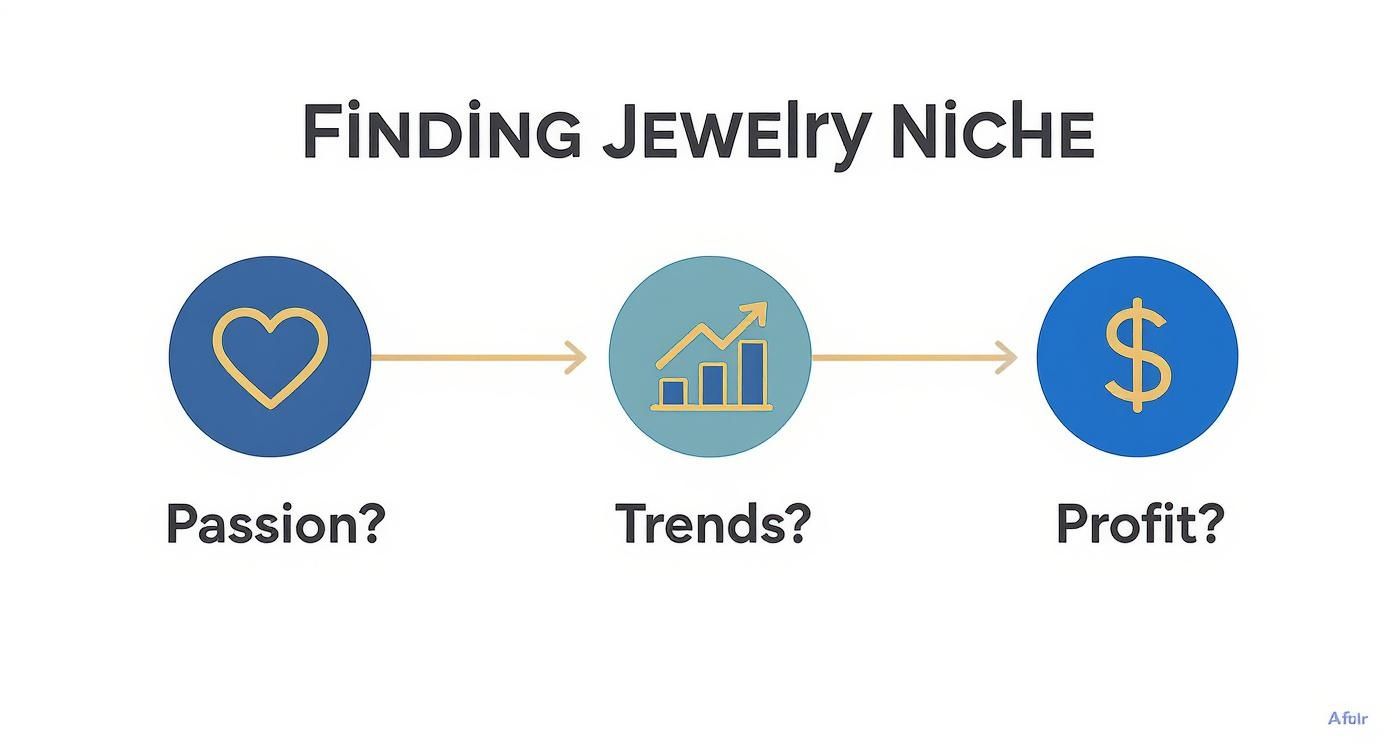
As the infographic shows, the best strategy always starts with your personal strengths. Are you a creator at heart, or are you a savvy curator who knows what will sell?
The Four Main Sourcing Models
Let's dive into the most common ways to build your inventory, from getting your hands dirty to a completely hands-off approach.
1. Handcrafting and In-House Production
This is the classic artisan's path. You're the designer, the maker, the everything. Every single piece is a product of your own two hands, which gives you 100% creative control and the power to offer truly one-of-a-kind jewelry. It's the soul of many beloved Etsy shops.
The catch? It’s incredibly labor-intensive. Scaling up when orders start pouring in can become a real bottleneck.
2. Working with a Production Partner
So, you love designing but can't possibly make every piece yourself? A production partner is your answer. You create the blueprints, and they handle the manufacturing. This unlocks the ability to produce larger quantities and experiment with more complex designs that might be out of reach for a solo maker.
Just be prepared to do your homework. You absolutely have to vet partners carefully to ensure their quality and ethical standards match yours.
3. Wholesaling and Private Labeling
This is your fast track to a full-fledged collection. You buy finished jewelry in bulk from a supplier and sell it under your brand. It’s an incredible way to launch quickly with a wide variety of products.
Many suppliers offer "private label" or "white label" options, so you can add your own branding and packaging. For boutique owners trying to stay on-trend, knowing how to source great wholesale jewelry for boutiques is a game-changer. The biggest challenge here is making your brand stand out when others might be selling similar items.
4. Dropshipping
Dropshipping is the ultimate hands-off model. You set up a storefront, and when a customer buys something, your supplier ships the product directly to them. You never touch the inventory.
The appeal is obvious: rock-bottom startup costs and zero inventory risk. But it comes at a price. Your profit margins will be thinner, and you have very little control over product quality or how long shipping takes.
Aligning Your Collection with Modern Values
Let’s be honest: today’s shoppers want to know the story behind their products. Weaving conscious materials into your collection isn't just a "nice-to-have"—it's a massive opportunity to connect with your ideal customer.
People are actively seeking out sustainable and ethical brands. Here are a few high-demand materials to consider:
- Recycled Metals: Using recycled gold and silver is a huge win. It drastically reduces the environmental toll of mining and sends a powerful message to eco-conscious buyers.
- Lab-Grown Diamonds & Gemstones: These are the real deal—chemically and visually identical to their mined counterparts—but without the ethical baggage and often at a better price point. The market for lab-grown gems is absolutely booming.
- Ethically Sourced Natural Stones: If you prefer mined gems, transparency is non-negotiable. Only work with suppliers who can prove their stones are conflict-free and sourced under fair labor practices.
Building your collection is a delicate dance between your creative vision, what the market wants, and the practical realities of production. Your sourcing method should feel like a natural extension of your brand story. Choose the path that lets you deliver beautiful, high-quality jewelry every single time, all while keeping your business profitable and sustainable for the long haul.
Building Your Brand and Pricing for Profit
A beautiful piece of jewelry is just an object. What gives it a soul is the story behind it. This is where your brand comes in. A powerful brand turns a simple product into an experience people connect with and genuinely want to be a part of. This is the real work—crafting a memorable identity that speaks directly to your ideal customer.
Your brand is so much more than a cool name and a pretty logo. It’s the entire feeling someone gets when they interact with your business, from the moment they land on your website to the experience of unboxing their first purchase. It’s your promise of quality, style, and the values you stand for. Nailing this emotional connection is what separates a fleeting trend from a legacy business.
To make sure your jewelry business doesn't just blend into the background, you need a crystal-clear identity. A great starting point is to explore proven strategies to build brand awareness that can help you create a narrative that actually sticks.
Crafting Your Unique Brand Identity
First things first, let's get to the core of your brand. What’s your story? Maybe you’re inspired by ancient mythology, the clean lines of modern architecture, or the untamed colors of a wildflower field. Whatever it is, that story becomes the bedrock for everything you build.
Next up, a name. It needs to be memorable and capture the essence of your jewelry. Critically, it should be easy to say, spell, and find online. Once the name is set, it’s time to get visual. Your logo, color palette, and fonts are the face of your brand. They need to instantly communicate your vibe, whether that’s minimalist and modern or ornate and vintage-inspired.
- Your Brand Story: What’s your "why"? What got you started? What makes your jewelry different? Share this on your website and social media to forge that personal connection.
- Your Visuals: Don't skimp here. A professional logo and a defined color palette create consistency across your website, packaging, and marketing.
- Your Voice: How do you speak to your audience? Are you warm and approachable, or chic and sophisticated? Keep that voice consistent in every email, product description, and Instagram caption.
Pricing Your Jewelry for Sustainable Profit
Okay, with your brand identity taking shape, let's talk numbers. Pricing your jewelry is a delicate balancing act. You have to cover your costs, communicate value, and—most importantly—make a profit. This is easily one of the most critical parts of building a successful jewelry business.
A classic rookie mistake is only accounting for the cost of the materials. To build a sustainable business, your prices have to cover so much more. Great pricing is part science, part art, and it sends a direct message about the quality and craftsmanship your brand represents.
Your price tag isn't just a number; it's a statement about your jewelry's worth. Price too low, and you risk devaluing your work in the customer's eyes. Price too high, and you might scare away your perfect audience. The sweet spot builds perceived value while protecting your profit margin.
So, how do you land on that magic number? It all starts with a simple but thorough formula. You absolutely have to track every single expense that goes into creating and selling a piece.
The most straightforward approach is the cost-plus pricing model. Here’s a quick look at how it works:
- Calculate Cost of Goods Sold (COGS): Add up all direct material costs (metals, gemstones, findings) and your direct labor costs (the time it takes to make the piece).
- Add Overhead Costs: Factor in a percentage of your indirect costs—think website fees, marketing spend, tools, and packaging supplies.
- Apply a Markup: Once you have your total cost per piece, you apply a markup to get your wholesale price. Then, you typically apply another markup to find the final retail price.
This method ensures every expense is covered and you're building in a healthy profit from day one. For a much deeper dive, our detailed guide on how to price your jewelry breaks down the specific formulas you can use right away. This isn't just about making your passion pay for itself; it's about building a profitable venture that's designed to last.
Choosing Your Sales Platform and Mastering Photography
This screenshot shows the first step of building a standalone jewelry brand on Shopify, a platform that gives you total control over your brand's look and feel.
You've got your brand story, and your collection is polished and ready. Now comes the big one: building the digital storefront where your hard work will finally meet your customers. This decision is huge. The platform you choose will impact everything from your fees and branding to the very audience you can reach.
Let's be real—selling jewelry today means being where your customers are. While brick-and-mortar stores still have their place, the online market is where the growth is. The most successful brands blend a strong online presence with other sales channels. It's also smart to know what's selling. Right now, gold jewelry dominates with about a 54.9% market share, and rings are the most popular category, making up 33.8% of sales.
Selecting the Right E-commerce Platform
There’s no single "best" platform. The right choice really depends on your goals, your budget, and how much time you want to spend on the technical side of things. Let's break down the big three for jewelry sellers.
-
Shopify: Think of Shopify as your own digital real estate. It’s perfect for building a standalone brand from the ground up. You get a fully customizable website, total control over branding, and access to some seriously powerful marketing tools. It's the move for anyone serious about building a long-term asset and owning their customer relationships.
-
Etsy: If you want to tap into a ready-made audience, Etsy is a fantastic starting point. It's a massive marketplace where people are actively searching for unique, handmade jewelry. The trade-off? You’ll face a lot of direct competition and have much less control over branding and the customer experience.
-
Amazon Handmade: This is Amazon's curated corner for artisans, offering access to its colossal customer base and legendary logistics (hello, Fulfillment by Amazon). Getting accepted is tough, though, and the platform's look is very "Amazon" – it’s less about your brand's unique vibe and more about the product itself.
My Takeaway: Go with Shopify if your goal is maximum brand control and long-term growth. Choose Etsy or Amazon Handmade if you want immediate access to a massive audience, especially when you're just getting your feet wet.
Mastering Product Photography on a Budget
In the world of online jewelry, your photos are the product. It's that simple. Since customers can't touch or try on your pieces, your images have to do all the talking. They need to scream quality, show off every detail, and capture the sheer beauty of your work.
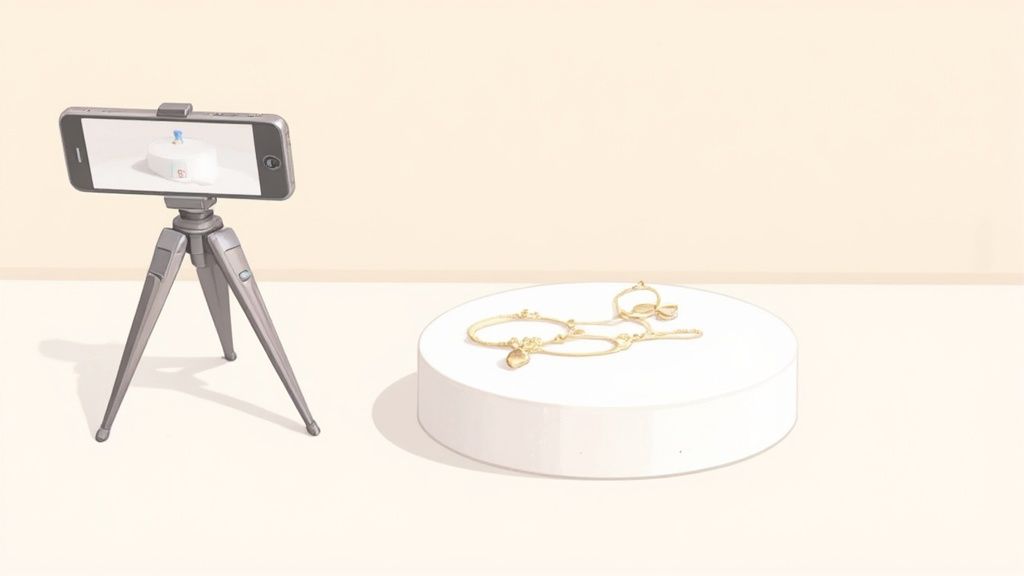
Good news: you don't need a fancy studio and a five-figure camera. I've seen incredible results from people using just their smartphone. The secret is in mastering the art of stunning product photos by focusing on the fundamentals: lighting, background, and perspective.
Practical Tips for Irresistible Jewelry Photos
Great lighting is everything. Seriously. Natural, indirect daylight is your best friend—it's soft, flattering, and completely free. Just find a spot near a large window, but make sure to avoid harsh, direct sun, which creates distracting shadows.
Next, simplify your background. You want the focus squarely on your jewelry's intricate details. A clean white or light gray backdrop is classic for a reason, but a textured surface like a piece of marble, slate, or linen can add a touch of personality.
Finally, you need to tell a complete story with your shots. Don't just take one photo and call it a day.
- The Studio Shot: This is your hero image. A clean, perfectly lit photo of the piece on a plain background, showing the entire item.
- The Detail Shot: Get in close! Use a macro lens or mode to highlight the craftsmanship—the facets of a gemstone, a unique clasp, or delicate metalwork. This is how you show off quality.
- The Lifestyle Shot: Show the jewelry on a model. This is crucial because it helps customers visualize the scale and how it will actually look on them.
- The Scale Shot: This is a simple but effective trick. Place the jewelry next to a common object, like a coin, to give an instant, undeniable sense of its size.
For a deeper dive, we’ve put together a guide with more actionable https://www.jewelrybuydirect.com/blog/jewelry-photography-tips?articleId=610720940118. Remember, keeping your photography style consistent across all your listings is key to building a brand that looks professional and feels trustworthy.
Marketing Your Brand and Scaling Your Business
https://www.youtube.com/embed/Zaz-sR-rBhs
Alright, your store is live, your photos look incredible, and you've got a collection you're proud of. What now? It’s time to get some eyeballs on your work and start making sales.
Let's be clear: having amazing jewelry is only half the battle. You have to get out there and show people what you’ve made. This is where you put on your marketer hat and start telling your story where your ideal customers are already hanging out.
The great news is you’re stepping into a massive market. The global jewelry industry is valued at a staggering $348 billion, and online sales are booming. The United States alone eats up about 25% of that pie, which means there’s a huge, hungry audience right at your fingertips. If you want to geek out on the numbers, you can discover more about jewelry industry trends and see just how big the opportunity is.
Lean Into Visual Marketing
Jewelry is all about the visuals, which makes platforms like Instagram and Pinterest your absolute best friends. But success here isn’t just about posting pretty pictures and waiting for the sales to roll in. You need to build a world around your brand—a vibe that people want to be a part of.
- Instagram is your digital storefront. Don't just post product shots. Mix it up! Show off the sparkle in a Reel, take people behind the scenes with a Story of you making a piece, or create a carousel post teaching your followers how to care for their silver. It’s about building a community, not just a catalog.
- Pinterest is a search engine for dreams. People go there looking for inspiration. Create stunning, vertical pins that link straight to your product pages. Think in terms of aesthetics and keywords. Build boards like "Minimalist Gold Hoops" or "Boho Layering Necklaces" that capture the exact style your customers are searching for.
You're not just selling a piece of metal and stone; you're selling a feeling. When someone scrolls past your post, they should immediately picture themselves wearing your jewelry and feeling more confident, stylish, or unique.
Build Real Connections with Email and Collaborations
Social media is fantastic for grabbing attention, but email is where you turn casual followers into loyal customers.
Start building your email list from the moment your store opens. A simple "10% off your first order" pop-up works wonders. Once they're on your list, you can give them exclusive first looks at new collections, share the real stories behind your designs, and make them feel like true insiders.
Another game-changer? Collaborating with the right people. Forget chasing influencers with a million followers. Instead, find micro-influencers whose personal style and audience are a perfect match for your brand. A genuine recommendation from someone their followers truly trust is worth more than any flashy ad. It's one of the most authentic ways to connect with people who are already on the hunt for jewelry just like yours.
Your Top Questions About Selling Jewelry, Answered
Jumping into the online jewelry world is exciting, but it’s natural to have a few questions. Getting straight answers is key to building your business on a solid foundation. Let's tackle some of the most common things aspiring jewelry sellers ask.
How Much Money Do I Really Need to Start?
This is the million-dollar question, but the answer can be surprisingly small. Your startup costs can range from under $500 to several thousand dollars, depending entirely on the path you choose.
You could get a handcrafted business off the ground on a marketplace like Etsy for a very modest amount. On the flip side, if you're planning a custom website with a large, sourced inventory, you'll be looking at a much bigger initial investment.
Your main upfront costs will boil down to a few key areas:
- The actual jewelry, whether that's raw materials or your first inventory order.
- Fees for your e-commerce platform of choice.
- Branding touches, like custom packaging that makes your pieces feel special.
- A small budget to get your marketing efforts started.
My advice? Start lean. Don't go all-in on a massive collection right away. Focus on a small, curated selection to test the waters. You can always expand once you see what your customers love and the revenue starts coming in.
What Are the Legal Requirements to Sell Jewelry?
The legal side of things can feel intimidating, but it's manageable. The specifics will vary depending on where you live, but a few steps are pretty standard across the board.
You’ll almost certainly need to register your business name. From there, look into getting a business license or a sales tax permit, which allows you to legally collect and remit sales tax.
Here's a big one for jewelers: if you're working with precious metals, you need to know about hallmarking laws. These regulations are in place to protect consumers and often require you to stamp pieces with their exact metal content. Think ".925" for sterling silver or "14K" for gold. It’s all about transparency and authenticity.
How Do I Safely Ship Delicate Pieces?
When you sell jewelry online, protective packaging is everything. Your goal is to make sure that beautiful, delicate piece arrives looking just as perfect as it did when you sent it.
The key is to prevent movement and absorb any impact during its journey. Start by placing the item in a sturdy jewelry box with plenty of soft padding. Then, place that box inside a cushioned mailer or a slightly larger shipping box. This double-layer approach is your best defense against rough handling.
And for any piece with a significant price tag, always purchase shipping insurance. Always. Giving your customer a tracking number is also a must—it builds trust and gives you both peace of mind.
Ready to source your signature collection without the hassle? JewelryBuyDirect offers direct-from-factory pricing on over 120,000 trend-driven styles with no minimum order. Find your next bestseller on JewelryBuyDirect.