






Arthur Lynch | Tue Jan 13 2026
How to Increase Retail Sales in Your Jewelry & Accessories Business
If you're looking for the secret to boosting sales of jewelry and fashion accessories in a market that feels more crowded by the day, let me be straight with you: there's no single magic bullet. Real, sustainable growth comes from getting all the little things right—from sourcing high-quality, affordable pieces to creating an unforgettable experience for your customers.
Your Modern Playbook for Retail Success
This isn't about high-level theory. This is a practical, hands-on guide to help you build a business that not only survives but thrives. We’ll get into the nitty-gritty of building an irresistible inventory—think high-margin, on-trend jewelry and fashion accessories—without tying up all your cash in bulk orders.
I'll show you how to craft in-store displays that make people stop and stare, and we'll unpack the digital strategies that turn a casual scroll on your website into a sale.
Think of what follows as your roadmap. It’s built on one simple, powerful idea: what you sell and how you sell it are two sides of the same coin. The most beautiful store or website won't matter if your jewelry feels dated or overpriced. On the flip side, even the most stunning collection of affordable, high-quality accessories will just sit there if nobody knows about it or if it’s poorly presented.
Start with a Foundation of Profitability
Before we even touch on merchandising or marketing, we have to start at the source. The absolute first step is sourcing a product mix of high-quality jewelry and fashion accessories that's both profitable for you and desirable for your customers.
This means finding suppliers who hit that sweet spot of quality and affordability. You need that flexibility to price your pieces competitively while still protecting your margins. It’s not just about the products themselves, but also the terms you get. Learning how to effectively negotiate with suppliers can give you a crucial financial edge right from the get-go.
The most effective way to boost sales starts long before a customer walks through your door. It begins with sourcing high-quality, affordable jewelry and fashion accessories that offer exceptional perceived value, allowing you to build a brand known for quality without sacrificing profitability.
This is where a modern approach gives you a real advantage. When you partner with suppliers offering trendy, high-quality items without demanding massive minimum orders, you can be nimble. You can test new styles, react instantly to what's trending, and keep your inventory exciting. This agility is your secret weapon for growing your business.
Build a Profitable Inventory with Smart Sourcing
Let's be honest: your products are everything. You can have the best marketing in the world, but if your inventory of jewelry and fashion accessories doesn't hit the mark, sales will stall. Smart sourcing isn't just about finding the lowest price; it's about building a collection that feels intentional, high-quality, and perfectly timed to what your customers want.
Getting this right is the foundation for everything else. It means moving beyond old-school bulk buying and adopting a more nimble, strategic approach to stocking your business with affordable, high-quality goods.
Think of it this way: a successful retail strategy has several key pillars, and it all starts with what you sell.
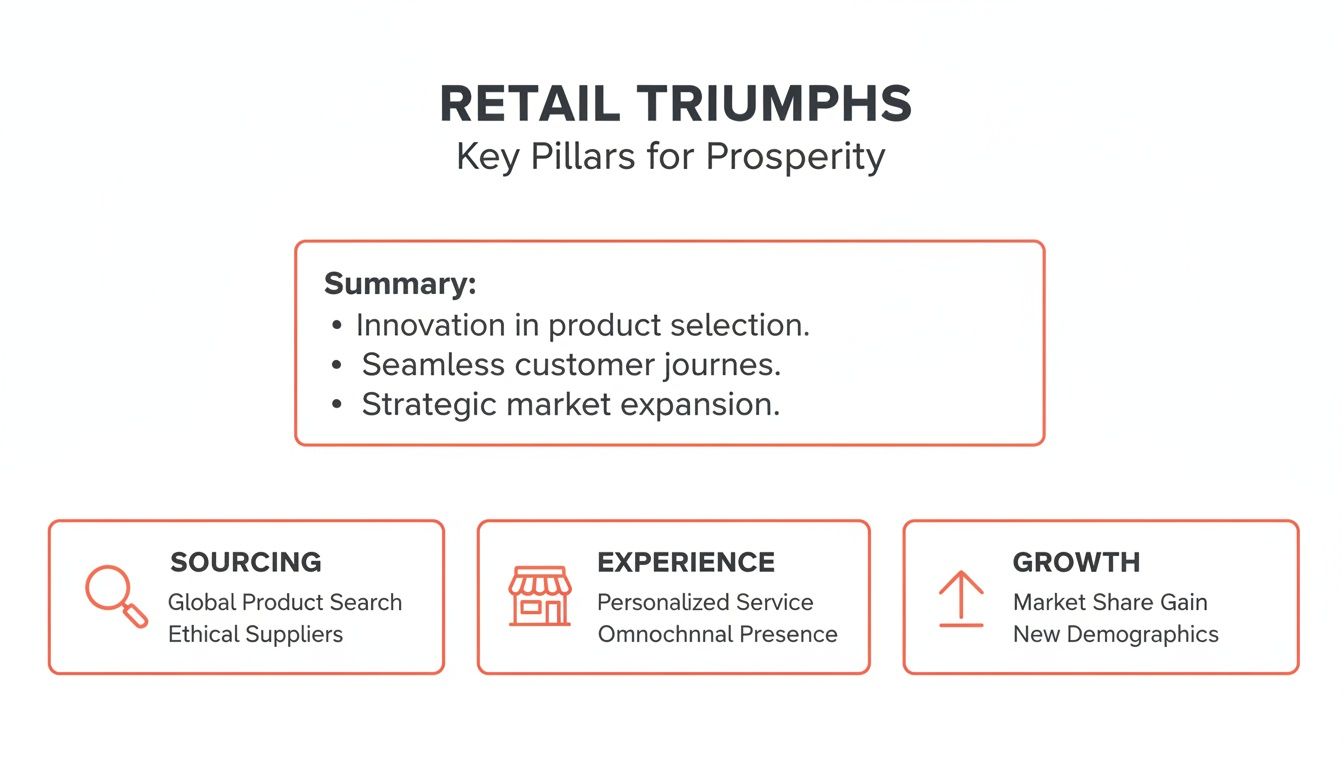
When your sourcing is strong, it naturally supports a better customer experience and clears the path for real, sustainable growth.
Capitalize on Emerging Jewelry and Accessory Trends
To keep customers coming back, your inventory needs to feel fresh. While your classic pieces are the bread and butter, it’s the on-trend accessories that create buzz and drive new sales. Shoppers today want items that tell a story and show off their personality.
We're seeing a huge shift away from traditional-only collections toward vibrant, personal styles. For instance, colored gemstones have absolutely exploded. Recent data from October 2025 showed colored stones and pearls leading the pack with a 22% sales growth and a whopping 26% jump in the average sale price, easily outpacing diamonds.
This isn't just a fleeting moment; it's a clear signal from the market. Bringing in high-quality, affordable pieces with turquoise, colorful enamel, or lab-grown sapphires can attract a whole new wave of customers looking for something unique.
My Pro Tip: The magic is in the mix. Keep your core collection of reliable bestsellers, but layer in small, curated batches of trendy items. This creates a "get it before it's gone" vibe and gives shoppers a reason to check in with your business constantly.
The Power of No-MOQ and Factory-Direct Sourcing
For years, the biggest headache for independent businesses has been the cash drain of traditional wholesale. Huge minimum order quantities (MOQs) force you to gamble your capital on styles you hope will sell. That model is broken.
A modern, no-MOQ sourcing model completely changes the game for sourcing high-quality and affordable jewelry and accessories.
Partnering with a no-MOQ supplier gives your business incredible freedom. It means you can:
- Test the waters. Want to try out those chunky silver rings everyone's talking about? Order five, not fifty. See how they sell first.
- Slash your financial risk. No more dead stock collecting dust in the back room and eating away at your profit margins.
- Broaden your appeal. You can afford to offer a much wider, more interesting variety of styles because you aren't tying up thousands of dollars in a single design.
This agile approach is exactly what you need to keep your inventory exciting. We've put together a guide with more ideas on finding the right wholesale jewelry for boutiques using this modern mindset.
Beyond that, sourcing directly from factory-backed platforms lets you cut out the layers of middlemen that inflate costs. By going direct, businesses routinely slash their procurement costs by 15-30%. This isn't just a cost-saving measure; it's a strategic weapon for stocking affordable, high-quality accessories.
Let's look at how these two sourcing models stack up in the real world.
Comparing Sourcing Models Traditional vs Flexible Wholesale
| Sourcing Aspect | Traditional Wholesale | Flexible No-MOQ Platform |
|---|---|---|
| Upfront Investment | High (due to large MOQs) | Very Low (order as few as one piece) |
| Inventory Risk | High (risk of unsold stock) | Minimal (test trends with small batches) |
| Product Assortment | Limited by budget | Wide and diverse, easy to expand |
| Speed to Market | Slow (long lead times) | Fast (quick replenishment on hot items) |
| Cost of Goods | Higher (multiple middlemen) | Lower (often 15-30% less) |
| Cash Flow | Constrained, tied up in inventory | Flexible, capital available for marketing |
The advantages are crystal clear. Lower costs mean you can either offer more competitive prices, run more aggressive promotions, or simply enjoy healthier margins. It gives your business the power to offer amazing quality at an affordable price—a true game-changer in a crowded market.
Mastering Visual Merchandising to Captivate Buyers
Let's be honest: even the most stunning collection of high-quality jewelry and accessories will fall flat if it's poorly presented. Visual merchandising is where you stop being just a store and start telling a story. It’s the art of turning your physical and digital spaces into captivating experiences that guide a buyer from "just browsing" to "I have to have it."
This isn't just about making things look pretty. When you get merchandising right, you create desire, highlight the true value of your pieces, and make the whole shopping experience feel intuitive and exciting. It's a direct line to increasing your sales.
Crafting an Irresistible In-Store Experience
Think of your physical store as a stage where every detail counts. The goal is to build an environment that not only shows off your products but actually encourages people to touch, try on, and discover.
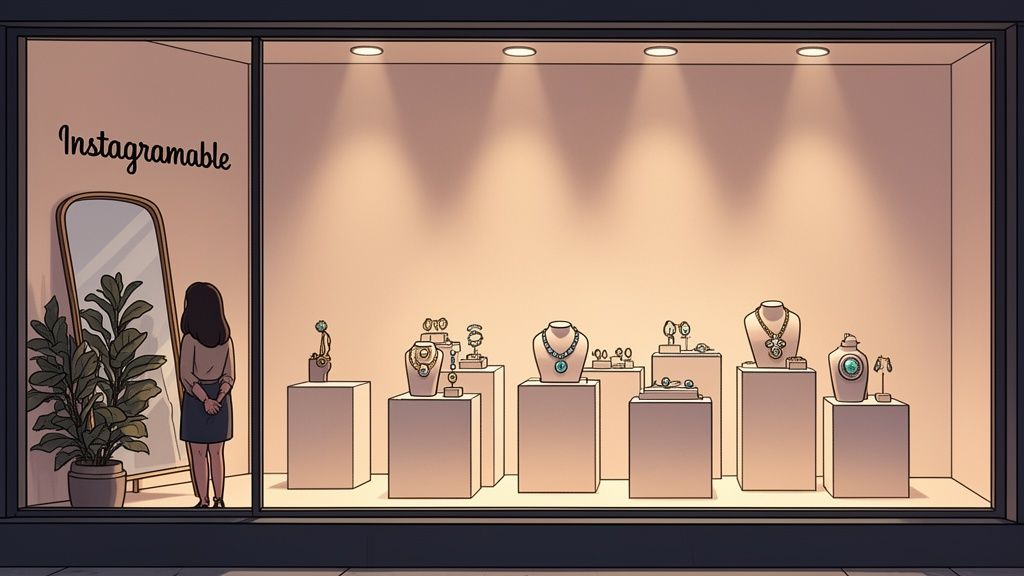
It all starts with your window display—it's your 24/7 billboard. Don't just throw a few pieces on some busts and call it a day. Create a theme that tells a story. Imagine a "Summer Blues" concept featuring affordable jewelry with turquoise, aquamarine, and sapphire-colored stones, all draped over light linens and accented with a few tasteful seashells. That’s a narrative that stops people in their tracks.
Once they're inside, you need to guide their eyes. Avoid the classic mistake of overwhelming customers with endless, uniform rows of jewelry cases.
- Group by Collection: Carve out small, distinct zones in your store. You could have a "Minimalist Gold" section with delicate chains and studs, a "Statement Silver" area with bold cuffs, and a "Bridal & Formal" corner. This helps shoppers find exactly what they’re looking for without getting frustrated.
- Vary Your Heights: Use a mix of risers, trays, and busts at different levels. This simple trick creates visual interest and naturally draws the eye toward specific, high-margin pieces you want to move.
- Tell a Story with Props: A vintage book, a beautiful geode, or a small bouquet of dried flowers can add so much context and personality. Placing a few rings on a piece of slate makes them feel more grounded and special.
And don't forget your secret weapon: lighting. Use focused spotlights to make your gemstones and metals sparkle. A well-lit piece instantly looks more valuable and luxurious. You can even set up a dedicated 'Instagrammable' corner with unique decor, a comfortable chair, and a great mirror. This encourages shoppers to snap photos wearing your jewelry, giving your business fantastic, free marketing.
For even more inspiration, check out our guide on creative retail display ideas that can completely transform your space.
Perfecting Your Digital Storefront
Online, your product photography and descriptions are your visual merchandising. They have to do all the heavy lifting to convey the quality, scale, and pure desirability of your affordable fashion accessories. Amateur photos will kill a sale faster than anything else.
Invest in high-quality imagery that shows your jewelry from every conceivable angle.
Your product page is the digital equivalent of a customer holding a piece in their hands. If your photos and descriptions don't make them feel the weight, see the sparkle, and imagine it on themselves, you’ve lost the sale.
Here’s a quick-and-dirty checklist for your product visuals:
- On-Model Shots: These are completely non-negotiable. They show scale and help customers visualize how a necklace will actually hang or how big a pair of earrings will look on them.
- Clean Product Shots: Use a plain white or light gray background to showcase the intricate details of the piece without any distractions.
- Lifestyle Images: Show your jewelry being worn in the real world—a statement necklace at a dinner party, a simple bracelet with a casual weekend outfit. Help them see it in their life.
- 360-Degree Views or Videos: For more intricate or expensive pieces, a short video or 360-degree view is fantastic for highlighting the craftsmanship and building serious trust.
Your product descriptions need to be just as compelling. Move beyond just listing the materials. Instead of "Gold-plated necklace," try something like, "A radiant, 18k gold-plated chain featuring five hand-set cubic zirconia gemstones that catch the light with every move." Use descriptive, SEO-rich terms like "hypoallergenic titanium steel" or "ethically sourced freshwater pearls" to call out your unique selling points and attract the right kind of search traffic for your high-quality accessories.
You can also digitally curate collections, just like in your physical store. Create landing pages for "Gifts Under $50," "The Vacation Edit," or "Trending Now: Chunky Hoops." From there, use upsell and cross-sell features strategically. When a customer adds a necklace to their cart, an automated suggestion for matching earrings is an effortless way to increase your average order value and help them complete their look.
Turning Your Online Store into a Sales Machine
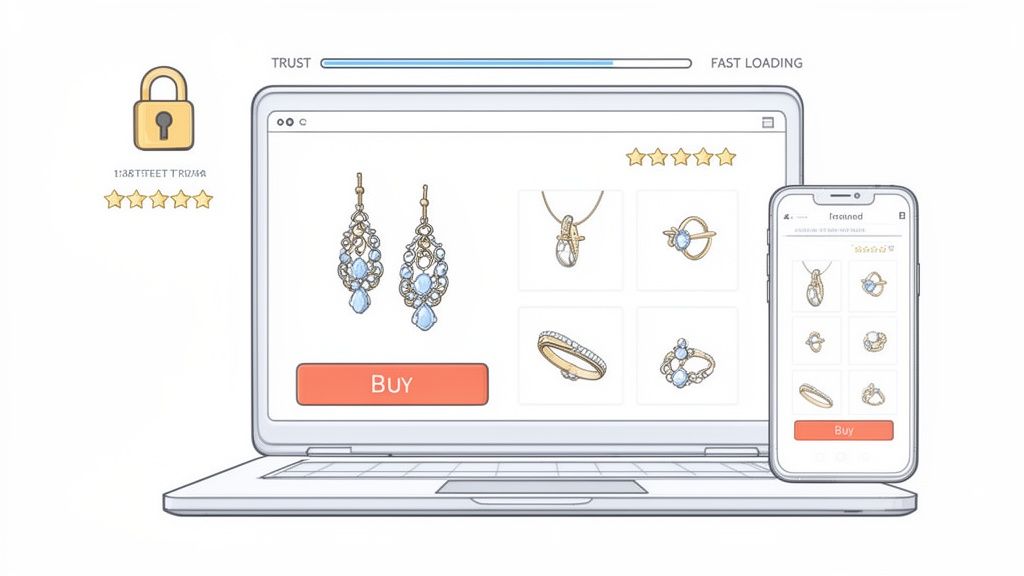
Think of your website as your hardest-working salesperson. It’s on the clock 24/7, ready to turn casual browsers into loyal customers. But if your online store isn't pulling its weight, it’s time for a tune-up. This goes way beyond just having pretty pictures; it’s about fine-tuning the mechanics that build trust, smooth out the customer journey, and make it incredibly easy for someone to click "buy."
Transforming your site into a conversion powerhouse means understanding how people find you and what they feel once they land on your page. It's a mix of smart tech and smart psychology, all aimed at making sure every click brings a shopper closer to a confident purchase.
Optimize Your Product Pages for Search
Before you can even think about a sale, customers have to find you. That’s where good old search engine optimization (SEO) comes into play, and it all starts with your product pages. Put yourself in your customer’s shoes: what words would they type into Google to find specific, high-quality jewelry or affordable fashion accessories you sell?
Instead of a generic title like "Gold Necklace," get descriptive. Something like "18k Gold-Plated Dainty Layering Necklace" is far more likely to match what a real person is searching for. Weave these natural, specific keywords into your product titles, descriptions, and even your image file names. This helps Google connect your business with people who are already looking for exactly what you offer—the best kind of traffic there is.
Build a Foundation of Trust and Security
Online shoppers are naturally skeptical. They aren’t going to hand over their credit card details if your site feels anything less than 100% secure. Building that feeling of trust is non-negotiable, and it takes more than just a security badge.
Start with social proof. Customer reviews and star ratings, displayed right there on the product page, are one of the most powerful trust signals you have. Seeing that other people bought and loved a piece instantly eases a new customer's anxiety.
But reviews are just the start. You also need to communicate reliability through crystal-clear policies and guarantees.
- Clear Policies: Your shipping and return policies shouldn't be buried. A fair, easy-to-find return policy gives customers the confidence to buy, knowing they aren’t taking a big risk.
- Secure Payment Options: Offer multiple, recognizable payment methods. Seeing logos for PayPal, Shop Pay, and major credit cards are instant trust markers.
- Supplier-Backed Guarantees: If your supplier offers protection, tell your customers about it! Mentioning full damage protection on arrival shows you stand behind your products, which builds incredible confidence.
Trust is the currency of e-commerce. Every element on your site either builds it or breaks it. From a clear return policy to showcasing real customer photos, each detail reassures a visitor that they are making a safe and smart purchase.
Create a Frictionless Mobile and Checkout Experience
Let’s be real: most of your customers are shopping from their phones. If your website is slow or a pain to use on a mobile device, you're bleeding sales. It's that simple. A mobile-first design isn't a luxury anymore; it's a basic requirement. Your site must load fast, with big, easy-to-tap buttons and a simple navigation menu.
That seamless experience has to carry all the way through to checkout. The average cart abandonment rate is a staggering 70%, and a clunky checkout is one of the biggest culprits.
Here’s how to fight back:
- Minimize Steps: Aim for a single-page checkout if you can. And please, don't force people to create an account. Always offer a guest checkout option.
- Offer Flexible Payments: Integrating "buy-now-pay-later" services like Klarna or Afterpay can be a game-changer for conversion rates. It breaks down the price barrier, making bigger purchases feel much more manageable.
- Be Transparent About Costs: Nothing kills a sale faster than a surprise shipping fee at the very end. Show all costs upfront.
The explosive growth in e-commerce proves that customers are more than willing to buy jewelry online. In the U.S. alone, online jewelry sales hit $16.8 billion and are projected to soar to $25.7 billion, making up nearly a third of all jewelry revenue. For a deeper look into these trends, you can explore more insights on the future of jewelry sales.
By focusing on these key areas—search visibility, trust signals, and a killer user experience—you create the kind of smooth, secure shopping journey that turns one-time visitors into repeat customers.
Price for Profit and Promote with Purpose
Pricing is one of those things that can feel more like an art than a science, but getting it right is crucial. It’s not just about covering your costs; your price tells a story about your brand's quality and value. Price too low, and you risk looking cheap. Price too high, and you'll scare customers away. The sweet spot is anchoring your prices to their real, perceived value.
This is where your sourcing strategy becomes a game-changer. When you find beautiful, on-trend, and high-quality accessories at a great wholesale price, you're not locked into a high retail price just to break even. You suddenly have flexibility. You can price a piece based on what your customer feels it's worth, not just what it cost your business to acquire.
Think about it: a stunning sterling silver necklace sourced directly from the factory can be sold at a competitive price that still nets you a fantastic margin. This approach lets your business deliver amazing value, building a loyal following of customers who trust your quality and your prices.
How to Calculate Your Retail Price for the Best Margin
Before you even think about running a sale, you need a solid pricing formula. A lot of retailers start with keystone pricing—simply doubling the wholesale cost. Honestly, that's often not enough to build a truly profitable business.
A better, more robust formula looks something like this:
Wholesale Cost + (Wholesale Cost x Markup) + All The Little Fees = Your Retail Price
Let's walk through a real-world example. Say your business sources a pair of gorgeous gold-plated hoop earrings for $5.
- Wholesale Cost: $5
- Your Markup: Aim for a 2.5x to 3x markup (150-200%) to give yourself a healthy cushion. Let's use 2.5x, which means you want a $7.50 profit on top of your cost.
- Expenses & Fees: Don't forget to factor in a bit for shipping, pretty packaging, and those pesky credit card transaction fees. Let's budget $1.50 per item.
- Final Retail Price: $5 (cost) + $7.50 (profit) + $1.50 (fees) = $14.00
This price covers everything, guarantees you make money, and still feels like a great deal to the customer. Sourcing high-quality, affordable pieces is what gives you the room to build in this kind of healthy margin without making your jewelry feel overpriced.
Get Creative With Your Promotions (It’s Not All About Discounts)
Promotions are fantastic for grabbing attention and moving older inventory, but be careful. If you're always running a 20% off sale, you're just teaching your customers to wait for the next discount, which kills your margins and devalues your brand.
The real goal is to create offers that boost your average order value (AOV) and get customers excited about more of your collection.
Try these powerful alternatives to a simple discount:
- Bundle Up: Create irresistible sets, like a "Necklace Layering Starter Kit" or a "Weekend Vibe Earring Trio." If three pairs of earrings sell for $15 each, you could bundle them for $39. The customer saves a little, and you've just tripled the number of units sold in a single transaction.
- Tiered Offers: This is my favorite way to encourage a bigger spend. Think: "Spend $50, get a free pair of our best-selling studs. Spend $100, get that zodiac necklace everyone loves." It's amazing how many people will add just one more item to their cart to hit that next reward level.
- Gift With Purchase (GWP): This is a classic for a reason. Offering a high-value freebie (that you sourced smartly, of course) with a minimum purchase often feels more special to a customer than a small discount. It’s a genuine gift, not just a marketing ploy.
The most profitable promotions don't just reduce prices; they add value. A well-chosen 'gift with purchase' or a thoughtfully curated bundle can generate more excitement and a higher average order than a simple percentage-off sale.
Finally, never underestimate the power of a well-timed flash sale. A 24-hour promotion, like "25% off all rings," creates a real sense of urgency that gets people to buy now. It's also a brilliant way to clear out seasonal styles before new arrivals land.
Just remember to track everything. See which offers your customers jump on and which ones fall flat. Every promotion is a chance to learn what your audience loves, helping you make the next one even more profitable.
Turn First-Time Buyers into Lifelong Fans
Landing a new customer is a great feeling, but the real secret to a thriving jewelry and accessories business isn't just acquisition—it's retention. The most stable, profitable brands are built on a foundation of repeat buyers who feel a genuine connection to your store. The work to build that relationship starts the second they complete that first purchase.
One of the simplest yet most effective moves you can make is to ask for an email at checkout. This opens up a direct channel to that new customer, letting you start building a relationship right away. Kick things off with a warm welcome email series that shares your brand’s story, maybe highlights a few core values, and offers a small thank-you discount on their next order.
Keep your email communication feeling personal, not like a mass-market blast. You can segment your audience to send special perks to your VIPs or notify customers about new arrivals that match their previous purchase history. This kind of thoughtful outreach makes people feel recognized and valued.
Build a Loyalty Program They’ll Actually Use
Rewarding customers for coming back is a time-tested way to keep them around. A loyalty program doesn’t have to be a complex, high-tech system to be effective. In fact, simple is often better.
A great starting point is a basic points-based system. Customers earn points for every dollar they spend, which they can then redeem for discounts. It’s straightforward, easy to understand, and gives them a tangible reason to choose you over a competitor.
If you’re looking for inspiration, checking out some of the best retail loyalty programs can spark some fantastic ideas tailored to your audience. The key is making the rewards feel both valuable and achievable, so customers are motivated to stick with you.
Exceptional service is the glue that holds customer loyalty together. When you stand confidently behind every product, you're not just selling an item; you're building the trust that fuels word-of-mouth marketing and repeat business.
This is where your choice of supplier directly shapes your customer experience. When you work with a partner who provides solid support and quality assurances, like damage protection, you can handle any customer issue with speed and confidence. That positive resolution is often what cements a customer's loyalty for life.
Think about it: combining smart e-commerce strategies with low-MOQ wholesale sourcing boosts your margins and sales. When your business can also offer reliable shipping and flexible payment options, you’re on your way to achieving an 85% repeat customer rate. It’s a powerful model for building a loyal following.
Common Questions About Growing Your Business
Building a jewelry and fashion accessories business is exciting, but let's be real—it comes with some tricky questions. Here are some of the most common ones I hear from business owners, with straightforward answers that build on the strategies we've already covered.
What’s the Fastest Way to Get a Sales Bump?
If you need a quick win, the magic combination is new inventory + a targeted promotion. I'm not talking about a complete collection overhaul. The key is to strategically add a few fresh, on-trend, high-quality pieces that will get your regulars excited.
Find a supplier with no minimum order quantity (no-MOQ) and grab a handful of affordable items you know are hot right now—maybe some colorful enamel rings or delicate pearl chokers. At the same time, run a flash sale or a gift-with-purchase offer, but aim it squarely at your email list and social followers. This creates a sense of urgency around your new arrivals and gives people a compelling reason to buy now.
How Can a Small Business Compete With the Big Chains?
You can't out-spend them, so you have to out-smart them. Compete on curation and value, not just a race to the bottom on price.
Big box stores thrive on volume, but your advantage is a unique point of view. When your business partners with a wholesale platform offering factory-direct pricing, you can get your hands on high-quality pieces without the crazy markups. This lets you offer beautiful, affordable jewelry and accessories at a competitive price point while still protecting your own margins.
Lean into what makes you different. Hand-pick every single item. Offer personalized service that makes people feel seen. Wrap your orders beautifully. Those are the details the big, impersonal retailers just can't match. You’re not just selling a product; you’re offering an experience.
Key Takeaway: Your unique brand story and curated selection are your biggest weapons. Don't try to be a smaller version of a big retailer; be something completely different.
My Budget Is Tight. Where Do I Focus My Money First?
With limited cash, your two best friends are smart sourcing and free marketing. These areas give your business the most bang for its buck, hands down.
First, lock in a supplier that doesn't force you into minimum order quantities. This is non-negotiable when you're starting out or running lean. It keeps your money liquid instead of tied up in boxes of inventory that might not sell, freeing you up to offer a wider variety of high-quality, affordable accessories.
Next, go all-in on organic marketing. Get comfortable on camera and make TikToks or Instagram Reels showing off your pieces. A simple video of a necklace catching the light or earrings on a model can work wonders. Focus on growing your email list and sending out content that your subscribers actually want to open. These channels deliver the best results for your time without demanding a big ad budget.
How Do I Know Which Trends Are Worth Investing In?
Don't guess—test. It's so easy to see a trend blowing up on social media and want to go all in, but you have to see if it resonates with your audience.
Keep an eye on what fashion influencers are wearing and what industry publications are highlighting. Then, use a no-MOQ sourcing model to dip your toes in the water. Order a very small batch of a few promising styles. The ones that sell out instantly? That’s your green light. Let your customers' wallets, not your crystal ball, dictate where your business makes its bigger inventory investments.
Ready to build a more profitable inventory with less risk? JewelryBuyDirect offers over 120,000 on-trend styles with no minimum orders, factory-direct pricing, and fast global shipping. Start sourcing smarter today at JewelryBuyDirect.