






Arthur Lynch | Wed Dec 31 2025
How to Calculate Retail Markup for Your Jewelry & Accessories Business
Figuring out your retail markup is actually pretty straightforward. At its core, it’s just the difference between what you sell a product for and what it cost you, divided by that cost.
This simple percentage is the secret sauce to making sure your jewelry and fashion accessories business is actually profitable. It’s the first thing you need to lock down before you can price anything, from a statement necklace sourced from a trusted supplier to a pair of simple, high-quality studs.
Understanding the Basics of Markup
Before you get into the weeds of pricing strategy, you have to nail the fundamentals of retail markup. Think of it as the engine that powers your store’s financial health. For anyone sourcing and selling jewelry or fashion accessories, knowing how to calculate markup is non-negotiable.
A solid markup ensures you’re not just covering the cost of the piece itself, but also all the other business expenses—think shipping from your supplier, marketing, and even that beautiful packaging you use. What’s left over is your profit.
Getting this number wrong is a surprisingly common mistake. The formula is simple: ((Selling Price - Cost Price) / Cost Price) × 100. Yet, industry data shows that miscalculation can lead up to 30% of small retailers to underprice their products by 10-15%, which eats directly into their bottom line. If you want to dig deeper, Sage.com has some great insights on pricing strategies that highlight these challenges.
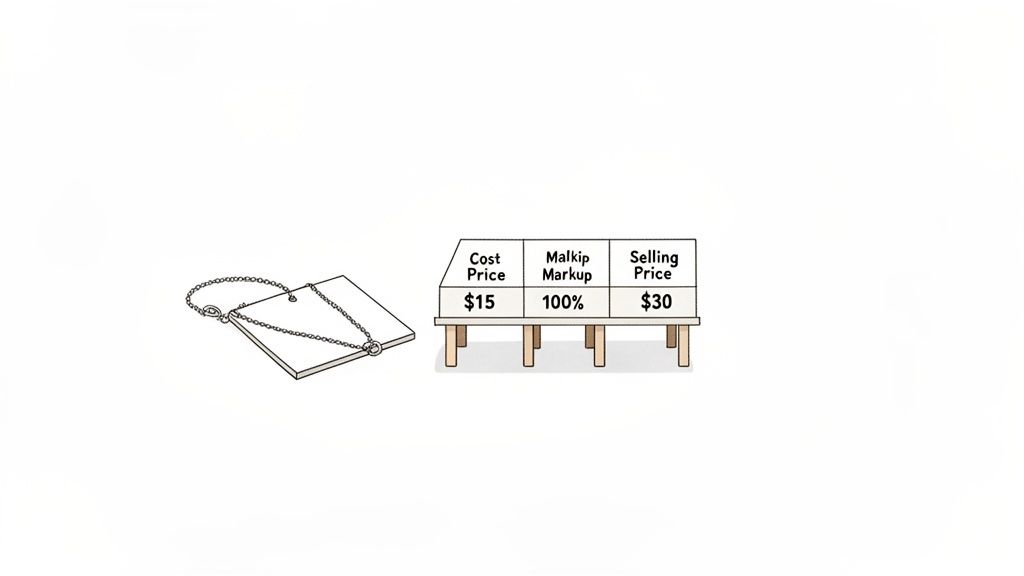
Key Terms You Need to Know
To really get this right, you need to be perfectly clear on a few key terms. These are the building blocks for every single pricing decision you'll make in your business, especially when sourcing affordable accessories.
Let’s break down the essential components you'll be working with.
| Term | Definition | Example (for a $10 Bracelet) |
|---|---|---|
| Cost Price | The total amount you paid to source the product, including shipping and fees. | You sourced the bracelet from your supplier for $10. |
| Selling Price | The final price a customer pays for the product in your store. | You list the bracelet for sale at $25. |
| Markup | The dollar amount added to the cost price to determine the selling price. | The markup is $15 ($25 Selling Price - $10 Cost Price). |
Once you’ve got these definitions down, the formula becomes second nature.
Mastering this one calculation is the most important first step for any business focused on sourcing high-quality, affordable jewelry. It gives you the financial clarity needed to build a profitable inventory and grow your brand.
The Fundamental Markup Formulas Every Retailer Needs
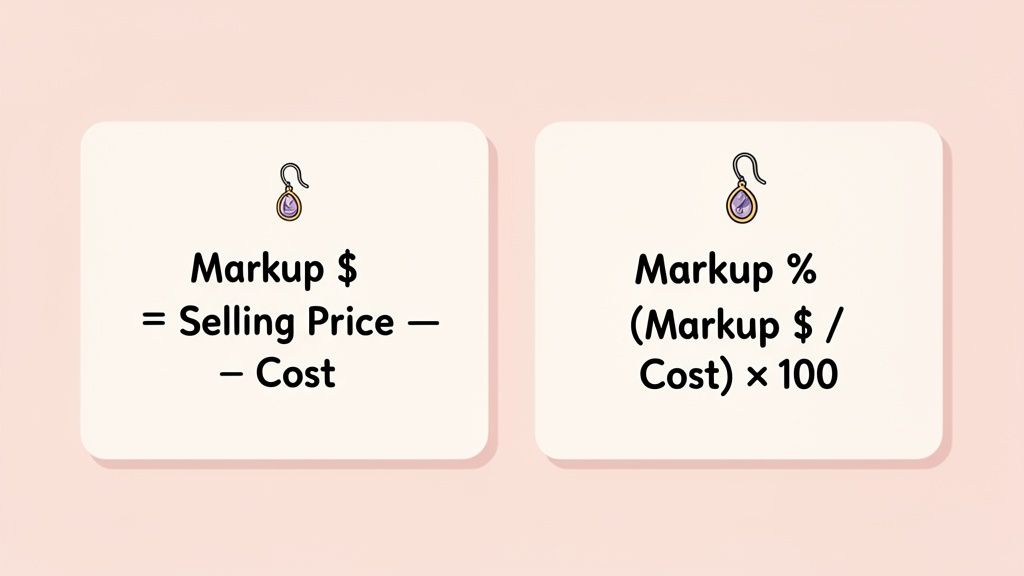
Alright, now that we've covered the basics, let's get into the practical math. There are two simple but incredibly powerful formulas you’ll be using every single day. These are your bread and butter for turning beautiful, affordably sourced jewelry into a profitable business.
Whether you're pricing a new line of on-trend fashion rings or a timeless collection of high-quality sterling silver earrings, getting these calculations right is non-negotiable.
Calculating Markup in Dollars
First up is figuring out your markup in simple dollars. This is the raw cash amount you’re adding to the cost of an item before you put it on the shelf. It’s the most direct way to see your potential profit on a single piece.
The formula couldn't be easier:
Selling Price – Cost Price = Markup Amount ($)
Let's run through a real-world scenario. Say you've sourced a stunning pair of high-quality sterling silver earrings. After factoring in shipping from your supplier and all other expenses, your true landed cost is $12. Based on your brand and what your customers are willing to pay, you decide the perfect retail price is $36.
Plugging that into the formula, it looks like this: $36 (Selling Price) - $12 (Cost Price) = $24 (Markup Amount).
That $24 is your gross profit for each pair sold. It's what you'll use to cover rent, marketing, salaries, and everything else before you take home your net profit.
Calculating Markup as a Percentage
Knowing the dollar amount is great, but the real magic happens when you convert it to a percentage. Why? Because a percentage gives you a consistent standard you can apply across your entire inventory, from a tiny charm to a statement necklace you've carefully sourced.
Here’s how you find it:
(Markup Amount / Cost Price) × 100 = Markup Percentage (%)
Let's stick with our earring example. We take the $24 markup amount we just calculated and divide it by the $12 cost: ($24 / $12) × 100 = 200%.
That 200% markup is your new benchmark. It gives you a reliable starting point for pricing similar items, which creates predictability in your revenue and makes sourcing new products much easier. These calculations are the heart of a good cost-plus pricing strategy, where you simply add a standard markup to what an item costs you.
Of course, this works both ways. If you already have a target markup percentage in mind, you can calculate your selling price from there. For example, many European accessory boutiques aim for markups between 140% and 220% to handle high operating costs like VAT or to offer customer perks like free shipping on their sourced goods.
For a deeper dive into profit margins and how they relate, our guide on using a wholesale profit margin calculator is the perfect next step: https://www.jewelrybuydirect.com/blog/wholesale-profit-margin-calculator?articleId=610767962198
Putting Markup into Practice with Real Jewelry Examples
The formulas are great on paper, but where the rubber really meets the road is when you’re pricing actual inventory. Let's walk through a couple of real-world scenarios you’ll face every day as a business owner sourcing jewelry. This is where knowing how to calculate retail markup goes from theory to profit.
We'll start with something simple: a batch of trendy, affordable fashion necklaces. After that, we’ll look at pricing a high-quality sterling silver piece, which plays by slightly different rules. These examples mirror the kind of sourcing and pricing decisions you have to make constantly to keep your shop fresh and profitable.
Scenario 1: Pricing High-Trend Fashion Necklaces
Okay, imagine you just found a great new supplier for affordable, on-trend necklaces. You decide to source a batch of gold-plated pendants that are perfect for impulse buys. Your goal here is to sell a lot of them, so you need a markup that’s both healthy and competitive.
Let’s add up what one necklace really costs you:
- Wholesale Price per Unit: $3.50
- Prorated Inbound Shipping & Fees: $0.50
- Packaging (box and insert): $0.75
Your Total Cost Price, sometimes called the "landed cost," is $4.75. This is the number you have to work from—not just the supplier's price. For a fast-moving fashion item like this, a 250% markup (which is a 3.5x multiplier) is a really solid place to start.
So, the math looks like this: $4.75 (Cost) × 2.50 (Markup Multiplier) = $11.875.
Nobody prices things at $11.875. You’d round this up to a clean, attractive retail price like $12.00 or $12.50. This gives you a great profit on each sale while keeping the price in that sweet spot for your target customer who is looking for affordable fashion.
Scenario 2: Setting the Price for Sterling Silver Rings
Now for a piece with a higher perceived value: a classic, high-quality sterling silver ring. Your customers already expect to pay more for genuine sterling silver, so your markup strategy can shift. The percentage might be lower, but the actual dollar profit you make will be higher.
Here’s the cost breakdown for a ring you sourced:
- Wholesale Price per Unit: $9.00
- Prorated Inbound Shipping & Fees: $0.75
- Premium Packaging (branded pouch): $1.25
The Total Cost Price for one ring shakes out to $11.00. For sterling silver, a 200% markup (a 3x multiplier) is a common industry standard. It perfectly balances the perceived value of the metal with your need for profit.
Here's the calculation: $11.00 (Cost) × 2.00 (Markup Multiplier) = $22.00. This gives you a final retail price of $33.00 ($11 cost + $22 markup).
See the difference? This price is totally competitive for a genuine sterling silver piece, and it nets you a $22.00 gross profit. That's a much bigger cash gain per sale than the fashion necklace, even with a lower markup percentage.
These same principles hold true whether you're sourcing finished pieces or making them yourself. If you're a designer, be sure to check out our deep dive on how to price handmade jewelry to make sure you’re accounting for your time and materials correctly.
What these examples really show is that a "one-size-fits-all" markup just doesn't work. The smartest business owners tailor their markup based on the product’s material, its sourcing cost, and what customers believe it's worth. This is how you build a truly strategic and profitable pricing model for your entire collection.
Using Strategic Markup to Maximize Your Profits
Slapping the same markup percentage on every piece you source is one of the biggest missed opportunities I see. A one-size-fits-all approach might feel simple, but I guarantee you’re leaving money on the table. To really grow your business, you need to think less like a calculator and more like a strategist.
It’s about moving beyond individual items and looking at your inventory as a complete, interconnected collection of sourced goods. A smarter approach means using different markups for different product categories. This lets you be more competitive where you need to be and more profitable where you can be.
This diagram breaks down the fundamental flow of markup, from your initial cost to the final price tag your customer sees.
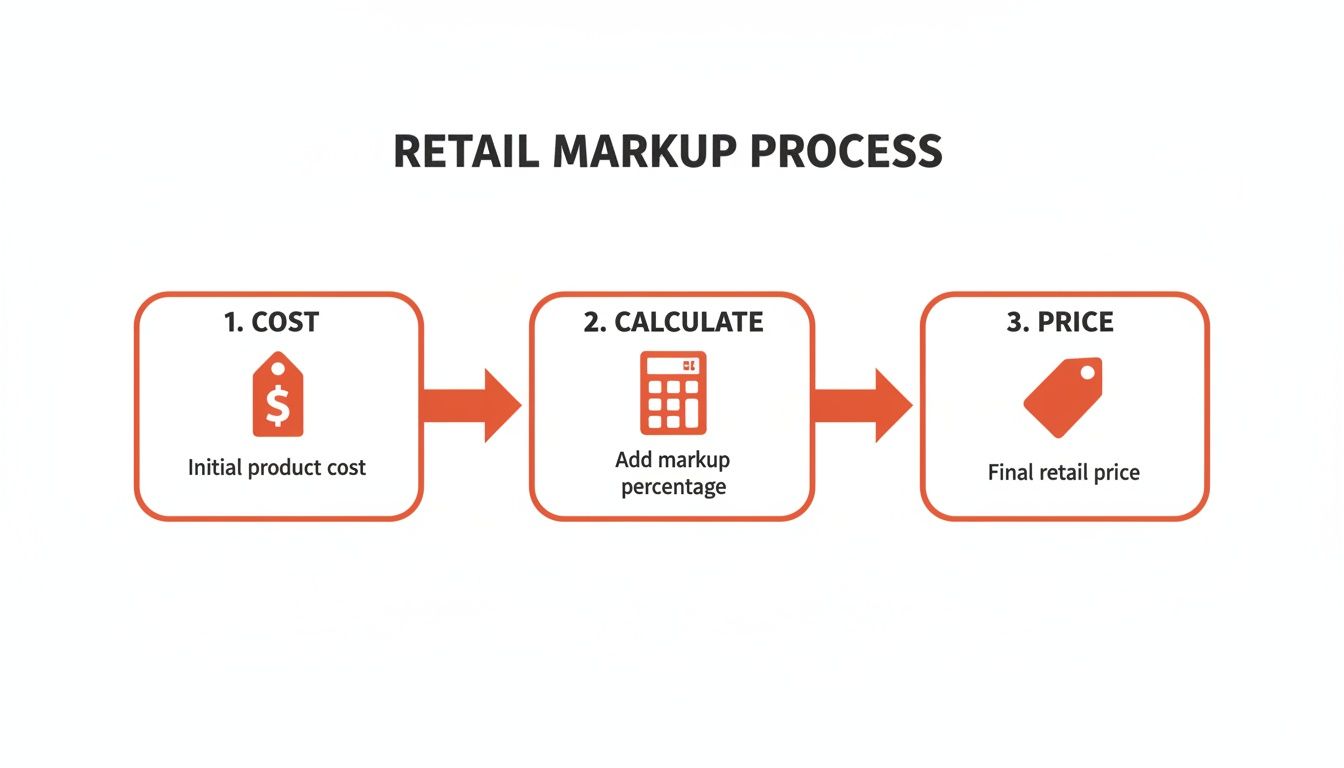
Each step is a building block, ensuring your final price is built on solid cost accounting and a clear profit goal.
Adopt a Tiered Markup Strategy
A tiered markup strategy is a game-changer, especially for a business with a diverse collection of sourced jewelry and accessories. The idea is simple: you apply different markup percentages based on things like product type, your cost from the supplier, or its perceived value. This gives you incredible flexibility.
Think of it in terms of categories. For example, you could set up tiers like this:
- High-Volume Fashion Accessories: For your lower-cost, trendy items you've sourced—think alloy rings or basic chains—you can often apply a much higher markup, maybe even 250-300%. Their low price point makes them easy impulse buys, so a higher markup maximizes the return on each small sale.
- Core Sterling Silver Pieces: Your bread-and-butter items, like classic 925 sterling silver earrings from a trusted supplier, are perfect for a standard keystone-style markup (around 200%). This reflects the material's high quality without alienating your core customer base.
- Premium or Unique Gemstone Items: For those higher-cost, unique pieces you source, you can actually use a lower markup percentage, say 100-150%. While the percentage is smaller, the total dollar profit on each sale is significantly larger, making it a win-win.
This approach lets you stay sharp on popular, affordable items while capturing the true value from your unique, high-end pieces. If you want to dive deeper into this, we have a complete guide right here: https://www.jewelrybuydirect.com/blog/how-to-price-jewelry?articleId=610805940310.
Calculate Your Weighted Average Markup
When you’re juggling thousands of SKUs from various suppliers, figuring out if your entire store is actually profitable can feel overwhelming. That's where the weighted average markup comes in. It’s a single, powerful number that gives you a bird's-eye view of your overall markup across your entire, varied inventory.
This average isn't just a vanity metric; it's crucial for financial planning, especially breakeven analysis. Let’s say your boutique has $10,000 in fixed costs every month. If your weighted average markup is 66.42%, you know you need to hit roughly $15,000 in sales just to cover your costs. Knowing that number helps you make much smarter decisions about everything from inventory purchasing to sales goals.
By blending different markups, you create a balanced pricing structure that can absorb the natural ups and downs of sourcing costs and consumer demand. It’s your safety net, ensuring the business stays profitable even when some items don't fly off the shelves.
This flexibility is also your secret weapon during peak seasons. Smart pricing is a cornerstone of effective holiday sales strategies, as it lets you adjust markups to capitalize on a flood of demand without scaring customers away. The real key to long-term success is shifting your mindset from just calculating markup to strategizing with it.
Common Markup Mistakes and How to Avoid Them
Knowing how to calculate retail markup is one thing, but actually applying it correctly is where many business owners get tripped up. The formulas are just the starting line—it’s sidestepping the common pitfalls that will truly protect your bottom line, especially when dealing with the slim margins of affordable goods.
These aren't complicated mistakes, but they happen all the time. A tiny miscalculation in your costs can quietly snowball, eating away at the profit you thought you were making on every single sale. Let’s break down the most frequent errors I see and, more importantly, how you can steer clear of them.
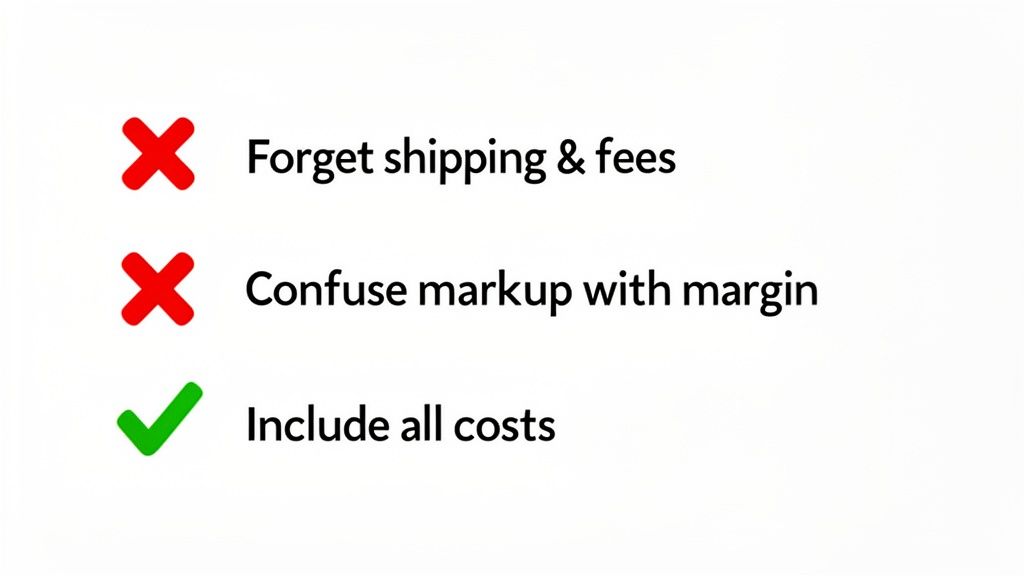
Forgetting to Include All Your Costs
By far, the most common mistake is calculating markup using only the wholesale price from your supplier. This completely ignores a ton of other expenses that are part of your true Cost of Goods Sold (COGS).
To price accurately, you need to work from your landed cost—that’s the total amount it takes to get an item from your supplier’s warehouse into your customer's hands.
Here’s a quick rundown of costs people often forget when sourcing products:
- Inbound Shipping: What did it cost to get the products to you?
- Packaging Materials: Think boxes, velvet pouches, thank-you cards, and bubble mailers.
- Payment Processing Fees: Platforms like Shopify and PayPal will take a small cut of every sale.
- Customs and Duties: If you're sourcing internationally, these import fees can be a nasty surprise if you don't account for them.
The Fix: Before you even think about markup, get your true landed cost per item. A simple spreadsheet works perfectly. Add up all the associated fees for a single supplier order, then divide that total by the number of units you bought. That is the "Cost Price" you should be using for your calculations.
Confusing Markup with Gross Margin
This is a classic mix-up, and it can throw your entire pricing strategy off course. While markup and gross margin both deal with profitability, they are fundamentally different metrics and tell you very different stories about your business.
It’s easy to get them tangled, but doing so can make you think you're more profitable than you actually are.
To clear things up, here’s a simple table breaking down the key differences between these two crucial metrics.
Markup vs. Gross Margin: A Critical Distinction
| Metric | Formula | What It Tells You | Common Pitfall |
|---|---|---|---|
| Markup % | (Selling Price - Cost) / Cost |
How much you're increasing the price over your cost. | Using this figure to guess your final profit percentage. |
| Gross Margin % | (Selling Price - Cost) / Selling Price |
The percentage of the final sale price you actually keep as profit. | Confusing it with markup when setting initial prices. |
The key takeaway? A 100% markup sounds great, but it translates to a 50% gross margin. Understanding this distinction is absolutely essential for making smart pricing decisions that ensure your business is actually making money.
Underpricing to Compete on Cost Alone
When you find a great supplier with affordable goods, the temptation is to set a super low markup and become the cheapest option on the market. Trust me, this is a race to the bottom you can't win.
Trying to compete purely on price devalues your brand and the effort you put into sourcing high-quality items. It also attracts customers who are only loyal to the lowest price tag—they'll be gone the second a competitor undercuts you by a dollar.
What to do instead: Focus on competing with value, not just price. What makes buying from you a better experience? Maybe it’s your unique curation of pieces, your top-notch customer service, your beautiful unboxing experience, or your lightning-fast shipping. Customers will happily pay a slightly higher price when they feel they're getting more than just a piece of jewelry. Your markup should reflect the total value you provide, not just the hard cost of the item.
Common Questions About Jewelry Markup
Once you get the hang of the formulas, the real questions start to pop up. Pricing jewelry and accessories isn't just a math problem—it's about making smart decisions that fit your brand, your sourcing strategy, and your market. Let's dig into some of the questions I hear most often from fellow retailers.
Getting these answers right is what separates knowing the theory from actually building a profitable business.
What Is a Good Markup Percentage for Jewelry?
I wish there was one magic number, but the truth is, it varies. For most fashion and sterling silver jewelry, a good starting point is a 100% to 300% markup. In simpler terms, that’s a 2x to 4x multiplier on what it cost you to source it.
For trendy, lower-priced accessories that fly off the shelves, you can usually push toward the higher end of that range. This helps you get the most out of each small, quick sale. On the flip side, for a pricier piece of high-quality material, you might use a lower percentage, but the actual dollar profit you make will be much larger.
A tiered strategy works best. I always recommend basing your markup on the product type, how much demand there is, your sourcing costs, and what your competitors are charging.
How Do I Include Shipping and Other Fees?
This is a big one, and it's where a lot of new sellers get tripped up. Before you even think about your markup, you have to figure out your true "landed cost" for every single item. This is way more than just the wholesale price on the supplier's invoice.
Your landed cost is what it really costs to get that piece of jewelry into a customer's hands. Make sure you're adding up all these little expenses:
- Inbound Shipping: What you paid to get the inventory from your supplier to your door.
- Customs and Duties: Any import fees if you’re sourcing from another country.
- Packaging Materials: Think boxes, pouches, mailers, and any branded cards you include.
- Payment Processing Fees: That small cut that platforms like Shopify or PayPal take from every sale.
Add all of that together, and that's your actual cost. Pricing based on this number ensures you're covering every expense and not accidentally eating into your profits.
Should I Use the Same Markup for Online and In-Store Sales?
Not always. Your markup should reflect the costs of each specific sales channel. A physical boutique has some hefty overhead—rent, electricity, and staff salaries all add up.
Your online store has its own unique costs, too. You're probably spending money on digital ads, paying monthly fees for your e-commerce platform, and dealing with higher fulfillment and shipping expenses.
Take a look at the costs for each channel independently. You might find that you need a slightly different markup for each to keep your profit margins consistent. Or, you might decide to keep the prices the same for brand consistency and just accept that one channel will naturally be a bit more profitable than the other.
How Often Should I Review My Markup Strategy?
Pricing isn't a "set it and forget it" task. You should be looking at your markup strategy pretty regularly—I'd suggest quarterly, or at the very least, twice a year. This keeps you in sync with the market and your sourcing costs.
It's also crucial to reassess your markups anytime something big changes. Did your supplier just raise their prices? Did shipping rates go up again? Are your competitors running a massive sale? These are all triggers to go back and check your numbers. Staying flexible and adjusting your prices based on real-time data is how you protect your margins in the fast-paced jewelry world.
Finding a reliable partner is the first step to building a profitable inventory. At JewelryBuyDirect, we provide access to over 120,000 high-quality, affordably priced jewelry and fashion accessories with no minimum order. Explore our catalog and start sourcing smarter.