






Arthur Lynch | Sun Dec 21 2025
How to buy jewelry wholesale: A Guide to Sourcing for Your Business
Jumping into the wholesale jewelry market without a plan is a classic rookie mistake. It's tempting to start browsing beautiful catalogs right away, but the real work—the work that leads to profit—begins with a solid strategy. You need to nail down your brand's specific niche, who you're selling to, and exactly what your budget looks like to source high-quality, affordable jewelry and fashion accessories for your business.
This initial legwork is what separates the pros from the hopefuls. It’s the difference between buying inventory that flies off the shelves and getting stuck with boxes of pieces that just don't sell, ultimately impacting your bottom line.
Your Blueprint for Profitable Jewelry Sourcing
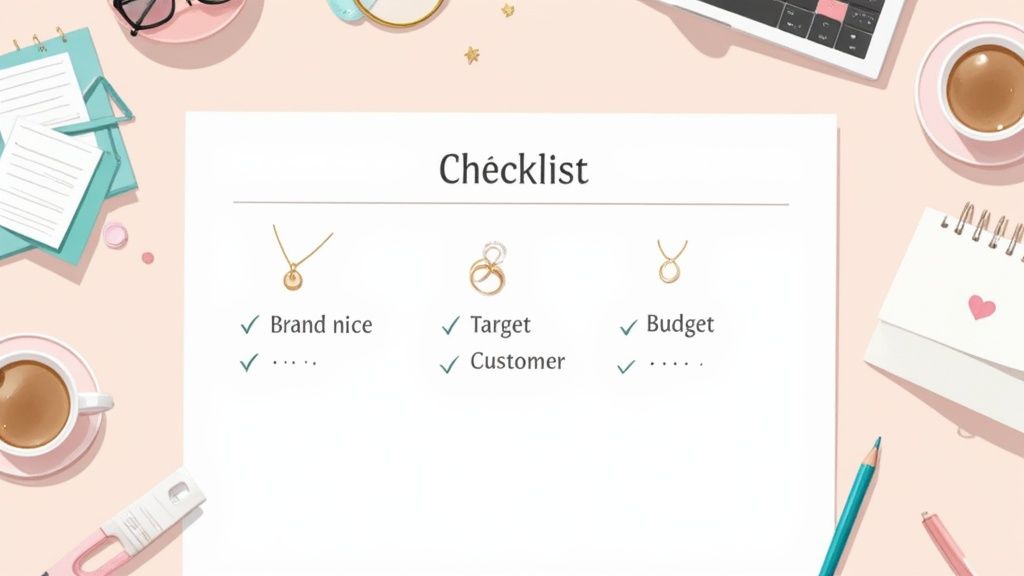
Before you even think about contacting a supplier, you need to get crystal clear on your own business. Launching a jewelry line or expanding your shop’s collection requires a smart sourcing strategy built from the ground up to find that perfect balance of quality and affordability.
Think of it this way: wandering into the wholesale world without a plan is like going grocery shopping when you’re hungry and without a list. You'll end up with a cart full of stuff that looked good at the moment but doesn't make a coherent meal. This planning phase is what turns random browsing into a professional procurement process designed for business growth.
Nail Down Your Brand and Customer
First things first, who are you? Before you look at a single piece of jewelry, you have to define your brand’s soul. Are you all about delicate, minimalist sterling silver for everyday elegance? Or are you selling chunky, vibrant statement pieces for a trend-focused crowd? Your niche dictates the type of quality and price point you need to source.
Once your brand identity is locked in, your target customer comes into focus. This clarity is your secret weapon, helping you source pieces you know they’ll want to buy. For instance, if you run a boutique for eco-conscious consumers, you'll be looking for suppliers who can provide high-quality, sustainably made accessories. On the other hand, if your brand is built on accessible, fast-fashion trends, your priority will be finding manufacturers who offer affordable pricing on fun, on-trend designs.
A well-defined niche isn't just about buying the right products—it supercharges your marketing. When you know exactly who you're talking to, you can craft a brand story that connects on a deeper level and keeps customers coming back.
Set a Realistic Sourcing Budget
Your budget is much more than what you pay for each necklace or ring. To truly understand your costs and protect your margins, you have to look at the bigger picture. A common pitfall is underestimating the "hidden" costs of sourcing, which can quickly erase the value of finding "affordable" jewelry.
Make sure your budget accounts for all these moving parts:
- Sample Orders: Never commit to a bulk order without verifying the quality first. You’ll need to factor in the cost of ordering samples from a few shortlisted suppliers.
- Shipping and Freight: This can be a major expense, especially with international suppliers. Costs vary wildly based on weight, package size, and the carrier you choose.
- Import Duties and Taxes: Don't get caught off guard by government fees. These are mandatory and based on the declared value and type of jewelry you’re importing.
- Contingency Fund: I always recommend setting aside an extra 15-20% of your total budget as a cushion. This covers unexpected headaches like customs delays, a batch that doesn't meet quality standards, or sudden shipping price hikes.
Getting this foundation right—brand, customer, and a comprehensive budget—is what sets you up for success. Once your beautiful new inventory arrives, you'll also need to know how to increase online sales with proven tactics to ensure your smart sourcing pays off.
Finding and Vetting High-Quality Wholesale Suppliers

Let’s be honest: your jewelry business is only as good as its suppliers. Finding a partner who delivers consistent quality at an affordable price point is absolutely essential for profitability. This is where the real work begins—knowing where to look and how to tell a great partner from a potential headache.
Think of this process as part research, part old-fashioned networking. The goal is simple: build a solid shortlist of potential suppliers who can meet your business's needs for quality, price, and production volume.
Where to Discover Reputable Jewelry Wholesalers
The search for that perfect supplier can feel like looking for a needle in a haystack. But if you know where to focus your energy, you can cut through the noise. Each sourcing channel has its own quirks and benefits, from endless variety to highly curated collections that balance quality and cost.
I've put together a quick comparison to help you figure out which path makes the most sense for your business right now.
Comparing Wholesale Supplier Sourcing Channels
| Sourcing Channel | Best For | Pros | Cons |
|---|---|---|---|
| Online B2B Marketplaces | Retailers comfortable with extensive vetting and looking for a massive selection (e.g., Alibaba). | Huge variety, competitive pricing, direct access to manufacturers. | Quality can be inconsistent; high risk of scams; requires deep due diligence. |
| International Trade Shows | Buyers who want to build relationships and assess quality in person (e.g., JCK Las Vegas). | See/touch products, meet suppliers face-to-face, discover new trends. | Expensive (travel, tickets), time-consuming, can be overwhelming. |
| Industry Associations | Businesses seeking established, pre-vetted suppliers with a proven track record (e.g., Jewelers Board of Trade). | Members are typically reputable and established. | Smaller selection, may require membership fees, less price competition. |
| Curated Wholesale Platforms | Startups and retailers who need high-quality, affordable fashion accessories with speed and convenience. | Pre-vetted suppliers, simplified ordering, often no MOQs. | May have slightly higher unit costs than direct sourcing. |
There's no single "right" answer here. Many successful retailers use a mix of these channels. If you're just starting and want a more guided approach, exploring a curated list of the best wholesale jewelry suppliers can be a great way to find reliable partners without the exhaustive legwork.
The Essential Vetting Checklist
Got your shortlist? Great. Now comes the most important part. Proper vetting is what protects your money, your brand, and your sanity. Don't cut corners here to save a few cents per piece.
A rookie mistake I see all the time is picking a supplier based only on the lowest price. A cheap partner who sends you a batch of defective pieces isn't a bargain—they're a liability. The real value is in the sweet spot between cost, quality, and reliability.
First, do a basic background check. Ask for their business license and registration to confirm they’re a legitimate company. A quick online search for reviews, testimonials, or mentions on other B2B sites can be incredibly revealing. A few bad reviews aren't necessarily a deal-breaker, but a clear pattern of complaints about quality or shipping is a major red flag.
Then, you need to understand their capabilities. What's their production capacity? What are their typical lead times? Do they specialize in the materials you need? A supplier who excels at mass-producing sterling silver might not be the right fit for your delicate, hand-finished gold-plated designs. A virtual factory tour, if they offer one, is a fantastic way to get a feel for their operation without booking a flight.
Verifying Compliance and Quality Standards
Compliance isn't just about paperwork; it's about protecting your customers and your business from legal trouble. With the global jewelry wholesale market hitting $162.9 billion in 2024, navigating international regulations is part of the job of sourcing high-quality goods.
Your supplier should be able to provide documentation showing they meet key standards. Don't be shy about asking. Two big ones you should know are:
- REACH: This is a European Union regulation that restricts harmful chemicals. It’s crucial for controlling substances like nickel, lead, and cadmium in your jewelry.
- Proposition 65 (Prop 65): A California law that requires warnings for products containing chemicals known to cause cancer or reproductive harm.
Confirming a supplier meets these standards can save you from a world of headaches, like costly product recalls or being blocked from certain markets.
Finally, just ask direct questions. How do they handle quality control? Do they have an in-house team that inspects items before shipping? What percentage of products gets checked? A transparent, professional supplier will have no problem answering these questions. Their answers (or lack thereof) will tell you everything you need to know.
Navigating Global Sourcing Hubs Like Asia Pacific
If you want to find affordable, high-quality jewelry for your business, you have to know where the world’s manufacturing happens. While the global market is huge, a few key regions really dominate production. They offer tightly integrated supply chains, incredible craftsmanship, and competitive prices that can give your brand a serious edge.
The Asia Pacific (APAC) region is the undisputed powerhouse in this space. It’s not just a major player—it's the center of the wholesale jewelry universe. Understanding this landscape is the first real step for any business serious about sourcing affordable, quality jewelry wholesale.
Why Asia Pacific Is the Go-To Sourcing Hub
The numbers don't lie. The Asia Pacific region is on track to command the largest share of the global jewelry market at 45% by 2025, a slice of the pie valued at an incredible $156 billion. This makes it the primary destination for buyers looking for cost-effective, high-volume sourcing from manufacturing giants like China and India.
This dominance isn't a fluke. It’s built on a few key advantages for businesses:
- Integrated Supply Chains: Countries like China have incredibly efficient systems that handle everything from raw material sourcing and component manufacturing to final assembly and packaging, often within a small geographic area.
- Cost Efficiency: Lower labor and production costs translate directly into more affordable wholesale prices, giving your profit margins much-needed breathing room.
- Massive Scale: The sheer volume of production means these hubs can handle orders of any size, from a small boutique's first run to a massive retail chain's seasonal collection.
China's integrated supply chains, for instance, are a huge advantage for direct-to-consumer brands that need flexible inventory. Suppliers there often offer low minimum order quantities (MOQs), which is a game-changer when you're testing new styles and don't want to tie up cash in a mountain of stock.
Tapping into the APAC market isn't just about finding a cheaper product. It's about accessing a manufacturing ecosystem that has been fine-tuned for decades to produce quality jewelry at scale, giving you a competitive advantage in your home market.
Mastering Communication and Cultural Nuances
Of course, sourcing from thousands of miles away has its challenges, and they usually boil down to communication and business culture. While language barriers are the most obvious hurdle, subtle differences in business etiquette can be just as tricky to navigate when sourcing quality fashion accessories.
In many Asian cultures, for example, building a personal relationship is a crucial first step before any real business gets done. Jumping straight into price negotiations can come off as blunt or even rude. Instead, take the time to build rapport. Ask about their company, show genuine interest in their craft, and approach every conversation with patience and respect.
For a deeper dive into working with suppliers in this region, our guide on sourcing from wholesalers in China for jewelry offers practical tips for bridging these cultural gaps.
When to Hire a Local Sourcing Agent
While you can absolutely manage supplier relationships directly, sometimes you just need an expert on the ground. A local sourcing agent is a professional based in the manufacturing country who acts as your eyes, ears, and advocate. They can be invaluable for navigating complex situations and ensuring quality.
Consider hiring an agent if you find yourself in these scenarios:
- Complex Negotiations: An agent who speaks the local language and understands the unwritten rules of business culture can negotiate far more effectively on your behalf.
- Quality Control Concerns: Nothing beats having someone visit the factory to inspect your products before they ship. They can catch potential issues early and save you from the headache of a defective order.
- Finding Specialized Suppliers: Agents have deep networks and can connect you with niche manufacturers that are nearly impossible to find on public B2B platforms.
While an agent adds a cost—usually a commission of 3-10% of your order value—the value they provide in minimizing risk, ensuring quality, and streamlining communication often far outweighs their fee. This is especially true for larger or more complex orders.
Hammering Out the Details and Placing Your First Order
You’ve narrowed down your list of potential suppliers, and now comes the crucial part: talking business. This is where a promising connection turns into a profitable partnership. Getting a great deal on wholesale jewelry is about more than just the price per piece—it's about building an agreement that fuels your long-term growth.
Negotiating is a dance. It’s a blend of solid preparation, clear communication, and building a real relationship. Remember, suppliers are just like you; they want reliable, long-term partners. If you approach the conversation as a collaborator, not an adversary, you’ll find it’s a much more productive (and pleasant) experience.
The Art of the Deal: Key Negotiation Points
When you get down to brass tacks, the unit price is just the starting line. The real value is often hidden in the terms surrounding the purchase. You need to be ready to discuss a few key areas to make sure the final deal works for your budget, cash flow, and how you run your business. A well-structured deal protects your margins and helps you offer affordable, high-quality products.
Here's what you absolutely need to cover with any potential wholesale partner:
- Tiered Pricing: Most suppliers will cut you a better deal for bigger orders. Always ask for their price list and pay close attention to the tiers. For example, what's the price break between buying 50 units versus 500? Knowing this helps you map out future costs as your business expands.
- Minimum Order Quantities (MOQs): This is simply the smallest order a supplier will accept. If their standard MOQ feels too high, don't just walk away. See if they're open to a smaller trial order. Let them know you're serious about a larger commitment if the product sells well.
- Payment Terms: This is a huge deal for managing your cash flow. Many suppliers want payment in full upfront, but some are flexible. It's common to find terms like 50% upfront and 50% upon shipment. If you've been in business for a while, you might even be able to swing "Net 30" terms, where you pay 30 days after getting the invoice.
- Return Policies: What's the plan if you get a box of damaged or defective items? A good supplier will have a crystal-clear policy for returns, replacements, or account credits. Settle this before you place your order to save yourself a massive headache later.
For a deeper dive into sealing the deal, our guide on how to negotiate with suppliers is packed with actionable advice to help you get the best terms possible.
Why Samples Are Non-Negotiable
Let me be clear: never, ever place a bulk order without seeing samples first. Product photos can be incredibly deceiving. A small investment in samples can save you from a catastrophic financial blunder. It is your one and only chance to hold the jewelry in your hands and confirm it meets your quality standards before you commit thousands of dollars.
Think of samples as a business insurance policy. The cost of a few pieces is nothing compared to the potential loss from a bulk order of unsellable, low-quality inventory. It’s the single most important quality control step you can take.
When your samples arrive, this isn't the time for a quick glance. You need to put them through their paces. This is your opportunity to scrutinize every single detail, from the raw materials to the final polish, to ensure they meet the quality your business promises.
Your Sample Evaluation Checklist
Treat this like a formal inspection. I highly recommend creating a physical or digital checklist to make sure you evaluate each sample consistently, especially if you're comparing pieces from different suppliers. This takes the guesswork out of it and helps you make a decision based on facts, not just a gut feeling.
Here’s what to look for when you unbox those samples:
- Material Authenticity and Feel: Does the sterling silver actually feel like sterling silver? Is the gold plating rich and even, or does it look thin and cheap? Look for the proper stamps, like "925" for sterling. The weight and feel of a piece can tell you a lot.
- Craftsmanship and Finish: Get up close and inspect the details. Are the stone settings secure? Do the clasps work smoothly and feel sturdy? Be on the lookout for sloppy soldering, rough edges, or any imperfections that scream poor manufacturing.
- Consistency: Did you order a few of the same item? If so, are they identical? While handmade pieces will have slight variations, significant differences in color, size, or quality on mass-produced items are a major red flag.
- Packaging and Presentation: How did the supplier pack the samples? This isn't about the product itself, but it says a lot about their attention to detail. If items show up tangled or damaged because of lazy packaging, imagine how a bulk shipment might arrive.
Once you've put the samples through the wringer and negotiated terms you're happy with, you can finally place that first order with confidence. You’ve done the legwork to build a solid foundation for a profitable partnership.
Getting Your Jewelry Home: Logistics and Quality Control
Once you've sealed the deal and placed your first major order, the real work begins. This is where your sourcing plan hits the pavement—the world of international logistics and making sure what you ordered is what you actually get. Nailing your shipping and having a rock-solid quality control process are non-negotiable. They protect your investment and your brand's reputation for high-quality accessories.
Getting your inventory from the factory to your storefront means understanding shipping terms, forecasting all the hidden costs, and having an inspection plan ready the moment those boxes arrive. This is the stuff that separates the seasoned pros from the rookies who learn very expensive lessons the hard way.
Cracking the Code of International Shipping
When you're sourcing from overseas, getting your products home can feel like a complex puzzle. The first big piece is choosing between air and sea freight.
Air freight is fast—we're talking days instead of weeks—but it comes with a hefty price tag. It’s perfect for high-value, lightweight pieces or when you need an urgent restock. Sea freight is the opposite: much slower, but far kinder to your budget, especially for heavier or bulkier orders where you can afford to wait.
Next, you absolutely have to get familiar with Incoterms. These are the global rules of the road for shipping, defining who's responsible for what and when. You'll run into these two all the time:
- FOB (Free On Board): The supplier gets your goods to the port and onto the ship. The second they're on board, everything else—the shipping cost, insurance, and import process—is on you.
- EXW (Ex Works): The supplier's job ends the moment they make the goods available at their factory door. You have to arrange everything from pickup and export clearance to the final delivery.
Knowing which term you're agreeing to is critical because it directly hits your final cost. Always get this clarified before you sign a purchase order.
Don't Get Blindsided by Landed Costs
This is a classic rookie mistake: forgetting about import duties and taxes. The price you pay your supplier is just the beginning. Your true expense is the landed cost—the all-in total to get a product to your warehouse. This includes the item's price, shipping, insurance, customs duties, and any other taxes.
These fees can vary wildly depending on the country you're importing to and the type of jewelry. If you don't budget for them, a profitable order can quickly turn into a financial headache. It's wise to work with a customs broker or use an online calculator to get a solid estimate beforehand. That way, you can price your pieces correctly and protect your margins.
This decision tree gives you a great visual for how those early negotiations around pricing, MOQs, and samples connect directly to your final purchasing and logistics strategy.
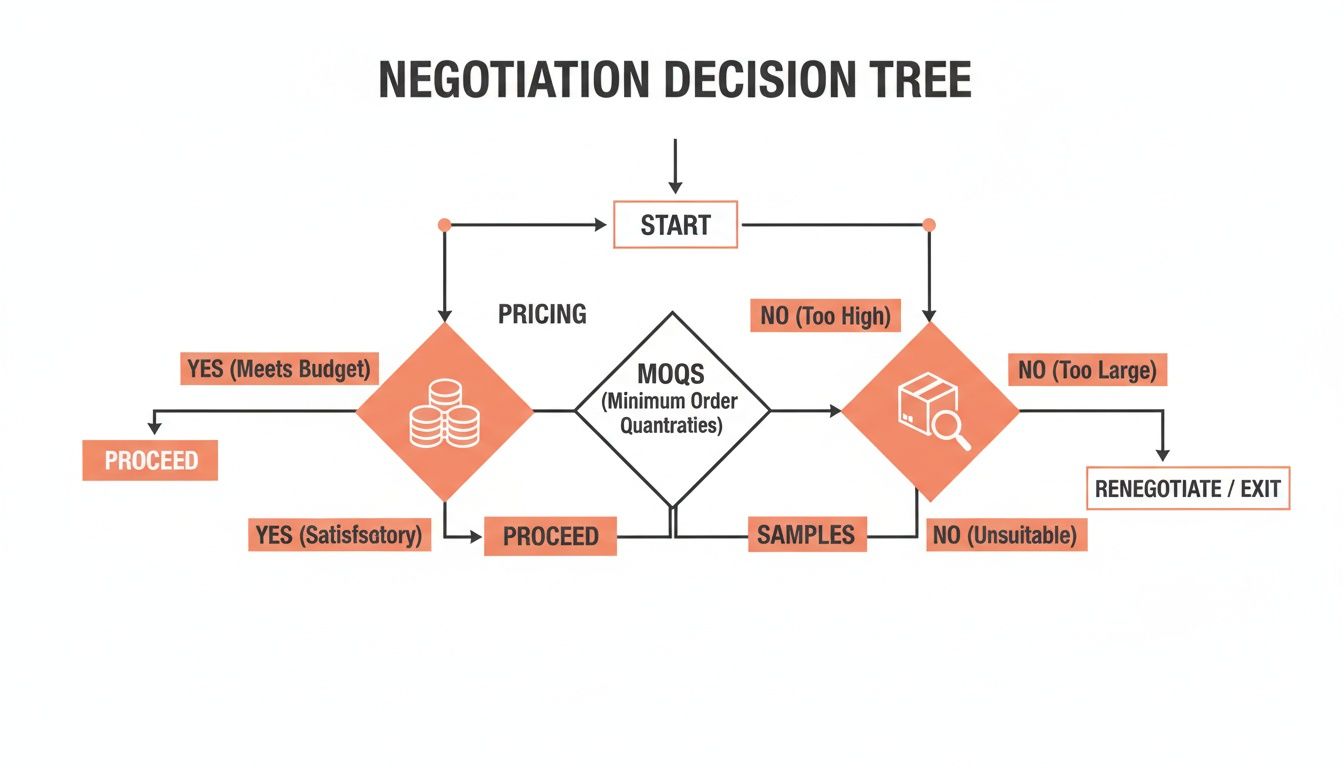
As you can see, successful logistics planning really starts at the negotiating table, since every decision you make there impacts your landed cost and what you’ll need for quality control.
Your Bulletproof Quality Control Playbook
Your work isn't done when the shipment finally shows up. Now it's time to verify you got exactly what you paid for. A meticulous quality control (QC) check is your last line of defense before a faulty product ends up in a customer's hands.
The global jewelry market has been on a tear, with projections to hit $480.5 billion by 2025 according to market trend analysis from Fortune Business Insights. That boom means suppliers are slammed, which makes a rigorous QC process more crucial than ever to catch the mistakes that can slip through.
Never assume a shipment is perfect, even if you loved the samples. Production errors are a fact of life, especially on larger runs. A systematic inspection protects both your brand and your bank account.
You have a couple of options here. You can hire a third-party inspection service in the supplier’s country to check the goods before they ship, which is a fantastic idea for big orders. It saves you the nightmare of dealing with defects from halfway across the world.
Alternatively, you can conduct the checks yourself when the items arrive. If you go this route, be systematic. A checklist is your best friend.
- Count Everything: First things first, do a full count and make sure it matches your purchase order and the packing slip.
- Hunt for Defects: Grab a random sample (or every single piece, if you can) and look for scratches, tarnish, loose stones, wonky clasps, or inconsistent plating.
- Check the Specs: Break out the calipers and a scale. Do the dimensions and weight match what you approved in the samples?
- Document, Document, Document: Take clear photos of every single defect or issue you find. This evidence is your leverage if you need to file a claim with your supplier for replacements or credit.
Answering Your Top Questions About Buying Wholesale Jewelry
Diving into the world of wholesale jewelry always brings up a ton of questions. It doesn't matter if you're just starting out or have been at this for a while—getting the right answers is what separates a profitable business from a struggling one. Let's break down some of the most common questions business owners have about sourcing affordable, high-quality pieces.
What’s a Realistic Starting Budget for Wholesale Jewelry?
This is probably the number one question I get asked, and the answer isn't one-size-fits-all. A good starting point can be anywhere from $500 to $5,000, and it really boils down to your business model. You definitely don't need a massive investment to get started, especially with all the flexible wholesale platforms available today.
For a small online boutique or someone just testing the waters with a new collection, a budget of $500–$1,500 is a great place to start. This gives you enough capital to buy from suppliers who have low—or even no—Minimum Order Quantities (MOQs). You get to experiment with different styles without tying up a ton of cash in inventory.
Now, if you're launching a more established brand or stocking a physical store, you'll want to aim higher, probably in the $2,000–$5,000 range. A bigger budget like this lets you handle higher MOQs, offer a much wider variety of products, and comfortably cover all those little "hidden" costs that can pop up.
Here's a piece of advice I always give: Whatever your product budget is, set aside an extra 20-30% just for logistics. This is your safety net for samples, international shipping, and any surprise import taxes or duties. Trust me, it ensures you’re never caught off guard.
How Can I Guarantee Quality from an Overseas Supplier?
Making sure the quality is there, especially when you can't just hop on a plane and visit the factory, is all about having a solid verification process. The biggest rookie mistake is trusting product photos alone. Don't do it.
First things first: always order samples. This is completely non-negotiable. Get them in your hands and scrutinize everything—the feel of the material, the thickness of the plating, the quality of the clasps, the overall finish. It's a small upfront cost that can save you from a massive headache and a warehouse full of defective goods.
Next, ask for their paperwork. Any reputable supplier should be able to provide quality certifications like ISO 9001 (which covers their manufacturing process) and compliance reports for safety standards like REACH or California's Prop 65. This is your proof that they meet international regulations for materials like nickel, lead, and cadmium.
And for those really big or high-value orders, think about hiring a third-party inspection service in the supplier's country. For just a few hundred dollars, they'll inspect your goods before they ship and send you a detailed report with photos. It’s far cheaper than finding a problem after everything has already landed at your door.
What Are MOQs and How Can I Negotiate Them?
MOQ stands for Minimum Order Quantity. It's the smallest order a supplier is willing to accept, and they use it to make sure their production runs are profitable. They can seem intimidating, but they aren't always set in stone.
The best way to negotiate is to build a real relationship. Explain that you're aiming for a long-term partnership and want to start with a smaller trial order to test your market. When you frame it as the first step toward larger, consistent orders down the road, they're more likely to be flexible.
Another great strategy is to ask if you can meet their MOQ by mixing and matching different styles. So, instead of ordering 500 of a single necklace design, see if they'll let you order 100 units of five different necklaces. The supplier still hits their volume target, and you get more variety for your store. A professional approach and a clear vision for growth can go a long way.
What's the Difference Between a Manufacturer, a Wholesaler, and a Dropshipper?
Getting these terms straight is essential because each model serves a totally different business need and comes with its own profit margins.
-
Manufacturer: This is the factory actually making the jewelry. Buying direct from the source gets you the absolute lowest price per piece, but it usually comes with the highest MOQs. This route is best for established brands that have solid sales data and can handle large volumes.
-
Wholesaler: Think of a wholesaler as the middleman. They buy in huge quantities from manufacturers and then resell the jewelry in smaller (but still large) batches to retailers like you. Their prices are a bit higher than a manufacturer's, but their MOQs are much more manageable for small and medium-sized businesses.
-
Dropshipper: A dropshipper is a partner who holds zero inventory. When you get a sale on your site, you just forward the order to them, and they ship the product directly to your customer. There's no upfront inventory cost, which is amazing for testing new products. The trade-off? You get the lowest profit margins and have no control over quality or shipping times.
Ready to source high-quality, affordable jewelry without the hassle of high MOQs? JewelryBuyDirect offers over 120,000 on-trend styles with factory-direct pricing, no minimum orders, and fast worldwide shipping. Explore our wholesale collections and start scaling your business today!