






Jennifer Lopez | Tue Oct 13 2026
Handmade Glass Beads: A Wholesale Buyer's Guide
A wholesaler sends you a polished catalog of handmade glass beads. The colors look perfect, the photos resemble last season's best sellers, and the price seems workable. You place the order without asking for lot records, material reports, or a clear definition of “handmade.”
The second delivery is where the trouble starts. The holes are inconsistent, the color has shifted, several beads show haze or micro-bubbles, and the supplier's “lead-free” statement comes without a certificate. The craft story attracted the sale, but the missing buying discipline created the return.
Handmade glass beads reward retailers who inspect what they're buying. They also punish buyers who confuse a beautiful photograph with verified quality. This guide gives you a practical framework for technique literacy, supplier checks, chemical safety, origin and recycled-content claims, pricing, customization, customer care, and product listings. For a broader sample-approval process, review this guide on how to review jewelry samples, then apply the same discipline to your bead lots.
Why Buying Handmade Glass Beads Without a Checklist Is Risky
The appeal of handmade glass beads is also the source of their commercial risk. A bead made by an individual artisan can carry subtle differences in shape, winding, color layering, and surface finish. Those differences may create character in a one-off necklace, but they can create customer complaints when a boutique promises matching earrings, repeatable bracelet colors, or a consistent wholesale collection.
Three silent failures appear repeatedly.
Visual inconsistency is the first. A supplier may send an attractive sample, then produce a later batch with different dimensions, hole placement, color saturation, or surface clarity. “Handmade” explains variation. It doesn't excuse a supplier who never defines acceptable variation.
Undocumented chemical safety is the second. A general “non-toxic” or “lead-free” phrase isn't a laboratory report. Glass can contain different base compositions, colorants, coatings, or recycled inputs, and a finished jewelry piece may also include clasps, wires, plated components, or other metal findings.
Unverifiable origin claims are the third. “African handmade,” “Venetian,” and “recycled glass” can describe different things. The production location, raw-glass origin, artisan attribution, and recycled-content method are separate questions.
Buyer's rule: Treat the sample as a product test, not a mood board.
Before issuing a larger purchase order, request the supplier's lot number, dimensional tolerances, inspection records, material composition, chemical test documentation, and explanation of cultural or geographic claims. Ask whether the supplier can repeat the color and size, not merely whether the sample looks good.
The rest of the buying decision follows from that evidence. Technique tells you what variation to expect. Lot testing tells you whether the variation is controlled. Compliance documents tell you what you can responsibly sell. Pricing analysis tells you whether the product remains profitable after defects, freight, and rework.
How Handmade Glass Beads Are Actually Made
A buyer doesn't need to become a glass artist, but you do need to understand what happens between raw glass and a finished bead. The production method affects shape, surface detail, repeatability, labor, and the language you can use in a product listing.
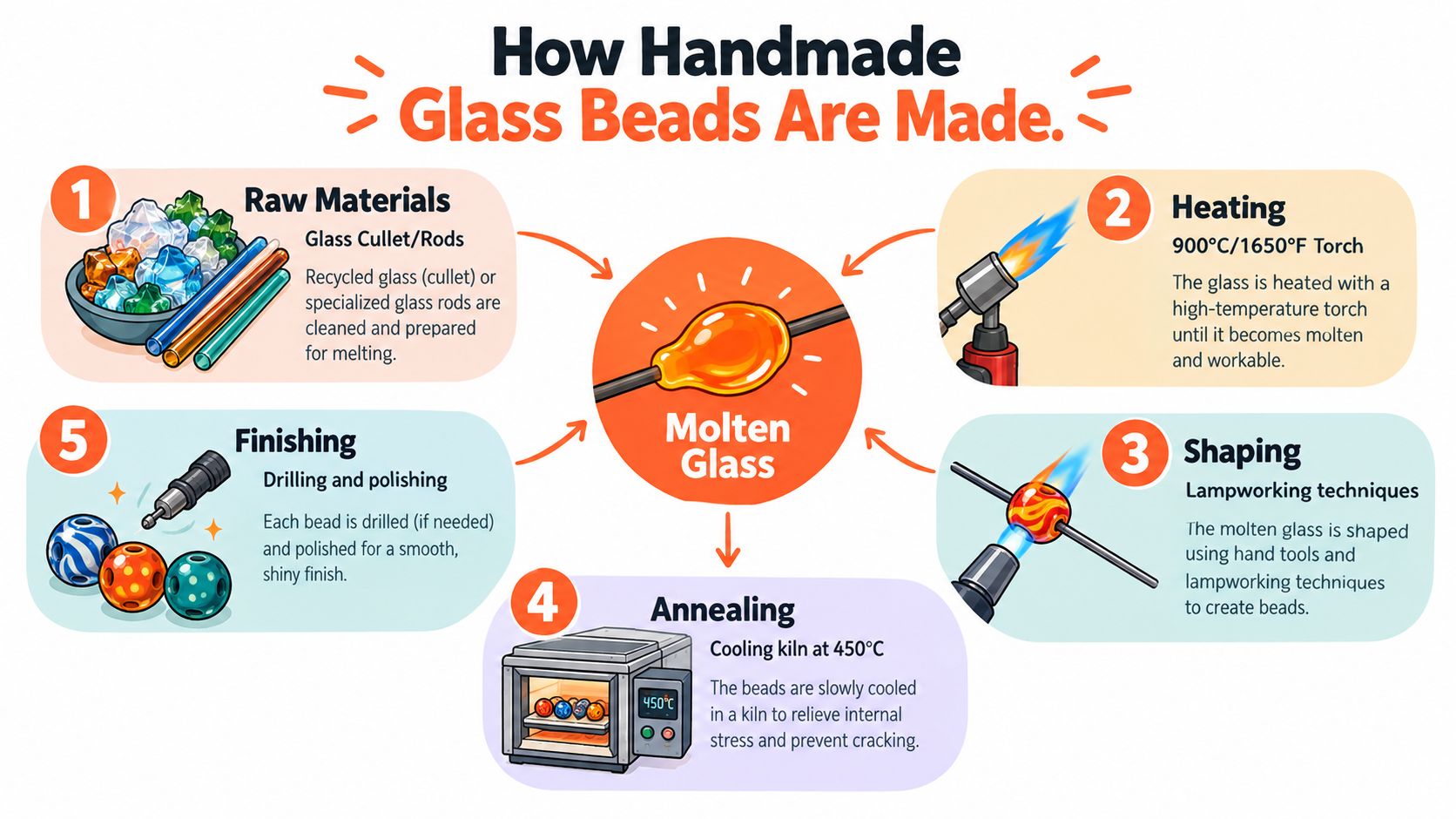
The main techniques buyers should recognize
Lampwork, often called wound glass beadmaking, uses a torch to heat glass rods until they soften. The artist winds molten glass around a coated metal mandrel, adds layers or surface decoration, shapes the bead with tools, and anneals it in a kiln. Each bead carries an artisan's decisions, so lampwork works especially well for focal beads, statement jewelry, and collections where visible individuality is part of the value.
Murano refers to the Venetian island's longstanding glassmaking heritage, not automatically to every colorful glass bead sold under a Venetian-sounding description. Murano traditions include cane work, layered color, and millefiori patterns, where cross-sections of patterned glass canes create repeated floral or geometric motifs. If authenticity matters to your positioning, ask what the claim means, where the bead was made, and what documentation supports it.
Seed beads are small beads used for spacers, woven work, embroidery, and dense patterns. Czech and Japanese seed beads are familiar reference points for size and consistency, but “seed bead” describes a format more than a guarantee that every unit was individually shaped by hand. Ask whether the line is drawn, cut, pressed, finished, or manually sorted.
Pressed beads form molten glass inside molds. The method supports stronger dimensional consistency and efficient repeat production, which makes pressed glass useful for affordable collections, repeatable color stories, and larger unit requirements. Pressed does not mean poor quality. A clean mold, controlled finishing, and sensible inspection often matter more than the romance of the label.
Dichroic beads use thin-film coated glass that shifts color as the viewing angle changes. They create strong focal effects, but the coating deserves specific handling and durability questions. Ask whether the dichroic layer is internal, surface-applied, or protected by another glass layer.
Watch the wording on supplier sheets. Handmade should describe how the bead itself was formed. Hand-finished may mean a bead was produced by a more standardized process and then polished, coated, sorted, or decorated by hand. Those are different production claims, and your listing should preserve the distinction.
A short visual demonstration can help your team recognize flame shaping, layering, and finishing before you approve samples.
Comparing Lampwork, Murano, Seed, Pressed, and Dichroic
Choose bead styles by the role they must play in your assortment. A boutique built entirely around premium focal beads may look distinctive but struggle with unit economics. A range of uniform spacers controls cost yet gives customers little reason to remember it. Match visual impact, repeatability, and supplier verification before approving a line.
| Style | Typical Wholesale Range | Best Use Case | Volume Fit |
|---|---|---|---|
| Lampwork | Request a lot-specific quote because labor and decoration vary widely | Statement focal beads and artisan-led collections | Small to moderate repeat runs |
| Murano | Pricing depends on documented origin, cane work, and finish | Heritage-positioned focal pieces and giftable designs | Moderate, subject to supplier capacity |
| Seed | Usually the lowest per-unit tier, with cost driven by size, finish, and sorting | Spacers, woven jewelry, embroidery, and pattern work | High volume |
| Pressed | Mid-tier option for repeatable shapes and colors | Coordinated bracelets, earrings, and volume collections | High volume |
| Dichroic | Premium focal tier because the visual effect and coating add complexity | Statement pendants, focal beads, and attention-grabbing accents | Small to moderate repeat runs |
Lampwork earns its premium through visible variation and the maker's forming work. Dichroic earns attention through color shift, but ask whether the layer is internal, surface-applied, or protected by another glass layer. Murano supports heritage positioning only when the origin is documented and the supplier's wording is accurate.
Use seed beads as the workhorse and pressed glass as the practical middle tier for coordinated components. Before approving either, ask suppliers about origin, recycled content, and chemical-safety documentation rather than treating a craft label as proof. For adjacent component ranges, compare the construction and price logic with acrylic beads for jewelry making, especially when weight, color matching, or lower-cost testing matters.
No-MOQ wholesale platforms can change the buying calculation for small boutiques. They let you test a premium focal line beside supporting seed or pressed components without committing to a large first order. Confirm that no-MOQ availability applies to the exact style, color, and finish you want, then request lot-specific details before expanding the order.
Build the assortment around two premium lines, one lampwork and one dichroic or properly documented Murano, then use pressed glass or seed beads for the supporting tier. Let the supporting tier carry most unit volume while premium focal pieces provide distinction and margin opportunity. Keep the range easy for customers to understand.
Quality Indicators Buyers Can Verify Before They Pay
A skilled buyer can spot obvious defects, but appearance alone won't verify material safety, lot consistency, or origin. Use a written supplier process and apply it to a sample pack before you approve a larger purchase order.
Start with lot control
Australia's CSIRO AP-S0042 glass-bead specification requires representative sampling at least once per production lot. It calls for checks covering foreign matter, optical quality, size, shape, color, and moisture-proof coating. It also specifies laboratory analysis for lead, antimony, arsenic, mercury, cadmium, and total chromium using methods such as ICP-MS.
Use that structure even if your product isn't being purchased for the same technical application. Ask the supplier to identify the production lot, retain representative samples, and provide inspection records that relate to that lot.
Inspect the sample under magnification
The California Department of Transportation glass-sphere specification offers a useful measurable benchmark. It requires at least 85% of beads, counted under 20× magnification, to be colorless, true spheres without dark spots, milkiness, air inclusions, or surface scratches. It also limits total arsenic, antimony, and lead to 200 parts per million each.
That document addresses technical glass spheres rather than fashion jewelry, so don't present it as a universal jewelry rule. Use it as a model for writing your own acceptance criteria. Define what percentage of visible defects you will tolerate, how you'll inspect them, and what happens when a lot fails.
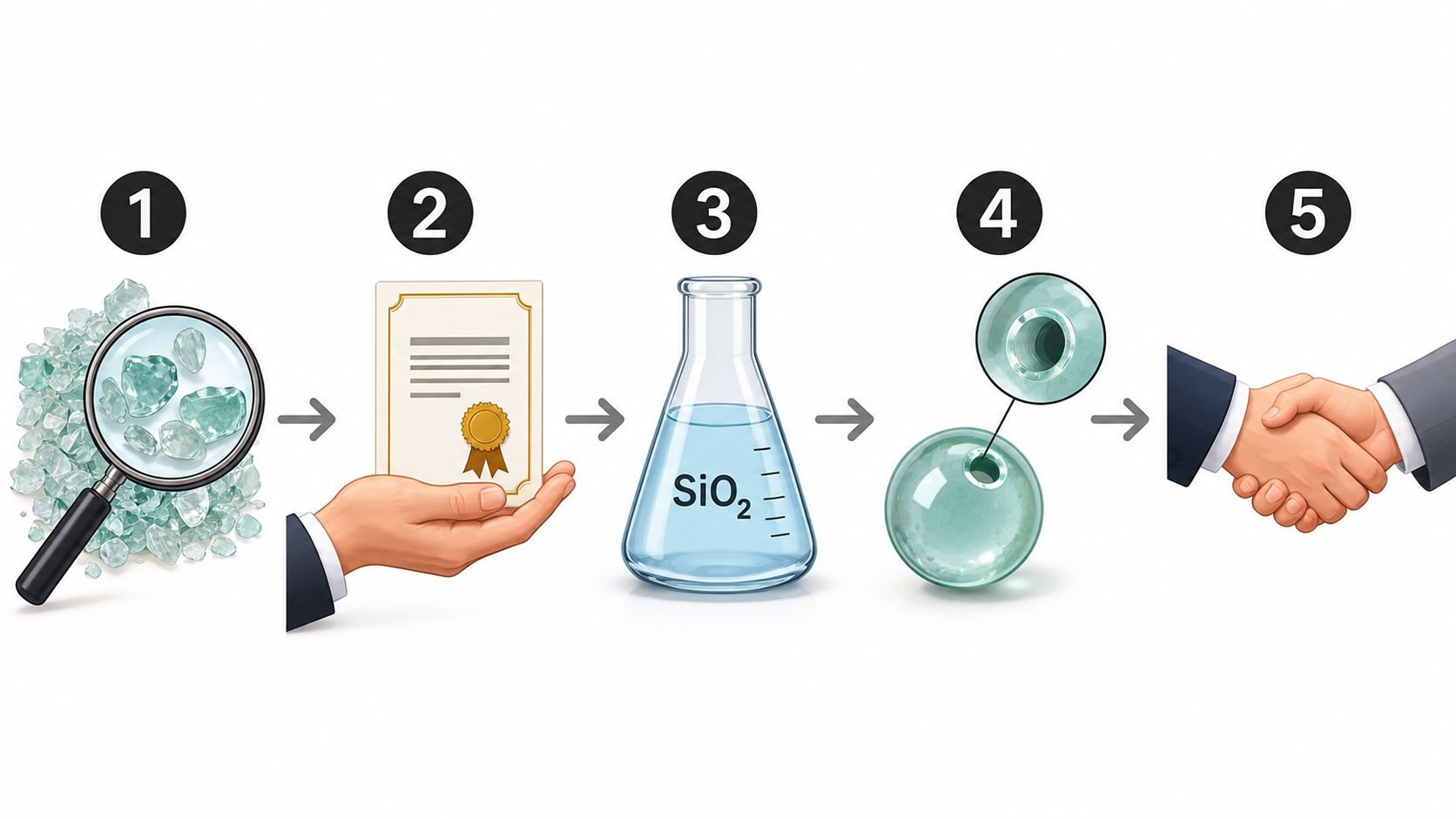
Run this supplier verification flow
- Request the lot identity. Ask for the production lot number, manufacturing date, bead dimensions, and expected tolerance for size, hole diameter, color, and shape.
- Request representative samples. The sample should come from the lot you may buy, not a hand-picked showroom set. Keep your own retained sample for future comparison.
- Inspect in neutral light. Photograph beads under consistent lighting and inspect them with magnification. Warm catalog lighting can disguise haze, micro-bubbles, scratches, and uneven coating.
- Request chemical documentation. Ask for a recent, batch-specific laboratory report. A generic supplier statement isn't enough for a product you'll market as safe or compliant.
- Challenge origin and sustainability claims. Ask where the bead was formed, where the base glass came from, whether the material was recycled or salvaged, and what evidence supports the claim.
Send this copy-and-paste question list before approving a larger PO:
- What is the production lot number and acceptable size variation?
- Can you provide representative sample inspection records?
- Which defects do you record, and how do you handle failed lots?
- What is the glass composition and colorant information?
- Can you provide a recent batch-specific report for relevant chemicals?
- Where was the bead formed, and where did the raw glass originate?
- What does “recycled” or “upcycled” mean for this exact product?
- What evidence supports any cultural or artisan attribution?
Safety, Compliance, and What to Ask About Skin Contact
Chemical safety has three separate parts, and buyers who collapse them into “lead-free” miss important risks.
Composition asks what substances are present in the bead. Historical glassmaking used lead compounds for color and opacity, including lead-antimonate yellow, and recycled glass can combine materials from different sources. That history doesn't prove a contemporary bead is unsafe, but it does prove that color and appearance cannot establish chemical composition.
Migration or leaching asks whether substances can move from the material's surface during sweat, wear, cleaning, or contact. A total-content report and a migration test answer different questions, so request the report that matches the intended product and destination.
Mechanical safety concerns chips, cracks, sharp edges, brittle coatings, and hole damage. A chemically acceptable bead can still create a poor customer experience or a physical hazard if it breaks against skin or cuts cord during wear.
For European Union sales, jewelry-related REACH restrictions cited by Conphora's jewelry compliance guidance limit lead to less than 0.05% by weight in an individual part and cadmium to less than 0.01% in applicable metal parts. Nickel restrictions apply to piercing posts and items intended for prolonged skin contact, with release limits depending on the use category.
Those limits matter even when the bead itself is glass. The finished accessory may include a clasp, wire, chain, plated cap, or other metal component. Request documentation for the complete component set, not only the nonmetallic bead.
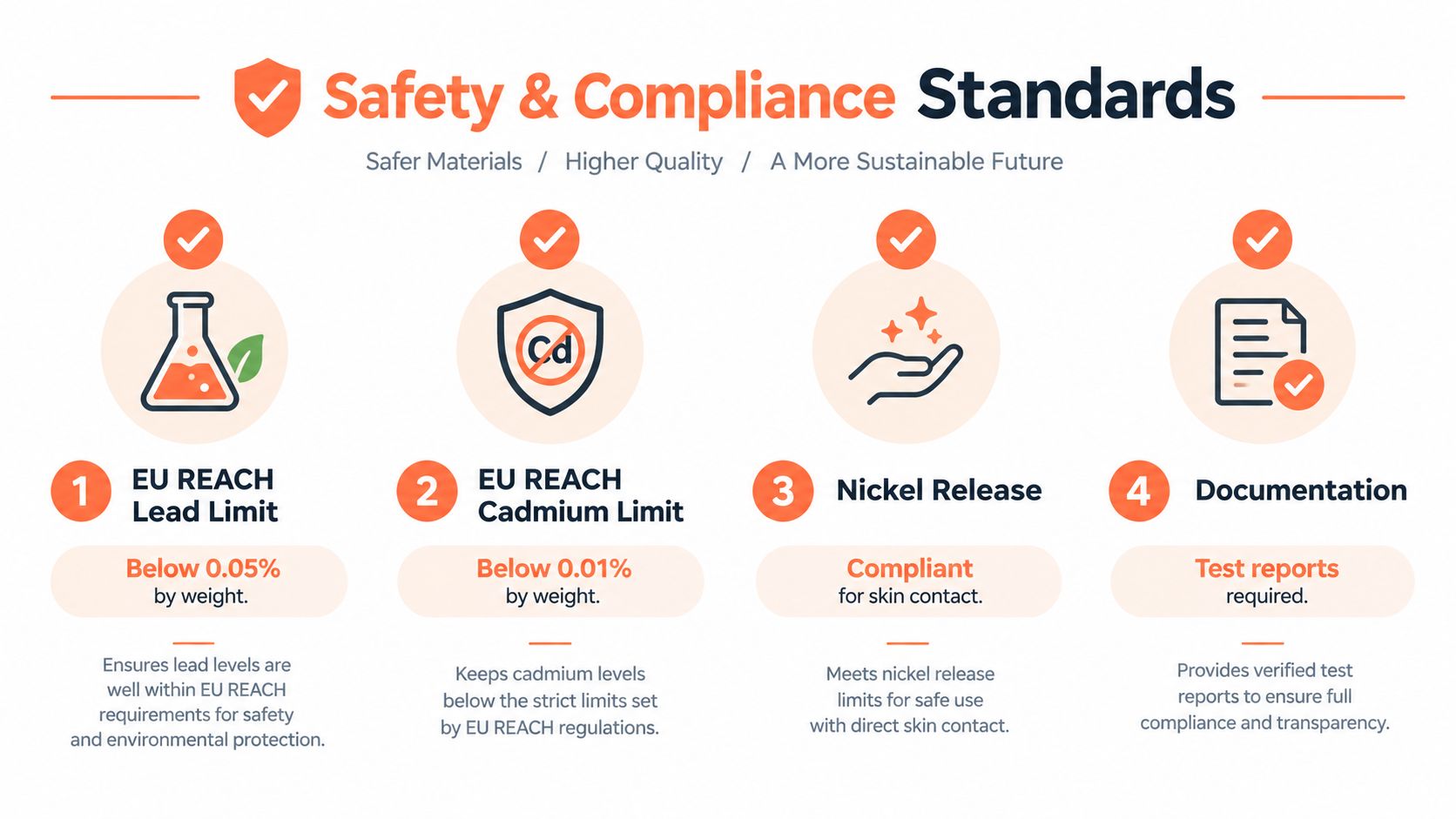
For each destination, request recent batch-specific laboratory reports, material declarations, relevant migration or release testing, coating and abrasion information, and clear age-use guidance. Requirements differ across the EU, United Kingdom, United States, and Australia, and product categories can change the applicable rules. Don't use one report as a universal passport.
Compliance language should be narrower than marketing language. If the document tests a specific batch and component, make the product claim specific to that batch and component.
Pricing, Wholesale Sourcing, and Private-Label Strategy
The per-bead price is only the beginning of your cost. Handmade goods create labor variation, sorting time, defect exposure, batch inconsistency, freight cost, and potential rework. A cheaper bead can become the expensive choice if it forces you to remake bracelets, photograph multiple color versions, or discard mismatched pairs.
Calculate landed cost by adding the bead price, shipping, duties where applicable, inspection time, expected defects, findings, packaging, and the cost of carrying slow-moving stock. No-MOQ platforms change the decision because a small boutique can test a style without buying a full case or filling a shelf with unproven inventory. That makes experimentation more rational, but it doesn't remove the need for sample approval.
Some curated B2B platforms offer 15% off the first three orders and free-shipping thresholds of $150+, which can lower the cost of a controlled trial when the terms are clearly stated. Verify the current offer, eligible products, and destination before building it into a margin calculation.
Use private label selectively
Private label makes sense when you've identified a repeatable style, color story, or construction that deserves ownership. It can give a growing brand a signature look that competitors can't replicate just by searching the same public catalog. Start with a narrow brief: bead shape, diameter, hole size, finish, color references, packaging, allowable variation, and inspection requirements.
For a plain-language explanation of the model, see this guide to private label brand explained. The commercial point is straightforward. Customization earns its keep only when the design is repeatable and the expected reorder value justifies development work.
Use bulk beads for jewelry making when you need a reliable component tier, then reserve custom development for the styles that distinguish your brand.
Recycled and upcycled are not interchangeable claims. Recycled content generally describes material processed back into a usable input, while upcycled content can describe salvaged or repurposed material used in a new product without implying the same processing route. Ask for the production location, raw-glass origin, material composition, recycled-content methodology, batch consistency, and evidence supporting sustainability language. A bead can be handmade in one country from imported or salvaged glass originating elsewhere.
Using Handmade Glass Beads in Designs, Care, and SEO Listings
Good sourcing still needs good merchandising. Start with three construction patterns that make the difference between a bead assortment and a sellable product line.
Focal and spacer designs use one larger lampwork or dichroic bead as the visual anchor, with pressed-glass or seed-bead spacers controlling rhythm and cost. This gives the customer a clear reason to notice the premium component without forcing every bead in the piece to carry premium labor.
Texture layering combines matte, glossy, and coated finishes in one bracelet or necklace. Keep the palette controlled, then let surface contrast create interest. Modular strand sets give customers multiple ways to restyle a necklace or bracelet and help you sell coordinated components rather than isolated units.
Don't publish unsupported “high quality” language. State the technique, measured size, finish, hole information, country of production when verified, and any documented care limits. For practical product description tips for Shopify, focus on details a customer can use to decide.
Care instructions should be plain:
- Wipe with a dry, soft cloth.
- Keep dichroic pieces away from ultrasonic cleaners unless the supplier confirms compatibility.
- Store pieces away from direct sunlight and separate them to reduce scratching.
- Keep strung jewelry flat so the cord isn't left under unnecessary stretch.
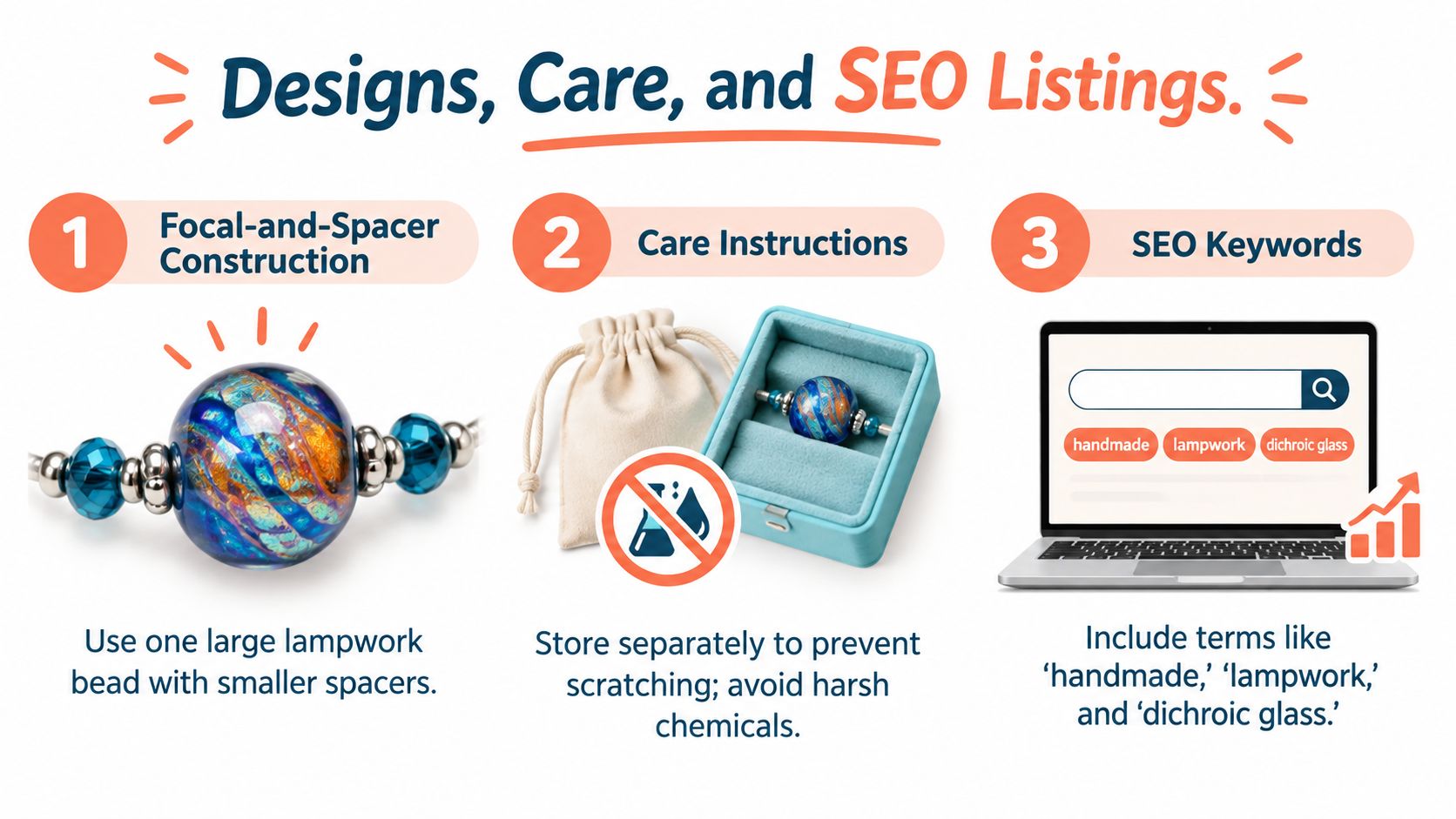
For search visibility, front-load the phrase handmade glass beads in the title. Use a structure such as “Handmade Glass Beads, Lampwork Blue 10 mm for Jewelry Making”, adjusting the size and style to the verified specification. Alt text should name the technique, color, shape, and use, for example, “Blue handmade lampwork glass bead with layered dot pattern for bracelet making.”
Use a cover image ratio of 383:204, approximately 1.877:1. Suitable proportional sizes include 766×408, 1,149×612, or 1,532×816 pixels. Keep the bead, finished jewelry, and any important text in the central safe area because a different ratio may crop the sides or top and bottom in a cover-style display.
For related components, organize complementary products such as charm bracelet beads wholesale around the same color and technique language.
A Sourcing Action Plan You Can Run This Quarter
Start with five actions:
- Audit your current assortment and rebalance premium lampwork or dichroic focal pieces against pressed or seed-bead support styles.
- Send suppliers the verification questions and require lot-based inspection language before approving a larger PO.
- Request documented chemical-compliance reports before using beads in children's accessories or skin-contact products.
- Place a small trial order through a no-MOQ platform and evaluate repeatability before committing to a case.
- Rewrite your top three listings with a front-loaded handmade glass beads title and technique-specific alt text.
JewelryBuyDirect's catalog includes 120,000+ SKUs, factory-direct pricing, SGS-certified manufacturing partners, no minimum order quantity, and 15% off the first three orders, so it can serve as one practical starting point for a controlled sourcing test. Verify current terms before ordering.
Use a small trial to test the bead, the supplier, and your own merchandising process before scaling. Visit JewelryBuyDirect to compare handmade glass-bead jewelry and jewelry-making components with no-MOQ sourcing, then approve only the lots that meet your documented quality and compliance requirements.