





Cathy Lopez | Tue Nov 17 2026
Earring Hook Types: Styles, Fit and Fastening Compared
The usual advice treats earring hook types as a style menu. Pick a fishhook because it looks light, a leverback because it looks "better," and call the job done. That advice fails the moment a dangle hits the floor on a commute, a thin lobe sags under a heavy clasp, or a plated wire irritates a piercing you thought was fine. Security beats the name on the listing. Fit, weight, and loss risk decide the hook. Style comes second. Stock a pair of options, not one universal winner.
Earring Hook Types at a Glance
Security matters more than the name. Read the security column as loss risk during wear, not as a verdict on how strong the metal is. A thin open wire can be tough steel and still walk out of a lobe. A locking clasp can be poorly made and still beat an open wire on retention.
Six families show up in almost every shop and wholesale listing, ordered here from the lightest and most open to the most locked down.
| Hook type | How it closes | Security | Typical use |
|---|---|---|---|
| French wire (fishhook) | Open wire closed by a separate stopper or silicone back | Low to moderate; loose if the back is lost | Everyday studs and light dangles |
| Shepherd's hook | Open curved wire with no separate back | Low; a snug curve is the only hold | Fashion dangles and statement pieces |
| Kidney wire | Curved wire whose bend snaps shut | Moderate; stays closed without a back | Medium-weight dangles and hoops |
| Leverback | Hinged lever that clamps the wire against the post | High; locks shut | Heavier stones, pearls, and daily or travel wear |
| Hinged or latch hoop | Hoop closed by a hinge or latch | High; the latch quality sets the hold | Hoops and sleepers worn all day |
| Screw-back post | Post with a threaded back screwed on | Very high; it can't slip off | High-value studs and security-first gifts |
Product labels overlap, so match the mechanism, not the marketing line. A French wire is the fishhook: open wire plus a separate stopper. A shepherd's hook is the open curve with nothing behind it. A kidney wire snaps its own bend shut. A leverback uses a hinged lever. Hinged or latch hoops close on a hinge or latch. Screw-back posts thread onto the post.
Use the table as a three-input lookup. Weigh the piece, name the wearer's activity, and price the stone or pearl.
- Light piece, desk or evening wear, modest value: French wire or shepherd's hook.
- Medium dangle that must stay on without a loose back: kidney wire.
- Heavier stone, commute, travel, or a gift that can't be lost: leverback, hinged hoop, or screw-back.
The rows below cover fit, fastening, nickel safety, wire specs, and the wholesale checks that keep a cheap hook from becoming an expensive return.
How Each Hook Opens, Closes and Stays Secure
Choose a hook by how it closes and where that closure can fail. French wires rely on a separate stopper, kidney wires secure themselves, and leverbacks and hinged hoops use moving parts that must engage fully.
A French wire passes through the lobe, then a stopper slides up behind it. To put one on:
- Hold the wire by its loop.
- Guide the tip through the lobe from front to back.
- Slide the stopper up until it sits against the lobe.
- Check that the stopper is seated firmly.
To remove it, pull the stopper down, draw the wire back through the lobe, and let the tip relax. A loose or poorly seated stopper can catch on a collar or scarf, or slip off when the wearer turns their head.
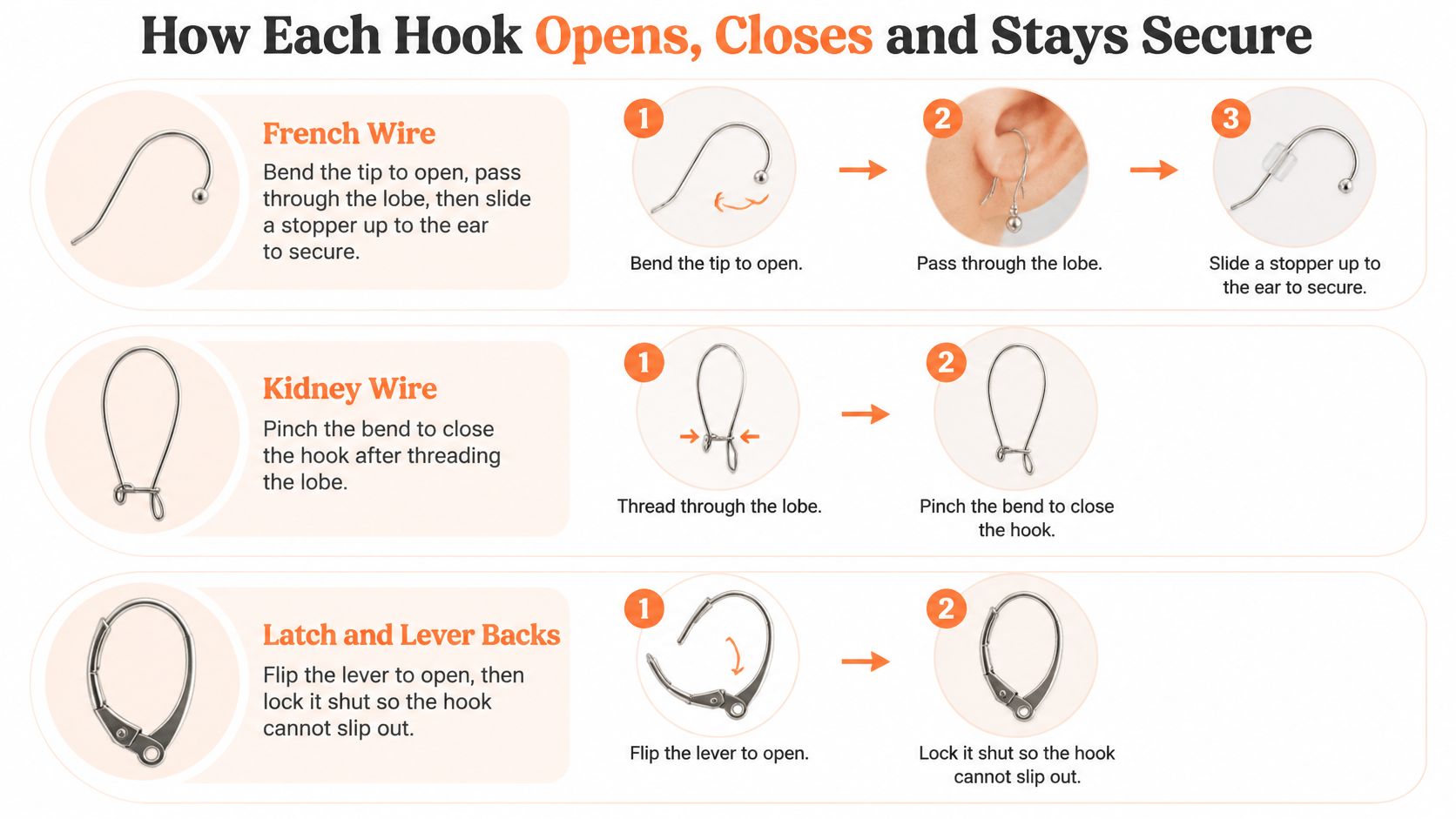
A kidney wire passes through the lobe, then closes when the tail snaps into the curved loop. It has no separate stopper to misplace, making it a practical choice for medium dangles. The bend needs enough tension to stay closed, while remaining easy for the wearer to open and fasten.
A leverback opens when the wearer presses the lever, then closes as the lever clamps against the post. Check the hinge and closure by opening and closing the finding repeatedly. A lever that stops staying shut is not ready for sale.
Hinged hoop insertion:
- Open the hinge or latch.
- Pass the hoop through the lobe.
- Close it and confirm the latch engages fully.
A latch that appears closed but has not engaged can let the hoop fall out. For a small hinged style, such as the Minimalist Geometric S925 Sterling Silver Huggie Hoop Earrings with Triple Row Rhinestone Inlay, check that the closure seats reliably.
Screw-back insertion:
- Hold the post by its head.
- Thread the back onto the post until it sits against the earlobe.
A back that stops short may work loose. Stripped or mismatched threads can prevent a secure fit, so stop if the back does not turn smoothly.
Practical rule: Confirm that every closure engages fully and stays shut after repeated openings before listing the pair.
Stoppers, threaded nuts, and silicone sleeves are separate components with their own fit and fastening requirements. Use this guide to earring back types explained when selecting backs independently from the wire.
Matching Hooks to Earlobe Shape and Piercing Type
The ear decides the hook. Style is the second conversation. Lobe thickness, stretch, piercing age, and how many holes share one lobe tell you whether a wire will sit, pull, or walk out.
| Ear situation | Best hook | Hook to avoid |
|---|---|---|
| Stretched or large-gauge lobe | Leverback or screw-back with a wider loop | Thin open French wire that slides out |
| Thin or short lobe | Kidney wire or light French wire | Heavy leverback that pulls the lobe down |
| Fresh or sensitive piercing | Smooth, burr-free hook in a verified low-nickel metal | Cheap plated hook with an unknown alloy |
| Two piercings in one lobe | Lightweight French or kidney wire | Bulky leverback that crowds the ear |
| Children or gift buyers | Screw-back or locking hook | Loose open wire that can be lost |
When the lobe won't hold an open wire
A stretched or large-gauge lobe needs a wider loop. A thin French wire drops through the channel the way a small ring drops off a stretched finger. A leverback or screw-back with a wider loop stays in the piercing instead of relying on friction that isn't there.
A thin or short lobe is the opposite problem. A kidney wire or a light French wire sits without dragging the piercing downward. A heavy leverback looks secure on the bench and then pulls the lobe for the rest of the day. Customers call that "the earring hurts," and they return the pair, not the finding.
When the piercing itself is the constraint
A fresh or sensitive piercing needs a smooth, burr-free tip and a metal whose nickel behavior you can name. A bargain plated hook of unknown alloy is the one to leave off that SKU. Burrs and worn plating are what make a new piercing angry, long before the design does.
Two piercings in one lobe leave little real estate. Lightweight French or kidney wires stack. A bulky leverback crowds the second hole, tilts both pieces, and snags hair between them. Sell the leverback on a single-hole, heavier design instead.
Children and gift buyers need a closure that doesn't open by accident. A screw-back or a locking hook survives a school day and a suitcase. A loose open wire is a lost earring and a bad review from the person who paid for it.
If a sample pulls, gapes, or irritates the piercing on a real ear, replace the hook before you reorder the style.
Match the ear first. Then pick the look that still fits that row.
Weight, Movement and Loss Risk Trade-offs
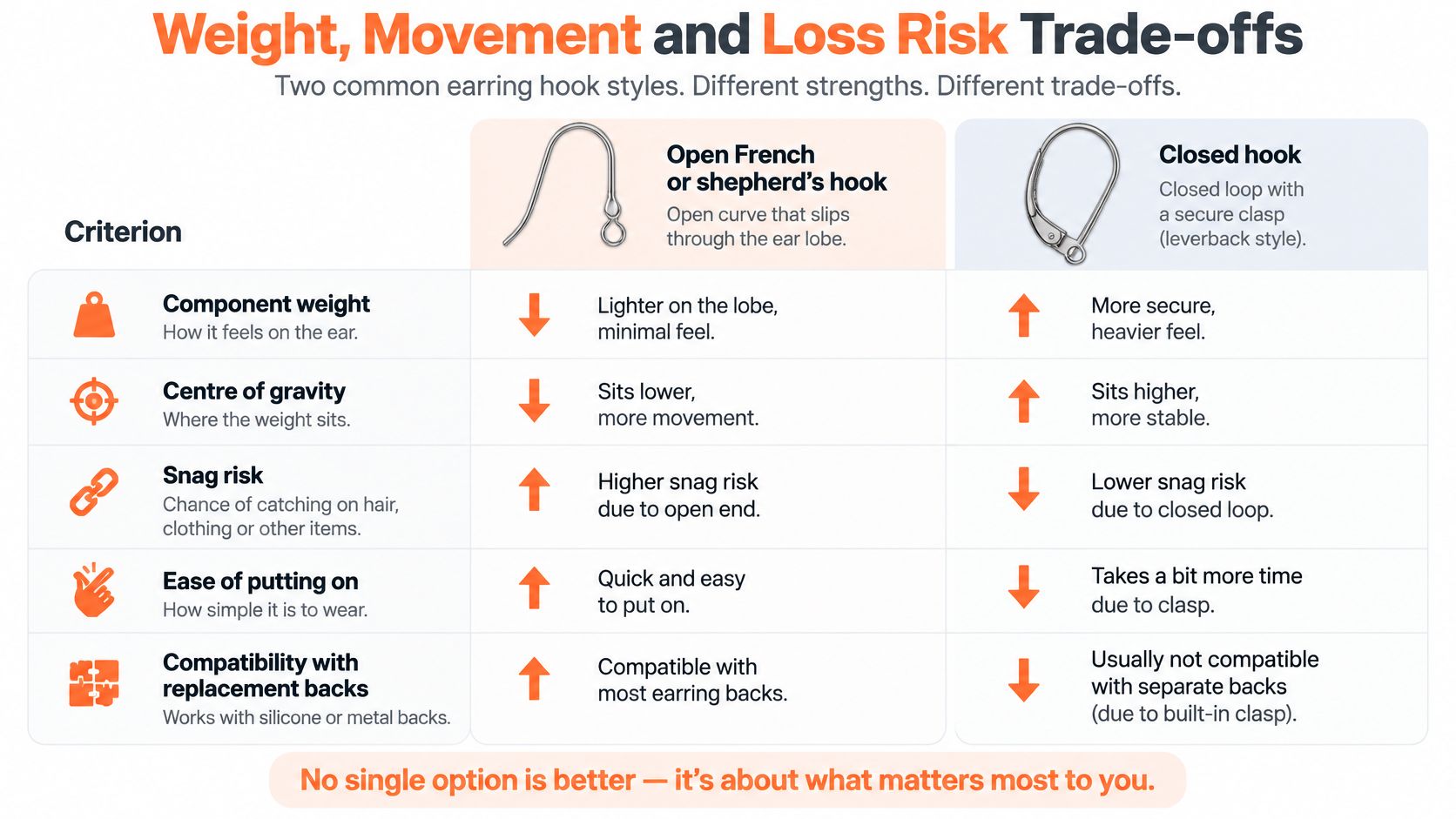
Hook choice changes how an earring hangs, moves, and stays on. Assess the earring's weight, center of gravity, snag risk, ease of putting it on, and compatibility with replacement backs.
An open French or shepherd's hook is lightweight and easy to insert, but movement can push the unlatched wire out of the piercing. Commuting, travel, scarves, and gym bags all raise the risk. A leverback or other hinged closure holds the earring in place more securely, but adds weight, hardware cost, and a latch that can fail. Check that the closure stays engaged after repeated openings.
A heavy dangle on a light open hook can pull the lobe downward and tilt the earring. The Minimalist Eye-Shaped Dangle Earrings with Simulated Pearl Drops and Alloy Base for Women shows why the hook must support the design's weight and balance. If the drop swings or tips forward during wear, choose a sturdier hook or reduce the drop's weight.
What to record before you list
Check replacement backs before listing. A French wire needs a stopper or silicone back sized for its wire. A leverback requires its matching clasp, not a generic nut from another line.
Test each sample by hanging the earring and gently shaking it. Note whether it twists, slides, or opens, then record the result alongside the hook type. That gives buyers a practical account of movement and security instead of an unsupported claim that one hook is best.
Hook security and material safety are separate checks. A DeKalb County public-health rule lists implant-suitable materials such as ASTM/ISO-compliant titanium, niobium, solid platinum, and qualifying steel. It also warns that nickel-directive compliance alone does not establish suitability for body piercing. Match the hook to the earring's weight and expected movement, then assess the material separately.
Nickel Safety and Material Standards for Hooks
Choose hook materials by their nickel release, not by the finish name. A polished surface can still conceal a nickel-bearing base, and plating can wear with use.
A 2025 systematic review and meta-analysis reported an association between body piercings and nickel allergy in the general population, with an odds ratio of 5.9 and a 95% confidence interval of 3.6–9.4, based on 5,333 participants. The same review reported an association among dermatitis patients, with an odds ratio of 3.6 and a 95% confidence interval of 2.3–5.8, based on 20,330 people. These findings do not mean every wearer will react. They make nickel-release limits relevant to hook selection.
The EU nickel restriction took effect in 2000 and was adjusted in 2004. Its limits apply to the complete assembly, including the wire, clasp, and plating.
| Product type | Nickel-release limit (µg/cm² per week) | Test method |
|---|---|---|
| Post assemblies inserted into pierced ears, including hooks | Less than 0.2 | EN 1811 |
| Earrings and decorative fronts in prolonged skin contact | 0.5 or less | EN 1811 |
| Nickel-free coated products | 0.5 or less for at least two years of normal use | EN 1811 with coating durability checks |
EN 1811 is the European reference method for measuring nickel release. Coated hooks must remain within the prolonged-contact limit after two years of normal use. Initial plating appearance alone does not establish compliance.
Which metals earn the default slot
Start with stainless steel, titanium, or sterling silver when the grade is specified. Plated alloy can also work, but its suitability depends on the base metal, coating durability, and nickel-release results for the finished hook.
For a closer look at nickel allergy and jewelry materials, focus on the metal and construction rather than a broad label. A fishhook may feel comfortable while still being unsuitable for a wearer sensitive to nickel. Match the material to the customer's needs, then assess fit and security separately.
A fashion pair such as the Polished Titanium Steel Irregular Textured Spiral Eggshell-Shaped Earrings for Women, listed at 20 g across three variants, should be described according to its stated material and finish. Do not treat a style name or clean-looking surface as proof of nickel safety.
Specify the tested material and construction, not just the finish.
Wire Gauge and Dimensions for Production Specs
Hook geometry should match the earring's weight, attachment method, and required security. The style name is not a production specification.
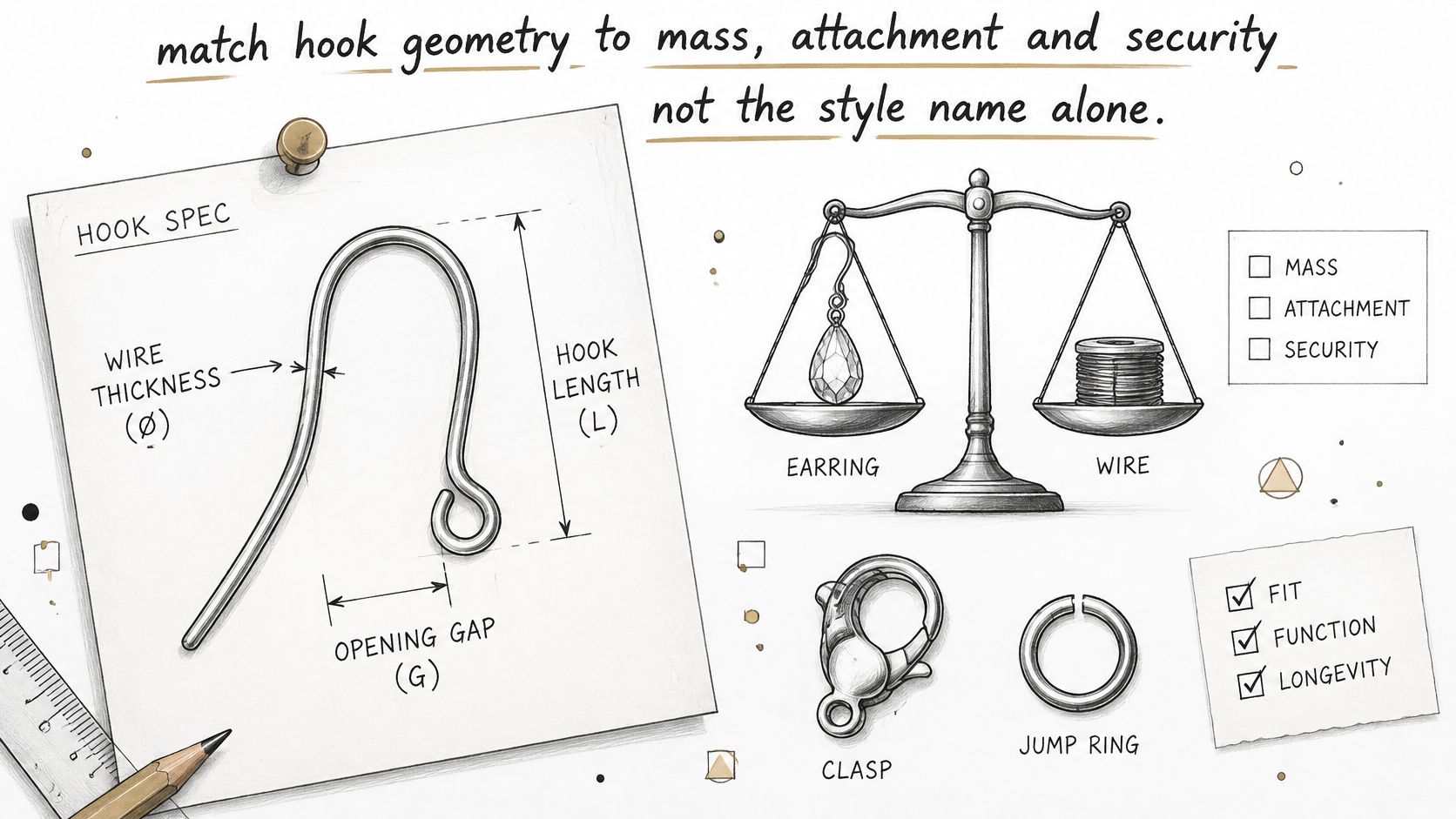
AWG runs backward from intuition: a lower number means thicker wire. An 18-AWG hook is stiffer and resists bending better than a 22-AWG hook, but it can feel less comfortable through the lobe. Specify diameter in millimetres as well as AWG because gauge conversions and supplier naming can differ.
A jewelry wire findings guide gives these practical benchmarks: lightweight French hooks are 20–22 AWG, 18–20 mm long, with a 2–3 mm attachment loop. Medium-weight kidney wires are 18–20 AWG, 15–18 mm long, with a 3–4 mm loop. Leverbacks are 18–20 AWG, 12–15 mm long, with a 4–5 mm loop.
| Hook type | Wire gauge (AWG) | Wire length (mm) | Loop inside diameter (mm) |
|---|---|---|---|
| Lightweight French wire | 20–22 | 18–20 | 2–3 |
| Medium-weight kidney wire | 18–20 | 15–18 | 3–4 |
| Leverback | 18–20 | 12–15 | 4–5 |
| Shepherd's hook | 20–22, same open-wire rule as a light French wire | 18–20 | 2–3 |
| Hinged or latch hoop | 18–20 when the hoop carries stones or all-day wear | Record the hoop diameter in mm on the purchase order | Latch overlap fully engaged, not a fixed ear-wire loop |
French hooks need a separate stopper or silicone back. Kidney wires have their own closure. Leverbacks reduce loss risk, but add weight and assembly cost.
Fields worth copying onto the purchase order
- Loop inside diameter: Confirm the pendant ring fits.
- Wire straightness: A bowed wire hangs crooked.
- Burr-free insertion tip: A nick can irritate the lobe.
- Symmetry: Check that both earrings match.
- Closure overlap: Require the latch or bend to pass the closed position.
- Pull-test acceptance: State the pass rule before shipment.
Specify the finished earring, not just the finding in a bag. Check that the pendant hangs without twisting, the loop stays closed under normal handling, and the closure remains engaged after repeated openings. The jewelry findings and components guide covers how hooks fit with related hardware, including jump rings and posts.
A catalog example such as the Bohemian Vintage Sunflower Ear Hooks still needs millimetre specifications for production. Its sunflower motif does not determine the wire gauge.
The forming demo shows how to bend wire into an open French-style hook, making the shape and loop easier to inspect before approving a supplier's sample.
How to Verify Hook Quality Before You Buy Wholesale
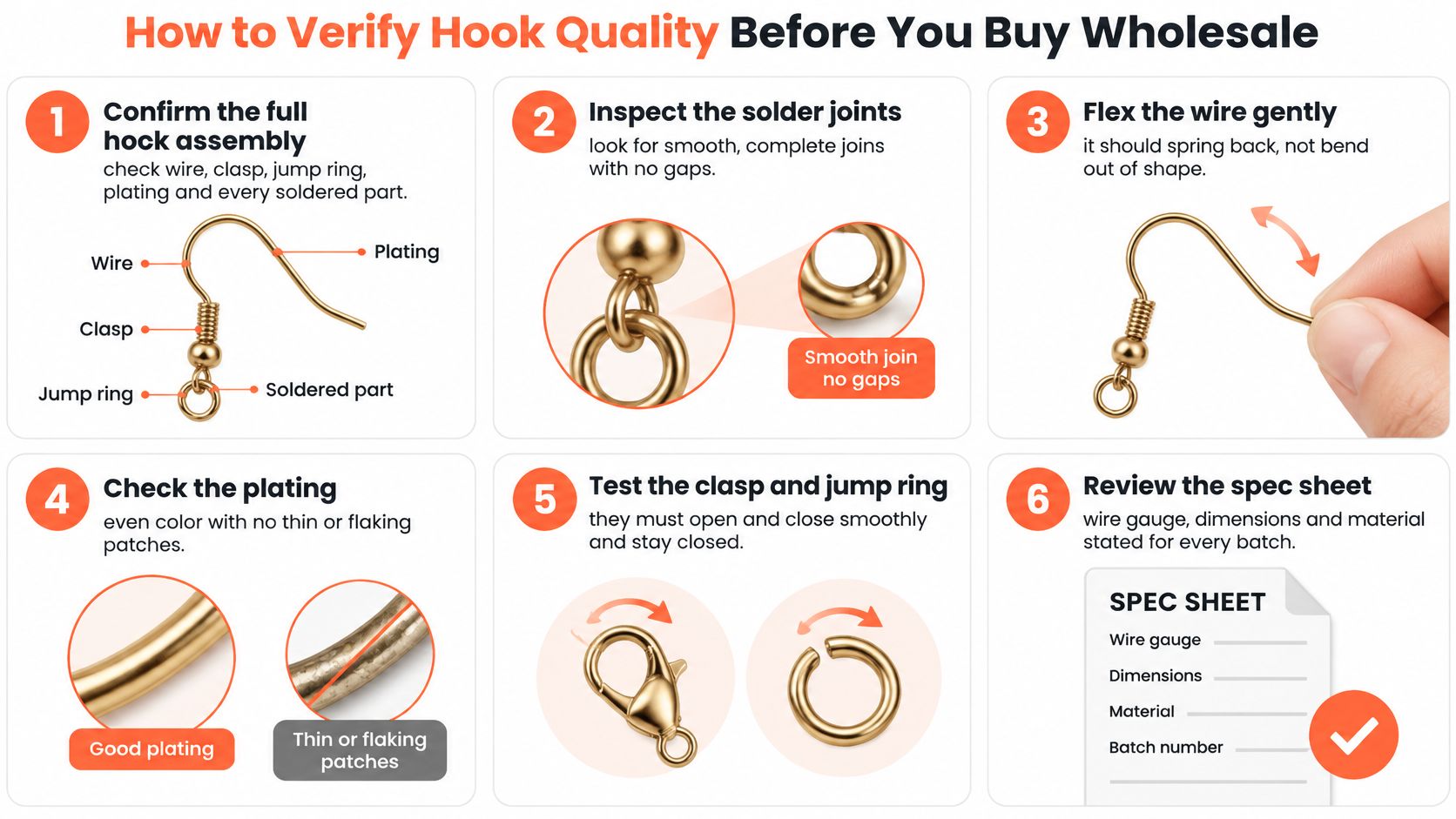
A low-priced hook can become an expensive order if the specification, finished sample, and production batch do not match. Verify the assembly and its paperwork before paying the deposit, then tie both to the goods you receive.
The sequence before you pay the deposit
- Get the construction in writing. The specification sheet should identify the wire, clasp, jump ring, plating, and any soldered joint. Match these details to the finished sample, not just a loose finding.
- Request a lab report for the production batch. The report should identify the tested hook, its material, and the batch or finish it covers. Ask whether testing followed EN 1811:2023, covered individual subcomponents, and included checks before and after EN 12472 abrasion and corrosion simulation when relevant. Confirm the report addresses the material and coating claims on the order.
- Inspect a finished sample. Check hooks after polishing and plating, since a worn coating can expose the substrate. A bare, pre-plating sample cannot confirm the finished item's surface.
- Match the paperwork to the shipment. Record the supplier, batch, finish, and report reference on the purchase documents. If the production batch changes, request a report applying to the goods being supplied.
Keep the same fields on buyer-facing documents. Sprello's line sheet minimums and compliance details show how to present specifications clearly, so sales staff can describe the tested metal and finish accurately.
Use discrepancies as a reason to pause approval. If the sample, report, and listing describe different materials or finishes, resolve the mismatch before the order ships.
Build a Hook Assortment for Your Store
Build your assortment around three decisions: the range of hook types, the materials you can document, and the cost of getting each style to your shelf. List the closure clearly so buyers can compare like with like.
Landed cost, not the unit price
A low per-piece price is a weak comparison. Published sourcing guidance on partnering with wholesale jewelry factories puts raw materials at 40–60% of jewelry cost, labor at 15–25%, plating or coating at 10–15%, packaging at 5–10%, and overhead or profit at 10–20%. The same guidance recommends checking material grade, plating thickness in microns, nickel content, and water resistance through laboratory reports or third-party inspection. Add plating, packaging, inspection, freight, and defects to your comparison; a cheap hook can have a high landed cost.
Scale changes the math. A buying guide for Chinese jewelry wholesale gives typical factory minimums of 1,000–3,000 pieces per style for fashion earrings such as studs and hoops, with 25–40 days after approval and mould costs of roughly $180–$450. Plating complexity and stone setting add cost. Ready-made components and smaller batches can limit your exposure when demand shifts. Use these earring supply wholesale notes to plan orders across different lead times.
JewelryBuyDirect sells jewelry in stainless steel, 925 sterling silver, titanium steel, copper, alloy, brass, 18K gold-plated styles, gemstone, pearl, and moissanite and S925. Its Jewelry Making category includes jewelry sets, pendants, and jewelry findings.
Three moves this week
- Choose a clear range of hook types and label each listing with its closure and intended earring weight.
- Set material and nickel-test requirements for each batch, and reject listings that claim more than the supporting report.
- Compare landed cost per hook, including minimum order quantities and lead times, before judging a unit price.
The assortment works when buyers can identify the closure, material, and full cost without guesswork. Visit JewelryBuyDirect to compare jewelry and findings for the range you plan to stock.