






Arthur Lynch | Fri Nov 28 2025
A Business Guide to Sourcing High-Quality, Affordable Direct Factory Jewelry
Sourcing direct factory jewelry is a game-changer for businesses aiming to secure high-quality, affordable fashion accessories. It means you stop dealing with the usual middlemen and go straight to the source—the manufacturer. This simple shift gives your business incredible control over procurement costs, the quality of your pieces, and the final designs you offer your customers.
Why Sourcing Direct Factory Jewelry Wins for Your Business
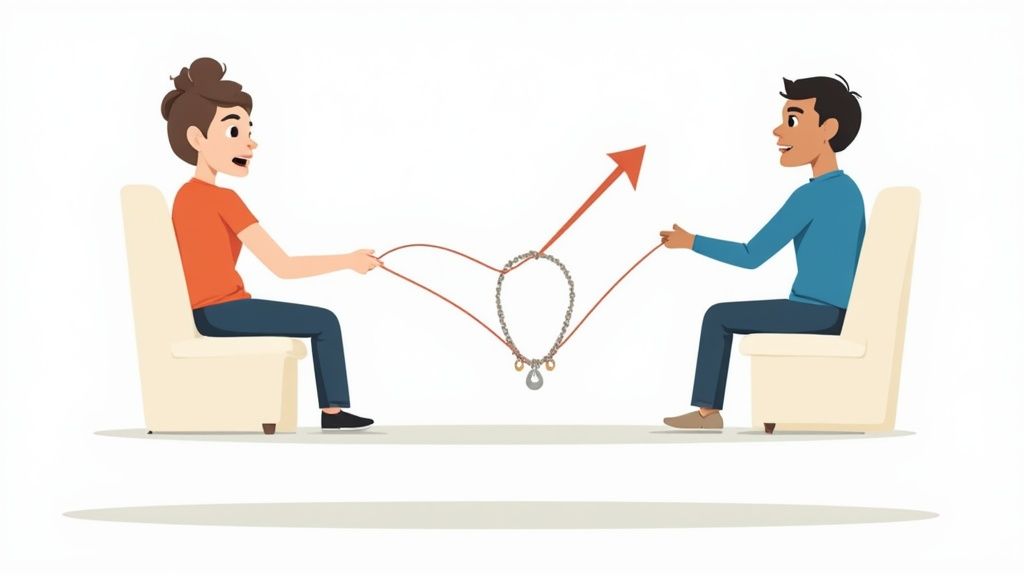
If you're a growing jewelry or fashion accessories business, one of the smartest moves you can make is to bypass traditional wholesalers and work directly with a factory. This isn't just about shaving a few dollars off your costs; it's a fundamental change that puts you firmly in the driver's seat of your supply chain, product quality, and ultimately, your brand's bottom line.
Think about it: you could create exclusive, high-quality collections that your competitors can't easily replicate. By building a relationship with a factory, you gain influence over the design process, can specify the exact materials you want, and ensure every piece meets your high standards for craftsmanship. That level of control is something you just can't get when you're buying from a distributor with an opaque supply chain.
Maximize Your Profit Margins with Affordable Sourcing
The most obvious win from sourcing direct factory jewelry is financial. When you cut out the layers of middlemen—importers, distributors, regional wholesalers—you also cut out their markups. Every entity in that chain can add 20-50% to the cost.
By going straight to the source, the price you pay is much closer to the actual production cost. This gives your business two powerful options:
- You can pass those savings on and offer more competitive, affordable prices to your customers.
- Or, you can maintain standard retail pricing and massively boost your profit margin on every single sale.
This financial advantage is especially critical for boutiques and online stores competing against larger players. For more on this, we have a great guide on how to reduce procurement costs for your business.
For a quick look at how these two sourcing approaches stack up, here's a simple comparison for your business.
Direct Sourcing vs Traditional Wholesaling
| Factor | Direct Factory Sourcing | Traditional Wholesaling |
|---|---|---|
| Cost | Significantly lower, no middleman markups. The most affordable option. | Higher due to multiple markups from distributors and agents. |
| Profit Margin | Substantially higher potential for your business. | Thinner margins, less pricing flexibility. |
| Customization | Full control; create exclusive, high-quality designs. | Limited to no customization; you buy what they stock. |
| Quality Control | Direct oversight, set your own standards for high-quality craftsmanship. | Inconsistent; quality depends on the wholesaler's sources. |
| Brand Identity | Easy to build a unique brand with exclusive products. | Difficult to differentiate; you sell the same items as others. |
| Communication | Direct line to the manufacturer for clear, fast feedback. | Communication is filtered through several layers. |
Ultimately, the choice comes down to control. Sourcing direct gives you the power to shape your business from the ground up, while traditional methods often leave you reacting to the market instead of leading it.
Gain Unmatched Control Over Product Quality and Customization
Working directly with a manufacturer elevates your business from a reseller to a true brand builder. You suddenly have the ability to customize products in ways a wholesaler could never offer. This might be as simple as adjusting plating thickness for durability or choosing specific gemstones, or as ambitious as bringing a brand-new, high-quality design to life from a sketch.
This direct line of communication is your ticket to building a unique brand identity. You can create signature pieces that reflect your vision, ensuring your inventory stands out in a crowded market and resonates deeply with your target audience.
This control also applies to quality assurance. You can establish clear, non-negotiable standards for materials and craftsmanship. This dramatically cuts down on the risk of receiving a bad batch of inconsistent or low-quality items that lead to customer returns and tarnish your business's reputation.
It's a big deal in a global jewelry market that's projected to be worth around $348 billion in 2025. More and more, consumers want the transparency and unique, high-quality options that direct-from-factory models can provide. You can read more about these global jewelry industry statistics and trends to see where the market is headed.
Finding the Right Jewelry Manufacturing Partners for Your Business
This is where the real work begins—finding a reliable factory to bring your vision for high-quality, affordable accessories to life. It’s more than just a quick Google search; this is about carefully building a shortlist of potential partners who can meet your quality standards and grow with your business. The goal is to cut through the noise and find factories that are a genuine match.
The easiest place to start your search is online. Huge B2B platforms like Alibaba are a goldmine, but they can also be overwhelming. You need a game plan. Don't get distracted by pretty product photos. Instead, dive deep into supplier profiles. Look for crucial trust signals like "Verified Supplier" badges—this means a third-party has actually inspected their facility.
Pay close attention to their history on the platform. How long have they been in business? What does their transaction history look like? A factory with 5+ years of experience and a steady stream of positive feedback is always a much safer bet for ensuring quality than a new shop with no track record. This simple due diligence can help you filter out a ton of questionable operators.
Tapping Into Your Network—Both Online and Off
While online platforms give you incredible reach, you can't beat the power of a personal connection. Industry trade shows are one of the best ways to source direct factory jewelry. Attending an event like the Hong Kong International Jewellery Show lets you meet factory owners face-to-face, hold the products in your hands, and assess the quality of their craftsmanship up close.
Nothing builds trust faster than a handshake and a real conversation. At the same time, don't forget to lean on your professional network. Ask for introductions from other business owners you know. A warm referral from someone you trust can save you months of painful trial and error in finding a high-quality, affordable partner.
A strong network is your secret weapon. One good introduction from a respected peer can open doors to factories that don't even advertise on public platforms, giving your business access to unique capabilities and better terms.
With the North American jewelry market projected to hit around $67.87 billion in revenue by 2025, the competition is only getting tougher. Having a rock-solid factory partner is no longer just a nice-to-have; it's a massive competitive advantage.
Bringing in a Local Expert: The Sourcing Agent
If your business is new to sourcing overseas or you're just looking to scale without the headaches, hiring a local sourcing agent can be a game-changer. Think of them as your boots on the ground—an expert who knows the local manufacturing scene and can navigate the cultural and language barriers for you.
A good agent will handle the heavy lifting for your business:
- Vetting Factories: They’ll physically visit facilities to confirm they're legitimate and have the production capabilities to deliver high-quality goods.
- Negotiating Prices: Their local expertise can often land you more affordable pricing and better terms than you could get on your own.
- Managing Quality Control: They can conduct inspections during and after production, catching potential quality issues before your order ships.
Yes, there's a cost involved—usually a commission of 5-10% of your order value. But when you weigh that against the time you save and the costly mistakes you avoid, it's often a worthwhile investment for securing high-quality, affordable products. Once you start building these relationships, it's crucial to implement essential vendor management best practices to keep things running smoothly.
For a more focused look at finding partners in major manufacturing hubs, our guide on locating jewelry wholesalers in China is a great next step.
Vetting Factories to Ensure High Quality and Reliability
You've got a list of potential factories. Now comes the real work: vetting. This is where you separate the reliable, long-term partners from the ones that will give your business nothing but headaches. Don't be tempted to rush this stage. Doing your homework now is your best insurance against shoddy work, missed deadlines, and wasted money.
The journey from finding a name to placing a bulk order often follows a few common paths, whether you're starting online, meeting face-to-face at a show, or working through a local expert.
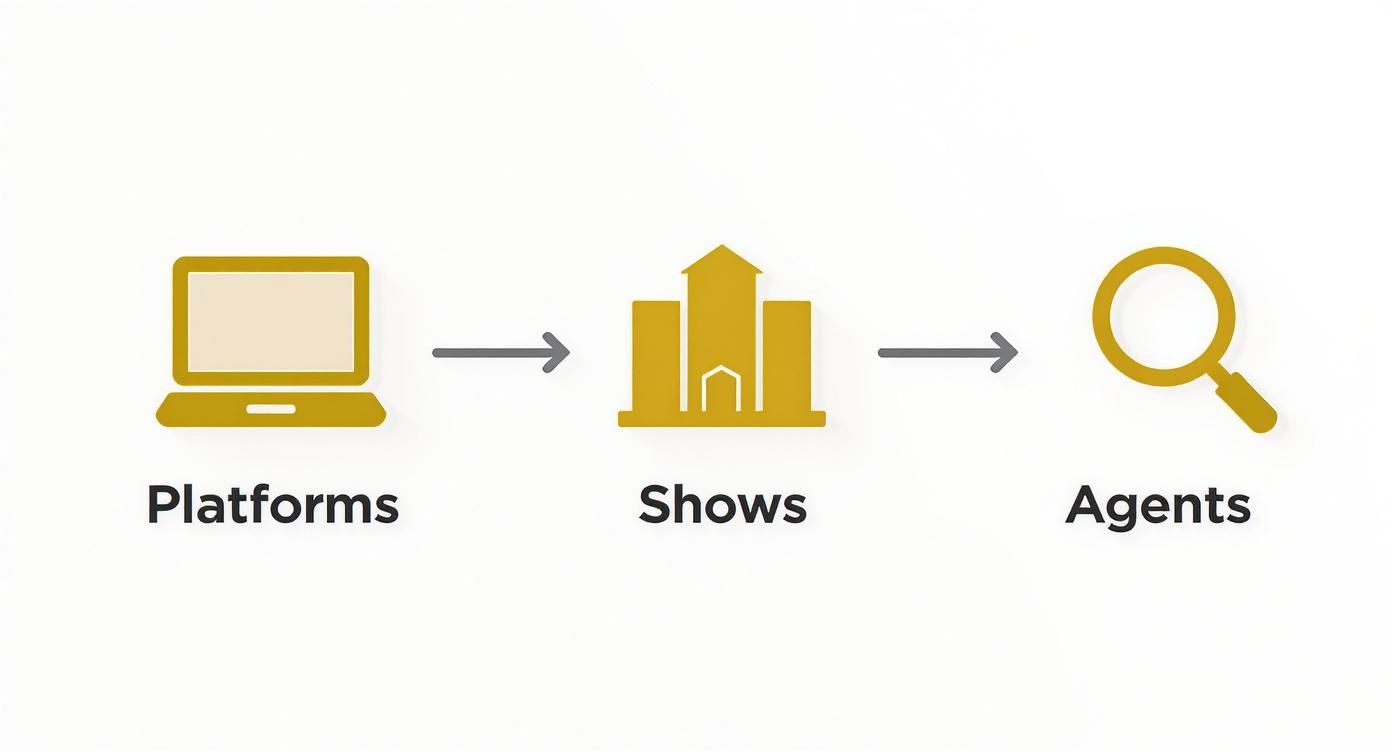
No matter how you find them, the real evaluation of quality and affordability starts once you make first contact.
Start with the Paperwork
Before you even start talking about designs or pricing, ask for their business license and any quality certifications they hold. This is the quickest, most effective filter for verifying legitimacy.
Any professional operation will have these documents ready. What you're hoping to see is a certification like ISO 9001. This doesn't guarantee every single piece will be flawless, but it shows they have a documented quality management system in place. It’s a huge green flag that they take process and high quality seriously.
If a potential partner hesitates or makes excuses when you ask? Walk away. You're building a business relationship, and it has to start with transparency.
How to Actually Test for High Quality with Samples
Getting a sample isn't just about seeing if they can make one beautiful piece. A single perfect sample proves they can do high-quality work, not that they will do it consistently for a thousand-unit order.
Your real goal with sampling is to test for consistency, not just a one-off display of quality. The trick is to order a small batch of the same item, say 5-10 units.
When the batch arrives, line them up and get critical. Look for the tiny differences that signal a lack of process control, which is the enemy of high quality.
- Plating: Is the color and thickness of the finish exactly the same on every piece?
- Stone Setting: Are all the prongs tight? Are the stones set at the same height and angle?
- Weight & Feel: Do they all have the same heft? Use calipers to check dimensions. Even tiny variations can point to sloppy casting or finishing.
This small-batch test gives you a far more honest preview of the quality you’ll get in a full production run.
Take a Tour—Virtually
Years ago, this step meant booking an expensive flight. Now, you can learn a surprising amount from a video call if you know what to look for. Ask for a live virtual tour of the facility.
Pay close attention to the background. You’re looking for signs of a well-run operation that can produce high-quality goods. Is the workshop clean and organized, or is it chaotic? A tidy workspace almost always correlates with a disciplined production process. Ask to see specific stations—casting, polishing, plating, and especially their quality control area.
A factory that takes pride in its high-quality work will be eager to show you everything. If their answers are vague or the camera movements seem curated, it might be a sign they’re hiding something. Trust your gut.
Talking Shop: Mastering Communication and Negotiation
https://www.youtube.com/embed/NsWHo9D1hCk
When you're sourcing direct factory jewelry, your ability to communicate your vision clearly is everything. It's the difference between a high-quality product that sells and a box of expensive mistakes. Especially when working with overseas factories, small misunderstandings can blow up into major production headaches.
The absolute key to getting this right is your technical package, or "tech pack." Don't think of this as an optional step—it is the single source of truth for the factory. A vague or incomplete tech pack is just asking for trouble. It needs to be incredibly visual and precise, leaving zero room for interpretation.
Think of it as a blueprint. If you don't call out every single detail for high-quality production, you're forcing the factory to fill in the blanks, and their interpretation might be miles away from what your business expects.
The Power of a Perfect Tech Pack for High-Quality Results
A solid tech pack is your best insurance policy against production errors. It cuts through any potential confusion and guarantees that everyone knows exactly what high-quality output you expect.
So, what goes into a killer tech pack for your fashion accessories business?
- Detailed Diagrams: This means proper computer-aided design (CAD) drawings or, at a minimum, super clear photos from every angle.
- Precise Measurements: List every dimension in millimeters (mm).
- Material Specifications: Get specific. Don't just say "gold-plated." It should read more like, "925 sterling silver with 14k gold plating at 1.0 micron thickness."
- Finishing Details: Explicitly state the high-quality finish you want. Is it "high polish," "matte," or a "brushed" texture?
Getting this granular from the start saves you from costly rework and ensures the final production run looks identical to the high-quality sample you approved.
Negotiating an Affordable and Fair Partnership
Once you've nailed down communication, it's time to talk numbers. But here’s a pro tip: successful negotiation isn't about grinding the factory down to the lowest possible per-piece price. It's about building an affordable deal that works for both of you, setting the stage for a long-term, profitable relationship.
A win-win negotiation creates a partner, not just a supplier. A factory that feels respected is far more likely to prioritize your orders, maintain high-quality standards, and work with you when your business is in a pinch.
Look beyond the unit cost to find affordable terms. Often, the real wins are in negotiating Minimum Order Quantities (MOQs), payment schedules, and production timelines. For a much deeper look at this, check out our guide on how to effectively negotiate with your suppliers.
Try to agree on a fair payment structure. A common setup is a 30% deposit upfront and the remaining 70% after the goods pass a pre-shipment inspection. This protects your cash until you've signed off on the quality. It's a balanced approach that builds trust and keeps both sides invested in getting it right.
Managing Your First Order and International Shipping

You’ve done the hard work of vetting your factory and hammering out affordable terms. Now it’s time for the exciting part—placing that first official order. This final stretch is all about precision, from the paperwork you file to navigating international logistics to get your high-quality jewelry from their workbench to your storefront.
It all starts with a formal Purchase Order (PO). This is a legally binding contract that puts everything you've agreed upon in writing. Your PO needs to be exhaustive, listing out item descriptions, quantities, prices, high-quality material specs from your tech pack, and the payment and shipping terms you negotiated. A rock-solid PO is your best defense against misunderstandings.
Approving the Pre-Production Sample for Quality Assurance
Before the factory produces thousands of pieces, you need to sign off on one last, critical item: the pre-production sample (PPS). This isn't just another sample; it's made using the exact molds and methods intended for your full run. It's your final chance to spot any quality issues before they get multiplied by a thousand.
When that PPS arrives, be ruthless. Get out your calipers and your tech pack. Check every dimension, confirm the materials and plating thickness, and test every clasp. The factory should not move forward until they have your explicit, written approval. This step is your single most important quality control checkpoint.
Getting a Handle on Shipping Terms
International shipping has its own vocabulary, and a few key Incoterms dictate who is responsible for what. You’ll almost certainly run into these two:
- EXW (Ex Works): The factory’s job is done once the jewelry is packaged at their loading dock. From that point on, your business is on the hook for everything: pickup, export documents, freight, insurance, and import duties.
- FOB (Free On Board): The factory handles getting your order to the designated port and clearing it through their country's export customs. The moment the goods are loaded onto the ship, responsibility—and cost—flips to you.
For most businesses new to importing, FOB is the way to go. It takes the complexities of the export process off your plate, letting you focus on the main transit and customs clearance in your country.
Navigating customs and duties can feel like a maze, but it's just a standard part of the import game. Forgetting to budget for these taxes can eat your entire profit margin, making your "affordable" sourcing much more expensive.
This is where a good freight forwarder or customs broker becomes your most valuable player. They are the experts who manage the paperwork, ensure your shipment is classified correctly, and get your products cleared without a hitch. As you're placing that first big order, remember how crucial it is to secure comprehensive jewelry insurance to protect your investment in transit. Bringing in these logistics pros saves time and prevents costly mistakes, ensuring your new collection arrives safe, sound, and on budget.
Diving Into Your Top Sourcing Questions
Jumping into direct factory sourcing can feel intimidating for any business. There's a lot to figure out, and a few key questions always pop up. Getting these early details right is what separates a smooth, profitable partnership from a series of headaches.
Let’s walk through the most common concerns for businesses sourcing affordable, high-quality jewelry and fashion accessories.
What’s a Realistic MOQ I Should Expect?
The Minimum Order Quantity (MOQ) is often the first big hurdle for a business testing a new concept. So, what’s a reasonable number? The truth is, it depends on the complexity and material of the accessory.
- For simpler designs in base metals like brass or stainless steel, you can often find factories willing to start as low as 50–100 pieces per style.
- But if you're looking at more complex pieces—think custom molds or anything in 925 sterling silver—the number usually jumps to a 200–500 piece minimum to be affordable.
Here's a tip: don't take the first number as final. Most factories are open to negotiation. Propose a smaller trial order for your first run. It's a great way to test their quality and see how your customers react before committing significant capital.
How Can I Pay an Overseas Factory Safely?
Sending a large sum of money to a factory can be nerve-wracking for any business. The golden rule here is simple: never, ever pay 100% upfront. A fair and standard deal is a 30% to 50% deposit to get production rolling. The final balance isn't paid until the goods are finished and pass your pre-shipment quality check.
The most common way to pay is a simple bank wire transfer (T/T). But for an extra layer of security, especially with a new supplier, I'd strongly recommend a service like Alibaba Trade Assurance. It works like an escrow, holding your money until you confirm you’ve received your order and it’s up to your high-quality standards.
A staged payment structure is your best friend in this process. It gives the factory the capital they need to start, but it keeps you in control, ensuring you don't release the final payment until you’re happy with the product quality.
What Has to Be in My Product Spec Sheet?
Think of your spec sheet, or "tech pack," as the architectural blueprint for your jewelry. If it's vague, you're inviting mistakes that compromise quality. Your goal is to leave zero room for interpretation.
To make sure your factory produces exactly the high-quality accessory you envision, your tech pack absolutely must include:
- Clear Visuals: Provide high-resolution images or technical drawings from every possible angle.
- Exact Measurements: Every dimension needs to be listed precisely in millimeters.
- Material Breakdown: Be incredibly specific. Instead of "gold plated," write "925 sterling silver with 14k gold plating at 1 micron thickness."
- Component Details: List out the type of stone, its exact size, and the specific style of clasp or finding you want.
- Branding Placement: Show exactly where any logos or quality stamps should go and their dimensions.
The more detail you pour into this document, the less risk you have of a production disaster.
Should My Business Hire a Sourcing Agent?
This is a big strategic question. For a business brand new to importing, a good sourcing agent can be a lifesaver. They handle the factory vetting, day-to-day communication, and quality control, usually for a commission of 5–10% of your order value. They’re your person on the ground ensuring both quality and affordability.
On the other hand, if you've got some experience, are working with a tight budget, or just prefer a direct line to your manufacturer, managing the process yourself is the best way to protect your profit margins. There’s no single right answer—it all comes down to your business's experience level, budget, and how much control you want over the process.
Ready to source high-quality jewelry with confidence? At JewelryBuyDirect, we eliminate the guesswork. With over 120,000+ on-trend styles, no minimum order quantity, and factory-direct pricing, we empower your business to grow. Explore our catalog and see why thousands of businesses trust us to build their high-quality, affordable collections. https://www.jewelrybuydirect.com