






Jennifer Lopez | Sat Oct 24 2026
Cubic Zirconia Dangle Earrings for Boutiques
Stop buying cubic zirconia dangle earrings on sparkle alone. That's the most popular advice in this category, and it's exactly why boutiques eat returns on earrings that photographed beautifully. A stone can flash in a supplier video and still chip in transit, irritate ears, pull at the piercing, or slide out of a fishhook at a wedding. If you source for business, you don't buy a sparkle effect. You buy a complete product with a cut, a setting, a contact metal, a weight, a closure, and a listing that has to tell the truth.
Why Cubic Zirconia Dangle Earrings Deserve a Closer Look

A low unit price does not make CZ dangles a low-risk purchase. It can make buyers overlook the details that determine comfort, durability, and sell-through. Those details rarely show in a hero photo, so check them on a sample before placing an order.
A dramatic silhouette adds pressure on the piercing, so the longest drop is not always the best seller. Extra length and stones can increase discomfort, snagging, and the chance of losing an earring. A lighter, balanced design with a secure closure is often easier to wear for the occasion customers bought it for.
The five specs that matter more than the photo
Check these specifications before comparing prices:
- Cut quality: Poorly cut CZ can look glassy and flat in daylight, even when supplier lighting makes it flash.
- Ear-contact metal: The post, hook, and backing affect skin comfort. The stone does not.
- Total pair weight and drop length: Publish both. A cropped image cannot show customers how an earring will feel or hang.
- Closure type: Lever-backs and secure hinged closures help prevent loss compared with open hooks.
- Stone setting: Prongs, girdles, and contact points affect how well stones withstand shipping and handling.
If a supplier cannot provide the weight, drop length, and post material, you have a photo, not a fully specified product.
Treat each earring as a product with measurable details, not just a sparkle effect. Request samples you can wear-test, documentation you can file, and dimensions you can publish. Those checks help you source affordable jewelry and fashion accessories that protect your margin instead of adding avoidable return costs.
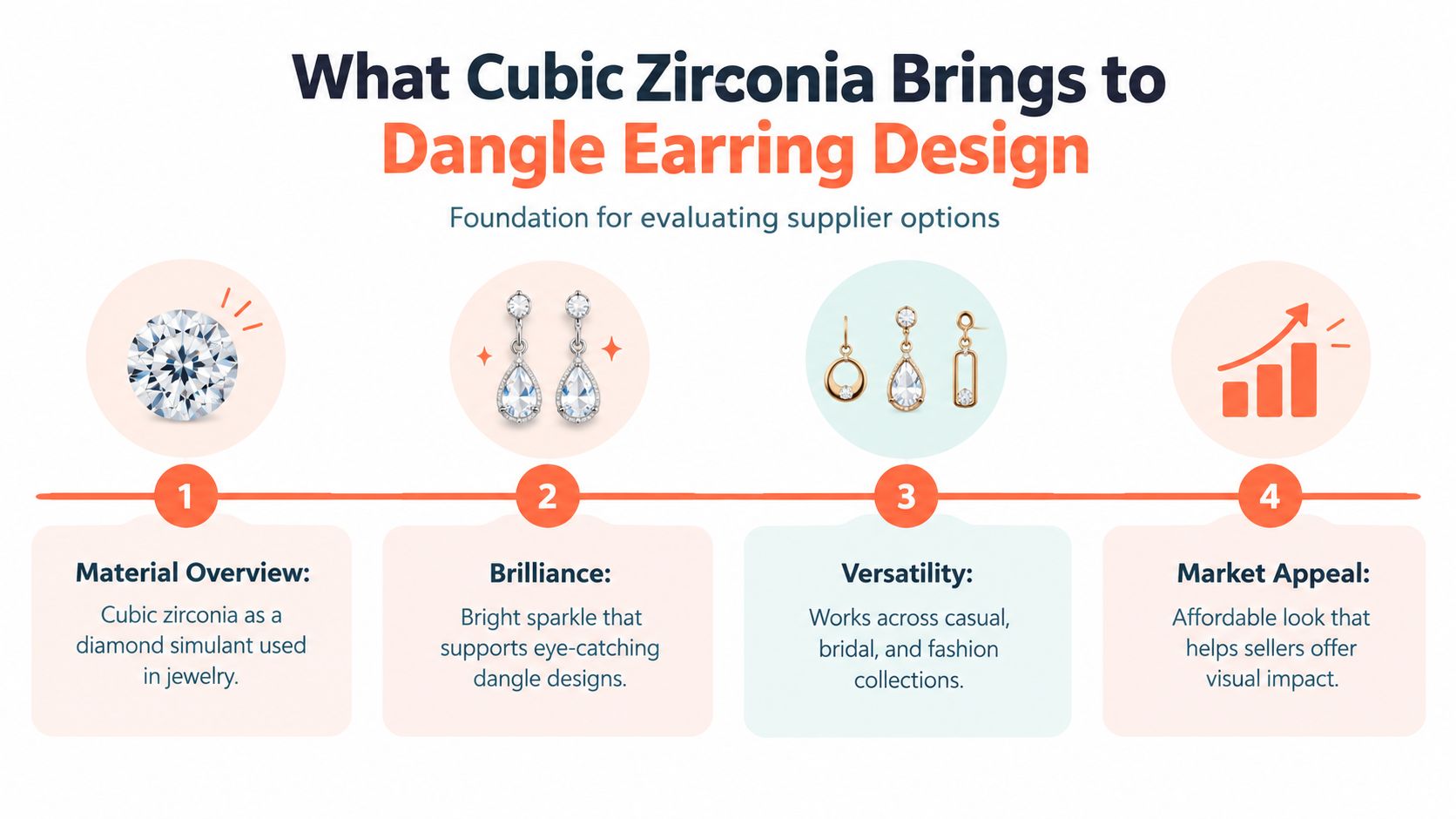
What Cubic Zirconia Brings to Dangle Earring Design
Cubic zirconia has a documented production history that began with a natural mineral identified in 1937 and reached industrial scale by 1980. Facetable crystals were first produced in 1969, and a practical skull-melting process developed in the Soviet Union in 1972 made larger-scale production feasible. CZ entered commercial markets as a diamond imitation in 1976, according to the history and production timeline for cubic zirconia.
By the end of 1980, estimated annual production had reached 13 metric tons, equivalent to about 60 million carats of rough CZ. Roughly 3 metric tons represented faceted material suitable for jewelry (production history and figures). That manufacturing scale lets buyers source multi-stone dangle designs with consistent stones, rather than relying on matched natural gems.
Why the optics work in motion
Movement puts CZ's sparkle to work. The Gemological Institute of America data on cubic zirconia reports a refractive index of 2.15 to 2.18 and dispersion of 0.058 to 0.066. A well-cut stone can show strong brilliance and visible spectral fire. On a dangle, multiple stones catch light from different angles as the wearer turns, giving the design sparkle that a product photo alone cannot convey.
Cut determines whether those optical properties translate into a sellable finish. Inspect samples in ordinary room light and daylight, not only in a light box. Well-cut stones produce bright, sharp flashes. Poorly cut ones can look white and lifeless.
The durability trade-off you must respect
CZ has a Mohs hardness of 8.0 to 8.5 (Gemological Institute of America data) and no cleavage. It resists routine abrasion, but remains somewhat brittle, with conchoidal to uneven fracture. In buying terms, that means scratches are less of a concern than chips caused by hard impacts to edges and points. Describe it as durable fashion jewelry that needs sensible handling, not as equivalent to diamond.
For assortment contrast, the Bohemian Minimalist 925 Sterling Silver Teardrop Baroque Pearl Earrings Asymmetric Design is listed at 70.04 with one variant, and its availability is not confirmed. Check its weight and drop length on a sample before listing. Product pages need those details to set clear expectations about wear and movement.
Quality Indicators That Separate Sellable CZ Dangles from Returns
Edge chipping is the failure I see most, and it's predictable. A faceted CZ drops on a hard surface, knocks against its pair mate in a loose poly bag, or swings into a metal component during shipping. The girdle or a pointed facet takes the hit. Your inspection process should be built around that reality.
Inspect the stone and setting first
- Girdles and pointed facets: Run samples under magnification and look for tiny chips, rough edges, and uneven points.
- Prongs: Check that each prong seats the stone without lifting, gaps, or sharp exposed tips that catch hair.
- Stone-to-stone contact: Reject designs where hanging stones repeatedly strike each other or the frame. That contact multiplies in transit.
- Pair matching: Compare both earrings side by side for stone size, alignment, drop length, and swing. A mismatched pair reads as defective to customers.
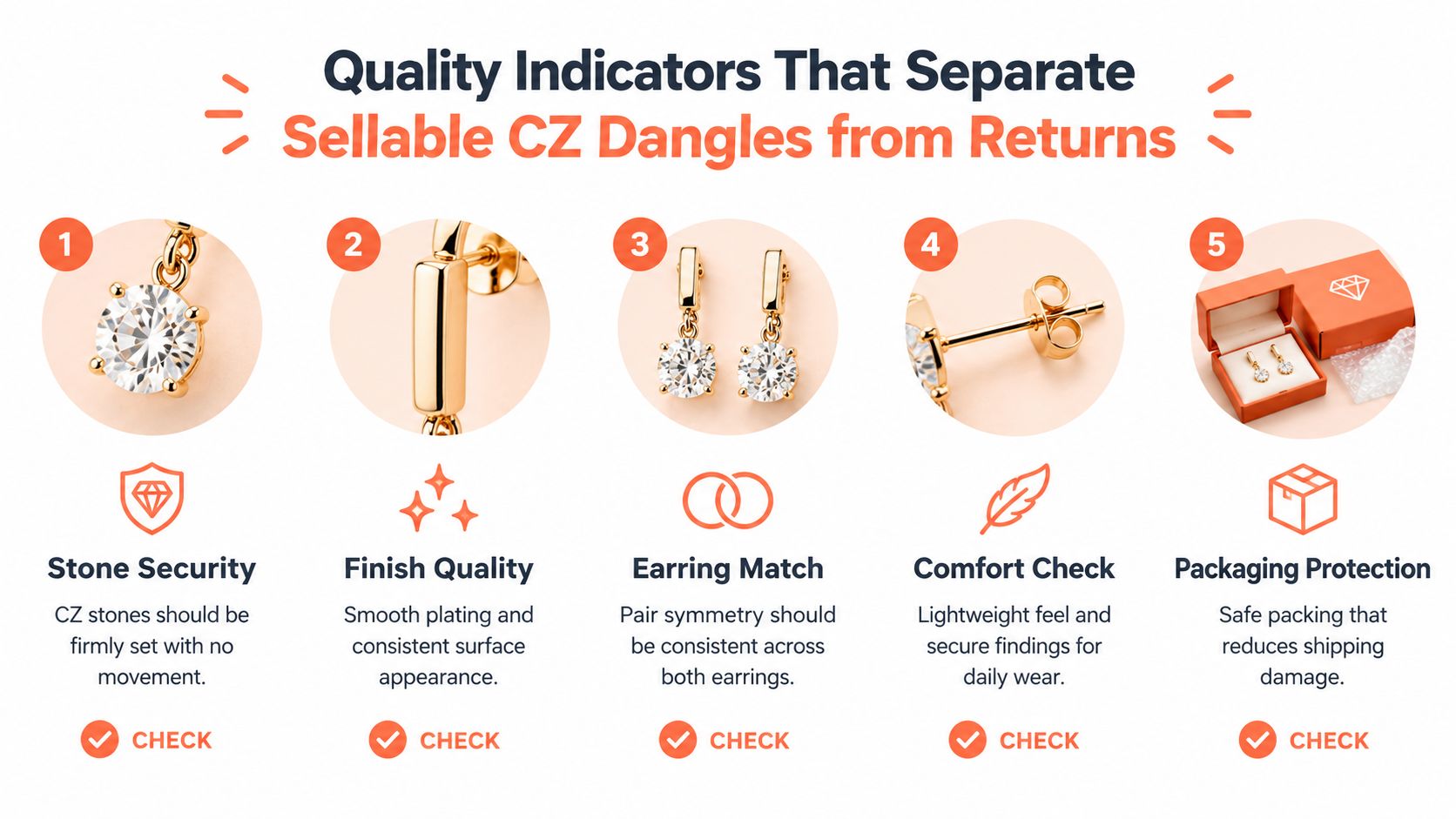
Packaging belongs in quality control, not as an afterthought. Require each earring to be immobilized separately so it can't pendulum into its mate or into posts and backings. If a supplier ships beautiful stones loose in a shared bag, that supplier is creating your damage claims.
Verify the ear-contact pathway separately
CZ itself is chemically inert. That's discussed in the guide to verifying CZ earring materials for sensitive ears, which makes the key distinction that risk comes from the post, hook, backing, plating, solder, or adhesive. For earrings sold into the European Economic Area, the EU REACH Annex XVII nickel restriction limits nickel release from assemblies inserted into pierced ears to less than 0.2 micrograms per square centimetre per week, and other parts in direct and prolonged skin contact to 0.5 micrograms per square centimetre per week.
Don't accept a bare nickel-free claim. Ask for EN 1811 nickel-release test documentation, identify the base metal and plating system, and confirm coatings hold up under normal-use durability conditions. Dangles move against skin more than studs do, so a thin decorative coating wears faster at the hook and post. When you merchandise sensitive-ear options, compare documented contact metals, including the options covered in this guide to titanium earrings for sensitive ears, and avoid blanket hypoallergenic language you can't evidence.
Inspection rule: Test the stone for impact damage and the metal for skin contact. Those are two different products joined in one earring, and conflating them causes both complaints and compliance risk.
Matching Dangle Styles and Closures to Real Customers
Your customer isn't buying a silhouette. She's buying something to wear through dinner, dancing, a workday, or a flight without thinking about her ears. Match the design to that job, and publish the specs that let her self-select.
Dangles put strain on the piercing. Longer and heavier designs pull downward, catch on hair and collars, and can stretch the piercing during extended wear. Weight concentrated at the bottom of a long drop feels heavier than the same weight balanced closer to the ear, so center of gravity matters as much as total grams. Hold samples, wear them for a few hours, and move in them before you commit.
Dangle Earring Style and Closure Comparison by Use Case
| Use Case | Recommended Silhouette | Closure Type | Comfort Level | Loss Risk | Wear Duration |
|---|---|---|---|---|---|
| Weddings | Medium drop with balanced multi-stone layout | Lever-back or secure hinged closure | High when lightweight | Low | All-day event wear |
| Work | Short, restrained dangle with limited swing | Lever-back or screw-back post | High | Low | Full workday |
| Dancing | Compact drop with weight close to the ear | Lever-back or secure hinged closure | Moderate to high | Low | Evening activity |
| Travel | Short dangle that won't catch on clothing or headphones | Screw-back or hinged closure | High | Low | Extended wear |
| Occasional evening wear | Longer statement drop | Lever-back preferred over open hook | Moderate | Moderate with fishhook, lower with lever-back | Short event wear |
Fishhooks look effortless in photos and cause avoidable loss. They back out when hair brushes them, when a customer removes a sweater, and when she dances. If you stock fishhook styles, position them for lower-activity wear and consider supplying clear stoppers. For active shoppers and all-day events, steer your assortment toward lever-backs, screw-backs, or secure hinged closures.
Publish total pair weight, drop length, closure type, and intended wear duration on every product page. Those four facts prevent more disappointment than another paragraph about sparkle. They also help customers with stretched or sensitive piercings choose lighter designs without emailing you first.
Don't assume daily wear from appearance. A gold-plated or alloy component can react differently to sweat, lotions, and sulfur exposure than the CZ stones mounted in it. Label occasional-wear finishes as occasion wear. Customers respect direct guidance, and they return less when expectations match the product.
Sourcing CZ Dangle Earrings from Wholesale Suppliers
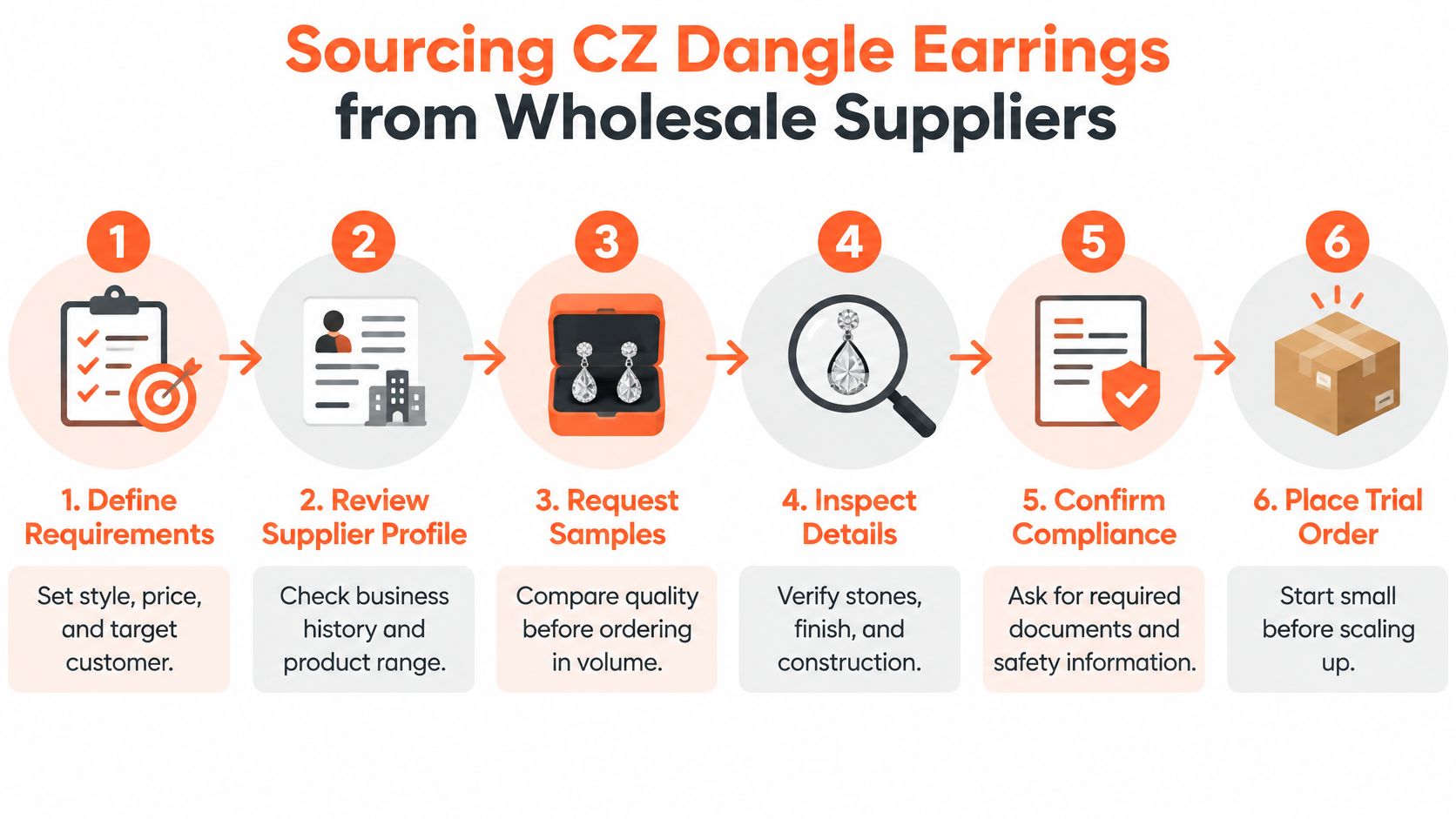
A low unit cost cannot make up for inconsistent quality or unclear product details. Set sourcing requirements before negotiating, then test a sample order against the supplier's written specifications.
The sourcing flow below lays out a practical sequence from requirements to trial order.
Documentation to request up front
- Material disclosure: Require the post, hook, backing, base metal, and plating system in writing. “Silver-colored” does not identify a material.
- Compliance evidence: Request the nickel-release documentation outlined in the quality section, and file it by style.
- Finished specifications: Get the stone size and quality grade, dimensions, total pair weight, closure type, and packaging method before sampling.
Compare samples with the documents, then wear-test them. Check the supplied packaging by moving the packed earrings to see whether they strike each other. Start with a trial order to confirm consistency before placing a larger order.
Use a real due-diligence framework
The OECD five-step due-diligence framework overview gives jewelry businesses a sourcing control system. It covers management systems, supply-chain risk assessment, risk mitigation, independent audits where appropriate, and public reporting on implementation. It also recommends adopting a minerals-sourcing policy, gathering supplier information, mapping upstream actors, and responding to red flags.
Apply those habits at a scale that fits your business. Keep a supplier file, record what you verified, note red flags, and repeat checks when reordering. Compare published catalog details with your samples. JewelryBuyDirect is a wholesale platform with a published catalog, and its wholesale cubic zirconia jewelry sourcing overview lists category breadth you can compare against your samples.
Before scaling an order, test three samples. Open and close each lever-back ten times, then check that the hook's finish has not flaked or discolored.
Writing Listings That Sell CZ Dangles Honestly
Honest naming sells. Customers who want an affordable diamond look aren't asking you to pretend CZ is diamond. They're asking for beauty at a price they can justify, described accurately enough that they trust you.
For U.S. retailers, the rule is concrete. The Federal Trade Commission guidance on advertising diamonds clearly states that calling a simulated or imitation diamond such as cubic zirconia a laboratory-created diamond without clear qualification may mislead consumers into believing it has the same optical, physical, and chemical properties as a mined or lab-grown diamond. Identify the stones as cubic zirconia, imitation, or simulated in your description.
Put that disclosure early, near the claim it qualifies, in plain language customers can understand. Don't bury simulated at the bottom under shipping details while the headline implies diamond. The FTC resources for businesses that manufacture or sell jewelry place responsibility on manufacturers and sellers to comply with the Jewelry Guides when describing materials and characteristics.
A listing structure that prevents confusion
- Material facts first: Cubic zirconia stones, base metal, plating, post and backing material, dimensions, pair weight, and clasp type.
- Value language second: Diamond look or luxury appearance is acceptable positioning after the material identity is clear.
- Wear guidance third: Suggested use case, closure security, and care limits for plated components.
That order does commercial work. Shoppers scanning quickly get the facts that determine fit and comfort, and shoppers comparing value understand what they're paying for. If you want copy that converts without discounting your way out of margin, the principles behind protecting margins with persuasive Shopify copy apply directly here. Specificity sells better than adjectives because it answers the objection before checkout.
Sell the look boldly. Name the material plainly. Those two moves build the trust that makes affordable jewelry repeatable business.
Rewrite any listing that uses hypoallergenic without naming and evidencing the contact metal. Replace vague comfort claims with the post material, backing material, and test documentation status you can stand behind. Distinguish sterling silver from silver-colored base metal every time.
Caring for CZ Dangles and Photographing Them Without Cropping
Care instructions protect more than the stones. Plated and alloy components can suffer from sweat, lotions, perfume, and sulfur exposure, even when the CZ itself handles routine wear well. Advise customers to put earrings on after applying cosmetics, wipe them with a soft, dry cloth after wearing, and store each earring separately to prevent contact between stones and metal parts.
Packaging and storage that prevent chips
- Immobilize each earring: Follow the separate immobilization guidance in the quality section, using cards, slots, or individual compartments.
- Separate the pair: Keep hooks, posts, and lower stones from rubbing together in a shared pouch.
- Keep plated metal dry: Store earrings away from bathroom humidity. Tell customers that finish durability varies, so they should not assume every plated pair suits daily wear.
- Check incoming stock for loose prongs and chipped girdles before display. Remove any piece with a lifted stone from sale.
Photograph the full drop
Cropping problems are usually math problems. The Shopify explanation of theme image aspect ratios explains that slideshows, image banners, and full-width sections can crop images whose ratios do not match the section. Our cover image ratio is 383:204, or approximately 1.877:1. At that ratio, a dangle photographed at 4:3 can lose its lowest stone when the banner crops the bottom edge. Prepare the cover at 1.877:1 and leave at least one stone-width of margin below the drop.
Keep space above the hook, too. A cropped earring makes it harder for shoppers to judge its length. Pair the cover with a full-length product image, a closure close-up, and a scale reference. The jewelry photography tips for product pages offer practical guidance for showing finish and setting detail. For supplier images that are too small or soft for your templates, use AI-enhanced product photos for e-commerce to improve clarity without changing proportions.
Retouch carefully. Improve resolution and lighting, keep the earring's proportions truthful, and show the backing. Customers need to see the closure they are buying.
Building a CZ Dangle Assortment That Sells and Stays Sold
Start with three distinct styles: a short work-appropriate drop, a balanced wedding piece with a secure closure, and a longer evening style labeled for occasional wear. Publish each style's weight, drop length, materials, and closure so customers can choose based on fit and use, not sparkle alone.
Before listing, confirm the stone and contact-metal checks in the quality section are complete. Then order three pieces of each test style. Track sell-through, complaints, loss reports, and damage returns over two order cycles. Reorder only styles whose sales justify their space and whose complaints and returns stay low. A style that draws clicks but prompts fit or damage complaints is not a dependable seller.
Use those results to shape the assortment, rather than adding near-duplicate drops. This gives your boutique a focused CZ category built around real customer needs and products you can reorder with confidence.
Start with a focused trial of cubic zirconia dangle earrings, then sample the silhouettes that suit your customers' wear needs. Visit JewelryBuyDirect to compare wholesale CZ dangle styles and related fashion accessories for your boutique.