






Arthur Lynch | Wed Dec 24 2025
A Business Guide to Sourcing High-Quality Costume Jewelry in Bulk
Sourcing costume jewelry in bulk is the foundational step for any thriving jewelry business, whether you're a startup or scaling your retail empire. This process is how you acquire high-quality, on-trend pieces at affordable wholesale prices, enabling you to build a profitable and diverse inventory that keeps your customers coming back.
Building Your Smart Sourcing Strategy
Sourcing isn't just about finding the cheapest supplier; it's about making strategic choices that balance affordability with quality to build your brand. A smart strategy ensures every piece you purchase fits your brand's aesthetic, meets your quality standards, and promises a solid return on investment.
Without a clear plan, you risk ending up with low-quality inventory that tarnishes your brand reputation, ties up cash, and stalls your growth. This initial planning phase is crucial—it transforms your business vision into a concrete purchasing roadmap, shaping everything from supplier relationships to your bottom line.
Define Your Brand and Customer
Before browsing a single supplier catalog, you need to establish your brand's identity. Are you known for minimalist, modern designs, or do you cater to a bohemian, free-spirited clientele? Defining your niche helps you avoid the common mistake of chasing every trend, ensuring your collection remains curated and cohesive.
Equally critical is understanding your ideal customer:
- Their Style and Demographics: Are you selling to style-conscious Gen Z shoppers or professionals seeking classic, office-appropriate accessories?
- Their Budget: How price-sensitive is your audience? This directly influences the quality and price point you need to target when sourcing.
- Their Values: Do they prioritize durability and hypoallergenic materials, or are they focused on fast-fashion impulse buys?
This is the filter through which you should make every sourcing decision, ensuring you procure high-quality, affordable jewelry that resonates with your target market.
When you align your brand, customer profile, and market analysis, you create a powerful sourcing guide. It simplifies purchasing decisions and dramatically increases your chances of stocking high-demand, profitable items.
Analyze the Current Market
Understanding your niche is essential, but grasping the broader market landscape is just as important. The global costume jewelry market is vast and competitive, offering both challenges and significant opportunities for businesses that source intelligently.
Currently, the market is valued between USD 30–38 billion, with projections showing it could nearly double in the next decade. This incredible growth, detailed in costume jewelry market growth reports, highlights why sourcing high-quality yet affordable fashion accessories is crucial for maintaining competitive pricing and healthy profit margins.
A successful sourcing strategy is proactive, not reactive. By anticipating trends and understanding your customer’s desire for quality and value, you can purchase inventory that feels fresh, relevant, and perfectly curated for your audience.
This forward-thinking approach transforms buying from a simple transaction into a strategic advantage. It also informs how you select suppliers. For instance, understanding the benefits of sourcing directly from jewelry factories can give your business a major edge on pricing, customization, and quality control.
With this solid foundation, you’re ready to find and vet the right partners who can supply the high-quality, affordable jewelry your business needs to succeed.
How to Find and Vet Wholesale Jewelry Suppliers
Choosing the right supplier is one of the most critical decisions for your business. This is more than a transaction; it's a partnership that powers your entire inventory. Finding a reliable source for high-quality, affordable costume jewelry in bulk is the bedrock of your brand's reputation and profitability.
A great supplier delivers consistent quality, ships reliably, and communicates clearly. This frees you up to focus on what you do best: marketing and selling to your customers.
Where to Discover Quality Suppliers
The search for the perfect partner begins with knowing where to look. While a simple Google search yields thousands of results, the best suppliers—those offering a prime balance of quality and price—are often found through more specialized channels.
To find high-quality and affordable sources, explore these avenues:
- B2B Marketplaces: Platforms like Alibaba, Faire, and Global Sources are excellent starting points. They connect you with a vast network of global manufacturers and wholesalers, offering competitive pricing on a wide array of fashion accessories.
- Industry Trade Shows: Events like ASD Market Week or MAGIC are invaluable for sourcing. They allow you to meet suppliers in person, assess the quality of the jewelry firsthand, and build relationships that are difficult to replicate online.
- Niche Supplier Directories: Specialized directories for fashion accessories can be goldmines for discovering unique suppliers that aren't on the major platforms. This can provide your business with a competitive edge through exclusive styles.
Combining the convenience of online marketplaces with the hands-on evaluation at trade shows will give you a comprehensive view of your sourcing options.
How to Properly Vet a Potential Partner
Once you have a shortlist of potential suppliers, the real work begins. Vetting is how you separate reliable partners from future problems. Skipping this step can lead to poor-quality products, shipping delays, and financial loss.
Start by investigating their reputation. Look for online reviews and testimonials from other business owners. A supplier with a solid history of delivering quality goods is a safer bet. For a deeper look into working with overseas partners, our guide on navigating jewelry wholesalers in China offers specific, actionable advice.
A slick website can be deceiving. A supplier's true value is revealed in their processes, communication, and client feedback. Always dig deeper than their marketing materials.
Next, initiate contact. The speed and thoroughness of their response are telling. Slow or vague communication before you've even placed an order is a major red flag for the future of the partnership.
Your Essential Supplier Vetting Checklist
Before committing to a large order, you need clear answers to several key questions. This isn't about being difficult; it's about being a savvy business owner protecting your investment.
Key Questions to Ask Every Potential Supplier:
- What is your Minimum Order Quantity (MOQ)? This is crucial for managing your budget. Suppliers with low or no MOQs are ideal for testing new styles without significant financial risk.
- Can you provide product samples? This is non-negotiable. Never place a bulk order without physically inspecting the quality. A reputable supplier will readily provide samples, though you'll typically cover the cost.
- What are your production lead times? Knowing the timeline from order placement to shipment is essential for inventory planning and marketing campaigns.
- What is your process for handling defects or damaged items? No manufacturing process is perfect. A good supplier will have a clear, fair policy for returns, refunds, or replacements. Clarify this before a problem arises.
- Can you provide trade references? Ask to speak with a few of their current clients. Hearing directly from other businesses is one of the best ways to verify their reliability and product quality.
Asking these questions upfront establishes a professional, transparent relationship. It protects your investment and ensures the supplier can meet your standards for high-quality, affordable jewelry, turning sourcing into a profitable, long-term partnership.
Mastering Negotiation and Placing Your First Order
You've vetted your options and found a promising supplier. Now, it's time to secure a deal that maximizes your profit margins. Negotiating for costume jewelry in bulk is less about aggressive tactics and more about strategic communication aimed at building a mutually beneficial partnership.
Confidence in negotiation comes from preparation. Before you reach out, understand the market rates for the quality and materials you're seeking. This knowledge is your anchor, preventing you from accepting an initial high quote and giving you a realistic basis for discussion.
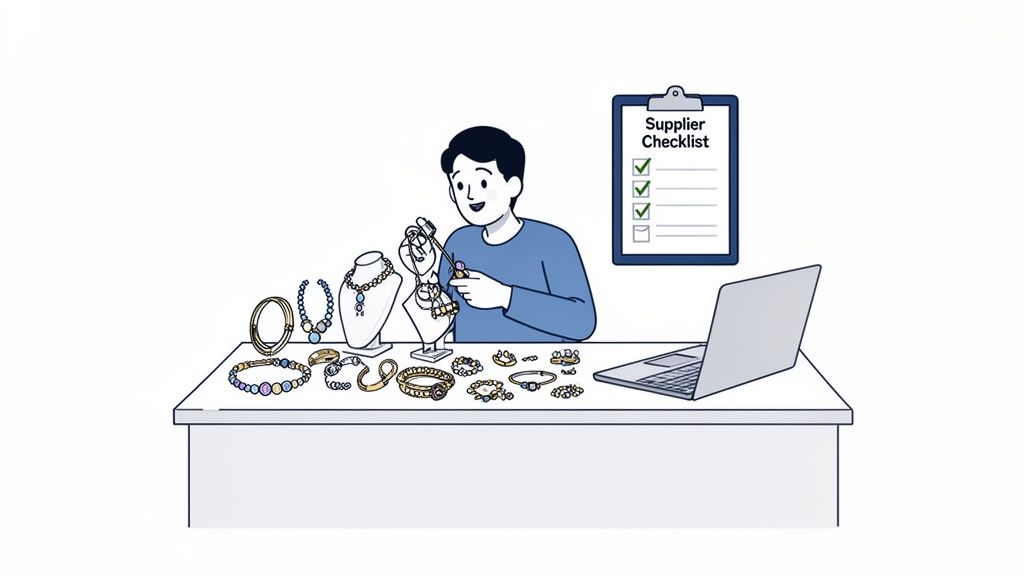
Approaching the Negotiation Table
Your order volume is your greatest leverage. Suppliers are typically more flexible on pricing for larger, consistent orders because it provides them with predictable business.
Use this to your advantage by discussing tiered pricing. Frame the conversation around growth. For instance, you could say, "I plan to start with an order of 500 units. If these sell well, I intend to place recurring monthly orders of 1,000 units. What pricing structure can you offer for that higher volume?"
This signals that you are a serious, long-term buyer, incentivizing them to offer a better deal from the start.
The goal of negotiation isn't just to lower the price of a single order. It's to establish a pricing structure that supports your business's profitability and growth over time. Think of it as co-creating a win-win financial model with your supplier.
Look beyond the per-unit cost. Other negotiable points can significantly impact your bottom line:
- Payment Terms: Instead of paying 100% upfront, propose a 30/70 or 50/50 split—a deposit at the time of order and the balance upon shipment. This can greatly improve your cash flow.
- Shipping Costs: For a large order, ask if they can offer a reduced shipping rate or include it in the price. This is sometimes an easier concession for a supplier than lowering the item cost.
- Packaging Options: Inquire about custom-branded packaging. Many suppliers offer this for a small fee, which can elevate your customer's unboxing experience and reinforce your brand.
For more in-depth strategies, our guide on how to negotiate effectively with your suppliers provides actionable frameworks you can apply immediately.
Different situations call for different tactics. Here’s a breakdown of common approaches for sourcing fashion accessories.
Effective Negotiation Tactics for Bulk Jewelry Orders
| Tactic | Best For | Potential Outcome | Key Consideration |
|---|---|---|---|
| Volume-Based Discounting | Placing large initial or recurring orders. | Tiered pricing structure that rewards larger purchases with a lower per-unit cost. | Base your volume on realistic sales projections to avoid over-committing. |
| Bundling | Purchasing a wide variety of styles or collections from a single supplier. | An overall discount on the entire order, improving affordability across your range. | Ensure all bundled items meet your quality standards; don't sacrifice quality for a deal. |
| Long-Term Partnership | Buyers committed to a single, high-quality supplier for a long period. | Better pricing, priority production, and more flexible payment terms over time. | Requires building trust by proving your value as a consistent, reliable customer. |
| Payment Term Flexibility | Businesses needing to manage cash flow effectively. | Paying a deposit upfront (e.g., 30%) and the balance upon shipment or delivery. | Easier to negotiate after establishing a track record of successful orders with the supplier. |
The most effective approach often combines these tactics, tailored to your business needs and the supplier's model.
Crafting a Flawless Purchase Order
Once terms are agreed upon, formalize them with a Purchase Order (PO). A vague PO is an invitation for errors. This document is the legal blueprint for your order and must be precise.
Every detail matters. A comprehensive PO leaves no room for misinterpretation and protects your business.
Your PO must include:
- Item SKU/Model Number: Use the supplier’s exact product codes.
- Detailed Product Description: Be specific about materials ("316L stainless steel," "rhodium-plated 925 silver"), colors (use Pantone codes if available), dimensions, and weight.
- Quantity: The exact number of units for each item.
- Agreed-Upon Unit Price: The final negotiated per-piece price.
- Total Price: The final cost for the entire order, including discounts.
- Packaging Requirements: Specify how each piece should be packaged (e.g., individual poly bag, branded box).
- Shipping Address and Method: Confirm the final destination and shipping terms.
- Delivery Deadline: State the agreed-upon shipment date.
A meticulous PO is your safety net. If there's an issue with the final shipment, this document is your proof. This level of professionalism sets the stage for a strong, reliable supplier relationship from the very first order.
Getting Your Order Made Right and Shipped Smart
Placing a large order is a milestone, but the phase between payment and delivery is critical. Your diligence in quality control and logistics during this period will determine the success of your investment in costume jewelry in bulk.
Leaving quality entirely to your supplier is a risky move that can result in receiving unsellable goods. A proactive, hands-on approach is the only way to safeguard your business against defects, delays, and unexpected costs.
Your Golden Ticket: The Pre-Production Sample
Before full production begins, you must obtain a pre-production sample (PPS). This is not the same as the initial design sample. A PPS is the first item made using the final production line, molds, and materials for your bulk order.
It is your last chance to catch quality issues before they are multiplied. Is the plating quality consistent? Does the clasp feel secure? Is the color accurate? A physical sample reveals what a photo cannot. Any high-quality supplier will provide a PPS, as it protects both parties from future disputes.
I can't stress this enough: Never approve a bulk order based on a photograph. It's one of the fastest ways to lose money in this business. A photo can easily hide flimsy construction, cheap-feeling materials, or a finish that will tarnish after one wear.
How to Inspect Your Finished Jewelry
Once production is complete, the entire batch requires final inspection. The method you choose depends on your order size, budget, and risk tolerance.
- Inspect It Yourself on Arrival: This is the most common method for small businesses. You or your team personally check every piece after delivery and before adding it to your sellable inventory.
- Hire a Pro on the Ground: For larger, high-value orders, especially from overseas, hiring a third-party inspection service is a smart investment. A professional inspects the goods at the factory before shipment, saving you the cost and hassle of dealing with thousands of defective items after they've arrived.
Here’s a comparison to help you decide which approach is right for your business:
| Inspection Method | Best For | Pros | Cons |
|---|---|---|---|
| Self-Inspection | Small orders, new businesses, domestic suppliers | No extra cost, you have total control over quality assessment. | Time-consuming; defects are only found after you've paid for shipping. |
| Third-Party Inspection | Large orders, international suppliers, high-value items | Catches problems at the source, provides a professional report for claims. | Added expense and requires coordination with your supplier. |
Untangling the Shipping Maze
Understanding logistics basics will save you from major headaches. When importing costume jewelry in bulk, you'll typically choose between air freight and sea freight.
Air freight is fast (1-2 weeks delivery) but more expensive. It's ideal for smaller, lighter shipments or when you need to restock popular items quickly.
Sea freight is the more affordable option for large, heavy shipments but requires patience (30-60+ days transit time). If you choose sea freight, you must plan your inventory needs well in advance.
You'll also encounter Incoterms, which are universal trade terms defining the responsibilities of the seller and buyer. Terms like FOB (Free On Board) and EXW (Ex Works) clarify when ownership and costs transfer to you. Ensure these are clearly defined in your contract.
Finally, factor in customs duties and taxes. Every country has regulations for imported goods, and payment is your responsibility. A customs broker can handle the paperwork, ensuring your high-quality fashion accessories clear customs smoothly and arrive at your warehouse without delay.
Turning Boxes into Profit: Inventory Management and Pricing
The delivery has arrived. Those boxes of costume jewelry in bulk are in your hands, and now the opportunity for profit truly begins. Effective inventory management from this point forward is crucial. It’s a system for maximizing sales, minimizing waste, and ensuring your investment in high-quality jewelry pays off.
Without a solid plan for checking in, tracking, and pricing your new stock, even the best products can become a logistical burden. A streamlined process prevents stockouts of best-sellers, frees up cash from slow-moving items, and separates professional retailers from amateurs.

First In: Receiving and Cataloging Your Stock
As soon as the shipment arrives, your system should activate. This initial check-in is your first line of defense against supplier errors and the foundation for accurate inventory tracking.
First, compare the packing slip against your purchase order. Verify that you received the correct styles, colors, and quantities. Most importantly, inspect for damage. Document any discrepancies or defects with clear photos immediately. This is essential for a smooth resolution with your supplier.
Once verified, log every item into your system.
- The Simple Spreadsheet: For new businesses, a Google Sheet or Excel file works well. Create columns for a SKU (your unique product ID), product name, cost per unit, quantity received, and supplier.
- Inventory Software: As you grow, inventory management software is a wise investment. E-commerce platforms like Shopify have built-in tools, while dedicated systems like Cin7 can automate tracking across multiple sales channels.
Consistency is key. Every piece needs a unique SKU and a designated place on your shelves for efficient order fulfillment.
Smart Tracking: Using Data to Drive Decisions
With your jewelry cataloged, data analysis can begin. This is about more than just knowing when to reorder; it's about understanding customer demand to make smarter purchasing decisions for your next bulk order.
A proven method is the ABC analysis for inventory prioritization:
- 'A' Items: Your superstars—the top 20% of products generating 80% of revenue. Never allow these high-quality best-sellers to go out of stock.
- 'B' Items: Your consistent, middle-range sellers. Monitor their performance closely.
- 'C' Items: Your slow-movers. These often tie up capital. Consider promotions or bundling to move them.
Think of your inventory management as a feedback loop. Your sales data should tell you exactly what to buy next, so you're investing more capital in proven winners instead of just guessing at trends.
For multi-channel retailers, this is even more critical. If you're an Amazon seller, you must master Amazon inventory management to avoid stockouts that can harm your product rankings. Good management ensures your capital is actively generating revenue.
Pricing Models That Protect Your Profit
Finally, let's talk about pricing. Your goal is to achieve a healthy profit margin on every piece sold. A common mistake is failing to account for all the costs associated with acquiring your products.
Your retail price must be based on your Landed Cost—the total expense to get one item into your inventory.
This includes:
- The per-unit cost from the supplier
- Prorated shipping fees
- Customs duties and taxes
- Packaging materials
Once you have this number, you can apply your markup. A standard retail strategy is Keystone Pricing, which means doubling the landed cost (a 100% markup). If a high-quality necklace has a landed cost of $5, you would price it at $10.
However, this is a guideline, not a rigid rule. You might apply a higher markup for a unique, high-demand piece or adjust based on competitor pricing. This strategic approach ensures every sale contributes to a sustainable, profitable business.
Have Questions About Buying Jewelry in Bulk? Let's Get Them Answered.
Navigating the world of wholesale costume jewelry means balancing the search for high-quality, affordable pieces with smart financial decisions for your business. It's a challenging but rewarding process. Let's address some of the most common questions from retailers.
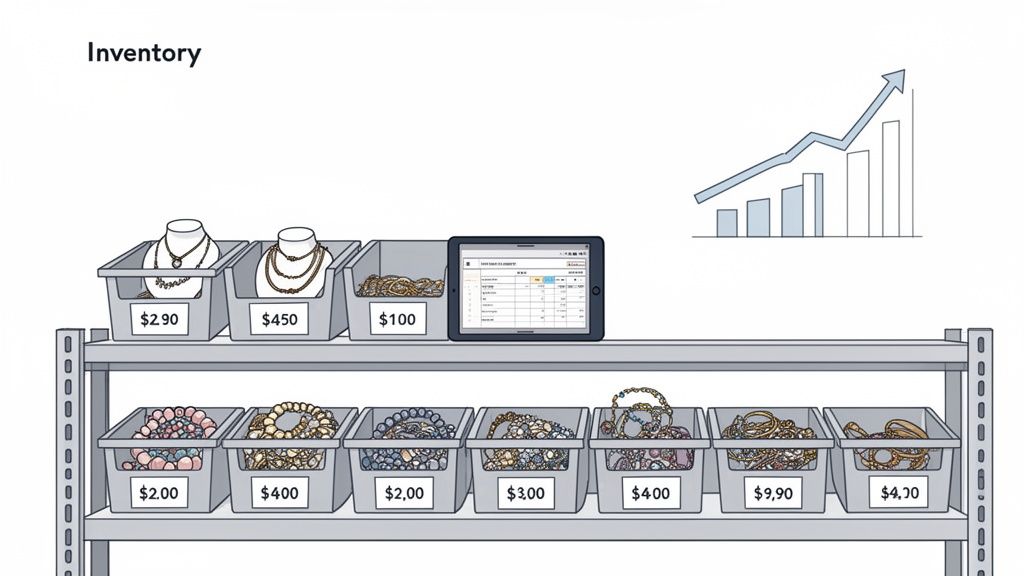
What Should I Look for in Quality Costume Jewelry Materials?
Material choice directly impacts customer satisfaction and your brand's reputation. The goal is to find the sweet spot: materials that look and feel premium but are affordable enough to ensure profitability.
Focus on these materials for the best combination of quality, durability, and value:
- 316L Stainless Steel: An excellent choice for durable, everyday jewelry. Often called "surgical grade," it is hypoallergenic, tarnish-resistant, and offers the high-end look of silver without the high cost.
- 925 Sterling Silver: A classic material with a premium feel that customers recognize and trust. While it costs more than steel, rhodium-plated sterling silver is a worthwhile investment for timeless styles.
- Gold-Plated Brass or Stainless Steel: This allows you to offer the popular look of gold at an accessible price point. The key to quality is plating thickness. Inquire with your supplier and aim for at least 1 micron over a durable base like brass or stainless steel to ensure longevity.
Conversely, avoid cheap, unspecified metal alloys. They often contain high levels of nickel, a common cause of skin irritation. Saving a few cents per piece is not worth the risk of customer complaints and damage to your brand's reputation for quality.
How Can I Find Suppliers Without Huge Minimum Orders?
The Minimum Order Quantity (MOQ) can be a significant barrier for small businesses. Finding a supplier with no MOQ is ideal, as it allows you to test new trends and fashion accessories without a large upfront investment.
Fortunately, many wholesalers now cater to independent retailers and offer greater flexibility. Search B2B platforms that have filters for "No MOQ" or "Low MOQ." These suppliers are often better partners for growing businesses.
A supplier that lets you start small is a supplier that's invested in your growth. It’s a sign that they're looking to build a real, long-term partnership, not just make a quick buck off a massive first order.
This flexibility allows you to purchase small batches of new styles, gauge customer response, and then invest more heavily in proven sellers. It keeps your inventory fresh and your capital fluid.
What’s the Best Way to Handle Returns or Defects in a Bulk Order?
Discovering damaged or incorrect items in a large shipment is frustrating, but with preparation, it's a manageable issue.
Success starts before you place the order. Secure a clear return and defect policy in writing from your supplier. A reputable partner will have a straightforward process for replacements, credits, or refunds.
When the order arrives, act quickly:
- Inspect immediately. Don't let boxes sit. Check the contents against your packing slip as soon as they arrive.
- Document everything. Take clear photos or a short video of any damage, incorrect items, or shortages.
- Communicate promptly. Contact your supplier within their specified timeframe (usually 3-7 days) and provide all documentation.
Presenting a clear, professional, and well-documented claim makes it easy for the supplier to resolve the issue. This not only fixes the immediate problem but also reinforces your position as a serious, organized business partner, strengthening your long-term relationship.
Ready to source trendy, high-quality jewelry with confidence? JewelryBuyDirect offers over 120,000 styles with no minimum order, factory-direct pricing, and free shipping on orders over $150. Start building your profitable inventory today at https://www.jewelrybuydirect.com.