






Arthur Lynch | Thu Oct 23 2025
Your Guide to Costume Jewellery Bulk Buying
If you're in the business of selling accessories, buying costume jewellery in bulk is the single smartest move you can make. It’s the secret sauce for boosting your profit margins and keeping your inventory fresh and exciting. For anyone running an e-commerce shop, a subscription box service, or a local boutique, this strategy is the bedrock of a scalable and successful business.
The Billion-Dollar Opportunity in Costume Jewellery
Think about transforming your small shop into a go-to brand. The key isn't some complex, unattainable secret—it's mastering the art of smart bulk buying. This isn't just about getting a good price; it’s a foundational business model that gives you the speed and flexibility to outmaneuver competitors.
For online stores and subscription box owners, sourcing in bulk is a game-changer for operations. Instead of juggling dozens of tiny orders from different suppliers, you consolidate your buying power into one streamlined process. This simplifies everything from inventory tracking to shipping, freeing you up to focus on what really grows your business: marketing and customer engagement.
Unlocking Profitability and Trend Agility
The most obvious win here is financial. When you buy direct and in larger volumes, your cost-per-piece drops dramatically. That creates a healthy buffer for your profit margins, giving you the freedom to either compete on price or position your brand as a source for affordable luxury.
But the real magic happens when you combine savings with speed. Bulk purchasing lets you jump on trends the moment they emerge. Seeing minimalist gold-plated hoops take over European street style? Or maybe bold, chunky resin rings are blowing up on social media? Buying in bulk means you can get these hot-ticket items in stock fast, catching the wave of customer demand right at its peak. This agility is your competitive edge.
And make no mistake, this market is on fire.
The global costume jewelry market was valued at around USD 48.6 billion in 2024. Experts predict it will explode to a staggering USD 111.1 billion by 2035, growing at a compound annual growth rate (CAGR) of about 7.8%.
This isn't just growth; it's a massive opportunity waiting to be seized. As consumers' hunger for new, affordable, and on-trend accessories keeps climbing, knowing how to source effectively becomes your superpower. If you're looking to build your business from the ground up, this guide on how to start a jewelry business offers a fantastic roadmap for turning that opportunity into a profitable reality.
Spotting Global Jewellery Trends Before They Peak

In the fashion world, timing isn't just a factor—it's the whole game. Stocking the next big thing before it's everywhere is what separates a business that leads from one that's always playing catch-up. To do this, you need a systematic approach to trend forecasting.
Success in sourcing costume jewellery bulk is really about anticipation. You have to train your eye to spot the tiny shifts in aesthetics and consumer moods that hint at the next big wave. Think of yourself as a trend detective, piecing together clues from multiple sources to build a clear, actionable picture of what's coming.
Decoding Digital and Runway Clues
Your first stop for intel is the new runway: social media. Platforms like TikTok and Instagram are where trends are born and go viral in a matter of days. Actionable Insight: Create "listening" dashboards using tools like Google Alerts or social listening software for keywords like "jewelry haul," "earring stack," and emerging aesthetic terms (e.g., "mermaidcore," "balletcore"). Monitor what top fashion influencers in your target regions are wearing and tagging.
Next, shift your focus to the traditional fashion industry. The major runway shows in Paris, Milan, and New York are your long-range forecast. Actionable Insight: Don't just watch the shows. Pay for a subscription to a trend forecasting service like WGSN or Trendalytics, which breaks down runway looks into commercial themes, color palettes, and key accessory silhouettes that will hit the mainstream in 6-12 months.
Your real goal is to build a predictive model for your inventory. By blending the fast-burning trends from social media with the longer-term forecasts from the runway, you create a collection that feels both incredibly current and wisely forward-thinking.
Finally, high-end fashion blogs and digital magazines are the perfect bridge between these two worlds. They translate runway looks for consumers, often highlighting the exact accessory trends that are about to blow up. Actionable Insight: Set up an RSS feed aggregating posts from top-tier publications like Vogue, Who What Wear, and The Zoe Report to get curated insights delivered daily.
Understanding Regional Style Palettes
A piece that flies off the shelves in New York might be a complete dud in Tokyo. Getting a feel for regional preferences is absolutely critical when you’re buying costume jewellery bulk. Tastes are shaped by everything from local culture and climate to street style, creating distinct style "palettes" across the globe.
Here’s a look at how different markets stack up.
Global Costume Jewellery Trend Snapshot
The table below offers a quick reference guide to the dominant jewellery styles and materials trending across key global markets. Understanding these nuances can help you tailor your inventory to specific customer bases.
| Region | Dominant Style Trends | Popular Materials | Key Consumer Focus |
|---|---|---|---|
| North America | Bold, statement pieces; stackable rings; personalized jewellery (initials, birthstones). The "mob wife" aesthetic brought back chunky gold, while "quiet luxury" favors simple, elegant chains. | Gold-plating, colourful enamel, semi-precious stones, lab-grown gems. | Self-expression, confidence, and recognisable brand aesthetics. |
| Europe | Classic elegance mixed with artisanal, unique designs; sculptural metalwork. Focus on mismatched earrings and art-inspired shapes. | Sterling silver, resin, natural stones, high-quality plating, recycled metals. | Uniqueness, craftsmanship, and conversation-starting pieces. |
| Asia-Pacific | Delicate, layered looks; minimalist charms; feminine and intricate details. K-fashion drives demand for asymmetrical earrings and "skinny" stacking rings. | Rose gold, pearls, fine chains, crystals (e.g., cubic zirconia), jade. | Subtlety, personalization through mixing and matching, quality finish. |
As you can see, a one-size-fits-all approach just doesn't work. The right product for the right market is key to avoiding dead stock and maximizing sales.
The explosion of social media, fashion bloggers, and streaming shows has turned costume jewellery into one of the fastest-growing accessory categories on the planet. The Asia-Pacific region is a powerhouse, leading in both consumption and manufacturing thanks to a massive population, rising incomes, and a robust production infrastructure. You can dive deeper into the numbers with a detailed market analysis from Straits Research.
Balancing Trendy with Timeless
Chasing trends is a thrill, but a truly sustainable business needs balance. The most profitable strategy is always a smart mix of those fleeting "hot" items and the timeless "evergreen" pieces that sell year after year.
Hot items—like a specific style of earring worn on a hit TV show—create buzz and drive a flood of immediate sales. Think of them as high-velocity, short-lifespan products.
Your evergreen pieces are the foundation of your business. These are the classics that are always in demand: simple gold hoops, elegant pearl studs, delicate chain necklaces, and solitaire-style rings. They deliver consistent, reliable sales that keep the lights on, allowing you to take calculated risks on micro-trends. Actionable Insight: Aim for an inventory mix of approximately 70% evergreen styles and 30% trend-driven pieces. This lets you capture the market's excitement without betting the farm on a fad that could fizzle out.
How to Find and Vet Reliable Bulk Suppliers
Your business is only as strong as its weakest link, and for a retailer, that's almost always the supply chain. Finding the right partner to supply your costume jewellery in bulk is easily the most important decision you'll make early on. This isn't just a hunt for the lowest price; it's about building a solid, reliable relationship that guarantees quality products show up on time, every time.
Think of it like hiring a key employee. You wouldn't just hire the first person who walked through the door, would you? Of course not. You'd review candidates, check their references, and make sure they’re the right fit for your company’s vision. You need to bring that exact same energy to finding a supplier.
Where to Find Your Perfect Supplier Match
The sourcing world is huge, and each channel has its own quirks, pros, and cons. Your job is to explore these avenues and figure out which one clicks with your business model, whether you're a tiny startup just dipping your toes in the water or an established brand ready to scale.
Here’s a look at the main places you'll be searching:
- Massive B2B Marketplaces: Think of giants like Alibaba. They offer a dizzying amount of choice and rock-bottom prices, but it’s the wild west. You’ll be dealing with high Minimum Order Quantities (MOQs) and need to be on your guard to vet suppliers carefully.
- Curated Wholesale Platforms: Sites like Faire or FashionGo are built specifically for independent retailers. They do a lot of the initial vetting for you and offer friendlier terms like low MOQs and net payment options. This makes them a much safer bet for new businesses.
- Industry Trade Shows: Nothing beats meeting suppliers face-to-face. At a jewelry trade show, you can physically touch the products, see the quality for yourself, and start building a real relationship. That hands-on experience is priceless for judging quality and striking a good deal.
- Direct Factory Sourcing: If you’re moving serious volume, going straight to the source and working with a manufacturer can give you the best possible pricing and total control over customization. Be warned, though: this route demands huge order commitments and a good grasp of international logistics.
To get you started, our guide to the best wholesale jewelry suppliers has a handpicked list of trusted partners that can save you a ton of time.
The Art of Vetting Potential Partners
Okay, so you have a shortlist of potential suppliers. Now the real work starts. Vetting is your due diligence—the detective work that separates the dependable pros from the partners who will give you headaches. Rushing this part is a one-way ticket to disaster, filled with shoddy products, blown deadlines, and angry customers.
Your mission is to get cold, hard proof of a supplier's reliability, not just fall for their slick marketing talk. Start by asking direct questions that cut to the chase about how they operate. A good supplier has nothing to hide and will be upfront with you.
A supplier isn't just a vendor; they are an extension of your brand. Their quality becomes your quality, and their reliability becomes your reliability. Choose a partner who understands and respects that responsibility.
Your Essential Supplier Vetting Checklist
Don't wing it. Use a structured approach to evaluate every potential partner. Actionable Insight: Create a supplier scorecard in a spreadsheet. Rate each potential partner on a scale of 1-5 across key criteria like communication speed, sample quality, MOQ flexibility, and pricing. This provides an objective way to compare your options.
1. Verify Their Credentials and Reputation
First, cover the basics. Ask for their business license and any quality certifications they have, like ISO 9001. Then, do some digging online. Look for reviews, testimonials from other buyers, and check out their presence on professional sites. A supplier with a long, positive track record is always a safer bet.
2. Request and Scrutinize Samples
This is non-negotiable. Never, ever place a bulk order without seeing and touching a sample first. When it arrives, don't just give it a quick glance. Put it through its paces. Check for:
- Plating Quality: Is the finish even? Does it look like it will scratch or tarnish after a week?
- Clasp and Finding Strength: Do the clasps feel secure? Are the earring posts flimsy or solid?
- Stone Settings: Are the stones held firmly in place, or do they feel loose? Can you see any sloppy glue?
- Overall Finish: Look for any scratches, uneven polishing, or messy soldering jobs.
3. Clarify Production and Shipping Logistics
Get everything in writing. A simple misunderstanding about logistics can lead to massive delays and surprise costs that wreck your profit margins.
- Minimum Order Quantity (MOQ): Can you actually meet their minimums? Find out if it’s per style or for the total order, and don't be afraid to ask if they're negotiable for a first-time buyer.
- Production Lead Time: Get a clear answer on how long it takes them to make your order after you’ve signed off on the final samples.
- Shipping Terms (Incoterms): Clarify exactly who is responsible for shipping costs, insurance, and customs at every step. This stuff gets complicated fast.
- Payment Terms: What’s the required deposit? What are your payment options? Some suppliers even offer "buy now, pay later" terms.
By working through this process methodically, you’re not just buying jewelry—you’re protecting your investment and building the foundation for a strong partnership that will help your business grow.
Calculating Your True Costs and Pricing for Profit
Making a real profit when buying costume jewellery bulk is about more than just the sticker price on a necklace. The per-item cost you see from a supplier is only the beginning—the real money is made (or lost) in understanding the total cost to get that piece into your customer's hands.
Let's pull back the curtain on the financial side of sourcing.
Ignoring the hidden expenses is one of the quickest ways to watch your profit margins vanish. Think of it like this: the real cost of each piece is its final, all-inclusive ticket price. In the industry, we call this the landed cost.
Uncovering Your True Landed Cost
Calculating your landed cost is simple: just add up every single expense that comes with acquiring your inventory. It's the only way to get an honest picture of your cost of goods sold (COGS) and set prices that actually make you money.
Here’s a quick rundown of what you need to tally up:
- Product Cost: The straightforward price you pay the supplier for the jewellery.
- Shipping & Freight: What it costs to get your order from their warehouse to your door.
- Customs & Duties: The taxes and tariffs your country charges for imported goods. These can swing wildly, so do your research.
- Insurance: A must-have to protect your shipment against damage or loss while it's on the move.
- Payment Processing Fees: Those small but significant charges from banks or payment platforms for sending money, especially internationally.
Once you add all of these up, divide the total by the number of items in your order. That final number is your true cost per item. This, not the supplier's list price, is the foundation for all your pricing decisions. To really nail this, you'll need to implement solid best practices for inventory management.
This infographic breaks down the crucial process of checking out your suppliers, which is a huge part of keeping costs and quality in check.
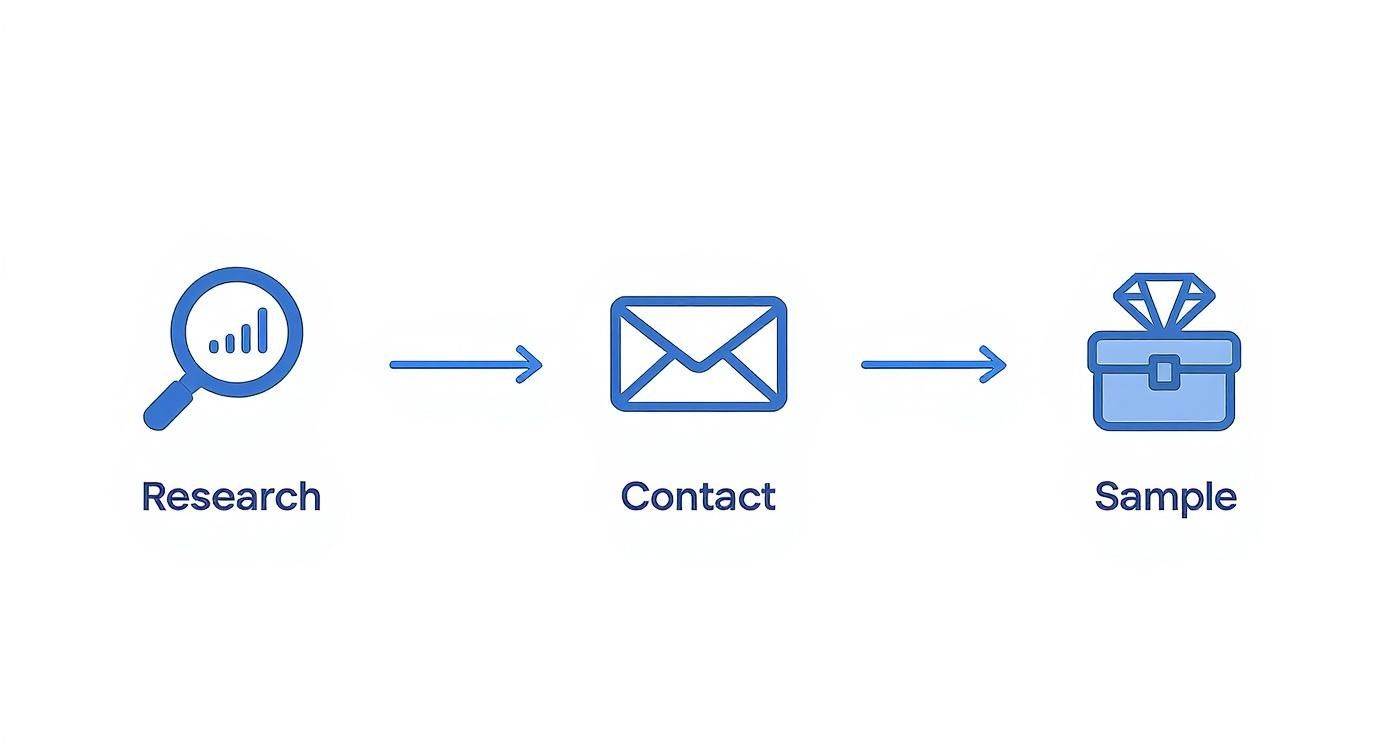
Following a clear path of research, direct communication, and getting samples in your hands ensures you partner with people who are transparent about their pricing. That reliability has a direct impact on your bottom line.
Smart Pricing Strategies for Maximum Profit
Okay, so you've got your true landed cost. Now for the fun part: pricing your products. Two main strategies are used everywhere in retail, and both work great for costume jewellery bulk.
1. Keystone Pricing
This is the old-school, back-of-the-napkin method. You simply double your landed cost to get your retail price. If a pair of earrings cost you $5 all-in, you sell them for $10. It's clean, easy, and locks in a 50% gross margin.
2. Value-Based Pricing
This strategy is more of an art form. Instead of a fixed markup, you price your jewellery based on what the customer thinks it’s worth. A super trendy, in-demand piece could sell for a much higher markup than a classic staple, even if they cost you the same amount. This takes a good feel for your market, but it can lead to much bigger profits.
And believe me, the market can support it. As of 2025, the global jewellery market was valued at a whopping USD 348 billion. Costume jewellery grabbed a massive 22% slice of that pie, clocking in at around USD 77 billion. That tells you there's a huge customer appetite that can absolutely sustain smart, value-driven pricing.
Actionable Insight: Use a blended approach. Apply keystone pricing as your baseline for all products to ensure profitability. Then, for your top 10% hottest-selling or most unique items, switch to value-based pricing, testing markups of 2.5x to 4x your landed cost to maximize your income.
Managing Your Orders and Payments
The final piece of the puzzle is managing your orders like a pro. Your cash flow and landed cost can change dramatically based on the terms you negotiate.
Don't be shy about discussing Minimum Order Quantities (MOQs). A lot of suppliers will bend the rules and lower their MOQ for a first-time buyer to get the relationship started.
Also, get crystal clear on payment terms. A common deal is 30% upfront and the final 70% when the order is ready, but there's always room to negotiate. Understanding these details before you commit is key to keeping your finances healthy. For a closer look at the numbers, check out our handy guide on using a wholesale profit margin calculator.
Building a Bulletproof Quality Control Process
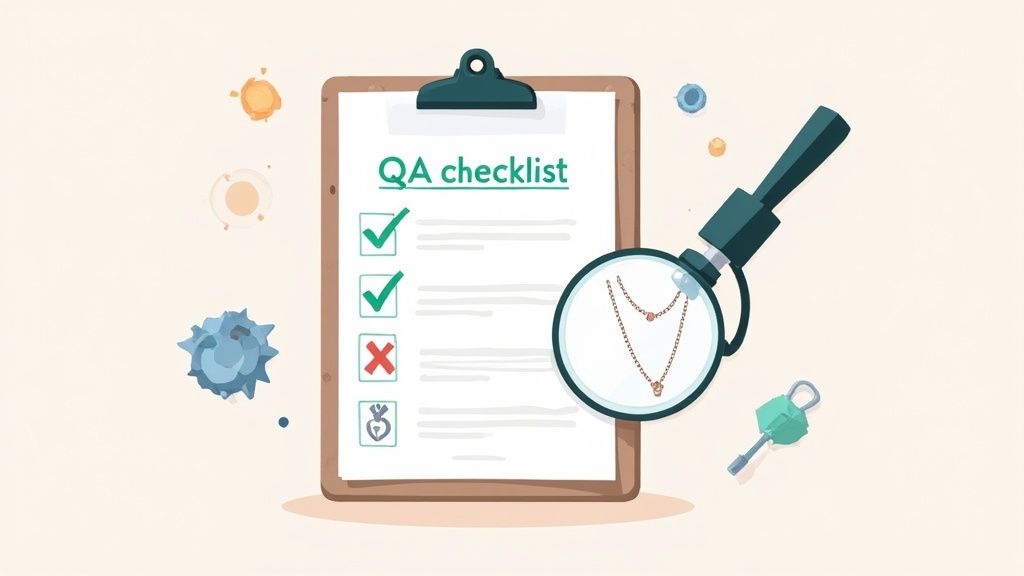
It only takes one bad batch of jewellery to destroy months, or even years, of building customer trust. When you're buying costume jewellery bulk, inconsistent quality isn't just a minor headache—it's a direct threat to your brand's reputation and your bottom line. A solid quality assurance (QA) process is your only real defense.
Think of QA as your brand's insurance policy. It's how you systematically catch defects before they ever reach a paying customer, preventing a flood of negative reviews, expensive returns, and irreversible damage to your name. Skipping this step is like letting a stranger pack your parachute; whatever you save upfront just isn't worth the risk.
From Samples to Production Runs
Your quality control shouldn't start when a mountain of boxes lands on your doorstep. It has to begin the moment you request your very first sample. That initial piece is your gold standard—the benchmark against which every future order will be judged.
Actionable Insight: Create a "gold standard" tech pack for each product. Take high-resolution photos of the approved sample, note its exact weight in grams, measure dimensions with calipers, and specify the plating color using a Pantone code if possible. This document removes all ambiguity when comparing the final production run.
When the full production order arrives, it’s time to play detective. Randomly pull a decent portion of the order (a good rule of thumb is 5-10% for larger runs) and compare each piece, side-by-side, with your approved sample and tech pack. This isn’t a quick glance; it’s a methodical, focused inspection.
A great supplier actually welcomes this kind of scrutiny. They know that your commitment to quality is a reflection of their own craftsmanship. If a potential partner ever pushes back on your QA checks, see it for the massive red flag it is.
This hands-on inspection is where you protect your investment and your brand. You’re looking for all the little flaws that can turn a piece your customer was excited about into a major disappointment.
Your Essential QA Inspection Checklist
To keep your inspections consistent and thorough, you need a checklist. It removes the guesswork and makes sure you don't overlook a critical detail. Your list should cover the absolute fundamentals of costume jewellery construction.
1. Plating and Finish:
- Consistency: Is the color uniform across the entire piece? Does it perfectly match the sample? Keep an eye out for splotches or strange discoloration.
- Durability: Gently scratch a hidden spot with your fingernail. Good plating shouldn't flake or peel away.
- Surface: Look closely for any bubbles, pits, or scratches in the finish.
2. Hardware and Construction:
- Clasps and Closures: Open and close every clasp at least ten times. Does it feel secure and snap shut properly?
- Soldering Joints: Check the points where metal is joined. Are they smooth and clean, or do they look lumpy and weak?
- Earring Posts: Make sure they are straight, feel sturdy, and don't bend with minimal pressure.
3. Stone Settings:
- Security: Gently push on each stone with a fingernail or a tool. Is it set firmly, or does it wiggle? Loose stones are one of the most common customer complaints.
- Alignment: Are the stones straight and centered in their settings? Crooked stones scream sloppy, rushed work.
- Adhesives: Look for any visible glue residue peeking out from around the settings.
Self-Inspection vs. Third-Party Services
When you're starting out, inspecting orders yourself is almost always the best way to go. It’s cost-effective, gives you total control, and helps you develop a deep understanding of your product's potential weak points. That knowledge is priceless when giving feedback to your supplier.
But as your business grows, inspecting every order yourself becomes a huge time suck. For those really big orders of costume jewellery bulk—we're talking thousands of units—hiring a third-party inspection service can be a game-changer.
These companies act as your unbiased eyes on the ground, often performing checks right at the factory before the shipment even leaves. You get a detailed report, which saves you a ton of time and gives you professional leverage if you need to address quality issues with the supplier. The right choice really comes down to your order volume, how much risk you're willing to accept, and what your own time is worth.
Your Biggest Bulk Buying Questions, Answered
Jumping into the world of costume jewellery bulk buying can feel like trying to decipher a secret code. You’re suddenly hit with acronyms like MOQ, confusing shipping terms, and the nagging fear of getting a bad batch of products from halfway around the world. Let’s cut through the noise and tackle these common questions head-on.
Think of this as your personal field guide. I'm going to walk you through the hurdles that trip up most new buyers, giving you the kind of straightforward advice that helps you make smart, profitable decisions right from your first order.
What’s a Reasonable Minimum Order Quantity?
Honestly, "reasonable" is completely relative. What works for a big-box store would bankrupt a boutique. It all comes down to the stage your business is in and who you're buying from.
For instance, you'll see massive factories on sites like Alibaba with Minimum Order Quantities (MOQs) of 100 to 500 pieces per style. For a new business, that's a huge gamble. If that one design doesn't sell, you're stuck with a mountain of dead stock and a hole in your budget.
Actionable Insight: Start with suppliers who prioritize flexibility over the lowest per-unit cost. Your goal in the beginning is market testing, not margin optimization. Find partners with low or no MOQs to test a wide variety of styles. Once you identify consistent best-sellers through sales data, then you can source those specific items in larger quantities from a manufacturer to improve your margins.
A much safer bet for startups are curated wholesale marketplaces like Faire. Their whole model is designed to support independent retailers. You can find suppliers with order minimums as low as $100 total, often with no per-item minimums. This lets you build a diverse and interesting collection without betting the farm on a single necklace.
How Do I Handle International Shipping and Customs?
International logistics look scary from the outside, but it’s a process that becomes second nature once you know the players. The first thing you absolutely must do is clarify the shipping terms (officially called Incoterms) with your supplier. Terms like FOB (Free on Board) or EXW (Ex Works) define who is responsible for what, and when.
For any business that isn't a massive corporation, hiring a freight forwarder or customs broker isn't just a good idea—it's essential. Think of them as your personal guide through the maze of global trade. They handle the mountain of paperwork, calculate and pay the right duties, and make sure your shipment doesn't get stuck in limbo at the port.
As a rule of thumb, add an extra 20-30% to your product cost to cover your "landed" costs—that’s the shipping, duties, and broker fees. And while express couriers like DHL or FedEx are fast for tiny orders, they are way too expensive for true bulk shipments.
What Are the Most Common Quality Issues to Look For?
When you’re inspecting costume jewellery, the tell-tale signs of poor quality almost always show up in three places: the plating, the hardware, and the stone settings. Get good at spotting these, and you'll save yourself a world of headaches.
Here’s a quick checklist to keep in your back pocket:
- Poor Plating: Look for a finish that’s thin, uneven in color, or flakes off when you gently scratch it. If you see the dull base metal peeking through, that piece is going to tarnish in a heartbeat.
- Weak Hardware: This is a big one. Open and close every single clasp. Check the earring backs. Do they feel solid and secure, or flimsy and cheap? A broken clasp makes a necklace completely worthless.
- Sloppy Stone Settings: Look at each stone up close. Are they set straight or are they crooked and loose? If you can see dried glue oozing out from the edges, that’s an instant red flag for shoddy work.
Beyond those top three, keep an eye out for surface scratches, weak soldering joints, and any hints of early tarnish. A solid quality checklist built around these points is your best friend for every shipment you receive.
How Can I Test New Styles Without a Big Investment?
The secret to a successful jewellery business is constantly testing new styles to keep things fresh—without risking all your capital on a flop. The best way to do this is to find suppliers who understand that small businesses need to be nimble.
Look for wholesalers with super-low MOQs or those who sell products in small pre-packaged assortments, like three or six units of a style. This setup is perfect for buying a wide variety of pieces in small numbers. It lets you see what your customers get excited about before you commit to a larger costume jewellery bulk order.
Another fantastic, zero-risk strategy is dropshipping. Sure, the profit margins are thinner since you're buying one at a time, but it's the ultimate testing lab. You can list dozens of "virtual" products in your online store and gather real-world sales data without ever touching the inventory. Once a particular earring or bracelet starts selling consistently, you know it's a winner, and you can confidently invest in a bulk order to get much healthier margins.
Ready to source high-quality, trend-forward pieces with unmatched flexibility? At JewelryBuyDirect, we offer over 120,000 styles with no minimum order requirements, direct-from-factory pricing, and new arrivals daily. Start building your profitable collection today at https://www.jewelrybuydirect.com.